INTRODUCTION
Conventional management based on agricultural practices such as straw-burning and excessive tillage increases soil erosion and compaction, which contributes to loss of soil quality. Under Mediterranean climate conditions, characterized by a long, hot and dry summer season, accumulation of organic carbon is limited. Conventional tillage (CT) in this environment accelerates mineralization of organic carbon and increases surface runoff and erosion.
However, conservation agriculture attaches great importance to the maintenance of soil structure, productivity and biodiversity under three basic principles: minimum soil disturbance, soil covering and crop rotation. Direct drilling (DD) systems have greatly reduced both soil loss rates by erosion and production costs in dryland agriculture in the Mediterranean area (Ordóñez-Fernández et al. Reference Ordóñez-Fernández, González-Fernández, Giráldez-Cervera and Perea-Torres2007) and they have also increased soil organic carbon (Murillo et al. Reference Murillo, Moreno, Girón and Oblitas2004). These results are particularly important in arid and semi-arid zones where soil organic matter content is frequently low (Acosta-Martínez et al. Reference Acosta-Martínez, Klose and Zobeck2003a).
Soil quality determines the sustainability and productivity of agro-ecosystems. Several indicators, combining soil chemical, physical and biological properties, have been used to determine the effect of soil management systems on soil quality (Doran & Parkin Reference Doran, Parkin and Doran1994). In some soils, physical and chemical parameters have been used to measure soil quality (Parr & Papendick Reference Parr and Papendick1997). However, in general these parameters change slowly and several years are necessary to obtain significant differences, whereas biological and biochemical parameters could be more sensitive and rapid indicators of changes in soil management practices (Nannipieri et al. Reference Nannipieri, Grego, Ceccanti, Stotzky and Bollag1990). Nutrient availability is influenced by organic matter turnover and immobilization of nutrients, both processes in which soil microorganisms are involved (Jenkinson Reference Jenkinson and Wilson1988). Enzyme activities have been used in a variety of ways to assess issues of agronomic and environmental quality. They have been tested as indices of soil quality, soil productivity, pollution effect and nutrient cycling potential (Nannipieri et al. Reference Nannipieri, Grego, Ceccanti, Stotzky and Bollag1990; Madejón et al. Reference Madejón, Moreno, Murillo and Pelegrín2007; Melero et al. Reference Melero, Madejón, Ruiz and Herencia2007). Thus, changes in soil enzyme activities represent alterations in soil quality, which may be used to compare management practices. In general, soil enzymatic activities increase under conservation tillage for a wide range of soils and climatic conditions (Acosta-Martínez et al. Reference Acosta-Martínez, Klose and Zobeck2003b; Roldán et al. Reference Roldán, Salinas-García, Alguacil, Diaz and Caravaca2005; Madejón et al. Reference Madejón, Moreno, Murillo and Pelegrín2007). In addition, several authors have found higher soil enzyme activities under crop rotations than under continuous cropping (Acosta-Martínez et al. Reference Acosta-Martínez, Klose and Zobeck2003b).
The aims of the present work were: (i) to assess the long-term effect of DD on soil enzyme activities in a dryland Vertisol after a period of 23 years; and (ii) to determine which soil quality indicators are best capable of determining the impact of soil management systems on soil quality. It was hypothesized that DD would have a positive effect by increasing soil fertility and enhancing soil biochemical functionality. Furthermore, among enzymatic activities, dehydrogenase and β-glucosidase could be better indicators of different soil management practices.
MATERIALS AND METHODS
The site and management of the systems
The site is a long-term tillage trial established in 1982 at the Tomejil dryland farm in Carmona (Seville, SW Spain; 37°24′7′′N, 5°35′10′′W). The soil is a heavy clay classified as a Chromic Haploxeret (Soil Survey Staff 1999), with 600 g clay/kg (700 g montmorillonite/kg clay, 200 g illite/kg clay and 100 g kaolinite/kg clay), with high levels of potassium and calcium carbonate (CaCO3, 250 g/kg; Giráldez et al. Reference Giráldez, Gonzalez, Ordóñez, Laguna and De Haro1995). The average annual rainfall at the farm is 580 mm, the mean temperature is 18°C and the mean daily evapotranspiration is 3·3 mm.
Two treatments were tested: CT and DD. Three replicates (15 m wide×180 m long) per treatment were established in a completely randomized experimental design. CT consisted of a mouldboard plough pass once the stubble was burned and successive cultivator passes to diminish the soil clod size. In DD, crop residue was left on the soil surface until it decayed.
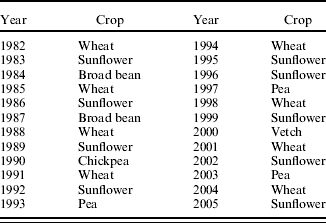
The annual crop rotation was a basic cereals: sunflower: legumes pattern (Table 1). In 1996, the initial chickpea crop suffered an acute infestation of Fusarium spp., forcing a modification of the rotation. Sunflower was chosen again, since there was no other crop that could be sown that late in the season, the beginning of March. No specific differences were noted between treatments with respect to the occurrence of the disease.
The crop rotation for the 23 years of the experiment
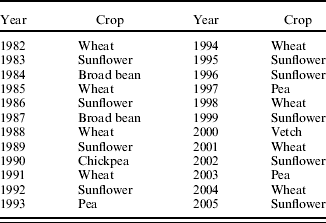
Wheat, Triticum aestivum L.; sunflower, Helianthus annus L.; broad bean, Vicia faba L.; chickpea, Cicer atietinum L.; Vetch, Vicia faba L.; pea, Pisum sativum L.
Fertilizer was only applied during the cereal phase of the rotation, following the normal practices of local farmers. A basal dressing of 39·6 kg N/ha and 101 kg P2O5/ha was applied mid-November, 1 week before seeding, and a top dressing of 200 kg urea/ha was applied later, in the middle of winter, depending on rain occurrence. The soil was equally fertilized in both treatments; with DD, the fertilizer granules were not incorporated, but remained on the soil surface until dissolution by infiltrating water. Weeds were controlled in CT by the tillage and in DD by application of glyphosate (18%) (N-(phosphonomethyl) glycine) and MCPA (18%) (2-methyl-4-chlorophenoxyacetic acid) at a rate of 0·6 and 0·5 litre/ha, respectively. In both treatments the occasional regrowth of weeds was avoided with additional applications of both herbicides at higher doses, 1 litre/ha each. The herbicide application schedule was similar every year, with a single dose before the legume plants and wheat, due to their early drilling in the autumn.
Sampling and soil chemical and biochemical analysis
Soil samples were collected at a depth of 150 mm before sowing a pea crop in October 2006. In each replicated plot of each treatment, three individual samples were collected randomly and were analysed independently (total of nine individual samples per treatment). Soil field-moist samples were sieved (2 mm) and immediately stored at 4°C in plastic bags loosely tied to ensure sufficient aeration but delay moisture loss until assaying of microbiological and enzymatic activities. Biochemical analyses were carried out within 2 weeks. Duplicate samples were air-dried for chemical analysis.
Soil pH and electrical conductivity (EC) were determined in a 1:2·5 soil/water ratio. Total oxidizable organic C was determined using the Walkley & Black (Reference Walkley and Black1934) wet dichromate oxidation method.
Dehydrogenase was determined according to Thalmann (Reference Walkley and Black1968) after soil incubation with 2,3,5-triphenyl-tetrazolium chloride (TTC) and measurement of triphenyl formazan (TPF) absorbance at 546 nm. Values of dehydrogenase activity are expressed as μg TPF/mg dry weight soil. Protease activity was measured after incubation of soil with casein and measurement of the absorbance of the extracted tyrosine at 700 nm following the procedure described by Ladd & Butler (Reference Ladd and Butler1972). Protease activity is expressed as μg/tyrosine/2 h/mg dry weight of soil. Alkaline phosphatase was determined according to Tabatabai & Bremner (Reference Thalmann1969) after soil incubation with p-nitrophenyl phosphate disodium and measurement of p-nitrophenol absorbance at 400 nm. β-Glucosidase activity was measured as indicated by Eivazi & Tabatabai (Reference Eivazi and Tabatabai1988), after soil incubation with p-nitrophenyl-β-d-glucopyranoside and measurement of p-nitrophenol absorbance at 400 nm. Values of β-glucosidase and alkaline phosphatase activity are expressed as μg p-nitrophenol/h/mg dry weight soil.
For each analysis, three replicates per sample were done. Results were based on oven-dry weight of soil.
Statistical analysis
Statistical analyses were carried out using the program SPSS 11.0 for Windows and results were expressed as mean values. Significant differences between management systems (CT and DD) were determined by a Student's t-test at P⩽0·05. The coefficient of variation (CV) of all parameters was calculated for each treatment. A correlation matrix of different properties was based on Pearson correlation coefficients (P⩽0·01 and P⩽0·05). Soil chemical and biochemical variables were analysed using principal component analysis (PCA).
RESULTS
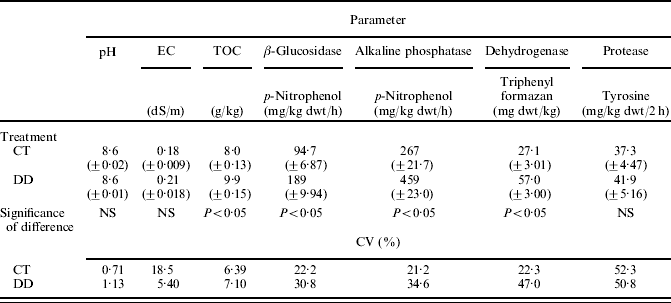
No significant differences in pH and EC mean values were found between DD and CT treatments (Table 2) after 23 years.
Mean values of the soil chemical (pH, EC and TOC) and biochemical (β-glucosidase, alkaline phosphatase, dehydrogenase and protease activities) properties ±s.e. at 0–150 mm depth, under CT and DD, and values of CV for each soil property
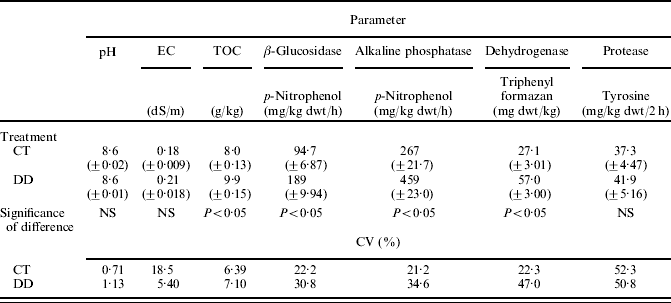
Dwt, dry weight.
Total organic carbon (TOC) mean values were higher in DD than in CT treatments (Table 2). The activities of β-glucosidase, alkaline phosphatase and dehydrogenase were greater in DD, but protease activity values were not different between tillage systems (Table 2).
The CV of the biochemical properties were higher than those of the chemical properties in both studied treatments (Table 2). The highest variability was observed for protease activity and the lowest for pH.
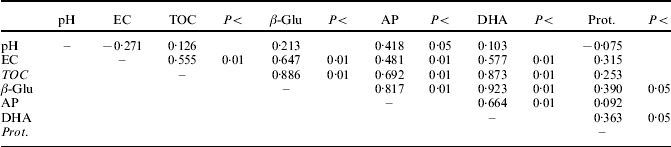
Correlation coefficients (with their level of significance) between the different properties are shown in Table 3. In general, enzymatic activities (β-glucosidase, alkaline phosphatase and dehydrogenase) showed a high correlation coefficient (from r=0·481 to r=0·886, P⩽0·01) with TOC contents, and they were correlated with each other (from r=0·664 to r=0·923, P⩽0·01). Protease activity was significantly and positively correlated (P<0·05) with β-glucosidase and dehydrogenase activities.
Correlation coefficients between enzyme activities, microbial biomass, TOC, and nutrient content in soil samples
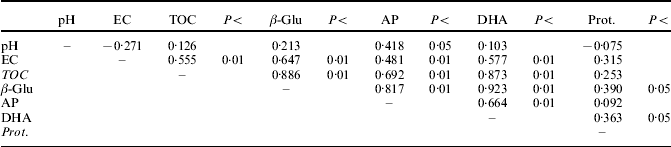
n=54.
β-Glu, β-glucosidase activity; AP, alkaline phosphatase activity; DHA, dehydrogenase activity; Prot., protease activity.
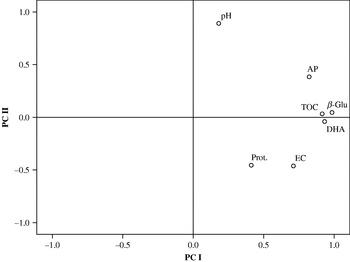
A graphical representation of the six studied properties projected on the plan defined by the two first factors is shown in Fig. 1. The first and second principal components explained 58% and 20%, respectively, of total variability. The first principal component was highly correlated with β-glucosidase, dehydrogenase and TOC, whereas the second was highly correlated with pH. PCA showed that pH is clearly the most differentiated parameter.
Graphical representation of the loadings of the soil chemical and biochemical properties projected on the plane defined by the two principal components (PC I and PC II). β-Glu: β-glucosidase activity; AP: alkaline phosphatase activity; DHA: dehydrogenase activity; Prot.: protease activity.

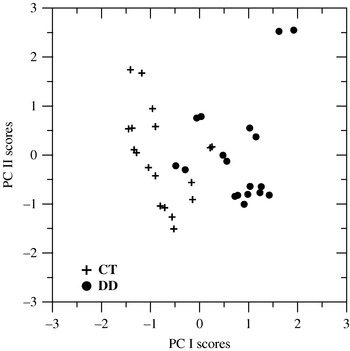
PCA can partly distinguish between CT and DD (Fig. 2). Each soil is represented according to the values of the variables acquired after the PCA, which gave two principal components (PC I and PC II).
Analyses of soils under CT and DD agriculture practices according to the two principal components (PC I and PC II). Each point is the average of three replicates.

DISCUSSION
Under a dryland system, neither DD nor CT treatment affected pH, owing to the strong buffering capacity of this soil with high carbonate content (Melero et al. Reference Melero, Madejón, Ruiz and Herencia2007). This buffering capacity could also explain the lowest spatial variability observed for pH values in the present study. Other authors have also reported that soil pH showed low spatial variability in a soil silty clay loam (Cox et al. Reference Cox, Gerard, Wardlaw and Abshire2003) and in a heavy clay (Machado et al. Reference Machado, Lana, Lana, Guimaraes and Ferreira2007). In the present study, neither system showed soil salinization after 23 years of inorganic fertilization, as demonstrated by EC measurements. Roldán et al. (Reference Roldán, Salinas-García, Alguacil, Diaz and Caravaca2005) also reported no changes in soil pH and EC in both no-tillage and CT systems after 6 years in clay Vertisol. However, Rahman et al. (Reference Rahman, Tanaka and Hoque2003) found lower pH and EC after 15 years in a no-tillage system than in CT on a sandy clay pumic Andisol.
Long-term no-tillage systems result in changes in soil organic matter, aggregate size distribution, bulk density and water retention compared with CT systems (Mrabet Reference Mrabet2002). CT increases the rate of organic matter decomposition and C mineralization by increasing the contact between soil microorganisms and crop residues (Salinas-García et al. Reference Salinas-García, Velásquez-García, Gallardo-Valdez, Díaz-Mederos, Caballero-Hernández, Tapia-Vargas and Rosales-Robles2002). Furthermore, the increase in TOC under the DD system is probably associated with the high input of crop residues, left on the soil surface, and crop rotation combined with conservation tillage (Reeves Reference Reeves1997).
The increase of organic matter is critical to improving the quality of Mediterranean soils, which are characterized by low organic matter levels and by the high rate of mineralization (Acosta-Martínez et al. Reference Acosta-Martínez, Klose and Zobeck2003a).
The high input of organic matter through crop residues left on the soil surface under DD likely increased synthesis of soil enzymes. Since hydrolytic enzyme activities are inducible enzymes, their activity is regulated by nutrient availability in soils (Burns Reference Burns1982); therefore, the stronger hydrolytic activity of the DD treatment could also reflect greater nutrient availability for microorganisms and plants in comparison with CT.
The high correlation between TOC and biochemical properties demonstrates the important role of organic matter in the protection of enzymes in soil organo-mineral complexes (Tabatabai Reference Tabatabai and Bremner1994) and also that the input of carbon from crop residues encourages microorganisms to produce enzymes related to nutrient cycling (Masciandaro et al. Reference Masciandaro, Ceccanti and Garcia1997). With the exception of protease, enzyme activities also showed a high correlation with each other, due to the close relation between all of them and TOC (Jiménez et al. Reference Jiménez, De La Horra, Pruzzo and Palma2002). It is likely that protease activity showed a lack of relation with other enzymatic activities and with TOC owing to its high spatial variability. Enzymatic activities provide meaningful indicators of chemical and biological soil quality parameters, and therefore have an important role in monitoring soil quality. Furthermore, soil enzyme activities are being widely used as soil quality indexes as they demonstrate a more rapid and sensitive response to changes in soil management practices than soil chemical properties, such as soil organic matter content (Melero et al. Reference Melero, Madejón, Ruiz and Herencia2007).
The PCA analysis suggested that TOC and β-glucosidase and dehydrogenase activities proved useful as indicators of the impact of tillage systems on soil quality. Additionally, dehydrogenase and β-glucosidase were useful soil quality indicators to reflect the changes in soil total biological activity and biochemical status involved in the carbon cycle. The activities of both dehydrogenase and β-glucosidase showed the strongest correlation with organic matter (r=0·873 and 0·886, respectively).
The conclusion that soils managed by DD showed a higher increase of hydrolytic activity than soils managed by CT is of great importance to organic matter turnover and nutrient availability. In the conditions and soils tested in the present study, PCA suggested that TOC and the activities of β-glucosidase and dehydrogenase were the most sensitive indicators for assessing the differences between soil management effects on soil quality. Long-term DD was the most effective tillage practice for improving soil chemical and biochemical qualities. The present results demonstrate that DD contributes to long-term sustainability of dryland agriculture systems by maintaining soil quality.
We thank the IFAPA and the Ministry of Education and Science of Spain for financial support to the project INIA RTA2006-00058-CO3-02, which enabled this work to be carried out.