Introduction
Demographic changes taking place during the last few decades, such as increasing life expectancies and lower fertility rates, have generated population ageing in all parts of the world, but especially in developed countries. Between 1960 and 2004, the percentage of those aged up to 14 years old decreased from 25 per cent to 16 per cent in the 25 European Union countries, whereas the proportion of the population aged 65 and over rose from 10 to 12 per cent during the same period and is expected to rise to 30 per cent by 2050. Moreover, the biggest population increase affects those aged over 80 years, the number of whom is expected to double by 2050 to 51 million citizens (Eurostat 2007). Women account for 59 per cent of the population aged 60 or over in Europe and for 70 per cent of the oldest-old. According to the United Nations' population projections for 2050, Spain will be the second most aged country in the world (after Japan), with 33 per cent of the population 65 or more years and 12 per cent aged 80 and over (United Nations 2006).
These population changes have generated concern around the world about health expenditure and the economic sustainability of the national pension systems. Older people tend to experience more disability, dependency and morbidity, to be more at risk of living alone, and constitute the majority of those with health problems in developed countries (Grundy and Sloggett Reference Grundy and Sloggett2003; IMSERSO 2006a). Little is known, however, about health inequalities in this increasingly important segment of the population, or about the social determinants of their health status, at least as compared with younger people. Most of the studies about social inequalities in health among elderly people conclude that socio-economic inequalities in health prevail in old age (Arber and Ginn Reference Arber and Ginn1993; Dahl and Birkelund Reference Dahl and Birkelund1997; Marmot and Shipley Reference Marmot and Shipley1996; Rahkonen and Takala Reference Rahkonen and Takala1998; Thorslund and Lundberg Reference Thorslund and Lundberg1994). There are, however, still many gaps in our knowledge of social inequalities in health in old age that require further research (Beckett Reference Beckett2000; McMunn et al. Reference McMunn, Breeze, Goodman, Nazroo, Oldfield, Marmot and Wilkinson2006; Von Dem Knesebeck et al. Reference Von Dem Knesebeck, Wahrendorf, Hyde and Siegrist2007).
Research about the social determinants of health among older people has only recently started to integrate three different approaches that were usually studied separately: socio-economic position, family characteristics and social support. Although occupational or social class constitutes one of the most common indicators used in research about social inequalities in health, its measurement among elderly people is controversial because some elderly women have never worked or have had a discontinuous working career because of family duties, especially in southern European countries. Moreover, it has been suggested that social class indicators based on occupation are inadequate for older people because the impact of occupation on health decreases with time since leaving the labour market (Hyde and Jones Reference Hyde and Jones2007). Educational qualifications have usually been used instead because they can be applied to all adults and are more stable throughout the life-course (Arber and Cooper Reference Arber, Cooper, Annandale and Hunt2000; Arber and Khlat Reference Arber and Khlat2002). In a review of socio-economic indicators in research on health inequalities among elderly people, Grundy and Holt (Reference Grundy and Holt2001) stated that social class or education combined with a deprivation indicator was the most sensitive indicator.
Whereas health variations among men have traditionally been studied using a social class framework, women have been forgotten or studied through the role approach, emphasising their role in the domestic area (Lahelma et al. Reference Lahelma, Arber, Kivelä, Roos, Arber and Khlat2003; Nathanson Reference Nathanson1980). Although household composition is considered to be one of the most basic and essential determinants of the well being of older adults (Evandrou et al. Reference Evandrou, Falkingham, Rake and Scott2001; Zimmer Reference Zimmer2001), research on the living arrangements of elderly people has mostly centred on samples made up exclusively of women and assumed their traditional role in family responsibilities, especially in the potential risks among those living alone (Anson Reference Anson1988; Michael et al. Reference Michael, Berkman, Colditz and Kawachi2001; Sarwari et al. Reference Sarwari, Fredman, Langenberg and Magaziner1998). On the other hand, providing direct care to other people has been associated with presenting worse health (Minkler and Fuller-Thompson Reference Minkler and Fuller-Thomson2001; Musil and Ahmad Reference Musil and Ahmad2002), above all among women in relation to stress (Mui Reference Mui1995; Walker, Pratt and Eddy Reference Walker, Pratt and Eddy1995; Pavalko and Woodbury Reference Pavalko and Woodbury2000; Hirst Reference Hirst2005). Although informal care to family members has usually referred to women, the literature about care-giving and its impact on health is increasingly incorporating men as important providers of care inside and between households (Baker and Robertson Reference Backer and Robertson2008; Crocker Reference Crocker Houde2002; Gregory, Peters and Cameron Reference Gregory, Peters and Cameron1990; Horowitz Reference Horowitz1985; Kaye and Applegate Reference Kaye and Applegate1993).
Regarding social support, several epidemiological studies have found a positive association with both physical and psychological health among elderly people (Grundy and Sloggett Reference Grundy and Sloggett2003; Oxman et al. Reference Oxman, Berkman, Kasl, Freeman and Barret1992) and that the association varies by socio-economic position (Oakley and Rajan Reference Oakley and Rajan1991) and gender (Shye et al. Reference Shye, Mullooly, Freeborn and Pope1995). Two types of mechanisms have been described when studying the relationship between social support and health: the direct positive effects of support and the buffering effect, by which social support moderates the impact of acute and chronic stressors on health (Stansfeld Reference Stansfeld, Marmot and Wilkinson1999). Filial obligation in Spain, as in other Mediterranean countries, is a strong value and it has been stated that breaking the intergenerational contract of support has consequences for the physical and mental health of older adults (Zunzunegui et al. Reference Zunzunegui, Koné, Johri, Béland, Wolfson and Bergman2004).
The aim of this study is to analyse the social determinants of health in the Autonomous Community of Catalonia, Spain using a combined framework of socio-economic position, family roles and social support. The analyses are based on three health indicators shown to be important in gerontological research: self-perceived health, mental health and functional limitations (Beckett et al. Reference Beckett, Brock, Lemke, Mendes de Leon, Guralnik, Fillenbaum, Branch, Wetle and Evans1996; Idler and Benyamini Reference Idler and Benyamini1997).
Methods
Data
The data are from the 2006 Encuesta Salud de Catalunya (Catalonian Health Survey) (hereafter ESCA 2006), a cross-sectional study that collected information about morbidity, health status, health-related behaviours and use of health care services, as well as socio-demographic data from a representative sample of the non-institutionalised population of Catalonia, a region in the North East of Spain with about seven million inhabitants. In total, 18,126 subjects were randomly selected using a multiple-stage random sampling strategy with a maximum global error of ±0.7 per cent. Trained interviewers administered the questionnaires at people's homes in a face-to-face interviews (Mompart et al. Reference Mompart, Medina, Brugulat and Tresserras2007).
For the purposes of this study a sub-sample of people aged 65–85 years who had no paid job was selected (1,113 men and 1,484 women). The minimum age has been chosen based on the standard legal retirement age in Spain (Consejo Economíco y Social 2000), and the exclusion of all people with paid work is justified by the fact that the meaning of living arrangements and their impact on health depends to a great extent on employment status (Artazcoz et al. Reference Artazcoz, Borrell, Benach, Cortès and Rohlfs2004). Employment status is not a confounding variable but an interacting variable, i.e. the meaning of family characteristics and socio-economic status can be different and have a different impact on health depending on being in work. Moreover, with the available cross-sectional data it would not be possible to test for the ‘healthy worker hypothesis’, that good health increases the probability of getting or keeping a paid job (Ross and Mirowsky Reference Ross and Mirowsky1995).
The decision to take 85 years as the maximum age, on the other hand, was based on the fact that, although institutionalisation rates in Spain are lower than in other European countries, among those aged 85 and over, they are almost four times higher than among the total elderly population and depend on variables such as sex, socio-economic position, family characteristics and health (Arber and Cooper Reference Arber and Cooper1999; Grundy and Jitlal Reference Grundy and Jitlal2007; IMSERSO 2006a). More specifically, in Catalonia, the most recent data on institutionalisation rates showed that in January 2006, 75 per cent of elderly residents of public institutions were older than 80 years, and that among them, 83 per cent were women (IMSERSO 2008). Apart from that, taking people younger than 86 reduces the probability of social selection among the oldest old (Idler Reference Idler1993; Orfila et al. Reference Orfila, Ferrer, Lamarca and Alonso2000; Vuorisalmi, Lintonen and Jylhä Reference Vvorisalmi, Lintonen and Jylhä2006). Moreover, those aged over 85 presented a higher non-response rate in some of the predictor variables such as social support (37.5% vs. 5.7% among 65–85 years) and in the outcome variable mental health (37.7% vs. 5.7% among 65–85 years).
Health outcomes
Self-perceived health status was elicited by asking the respondents to describe their general health as ‘excellent’, ‘very good’, ‘good’, ‘fair’ or ‘poor’. The variable was dichotomised by combining the categories ‘fair’ and ‘poor’ to indicate perceived health as below ‘good’ (Manor, Matthews and Power Reference Manor, Matthews and Power2000). Self-perceived health is a broad indicator of health-related wellbeing and has also proved to be a good predictor of mortality (Ferraro and Farmer Reference Ferraro and Famer1996; Idler and Benyamini Reference Idler and Benyamini1997; Mossey and Shapiro Reference Mossey and Shapiro1982).
Poor mental health status was measured with the 12-item version of the Goldberg General Health Questionnaire (12-GHQ) (Goldberg et al. Reference Goldberg, Cooper, Eastwood, Kedwart and Shepherd1970). This is a screening instrument widely used to detect current, diagnosable psychiatric disorders (Goldberg Reference Goldberg1972). The original variable was recoded into a dichotomy, taking scores higher than two to indicate poor mental health status (value 1).
Limiting long-standing illness (LLI) was generated through the combination of the questions, ‘During the last 12 months have you had any trouble or difficulty for gainful employment, housework, schooling, studying, because of a chronic health problem (that has lasted or it is expected to last three or more months)?’ and ‘Apart from that considered before, during the last 12 months have you had to restrict or decrease everyday activities such as taking a walk, doing sport, playing, going shopping, etc. because of a chronic health problem?’ The final variable was scored ‘1’ when the interviewee answered positively to at least one of the questions, and ‘0’ otherwise.
Predictor variables
Socio-economic position was measured through two indicators: educational attainment and material deprivation. Educational attainment was generated by collapsing some categories of the original variable because of the few individuals in some groups. The final variable was made up of the following categories: more than primary education (reference category), primary education, and less than primary education. Material deprivation was measured through variables measuring household material standards and generated by combining the following five items: having a shower and/or a bath, having hot running water, having central or dispersed heating, having an elevator, and having a washing machine. The resulting variable, household resources, had the following three categories: not lacking any of the items, lacking one of the items and lacking two or more of the items.
Family characteristics were measured through three variables: living arrangements, living with a disabled person in the household and caring for a disabled person. Living arrangements were measured through the combination of the variables household size and marital status, generating a four-categories variable to reflect the most usual types of households among the population under study: living with partner (reference category), living alone, not living with partner but living with other people and being the household head, and not living with partner but living with other people and not being the household head. People were asked about living with anyone needing special attention through disability, dependence or limitations in carrying out familiar, social or job-related activities. It had the value ‘1’ when answers were positive, and ‘0’ otherwise. In addition, people were asked about who was the main carer of the disabled person at home. This variable was dichotomised to take the value ‘1’ when the respondent stated being the main carer, and ‘0’ otherwise.
Social support was measured through a reduced version of the original 11-items Duke Social Support Scale, the validity and reliability of which has been demonstrated in several studies in Spain and other countries (Bellón et al. Reference Bellón, Delgado, de Dios and Lardelli1996; Broadhead et al. Reference Broadhead, Gehlbach, Degruy and Kaplan1988; De la Revilla et al. Reference De la Revilla, Bailón, De Dios, Delgado, Prados and Fleitas1991). The version used in ESCA 2006 is based on the first validation of the questionnaire, in which three of the 11 original items could not be classified into the two dimensions of social support: confidant and affective social support (Broadhead et al. Reference Broadhead, Gehlbach, Degruy and Kaplan1988). In the original questionnaire, people where asked eight questions about social support using a Likert-type scale with value ‘1’ meaning ‘less than desired’ and ‘5’ ‘as much as desired’. The Cronbach's alpha coefficients of the two groups of items were 0.87 for the confidant social support questions, and 0.84 for the affective social support ones.
The confidant social support index is the result of combining the responses to the following prompts: ‘I get invitations to go out and do things with other people’, ‘I get chances to talk to someone about problems at work or with my housework’, ‘I get chances to talk to someone about my personal and family problems’, ‘I get chances to talk to someone about money matters’ and ‘I get useful advice about important things in life’, and scored from ‘5’ (minimum confidant social support) to ‘25’ (maximum confidant social support). The affective social support index is the result of combining the following questions: ‘I get love and affection’, ‘I have people who care what happens to me’ and ‘I get help when I'm sick in bed’, and scored from ‘3’ (minimum affective social support) to ‘15’ (maximum affective social support).
Statistical analysis
Multiple logistic regression models were fitted in order to calculate adjusted odds ratios (aOR) and 95 per cent confidence intervals (CI). Separate models were run for each sex. The analysis was carried out following a hierarchical modelling strategy in which the explanatory variables of the conceptual framework were added in three steps (Victoria et al. Reference Victoria, Huttly, Fuchs and Olinto1997). First, logistic regression models adjusted for age and socio-economic position were fitted (model 1). To study the impact of the household characteristics, the type of household and the caring tasks were added at the second step (model 2). Finally, to control by the level of social support, the confidant social support and the affective social support indexes were introduced (model 3). Analyses included weights derived from the complex sample design. Goodness-of-fit was obtained using the Hosmer Lemeshow Test (Hosmer and Lemeshow Reference Hosmer and Lemeshow2000).
Results
General description of the population
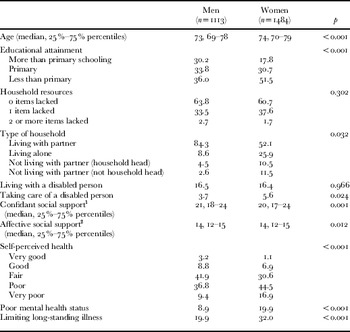
Table 1 profiles the population under study. Women were slightly older than men and had lower educational attainment, whereas levels of material deprivation measured through lack of household resources were similar in both sexes. Regarding type of household, women were more likely than men to live alone (26% vs. 9%) or with people other than the partner both as household head (10% vs. 4%) and not as household head (11% vs. 3%), whilst living with the partner was more frequent among men (84% vs. 52%). Whereas no gender differences were found in living with a disabled person, the percentage of women taking care of disabled people at home was higher than among men (6% vs. 4%). Both kinds of social support were high among the men and women in the sample, but especially affective social support. Women were more likely to report poor self-perceived health status, their frequency of poor mental health status was more than double that of men, and they suffered more limiting long-term illnesses (LLI).
General description of the study population (in percentages). Catalonian Health Survey, 2006

1 The Confidant Social Support Index ranges from 5 to 25.
2 The Affective Social Support Index ranges from 3 to 15.
Gender differences in health status
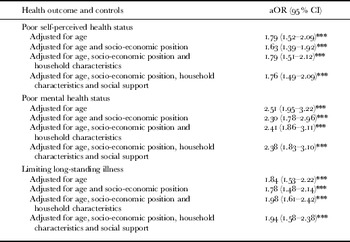
The prevalence of poor health outcomes was significantly higher among women for all three indicators, but especially regarding poor mental health status (Table 2). After adjusting for age and socio-economic position, women were more likely to report poor self-perceived health status (aOR=1.63; 95% CI=1.39–1.92), poor mental health status (aOR=2.30; 95% CI=1.78–2.96) and LLI (aOR=1.78; 95% CI=1.48–2.14). Gender differences in the three health indicators remained after additionally adjusting for household characteristics and social support.
Odds ratios (aOR) and 95% confidence intervals (CI) comparing health outcomes of women to men. Catalonian Health Survey, 2006

Significance levels: * p<0.05; ** p<0.01; *** p<0.001.
Relationship between the socio-economic position and household characteristics with the health outcomes
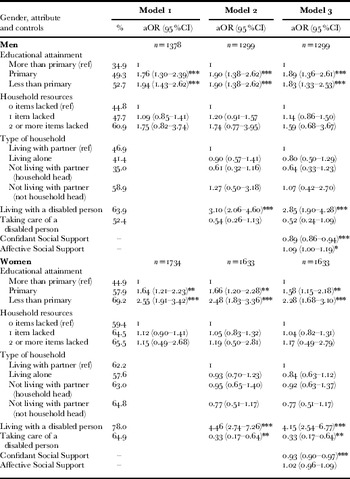
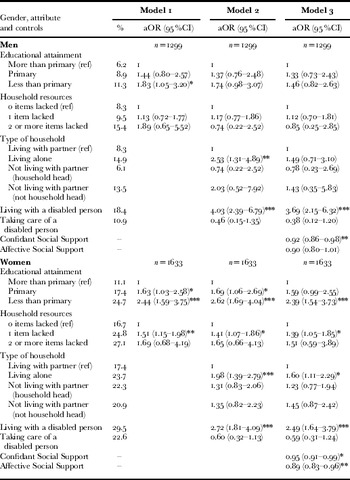
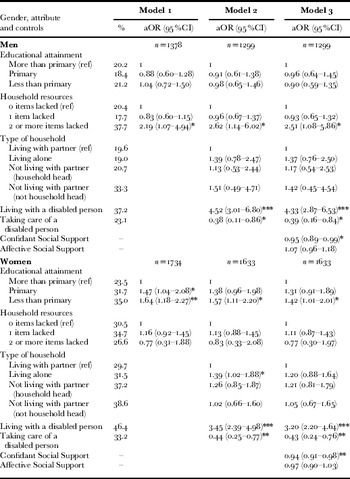
Tables 3 to 5 show step-by-step the hierarchical modelling carried out. In Model 1, only the socio-economic variables were introduced in the analysis as explanatory variables of the health indicators under study. In both sexes, an association between educational attainment and poor health outcomes was observed and a consistent gradient was found in almost all the health indicators considered. People with less than primary education had the highest probability of reporting a poor self-perceived health status (aOR=1.94; 95% CI=1.43–2.62 among men and aOR=2.55; 95% CI=1.91–3.42 among women) and a poor-mental health status (aOR=1.83; 95% CI=1.05–3.20 among men and aOR=2.44; 95% CI=1.59–3.75 among women) compared to those with more than primary education. Low educational attainment was not significantly associated with having a LLI among men, whilst a positive relationship with a gradient was found for women (aOR=1.64; 95% CI=1.18–2.27 for less than primary education and aOR=1.47; 95% CI=1.04–2.08 for primary education, compared to more than primary education). Lacking one of the household resources considered in the material deprivation indicator was only positively related to poor mental health status among women (aOR=1.51; 95% CI=1.15–1.98), whereas lacking two or more items was only positively related to having a limiting long-standing illness among men (aOR=2.19; 95% CI=1.07–4.94).
Multivariate associations between poor self-perceived health status and the socio-economic, household living arrangements and social support indicators, men and women 65–85 years old, Catalonia 2006

Notes: Adjusted by age. aoR: adjusted odds ratios. CI: 95 per cent confidence interval.
Significance levels: * p<0.05; ** p<0.01; *** p<0.001.
Multivariate associations between poor mental health status and the socio-economic, household living arrangements and social support indicators, men and women 65–85 years old, Catalonia 2006

Notes: Adjusted by age. aoR: adjusted odds ratios. CI: 95 per cent confidence interval.
Significance levels: * p<0.05; ** p<0.01; *** p<0.001.
Multivariate associations between limiting long-standing illness and the socio-economic, household living arrangements and social support indicators, men and women 65–85 years old, Catalonia 2006

Notes: Adjusted by age. aoR: adjusted odds ratios. CI: 95 per cent confidence interval.
Significance levels: * p<0.05; ** p<0.01; *** p<0.001.
When household characteristics were introduced in Model 2, living alone was the only type of living arrangement significantly associated with health status. Both men and women in this situation were more likely to report poor mental health status as compared to those living with the partner (aOR=2.53; 95% CI=1.31–4.89 and aOR=1.98; 95% CI=1.39–2.79, respectively), and only among women was it positively associated with LLI (aOR=1.39; 95% CI=1.02–1.88). When controlling for social support in Model 3, however, living alone was only significantly associated with poor mental health among women. Living with a disabled person was positively and strongly associated with all the health indicators in both sexes, even after adding social support in the analysis. Taking care of disabled people at home, however, was negatively associated with having a LLI in both sexes (aOR=0.38; 95% CI=0.11–0.86 among men and aOR=0.44; 95% CI=0.25–0.77 among women) and with having a poor self-perceived health status among women (aOR=0.33; 95% CI=0.17–0.64).
In Model 3, subjective social support, disaggregated in confidant and affective social support, was introduced together with all the other explanatory variables of the study. Confidant social support was negatively associated with all the health indicators in both sexes, whilst affective social support was only negatively and significantly associated with poor mental health status among women (aOR=0.89; 95% CI=0.83–0.96) and positively associated with poor self-perceived health status among men (aOR=1.09; 95% CI=1.00–1.19).
Discussion
This study is a contribution to the relatively new but growing literature about the multiple determinants of health inequalities among older people. As in Grundy and Sloggett's study (Reference Grundy and Sloggett2003) carried out in England, we have included different dimensions of health status and of its determinants. Regarding health indicators, however, we have included one closely related to the age group under study, that is, long-standing illnesses generating functional limitations. And regarding the predictor variables, our study overcomes some shortcomings of previous research and provides other important dimensions that are not usually considered. First of all, educational attainment had three categories instead of being a dichotomous variable, making it possible to analyse the socio-economic gradient in health inequalities. Moreover, household living arrangements was used instead of marital status, a much more important determinant of wellbeing among elderly people, together with two other dimensions of household characteristics: living with a disabled person and taking care of a disabled person. Finally, social support has been measured with two dimensions, showing that the relationship between each of them and health is different depending on the kind of social support received.
The main findings of the study can be summarised as follows. First, as is also the case in younger adults, health status among elderly women is poorer than among the men in the three dimensions of health considered. Secondly, even after controlling for social support, living with a disabled person is positively related to all the health indicators considered and in both sexes, whereas taking care of disabled people at home is negatively associated with having a LLI in both sexes and with having a poor self-perceived health among women. Thirdly, whereas living alone was associated with poor mental health status in both sexes, the association disappeared among men after adjusting for social support. Finally, confidant social support is negatively related to poor health status, whereas affective social support only behaves this way with poor mental health among women.
Gender differences in health status
The results show that elderly Catalonian women have a poorer self-perceived health status, a poorer mental health status and are more likely to report LLI than their male counterparts. Gender inequalities in health among older people are especially important regarding poor mental health, with women presenting a probability of suffering from it almost two-and-a-half times higher than men. These differences remained after controlling for all the other variables. The higher prevalence of mental health problems among women in all age groups has been reported in other studies (Sonnenberg et al. Reference Sonnenberg, Beekman, Deeg and van Tilburg2000; Zunzunegui et al. Reference Zunzunegui, Béland, Yacer and León1998). The different gender patterns depending on the health indicator analysed, as well as the differences in factors associated with each of them point out the importance of examining different health indicators in trying to understand fully the complexity of inequalities in health (Lahelma et al. Reference Lahelma, Martikainen, Rahkonen and Silventoinen1999; Macintyre et al. Reference Macintyre, Kunt and Sweeting1996; Matthews, Manor and Power Reference Matthews, Manor and Power1999).
Relationship of the socio-economic position, household characteristics and social support with the health outcomes by sex
Some research about social inequalities in health among elderly people has suggested using a set of measures of socio-economic position instead of a single indicator in order to explore the multidimensional nature socio-economic position has in old age (Avlund et al. Reference Avlund, Holstein, Osler, Damsgaard, Holm-Pedersen and Rasmussen2003; Dalstra et al. Reference Dalstra, Kunst and Mackenbach2006; Grundy and Holt Reference Grundy and Holt2001; Huisman, Kunst and Mackenbach Reference Huisman, Kunst and Mackenbach2003; Von Dem Knesebeck et al. Reference Von Dem Knesebeck, Wahrendorf, Hyde and Siegrist2007). Accordingly, two different indicators were used in our study. Educational attainment was more related to the health of women and especially to self-perceived health status, in line with the claim that educational level is a better indicator of health inequalities for women (Arber and Khlat Reference Arber and Khlat2002). The socio-economic gradient in health among elderly people according to educational attainment found in the present study is consistent with previous research (Dalstra et al. Reference Dalstra, Kunst and Mackenbach2006; Huisman, Kunst and Mackenbach Reference Huisman, Kunst and Mackenbach2003).
Material deprivation, as a measure of household material standards of living, was only related to poor mental health among women and more strongly to having a LLI among men after controlling for all the other variables. This result contrasts with other studies in which measures of material deprivation were more strongly associated with poor health among women than men (Borrell et al. Reference Borrell, Muntaner, Benach and Artazcoz2004; Grundy and Sloggett Reference Grundy and Sloggett2003), but is in line with the finding of an association between material deprivation and poor mental health (Eachus et al. Reference Eachus, Williams, Chan, Davey Smith, Grainge, Donovan and Frankel1996; Groffen et al. Reference Groffen, Bosma, Van den Akker, Kempen and van Eijk2007).
Anson (Reference Anson1988) found that women living with a partner were the healthiest and women living alone or being head of families were the least healthy, which pointed to the importance of adult support for health status. Consistently, living alone was associated with poor mental health in both sexes and with having a LLI among women, although only the association between living alone and poor mental health among women persisted (albeit weakened) after controlling for social support. This result is in line with those of a study carried out among 60–72 year-old nurses which found that social engagement and social network variables were associated with a decreased risk of decline in mental health among women living alone (Michael et al. Reference Michael, Berkman, Colditz and Kawachi2001).
Our findings suggest that living alone can have different meanings for elderly men and women, with a high negative impact on women's mental health. A possible explanation of this outcome is the phenomenon of the ‘feminisation of poverty’ (Pearce Reference Pearce1978), together with higher widowhood rates among women, which especially applies in Spain, where many elderly widows live with very small pensions. The association between deprivation and poor mental health among women would support this hypothesis. As also found by the Caregiver Health Effects Study (Schulz and Beach Reference Schulz and Beach1999) in a sample of Americans aged 66 to 96 years, living with a disabled person was positively and strongly related to poor health; but unlike that study, we found that caring for a disabled person was negatively related to poor health. Surprisingly, whereas taking care of a disabled person presented a negative association with having a poor self-perceived health among women and with having a LLI in both sexes, living with a disabled person was positively and strongly related to all the health outcomes among both men and women, even after controlling for social support. These findings could be explained by a probable reverse causation effect, whereby those taking care of a disabled person would represent a selection of the healthiest elderly, whereas living with a disabled and not taking care of him or her could be related to a higher prevalence of poor health status. Shulz and Beach (Reference Schulz and Beach1999), for instance, found that individuals with a disabled spouse who were not providing care had higher rates of prevalent disease compared to the other three caregiving groups analysed.
Confidant social support was negatively associated with having a poor self-perceived health status, poor mental health and a LLI, whilst affective social support was only negatively related to poor mental health among women and positively associated with poor self-perceived health status among men. Perceived support has been found to protect individuals from the effects of stress (Cohen and Wills Reference Cohen and Wills1985, Kessler and McLeod Reference Kessler, McLeod, Cohen and Syme1985, Wethington and Kessler Reference Wethington and Kessler1986) and to attenuate the effect of disability on depressive symptoms (Allen, Ciambrone and Welch Reference Allen, Ciambrone and Welch2000; Jang et al. Reference Jang, Haley, Small and Mortimer2002; Taylor and Lynch Reference Taylor and Lynch2004; Turner and Noh Reference Turner and Noh1988). In a study carried out in Spain, it has been found that those elderly people with more social links presented lower risks of mortality, cognitive deterioration, depression and disability, and even higher probabilities of recovering after a disability (Otero et al. Reference Otero, Zunzunegui, Béland, Rodríguez Laso and García de Yebenes2006). This study, however, shows that affective social support is positively related to poor self-perceived health status among men. A possible explanation of this outcome is that elderly men with poor self-perceived health receive more attention from their spouses or other family members. This, however, is a speculation that deserves further investigation.
Although family networks are an important source of support in Spain, the family has been found to be more likely to provide both positive and negative interactions than friends (Aneshensel, Pearlin and Schuler Reference Aneshensel, Pearlin and Schuler1993; Antonucci Reference Antonucci, Binstock and George1990; Rogers Reference Rogers1996). Some studies describe the existence of a hierarchical order in the effect of the provision of support on depressive symptoms among elderly people, emotional support from friends (more likely to provide confidant social support) being more important than that from the family (more likely to provide affective social support) (Dean, Kolody and Wood Reference Dean, Kolody and Wood1990; Harlow, Goldberg and Comstock Reference Harlow, Goldberg and Comstock1991). In line with this evidence, in this study both affective and confidant social support protect elderly women against poor mental health, whereas in the case of men only confidant social support is significantly and negatively related to poor mental health. Given the nature of the sample, however, we cannot rule out the possibility that those with poor mental health receive the least support – the so-called ‘contamination hypothesis’ (George et al. Reference George, Blazer, Hughes and Fowler1989). Previous research, however, has demonstrated less support for the hypothesis of mental health affecting perceived social support than for perceived social support affecting mental health (Taylor and Lynch Reference Taylor and Lynch2004).
Limitations
One of the limitations of this study is its cross-sectional design, a fact that prevents us from determining the directions of causation. For example, as mentioned before, the relationships between living arrangements, caring activities and social support with health are likely to be reciprocal. However, some possible explanations for both causality directions have been provided.
A second limitation seems from the nature of the sample. Limiting the study to community-residing people may have biased the results in the sense that, as men are more likely to have a spouse caring for them when disabilities appear in old age, women have a higher probability of being excluded from the sample because of their higher institutionalisation rates (Marmot, Koveginas and Elston Reference Marmot, Kogevinas and Elston1987; United Nations 2005). It would be expected that less healthy women would be excluded from the study but yet there was still an excess of female morbidity for the three health indicators analysed. Institutionalisation rates in Spain, however, are among the lowest in Europe (IMSERSO 2006a).
Moreover, the way the variable dealing with taking care of a disabled person has been generated could explain the unexpected outcome, whereby those doing so were healthier. In this study, carers were considered as those defining themselves as the main carers of the disabled persons at home. Perhaps the model could be improved by taking into account the amount of care provided, but unfortunately this was not possible with the original database.
Policy implications
This study has provided evidence of the importance of simultaneously considering socio-economic position, household characteristics and social support, as well as different health outcomes, in order fully to understand health inequalities among elderly people. It has also emphasised the importance of examining family roles and health not only among women but also among men, as well as the different effects that gender patterns in old age have on different dimensions of health. An integrated approach to socio-economic inequalities, simultaneously studying indicators of household living standards, household structure and social support is needed both in research on inequalities in health as well as in social and health policies addressed to elderly people. Moreover, this study sheds some light on the mechanisms explaining gender inequalities in health among elderly people in Mediterranean countries. Unlike previous research, the hierarchical modelling strategy followed here enabled us to see the impact on health of the three dimensions examined by adding them step-by-step, that is, socio-economic position, family characteristics and social support.
In Spain, as in the rest of Europe, the majority of elderly people prefer to live in their homes (77%), and only with their children or in institutions as the last options in case of need (IMSERSO 2007). On November 30th 2006, the Act for the Promotion of Personal Autonomy and Care for Dependent Persons was passed in the Congress of Deputies, with implementation commencing at the end of 2007 and constituting a step forward in social policy in Spain (IMSERSO 2006b). The results of this study show the importance of developing specific policies oriented towards elderly people facing disabilities and their families, such as the one mentioned above. ‘Ageing at home’ requires the expansion of public care services, to date very underdeveloped in Spain, such as respite services to the family of the dependants, the expansion of home visits to elderly people by health professionals, and the adaptation of housing to the ageng process (e.g. installing elevators in flats and showers instead of baths).
Acknowledgments
The study was partially financed by Pompeu Fabra University (Universitat Pompeu Fabra) and the Barcelona Public Health Agency (Agència de Salut Pública de Barcelona).