Ramsey et al. are probably right not to operationalise innovation in terms of psychological processes (as they write in sect. 5.2) in order to grasp examples from the whole spectrum of the phenomenon. Caro and Hauser (Reference Caro and Hauser1992) did something similar when investigating teaching in animals. The impact of a particular behaviour on fitness is only indirectly linked with its mechanism. Thus, it seems appropriate to make a phenomenological inventory.
Nevertheless, I feel that we might increase our sensitivity for innovation if we elaborate on the interrelation between psychological processes and innovation. I say this, first, because despite the claim the authors make, their article is inherently about issues of psychological processes. I also say this because I think that this approach will help us to find more examples of innovation.
The target article is inherently psychological because the authors propose that innovation is mainly an intrinsically driven (yet not innately determined) process: In their Figure 1, they set innovation well apart from externally induced processes for novel learned behaviour. This view is the main difference between the operationalisation of innovation provided by Lefebvre et al. (Reference Lefebvre, Gaxiola, Dawson, Timmermans, Rosza and Kabai1998) and that of the authors of the present target article. For the former authors, simply any type of behavior that was reported as being novel contributed to the innovation frequency of a species, regardless of whether it was environmentally induced or not. This approach is more consistent with regard to indifference to the mechanisms involved in innovation than the approach of Ramsey et al. It is possible in principle, for example, that the impact of a “weak” innovation on the performer's fitness is considerably larger than that of an invention.
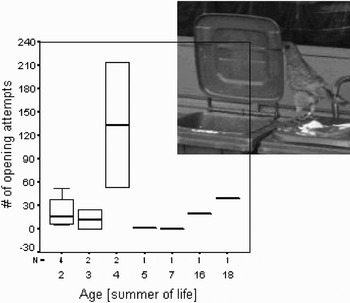
Subadult keas in their fourth summer of life are an extraordinary subgroup with respect to their persistency in attempting to open rubbish lids. This makes them most likely to innovate solutions for mechanical problems (Gajdon et al. Reference Gajdon, Fijn and Huber2006).

Differentiating between varying forms of innovation is an issue of classifying different mechanisms and degrees of novel behaviour with different likelihoods that the novel behaviour will be displayed. The effort that Ramsey et al. have made in differentiating between these forms will be appreciated by members of the scientific community – myself included – who feel puzzled by the indiscriminative approach by Lefebvre and his collaborators, though the latter nevertheless has yielded interesting results (Lefebvre & Bolhuis Reference Lefebvre, Bolhuis, Reader and Laland2003; Timmermans et al. Reference Timmermans, Lefebvre, Boire and Basu2000). As the authors of the target article mention, distinguishing different forms of innovation might be the first step to comparing the complexity of innovation between species. However, a more sophisticated methodology has to be elaborated in order to determine to what degree an innovation deviates from the usual ethogram of a given species, sub group, or individual, or to which degree it has to cope with novelty and by which mechanisms it does so when innovating. This might have a considerable impact on whether we consider a behaviour to be innovative or not.
For example, in Figure 2 of target article, in most boxes of the key for determining whether a behaviour is an innovation, and where there is a reference to the occurrence of the candidate behaviour in captivity, its absence in captivity increases and its presence in captivity decreases the probability that the behaviour is an innovation in the field. However, taken that Kummer and Goodall (Reference Kummer and Goodall1985) are right that some animals might be more innovative in captivity, this will be a conservative indicator for innovation in such species. For example, it was found that only a few individual keas, Nestor notabilis, an endemic mountain parrot of New Zealand, removed a tube from a long upright pole, thereby gaining access to a reward inside the tube (Gajdon et al. Reference Gajdon, Fijn and Huber2004). However, the majority of keas succeeded in the aviary. This result from captivity does not necessarily reduce the probability that the birds were innovated to remove the tube in the field. If the birds reared in captivity are more attentive to combining objects with each other, as indicated by ongoing developmental investigations, captive animals are more likely to bring the tube to the end of the pole. Thus, they might find the solution more easily because of a competence in sensorimotor intelligence that their wild conspecifics might not rely on. One approach to evaluating the referential value of captivity is to provide simple tasks in the field and laboratory to determine differences in motivation and organisation of exploratory behaviour and sensorimotor intelligence.
The example of the kea indicates that the issue of ontogenetic development as a process for new behaviour should not be reduced to maturation. Rather, the interaction of environmental condition and cognitive development might equip animals with different skills that make them more or less likely to innovate. For example, an animal's willingness to interact with novelty is a crucial skill for innovation. Besides birds from island populations being more explorative (Haemig Reference Haemig1989; Mettke-Hofmann et al. Reference Mettke-Hofmann, Winkler and Leisler2002), Mettke-Hofmann et al. (Reference Mettke-Hofmann, Ebert, Schmidt, Steiger and Stieb2005a) also found that warblers of a migratory species were less explorative than warblers of a resident species, but that the difference diminishes at the beginning of the breeding season. Fairbanks and McGuire (Reference Fairbanks and McGuire1993) showed that the parental style of vervet monkey mothers had considerable impact on how their offspring reacted to novel situations. A subject's willingness to interact with novel situations also changes during ontogeny. In vervet monkeys, it increases in juveniles and decreases as the animals become older (Fairbanks Reference Fairbanks1993). Such studies indicate that the psychological disposition an individual displays for interacting with novelty changes during its life span, so that it will profit when changes are most likely to occur and when interacting with them is most needed (e.g., when an individual leaves its natal group site; Bischof Reference Bischof1985).
From this it follows that (1) each individual needs its own referential subgroup to evaluate the degree by which a novel behaviour deviates from the subjects' usual performance (see Fig. 1); (2) this should not dispute the fact that there are subgroups that are more likely to innovate; and (3) considering mechanisms that provide a disposition for innovation, as well as characteristics of the species' life history, can help to find innovation when it is most likely to occur. This might reveal a considerably different picture of innovative capacity than that which we have gained so far with previous operationalisations of innovation.