1. INTRODUCTION
Strapdown Inertial Navigation System (SINS) initial alignment is a process of determining the initial value of attitude. The precise initial alignment for SINS is very important, especially for the high precision SINS. The navigation precision is largely decided by the initial alignment accuracy. Because of this, SINS initial alignment technology is a frequent research topic (Wu et al., Reference Wu, Zhang and Wu2012; Silson, Reference Silson2011; Arunasish et al., Reference Arunasish, Smita and Ghoshal2011).
Alignment methods generally use two feature vectors of the earth: the acceleration of gravity g and the self-rotational angular rate of the earth ωie. Many alignment algorithms such as Kalman filter, gyrocompass or other methods can accurately obtain the attitude matrix of the base in the static case. In many cases, even the limit of theoretical accuracy can be achieved just by using a coarse alignment (Jiang, Reference Jiang1998). However, the process of the alignment is affected by various interference factors of the base, such as engine rotation, crew motion, goods loading, and wave surging, etc. Because the intensity of the interference signal is obviously larger than ωie, the performance of the initial alignment can severely degrade precision and increase the time taken for alignment.
In order to solve the alignment problem on a rocking base, there are three kinds of common treatments: The first is to introduce more complex alignment algorithms. For example, a fast high precision alignment algorithm was proposed by introducing adaptive neuro-fuzzy inference systems (ANFIS) to predict the errors for a 15-order Kalman filter (Chiang et al., Reference Chiang, Huang and Niu2010). Their experiments on LN200 (Litton) and CIMU (Honeywell) showed the performances of the alignment were improved. However, the ANFIS seems difficult to apply in practice due to its complexity, and ANFIS should be trained before use. The application of the initial alignment with non-linear filtering was discussed by some scholars (Arunasish et al., Reference Arunasish, Smita and Ghoshal2011; Zhou, et al., Reference Zhou, Gao and Chen2007), but the nonlinear filtering is so complex that the higher calculation speed required of the navigation computer has to be considered. The second method is to use pre-filtering technology. In this case, the gyro and accelerometer data are first processed by a low-pass filtering to reduce the disturbance and noise in the data (El-Sheimy and Nassar, Reference El-Sheimy and Nassar2004; Sun and Sun, Reference Sun and Sun2010; Lü, et al., Reference Lü, Xie and Chan2009). Generally, the initial alignment method already contains a low-pass filter. If the alignment algorithm is properly designed, the low-pass pre-filter may not be necessary to provide additional attenuation. The third method is to use the inertial frame as a transitional coordinate to realize the initial alignment (Gao et al., Reference Gao, Zhang and Li2010; Vidya et al., Reference Vidya, Brajnish and Kumar2009; Gu et al., Reference Gu, El-Sheimy and Taher2008). In this case, the attitude transformation matrix Cbn is decomposed into several middle attitude matrices formed based on the inertial frame. Therefore, the initial alignment problem would be converted into the inertial frame for data processing. This algorithm is an open loop method (Vidya et al., Reference Vidya, Brajnish and Kumar2009; Gu et al., Reference Gu, El-Sheimy and Taher2008). Because of the deficiency of damping, disturbance and noise can only be reduced by acceleration integral or double integral. In addition, the alignment accuracy is greatly influenced by vibration amplitude and integration time.
The above alignment methods have advantages and disadvantages. In recent years, some scholars have developed methods based on a combination of the above approaches. Lian et al. (Reference Lian, Hu and Wu2007) combined the second and third methods by employing a cascade of low-pass Finite Impulse Response (FIR) filters to pre-process the gyro and accelerometer data in the inertial frame. Although the alignment accuracy is improved, the total filtering order in that algorithm is higher than 200, and the time delay reaches 101 s, which decreases the dynamic adaptability of the system. Li et al. (Reference Li, Wu and Wang2013) stored 300 s of the laser gyro and accelerometer data for the coarse alignment. Then the stored data and the new data would be filtered by a Kalman filter sequentially. The whole alignment takes 600 s. The alignment accuracy on the rocking base reaches 0·08°. Obviously, the process is complicated and most importantly, it needs extra memory and a more powerful navigation computer.
A novel alignment is proposed in this paper to deal with SINS quick alignment on a swaying base. The main idea is completely opposite to the second method mentioned above, which was aimed at removing the influence of the vehicle disturbance by additional pre-filtering, and believed that the lower bandwidth of the filter should be good for removing the interference, so that the alignment accuracy could be improved. For example, the cascaded filter was used to control the bandwidth of the filter to 0·0125 Hz (Lian et al., Reference Lian, Hu and Wu2007). But in this paper, the low-frequency change of the attitude angle is considered as a useful signal that reflects the true motion reaction of the base, which should not be removed. Otherwise, though the data may seem to be smooth, the alignment deviation has been produced and cannot reflect the true attitude angle of the vehicle. In order to present the effect of the vehicle rocking in the alignment results, the low-frequency motion of the base should be tracked in the alignment algorithm. In other words, the initial alignment algorithm should not suppress the frequency bandwidth excessively in data processing, but maintain a certain sensitivity for the low frequency signal. Based on this idea, an effective and rapid alignment algorithm is devised in this research. The inertial frame alignment method is adopted for the coarse alignment. The alignment method in the inertial frame is very sensitive to the base rocking, but its deficiency is low quality for the alignment accuracy. In this paper, the inertial frame alignment is employed as the coarse alignment, whose deviation is controlled within 2° in the first step. Then the fine alignment is completed by a Kalman filter. It is well known that a Kalman filter can be competent for fine alignment if the small misalignment condition can be met, instead of non-linear filtering such as the Extended Kalman Filter (EKF), Unscented Kalman Filter (UKF) or Particle Filter (PF). However, the ordinary KF cannot track the attitude change rapidly because only two horizontal velocities are used as the measurement-vector. To improve the attitude tracking capability of the KF, two horizontal accelerations are also considered as measurement-vectors.
A high precision LINS is used to verify the alignment algorithm. The experimental results show that the method proposed in this paper has the ability to realize the initial alignment within 180 s. The alignment accuracy can achieve the theoretical accuracy. In addition, the vehicle navigation experiment on a rocking base further proves that the algorithm can meet practical requirements.
2. COARSE ALIGNMENT IN THE INERTIAL COORDINATE FRAME
The basic idea using the inertial frame for the initial alignment is to decompose Cbn(t) into several attitude matrices, whose references are all based on the inertial frame. The decomposition method in this paper is as follows:
 $$C_b^n (t) = C_{i_0} ^n (t)C_{i_{b0}} ^{i_0} C_b^{i_{b0}} (t)$$
Two transition reference inertial frames are introduced respectively:
a) i 0 frame: At the starting time for the initial alignment, ox i0 is in the local meridian plane parallel to the equatorial plane, oz i0 points to the earth's rotation axis direction, oy i0 is determined by the right-hand coordinate.
b) i b0 frame: At the starting time for the initial alignment, i b0 frame coincides with the body frame, and is fixed in the inertial space.
Equation (1) shows that time-varying matrix Cbn(t) is composed of three parts. One part is  ${\bf C}_{i_0} ^n (t)$, which is produced by the earth rotation rate:
 $${\bf C}_{i_0} ^n (t) = \left[ {\matrix{ { - \sin \omega _{ie} t} & {\cos \omega _{ie} t} & 0 \cr { - \sin L\cos \omega _{ie} t} & { - \sin L\sin \omega _{ie} t} & {\cos L} \cr {\cos L\cos \omega _{ie} t} & {\cos L\sin \omega _{ie} t} & {\sin L} \cr}} \right]$$
where L is the latitude, ωie is the rotation rate of the earth, t is the time for alignment.
Another part is  ${\bf C}_b^{i_{b0}} (t)$, which represents the relative motion between the vehicle and the inertial frame. It can be obtained by the output signal of the gyroscopes:
 $${\bf \dot C}_b^{i_{b0}} (t) = {\bf C}_b^{i_{b0}} (t)({\bi \omega} _{i_0 b}^b \times )$$
Where:  $({\bi \omega} _{i_0 b}^b \times )$ is a skew-symmetric matrix, which is measured by the gyroscopes in the body frame. The third part
 $C_{i_{b0}} ^{i_0} $ is a constant value, which represents the relationship between two inertial frames. Owing to
 $$f_{i_{b0}} = C_b^{i_{b0}} f^b $$
 $$g_{i_0} = C_n^{i_0} g^n $$
Where: fb is measured by the accelerometer, gn=[0 0 −g]T, and so the relationship of  $g_{i_0} $ and
 $f_{i_{b0}} $ is
 $$g_{i_0} = C_{i_{b0}} ^{i_0} f_{i_{b0}} $$
Selecting different time t l and t m,  $C_{i_{b0}} ^{i_0} $ can be presented as:
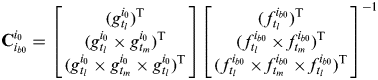 $${\bf C}_{i_{b0}} ^{i_0} = \left[ {\matrix{ {(g_{t_l} ^{i_0} )^{\rm T}} \cr {(g_{t_l} ^{i_0} \times g_{t_m} ^{i_0} )^{\rm T}} \cr {(g_{t_l} ^{i_0} \times g_{t_m} ^{i_0} \times g_{t_l} ^{i_0} )^{\rm T}} \cr}} \right]\left[ {\matrix{ {(\,f_{t_l} ^{i_{b0}} )^{\rm T}} \cr {(\,f_{t_l} ^{i_{b0}} \times f_{t_m} ^{i_{b0}} )^{\rm T}} \cr {(\,f_{t_l} ^{i_{b0}} \times f_{t_m} ^{i_{b0}} \times f_{t_l} ^{i_{b0}} )^{\rm T}} \cr}} \right]^{ - 1} $$
To improve the measurement accuracy on a rocking base, it can be integrated from Equation (6):
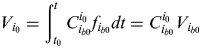 $$V_{i_0} = \int_{t_0} ^t {C_{i_{b0}} ^{i_0} f_{i_{b0}} dt} = C_{i_{b0}} ^{i_0} V_{i_{b0}} $$
So that
 $${\bf C}_{i_{b0}} ^{i_0} = \left[ {\matrix{ {(V_{t_l} ^{i_0} )^{\rm T}} \cr {(V_{t_l} ^{i_0} \times V_{t_m} ^{i_0} )^{\rm T}} \cr {(V_{t_l} ^{i_0} \times V_{t_m} ^{i_0} \times V_{t_l} ^{i_0} )^{\rm T}} \cr}} \right]\left[ {\matrix{ {(V_{t_l} ^{i_{b0}} )^{\rm T}} \cr {(V_{t_l} ^{i_{b0}} \times V_{t_m} ^{i_{b0}} )^{\rm T}} \cr {(V_{t_l} ^{i_{b0}} \times V_{t_m} ^{i_{b0}} \times V_{t_l} ^{i_{b0}} )^{\rm T}} \cr}} \right]^{ - 1} $$
A high precision LINS (gyro drift 0·007°/h, accelerometer accuracy 2×10⁻⁵ g) was used for the coarse alignment test on a rocking vehicle to confirm the effect of the algorithm. The experiments were arranged on a windy day. The wind speed was 12~15 m/s during the test, and the swaying of the vehicle was obvious. Data acquisition time was about 600 s in the experiments. A typical set of experiment results are shown in Figure. 1.
The coarse alignment results under wind disturbance: (a) pitch, (b) yaw, (c) roll.

The gyrocompass alignment results and the coarse alignment results in the inertial frame are compared in Figure. 1. It is shown that there are three large impacts on the vehicle body due to the gusts at 110 s, 270 s and 320 s, and the experimenters on the vehicle could obviously feel the shaking of the vehicle body. Both methods can consistently trace the altitude angle fluctuation. The coarse alignment in the inertial frame is more sensitive to altitude change compared with the gyrocompass alignment. However, the damping for the coarse alignment in the inertial frame is relatively small, and many high frequency noise and wave peaks are obvious in the test curves in Figure 1. Experiments suggest that the azimuth error of the coarse alignment can be limited within ±2° within 20~30 s. It is enough for a coarse alignment.
3. FINE ALIGNMENT BASED ON KALMAN FILTER
KF alignment is a kind of linear algorithm. It has a satisfying precision if the coarse alignment error is less than 4~6°. It has a simpler model and less calculation time than EKF, UKF or PF. The state vector of the KF in the initial alignment algorithm is generally selected as X=[δV eδVn δψ δγ δθ ∇e ∇nεe εn εu]T, and the horizontal velocity error Z=[δV eδV]T is taken as the measurement vector (Jiang and Lin, Reference Jiang and Lin1992; Wang, et al., Reference Wang, Cai and Lu2004). The condition of the filtering stabilisation is that the system model must be completely controllable and observable. Unfortunately, SINS is not a completely observable system. Generally, there are only seven observable states (Wang, Reference Wang2009). From the control point of view, enhancement of the degree of observability is helpful to improve the performance of the alignment speed and accuracy.
In order to improve the observability of the system, a simple method can be adopted for the horizontal acceleration variables as the measurement vector in addition to two level velocities. There are two merits for this consideration:
1) The number of observable states is increased from seven to eight (Wang, et al., Reference Wang, Cai and Lu2004) and the system stability is improved. It is beneficial to enhance alignment speed and accuracy.
2) In the case of base rocking, the acceleration of gravity signal to noise ratio (SNR) is much higher than that of the earth rotation rate in SINS, thus two horizontal acceleration variables will strengthen the algorithm sensitivity for the attitude fluctuation and it will enhance the algorithm capability of tracing the attitude angle change.
The alignment state equation for KF used in this paper can be written as:
 $$\dot X(t) = Fx(t) + w(t)$$
 $$X = [\matrix{ {\delta V_e} & {\delta V_n} & {\delta \psi} & {\delta \gamma} & {\delta \theta} & {{\rm \Delta} _e} & {{\rm \Delta} _n} & {\varepsilon _e} & {\varepsilon _n} & {\varepsilon _u} \cr} ]^T $$
where δV e and δV n are velocity errors of the east and the north, respectively. δψ, δγ and δθ are yaw, pitch, roll angle error, respectively. ∇e and ∇n are accelerometer biases. ε i(i=e, n, u) is gyro bias, w(t) is systematic noise and,
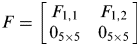 $$F = \left[ {\matrix{ {F_{1,1}} & {F_{1,2}} \cr {0_{5 \times 5}} & {0_{5 \times 5}} \cr}} \right]$$
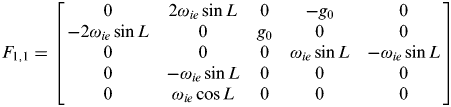 $$F_{1,1} = \left[ {\matrix{ 0 & {2\omega _{ie} \sin L} & 0 & { - g_0} & 0 \cr { - 2\omega _{ie} \sin L} & 0 & {g_0} & 0 & 0 \cr 0 & 0 & 0 & {\omega _{ie} \sin L} & { - \omega _{ie} \sin L} \cr 0 & { - \omega _{ie} \sin L} & 0 & 0 & 0 \cr 0 & {\omega _{ie} \cos L} & 0 & 0 & 0 \cr}} \right]$$
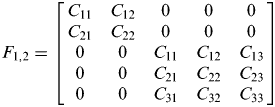 $$F_{1,2} = \left[ {\matrix{ {C_{11}} & {C_{12}} & 0 & 0 & 0 \cr {C_{21}} & {C_{22}} & 0 & 0 & 0 \cr 0 & 0 & {C_{11}} & {C_{12}} & {C_{13}} \cr 0 & 0 & {C_{21}} & {C_{22}} & {C_{23}} \cr 0 & 0 & {C_{31}} & {C_{32}} & {C_{33}} \cr}} \right]$$
The measurement equation is written as:
 $$Z(t) = Hx(t) + v(t) = \left[ {\matrix{ 1 & 0 & 0 & 0 & 0 & 0 & 0 & 0 & 0 & 0 \cr 0 & 1 & 0 & 0 & 0 & 0 & 0 & 0 & 0 & 0 \cr 0 & 0 & 0 & { - g_0} & 0 & 0 & 0 & 0 & 0 & 0 \cr 0 & 0 & {g_0} & 0 & 0 & 0 & 0 & 0 & 0 & 0 \cr}} \right]x(t) + v(t)$$
 $$Z = [\matrix{ {\delta V_e} & {\delta V_n} & {A_e} & {A_n} \cr} ]^T $$
where A e and A n are east and north accelerometer outputs, respectively. v(t) is measurement noise.
To verify the performance of the algorithm proposed by this paper, an alignment test on the rocking vehicle by using the LINS was undertaken. Two different measurement vectors Z=[δV eδV]T and Z=[δV eδVn Ae An]T were employed to make offline calculations. As for the experiments, the wind speed was about 4~5 m/s, and the engine was shut down. The test results are shown in Figure 2. It is concluded that although the measurement vectors are different, the level of the alignment results of the attitude angle are the same and the time to reach the steady state is just a few seconds. The two curves in Figure 2(a) and (c) coincide approximately. Taking Z=[δV eδV]T as the measurement, there is almost no overshoot for the yaw alignment curve with overall smoothness. The rising time is about 25 s. This is because the velocity is the integral of the acceleration, and the integral can achieve a filtering effect for the acceleration with larger damping. However, if using Z=[δV e δVn Ae An]T as the measurement vector, the rising time of the course alignment curve is about 10 s. The response speed for the tracking yaw step change is quicker. It has more obvious high frequency dithering in the dynamic response stage, and appears to be smooth in the steady state. The two methods have almost consistent results after 100 s for the azimuth alignment, and the difference is smaller than 0·004° between these two methods.
The comparison results of the different measurement equations: (a) pitch; (b) yaw; (c) roll.
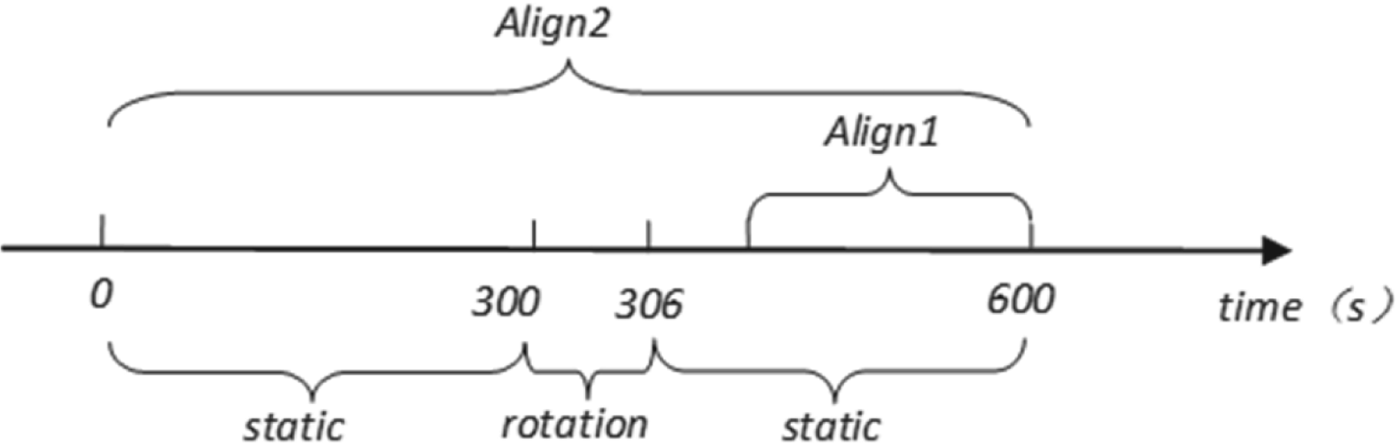
To illustrate the tracking performance of the algorithm, some alignment tests should be carried out. The LINS was placed on a single axle turntable. After keeping it at a standstill for five minutes, the turntable was controlled to turn from 0° to 180° at a rate of 30°/s. Then it was kept static for another five minutes. The whole time of the test course was about ten minutes, as shown in Figure 3. The two alignments were carried out from 0 s and 350 s respectively. The results for these two alignments are shown in Figure. 4.
The test course for the confirmation of the tracking performance.
The test results for the tracking performance of the algorithm: (a) pitch, (b) yaw, (c) roll.
From Figure 4, we see the two alignment results of pitch, roll and yaw almost coincide after 450 s. This illustrates that the algorithm can track the vehicle attitude under great change in the alignment process. When the heading angle has a step change of 180° input by the turntable, the transient process of the alignment algorithm is about 150 s. After the data is stabilised, its precision can reach static alignment accuracy.
The above results are just for the fine alignment and do not contain the coarse alignment process. Based on Section 2, the coarse alignment time can be selected for 30 s. The entire alignment process can be completed within 180 s.
4. ALIGNMENT EXPERIMENT ON A VEHICLE WITH A ROCKING BASE
The same LINS as before was used for the actual condition alignment test in a vehicle rocking base. During the experiment, the vehicle was disturbed as the real working condition, considering the cases of engine vibration, gust disturbance, the crew up and down. All of the experiment results suggest that the accuracy of the alignment algorithm proposed by this paper is satisfied with practical application, with alignment time less than 180 s.
4.1. Alignment experiment with vehicle swaying
The alignment accuracy evaluation criteria should first be discussed. Unlike the conventional static alignment, the mean square deviation cannot be taken as the criterion of accuracy because the vehicle attitude itself is changing during the alignment process. This paper proposes a novel criterion, which checks the alignment accuracy by using the repetitiveness of a group of the alignment results. These group alignment data have the same final time point, but the alignment starting time is different. Generally, the final convergence results are different because the start time point of the KF in the initial state (coarse alignment results) is not the same. Therefore, this evaluation method can evaluate not only the fine alignment accuracy, but also the coarse alignment performance.
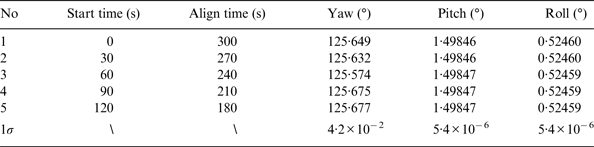
Windy weather was selected for the experiment. The wind speed was about 12 m/s. The vehicle for the test was parked beside a road. There were a lot of cars and trucks passing along the road with a speed range from 60 to 80 km/h. The airflow would impact on the test vehicle when a car or a truck passed by. The experiment staff in the test vehicle could feel the shaking. At the same time, the vehicle engine was still on while testing. The time spent to test alignment data was 300 s. The alignment algorithm proposed by this paper was employed to calculate the data respectively from different starting times 0 s, 30 s, 60 s, 90 s, 120 s, and all calculations were finished on 300 s. A set of typical test results are shown in Figure 5 and Table 1. Only three curves (0 s, 60 s and 120 s) are shown in Figure 5 to make the graphs clearer. It should be noted that a sharp peak impact can be observed at the switch moment between the coarse alignment and the fine alignment. These impacts are not the real attitude of the vehicle swaying, but are caused by the switching algorithm. Figure 5(a) and (c) suggest that there are also at least four real impacts in level attitudes respectively at 55 s, 130 s, 165 s and 290 s. In Figure 5 it is illustrated that both coarse alignment and fine alignment can restrain the disturbance from the engine vibration and both of them can trace the attitude angle step change due to the gust impact. Although the start times of the five experiments are different, two level attitudes have almost the same values and the repetitiveness for the azimuth alignment is 0·042° (1σ). This suggests that the algorithm proposed by this paper can finish the alignment task within 180 s under practical conditions, and alignment accuracy can meet the theoretical value.
The three alignment results on the rocking vehicle base with different starting times: (a) pitch, (b) yaw, (c) roll.
Alignment results for the vehicle base swaying.
4.2. Experiment on a moving vehicle
The alignment accuracy of the LINS directly influences the navigation results. Thus the alignment effect could be checked by using the navigation positioning accuracy. To further confirm the effectiveness of the algorithm, larger amplitude swinging was produced deliberately by man-made intervention during the alignment, and then the vehicle navigation experiment was carried out. The interferences could be sequenced as opening and closing the door on 80 s after the beginning of the alignment, rocking the vehicle body on 90 s, and two people getting on the vehicle and starting the engine at 170 s. The whole period for the alignment was about 180 s. The alignment curves are shown in Figure 6. Because of two researchers getting on the vehicle, the pitch changes about 0·24°. The maximum magnitude change of the roll angle reaches 0·4° in the alignment process. It is reasonable to conclude that the alignment algorithm has the capability to track the change of the vehicle attitude. In addition, it can be seen from Figure 6(a) and (c) that there is slight influence on the horizontal attitude angle due to the operation of the vehicle engine after 170 s. From the partially enlarged drawing in Figure 6(c), it can be observed that there is a high frequency vibration of the pitch angle of about 0·002° due to the operation of the engine. However, there is slight effect on the azimuth because of the door switching and persons getting on, and the engine working has hardly any effect on the azimuth.
The alignment process under man-made interference conditions: (a) pitch, (b) pitch for engine not working, (c) pitch for engine working, (d) yaw, (e) roll.
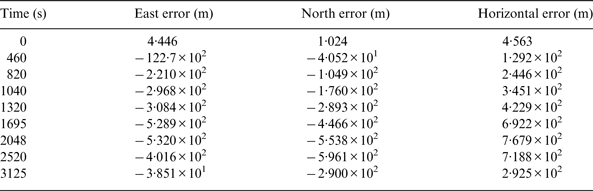
After the alignment, a navigation experiment was carried out on an ‘L’-shaped road in Xi'an, China. The average speed of the experimental vehicle was controlled at around 70 km/h as closely as possible to excite the dynamic error of the LINS. The navigation experiment lasted about 3400 s. The distance covered was 62·5 km. A GPS was set on the top of the vehicle to record the longitude and latitude. Several mark-points in the experimental route were reached every 6~9 km. The GPS and LINS data including the time stamps were recorded at every mark-point during the navigation process.
The route for the experiment is shown through a satellite picture in Figure 7(a). The LINS navigation results are compared with the record of the GPS carried with the vehicle in Figure 7(b), from which it can be shown that the LINS navigation results are close to GPS data at the beginning. After several curves, the LINS positioning errors begin to increase. The positioning errors of every mark-point are shown in Table 2. It can be seen in Table 2 that the maximum positioning error presents at about 2048 s in this experiment. The horizontal positioning error is 767·9 m, which is in the order of normal navigation error for the LINS.
Navigation results by LINS: (a) Route of experiment (Xian China), (b) Comparison of GPS and LINS.
Position errors.
5. CONCLUSIONS
In this paper, a novel methodology is put forward to solve the initial alignment problem for SINS under the conditions of a rocking base that may be different from the current mainstream viewpoint. It emphasises tracking the low frequency attitude change of the vehicle by the initial alignment algorithm. The swaying signal is taken as the useful signal, rather than trying to suppress the bandwidth to filter the rocking information of the vehicle. According to this idea, the alignment algorithm in the inertial frame with good tracking performance is used for the coarse alignment. A Kalman Filter (KF) is applied for the fine alignment, while the horizontal acceleration of gravity is also taken into the measurement equation. This enhances the tracking ability of the KF for the attitude angle's change. The experimental results in the high precision LINS show that the proposed method is competent for alignment in 180 s on the rocking base, and the alignment accuracy is 0·042°. The navigation tests suggest that LINS level position error is about 718 m after almost one hour by using the alignment algorithm.
The proposed alignment algorithm presents the features of simple, rapid convergence, with no additional memory, no special requirements for the navigation computer, and providing a strong application value compared with other methods. More significantly, the attitude tracking viewpoint proposed in this paper is validated by solving the problem of the initial alignment on a rocking base. This approach can be taken as a basic idea of the alignment algorithm to avoid complex nonlinear filtering and other problems, such as large computer, low accuracy, complex modelling and time delaying.
FINANCIAL SUPPORT
This work was supported by the Key Research Project Supported by China National Nature Science Foundation (grant number 61135001) and the Youth Program Supported by China National Nature Science Foundation (grant number 61203234).