

The midline viscera in the neck are predisposed by anatomic proximity to the invasion of thyroid gland carcinoma. The literature is replete with reports focusing on thyroid cancer involving invasion of the trachea, but offers few articles documenting involvement of the oesophagus. This tubular passageway is invaded less often than the tracheaReference Freschi, Lardi, Castagnoli, Taddei, Bechi and Bucciarelli1–Reference McCaffrey, Bergstralh and Hay3 perhaps due to its posterior location. The oesophageal musculature becomes involved through direct tumour invasion or extracapsular extension of affected paratracheal lymph nodes. The oesophageal mucosa being a tough barrier to penetrate accounts for the rare neoplastic extension to the luminal surface.Reference McCaffrey2 The observed incidence of thyroid cancer invading the oesophagus (TCIE) has ranged from less than 1 to 22%.Reference Freschi, Lardi, Castagnoli, Taddei, Bechi and Bucciarelli1–Reference McCaffrey, Bergstralh and Hay3
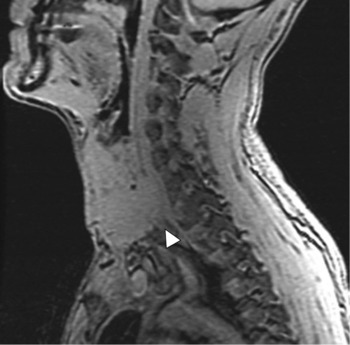
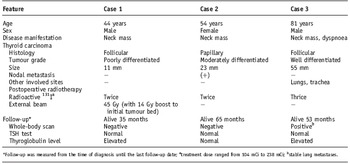
Owing to the paucity of outcome data, we followed up three cases of TCIE (Table 1; Figure 1) in which thyroidectomy with tumour shaved off the muscular layer of the oesophagus was the primary treatment. All patients received adjuvant postoperative radioactive iodine therapy ± external beam irradiation. In case 1, external beam irradiation was given to the entire anterior portion of the neck and also to the upper mediastinum because of the presence of tumour in the resection margin following completion thyroidectomy and a second dose of radioiodine. Subsequent doses of radioiodine were given for residual disease in the thyroid bed, metastatic spread to the lungs and suspected occult recurrent neoplasm. After a median follow-up of 53 months, all patients were alive and free of local disease. One individual was asymptomatic from imaging scan-shown pulmonary metastases. Our patients were submitted for follow-up procedures such as periodic clinical examination, plasma thyroglobulin level determination, 131Iodine total body scintigraphy and thyroid hormone suppressive therapy.
Magnetic resonance imaging (sagittal view) shows a neck mass extending to the oesophagus (arrowhead).

Patient demographic data, treatment and outcome

* Follow-up was measured from the time of diagnosis until the last follow-up date; atreatment dose ranged from 104 mCi to 238 mCi; bstable lung metastases.
The debate concerning appropriate management of thyroid cancers continues because cohort studies in which therapy is randomized have not been undertaken. However, the application of aggressive management for TCIE may be less controversial. We evaluated the effects of combined therapy for this particular malady as the observed prognosis has not been uniformly dismalReference Freschi, Lardi, Castagnoli, Taddei, Bechi and Bucciarelli2–Reference McCaffrey, Bergstralh and Hay4 and the potential for local recurrence is real.Reference Ito, Tomoda, Uruno, Takamura, Miya, Kobayashi, Matsuzuka, Kuma and Miyauchi4 However, we need to acquire more information from long-term follow-up of our patients to ascertain the real contribution of combined therapy in controlling non-anaplastic thyroid carcinoma and prolonged progression-free survival of individuals with TCIE.