As the focal article (Kraiger et al., Reference Kraiger, Fisher, Grossman, Mills and Sitzmann2022) points out, the field of industrial-organizational (I-O) psychology agrees that it is important to “facilitate human interaction in online graduate education.” As members of the Society for Industrial and Organizational Psychology’s (SIOP) Education and Training Online Programs Subcommittee, we are committed to identifying and developing new methods and materials to best engage this student and alumni population. To inform this endeavor, we recently asked faculty, current students, prospective students, and alumni of online graduate programs about their engagement with the I-O profession via an informal survey. With our commentary, we provide a perspective that was not addressed by the data presented in the focal article: the best methods and modalities for fostering online graduate program engagement from the perspective of online graduate program students and faculty.
The emphasis of the focal article’s supplemental survey on experiences of instructors not affiliated with online programs is somewhat surprising given that the focal article also acknowledges that online instruction is not simply the replication of face-to-face content (e.g., reading materials) in a learning management system. It is also surprising, as a crisis-related event such as the COVID-19 pandemic may not represent the best context in which to gather perceptions of online education for application to noncrisis times. Perhaps a more effective approach would involve seeking input from those who are affiliated with online I-O programs and who specifically have experience with online education even during noncrisis times. Online I-O program faculty and student perspectives have been sought in past efforts to examine online education in I-O.
For example, Sanders et al. (Reference Sanders, Henning, MacCarty and Grossman2020) surveyed SIOP members who were affiliated with online or hybrid graduate programs. Their results indicated that these programs faced unique challenges, not as readily found in face-to-face programs, including “sense of community, interaction with peers, and engagement.” In particular, it appears that students and alumni of online programs, when compared with students/alumni of in-person programs, report lower availability of resources, lower opportunities for professional development/networking, and lower alumni engagement (Grossman & Sanchez, Reference Grossman and Sanchez2020). Additionally, alumni of online programs appear to remain less involved with SIOP after graduation (Grossman & Sanchez, Reference Grossman and Sanchez2020).
Clearly, there is work to be done, and the focal article provides recommendations for ways to enhance the quality of online I-O graduate programs. However, the recommendations provided omit input from those affiliated with online programs. This is a notable oversight because arguably those affiliated with online programs best understand the most appropriate criteria for determining program effectiveness. Within the focal article, some of the criteria used to determine effectiveness of online programs may suffer from a lack of criterion-related validity—for example, as noted in the focal article, many online programs cater to nontraditional students (Huelsman & Shanock, Reference Huelsman, Shanock and Shoenfelt2020). These students are often working full time and may already be in the field; thus, the use of a required internship as a metric for determining advances in applied experience is flawed because these students have no need for an internship and gain applied experiences in other ways.
Just as the best practices for supporting online I-O undergraduate education involve unique and important distinctions from traditional learning environments (LeNoble & Roberts, Reference LeNoble and Roberts2021), so too should our approach to online I-O graduate education fully reflect the nuances of online faculty, student, and alumni perspectives. As a result, to address what could be done to enhance online I-O graduate program engagement, we decided to ask individuals who are affiliated with these programs. By providing a voice to online program faculty, students, and alumni, we hope to increase the likelihood that online program changes will truly reflect the perspectives, needs, and goals of the stakeholders of these programs.
Seeking input from online program stakeholders
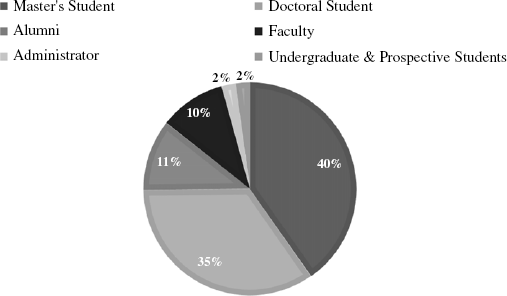
An informal, anonymous Google Form was distributed by committee members in three ways: posted to LinkedIn pages, posted to the I-O Program Directors group to be forwarded to I-O faculty and students, and emailed to connections who fell into one of the selected groups. A sample of 140 responses was collected. Figure 1 shows that three-quarters (75%) of the responses were from graduate students, with 40% of those being master’s students. Approximately 13% were faculty or administrators of an online program, and 11% were alumni. We received a small amount of data (2%) from those who were contemplating going to graduate school in an online program.
Figure 1.Respondent Stakeholder Group Affiliation
One goal of the survey was to address online student engagement with the I-O field. To better understand how well online students and educators recognized the importance of engaging with the field outside the classroom, the first question asked about their level of engagement with the I-O community. Just under half of the participants reported they were fully engaged with the I-O community (42%). Others were engaging at some level (47%) but weren’t sure how to do more. Finally, a small group (14%) were not aware that they should be engaging with the broader I-O community.
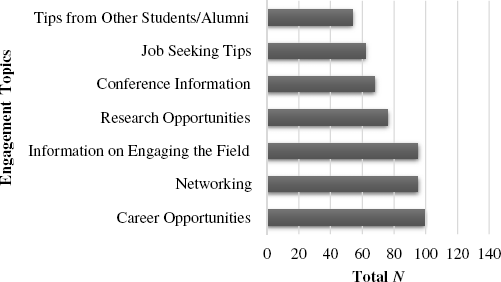
The second question was designed to determine which topics were of most interest to participants (respondents could select all that applied) to support online program engagement. The theme of career resources (e.g., career opportunities and job seeking tips) was selected by the most respondents. Other topics selected by the majority of respondents were encompassed by a general networking theme (e.g., engaging with the field, conference information/participation, connecting/networking with others, tips from other students or alumni). Finally, some respondents were particularly interested in research opportunities. Figure 2 shows the responses for the most popular themes.
Figure 2.Topics of Engagement Selected by I-O Graduate Program Stakeholders
After soliciting types of resource information participants were interested in, the survey asked for input on the best structures or strategies for disseminating these resources. The strategy that respondents requested the most was mentoring (70%). Students and alumni of online programs are looking for someone to help guide them through the engagement and job-seeking process, as well as early career challenges. Other requested dissemination methods included use of social media, blogs, and videos. Participants also were interested in methods that allowed for more interaction with others (e.g., information sessions, Ask Me Anything sessions, informal chat sessions).
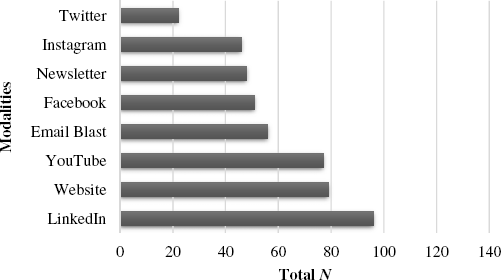
Finally, the survey results showed that the best mediums for disseminating and communicating about these opportunities are social media outlets (e.g., LinkedIn, YouTube, Facebook, Instagram, Twitter), with LinkedIn as the most frequent choice. Others were interested in emails and/or newsletters. Figure 3 shows the most frequently requested communication mediums. These results align with those of Gisler et al. (Reference Gisler, Gray, Roman and Rothstein2019), who asked graduate students to identify tools they used most frequently and found most helpful in staying informed. Specifically, they found that LinkedIn was the most commonly used tool, whereas rich site summary (RSS) feeds were found to be the most helpful. Other tools included research platforms, podcasts, and Facebook/Twitter (Gisler et al., Reference Gisler, Gray, Roman and Rothstein2019).
Figure 3.Preferred Engagement Modalities of I-O Graduate Program Stakeholders
Supporting online I-O graduate program engagement
Overall, the focal article makes the case that online programs are effective for teaching relevant knowledge and skills to their students. Where students need more support is in networking with other individuals in the field. As discussed above, our survey of those directly involved with online programs highlights a similar concern. We provide initial evidence that despite becoming more ubiquitous with graduate education in our field, online I-O programs are still in need of greater support and connection with the profession, as reported by those directly affiliated with online I-O education. In response to these findings, the Online Programs Subcommittee is developing resources for online programs to benefit their faculty, students, and alumni, particularly as they enter the professional world. We discuss the following initiatives of the Online Programs Subcommittee, which may inspire similar efforts across other I-O entities.
We will be sponsoring learning opportunities for students to interact with one another and other I-O psychologists. These opportunities should enhance learner–learner interactions and faculty–learner interactions as proposed by the focal article. As indicated by our results, we are also including learner–alumni opportunities. We are developing a series of webinars that online students and faculty can attend. They will be similar in approach to SIOP’s Bridge Builders group. These webinars will address topics that online students have expressed interest in receiving more information about. For example, students expressed a desire to have more information about careers. Possible topics could include SIOP members from various jobs (e.g., internal consultant, external consultant) sharing which knowledge and skills current job holders use and need to be successful across different careers.
Because online I-O graduate programs have a small, diverse group of students, individuals may have difficulty finding others who share characteristics or interests. One possibility is to develop student pairings across online programs, creating peer relationships among online learners. This may provide an added benefit of cross-fertilizing information across programs and could enhance the networks of the students, as advocated for in the focal article. The field and the Online Programs Subcommittee will need to continue to think outside the box to provide more informal peer interactions to support this unique group.
Finally, according to our survey results, students are indeed looking for e-mentoring relationships, as similarly discussed by the focal article. They understand that mentors can help provide benefits to them as they begin their careers in I-O psychology. As these students are already comfortable with the online modality, a lack of face-to-face mentoring should not diminish the relationship or the value. The SIOP Online Programs Subcommittee is devoted to providing mechanisms and forums that help online graduate students to find appropriate mentors, and we also encourage online programs to engage in these efforts themselves to reach their students more directly. These relationships may last the course of a student/alumni’s career, further enhancing long-term engagement with the profession.
Although we have seen an influx of online-education-affiliated members within SIOP, evidence suggests that engagement and awareness of opportunities for this demographic still poses a challenge. As administrators, faculty, students, and alumni from online and hybrid programs can attest, this is a much-needed focus. There remain many topics that warrant attention to provide appropriate support for this growing constituency of SIOP members. To best address such challenges, future initiatives should continue to include the voices and perspectives of those affiliated with online I-O graduate programs.




 You have
Access
As the focal article (Kraiger et al., Reference Kraiger, Fisher, Grossman, Mills and Sitzmann2022) points out, the field of industrial-organizational (I-O) psychology agrees that it is important to “facilitate human interaction in online graduate education.” As members of the Society for Industrial and Organizational Psychology’s (SIOP) Education and Training Online Programs Subcommittee, we are committed to identifying and developing new methods and materials to best engage this student and alumni population. To inform this endeavor, we recently asked faculty, current students, prospective students, and alumni of online graduate programs about their engagement with the I-O profession via an informal survey. With our commentary, we provide a perspective that was not addressed by the data presented in the focal article: the best methods and modalities for fostering online graduate program engagement from the perspective of online graduate program students and faculty.
The emphasis of the focal article’s supplemental survey on experiences of instructors not affiliated with online programs is somewhat surprising given that the focal article also acknowledges that online instruction is not simply the replication of face-to-face content (e.g., reading materials) in a learning management system. It is also surprising, as a crisis-related event such as the COVID-19 pandemic may not represent the best context in which to gather perceptions of online education for application to noncrisis times. Perhaps a more effective approach would involve seeking input from those who are affiliated with online I-O programs and who specifically have experience with online education even during noncrisis times. Online I-O program faculty and student perspectives have been sought in past efforts to examine online education in I-O.
For example, Sanders et al. (Reference Sanders, Henning, MacCarty and Grossman2020) surveyed SIOP members who were affiliated with online or hybrid graduate programs. Their results indicated that these programs faced unique challenges, not as readily found in face-to-face programs, including “sense of community, interaction with peers, and engagement.” In particular, it appears that students and alumni of online programs, when compared with students/alumni of in-person programs, report lower availability of resources, lower opportunities for professional development/networking, and lower alumni engagement (Grossman & Sanchez, Reference Grossman and Sanchez2020). Additionally, alumni of online programs appear to remain less involved with SIOP after graduation (Grossman & Sanchez, Reference Grossman and Sanchez2020).
Clearly, there is work to be done, and the focal article provides recommendations for ways to enhance the quality of online I-O graduate programs. However, the recommendations provided omit input from those affiliated with online programs. This is a notable oversight because arguably those affiliated with online programs best understand the most appropriate criteria for determining program effectiveness. Within the focal article, some of the criteria used to determine effectiveness of online programs may suffer from a lack of criterion-related validity—for example, as noted in the focal article, many online programs cater to nontraditional students (Huelsman & Shanock, Reference Huelsman, Shanock and Shoenfelt2020). These students are often working full time and may already be in the field; thus, the use of a required internship as a metric for determining advances in applied experience is flawed because these students have no need for an internship and gain applied experiences in other ways.
Just as the best practices for supporting online I-O undergraduate education involve unique and important distinctions from traditional learning environments (LeNoble & Roberts, Reference LeNoble and Roberts2021), so too should our approach to online I-O graduate education fully reflect the nuances of online faculty, student, and alumni perspectives. As a result, to address what could be done to enhance online I-O graduate program engagement, we decided to ask individuals who are affiliated with these programs. By providing a voice to online program faculty, students, and alumni, we hope to increase the likelihood that online program changes will truly reflect the perspectives, needs, and goals of the stakeholders of these programs.
Seeking input from online program stakeholders
An informal, anonymous Google Form was distributed by committee members in three ways: posted to LinkedIn pages, posted to the I-O Program Directors group to be forwarded to I-O faculty and students, and emailed to connections who fell into one of the selected groups. A sample of 140 responses was collected. Figure 1 shows that three-quarters (75%) of the responses were from graduate students, with 40% of those being master’s students. Approximately 13% were faculty or administrators of an online program, and 11% were alumni. We received a small amount of data (2%) from those who were contemplating going to graduate school in an online program.
Respondent Stakeholder Group Affiliation
One goal of the survey was to address online student engagement with the I-O field. To better understand how well online students and educators recognized the importance of engaging with the field outside the classroom, the first question asked about their level of engagement with the I-O community. Just under half of the participants reported they were fully engaged with the I-O community (42%). Others were engaging at some level (47%) but weren’t sure how to do more. Finally, a small group (14%) were not aware that they should be engaging with the broader I-O community.
The second question was designed to determine which topics were of most interest to participants (respondents could select all that applied) to support online program engagement. The theme of career resources (e.g., career opportunities and job seeking tips) was selected by the most respondents. Other topics selected by the majority of respondents were encompassed by a general networking theme (e.g., engaging with the field, conference information/participation, connecting/networking with others, tips from other students or alumni). Finally, some respondents were particularly interested in research opportunities. Figure 2 shows the responses for the most popular themes.
Topics of Engagement Selected by I-O Graduate Program Stakeholders
After soliciting types of resource information participants were interested in, the survey asked for input on the best structures or strategies for disseminating these resources. The strategy that respondents requested the most was mentoring (70%). Students and alumni of online programs are looking for someone to help guide them through the engagement and job-seeking process, as well as early career challenges. Other requested dissemination methods included use of social media, blogs, and videos. Participants also were interested in methods that allowed for more interaction with others (e.g., information sessions, Ask Me Anything sessions, informal chat sessions).
Finally, the survey results showed that the best mediums for disseminating and communicating about these opportunities are social media outlets (e.g., LinkedIn, YouTube, Facebook, Instagram, Twitter), with LinkedIn as the most frequent choice. Others were interested in emails and/or newsletters. Figure 3 shows the most frequently requested communication mediums. These results align with those of Gisler et al. (Reference Gisler, Gray, Roman and Rothstein2019), who asked graduate students to identify tools they used most frequently and found most helpful in staying informed. Specifically, they found that LinkedIn was the most commonly used tool, whereas rich site summary (RSS) feeds were found to be the most helpful. Other tools included research platforms, podcasts, and Facebook/Twitter (Gisler et al., Reference Gisler, Gray, Roman and Rothstein2019).
Preferred Engagement Modalities of I-O Graduate Program Stakeholders
Supporting online I-O graduate program engagement
Overall, the focal article makes the case that online programs are effective for teaching relevant knowledge and skills to their students. Where students need more support is in networking with other individuals in the field. As discussed above, our survey of those directly involved with online programs highlights a similar concern. We provide initial evidence that despite becoming more ubiquitous with graduate education in our field, online I-O programs are still in need of greater support and connection with the profession, as reported by those directly affiliated with online I-O education. In response to these findings, the Online Programs Subcommittee is developing resources for online programs to benefit their faculty, students, and alumni, particularly as they enter the professional world. We discuss the following initiatives of the Online Programs Subcommittee, which may inspire similar efforts across other I-O entities.
We will be sponsoring learning opportunities for students to interact with one another and other I-O psychologists. These opportunities should enhance learner–learner interactions and faculty–learner interactions as proposed by the focal article. As indicated by our results, we are also including learner–alumni opportunities. We are developing a series of webinars that online students and faculty can attend. They will be similar in approach to SIOP’s Bridge Builders group. These webinars will address topics that online students have expressed interest in receiving more information about. For example, students expressed a desire to have more information about careers. Possible topics could include SIOP members from various jobs (e.g., internal consultant, external consultant) sharing which knowledge and skills current job holders use and need to be successful across different careers.
Because online I-O graduate programs have a small, diverse group of students, individuals may have difficulty finding others who share characteristics or interests. One possibility is to develop student pairings across online programs, creating peer relationships among online learners. This may provide an added benefit of cross-fertilizing information across programs and could enhance the networks of the students, as advocated for in the focal article. The field and the Online Programs Subcommittee will need to continue to think outside the box to provide more informal peer interactions to support this unique group.
Finally, according to our survey results, students are indeed looking for e-mentoring relationships, as similarly discussed by the focal article. They understand that mentors can help provide benefits to them as they begin their careers in I-O psychology. As these students are already comfortable with the online modality, a lack of face-to-face mentoring should not diminish the relationship or the value. The SIOP Online Programs Subcommittee is devoted to providing mechanisms and forums that help online graduate students to find appropriate mentors, and we also encourage online programs to engage in these efforts themselves to reach their students more directly. These relationships may last the course of a student/alumni’s career, further enhancing long-term engagement with the profession.
Although we have seen an influx of online-education-affiliated members within SIOP, evidence suggests that engagement and awareness of opportunities for this demographic still poses a challenge. As administrators, faculty, students, and alumni from online and hybrid programs can attest, this is a much-needed focus. There remain many topics that warrant attention to provide appropriate support for this growing constituency of SIOP members. To best address such challenges, future initiatives should continue to include the voices and perspectives of those affiliated with online I-O graduate programs.