Family instability, defined as the incidents of family events that disrupt the cohesiveness, continuity, and predictability of the proximal childrearing context (Ackerman et al., Reference Ackerman, Kogos, Youngstrom, Schoff and Izard1999; Forman & Davies, Reference Forman and Davies2003), has been linked broadly to child functioning, of which one particularly salient aspect is elevated externalizing problems (e.g., Ackerman et al., Reference Ackerman, Kogos, Youngstrom, Schoff and Izard1999; Cavanagh & Huston, Reference Cavanagh and Huston2006; Fomby & Cherlin, Reference Fomby and Cherlin2007). The present work sought to build on prior work by illuminating the process through which family instability may shape child functioning by focusing on maternal parenting. Guided by differential susceptibility (Belsky & Pluess, Reference Belsky and Pluess2009) and biological sensitivity to the context theories (Ellis, Boyce, et al., Reference Ellis, Boyce, Belsky, Bakermans-Kranenburg and Van IJzendoorn2011), we sought to evaluate how maternal stress reactivity within the sympathetic nervous system may moderate the association between exposure to family instability and maternal parenting. Furthermore, building on the growing body of research that has called for greater specificity in parenting (e.g., Leerkes, Reference Leerkes2011; McElwain & Booth-LaForce, Reference McElwain and Booth-LaForce2006; Sturge-Apple et al., Reference Sturge-Apple, Jones and Suor2017), we included maternal sensitivity within two socialization contexts with different nature and demands.
Moderating role of sympathetic stress reactivity on parenting
Parenting behavior might be shaped by a myriad of factors including more distal family context (e.g., family instability) and parents’ own characteristics (Belsky, Reference Belsky1984). Here we sought to illuminate how family instability and mothers’ physiological stress reactivity may interactively be associated with parenting behavior, and thereby, child functioning. Family instability refers to the incidents of transitions within the family that disrupt the cohesiveness of the child-rearing context (Ackerman et al., Reference Ackerman, Kogos, Youngstrom, Schoff and Izard1999). According to the evolutionary theory of socialization (Belsky et al., Reference Belsky, Steinberg and Draper1991; Belsky, Reference Belsky2012), extra-familial risk factors (e.g., family instability) may be transmitted to children by shaping proximal family processes, including parenting behavior. Thus, when the distal environment is unstable, parents will likely limit their investment in children, as efforts devoted to parenting may never pay off and mitigate the risk for their children. Thus, evidence has linked family instability with less sensitive parenting behavior (e.g., Belsky et al., Reference Belsky, Schlomer and Ellis2012; Cooper et al., Reference Cooper, McLanahan, Meadows and Brooks-Gunn2009; Szepsenwol et al., Reference Szepsenwol, Simpson, Griskevicius and Raby2015).
Despite the evidence, some research failed to find a direct association between extra-familial risk factors and maternal parenting (e.g., Donahue et al., Reference Donahue, D'Onofrio, Bates, Lansford, Dodge and Pettit2010), suggesting the existence of potential moderating factors. Informed by differential susceptibility (Belsky & Pluess, Reference Belsky and Pluess2009) and biological sensitivity to the context theories (BSC, Ellis, Boyce, et al., Reference Ellis, Boyce, Belsky, Bakermans-Kranenburg and Van IJzendoorn2011), we sought to examine whether maternal sympathetic stress reactivity may operate as a susceptibility marker for the link between family instability and maternal parenting. According to the theories, individuals within the population differ in their susceptibility to environmental influences; those with heightened susceptibility are shaped by the context in a “for-better-and-for-worse-manner”. That is, highly susceptible individuals may develop greater functioning under a supportive environment, but poorer adjustment within the adverse environment. Heightened environmental susceptibility, according to BSC, can be indicated by one’s physiological stress reactivity, including reactivity within the autonomic nervous system (ANS, e.g., Obradović et al., Reference Obradović, Bush, Stamperdahl, Adler and Boyce2010).
As the primary driver for physiological stress reactivity, ANS maintains homeostasis in response to internal and external challenges. The sympathetic branch of ANS (i.e., sympathetic nervous system, SNS) drives the releases of catecholamines into the bloodstream (e.g., norepinephrine) when facing stressors, preparing the body for immediate “fight and flight” responses (e.g., elevated blood pressure, greater oxygen flow). The importance of measuring SNS reactivity to psychosocial/interpersonal stressors has been highlighted by prior research, and various markers of SNS stress reactivity were identified (e.g., shortening of the pre-ejection period, Ellis, Shirtcliff, et al., Reference Ellis, Shirtcliff, Boyce, Deardorff and Essex2011; reactivity in skin conductance level, Cummings et al., Reference Cummings, El-Sheikh, Kouros and Keller2007). Notably, salivary alpha-amylase (sAA), an enzyme secreted by salivary glands and involved in digesting carbohydrates, is regarded as a valid and minimally invasive marker for SNS activity (e.g., Granger et al., Reference Granger, Kivlighan, Blair, El-Sheikh, Mize, Lisonbee, Buckhalt, Stroud, Brohawn and Schwartz2006; Nater & Rohleder, Reference Nater and Rohleder2009). Furthermore, evidence has linked sAA reactivity to psychosocial stressors with plasma norepinephrine (e.g., Chatterton et al., Reference Chatterton, Vogelsong, Lu, Ellman and Hudgens1996), and other SNS reactivity indicators (e.g., skin-conductance reactivity; El-Sheikh et al., Reference El-Sheikh, Erath, Buckhalt, Granger and Mize2008; shortening of the pre-ejection period; Bosch et al., Reference Bosch, de Geus, Veerman, Hoogstraten and Amerongen2003) in response to stress.
Turning to parenting, research has also linked sAA reactivity (to psychosocial stressors) with parenting behavior, although findings are inconsistent. Some research has shown that individuals with heightened sAA reactivity to stressors tended to have less sensitive parenting (e.g., Out et al., Reference Out, Bakermans-Kranenburg, van Pelt and Van IJzendoorn2012). However, others have found that blunted sAA reactivity was associated with less sensitive parenting (e.g., Reijman et al., Reference Reijman, Alink, Compier-de Block, Werner, Maras, Rijnberk, van IJzendoorn and Bakermans-Kranenburg2015). More importantly, in addition to direct association with parenting behavior, heightened sAA reactivity may also operate as an indicator of heightened susceptibility to environmental influences that moderate the role of family context (e.g., Rudolph et al., Reference Rudolph, Troop-Gordon and Granger2010, Reference Rudolph, Troop-Gordon and Granger2011). Furthermore, although not directly using sAA reactivity, Sturge-Apple and associates (Reference Sturge-Apple, Skibo, Rogosch, Ignjatovic and Heinzelman2011) documented the potential moderating role of sympathetic stress reactivity between risky family contexts and parenting behavior. In particular, this study found that only for mothers with hyper-sympathetic reactivity, greater depressive symptoms were linked to more harsh and intrusive parenting. In contrast, only for mothers with hypo-sympathetic reactivity, lower family socioeconomic status was associated with more insensitive, disengaged parenting behavior. Furthermore, within the parenting literature, although previous research has identified susceptibility factors at other levels of analysis (e.g., genetic polymorphism, personality trait; Baião et al., Reference Baião, Fearon, Belsky, Teixeira, Soares and Mesquita2020; Sturge-Apple et al., Reference Sturge-Apple, Cicchetti, Davies and Suor2012), no other studies to our knowledge have examined physiological reactivity, particularly sAA reactivity, that explains the individual differences in the association between family risks and parenting behavior. Thus, we investigated this issue in the present study.
Family instability and child functioning: parental sensitivity as an indirect factor
The present work also sought to investigate whether parenting behavior operate as an indirect factor linking family instability and child externalizing problems. Although family instability has been directly linked to child functioning such as elevated externalizing problems (e.g., Ackerman et al., Reference Ackerman, Kogos, Youngstrom, Schoff and Izard1999; Cavanagh & Huston, Reference Cavanagh and Huston2006), fewer studies have examined the potential pathways through which family instability might shape child development. Towards this, we focused on the explanatory role of parental sensitivity given it is one of the most widely studied parenting characteristics (e.g., Leerkes et al., Reference Leerkes, Blankson and O’Brien2009) that captures the overall quality of parenting and plays a critical role in child socioemotional development (e.g., De Wolff & van IJzendoorn, Reference De Wolff and Van Ijzendoorn1997; Dunst & Kassow, Reference Dunst and Kassow2008).
In particular, evolutionary theories of socialization (Belsky et al., Reference Belsky, Steinberg and Draper1991; Belsky, Reference Belsky2012) suggest that the process through which family instability provides a “weather forecast” for children’s development might be through parenting behavior. Specifically, parental sensitivity and investment in children may be reduced in the context of unpredictable environments. In turn, children receiving these caregiving signals may calibrate their development accordingly. Thus, children exposed to insensitive parenting may manifest a variety of behavioral indicators, including greater risk-taking and externalizing problems. Greater family instability has been linked to less sensitive parenting behavior, and the latter with greater child externalizing problems (Belsky et al., Reference Belsky, Pasco Fearon and Bell2007; Pinquart, Reference Pinquart2017). Notably, the indirect role of sensitive parenting behavior from the evolutionary-developmental perspective aligns with more traditional developmental theories (e.g., the family stress model, Conger et al., Reference Conger, Ge, Elder, Lorenz and Simons1994). Experiences of disruptive family events (e.g., loss of job, death of family member) may put on a strain on parents’ emotional and psychological well-being, which undermines their ability to provide sensitive and responsive parenting towards their children (e.g., Conger et al., Reference Conger, Ge, Elder, Lorenz and Simons1994). These factors may then negatively shape child functioning.
Towards this, a number of studies examined parenting as an indirect factor of family instability. Yet, this line of work has yielded inconsistent results, with some studies documenting significant indirect effects of parenting behavior (e.g., Belsky et al., Reference Belsky, Schlomer and Ellis2012; Coe et al., Reference Coe, Davies, Hentges and Sturge-Apple2020; Osborne & McLanahan, Reference Osborne and McLanahan2007), while others reporting null findings (e.g., Donahue et al., Reference Donahue, D'Onofrio, Bates, Lansford, Dodge and Pettit2010; Forman & Davies, Reference Forman and Davies2003). For instance, in a three-wave longitudinal study, Coe and associates (Reference Coe, Davies, Hentges and Sturge-Apple2020) documented that maternal supportive parenting (i.e., greater sensitivity and lower disengagement) mediated associations between family instability and child externalizing problems. With a repeated measurement of all constructs across three waves, greater family instability at the first measurement occasion predicted a greater decrease in maternal sensitive and supportive parenting between waves 1 and 2, which in turn, predicted a greater increase in child externalizing problems between waves 2 and 3. Taken together, despite prior evidence, more work is needed during early childhood as much of the existing research has focused on later developmental stages (e.g., adolescence, Belsky et al., Reference Belsky, Schlomer and Ellis2012; Donahue et al., Reference Donahue, D'Onofrio, Bates, Lansford, Dodge and Pettit2010; Forman & Davies, Reference Forman and Davies2003) and has not directly assessed change in parenting and child functioning (e.g., Forman & Davies, Reference Forman and Davies2003; Belsky et al., Reference Belsky, Schlomer and Ellis2012; Donahue et al., Reference Donahue, D'Onofrio, Bates, Lansford, Dodge and Pettit2010; Osborne & McLanahan, Reference Osborne and McLanahan2007). In addition, this line of research has also not considered how individual characteristics of parents (e.g., physiological stress reactivity) function interactively with extra-familial factors in shaping parenting behavior.
Parenting in the discipline context
A vast majority of the literature examining family instability to date has regarded parental sensitivity as a universal construct, assuming that parents who are sensitive to their children in one context will be sensitive in other contexts as well, regardless of the nature or demands of the tasks. Yet, there has been a growing body of research highlighting the importance of gaining greater specificity in understanding parent sensitivity across different socialization contexts (e.g., Grusec & Davidov, Reference Grusec and Davidov2010; Leerkes et al., Reference Leerkes, Blankson and O’Brien2009; McElwain & Booth-LaForce, Reference McElwain and Booth-LaForce2006; Sturge-Apple et al., Reference Sturge-Apple, Jones and Suor2017). In the present study, we focused on maternal sensitive parenting within two discipline contexts, seeking to gain a more precise understanding of parenting within different discipline contexts. We focused on maternal sensitivity in discipline contexts given it is one of the most widely studied parenting characteristics (e.g., Leerkes et al., Reference Leerkes, Blankson and O’Brien2009) that has been linked to both family instability and child externalizing problems in the previous literature. The challenges parents may face during these discipline contexts (i.e., parents enforcing rules that children may resist and/or become frustrated) may evoke considerable individual differences in sensitivity. Furthermore, the level to which parents are sensitive to their children is considered as a critical characteristic for parents to effectively discipline children, promoting compliance and internalization of rules (Grusec et al., Reference Grusec, Danyliuk, Kil and O’Neill2017). That is, when disciplining children, sensitive parents are capable to notice, consider and acknowledge children’s needs and wants, showing responsiveness, warmth, and empathy, and allowing for flexibility in emotion and behavior within a fair limit. These characteristics promote the adoption of reasonable and effective approaches to discipline (e.g., parents who are capable to take their children’s perspective are more likely to act fairly), setting up a positive climate between parents and children for the socialization to happen, and eventually facilitate more optimal outcomes of discipline (e.g., children’s greater compliance and internalization of rules; Grusec et al., Reference Grusec, Danyliuk, Kil and O’Neill2017).
In the present study, we examined maternal sensitivity during two different discipline tasks designed to mirror different discipline situations that a parent may face. First, the forbidden toys task presents an attractive toy to the child that they are instructed not to touch. This requires mothers to enforce rules interactively and in response to children’s strong temptations to misbehave (Vaughn et al., Reference Vaughn, Kopp and Krakow1984). During the task, mothers had to balance their role of enforcing rules and working on another competing task on their own (see details in method). In contrast, the second task involved mothers discussing recent misbehavior with their child in a retrospective manner such as parents are faced when hearing about transgressions after the fact and must use more cognitive methods of discipline (Wieland et al., Reference Wieland, Green, Ellingsen and Baker2014). Both tasks represent different discipline contexts which still require mothers to notice the child’s signals, remain empathic, but still firmly maintain the rules. However, the forbidden toy task represents discipline “in the moment”, evoking mothers’ individual differences in their ability to address discipline reflexively and implicitly. This is particularly true given a greater amount of misbehavior the child may display during the forbidden-toy task, and that mothers had to deal with the distraction of another demanding task. In contrast, the discipline discussion task assesses mothers’ ability to discipline retrospectively, and use explicit and deliberative reasoning to solve problems with children. As such, the two tasks may require different resources/strategies from mothers, with the former requiring active and spontaneous engagement with the social stimuli, while the latter demanding maintaining calm engagement during deliberate reasoning and problem-solving. Taken together, the forbidden toy scenario may require mothers (a) to enforce rules while children are prompted to misbehave while balancing with a demanding task; and (b) to provide a more real-time, interactive platform for mothers to provide feedback and helps for children to regulate their impulses.
The present study
Adopting a multi-method (i.e., survey, observation) and longitudinal design, the present study sought to evaluate how changes in maternal sensitive parenting may operate as an indirect factor linking family instability and the development of child externalizing problems over time. In addition, we sought to investigate how maternal SNS reactivity, indexed by sAA reactivity to an interpersonal stressor, may moderate the association between family instability and the growth in maternal sensitivity. Finally, the present study focused on young children (i.e., 3- to 4-year-olds) given this is a salient stage for the development of self-regulation and rule internalization (e.g., Calkins & Fox, Reference Calkins and Fox2002). During this period, with the guidance and supervision from parents, children gradually acquire the ability to regulate their impulses and behavior in response to contextual demands and behave in a socially acceptable manner. As such, parents play a critical role in shaping children’s self-regulation at this stage, which may have long-term implications for children’s development (e.g., Calkins & Fox, Reference Calkins and Fox2002; Kochanska & Knaack, Reference Kochanska and Knaack2003).
Guided by the BSC theory ( Ellis, Boyce et al., Reference Ellis, Boyce, Belsky, Bakermans-Kranenburg and Van IJzendoorn2011), we hypothesize that mothers with greater sAA reactivity to interpersonal stressors will show stronger associations between exposure to family instability and the change in their parenting behavior over time. In addition, we hypothesize that decreases in maternal sensitivity over time are linked to greater increases in child externalizing problems over time. Yet, given limited prior literature on context-specificity of parenting behavior, we only advance preliminary hypotheses with regard to parenting context. We further hypothesized that parenting within the forbidden toy task might be more strongly linked to family instability and child externalizing problems.
We focus on child externalizing problems for three reasons. First, given our primary goal was to examine parenting behavior within different discipline contexts as indirect factors, we only focused on child externalizing problems because more research has documented the association between externalizing problems and unstable family contexts (e.g., Cavanagh & Huston, Reference Cavanagh and Huston2006; Coe et al., Reference Coe, Davies, Hentges and Sturge-Apple2020; Forman & Davies, Reference Forman and Davies2003). Second, we draw on the evolutionary developmental perspective as a theoretical framework, this framework highlights the potential influences of exposure to family instability, as a more direct and salient indicator for externalizing behaviors (Belsky et al., Reference Belsky, Steinberg and Draper1991; Belsky, Reference Belsky2012). Third, we investigated the role of parenting behavior within two discipline contexts which involve parental socialization for the acceptable rules and appropriate behavior within social contexts and are more directly associated with externalizing behaviors in children.
The present study advanced the literature in several ways. First, limited research has examined the individual differences in parents’ susceptibility to more distal family risks (i.e., family instability) on their parenting. This study advanced the literature by focusing on parents’ physiological stress reactivity as a potential differential-susceptibility indicator for the association above (i.e., family instability and parenting). We regard this endeavor as a particularly novel aspect of this work. Second, given scarce research examining the potential indirect pathways of family instability on child development via family processes and inconsistent findings in prior literature (e.g., Coe et al., Reference Coe, Davies, Hentges and Sturge-Apple2020; Donahue et al., Reference Donahue, D'Onofrio, Bates, Lansford, Dodge and Pettit2010; Forman & Davies, Reference Forman and Davies2003), this longitudinal study contributes to the growing literature in understanding how unstable early family context may shape child development. Third, by including maternal sensitivity within two different discipline contexts, the study helps to gain greater specificity for how distal risks may be associated with parenting within different contexts.
Method
Participants
Participants were 235 young children and their parents, recruited from a midsized city in the Northeastern United States. We recruited families broadly from child-care centers, head-start programs, local events, and through flyers and family internet sites. Families were screened via the following eligibility criteria: (a) the target child was at least 3 years old and both parental figures were at least 18; (b) the target child and the two parental figures have been living in the same household for the entire previous year; (c) the two parental figures were of the opposite sex, and at least one of them was the biological parent; (d) the target child does not have cognitive or developmental disabilities, and all three family members could communicate fluently in English. The average age for children at the first measurement occasion was 2.97 years old (SD = 0.38, Age range: [2, 4]). This age range was due to the difficulty in scheduling family visits, thus we allowed for 1 month before and after children were age three. Around half of the children were girls (55.3%). 56.2% of children were identified as White, 21.3% as African American, and 16.2% as mixed race. Furthermore, 17.4% of the children were identified as Hispanic or Latino ethnicity. Mothers were on average 33.56 years of age (SD = 5.30, Age range: [20, 48]), and the median level for maternal highest education was an Associate’s degree. Median household income fell in the range of $55,000–$74,999, and 25.5% of families reported an annual income below $23,000. The second measurement occasion took place 1 year after the initial visit, and 218 families (92.8%) complete the second assessment. The study protocol was reviewed and approved by the Institutional Review Board of the University of Rochester (Title of the study: Interparental Relationship and Parenting, case number: RSRB939). Parents provided written consent before the families were enrolled in the study.
Procedure
Families completed a 2.5–3 hr visit at each measurement occasion in the laboratory. The visit room, where most family interactions took place, resembled the look of a living room and was equipped with audiovisual equipment. In addition, parents completed survey measures in quiet, separate rooms. We observed maternal parenting behavior in the following two tasks, with the order of the tasks being the same across all families (i.e., the forbidden toy task being the first, and the two tasks were separated by another task).
Forbidden toy task
During the modified forbidden toy task (Vaughn et al., Reference Vaughn, Kopp and Krakow1984), mothers stayed in the room with their children for 5 min while working on a flanker task on an iPad. The flanker task requires mothers to judge the direction of a center arrow occurring on the screen and served as a distraction for mothers. Before the task, the experimenter placed an attractive toy (a ball pit play tent) in the visit room and instructed mothers (without the presence of the child) that the child cannot touch or play with the attractive toy until the end of the task. The experimenter then led the child into the room and gave them two boring toys (e.g., empty play-doh boxes) to play with.
Discipline discussion task
Mothers and children completed the 5-min discipline discussion task (Wieland et al., Reference Wieland, Green, Ellingsen and Baker2014), and we modified the task to be age-appropriate for young children. More specifically, mothers were instructed to come up with a topic in which the child acted up or misbehaved recently. During the task, mothers talked to their children about that topic for the entire duration. In addition, the experimenter instructed mothers that they could switch to another similar task if they were done with the first topic. Given the task mostly involved mothers talking to the child, asking questions, and responding to child cues (e.g., being distressed), we consider the task appropriate in evaluating parenting behavior, supported by the considerable variation in maternal sensitivity in the task (see Table 1).
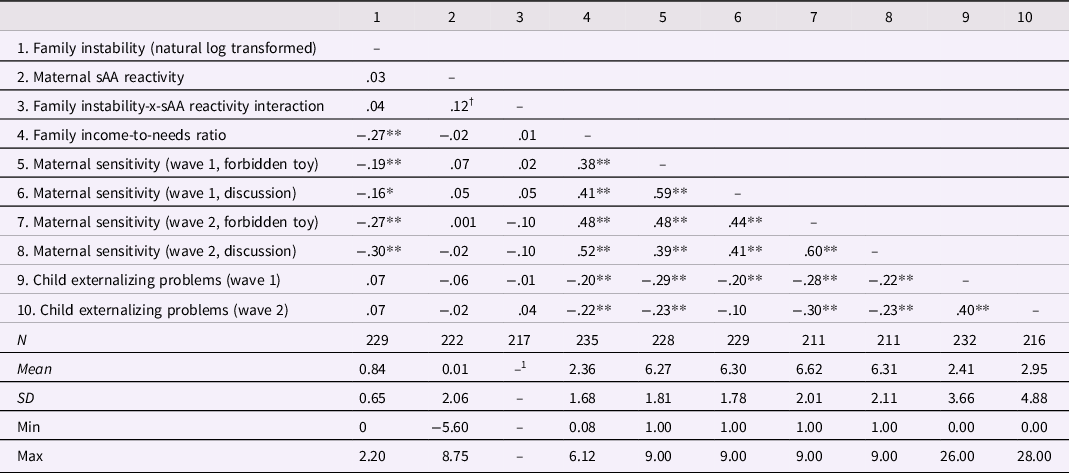
Descriptive information for key study variables

Note. 1. Family instability-x-sAA reactivity interaction was created after standardizing family instability and sAA reactivity terms (N = 217, Mean = 0.03, SD = 1.10, Min = −5.51, Max = 4.91).
** p < .01
* p < .05
† p < .10
Measures
Family instability
On the eight-item Family Instability Questionnaire (FIQ, Ackerman et al., Reference Ackerman, Kogos, Youngstrom, Schoff and Izard1999; Forman & Davies, Reference Forman and Davies2003), mothers reported the frequency of incidents of various disruptive family events during the past year. Events included: sickness, death of family members, loss of job for family members, parent intimate relationship changes (e.g., breaking up with a serious romantic partner), and children’s primary caregiver changes. Given FIQ assesses the frequency of family events, traditional measures (e.g., Cronbach α) may not be appropriate to assess the internal consistency. Yet, the psychometric soundness of FIQ has been established through its broad use in the literature (e.g., Li et al., Reference Li, Sturge-Apple, Martin and Davies2019) and strong association with child functioning (e.g., Forman & Davies, Reference Forman and Davies2003). We treated extreme values of FIQ (i.e., outside 3SD) as missing, resulting in several additional missing values (N(FIQ available) = 229). The family instability level during the past year showed considerable variability within the current sample (Mean = 1.87, SD = 2.00, Min = 0, Max = 8.00), and the level was comparable to prior studies (Forman & Davies, Reference Forman and Davies2003; Milan et al., Reference Milan and Pinderhughes2006). Yet, to adjust for the right skewness and range of family instability (i.e., the lowest value was only 0.94 SD below the mean) to test the pattern of any significant interaction (i.e., ±2 SDs; Roisman et al., Reference Roisman, Newman, Fraley, Haltigan, Groh and Haydon2012), we performed a natural logarithm transformation for family instability (after adding the constant one to all cases). After the transformation, the range for family instability improved (i.e., [−1.29, 2.09] SD, see Table 1), but still did not reach the full ±2 SDs range, as recommended by Roisman et al. (Reference Roisman, Newman, Fraley, Haltigan, Groh and Haydon2012). Nevertheless, we proceeded with the log-transformed family instability as it offers a closer distribution to the recommendation.
Maternal sensitivity (waves 1 and 2)
We observed maternal sensitivity in discipline discussion and forbidden toy tasks on both occasions. In both tasks, coders rated mothers’ behavior globally on a nine-point Likert scale (1 = “Not at all characteristics” to 9 = “Mainly characteristic”) based on the Caregiving around Discipline System (CADS, Jones-Gordils et al., Reference Jones-Gordils, Sturge-Apple and Davies2021). Higher scores in maternal sensitivity indicate that mothers perceive and interpret children’s signals accurately and respond to those cues appropriately and promptly. A highly sensitive mother is well attuned to their child’s needs/wants, being able to notice and accurately interpret children’s verbal and non-verbal signals (e.g., frowning eyebrow, pouting). In turn, these mothers respond to children’s cues with empathy, fairness, and understanding, even if children want to misbehave (e.g., acknowledging the difficulty of withholding the impulses or abiding rules, comforting and/or providing distraction when children are distressed rather than over-stimulating children). Furthermore, these responses appear to be prompt and well-timed to children’s needs. In contrast, mothers with low sensitivity may appear completely unattuned or uninterested in understanding the child or come across as highly unempathetic to the child’s needs. Two groups of coders completed the rating separately at each wave, reaching excellent inter-rater reliability [Intraclass correlation [ICC] = 0.83 (Wave 1 Discipline)/0.77 (Wave 1 Forbidden toy)/0.72 (Wave 2 Discipline)/0.83 (Wave 2 Forbidden toy)].
Salivary alpha-amylase (sAA, wave 1)
Maternal baseline sAA level and sAA reactivity was measured before (i.e., baseline) and around the 10-min interparental conflict discussion task (i.e., reactivity, Sturge-Apple et al., Reference Sturge-Apple, Davies, Cicchetti and Cummings2009). After arriving and consent, mothers were instructed to sit in a quiet room to answer a few surveys (i.e., around 5 min) before providing their first saliva sample. This sample was treated as an indicator for baseline sAA. Turning to sAA reactivity, it was created via the first saliva sample (i.e., before the task, used as an indicator for baseline sAA as well) and the sample immediately following the interparental conflict discussion task. Before the discussion task, each parent came up with the top three topics they commonly disagree about separately and picked two topics together that they felt comfortable discussing. The experimenter then instructed parents to talk about each topic for 5 min, and asked parents to stay on topic and try to find a resolution for each topic. This task was widely used and shown to be effective at evoking parents’ physiological stress responses (e.g., Sturge-Apple et al., Reference Sturge-Apple, Davies, Cicchetti and Cummings2009; Sturge-Apple et al., Reference Sturge-Apple, Li, Martin, Jones-Gordils and Davies2020). Furthermore, although families may differ in their discussion contents, the task had the advantage of greater validity in resembling real-life disagreement and stress reactivity that mothers experience in daily life. Testing for this advantage is evidence showing that the majority of mothers endorsed the similarity between the laboratory and real-life interparental conflict. Post-discussion survey indicated that 27.2% of mothers rated the discussion to be very similar to the disagreement they commonly had with their partner at home, with another 39.3% rated the discussion to be a little more positive or negative (See more details for sAA assaying in the supplemental material, and Table S1).
According to previous research, the sAA response to stress peaks within 5–10 min of the initial exposure to stress (e.g., Gordis et al., Reference Gordis, Granger, Susman and Trickett2006). Thus, sAA reactivity was derived from the two saliva samples before and immediately after the discussion task. More specifically, we first removed the outliers of the sAA values (i.e., outside 3SD), and performed a square root transformation of the two sAA values before vs. after-stressor to obtain a more normal distribution for each sample. Subsequently, we created the residualized change score of sAA by regressing the post-task sAA on pre-task sAA and saved the unstandardized residual. This approach allowed us to calculate the sAA reactivity score after controlling for the initial sAA value. The residualized change score was treated as the final indicator for sAA reactivity, with higher scores reflecting greater sAA reactivity to the interpersonal stressor.
Child externalizing problems (waves 1 and 2)
The experimenter rated child’s externalizing problems on the 21-item externalizing problem subscale of the MacArthur Health Behavior Questionnaire (HBQ, Albow et al., Reference Albow, Measelle, Kraemer, Harrington, Luby and Smider1999; e.g., “physically attacks people”, “defiant, talks back to adults”). Questions were on a three-point Likert scale (1 = “Never or not true” to 3 = “Often or very true”), and sum scores were created at each wave, with higher scores reflecting greater externalizing problems [Cronbach α = 0.85 (wave 1)/0.91 (wave 2)]. As an additional note, here we focused on experimenter-report because (a) experimenters have experiences interacting and observing other families and children and thus may provide a more objective perspective compared to parents. (b) Given surveys and parenting behavior observation were all obtained from, or targeted on mothers, having experimenter report for child functioning may potentially alleviate the bias for obtaining all information from or based on the mothers. (c) All experimenters in our family visits were extensively trained and observed children for at least 3 hours per measurement occasion (e.g., tasks, transition periods, and for many cases, transportation between participants’ homes and the research center). Thus, even though the experimenter-report is based on a shorter time window of observation compared to parents, this approach is balanced by its objectivity and experimenters’ careful training in the observation and could capture variability in children’s externalizing problems. Furthermore, this approach has been supported by prior research (e.g., Davies et al., Reference Davies, Martin, Sturge-Apple, Ripple and Cicchetti2016; Davies et al., Reference Davies, Thompson, Coe, Sturge-Apple and Martin2019; Manning et al., Reference Manning, Davies and Cicchetti2014; Li et al., Reference Li, Sturge-Apple and Davies2021), and the validity of using experimenter-report to measure child externalizing-problems has been established (e.g., Davies et al., Reference Davies, Martin, Sturge-Apple, Ripple and Cicchetti2016, Reference Davies, Thompson, Coe, Sturge-Apple and Martin2019).
Covariates
Family income-to-needs ratio (wave 1)
Mothers and fathers reported their annual household income on a 11-category scale (1 = “<6,000” to 6 = “$29,000–39,999” and 11 = “>125,000”). To obtain the family income-to-needs ratio, we first converted income categories into an index of actual family income by taking the median value of the corresponding income category (e.g., the category “$40,000–54,999” converted to $47,500 after rounding to an integer). The family income-to-needs ratio was then calculated by dividing the actual family income by the federal poverty line (The United States Department of Health and Human Services) of the corresponding family size (i.e., the sum number of adults and children in the family), with higher scores reflecting greater economic resources after adjusting for family size. Given the high correlation (r = 0.95, p < .001), maternal and paternal reports were averaged to serve as the final indicator for the family income-to-needs ratio.
Data analyses plan
Data analyses were performed in Mplus 8 (Muthén & Muthén, Reference Muthén and Muthén1998–2011). To assess the intraindividual change in parenting behavior and child externalizing problems, we adopted the latent difference score (LDS) approach to model changes between the two measurement occasions (McArdle & Hamagami, Reference McArdle, Hamagami, Collins and Sayer2001). Primary analyses involved examining how parent sAA reactivity may moderate the association between family instability and the change in parenting behavior from waves 1 to 2, and thereby, change in child externalizing problems between the two waves. Given the correlations in maternal sensitivity in forbidden toy and discipline discussion tasks (see Table 1), we examined maternal sensitivity in the two contexts in two separate models to avoid an inflation of standard errors (i.e., multicollinearity). Furthermore, to reduce multicollinearity and ensure all key study predictors were on relatively similar scales, family instability and maternal sAA reactivity were standardized before the creation of their interaction term. Finally, family instability, maternal sAA reactivity, the interaction term, and the covariate (i.e., family income-to-needs ratio) were specified as predictors for the latent difference score of maternal sensitivity, and child externalizing problems. Note that family income was included here as a covariate due to its association with family instability (e.g., Belsky et al., Reference Belsky, Schlomer and Ellis2012), maternal parenting (e.g., Conger et al., Reference Conger, Ge, Elder, Lorenz and Simons1994), and child externalizing problems (e.g., Scaramella et al., Reference Scaramella, Neppl, Ontai and Conger2008).
To improve model fit, we allowed all exogenous variables to covary, and covariances were specified between (a) wave 1 maternal sensitivity and the latent change in child externalizing problems, and (b) wave 1 child externalizing problems and the latent change in maternal sensitivity, resulting in fully saturated models. We handled missing data with Mplus via the Full information maximum likelihood approach (Enders & Bandalos, Reference Enders and Bandalos2001). Within the primary analyses, when significant family instability-x-sAA reactivity emerges, we probed the pattern of the interaction at ±1SD of maternal sAA reactivity (Aiken et al., Reference Aiken, West and Reno1991). In addition, we performed analyses following Roisman and associates’ (Reference Roisman, Newman, Fraley, Haltigan, Groh and Haydon2012) recommendation to test whether any detected interaction was consistent with the differential susceptibility pattern. Furthermore, to test indirect pathways, we used the RMediation via Monte Carlo simulation (Tofighi & MacKinnon, Reference Tofighi and MacKinnon2011) to obtain the robust indirect-effect estimates that accounted for the non-normality of the distribution of indirect effects. Conditional indirect pathways were calculated via Mplus bootstrapping with 1000 samples using bias-corrected confidence intervals. Finally, in the primary analyses, although we created sAA reactivity via the residualized change score approach, baseline sAA (i.e., sAA level before the interpersonal stressor) may still operate as a potential confounding factor. Thus, we reran the primary models by adding baseline sAA as an additional covariate (see supplemental material).
Results
Greater family instability was linked to less sensitive maternal parenting across different contexts (i.e., forbidden toy and discipline discussion) and measurement occasions, but not child externalizing problems (Table 1). Maternal sAA reactivity, in contrast, was not significantly associated with either maternal parenting or child functioning. Maternal parenting across contexts and measurement occasions were moderately correlated. Finally, greater maternal sensitivity seemed to be associated with lower child externalizing problems overall (i.e., except for the association between wave 1 maternal sensitivity during discipline discussion and wave-2 child externalizing problems).
Maternal sensitivity during forbidden toy task
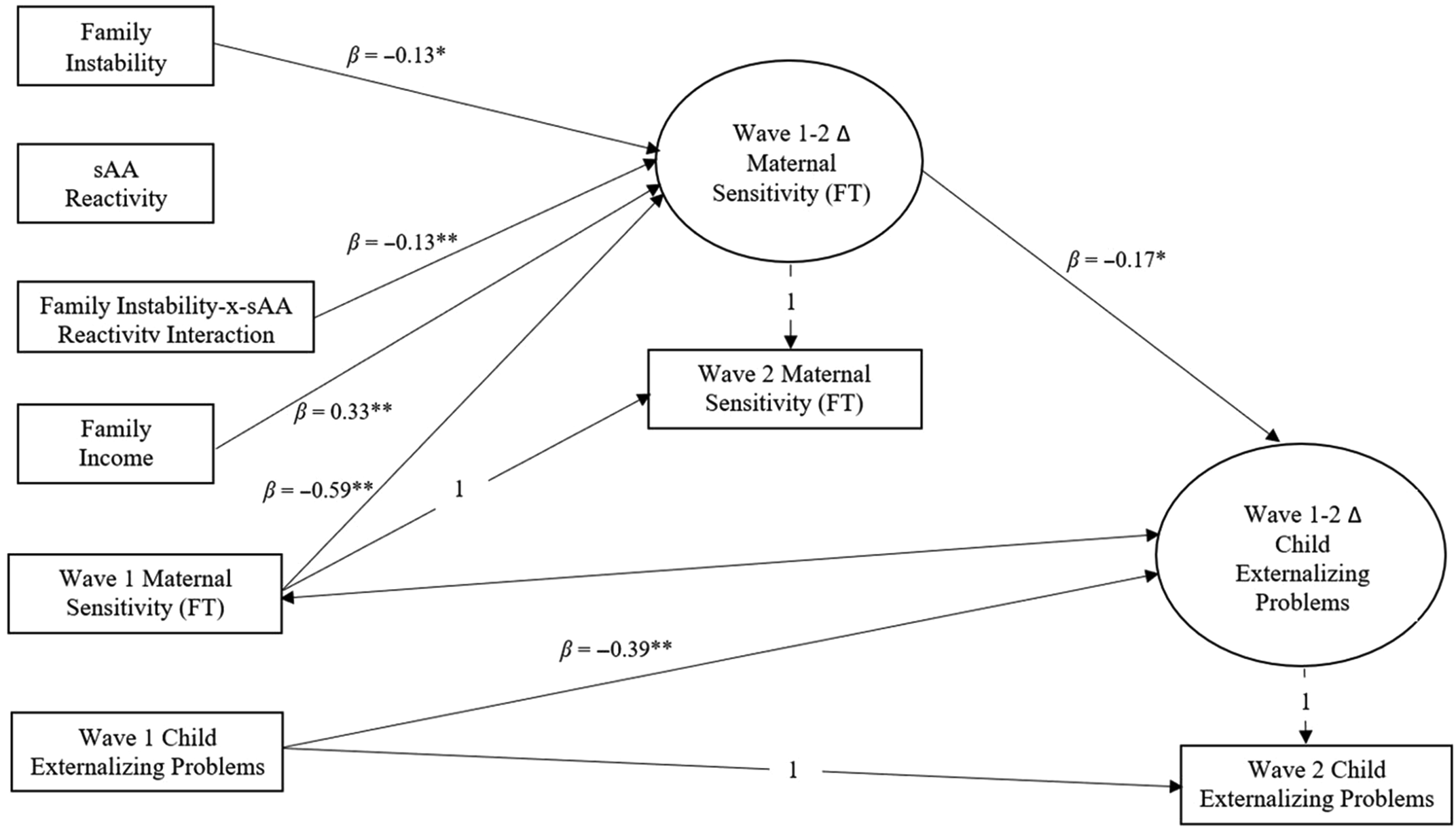
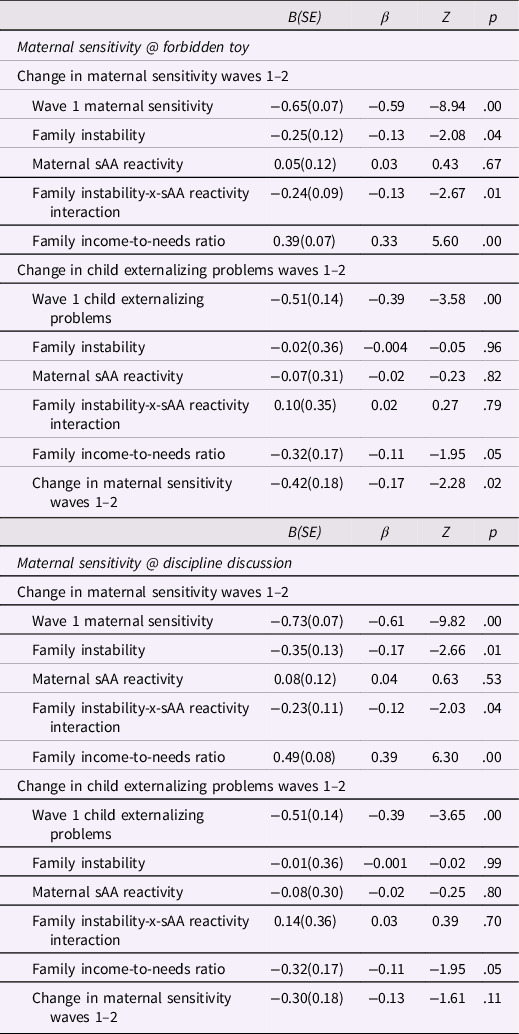
Turning to our primary findings (Table 2 and Figure 1), greater initial maternal sensitivity and child externalizing problems (i.e., wave 1) were both associated with lower increases in maternal sensitivity and externalizing problems over time, respectively. Greater family instability was associated with lower increases in maternal sensitivity during the forbidden toy task. The family instability-x-maternal sAA reactivity interaction also emerged as a significant predictor of the growth of maternal sensitivity over the two waves. Furthermore, greater increases in maternal sensitivity were associated with lower increases in child externalizing problems over time. Finally, a greater family income-to-needs ratio was linked to greater increases in maternal sensitivity, and a marginally lower increase in child externalizing problems over time, respectively. These findings remained the same after controlling for the sAA baseline level (see supplemental material, Table S2).
The structural equation model examining the Family instability-x-sAA reactivity interaction forecasting the growth in maternal sensitivity in forbidden toy task and the growth in child externalizing problems. Note. Pathway estimates presented in the graph were standardized coefficients. *p < .05, **p < .01. FT: Forbidden toy task.

Pathway coefficients for model predicting child behavioral problems (N = 235)

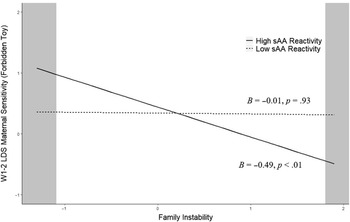
Turning to the family instability-x-sAA reactivity interaction, simple slope analyses (Figure 2) indicated that family instability was significantly associated with the change in maternal sensitivity during the forbidden toy task for mothers exhibiting greater sAA reactivity (+1SD sAA reactivity: B = −0.49, p < .01), but not for mothers with lower sAA reactivity (−1SD sAA reactivity: B = −0.01, p = .93). Regions of significance test (RoS on Z) indicated that the association between family instability and the change in maternal sensitivity was significant below −5.06SD and above −0.05SD of sAA reactivity. Further tests were conducted to examine the pattern of this interaction following Roisman and associates’ (Reference Roisman, Newman, Fraley, Haltigan, Groh and Haydon2012) recommendation, findings indicated that the pattern of the interaction was more consistent with differential susceptibility. That is, mothers with high sAA reactivity exhibited greater increases in sensitivity over time during the forbidden-toy task under low family instability, but also greater decreases in sensitivity under high family instability. In contrast, mothers with low sAA reactivity did not show such association (See details for Roisman et al. [Reference Roisman, Newman, Fraley, Haltigan, Groh and Haydon2012] test in the supplemental material).
Family instability-x-sAA reactivity interaction predicting the change in maternal sensitivity in forbidden toy task. Note. Simple slope coefficients in this graph were unstandardized coefficients. Gray-shaded areas reflected significant regions (RoS on X) where the association between sAA reactivity and the change (waves 1–2) in maternal sensitivity during forbidden toy task were significant. Note that the actual range of family instability (after log transformation) was [−1.30, 2.09], and this figure reflected such range. RoS on X: X < −1.09 and X > 1.80.

Finally, given the findings from the structural equation model, we examined two potential indirect pathways. To begin with, the indirect pathway involving family instability to change in maternal sensitivity, and thereby, change in child externalizing problems was not significant (Estimate = 0.10, 95% bootstrapped CI: [−0.002, 0.27]). Yet, the indirect pathway including family instability-x-sAA reactivity interaction to change in maternal sensitivity, and thereby, change in child externalizing problems proved significant (Estimate = 0.10, 95% CI: [0.01, 0.23]). That is, mothers with high sAA reactivity, within higher vs. lower family instability, exhibited greater decreases vs. increases in sensitivity over time, respectively, had children who showed higher vs. lower increases in externalizing problems over time, respectively (Conditional indirect pathway was significant for high maternal sAA reactivity: 95% bootstrapped CI: [0.02, 0.48], but not low maternal sAA reactivity: 95% bootstrapped CI: [−0.14, 0.17]).
Taken together, greater family instability and family instability-x-sAA reactivity were both linked to change in maternal parenting behavior during forbidden toy tasks over time, which itself was associated with the change in child externalizing problems. The pattern of family instability-x-sAA reactivity interaction proved consistent with differential susceptibility, such that mothers with greater sAA reactivity exhibited greater increases and decreases in maternal sensitivity under low vs. high family instability, respectively. Furthermore, only the indirect effects involving family instability-x-sAA reactivity change in maternal sensitivity change in child externalizing problems proved significant. These findings were generally consistent with the hypotheses.
Maternal sensitivity during discipline discussion task
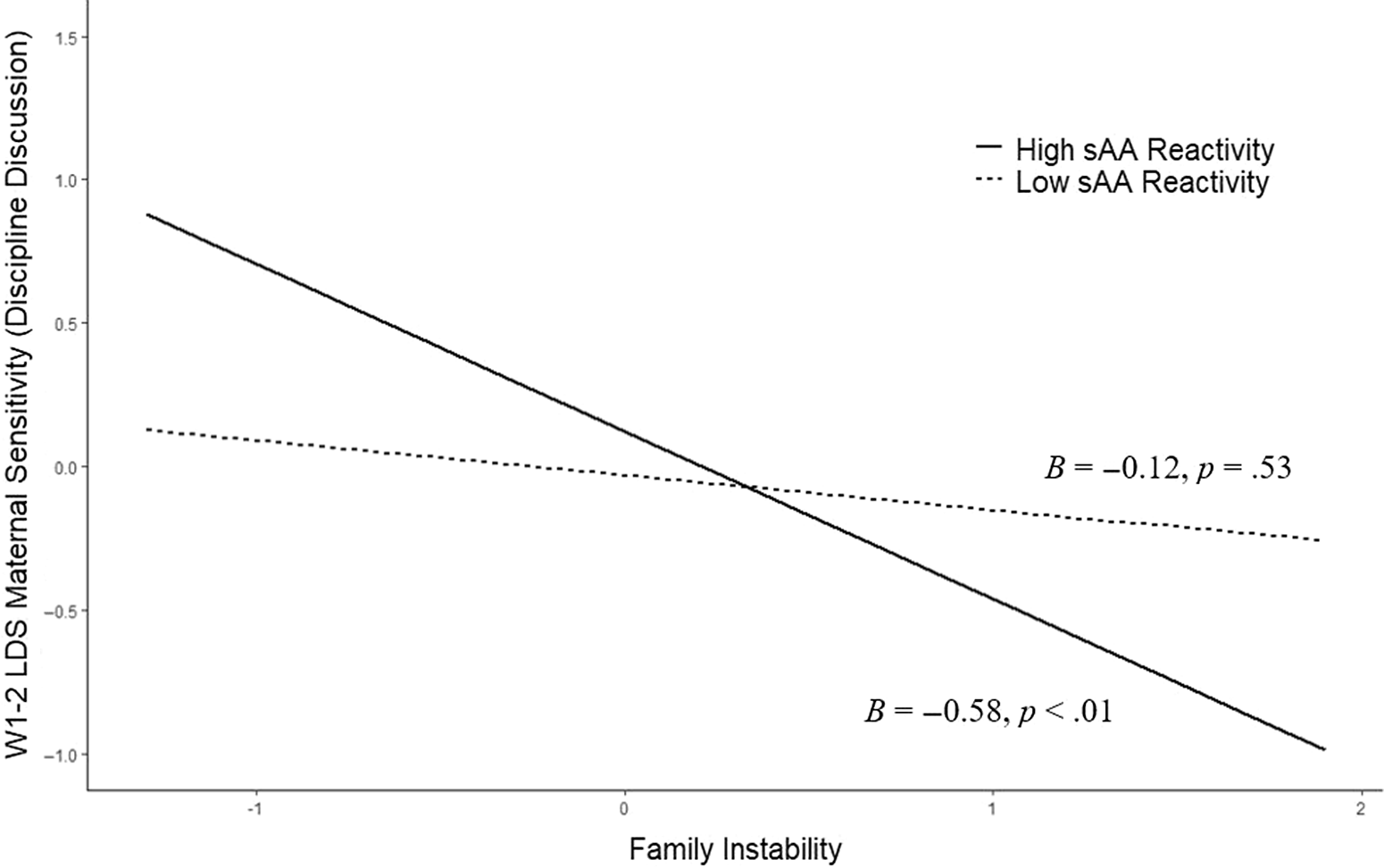
With regard to maternal sensitivity during the discipline discussion (Table 2), we found that greater initial maternal sensitivity and child externalizing problems each forecasted lower increases in maternal sensitivity and child externalizing problems over time, respectively. Greater family instability was linked to lower increases in maternal sensitivity during the discipline discussion task. A significant family instability-x-sAA reactivity interaction also emerged in association with the change in maternal sensitivity. Inspecting the pattern of this interaction indicated that greater family instability was linked to greater decreases in maternal sensitivity over the year for mothers with greater sAA reactivity (+1SD sAA reactivity: B = −0.58, p < .01). Such association, however, was not significant for mothers with low sAA reactivity (−1SD sAA reactivity: B = −0.12, p = .53). In addition, RoS on Z test indicated that the association between family instability and the growth in maternal sensitivity was significant below −63.51 SD and above −0.29 SD of sAA reactivity. The family income-to-needs ratio was linked to greater increases in maternal sensitivity, and marginally lower increases in child externalizing problems over time, respectively. Finally, we did not find significant associations between the growth in maternal sensitivity during discipline discussion and the change in child externalizing problems over time. Once again, all findings held the same after controlling for maternal baseline sAA level (See supplemental material, Table S2).
Given the family instability-x-sAA reactivity interaction, we performed additional tests to examine the pattern of the interaction (Roisman et al., Reference Roisman, Newman, Fraley, Haltigan, Groh and Haydon2012; Figure 3). Although the interaction was more consistent with the “for-better-and-for-worse” pattern, we did not find significant regions from the RoS on X test (see more details in the supplemental material). Finally, no indirect pathways were tested due to the insignificant association between the changes in maternal parenting and child functioning. To sum up, even though a significant family instability-x-sAA interaction was detected, these findings did not support differential susceptibility. Furthermore, parenting within the discipline discussion task was not associated with the change in child externalizing problems.
Family instability-x-sAA reactivity interaction predicting the change in maternal sensitivity in discipline discussion task. Note. Simple slope coefficients in this graph were unstandardized coefficients. Within the actual range of family instability, there were no significant regions (RoS on X) where the association between sAA reactivity and the change (waves 1–2) in maternal sensitivity during the discipline discussion task.

Discussion
Adopting a multi-method, longitudinal design, the present study evaluated maternal sensitivity within two different discipline contexts as potential indirect factors linking family instability and child externalizing problems. In addition, we examined how maternal sympathetic stress reactivity, indicated by sAA reactivity, moderates the role of family instability on maternal parenting. Findings revealed significant direct effects of family instability and family instability-x-sAA reactivity interaction in association with the change in maternal sensitivity within both forbidden-toy and discipline-discussion tasks. For both tasks, mothers with greater sAA reactivity exhibited stronger associations between family instability and the change in their sensitivity over time. Finally, tests of indirect pathways indicated that change in maternal sensitivity within the forbidden toy task operated as an indirect factor between family instability-x-sAA reactivity interaction and the change in child externalizing problems.
First, our findings that greater family instability was linked to lower increases and/or greater decreases in maternal sensitivity within both task contexts proved consistent with previous research (e.g., Belsky et al., Reference Belsky, Schlomer and Ellis2012; Szepsenwol et al., Reference Szepsenwol, Simpson, Griskevicius and Raby2015). These results also align with theoretical perspectives in that greater distal family risks may limit parents’ investment within the proximal child-rearing processes (Belsky et al., Reference Belsky, Steinberg and Draper1991; Conger et al., Reference Conger, Ge, Elder, Lorenz and Simons1994), reflected by less sensitive parenting. After all, coping with (multiple) unpredictable family events (e.g., job loss, breaking up with a romantic partner) may deplete mothers’ economic and psychological resources, compromising their physical and/or emotional well-being, and ultimately undermine their ability to be patient, child-centered, and discipline children with responsiveness, understanding, and flexibility.
Second, turning to family instability-x-sAA reactivity interaction, mothers with heightened sAA reactivity, within both parenting contexts, exhibited stronger associations between family instability and changes in their sensitivity over time. These findings proved consistent with BSC theory, such that heightened physiological stress reactivity may indicate one’s greater susceptibility to their contexts (Ellis et al., Reference Ellis, Essex and Boyce2005; Ellis, Boyce, et al., Reference Ellis, Boyce, Belsky, Bakermans-Kranenburg and Van IJzendoorn2011), as manifested by a stronger association between environmental conditions and parenting. With regard to the physiological marker, our findings are consistent with previous research that identified greater sAA reactivity to psychosocial/interpersonal stressors as a potential indicator of one’s heightened responsiveness to their social context (e.g., Rudolph et al., Reference Rudolph, Troop-Gordon and Granger2010; Reference Rudolph, Troop-Gordon and Granger2011; Cummings et al., Reference Cummings, El-Sheikh, Kouros and Keller2007). After all, individuals having stronger physiological reactivity may more readily register and respond to external stimuli and thus exhibit changes in their functioning. We added to the literature, however, that such heightened sensitivity to the context indicated by greater sAA reactivity, may be manifested on parenting behavior.
Turning to the interaction effects, we found that the family instability-x-sAA reactivity interaction was consistent with the differential susceptibility for maternal sensitivity only within the forbidden toy task. That is, although mothers with heightened sAA reactivity exhibited greater decreases in sensitivity over time under high family instability, they also demonstrated greater increases in sensitivity under low family instability. According to previous literature, the activation of the SNS may mobilize the resources and prepare individuals for external stimuli, which might promote active engagement with the social context (e.g., Porges, Reference Porges2007; Rudolph et al., Reference Rudolph, Troop-Gordon and Granger2010). Under benign contexts with low family instability, heightened sAA reactivity may facilitate mothers’ ability to pay attention and notice a child’s signals and bids and mobilize greater resources to respond with warmth and flexibility. Such findings align with previous research linking greater SNS reactivity with more sensitive parenting behavior (e.g., Reijman et al., Reference Reijman, Alink, Block, Werner, Maras, Rijnberk, van IJzendoorn and Bakermans-Kranenburg2014, Reference Reijman, Alink, Compier-de Block, Werner, Maras, Rijnberk, van IJzendoorn and Bakermans-Kranenburg2015). In contrast, mothers with greater sAA reactivity, within the highly unstable environment, may experience excessive alertness and repeated activation and mobilization of psychological and emotional resources. Thus, these mothers may be depleted with such resources to attend and respond sensitively to their children within discipline contexts. Furthermore, mothers with heightened sAA reactivity, within unstable environments, may respond to their children with greater aggression and punitive parenting. Consistent with this perspective is evidence showing that mothers with high SNS reactivity exhibited less sensitive, harsher, and more intrusive parenting towards their children (e.g., Sturge-Apple et al., Reference Sturge-Apple, Skibo, Rogosch, Ignjatovic and Heinzelman2011; Out et al., Reference Out, Bakermans-Kranenburg, van Pelt and Van IJzendoorn2012). That said, these findings highlight the importance to consider the joint effects of family context and sAA reactivity in evaluating parenting behavior.
Mothers with greater sAA reactivity also exhibited stronger associations between family instability and change in parenting within the discipline discussion context, however, we did not find significant regions of significance to fully support differential susceptibility. This absence of significant regions may be attributed to our lack of sufficient variability of family instability (i.e., −2 to +2 SD). It is also possible that sAA reactivity does not fully distinguish those mothers who are particularly susceptible from those who are not to the influences of family instability – in a for-better-and-for-worse-manner – with regard to their sensitivity during discipline discussion. Given the different nature and demands of the two tasks (see more discussion in the following paragraphs), future research is encouraged to evaluate whether other physiological markers may operate as a susceptibility factor within discipline tasks that require greater concentration, cognitive resources, and memory recall (e.g., parasympathetic stress reactivity; Li et al., Reference Li, Sturge-Apple, Martin and Davies2019). That is, unlike the forbidden toy which requires mothers to actively mobilize their resources to respond and adjust strategies to the child’s stronger impulses to misbehave at the scene while balancing with another task (i.e., working on the iPad), the discussion task may tap on different (moderating) processes (e.g., calmly discussing the situation, regulating emotion to stay on the task while providing developmentally appropriate reasoning and explanation).
Turning to child functioning, growth in maternal sensitivity within the forbidden toy task was associated with the change in externalizing problems. This specificity operated even when maternal sensitivity had a moderate correlation across both contexts and still had substantial unique variances (i.e., >60% unique variance on both measurement occasions). As noted, although sensitivity within both tasks requires mothers to be responsive and empathic to their children during discipline, the forbidden toy task involves an attractive toy that elicits children’s temptation to transgress at the scene. Given the nature and demands, we label this task as a “hot” discipline task, as it requires mothers to discipline the child while they had a stronger temptation and impulse to “misbehave” at the scene. In turn, children may show higher levels of misbehavior in the forbidden toy in contrast to the discipline discussion task. To do this, mothers needed to notice the child’s emotional states as it unfolds (e.g., curiosity, joy, frustration), interactively and contingently provide feedback and support while children are motivated to “misbehave” via various methods (e.g., jumping towards, pointing at, pretending to touch other things while approaching the forbidden toy). In addition, mothers needed to flexibly adjust their guidance and strategies given the child’s responses (e.g., whether previous strategies were successful, whether mothers needed to provide even stronger distractions or reasoning) all while regulating their own emotions to the child’s behavior. Furthermore, mothers needed to be child-centered while at the same time balancing their own task. This scenario may better resemble everyday life in which parents discipline their children, that these socialization processes may often happen in the context of other events going on (e.g., parents’ work, parents’ taking care of siblings). Thus, such a task provides an opportunity to assess the mother’s capacity to provide contingent support and responses and work interactively with the child to regulate their impulses (i.e., to not touch the forbidden toy). As such, mothers with greater sensitivity in a limit-setting task – who appreciate their child’s emotional states accurately and provide sufficient, appropriate, and prompt help and feedback (e.g., developmentally appropriate distraction) – may have children who better internalize the social rules and develop greater self-regulation and thus lower externalizing problems (e.g., Houck & Lecuyer-Maus, Reference Houck and Lecuyer-Maus2004; LeCuyer & Houck, Reference LeCuyer and Houck2006; Vrijhof et al., Reference Vrijhof, Euser, Bakermans-Kranenburg, van den Bulk, Bosdriesz, Linting, van Wijk, de Visser and van IJzendoorn2020).
In contrast to the forbidden toy task, parenting within the discipline discussion usually involves mothers bringing up a recent situation in which the child misbehaved, and thus does not involve the child’s emotionally salient temptation to misbehave at the scene. Therefore, we label it as “cold” discipline. Compared to the previous “hot” discipline task, this task does not involve disciplining when children had a strong temptation to misbehave. Although maternal sensitivity during the “cold” discipline may still play a role in the child’s understanding of right and wrong and internalization of the social rules (Grusec & Davidov, Reference Grusec and Davidov2010), it might not be as equally significant compared to the “hot” discipline task. This is because the latter may provide a more real-time, interactive platform for mothers to provide immediate feedback and scaffolding for children to acquire the ability to regulate their inappropriate impulses and externalizing problems. This interactive learning opportunity may be particularly important given the developmental stage of early childhood as young children may more easily learn when feedback is provided immediately. It may be that the discipline discussion task may be more salient as children age, develop greater cognitive processing capacities, and are involved in contexts external to the family (e.g., school, peers) which require parents to address discipline in a retrospective manner.
Finally, among the two indirect pathways tested, we only found the one involving the family instability-x-sAA reactivity interaction to be significant. That is, family instability-x-sAA reactivity was significantly associated with the change of maternal sensitivity in the forbidden toy task, which was then linked to child externalizing problems. In contrast, the indirect pathway involving the main effect of family instability was not significant. As such, the present findings were only partially consistent with previous theories and literature (e.g., Belsky et al., Reference Belsky, Steinberg and Draper1991; Coe et al., Reference Coe, Davies, Hentges and Sturge-Apple2020; Osborne & McLanahan, Reference Osborne and McLanahan2007). That is, only those mothers with heightened susceptibility to family instability (i.e., high sAA reactivity) may be shaped by family instability, to the degree that these effects may carry over and be manifested on their children. As such, the distal risk of family instability was transmitted to the child via proximal child-rearing processes of parenting, although only among highly sensitive mothers (i.e., greater sAA reactivity). The non-significant indirect pathway involving the main effect of family instability might be related to two reasons. First, we considered additional factors (i.e., maternal sympathetic stress reactivity), in addition to family instability compared to prior research. Second, given the distribution of family instability in the current sample, we did not have families experiencing extremely high levels of instability (i.e., more than eight disruptive family events during the past year) that is strong enough to show on children via less sensitive parenting.
Several limitations are worth highlighting. First, participants of this study consist of low- to middle-SES, two-parent families, thus the generalization of the present findings warrants caution. This limitation is tested by the lack of full-range distribution of family instability (i.e., −2 to +2 SD), which constrained our ability to fully test the pattern of the detected interaction (i.e., differential susceptibility). Second, although we adopted a longitudinal design and assessed changes in maternal sensitivity and child externalizing problems, these changes occurred within the same time (i.e., both constructs were measured at children’s ages three to four). Thus, given the overlap in the assessment period for these constructs, our design was not perfectly ordered in time. Third, although prior literature recommended capturing both positive and negative environmental conditions when testing differential susceptibility (e.g., Ellis, Boyce, et al., Reference Ellis, Boyce, Belsky, Bakermans-Kranenburg and Van IJzendoorn2011), the present work only measured family instability, or the lack thereof. As such, future research may benefit from assessing the positive side of the environment as well (i.e., a highly stable environment). Fourth, even though the interparental conflict discussion task has been widely used that evokes physiological reactivity, it is possible that the magnitude of physiological reactivity may depend on the level of conflict between parents during the discussion. Nevertheless, our paradigm was designed to resemble interparental conflict that may happen within naturalistic family settings (i.e., the majority of parents endorsed the similarity between laboratory discussion and the ones they commonly had at home), capturing mothers’ physiological reactivity to interpersonal stressors that may happen in everyday life. Furthermore, greater stress reactivity to the naturalist conflict discussion has been shown to indicate one’s greater susceptibility to other contextual stressors (e.g., family instability, Li et al., Reference Li, Sturge-Apple, Martin and Davies2019). In other words, the evidence suggests that individuals showing heightened stress reactivity within the conflict discussion task may have a greater tendency to experience higher reactivity to other stressors as well (e.g., disruptive life events). Thus, we consider the adoption of the current stress-evoking paradigm appropriate.
Fifth, although we assessed the role of parenting on child functioning in the study, a growing literature has suggested the role of children in shaping their own context (e.g., evoking different responses from parents; Choe et al., Reference Choe, Olson and Sameroff2013; Yan & Ansari, Reference Yan and Ansari2016). This is particularly true given the two contexts of the present work may evoke variability in child responses to parents. Despite that, controlling for observed child compliance during either task did not change the primary findings (see details in the supplemental material, Table S3), suggesting the present findings were robust even after accounting for the child-driven effect to a certain extent. Nevertheless, we encourage future research to consider the transactional processes involving family instability, parenting, and child functioning while evaluating the moderating role of physiological stress reactivity. Sixth, the present study only evaluated the single stress indicator – sAA – in mothers. Although sAA has been predominantly regarded as an indicator of SNS reactivity (e.g., Granger et al., Reference Granger, Kivlighan, Blair, El-Sheikh, Mize, Lisonbee, Buckhalt, Stroud, Brohawn and Schwartz2006; Nater & Rohleder, Reference Nater and Rohleder2009; Rohleder & Nater, Reference Rohleder and Nater2009), some evidence suggested that it is related to parasympathetic vagal withdrawal as well (e.g., Bosch et al., Reference Bosch, de Geus, Veerman, Hoogstraten and Amerongen2003). Future research may benefit from evaluating stress reactivity from multiple systems (e.g., sympathetic and parasympathetic systems) to elucidate the role of different systems in these processes. Seventh, the present study focused solely on mothers, and given the unique role of paternal parenting on child development (e.g., Cabrera et al., Reference Cabrera, Volling and Barr2018), we encourage future research to examine these research questions in fathers as well. Eighth, although our conceptualization of maternal sensitivity followed Ainsworth et al.’s (Reference Ainsworth, Blehar, Waters and Wall1978) classic definition (i.e., the degree to which mothers perceive the child’s signals accurately and respond timely in an appropriate manner), other research might use different operationalization for maternal sensitivity (e.g., Belsky et al., Reference Belsky, Schlomer and Ellis2012, maternal sensitivity indicated by the composites of supportive presence, respect for autonomy, and lower hostility level). We encourage future research to examine whether different operationalization for sensitivity may yield different results. Finally, the present study adopted an experimenter report to measure child externalizing problems, although this approach has several advantages outlined before, the experimenter may not have as extensive experience observing children compared to parents. This might be the reason that parenting behaviors were only moderately associated with child functioning in the present study. Furthermore, although the experimenters’ observation was based on the entire family visit, the assessment of child behavior might be confounded since part of the information was based on the parent-child interaction tasks, during which we also observe parenting behavior. Nonetheless, the overlapped time was only around 10 min (i.e., two 5-min parent-child interaction tasks) out of the roughly 3-hr family visit (i.e., about 5.6% overlapped time), so we consider this approach valid.
Taken together, this multi-method, longitudinal study illuminated how maternal sensitivity may operate as an indirect factor linking exposure to family instability and the growth in young children’s externalizing problems. For mothers with heightened SNS reactivity, greater family instability was associated with a greater decrease in maternal sensitivity, and thereby, more increases in child externalizing problems over time. Such indirect effect appeared to be context-specific, depending on the parenting nature and demands. Finding highlighted the importance to consider maternal individual characteristics in assessing parenting sequalae for family instability. Differences in findings across parenting contexts call for greater specificity in understanding parenting sensitivity rather than considering it as a universal construct.
Supplementary material
The supplementary material for this article can be found at https://doi.org/10.1017/S095457942200058X
Acknowledgments
We are grateful to the children and parents who participated in this project. Our gratitude is expressed to the staff on the project at Mt. Hope Family Center and the graduate and undergraduate students at the University of Rochester.
Funding statement
This research was supported by the Eunice Kennedy Shriver National Institute of Child Health & Human Development awarded to Melissa L. Sturge-Apple and Patrick T. Davies (5R01HD087761).
Conflicts of interest
None.
Ethical standards
This study was approved by the Institutional Review Board of the University of Rochester (title of the study: Interparental Relationship and Parenting, case number: RSRB939), written consent was obtained from both parental figures before enrolling families in the study.