INTRODUCTION
Today, the majority of natural habitats receive some level of management. This requires decisions about how an area should be managed and whether it should be managed to benefit a single species or a suite of species. In some situations such management objectives can conflict, as the management requirements of a particular species may be detrimental to others. Such conflicts are difficult to resolve as they often require the prioritization of one or a group of species or habitats over others. Where the species and habitats involved are of conservation importance, the identification of novel solutions to such conflicts becomes increasingly urgent.
Management conflicts are increasingly common. In south-western USA, for example, there is policy conflict between objectives to restore ponderosa pine (Pinus ponderosa) forests and a legal mandate to manage forests for the recovery of the Mexican spotted owl (Strix occidentalis lucida), which is listed as threatened under the US Endangered Species Act. Management for the forests requires aggressive thinning of stands and prescribed fire regimes, whilst the spotted owl tends to inhabit areas of dense forest (Prather et al. Reference Prather, Noss and Sisk2008).
Conflicts of management objectives become even more complicated when both the species and habitat are of high conservation concern. This is the situation conservation managers' face in developing management strategies for large herbivores within the Cape Floristic Region World Heritage Site, South Africa (Novellie & Kraaij Reference Novellie and Kraaij2010). Kraaij and Novellie (Reference Kraaij and Novellie2010) recently highlighted the difficulties in reconciling the need for short-interval fires to promote grazing for bontebok (Damaliscus pygargus pygargus) with the longer-interval fires needed to maintain fynbos plant diversity. In 2004, the fire rotation in Bontebok National Park was prolonged to favour plant diversity, resulting in reduced availability of young veld and a subsequent decline in bontebok densities. The conflicting conservation objectives in maintaining large mammals and plant species diversity in fynbos ecosystems thus represent a significant challenge (Novellie & Kraaij Reference Novellie and Kraaij2010).
Identical problems face conservation managers for the threatened (IUCN Red list Vulnerable, see http://www.iucnredlist.org/; CITES Appendix 1, see http://www.cites.org/eng/app/Appendices-E.pdf) Cape mountain zebra (Equus zebra zebra), as populations critical to the long-term survival of the subspecies inhabit fynbos habitats. The Cape mountain zebra meta-population has increased from just 80 animals in the 1950s to its current size of approximately 1600 animals as a result of past conservation initiatives (Castley et al. Reference Castley, Lloyd and Moodley2002). Nevertheless, to reach the IUCN Action Plan target of 2500 zebras (Novellie et al. Reference Novellie, Lindeque, Lindeque, Lloyd, Koen and Moehlman2002) requires more effective management of the meta-population to ensure population growth. Currently, over 91% of the meta-population derives from Mountain Zebra National Park (MZNP) stock which has provided founders for approximately 30 new Cape mountain zebra sub-populations (Novellie et al. Reference Novellie, Lindeque, Lindeque, Lloyd, Koen and Moehlman2002). The mixing of aboriginal populations is now a critical component of a meta-population strategy to halt further loss of genetic diversity (Moodley & Harley Reference Moodley and Harley2005). The problem is that effective population sizes in Kammanassie and Gamkaberg Nature Reserves are less than 50 animals (Watson & Chadwick Reference Watson and Chadwick2007), making them too small to remove individuals without putting them at risk of extinction (Soulé Reference Soulé1987; Novellie et al. Reference Novellie, Millar and Lloyd1996).
Continued population growth of these two natural populations requires habitat management that conflicts with existing management objectives (Watson et al. Reference Watson, Odendaal, Barry and Pietersen2005). Both Gamkaberg and Kammanassie consist of fynbos, a unique habitat that forms part of the Cape Floristic Region World Heritage Site. Fynbos requires fires intervals of at least 12–15 years to prevent the elimination of Proteaceae, one of the three main plant groups characteristic of fynbos (Van Wilgen et al. Reference Van Wilgen, Richardson and Seydack1994). In contrast, more frequent burns are needed to stimulate the grass productivity required by Cape mountain zebras (Watson et al. Reference Watson, Odendaal, Barry and Pietersen2005; Kraaij & Novellie Reference Kraaij and Novellie2010). An alternative management strategy suggested for these Cape mountain zebra populations is to acquire or lease cultivated land adjacent to reserves for pasture (Watson et al. Reference Watson, Odendaal, Barry and Pietersen2005). This has the potential to provide suitable habitat for Cape mountain zebras whilst avoiding the conflict of conservation priorities.
The Cape mountain zebra population in De Hoop Nature Reserve (DHNR) is the most genetically diverse (Moodley & Harley Reference Moodley and Harley2005) as it is the only population to have been founded from individuals from both MZNP and Kammanassie (Lloyd & Rasa Reference Lloyd and Rasa1989). As a consequence, these animals are critically important for the long-term survival of the subspecies. A recent status update for the population indicates that although the population increased between 1999 and 2005, population growth rate had declined (Smith et al. Reference Smith, Marais, Chadwick, Lloyd and Hill2008). For ungulate species not subject to predation, such as Cape mountain zebra, food resources are likely to be a key limiting factor (Sinclair Reference Sinclair1974; Sinclair et al. Reference Sinclair, Dublin and Borner1985). It is, therefore, vital to understand their resource requirements throughout the year in order to develop effective management strategies. Similar to Gamkaberg and Kammanassie, DHNR consists of natural fynbos, but it also contains grasslands that were historically converted for grazing stock. As a consequence it represents the ideal environment within which to assess the value of agricultural land to Cape mountain zebra populations inhabiting the high conservation priority fynbos habitat. In this study, we investigate spatial and temporal habitat use and the diet of Cape mountain zebra in DHNR in order to: (1) better understand the ecological processes regulating Cape mountain zebra populations, (2) facilitate the development of management strategies for the genetically diverse DHNR population and (3) determine whether the acquisition of agricultural grassland is a viable management strategy for Cape mountain zebra populations.
MATERIALS AND METHODS
Study area
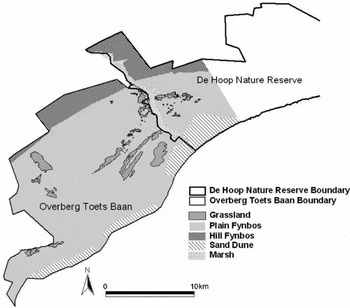
De Hoop Nature Reserve (34 ° 26' S, 20 ° 30' E) is a 32 300 ha area of fynbos within the Cape Floristic Region World Heritage Site in the Western Cape (South Africa), with an altitude range of 0–611 m (Hill et al. Reference Hill, Barrett, Gaynor, Weingrill, Dixon, Payne and Henzi2003). DHNR consists of three primary habitats: limestone hill fynbos and coastal plain fynbos, both characterized by proteoid, ericoid and restioid species (Mustart et al. Reference Mustart, Cowling and Albertyn1997), and small grasslands distributed across the coastal plain, which were transformed from fynbos for grazing stock (Fig. 1). The Cape mountain zebra population, which was founded in the 1970s, numbered 99 by 2006 (Smith et al. Reference Smith, Marais, Chadwick, Lloyd and Hill2008). It inhabits the western section of DHNR (30% of the total area) as well as a neighbouring conservancy, the Denel Corporation Overberg Toets Baan (OTB; 28 000 ha). For simplicity, DHNR and OTB are referred to as DHNR.
A map of the western half of De Hoop Nature Reserve and Overberg Toets Baan showing major habitat types within the area used by Cape mountain zebra.

The area receives winter rainfall (annual mean: 442 mm; range: 247–609 mm) and has a mild climate (mean annual temperature: 16.8 °C; mean minimum: 13.2 °C; mean maximum: 20.5 °C; Kotze & Fairall Reference Kotze and Fairall2006). We defined the seasons as spring: 17 August–16 November; summer: 17 November–16 February; autumn: 17 February–16 May; winter: 17 May–16 August.
Habitat availability
The spatial distribution of the three primary habitat types was plotted using aerial photographs (2001; CapeNature, Western Cape, South Africa), broad scale habitat maps (CapeNature; Moll et al. Reference Moll, Campbell, Cowling, Bossi, Jarman and Boucher1984), ground-truthing and geographical information system software (ArcView GIS; Environmental Systems Research Institute, Aylesbury, UK). Vegetation surveys were conducted within these habitats using 200 point surveys for canopy spread cover (Roux Reference Roux1963; Novellie & Strydom Reference Novellie and Strydom1987). Ten randomly selected 75 × 8 m quadrats were sampled in (separate) grasslands and in fynbos (six plains and four hill fynbos) each season. At each of the 200 points, if the pointer fell within the perimeter of the canopy of a plant, it was recorded as a ‘strike’. For each strike the plant group was recorded as either grass, dwarf shrub (<100 cm), tall shrub (≥100 cm), restioid, other dicotyledon, succulent or moss. For grasses, the species and height to the tallest leaf were also recorded. If less than 100 strikes were recorded, further points were surveyed. Percentage aerial cover of each plant group was calculated from the proportion of strikes for each quadrat.
Habitat use
Distribution
Seasonal habitat use was determined using two methods: distance sampling and dung pile counts. For distance sampling a route along existing tracks was established that sampled habitats in proportion to their total area. This route (total length 127 km) was divided into three transects that were driven on alternate days in alternate directions to ensure that areas were sampled throughout the day and season. When a zebra herd was sighted the herd size was recorded and the perpendicular distance from the transect to the centre of the herd was determined by pacing. Locations of the vehicle and centre of the herd were also recorded using a global positioning system (GPS) to allow distance estimates to be checked. When herds were sighted at a point at which the transect was curved, the observer moved to the point on the transect closest to the centre of the herd (Hiby & Krishna Reference Hiby and Krishna2001). Data were recorded using Cybertracker software (Release 3.064b, Cybertracker Conservation, Cape Town, South Africa) on a handheld computer with an integrated GPS (Garmin iQ3600; Garmin International Inc., Kansas, USA). As individuals in a herd are not statistically independent, each herd sighting was considered a single observation (Watson et al. Reference Watson, Odendaal, Barry and Pietersen2005). The density of zebra within the three major habitat types was estimated by using post stratification and Distance software (Buckland et al. Reference Buckland, Anderson, Burnham, Laake, Borchers and Thomas2004; Distance 5.0, Beta5; Research Unit for Wildlife Population Assessment, University of St Andrews, UK).
Dung pile counts were used to provide a second index of habitat use. A dung pile was defined as a group of faecal pellets that occurred together in a pile or that were scattered less than 1m apart (Novellie & Winkler Reference Novellie and Winkler1993). Dung piles were counted within ten 2 km × 3 m transects (Rivero et al. Reference Rivero, Rumiz and Taber2004) within grassland and ten within fynbos (six plains and four hill fynbos) each season. Transects were randomly located, but start points were moved where necessary to within 500 m from the nearest track to allow access. Start points were used as the locations for habitat surveys (see above). Start and end points were found and recorded using a GPS and transect lengths were estimated by pacing; actual distances surveyed were measured in ArcView GIS prior to analysis. Dung pile density was calculated for each transect.
Diet composition
Fresh dung piles (less than 12 hours old; glossy black/brown pellets that were slightly moist and soft enough to press between fingers) were sampled from across the study area throughout each season. Two pellets were collected from the centre of each dung pile and frozen at –20 °C until further analysis. A total of 180 dung piles were sampled.
Seventeen pellets were randomly selected for each season and oven-dried for 72 hours at 60 °C and milled to 1 mm fragments in a general purpose mill to reduce the variation in fragment size (Putman Reference Putman1984; Wolfe et al. Reference Wolfe, Whelan and Hayden1996). A sub-sample of each milled pellet was washed with distilled water over a 0.15 mm sieve to remove very small unidentifiable fragments (Wolfe et al. Reference Wolfe, Whelan and Hayden1996). After clearing in 0.05 M NaOH for one hour (Holechek et al. Reference Holechek, Vavra and Pieper1982; Wolfe et al. Reference Wolfe, Whelan and Hayden1996), sub-samples were mounted on slides using aqueous mountant. Four slides were prepared for each pellet using a standard mount size of 24 × 40 mm (Hansson Reference Hansson1970).
Point counts were used to determine diet composition. This method avoids the subjectivity and high variance associated with area measurements (Stewart Reference Stewart1967). Epidermal fragments were identified in 25 randomly generated fields of view on each slide, resulting in 100 fields per pellet. This allowed plant fragments that made up 1–15% of the diet to be included (Homolka Reference Homolka1987). A standard magnification of × 100 was used when selecting fields of view and × 400 was used to identify epidermal fragments each field of view. Epidermal fragments were identified as either grass, woody stem, other part of dicotyledon, restioid, other or unknown (indistinguishable). Grass fragments were identified to species where possible or otherwise to genus by comparing them to reference slides (see below); if they could not be identified they were recorded as unknown grass. Results for each season were expressed as percentage frequency occurrence of plants in pellets.
Reference slides of the epidermis of each grass species found during habitat surveys and of a selection of other plants were prepared to aid the identification of plant groups in the diet. Samples were soaked in 0.05 M NaOH for 1 hour to help separate and clear the epidermis (Holecheck et al. Reference Holechek, Vavra and Pieper1982; Wolfe et al. Reference Wolfe, Whelan and Hayden1996). Sections of the upper and lower leaf epidermis and stem epidermis were obtained and were soaked in 0.05 M NaOH for a further 20 minutes to improve clearing. Specimens were mounted on slides using aqueous mountant and diagrams were drawn. Diagrams of grass species in DHNR were also obtained from Intkey (Release 1.09; Dallwitz Reference Dallwitz1980).
Statistical analysis
Habitat availability
A chi-squared test for association was used to determine whether the availability of plant groups varied with season. To test for the effect of season on grass height, we used a mixed model analysis of variance (ANOVA) in which season was a within-group factor and plot was a between-group factor. Variables were transformed if necessary to conform to the assumptions of ANOVA (Zar Reference Zar1999) and homogeneity of variances were checked for (Field Reference Field2000; SPSS for Windows, Release 10, SPSS Inc., Chicago, USA). We used Tukey post-hoc tests to compare means for seasons.
Habitat use
We used a chi-square test for association in order to determine whether habitat use (herd sightings) varied with season. We used a chi-square goodness-of-fit analysis to test for differences between the expected and observed frequency of use for each habitat type relative to habitat availability measured as the proportional area of each habitat type. We used a Kruskal-Wallis analysis to determine whether dung density differed between habitats within seasons and ANOVAs to determine whether dung density differed between seasons within grasslands (within-group factor: season; between-group factor: plot) and fynbos (between-group factor: season). Tukey post-hoc tests were used to compare means for seasons.
We used multivariate analysis of variance (MANOVA) to determine whether season had an effect on diet composition. We checked for homogeneity of covariance (Field Reference Field2000) and transformed variables if necessary to conform to the assumptions of MANOVA (Zar Reference Zar1999). Pillai's trace test statistic was used as it is the most robust to violations of assumptions (Field Reference Field2000).
Habitat selection
We investigated the selection of grassland, measured as herd and individual density (sightings ha−1 visit−1) by using a mixed model analysis of covariance (ANCOVA), in which season was a within-group factor, plot (grassland patch) was a between-group factor and habitat variables (plant cover and grass height) were covariates (MINITAB for Windows, Release 13.32, Minitab Inc., Pennsylvania, USA). Only those covariates that were correlated with density were included in the model. All interaction terms were initially included in the model, non-significant covariates and factors were then omitted in turn and analyses repeated; only results of the final analysis are given.
RESULTS
Habitat availability
The area of DHNR used by zebra comprised 4.6% grassland, 83.3% plains fynbos and 12.2% hill fynbos (Fig. 1). Plains and hill fynbos were similar in plant group composition (χ 2 = 7.405, df = 5, p > 0.05) and were combined for further analysis.
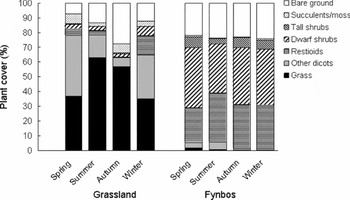
The mean cover of different plant groups varied with season within grassland (χ 2 = 154.27, df = 15, p < 0.001) and fynbos (χ 2 = 35.85, df = 15, p = 0.02; Fig. 2). In grassland, grass covered a larger proportion of the area during summer (63%) and autumn (59%) than during winter (35%) and spring (37%). Fynbos varied less between seasons and consisted largely of restioids and shrubs; grass covered less than 2% of the area (Fig. 2).
Seasonal variation in cover of different plant groups within grassland and fynbos.

A total of 18 grass species (grassland: 16 species; fynbos: 9 species) and an additional three genera were identified during habitat surveys. Only four species covered > 5% of grassland; Bromus pectinatus (7%) in spring, Lolium perenne (5%) and Sporobolus virginicus (6%) in summer and Cynodon dactylon in spring (6%), summer (35%) and autumn (55%) (Appendix 1, see supplementary material at Journals.cambridge.org/enc). A high proportion of species could not be identified in spring (37%) and winter (97%), largely owing to their degraded state; few were unidentified in summer (8%) and autumn (3%). This meant that the effect of species diversity on habitat use could not be investigated fully.
Grass height in grassland varied with season (F(3,15) = 19.40, p < 0.001) and plot (F(8,15) = 4.75, p = 0.005); grass was taller during spring (mean: 8 cm) and lower during autumn (mean: 3 cm) than during summer (mean: 5 cm) and winter (mean: 4 cm).
Habitat use
Distribution
A total transect length of 8081 km was driven (seasonal mean ± standard deviation: grassland 313 ± 30 km, plains fynbos 1641 ± 158 km, hill fynbos 67 ± 6 km) and there were 551 herd sightings (110–193 per season). Mean herd size was 4.8 ± 3.4 (range 1–28) in grassland, 3.8 ± 2.3 (1–13) in plains fynbos and 5.9 ± 2.2 (3–8) in hill fynbos.
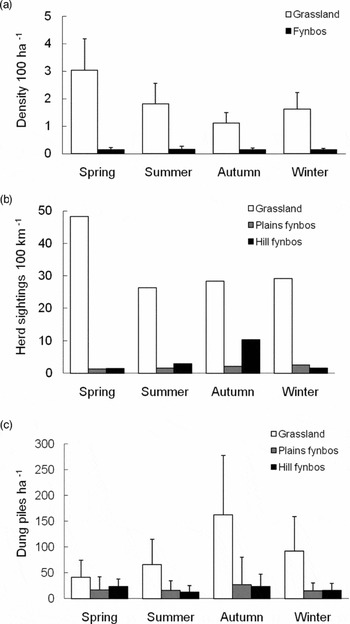
The density of zebras in grassland was higher than in fynbos in all seasons (Fig. 3a) and was highest in spring. Although distance sampling provides robust density estimates, figures only allow limited statistical analyses and so two indices of habitat use, namely sightings unit−1 sampling effort and dung piles ha−1, were used for further analysis. Habitat use (herd sightings) differed from that expected relative to area (χ2 = 1585.91, df = 3, p < 0.001) and with season (χ2 = 20.58, df = 3, p < 0.001; Fig. 3b). Herd sightings were higher in grassland and lower in fynbos than expected in all seasons and were highest in grasslands during spring (Fig. 3b). Data for plains and hill fynbos were combined due to small sample sizes in hill fynbos; low sample sizes may have caused the apparent higher sighting frequency in autumn compared to other seasons (Fig. 3b).
Seasonal variation in (a) Cape mountain zebra density in grassland and fynbos with 95% confidence intervals, (b) herd sightings per 100 km driven and (c) mean dung piles per hectare, with bars showing 1 standard deviation.

Dung pile density in plains and hill fynbos did not vary with season (χ 2 = 1.599, df = 3, p > 0.05; Fig. 3c) and as sampling effort was similar for the two habitats, they were combined for further analysis. Dung density was higher in grassland than in fynbos in all seasons except spring (Kruskal-Wallis: summer: χ2 = 7.829, autumn: χ2 = 8.251, winter χ2 = 12.110, df = 1, p < 0.01, n = 20; spring: χ2 = 3.294, df = 1, p = 0.070, n = 20; α = 0.0125 using the Bonferroni correction; Fig. 3c). Dung density within grassland varied with season (F 3,15 = 4.90, p = 0.014) and was higher during autumn than spring and summer (Fig. 3c). Dung density within fynbos did not vary with season (F 3,36 = 1.589, p = 0.209; Fig. 3c).
Diet composition
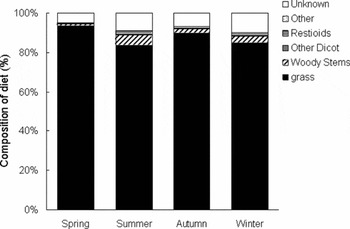
Grass made up the majority of the diet (mean: 88%), followed by woody stems (3%). The proportion of these two plant groups varied with season (MANOVA: Pillai's Trace = 0.447, F(6,128) = 6.13, p < 0.001; Fig. 4). The proportion of grass in the diet was significantly higher in spring (93%) than summer (83%) and winter (85%) and higher in autumn (90%) than summer. The proportion of woody stems in the diet varied inversely to grass (spring 1%, summer 5%, autumn 2%, winter 3%). Restioids (0.4–1.5%) and ‘other’ plants (0.3–0.8%) formed a very low proportion of the diet in all seasons (Fig. 4).
The proportion of grass, woody stems, restioids and other plant groups in the diet of Cape mountain zebra during each season.

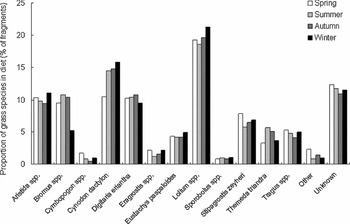
A total of 27 genera and 31 species of grass were found in the diet, representing 82% of genera and 25% of species listed for DHNR (C. Burgess, unpublished data); an additional eight unlisted species were also identified in the diet. The proportions of specific grass species/genera in the diet were similar across seasons (Fig. 5). The five genera/species eaten most frequently in all seasons were Lolium (mean 20% of the diet), Cynodon dactylon (14%), Digitaria eriantha (10%), Aristida (10%) and Bromus (9%; Fig. 5).
Seasonal variation in the proportion of specific grass species/genera in the diet of Cape mountain zebras; species names are used where only one was found in the genus, otherwise the genus name is given. ‘Other’ includes species/genera that formed less than 1% of the diet in all seasons.

Habitat selection
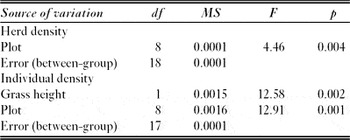
Grassland was selected throughout the year, but use varied with season. In order to determine which factors may have affected the selection of grassland we investigated grassland use in relation to season, plot (grassland patch) and habitat variables (plant cover and grass height). Dung pile density (dung piles ha−1) was not correlated with herd density (herd sightings ha−1 visit−1; Spearman's rho = 0.346, p = 0.077, n = 27) within plots. The seasonal pattern of dung density is thought to reflect the accumulation of dung piles after the winter rains (as dung decomposition is slower during dry seasons) rather than animal abundance and so it was not used for further analysis. Herd size in grassland did not vary with season (Kruskal-Wallis: χ2 = 7.034, df = 3, p = 0.071) and so both herd and individual density were used as indices of habitat use. The density of individuals is likely to be more important than herd density in explaining the use of potentially limited resources, particularly given the large variation in herd sizes in DHNR (1–28). Results of a mixed model ANCOVA showed that herd density varied with plot and individual density varied with grass height and plot (Table 1). Season, cover of ‘other dicotyledons’ and of dwarf shrubs had no effect on density.
Results of an ANCOVA on herd and individual density in which season was a within-group factor, plot was a between-group factor and habitat variables were covariates (grass height, cover of ‘other dicotyledons’, cover of dwarf shrubs).

Although the effect of grass species diversity on habitat use could not be analysed in detail owing to the number of unidentified species during particular seasons, the number of species (including coded unknown species) was not correlated with herd or individual density within plots (Spearman's rho = –0.058 and –0.141 respectively, p > 0.05, n = 27).
DISCUSSION
There is currently a conflict between management for three vitally important Cape mountain zebra populations and for the fynbos they inhabit, since the short-interval fires that promote grazing for zebras are detrimental to fynbos plant diversity. Our aim was to investigate how zebras used fynbos and grassland habitats and determine whether agricultural grassland could provide a potential management solution.
Although DHNR is predominantly natural fynbos, zebra selected areas historically converted to grassland in all seasons and their diet consisted largely of grass species throughout the year. These results are similar to those from MZNP, even though the majority of MZNP consists of grassland (Novellie et al. Reference Novellie, Fourie, Kok and Van Der Westhuizen1988; Winkler Reference Winkler1992). Considering the importance of grasses in the diet, the availability and quality of grass is likely to be vital to habitat selection. By selecting grassland, zebra can maximize their access to preferred food, since grasses are virtually absent in fynbos. There was, however, seasonal variation in the use of grassland, and the density of zebras on grassland in spring was almost twice that in winter and three times that in autumn. Density was not correlated with grass cover within grasslands, although it varied considerably with season, and neither did it appear to vary with grass species diversity. Individual zebra density increased with grass height, however. Zebras tend to select taller grass than most grazing ungulates (Bell Reference Bell and Watson1970; Grobler Reference Grobler1983), which allows them to increase their nutrient intake per bite. This is important for non-ruminants that do not achieve as high a digestive coefficient for a particular forage type as ruminants or foregut fermenters (Demment & Van Soest Reference Demment and Van Soest1985). In MZNP, zebras rarely graze below 10 cm during the late dormant and early growing season and tend to avoid grasslands where the grass is below 4 cm (Grobler Reference Grobler1983; Winkler Reference Winkler1992). In comparison, in DHNR the only grass available to zebras was 4 cm or shorter for half the year and just 5 cm for a further three months. This suggests that the grasslands in DHNR may not be sufficient for the zebra population to meet their high energy demands for most of the year.
The fact that the proportion of browse in the diet increased during the dry season suggests that the grasslands may also have been of low quality in nutritional terms at that time of year. Protein levels in grass tend to be highest when they are green after the rains and drop by up to 50% during the dry season (Grobler Reference Grobler1983). In comparison, small shrubs contain high levels of protein throughout the year and so as grass resources become scarce and nutritionally deficient, grazers benefit from increasing their intake of these plants (Owen-Smith Reference Owen-Smith, Huntley and Walker1982; Penzhorn Reference Penzhorn1982a). Both the MZNP population and plains zebras (Equus quagga burchelli) make seasonal movements associated with a relative change in diet quality in terms of crude protein in grass (Novellie et al. Reference Novellie, Fourie, Kok and Van Der Westhuizen1988; Ben-Shahar & Coe Reference Ben-Shahar and Coe1992). Although Cape mountain zebras eat a wide variety of species, the fact that diet composition did not vary with season suggests that they are selective foragers (Winkler Reference Winkler1992), as species availability did vary with season. Forage selectivity may have helped the population obtain additional nutrients in a poor quality habitat.
The fact that density was related to grassland patch indicates that factors other than those investigated also influence habitat use. One such factor may be the age of the vegetation (i.e. the time since the last burn), which varied from 3–100 years within DHNR. Water availability and shelter are not thought to explain the variation as water was available on most grasslands and DHNR has milder winters than MZNP, where temperature is not believed to influence habitat use (Novellie et al. Reference Novellie, Fourie, Kok and Van Der Westhuizen1988). It is more likely that social factors such as the presence of other breeding or non-breeding animals plays a role in the habitat selection of zebras (Winkler Reference Winkler1992). In MZNP, some breeding herds remained in the same community year-round rather than moving to better quality habitat (Penzhorn Reference Penzhorn1982a; Winkler Reference Winkler1992). Also bachelor males cover larger areas (up to 100 km2 in DHNR) than breeding herds (9.4 km2; Penzhorn Reference Penzhorn1982b), which allows them to visit more grasslands and to locate available females or breeding herd stallions to displace.
Management implications
The population growth rate of zebras in DHNR has slowed over the last decade (Smith et al. Reference Smith, Marais, Chadwick, Lloyd and Hill2008) and resource limitation is likely to be an important factor. In contrast to the population in MZNP, which make seasonal movements from open grassy plateaus to wooded hill slopes (Penzhorn Reference Penzhorn1982a; Grobler Reference Grobler1983), zebras in DHNR select the small areas of grassland throughout the year. Grazing pressure is, therefore, likely to remain high in the section of the reserve used by the zebra and is exacerbated by the poor quality of grasslands, resulting in the reserve being able to support lower densities of zebras. This is made worse by the fact that a game census in 2005 showed that populations of bontebok, eland (Taurotragus oryx) and ostrich (Struthio camelus) each numbered approximately 500 animals in DHNR. This is likely to have important implications for the quality of habitat for zebras because these species graze grass at a lower level than zebras and so reduce grass height (of palatable species) to below that favoured by zebras, particularly when grass production is at its lowest (Bell Reference Bell and Watson1970; Grobler Reference Grobler1983). Competition between bontebok and zebras is known to be significant in the nearby Bontebok National Park (Kraaij & Novellie Reference Kraaij and Novellie2010). Effective management strategies are, therefore, urgently required in order to ensure that the zebra population growth rate increases as this genetically diverse population is vital for the long-term survival of the meta-population (Moodley & Harley Reference Moodley and Harley2005). A short-term solution is to reduce populations of other large herbivores and to translocate some of the ‘excess’ bachelor male zebras (Smith et al. Reference Smith, Marais, Chadwick, Lloyd and Hill2008). This would help to reduce competition for resources and maximize reproductive potential of the remaining zebra population, but longer-term solutions are also required and managers must focus on maximizing grassland quality.
Habitat quality could be improved for grazing by stimulating grass production with more frequent fires within the fynbos, although this would increase the tension with maintaining plant diversity (Novellie & Kraaij Reference Novellie and Kraaij2010). Although, the majority of DHNR has not been exposed to fire for between 11 and 100 years, such that targeted burns could be used to improve the quality of resources available to zebra, fixed fire regimes are likely lead to an impoverishment of fynbos diversity (Van Wilgen et al. Reference Van Wilgen, Richardson and Seydack1994) and stimulating grass production with fires may also have detrimental effects through an increase in alien vegetation (Musil Reference Musil1993). Since DHNR must conserve its fynbos vegetation, the only viable fire management option may be to burn corridors through to potentially suitable habitat in the Eastern Sector of DHNR, a large area (22 600 ha) currently unused by zebras. Nevertheless, regular fires are not a long-term option for stimulating grassland productivity at DHNR.
In this study, we have shown that land that was previously converted to grassland for agriculture is of critical importance to zebra within a fynbos habitat and that the availability and quality of this habitat might limit population growth. This suggests that the acquisition or leasing of agricultural grassland adjacent to fynbos reserves is likely to be a valuable management strategy for populations. There is suitable pasture adjacent to DHNR and the strategy is also likely to benefit the populations in Kammannassie and Gamkaberg Nature Reserves, where the majority of the protected habitat is unsuitable (Watson et al. Reference Watson, Odendaal, Barry and Pietersen2005; Watson & Chadwick Reference Watson and Chadwick2007). Although a detailed study of the viability of adjoining agricultural land to assess its habitat suitability is now urgently required, this management solution could help to avoid the conflict of conservation priorities between current management for the unique fynbos habitat and for the threatened Cape mountain zebra populations in these three reserves. The provision of additional suitable habitat would ensure that sufficient forage is available all year, hopefully resulting in improved reproductive and survival rates and thus increased population growth rates. Anecdotal evidence from the reproductive output of a herd of zebras that escaped onto neighbouring farmland suggests that this likely to be the case. Increased population growth is vital so that populations reach numbers that allow the translocation of animals to new conservation areas in order to help achieve (and exceed) the IUCN's target of 2500 animals (Novellie et al. Reference Novellie, Lindeque, Lindeque, Lloyd, Koen and Moehlman2002). This will also help safeguard and increase the genetic diversity of the meta-population, which is vital in order to secure the long-term stability of the Cape mountain zebra (Hill Reference Hill2009).
By investigating spatial and temporal habitat use by Cape mountain zebra in DHNR, we have significantly advanced the knowledge of how the population uses resources and have contributed to the understanding of factors limiting population numbers. The results have important implications for the management of the DHNR population and for other genetically crucial Cape mountain zebra populations, thus helping to ensure the long-term survival of the meta-population. In addition, our findings propose a solution for the conservation conflict between management for an endangered species and management for a habitat classified as a World Heritage Site.
ACKNOWLEDGEMENTS
This study was funded by grants from the Darwin Initiative and British Ecological Society. We thank the Western Cape Nature Conservation Board and Denel Corporation for permission to work on their land and their staff. We are grateful to Dawood Hattas, Nancy Vaughan Jennings, Tony Verboom and Laurence Watson for help and advice, and to three anonymous referees for comments that helped to improve this manuscript.