1. Introduction
What is it about grandparents that is so lovely? I'd like to say that grandparents are God's gifts to children. And if they can but see, hear and feel what these people have to give, they can mature at a fast rate.
— Bill CosbyYou have to do your own growing no matter how tall your grandfather was.
— Irish proverbThe best babysitters, of course, are the baby's grandparents. You feel completely comfortable entrusting your baby to them for long periods, which is why most grandparents flee to Florida.
— Dave Barry (Babies and Other Hazards of Sex, Reference Barry1984, p. 54)From birth to adulthood children are gas-guzzlers. Across three traditional South American mixed-economy hunter–gatherer and horticulturist societies, Kaplan (Reference Kaplan1994) found that a child from birth to age 18 years consumes between 10 and 13 million more calories than the child itself produces. Who foots the bill? In cooperative breeding species such as humans, where child-rearing is not the exclusive domain of the parents, alloparents – that is, helpers other than the biological parents (Hrdy Reference Hrdy1999; Reference Hrdy2009) – can step up. According to the cooperative breeding hypothesis, ancestral mothers evolved in groups “where a broad range of individuals – not just the genetic father – assist the genetic mother in protecting, carrying, or provisioning offspring, thereby permitting her to produce and rear costlier, slower-maturing offspring than otherwise would survive” (Hrdy Reference Hrdy, Hewlett and Lamb2005a, p. 69). Indeed, Kaplan observed that a child's “excessive” consumption is offset by adults who, between 20 and 40 years of age, produce an average surplus of 2,000 to 4,000 calories a day, which is generally maintained until 65 years of age (see also Kaplan Reference Kaplan, Wachter and Finch1997; Kaplan et al. Reference Kaplan, Hill, Lancaster and Hurtado2000).
Who are these seeming altruists? Although it is still being debated whether the key sources of this and other help are fathers, grandmothers, grandfathers, siblings, or children (e.g., Hawkes et al. Reference Hawkes, O'Connell, Blurton Jones, Standen and Foley1989; Hill Reference Hill1993; Hrdy Reference Hrdy1999; Ivey Reference Ivey2000; Kramer Reference Kramer2005a), both formal and informal models point to the evolutionary significance of intergenerational transfers (e.g., Bogin Reference Bogin1997; Hamilton Reference Hamilton1966; Lee Reference Lee2003a; Reference Lee2008). Specifically, because individuals can increase their fitness by reproducing themselves or by helping kin who share common genes by descent (Hamilton Reference Hamilton1964), kin selection theory (Maynard Smith Reference Maynard Smith1964) predicts that it is most likely that these helpful individuals in the mother's social group will be close kin, such as children, siblings, uncles, aunts, and, crucially, grandparents. Indeed, although humans are similar to other cooperative breeding animals in many respects, it is the presence of knowledgeable, postreproductive helpers that sets them apart (Hrdy Reference Hrdy, Voland, Chasiotis and Schiefenhövel2005b). During the prolonged postreproductive period, grandparents may have the opportunity and the motive to boost their own fitness by investing resources in their children's and grandchildren's survival and reproduction.
The opportunity for grandparents to care for their kin has never been as great as it is today. With increasing human life expectancy in industrialized societies – for example, in the United States, women's life expectancy in the 20th century has increased from 50.7 (born 1900) to 79.7 (born 2000) years (see Arias Reference Arias2006) – today's grandparents' lives and those of their grandchildren overlap markedly, thus providing them with greater opportunity than ever before to play a significant role (Bengtson Reference Bengtson2001). Empirical evidence supports the considerable role that grandparents play in taking care of their grandchildren. In Switzerland, for instance, it is estimated that unpaid grandparental childcare amounts to at least two billion Swiss francs per year (Bauer & Strub Reference Bauer and Strub2002). In the United States, 28% of employed women rely on their parents or in-laws to provide childcare for their young children (Guzman Reference Guzman1999). Across ten European countries, 58% of grandmothers and 49% of grandfathers provided some care for their grandchild during a 12-month period (Hank & Buber Reference Hank and Buber2009; similar percentages are found in the United States: Guzman Reference Guzman2004). A sample of Germans aged 55 to 69 years was observed to spend, on average, 12.8 hours each month supervising their grandchildren (Kohli et al. Reference Kohli, Künemund, Motel and Szydlik2000).
Despite grandparents' historically unparalleled opportunity to care for their grandchildren, the impact of their investments may never have been smaller than it is today, at least when measured against classic components of fitness, such as number of offspring and child mortality. Specifically, with fertility rates below replacement and a delayed age at first childbirth in most industrialized societies, the probability of becoming a grandparent is falling. Moreover, low childhood mortality rates mean that the high-risk times of infancy – conditions under which grandparental investment may have evolved – have largely been removed.
In light of these changes in grandparenthood in industrialized societies, we ask: Does the help that grandparents provide, which may have benefited grandchildren in traditional and historical populations, still yield benefits for grandchildren in industrialized societies? Our theoretical and empirical review in this article is structured as follows. Section 2 defines grandparental investment, spells out its underlying evolutionary rationale, and summarizes evidence from natural fertility societies. Section 3 turns to recent extensions of research on grandparental investment in terms of the notion of grandparental solicitude. Specifically, we review several likely determinants of grandparental investment across human populations. In Section 4 we describe economic and sociological accounts of grandparental investment. Sometimes in direct conflict with each other, the economic, evolutionary, and sociological accounts explain some of the empirical data, but none explain all. Section 5 examines a range of recent demographic changes that render the environment in which contemporary grandparents find themselves unique in human history, and that have profoundly altered the basic parameters of grandparental investment. In Sections 6 and 7, we review evidence addressing the issue of whether grandparental care, which benefited grandchildren in traditional and historical populations, still yields benefits for grandchildren in industrialized societies. Finally, in Section 8, we discuss public health and policy implications of grandparental investment.
2. Grandparental investment: Definition, evolution, and evidence
2.1. What is grandparental investment?
Resources invested in one's offspring are referred to as parental investment (see Geary Reference Geary2000). Parental investment was originally defined as “any investment by the parent in an individual offspring that increases the offspring's chance of surviving (and hence reproductive success) at the cost of the parent's ability to invest in other offspring” (Trivers Reference Trivers and Campbell1972, p. 139). Trivers' key point was that the currency of parental investment is its cost to the parent's ability to invest in other offspring. Therefore, the definition of parental investment was highly restrictive. However, a broader definition has evolved that incorporates:
any characteristics or actions of parents that increase the fitness of their offspring at a cost to any component of the parent's fitness …, including any costs of parental care to the parent's subsequent mating success … survival … fecundity … growth …. In addition, it is logical to include costs to fitness of other offspring or any … other relatives. (Clutton-Brock Reference Clutton-Brock1991, p. 9)
We interpret parental investment and, by extension, grandparental investment using this broader frame (see also Dawkins Reference Dawkins2006; Geary Reference Geary2000; Hertwig et al. Reference Hertwig, Davis and Sulloway2002). Proxy outcome measures of parental investment and – to the extent that grandparents influence these outcomes – grandparental investment that have been used include child mortality, birth weight, breast-feeding, infanticide, homicide, abuse, attachment/bonding between parents and infants, inheritance, interbirth interval, and educational investment (Hagen et al. Reference Hagen, Barrett and Price2006). The pathway through which grandparental investment affects a child's development can be direct (e.g., direct support, advice, or as a role model) and indirect via a third party (most often the grandchildren's parents).
2.2. Why grandparental investment?
Cooperative breeding species such as humans can increase their inclusive fitness directly by reproducing themselves or indirectly by helping their relatives, who share a proportion of their genotype by descent, to transmit their genes into future generations (Hamilton Reference Hamilton1964). Grandparents can boost their inclusive fitness by devoting resources to their kin, helping to ensure the conception, birth, survival, growth, development, and reproduction of their relatives. The opportunity to increase indirect fitness is afforded by the long human lifespan in general, and in particular by the extensive postreproductive lifespan of human females that is unique among cooperative breeding animals (Hrdy Reference Hrdy, Voland, Chasiotis and Schiefenhövel2005b). Although various forms of reproductive termination occur across a range of species (Cohen Reference Cohen2004; Packer et al. Reference Packer, Tatar and Collins1998; Paul Reference Paul, Voland, Chasiotis and Schiefenhövel2005), humans are the only primate species in which reproductive termination is a distinct and universal trait (Caro et al. Reference Caro, Sellen, Parish, Frank, Brown, Voland and Borgerhoff Mulder1995; Pavelka & Fedigan Reference Pavelka and Fedigan1991). The survival of an organism beyond reproduction represents a biological anomaly: “[T]here should be little or no postreproductive period in the normal lifecycle of any species” (Williams Reference Williams1957, p. 407). Attempting to explain this anomaly, Williams hypothesized that it would be adaptive to cease reproduction before death if the benefits to the woman's survival – that is, removal of the risks associated with dying during childbirth, and the increased parenting effort that she could devote to her living children and grandchildren – outweighed the benefits to reproductive fitness brought to the woman by further reproduction.
Couched in terms of “Hamilton's Rule” (Hamilton Reference Hamilton1964), postreproductive helping behavior will evolve when an individual can help a related individual, who has a probability r (i.e., coefficient of relatedness) of sharing this same gene by common descent, to survive and reproduce. This holds as long as the benefit (B, i.e., benefit to the relative receiving help), multiplied by the probability of sharing that gene (r), outweighs the cost (C) to the helper, in terms of his own survival and forgone reproductive opportunities. To wit, postreproductive helping behavior should evolve when rB>C. It is likely that this condition held for human ancestors because (a) grandparents are closely related to their grandchildren (grandparents, on average, share 25% of their genes with each of their grandchildren, over and above the large proportion of genes that all humans share in any case; Dawkins Reference Dawkins2006), (b) helping comes with a relatively low opportunity cost, in terms of the grandparent's own reproductive success (especially in the case of postreproductive grandparents), and (c) there is a potentially large benefit to grandchildren in terms of survival (and subsequent reproduction) during the high-risk times of infancy and childhood.Footnote 1
Instigated by Williams' (Reference Williams1957) suggestion of the potential adaptive value of a postreproductive period, two related lines of reasoning have emerged, both emphasizing the vast investments required by the long childhood development period: the good-mother hypothesis and the grandmother hypothesis (reviews by Jamison et al. Reference Jamison, Cornell, Jamison and Nakazato2002; Peccei Reference Peccei2001a; Voland et al. Reference Voland, Chasiotis, Schiefenhövel, Voland, Chasiotis and Schiefenhövel2005).Footnote 2 The good-mother hypothesis holds that burdened with the long dependence of human children, a postreproductive period shields the mother from survival risks (i.e., pregnancy and giving birth) and the child from health risks (e.g., Down syndrome), and enables the mother to free up the resources to keep her children, particularly the youngest and most helpless, alive. This investment contributes to the mother's direct reproductive success by ensuring that her existing children survive. Thus, one would expect to see the presence of a mother and her increased longevity improving the survival chances and health state of her children, and we do.Footnote 3
The grandmother hypothesis suggests that a postreproductive grandmother can foster her inclusive fitness by supporting her reproductive daughter and her grandchildren, thus increasing her daughter's fertility and improving her grandchildren's chances of surviving (e.g., Hrdy Reference Hrdy1999). Moving the provisioning of children from exclusively the mother (i.e., breast-feeding) to allomothers, as the grandmother hypothesis proposes, has immediate reproductive consequences that could translate into inclusive fitness advantages for the allomothers (grandmothers): For example, ceasing to breast-feed terminates the mother's lactational amenorrhea (Ellison Reference Ellison1990), thus potentially reducing the interval to the daughter's next pregnancy. Comparative data confirm that humans wean their children at a younger age and have shorter inter-birth intervals than do orangutans, gorillas, and chimpanzees (Hawkes et al. Reference Hawkes, O'Connell, Blurton Jones, Alvarez and Charnov1998; Kramer Reference Kramer2005a; Lancaster et al. Reference Lancaster, Kaplan, Hill and Hurtado2000). The notion of the helpful grandmother, however, should not be conceptualized as selection to blindly maximize the number of offspring, because any increase in number of descendents is often accompanied by a decrease in investment per offspring and potentially survival (e.g., Coall et al. Reference Coall, Meier, Hertwig, Wänke and Höpflinger2009; Gibson & Mace Reference Gibson and Mace2005; Walker et al. Reference Walker, Gurven, Burger and Hamilton2008). Thus, we would expect to see the presence of a grandmother and her increased longevity improving the fertility of her daughter, but not at the expense of the survival and health of her grandchildren.
Although the good-mother hypothesis and the grandmother hypothesis, which are not mutually exclusive, predict a selective advantage associated with a postreproductive lifespan, attempts at modeling this advantage in contemporary, largely natural fertility, human populations have failed to support these hypotheses (e.g., Hill & Hurtado Reference Hill and Hurtado1991; Reference Hill and Hurtado1996; Rogers Reference Rogers1993; see also Austad Reference Austad1994). The benefits of early reproductive cessation in women – diverting resources from reproduction to maternal care and avoiding the costs of continuing to reproduce – do not appear to outweigh the benefits of having additional children. However, consideration of additional costs, such as the decline in fertility with older age, increased perinatal mortality risk associated with giving birth at an older age, and increased competition with increased family size, as well as the variety of additional benefits – earlier reproduction in daughters, improved growth and survival of grandchildren – suggests that the benefits of switching from reproduction to parenting could indeed outweigh the costs (Hrdy Reference Hrdy, Hewlett and Lamb2005a; Mace Reference Mace2000; Turke Reference Turke1997). Moreover, a recent analysis of data from two Gambian villages (1950–1975) showed that menopause may have a fitness advantage when the combined influence of both the increased maternal mortality associated with giving birth at an older age and the increased childhood survival associated with having a maternal grandmother present are taken into account (Shanley et al. Reference Shanley, Sear, Mace and Kirkwood2007; see also Sear et al. Reference Sear, Mace and McGregor2000; Shanley & Kirkwood Reference Shanley and Kirkwood2001). Thus, the joint positive influence of a “good mother” and a “helpful grandmother” on survival during childhood may have created a selective advantage for postreproductive survival in women.
2.3. Why postreproductive lifespan may not be adaptive
In contrast to the aforementioned views, there are evolutionary theories proposing that the early cessation of reproduction, which implies the availability of postreproductive grandmothers, is an exaptation. It is not or was not originally adaptive (for reviews, see Peccei Reference Peccei2001a; Voland et al. Reference Voland, Chasiotis, Schiefenhövel, Voland, Chasiotis and Schiefenhövel2005). On this view, menopause occurs because a woman has lived long enough to deplete the supply of primary oocytes with which she was born (Ellison Reference Ellison2001; but see Johnson et al. Reference Johnson, Canning, Kaneko, Pru and Tilly2004; Skaznik-Wikiel et al. Reference Skaznik-Wikiel, Tilly, Lee, Niikura, Kaneko-Tarui, Johnson and Tilly2007). Several theories of senescence propose that small fitness benefits early in an individual's life will be selected for even if they exact a cost to fitness later in life. The reduced strength of natural selection at older ages permits these negative effects to remain unchallenged (Kirkwood Reference Kirkwood1977; Medawar Reference Medawar1952; Williams Reference Williams1957). Therefore, rather than being advantageous itself, menopause may be a by-product of the adaptive benefit of producing, protecting, and storing a complete stock of primary oocytes at birth (Pavelka & Fedigan Reference Pavelka and Fedigan1991). Consistent with this interpretation is the similarity of human and chimpanzee ovarian follicle depletion rates (Jones et al. Reference Jones, Walker, Anderson, Lacreuse, Robson and Hawkes2007; for gorillas see Atsalis & Margulis Reference Atsalis and Margulis2008), which suggests that menopause may be a phylogenetic legacy and not unique to humans.
Even if this is the case, and menopause is a non-adaptive epiphenomenon that occurs because of humans' longevity, its presence creates the stage for helpful grandmothers. Bogin and Smith (Reference Bogin and Smith1996) proposed a biocultural model in which menopause is non-adaptive but helpful grandmothers still play a central role. Once women started living past their reproductive ceiling, the only way that they could improve their inclusive fitness was by caring for their children and grandchildren. Whether human longevity and specifically the postreproductive longevity associated with menopause is adaptive or an epiphenomenon, grandparents are still in the right place, at the right time.
2.4. Does grandparental investment enhance fitness? Evidence from natural fertility societies
The influence of helpful grandmothers has been most intensively studied in historical and contemporary natural fertility societies with little or no access to modern medical care, including contraception. In these societies, grandparental investment matters for mothers' reproductive success. Sear and Mace's (Reference Sear and Mace2008) review of 45 studies investigating the presence of kin (father, grandparents, older siblings) supports the beneficial influence of postreproductive relatives: The presence of a maternal or paternal grandmother was associated with an increase in her grandchildren's probability of surviving in 69% (9 of 13 studies) and in 53% (9 of 17 studies) of cases, respectively. For illustration, in their time series analysis of the Oromo agro-pastoralists of southern Ethiopia, Gibson and Mace (Reference Gibson and Mace2005) found that the presence of a hard-working maternal grandmother, who helped the mother with heavy domestic tasks (e.g., grinding maize), increased the probability of a grandchild surviving to three years of age by 25%. This effect is comparable to that achieved by installing a new water supply (Gibson & Mace Reference Gibson and Mace2006).
Omnipresent grandparents, however, are not inevitably advantageous. Sear and Mace (Reference Sear and Mace2008) found evidence that the presence of grandparents has been associated with detrimental consequences for child survival. In 83% (10 of 12 studies) of cases, the presence of maternal grandfathers had no effect, and in 75% the paternal grandfather had no effect or even a negative one on survival. There is currently little evidence supporting the adaptive significance of grandfathering (see Lahdenperä et al. Reference Lahdenperä, Russell and Lummaa2007). Negative effects have also been reported for paternal grandmothers who may, in contrast to maternal grandmothers, increase their daughter-in-law's fertility at the expense of grandchild survival (Leonetti et al. Reference Leonetti, Nath, Hemam, Neill, Voland, Chasiotis and Schiefenhövel2005; Reference Leonetti, Nath and Hemam2007; Mace & Sear Reference Mace, Sear, Voland, Chasiotis and Schiefenhövel2005). For example, in a historical German population (1720–1874), the presence of a paternal grandmother increased a grandchild's risk of stillbirth by 35% (Voland & Beise Reference Voland, Beise, Voland, Chasiotis and Schiefenhövel2005) and infant mortality up to one month of age by 85% (Voland & Beise Reference Voland and Beise2002). The majority of these studies have been conducted in patrilineal societies; recent evidence from a matrilineal society suggests that even maternal grandmothers may have a negative effect under some circumstances (Sear Reference Sear2008; but see Leonetti et al. Reference Leonetti, Nath, Hemam, Neill, Voland, Chasiotis and Schiefenhövel2005). The beneficial influence of grandparents cannot be taken as given. But there is evidence that the presence of maternal grandmothers in particular boosts the survival chances of their grandchildren.
2.5. The issue of confounding effects
The grandparental investment literature consists predominantly of correlational studies showing associations, or lack thereof, between grandparental presence and grandchild survival, for example. Of course, these studies do not show that this relationship is causal (Borgerhoff Mulder Reference Borgerhoff Mulder2007; Sear & Mace Reference Sear and Mace2008). Some argue that shared genes or environment effects may equally account for the observed associations. Grandparents who live under good socioeconomic conditions or who have a fortuitous genetic complement are more likely to live long and healthy lives, and it would make sense that their grandchildren are more likely to survive, are healthier, or have better cognitive abilities (e.g., Modin & Fritzell Reference Modin and Fritzell2009). Although this possibility cannot be ruled out, several pieces of evidence speak against it. First, if the effect is due to shared genes or environment, one would expect that all grandparents who share the same proportion of genes by common descent or share their residence with a grandchild to have similar effects on grandchild survival. Clearly, this is not the case, as we discuss in the next section. Second, the detailed ethnographic accounts that accompany many correlational studies not only corroborate associations between kin presence and survival, growth, and development, but also highlight potential behaviors that promote these beneficial effects (e.g., Gibson & Mace Reference Gibson and Mace2005; Leonetti et al. Reference Leonetti, Nath and Hemam2007). Third, many studies allow adjustment for a wide range of confounding variables (e.g., grandparental health, age, socioeconomic status, and residential distance) that at least partially control for shared environment effects (e.g., Borgerhoff Mulder Reference Borgerhoff Mulder2007; Coall et al. Reference Coall, Meier, Hertwig, Wänke and Höpflinger2009; Pollet et al. Reference Pollet, Nettle and Nelissen2006). Taken together, this evidence suggests that it is unlikely that these effects can be explained away by shared gene or shared environment effects.
3. Grandparental solicitude
Grandparental helping behavior will not occur invariably, but, according to Hamilton's rule, is moderated by opportunity costs that may differ across types of grandparents (e.g., grandmother vs. grandfather). Indeed, one of the most robust findings across the grandparental investment literature is that maternal grandmothers invest the most, have most contact, and the closest relationships with their grandchildren, followed by maternal grandfathers, paternal grandmothers, and, finally, paternal grandfathers.Footnote 4 Next to grandparent type, grandparental help is also likely to be a function of ecological conditions that determine the availability of grandparental resources, including the communities' subsistence strategy (e.g., the efficiency of food production), availability of relatives, marriage systems, residence patterns, inheritance patterns, and the health of relatives (reviewed by Sear & Mace Reference Sear and Mace2008). In what follows, we review five evolutionary factors that affect grandparents' inclination to invest their resources – genetic relatedness, paternity certainty, sex-specific reproductive strategies, reproductive value, and sex-biased grandparental investment – and two factors that influence the availability of resources – family size and birth order.
3.1. Genetic relatedness
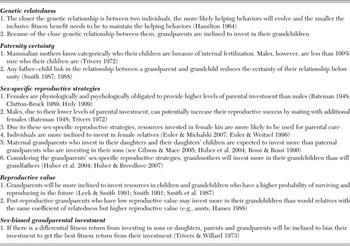
Hamilton's rule implies that the amount of resources transferred to an individual should depend on the relatedness of the provider (r, the coefficient of relatedness). The closer the genetic relationship between two individuals, the more likely helping behaviors will evolve and the smaller the benefit needs to be for this altruism to be maintained (Hamilton Reference Hamilton1964). There has been a long history of research suggesting that parents allocate their resources to children according to their genetic relatedness (e.g., Anderson Reference Anderson2005; Daly & Wilson Reference Daly and Wilson1980; but see Hofferth & Anderson Reference Hofferth and Anderson2003). Evidence that grandparents favor genetically related grandchildren also exists. The investment that grandparents make in a family reduces as the proportion of stepchildren in the family increases (Eggebeen Reference Eggebeen1992). Relatedly, relationships with step-grandparents are not considered to be as close as those with biological grandparents (Aldous Reference Aldous1995). In lesbian-mother families, grandchildren have more contact with the biological grandparents compared with non-biological grandparents (Patterson et al. Reference Patterson, Hurt and Mason1998). Although the size of the variance accounted for in these studies and the necessity of a focus on genetic relatedness has been questioned (Rose & Rose Reference Rose and Rose2001), the patterns appear robust (see Anderson Reference Anderson2005).
3.2. Paternity certainty
Paternity uncertainty is the (perceived) risk that a male is not the biological father of his children. In contrast to males, because of internal fertilization mammalian mothers know categorically who their children are (Trivers Reference Trivers and Campbell1972). In the few mammalian species in which males provide parental investment, they run the risk that their investment is being wasted on another male's offspring (Alexander Reference Alexander1974; Clutton-Brock Reference Clutton-Brock1991; Geary Reference Geary2000; Trivers Reference Trivers and Campbell1972). Both theoretical and empirical studies suggest that lower levels of paternity certainty are associated with reduced male parental care (see Anderson et al. Reference Anderson, Kaplan and Lancaster2007).
This logic can be extended to grandparents and their inclination to invest resources: Because the maternal grandmother is certain of her relationship with her daughter and her daughter's relationship with her grandchildren, it is predicted that maternal grandmothers will invest the most. Paternal grandfathers, on the other hand, are predicted to invest the least because there are two points of uncertainty between themselves and their grandchildren: They are not 100% certain of their relationship with their son nor of their son's relationship with their grandchildren. The maternal grandfather and paternal grandmother are indistinguishable between these two extremes and will both invest an intermediate amount, because they both have one point at which their relationship certainty with their grandchildren could be severed (Smith Reference Smith, Crawford, Smith and Krebs1987; Reference Smith and MacDonald1988).
Consistent with these predictions, across human societies maternal kin invest much more than paternal kin during the prenatal, delivery, and postnatal periods (Huber et al. Reference Huber, Linhartova, Cope and Lacy2004; Meehan Reference Meehan2005), and paternity uncertainty seems to be associated with reduced intergenerational investment from the father (Anderson et al. Reference Anderson, Kaplan and Lancaster2007; Kurland Reference Kurland, Chagnon and Irons1979) and the father's relatives (Gaulin & Schlegel Reference Gaulin and Schlegel1980; Hartung Reference Hartung1985). Yet, some caution should be taken in interpreting the effect of paternity uncertainty. Paternity certainty varies considerably across human societies (Anderson Reference Anderson2006). Moreover, throughout recent human history paternity certainty has increased substantially in many cultures (Gaulin Reference Gaulin1980). Although the rebuttal to this statement is usually that paternity certainty was lower in our ancestral environment, and it is to this that humans are tuned, the findings that investment varies by paternity certainty within communities suggest that humans respond to local conditions. Other authors state that focusing on paternity certainty alone is inadequate (Euler & Weitzel Reference Euler and Weitzel1996; Pashos & McBurney Reference Pashos and McBurney2008) and that in patrilateral and patrilocal societies it is unable to account for the higher levels of investment by paternal relatives (Pashos Reference Pashos2000; but see Gibson & Mace Reference Gibson and Mace2005).
3.3. Sex-specific reproductive strategies
Several authors have addressed the limits of paternity certainty by incorporating sex-specific reproductive strategies into their models of grandparental investment (Euler & Michalski Reference Euler, Michalski, Salmon and Shackelford2007; Euler & Weitzel Reference Euler and Weitzel1996; Huber & Breedlove Reference Huber and Breedlove2007). Because of the large energetic investment in the egg, as compared with the sperm, females are physiologically obligated to provide higher levels of parental investment than males (Bateman Reference Bateman1948). In mammals, internal gestation and the production of milk for offspring further increase this asymmetry (Clutton-Brock Reference Clutton-Brock1989). Whereas females may focus on parental investment, producing a few high-quality offspring, males (because of their low levels of parental investment) can increase their reproductive success by mating with additional females. Therefore, investment put into female kin is more likely to be transformed into parental care, whereas resources invested in a son may be used for mating or parenting effort.
In light of this, individuals are assumed to be more inclined to invest in female relatives, whether providing practical help in the form of childcare or more social and psychological support (Euler & Weitzel Reference Euler and Weitzel1996; Euler et al. Reference Euler, Hoier and Rohde2001). Extending this logic to grandparents, maternal grandparents who invest in their daughters and their children are expected to invest more than paternal grandparents who are investing in their sons and their sons' children (Euler & Weitzel Reference Euler and Weitzel1996). In fact, this female kin bias in grandparental investment has been found across disciplines and societies (e.g., Gibson & Mace Reference Gibson and Mace2005; Huber et al. Reference Huber, Linhartova, Cope and Lacy2004; Rossi & Rossi Reference Rossi and Rossi1990).
When combined with the notion of paternity certainty, sex-specific reproductive strategies further differentiate between the maternal grandfather and paternal grandmother. Because the maternal grandfather invests in his daughter's children, he invests more than the paternal grandmother who invests in her son's children (Euler & Weitzel Reference Euler and Weitzel1996). Evidence supports the significantly higher investment by maternal grandfathers compared with paternal grandmothers in the frequency of face-to-face interactions and emotional closeness (Hoffman Reference Hoffman1980). Thus, the combination of paternity uncertainty and sex-specific reproductive strategies predicts the often-found pattern of grandparental investment where the maternal grandmother invests the most, followed by the maternal grandfather, the paternal grandmother, and the paternal grandfather (e.g., Bishop et al. [2009] and their summary of the data; but for different interpretations, see Huber & Breedlove Reference Huber and Breedlove2007; Pollet et al. Reference Pollet, Nettle and Nelissen2006).
3.4. Reproductive value
An individual's age-specific future reproductive potential, the reproductive value, is another likely factor that influences how many resources he or she receives. If a parent or grandparent has the option of investing in his or her child who has just negotiated puberty and is beginning her reproductive career, or in that child's sibling who is equally related (r=.5) but is approaching the end of her reproductive career, the child's higher reproductive value may strongly influence this decision. Relatedly, one would expect grandparents to transfer resources to grandchildren as a function of their reproductive value, with grandparents favoring those grandchildren who have a higher probability of reproducing in the future (Leek & Smith Reference Leek, Smith and Smith1991; Smith Reference Smith and Smith1991; Smith et al. Reference Smith, Kish and Crawford1987).
Reproductive value may help us to understand, in part, why grandparents go to such enormous lengths and often self-sacrifice to support their teenage daughters who become parents. Individuals who have recently gone through puberty and are ready to begin their reproductive careers are at their peak reproductive value, which will gradually decline with age (Fisher Reference Fisher1930; Hamilton Reference Hamilton1966; Williams Reference Williams1957). If the aim is to maximize one's number of descendants in the future, preferentially investing in these high reproductive value young adults may be wise. Analyses conducted by Hughes (1988, as cited in Barrett et al. Reference Barrett, Dunbar and Lycett2002, pp. 53–55) suggest that it is these young adults with high reproductive value who have the largest influence on any related individual's inclusive fitness. This influence is greater than that of any other segment of the community. Thus, the high cost that some grandparents incur in helping their children through teenage parenthood may be outweighed by the inclusive fitness benefits, both in contemporary and in ancestral environments.
3.5. Sex-biased grandparental investment
Under certain conditions, biasing investment preferentially towards sons or daughters may increase the probability that an individual will have grandchildren in the future (Trivers & Willard Reference Trivers and Willard1973). In populations where members of one sex have higher potential reproductive success, grandparents may increase their inclusive fitness by preferentially investing in grandsons over granddaughters, or vice versa (see Euler & Weitzel Reference Euler and Weitzel1996; Jamison et al. Reference Jamison, Cornell, Jamison and Nakazato2002; Smith Reference Smith and MacDonald1988). In theory, this may be possible to explore; however, studies examining this Trivers-Willard hypothesis in humans across just two generations have shown mixed results, and examining it over three generations will be even more challenging. To our knowledge, there is currently no convincing evidence of sex-biased grandparental investment in humans.
Table 1 summarizes our review of the evolutionary factors that can be expected to moderate grandparents' inclination to invest their resources. We now turn to two factors that are likely to affect the availability of grandparental resources.
Factors associated with the inclination to invest grandparental resources (factors are derived using an evolutionary framework)

3.6. The availability of resources: Family size and birth order
Actual investments presuppose the availability of resources, which, in turn, depends on numerous variables, such as the socioeconomic status of the grandparents and their state of health. Two factors – family size and birth order – are often incorporated into evolutionary analyses of parental and grandparental investments (e.g., Hagen et al. Reference Hagen, Barrett and Price2006; Kaplan Reference Kaplan1994; Laham et al. Reference Laham, Gonsalkorale and von Hippel2005; Lawson & Mace Reference Lawson and Mace2009; Leonetti et al. Reference Leonetti, Nath, Hemam, Neill, Voland, Chasiotis and Schiefenhövel2005), and both affect the amount of resources to be distributed.
Although larger families can recruit older siblings to provide resources for a family (Kramer Reference Kramer2002; Reference Kramer2005a), increased family size typically dilutes the resources available for each child (Blake Reference Blake, Lancaster, Altmann, Rossi and Sherrod1987; Hertwig et al. Reference Hertwig, Davis and Sulloway2002; Marks Reference Marks2006) and grandchild (Laham et al. Reference Laham, Gonsalkorale and von Hippel2005; Leonetti et al. Reference Leonetti, Nath, Hemam, Neill, Voland, Chasiotis and Schiefenhövel2005; Uhlenberg & Hammill Reference Uhlenberg and Hammill1998). In a study of 787 Australian university students, Laham et al. (Reference Laham, Gonsalkorale and von Hippel2005) observed that the emotional closeness that a grandchild reported to his/her maternal grandfather or paternal grandmother depended on the availability of other kin (see also Smith Reference Smith and MacDonald1988). Moreover, the general finding that maternal grandfathers provide more investment to grandchildren than do paternal grandmothers (Eisenberg Reference Eisenberg1988; Euler & Weitzel Reference Euler and Weitzel1996; Hoffman Reference Hoffman1980; Pashos Reference Pashos2000) only held when the paternal grandmothers had other children in whom to invest.
Just as increased family size dilutes the resources available for each child and grandchild, so too does a higher birth order (Coall et al. Reference Coall, Meier, Hertwig, Wänke and Höpflinger2009; Van Bavel Reference Van Bavel2006). Furthermore, there is good evidence that birth order has an additional nonlinear influence on the distribution pattern of parental and grandparental investment. Even if parents aim to invest equally in all of their offspring, an unavoidable unequal distribution of resources results due to the effects of birth order (Hertwig et al. Reference Hertwig, Davis and Sulloway2002). The reason is that only the first and last born children have periods of investment that are not jeopardized by competition from siblings, thus undercutting middle-borns in a way that may have long-term consequences for family cohesion and relationships (Salmon & Daly Reference Salmon and Daly1998; see review of evidence in Hertwig et al. Reference Hertwig, Davis and Sulloway2002). By analogy, grandparents who invest equally in all of their grandchildren will also undercut middle-born grandchildren (but not so for bequests; see Bernheim & Severinov Reference Bernheim and Severinov2000).
Last but not least, as grandparents are making the investment, grandparent's family size may matter as well. In a study of 580 grandparent–grandchild relationships, Coall et al. (Reference Coall, Meier, Hertwig, Wänke and Höpflinger2009) found that grandparent's family size (i.e., number of children and grandchildren) explained approximately three times more of the variance in grandparental investment (shared contacts, occasions to meet, discussions, activities, interests, and important roles) than grandchild's family size (i.e., number of siblings and birth order).
4. Grandparental investment: Beyond kin-based explanations
According to the dominant Darwinian explanation, grandparents can increase the representation of their genes in future generations by providing help to their children and grandchildren. Kin altruism, however, is only one of several possible accounts of grandparental investment. Within the social sciences, the two disciplines that have been most concerned with the topic of intergenerational transfers – of which grandparental investment is one manifestation – are economics and sociology. Next, we review economic and sociological accounts of grandparental investments and a Darwinian account that shifts the emphasis in explanations of grandparental investment from ultimate causes to proximate mechanisms.
4.1. The economic view: Altruism versus mutual reciprocity
In the economic literature, grandparental investment is typically treated as part of the same type of transfers along the intergenerational chain that characterizes parental transfers to children (although there are three-generation variants of exchange, see e.g., Cigno Reference Cigno1993). Parental investment, in turn, has been an important subject of economic analysis at least since Becker (Reference Becker1974; Reference Becker1991) and Barro's (Reference Barro1974) influential work on why parents care about the well-being of their progeny. Since then, however, as Arrondel and Masson (Reference Arrondel, Masson, Kolm and Ythier2006) noted, there has been an “impressive blossoming of miscellaneous models and motivations introduced in the literature” (p. 980), possibly due to the fact that the diverse manifestations of intergenerational transfers – for instance, post-mortem or inter-vivos (transfers among living members of the family), financial or time transfers, upward or downward transfers – are assumed to have different determinants and to serve different goals. Consequently, there is no single overarching model of parental, let alone grandparental, investment, although most models rest on the utility maximization and rational choice framework. Reviewing these manifold accounts of intergenerational transfers is beyond the scope of this article; moreover, such reviews already exist (e.g., Arrondel & Masson Reference Arrondel, Masson, Kolm and Ythier2006; Cigno Reference Cigno, Kolm and Ythier2006; Cremer & Pestieau Reference Cremer, Pestieau, Kolm and Ythier2006; Laferrère & Wolff Reference Laferrère, Wolff, Kolm and Ythier2006). Instead, we focus – at the expense of other motives (e.g., a “warm glow” associated with the very act of giving; Andreoni Reference Andreoni1990) – on the two competing motives that a large proportion of economic models of intergenerational transfers have emphasized to explain inter-vivos intergenerational transfers: altruism and self-interested exchange.
Why do parents desiring to maximize their self-interest make enormous investments in their children? According to the Barro–Becker view, the solution to this puzzle is that a parent's welfare is influenced by the welfare of future generations. Formally, the parent's utility function is augmented by the child's likely lifetime utility (e.g., Barro Reference Barro1974; Becker & Tomes Reference Becker and Tomes1976; Reference Becker and Tomes1979), thus explaining why parents transfer resources to their children. Parents try to maximize total child quality as defined by the sum of their children's adult wealth. The model posits that parents allocate the resources as a function of child quality (e.g., the child's own skills and abilities), and later use wealth transfers to equalize outcomes across children (redistributive neutrality). Successive generations are linked by recursive altruistic preferences, that is, individuals have an altruistic concern only for their children, who in turn care altruistically for their children. Parents thus expect their children to adopt similarly altruistic behavior towards their children, and so on; thereby all generations of a family are linked together by a chain of intergenerational transfers.
According to the second motive, parents' transfers are less “pure,” but part of a bargaining between parents and children (see Laferrère & Wolff Reference Laferrère, Wolff, Kolm and Ythier2006). Transfers are a form of investment, like an investment into a portfolio, and the context of the investment is one in which parents anticipate that when they become old they will need help. Parents thus invest now (e.g., education expenses, gifts, loans) and in the future (promise of inheritance) to make their child behave altruistically toward them in the future – an intertemporal exchange between self-interested parents and children.
Both altruistic and exchange models face a number of empirical challenges, and according to Arrondel and Masson (Reference Arrondel, Masson, Kolm and Ythier2006), several surveys of the evidence have emphasized both models' “poor empirical performance” (p. 975). For the altruistic model, the challenges range from the empirical failure of the prediction that the amount of transfer should decrease with a child's income if the property of redistributive neutrality holds, to the fact that altruistic parents should transfer their wealth mainly in the form of gifts when children with limited liquidity need them most, rather than much later through bequests (Arrondel & Masson Reference Arrondel, Masson, Kolm and Ythier2006). For models of exchange, the crucial question is whether there exists a specific quid pro quo (intertemporal) exchange. If so, one would, for instance, expect that the levels of aid and attention that children give to their parents is positively correlated with their gift and inheritance expectations – a prediction for which there is, at best, mixed evidence (Arrondel & Masson Reference Arrondel, Masson, Kolm and Ythier2006).
Few economic models of the altruism and exchange variety and beyond have explicitly considered grandparental investment (e.g., Wolff Reference Wolff2000), or treated it differently from a replication of the parent–child relationship. Exchange concerns may make the transfer motive most suitable for application to the grandparent–parent and grandparent–grandchild relationships, respectively. But again, there is little empirical evidence for a quid pro quo exchange. Using data from the German Aging Survey, Hoff (Reference Hoff2007), for example, found that extensive financial transfers from grandparents to grandchildren existed, as did a small amount of instrumental support from grandchildren to grandparents; however, in only 10 out of 371 (2.7%) cases was any exchange of resources evident. Only for the 80–85-year-old grandparents did the proportion of grandchildren providing instrumental support to grandparents exceed the proportion receiving financial transfers from them. The relative value of these time transfers is hard to evaluate (Arrondel & Masson Reference Arrondel, Masson, Kolm and Ythier2006) and may be crucial to the minority of grandparents that receives them; however, it is clearly outweighed by the preceding decades of their investment.Footnote 5
4.2. The sociological view: Values, norms, and institutions
In sociology, the influential modernization paradigm has stressed the emergence of the nuclear family and the parallel weakening of bonds beyond the nuclear family. Probably owing to these predictions, the topic of grandparental investment has received scant attention from sociologists (Kohli Reference Kohli and Silverstein2004). This, however, changed in the closing years of the twentieth century, when demographic dynamics and economic pressure on state-funded old-age pension systems put the topic of intergenerational transfers and intergenerational solidarity (Monserud Reference Monserud2008; Wood & Liossis Reference Wood and Liossis2007) on sociologists' scientific agenda. Since then, their inquiries have mostly turned to structural factors, social institutions, and cultural values that shape the process of intergenerational transfer. Structural factors relate to macro-level properties, such as female participation in the labor force, or income and wealth distributions. Social institutions relevant for transfer concern, for instance, laws that regulate testamentary freedom (e.g., in Germany the surviving spouse and children have a legal right to half of the estate, whereas in the United States there are virtually no constraints on the estate holder), and how wealth is taxed at death. Cultural values – underlying norms of reciprocity, family obligations, and responsibility – have been suggested as shaping intergenerational transfers (e.g., Finch & Mason Reference Finch and Mason1993). In a representative sample of the German population (the German Aging Survey), Kohli and Künemund (Reference Kohli, Künemund, Bengtson and Lowenstein2003), for example, observed that retirees (>55 years) who agree to an unconditional solidarity norm (“If my family members need help, I will always be there”) are much more likely to provide monetary transfers (to their kin during the 12 months prior to the survey) than those who espouse a strategic norm of direct reciprocity (“If I help my family members, I can expect help from them in return”). Closely related to investigations of such norms are studies of the different roles that grandparents can adopt (Kivett Reference Kivett1993), and the meaning of (Werner et al. Reference Werner, Lowenstein and Katz1998) and satisfaction with (Reitzes & Mutran Reference Reitzes and Mutran2004) these roles.
As of now, the sociological inquiries have yielded a rich repertoire of empirical findings. On the one hand, it seems fair to say that this wealth of findings has not been born out of a strong theoretical framework, nor has it culminated in one, notwithstanding repeated calls from within sociology, and its crossover with psychology, for a theoretical synthesis (Smith & Drew Reference Smith, Drew and Bornstein2002; Reference Smith, Drew, Hohhughi and Long2004; Szinovacz Reference Szinovacz and Szinovacz1998b). On the other hand, sociologists' emphasis on variables and theoretical constructs (e.g., values and norms) that evolutionary researchers tend to neglect has revealed a number of key robust properties of intergenerational transfer and solidarity. Among these are the following: First, intergenerational support is not only a function of needs and the availability of resources, but also of the donor's (e.g., grandparent's) norms and values system (e.g., unconditional vs. conditional solidarity). Second, the development of public welfare systems – most profoundly implemented in European societies – has not crowded out support from beyond the nuclear family: There is a net flow of material resources from retirees to their adult children and grandchildren (Albertini et al. Reference Albertini, Kohli and Vogel2007). Third, for monetary resources, welfare state provision appears to enable rather than crowd out transfers (Attias-Donfut et al. Reference Attias-Donfut, Ogg and Wolff2005); furthermore, transfers in European countries to some extent depend on countries' welfare regimes (e.g., Albertini et al. Reference Albertini, Kohli and Vogel2007). Fourth, comparative analyses, for instance, between East and West Germany, have demonstrated that transfers from the elderly to their children occur even under unfavorable economic conditions (Kohli Reference Kohli and Silverstein2004).
Lacking an encompassing theoretical framework of grandparental investment, sociologists have made steps toward such a framework. One such step is the recent rational grandparent model (Friedman et al. Reference Friedman, Hechter and Kreager2008). It depicts grandparents as rational actors who use their relationship with their grandchildren as a conduit to a reciprocal relationship with the grandchildren's parents. That is, grandparents attempt to reduce the agonizing uncertainty regarding their quality of life in old age by investing differentially in the children of that child most likely, in the grandparent's perception, to reciprocate in the future. The mechanism assumed is that acts of investment in grandchildren activate children's norms of reciprocity. Clearly, this model shares aspects with other exchange theories (e.g., the indirect reciprocities model; Arrondel & Masson Reference Arrondel, Masson, Kolm and Ythier2006), but it also makes a number of unique predictions, some of which, however, are blatantly at odds with evolutionary theory, others with currently available evidence. For example, the model predicts, contrary to the kin altruism account of grandparental investment, that grandparents are indifferent as to whether their grandchildren are related to them or not (i.e., adopted). The model also assumes that to overcome the potential diffusion of responsibility among their children, grandparents must make investments “demonstrably and publicly differential” (Friedman et al. Reference Friedman, Hechter and Kreager2008, p. 42; these authors' emphasis). Such favoritism, however, is in conflict with both the parents' espoused value of equal treatment of children in egalitarian societies (Zervas & Sherman Reference Zervas and Sherman1994) and the “equal division puzzle” (Bernheim & Severinov Reference Bernheim and Severinov2000); that is, the consistent observation that today's bequests are to a large extent distributed equally across all children within a family.
4.3. An alternative Darwinian view: Evolutionary continuity and the empathy mechanism
Recent years have seen sustained challenges to the standard categories of altruistic motivations in evolutionary theory and economics. According to those, people desire to enhance the welfare of others at a net welfare loss to themselves because they are related to those others (kin altruism); or because they expect future material benefits in repeated interactions (reciprocal altruism); or because they are concerned about building a reputation (reputation-based cooperation). Two bodies of evidence have challenged the sufficiency of these categories. The first body of evidence, gathered by experimental economists and psychologists, suggests that a substantial portion of people are strongly motivated by “other-regarding preferences” and are guided by concerns for fairness that cannot be easily reduced to the “weak reciprocity” that is motivated by long-term self-interest in repeated interactions.
Perhaps the most famous social game challenging the weak reciprocity view is the Ultimatum Game (Güth et al. Reference Güth, Schmittberger and Schwarze1982). In its simplest form, the Ultimatum Game involves a single round in which one person (the proposer) proposes to split a fixed pie (say $100). The proposed split represents an ultimatum to the other person, the responder, who must accept or reject it. If the proposed distribution is accepted, it will be implemented. A rejection, however, results in a default payment – typically zero – for each player. Because of the extreme asymmetry in available actions, the equilibrium for this game involves very asymmetric payoffs: If the responder is self-regarding, she will accept any positive payoff in excess of the default value, even an offer of $1, because it is better than nothing. Knowing this, a self-regarding proposer will offer just that, $1. This prediction hinges on the assumption that the responder is rational and acts in a self-regarding manner, and that the proposer is convinced that the responder is rational and will act in a self-regarding manner. Conflicting with this prediction, a robust result in the Ultimatum Game, across hundreds of experiments, is that the vast majority of the offers to the responders are between 40 and 50% of the available pie (Fehr & Schmidt Reference Fehr, Schmidt, Kolm and Ythier2006). Moreover, those proposals that offer the responder less than 20% of the pie are rejected with a substantial probability.
The most influential interpretation of this behavior – which conflicts with the assumption made routinely by most economists (see Fehr & Schmidt Reference Fehr, Schmidt, Kolm and Ythier2006) that material self-interest is the sole motivation of all people – has been in terms of altruistic punishment (Fehr & Gächter Reference Fehr and Gächter2002). Altruistic punishment means that individuals punish unfair and uncooperative behavior, notwithstanding the fact that the punishment is costly for them and yields no material gain. In the Ultimatum Game, the proposer is assumed to anticipate the risk of altruistic punishment – both responder and proposer will receive nothing if the responder rejects the allocation – and thus offers a more equitable distribution than the equilibrium solution suggests. The threat of altruistic punishment of defectors has been suggested as a key condition of why humans, unlike other animals, are able to frequently cooperate with genetically unrelated strangers (i.e., no kin altruism), often in large groups, with people they will never meet again (i.e., no reciprocal altruism), and when reputation gains are small or absent (no reputation-based cooperation). Although altruistic punishment may be selectively disadvantageous at the individual level, it may be selectively advantageous at the group level (Wilson & Wilson Reference Wilson and Wilson2007), and thus could be the glue that keeps human societies together (e.g., Fehr & Gächter). Moreover, neuro-scientific evidence indicates that, first, negative emotions towards defectors and, second, hedonic responses in reward-related brain areas when people cooperate or punish others for violations of widely accepted social norms (e.g., de Quervain et al. Reference de Quervain, Fischbacher, Treyer, Schellhammer, Schnyder, Buck and Fehr2004; Sanfey et al. Reference Sanfey, Rilling, Aronson, Nystrom and Cohen2003) are the proximate mechanisms behind altruistic punishment.
Ethologists, primatologists, and psychologists have gathered the second body of evidence challenging the traditional categories of altruism. It suggests that precursory elements of key aspects of human moral behavior and other-regarding preferences, such as empathy, sympathy, consolation, perspective taking, theory of mind, and a sense of fairness, also exist in our closest primate relatives. De Waal (Reference de Waal2006), in particular, has attacked what he calls the “veneer theory,” according to which human morality is merely a fragile cultural layer, scarcely concealing the brutish natural tendencies that we have in common with other species. In contrast, he has argued that morality has evolved gradually in our forebears, especially in the great apes. The possibility of other-regarding preferences in nonhuman primates has triggered numerous fascinating studies of primates, and a heated debate. Some of these studies clearly support the notion of an evolutionary continuity between humans and primates with regard to crucial aspects of altruism (e.g., Brosnan & de Waal Reference Brosnan and de Waal2003; Brosnan et al. Reference Brosnan, Schiff and de Waal2005; Burkart et al. Reference Burkart, Fehr, Efferson and van Schaik2007; de Waal et al. Reference de Waal2008; Warneken et al. Reference Warneken, Hare, Melis, Hanus and Tomasello2007), whereas others cast doubt on the existence of profound other-regarding preferences among primates in general and specifically in contexts involving food acquisition and distribution (e.g., Jensen et al. Reference Jensen, Hare, Call and Tomasello2006; Silk et al. Reference Silk, Brosnan, Vonk, Henrich, Povinelli, Richardson, Lambeth, Mascaro and Schapiro2005; Vonk et al. Reference Vonk, Brosnan, Silk, Henrich, Richardson, Lambeth, Schapiro and Povinelli2007).
Possibly the single most important aspect of both of these roiling debates over the origins and the nature of human altruism for grandparental investment is the evolution of empathy. In several publications, de Waal (Reference de Waal2008; Preston & de Waal Reference Preston and de Waal2002) has proposed empathy to be a candidate mechanism that underlies directed altruism, which is altruistic behavior in response to another's pain, need, or distress. On this view, evolution may have selected empathy in animals as the main proximate mechanism to generate directed altruism. The mechanism, however, is not in opposition to the ultimate causes of behavior, but empathy-based altruistic acts are allocated in accordance with kin and reciprocal altruism theory (de Waal Reference de Waal2008, p. 279).
The empathy-mechanism thesis highlights the distinction between ultimate and proximate causes of behavior (Mayr Reference Mayr1961). Proximate mechanisms have received scant attention, with the kin altruism explanations of grandparental investment focusing instead on the investments' ultimate causes (reproductive success; section 2). According to de Waal's (Reference de Waal2008) argument, the ultimate benefits of altruistic acts could be quite time-delayed, and thus unable to provide the motivational force necessary to implement acts of directed altruism. Empathy in terms of a rapid emotional connectedness mechanism, however, could bridge the gap between altruistic acts now and ultimate reproductive success benefits in the future. The core of the empathic capacity lies in the access that an organism gains to the subjective state of another organism through the subject's own neural and body representation. The mechanism works so well because it gives individuals an emotional stake in the welfare of others.
How did the empathy mechanism evolve? De Waal (Reference de Waal2008) suggests that it “likely started in the context of parental care long before our species evolved” and “once the empathic capacity existed it could be applied outside the rearing context and play a role in the wider network of social relationships” (p. 282). Via the empathy mechanism, de Waal puts altruism back into altruism. Analogously, via the empathy mechanism one could also put altruism back into grandparental altruism. That is, the proximate cause for why grandparents care for the welfare of their children and grandchildren is not that they bet on return benefits of altruistic behavior, but may lie in their capacity for empathy, or in Hrdy's (Reference Hrdy2009) term, in humans' hypersociality. Empathy alerts them to their kin's needs, helps them to identify emotionally with them, and provides them with psychological benefits (e.g., satisfaction) from giving support.
4.4. Conclusion
What can we do with the multiple theoretical views on altruism in general and human grandparental investment in particular? In our view, the task for the future must not be to play them off against each other and declare one the winner. Grandparental investment can be analyzed and explained on multiple levels of description. Kin altruism, with its focus on fitness consequences, is key in understanding its evolution and in identifying a set of variables (Table 1) that explain some of the observed variance in grandparental investments. Kin-based accounts, however, have passed over the proximal causes, and left unregarded the motivational engine behind grandparents' altruistic acts. Even if, in the case of grandparental investment, there is no long delay between altruistic grandparental acts (e.g., babysitting) and their reproductive success, the question is whether grandparents muster their continuous motivation to care for their family's welfare by contemplating progeny or by proximate motivational mechanisms that are robust and disconnected from its ultimate goal.
Just as de Waal's new Darwinian view stresses proximate motivational mechanisms, sociological theories can be seen as revealing proximate motivational mechanisms by explaining how individuals' norms and values (e.g., conditional vs. unconditional altruism) affect the degree to which a grandparent cares. Moreover, interindividual differences in norms and values can help to discern which grandparents are better modeled in terms of the Barro–Becker kind of altruism and which grandparents can be modeled as partaking in a strategic bargaining game. Relatedly, the emotional connectedness mechanism or empathy mechanism could provide the psychological foundation for the Barro–Becker kind of parental and grandparental altruism.
Beyond these proximate levels, the sociological and economic theories consider grandparental investment and intergenerational transfers from a macro perspective that is missing in all Darwinian accounts. How are grandparental investments influenced by institutional arrangements (e.g., laws of inheritance)? Does a state-financed welfare system crowd out grandparental investment? An institutional perspective also highlights that intergenerational transfers are not necessarily unidirectional. To the extent that public pension systems are (partly) financed through a pay-as-you-go scheme (e.g., Germany; Börsch-Supan & Miegel Reference Börsch-Supan and Miegel2001), enormous tangible resources are also transferred from younger to older generations.
All of the theoretical views are valuable insofar as they focus on, analyze, and explain important yet different aspects of grandparental investment. Yet, at the same time, each view is deficient because of its narrow focus. Like in the Indian tale of the blind men and the elephant – in which each blind man touches a different part, but only one part, say, the tusk, to learn what the elephant is like, thus arriving at very different descriptions of the animal – each approach considers one of several aspects: ultimate causes, proximate mechanisms, values or institutions, welfare regimes, and so on. The task for the near future is to seriously attend to the other disciplines' views: Consider how rarely an article on grandparental investment published in an evolutionary journal cites sociological work, and vice versa. The task for the medium term is to work toward a comprehensive framework that integrates the different aspects of grandparental investments reviewed here. Such an integrative framework and interdisciplinary research program is timely. The way parental and grandparental investments, public and private transfers are institutionally organized and incentivized will be increasingly important in post-demographic transition societies where human capital becomes an ever smaller resource. Indeed, the link between grandparental investments and demographic trajectories is the topic of our next section.
5. A paradoxical new world: So much to share, so little impact?
According to demographic transition theory (e.g., Caldwell et al. Reference Caldwell, Caldwell, Caldwell, McDonald and Schindlmayr2006), societies progress from a pre-modern regime of high fertility and high mortality (Stage 1) to a post-modern regime of low fertility and low mortality (Stage 4), and possibly, according to some theorists, to a Stage 5, in which birth rates fall below death rates, thus causing the population to decline (but, for more optimistic recent findings, see Myrskylä et al. Reference Myrskylä, Kohler and Billari2009). At this point, most industrialized societies are in Stage 4, and most of the radical demographic and social transformation has occurred over the last 150 years. A wide range of factors has contributed to this transition, including progress in medical science, technology, the rise in productivity and income, the availability of contraceptive technologies, rising female participation in the labor market, increasing costs of having children (e.g., education), and new values that justify lower fertility, and even childlessness.
The conditions under which the beneficial role of grandparents may have evolved are still maintained in the few contemporary pre-industrialized small-scale societies that have not begun the demographic transition: short life expectancy, high fertility and infant mortality, and the wealthy out-reproducing the poor. In contrast, in post-demographic transition societies life expectancy is long, fertility and infant mortality are low, and the poor now out-reproduce the wealthy (Borgerhoff Mulder Reference Borgerhoff Mulder1998; Lee Reference Lee2003b). In what follows, we describe how these demographic changes affect basic parameters of grandparental investment in industrialized societies.
5.1. Shared lifespan
The recent increase in human life expectancy has expanded the shared lifespan between grandparents and grandchildren, thus creating theoretically an ideal situation for grandparents to impact their grandchildren's welfare. Using cohort-specific survival rates and age-at-first-birth data from Switzerland, Höpflinger et al. (Reference Höpflinger, Hummel and Hugentobler2006) estimated that of the grandchildren who reached 20 years of age in 1900, 27% would have had one or more living grandparents. This figure had risen to 92% in 2000. At 35 years of age, only 1% of grandchildren would have had at least one surviving grandparent in 1900; in the year 2000, even at 35 years of age, 39% of grandchildren would have had one or more surviving grandparents (for U.S. data, see Uhlenberg Reference Uhlenberg1996).
How will this trend continue in the future? Using mortality, fertility, and average age at first birth data for England and Wales, Murphy and Grundy (Reference Murphy and Grundy2003) estimated the proportion of people born between 1911 and 2050 with living mothers and women with living children. From the grandparent's point of view, the future looks bright. A combination of the decline in age at first childbirth to a low in the 1970s and steadily declining mortality rates means that 60% of 70-year-olds currently have two or more living children and by extension, potentially grandchildren. It is estimated that this proportion will remain above 50% until at least 2030. From the grandchildren's point of view, we may be about to leave a golden age of shared lifespan. A combination of an increasing age at first childbirth since the 1970s and a less marked decline in mortality rates means that it is more likely a mother will be dead for a given age of her children (and grandchildren). Therefore, the proportion of adults with a living mother, and thus the proportion of grandchildren with a living grandmother, has started to decline from those individuals born around 1970. In terms of human history, grandparents and grandchildren may currently be at the zenith of their shared lifespan.
More generally, even though the average age at first childbirth is rising (Billari et al. Reference Billari, Kohler, Andersson and Lundström2007), and hence delaying the onset of grandparenthood, in industrialized societies the typical grandparent is young (relative to life expectancy) and healthy (Manton et al. Reference Manton, Gu and Lowrimore2008). For example, Schwartz and Waldrop reported in Reference Schwartz and Waldrop1992 that nearly 50% of grandparents in the United States were aged less than 60 years, 33% less than 55 years, and only 20% older than 70 years. Some have argued that healthier grandparents are more likely to be pursuing their own, perhaps costly, interests outside their family (e.g., traveling). However, in industrialized societies, healthier and younger grandparents have been found to invest more in their grandchildren (Höpflinger et al. Reference Höpflinger, Hummel and Hugentobler2006; see also Euler & Weitzel Reference Euler and Weitzel1996), and to increase the chance of grandchildren surviving in historical populations (Lahdenperä et al. Reference Lahdenperä, Lummaa, Helle, Tremblay and Russell2004).
5.2. Low fertility rates
According to Kohler and colleagues, “The majority of the world's population is living in countries with near-replacement or below-replacement fertility” (Kohler et al. Reference Kohler, Billari and Ortega2002, p. 641). In Europe, for instance, Turkey is the only country among 46 countries studied where generation replacement is guaranteed (with a fertility level higher than 2.1 children in 2002; Council of Europe 2005). At the turn of the millennium, 14 countries in Europe had a total fertility rate below 1.3, which implies halving of the stable population size every 45 years (Kohler et al. Reference Kohler, Billari and Ortega2002). As a consequence, the probability of becoming a grandparent is falling, and those people who do become grandparents are likely to have fewer biological grandchildren, relative to the past.
5.3. Increased individual wealth and investment per child
The influence that grandparents, like parents, have on the development of grandchildren is largely dependent on resource availability (see Borgerhoff Mulder Reference Borgerhoff Mulder2007; Gibson & Mace Reference Gibson and Mace2005; Hadley Reference Hadley2004; Lawson & Mace Reference Lawson and Mace2009). In industrialized societies, ensuring that descendants' skill base and wealth makes them competitive, means that the cost of raising children has increased exponentially (see Borgerhoff Mulder Reference Borgerhoff Mulder1998; Kaplan Reference Kaplan1996; Mace Reference Mace1998). Thus, even though low childhood mortality and fertility rates may translate into fewer, wealthier descendants, the need for grandparental investment may not necessarily diminish. Rather, the increased cost of children may further exacerbate the demands on grandparents. Consistent with this interpretation, higher socioeconomic status grandparents invest more in family members (Cao Reference Cao2006) and show higher levels of affectual solidarity with their grandchildren (Wood & Liossis Reference Wood and Liossis2007). However, the aspect of socioeconomic status being investigated (e.g., income or education) and the form of investment being made (e.g., time or money) may strongly influence the association between grandparental wealth and investment.
In industrialized societies, higher socioeconomic status groups tend to delay reproduction. Even people who want to have children often consciously delay reproduction to accumulate resources (Hammarberg & Clarke Reference Hammarberg and Clarke2005). Increasingly, people are turning to reproductive technologies to assist conception later in life (Oakley et al. Reference Oakley, Doyle and Maconochie2008). The fact, however, that most industrialized countries cannot match demand for fertility treatments (Hoorens et al. Reference Hoorens, Gallo, Cave and Grant2007), and the increased risk of poorer outcomes for the mother and child associated with such technologies (Fisher et al. Reference Fisher, Hammarberg and Baker2005; Kalra, & Molinaro Reference Kalra and Molinaro2008), means that the probability of becoming a grandparent continues to fall, and that those people who become grandparents may need to provide especially high levels of investment.
To conclude, grandchildren and grandparents have never had and may never again have more shared lifetime than today. Moreover, intergenerational transfers remain a robust property of grandparent–grandchild relationships in industrialized societies, although they are dependent on a range of factors such as grandparents' socioeconomic status, their role within the family, grandparents' occupational status, and the presence of elderly parents to care for in addition to children and grandchildren (e.g., Attias-Donfut & Segalen Reference Attias-Donfut and Segalen2002; Cooney & An Reference Cooney and An2006). One likely consequence of the substantial increase in shared lifespan and the lower birthrate is that the time, money, and affection that grandparents invest is spread across fewer grandchildren, increasing the potential investment per grandchild. Paradoxically, however, their investments are likely to be less beneficial than ever – at least when measured in terms of fitness consequences. Does that mean that grandparental investment has become a vain endeavor?
6. Grandparental investment in industrialized societies: Any evidence for beneficial effects under low-risk conditions?
Lack of impact on classic fitness indicators in industrialized societies does not mean that grandparental investment has lost all significance. Rather, the question is on which other dimensions may one find evidence of potential benefits, inasmuch as they exist? Even in affluent societies, in which, typically, children receive medical care, do not starve to death, and learn to read and write, childhood experiences, for example, in terms of the availability of monetary, cognitive, social, and emotional resources, vary enormously. Reflecting such variation in the United States, the Gini coefficient – a classic tool for measuring inequality – climbed steadily from 0.395 in 1974 to 0.47 in 2006, before dipping slightly to 0.463 in 2007. In Britain, the Gini (and thus inequality) has risen from 0.25 in 1979 to 0.35 in 2006 (The Economist, April 2, 2009).
In light of heterogeneity in childhood experiences and grandparents' ability to provide a buffer against psychological and environmental challenges (Cohen & Wills Reference Cohen and Wills1985; Uhlenberg Reference Uhlenberg2009), one hypothesis is that the beneficial effects of grandparental investments in industrialized societies reside in “softer” dimensions, such as the grandchildren's cognitive and verbal ability, mental health, and well-being. However, according to another hypothesis, it is far from clear whether the unique environments that grandparents experience in industrialized societies necessarily support the contact, family structures, and relationships that are available in contemporary traditional societies and historical populations (see, e.g., Denham & Smith Reference Denham and Smith1989). As a consequence, the impact of grandparents on children's development may lack a systematic pattern and, literally, “may be beneficial, harmful, or neutral” (Denham & Smith Reference Denham and Smith1989, p. 348).
To evaluate which of these two hypotheses is more appropriate, we search for evidence in two stages. We first focus on the impact that grandparents have on the development of their grandchildren in low-risk family contexts. Our goal is to determine those effects of grandparental investment that emerge when no unusual risks shape the grandchild's development. Second, we turn to the effects of grandparental investment in two high-risk family contexts, namely, teenage pregnancies and maternal depression, and we aim to describe what may be called the buffering effects of grandparental investment under conditions of duress.
6.1. Low-risk family contexts: Grandparental investment and the physical and mental well-being of children and grandchildren
Could the beneficial influence of grandparents express itself in industrialized societies in terms of successful development on various psychological dimensions? In search of an answer, we conducted a systematic review of the grandparental investment literature. Empirical studies examining the influence of grandparents on their grandchildren have been conducted in sociology, psychology, medicine, biology, economics, and education. To identify these studies, we searched seven databases: PsychINFO (1970–2007), Medline (1970–2007), ERIC (1970–2007), Sociological Abstracts (1970–2007), EconLit (1970–2007), Biosis Preview (1980–2007), and ISI Web of Science (1970–2007), limiting the search to English-language journal articles. The same 11 searches were conducted in each database. The key words “grandparent” and “grandchild” were searched in the title, abstract, and keywords fields in each database, in combination with terms focusing on a range of measures reflecting childhood development: “development,” “verbal ability,” “verbal scores,” “SAT scores,” “academic performance,” “school performance,” “grade point average,” “cognitive performance,” “cognitive ability,” “adjustment,” and “behavioral development.” This search was completed in December 2007.
All searches were cross-matched for duplication, yielding 196 publications. We read the title and abstract of each study to identify those that could be relevant. If there was any indication that grandparental investment (in terms of time, money, care, contact, etc.) in industrialized societies was empirically studied, we read the complete article. We then culled this group, keeping only those articles that (a) provided direct measures of grandparental investment (rather than indiscriminate extended kinship investment), (b) provided direct measures of child outcome (e.g., SAT scores, school performance, grade point average, behavioral development), and (c) investigated a low-risk family context in industrialized societies. Because of the low-risk criterion, we excluded studies involving three-generation households, households where grandparents were the primary caregivers, and households where the influence of grandparents was examined following parental divorce – circumstances that typically represent higher risk family situations, in which grandparents and their families are often disadvantaged themselves (Brandon et al. Reference Brandon, Heyworth and Griffen2007; Lavers & Sonuga-Barke Reference Lavers and Sonuga-Barke1997). When one of the articles cited a study that appeared relevant, we looked it up and included it if the study met the described criteria; similarly, we looked up all studies that cited the article (using Web of Science).
This produced only 13 publications, and, of these, merely four publications met all of our criteria: Tinsley and Parke (Reference Tinsley and Parke1987), Falbo (Reference Falbo1991), Scholl Perry (Reference Scholl Perry1996), and Fergusson et al. (Reference Fergusson, Maughan and Golding2008).Footnote 6 Three features of the literature may account for why our search identified so few studies. The first is that very few studies provide direct measures of grandparental investment, but focus instead on outcomes, such as educational attainment as proxies for grandparental investment. The second feature is that many studies focus on co-residence, which occurs more frequently with non-intact families (high-risk context), but is generally low in countries such as the United States (Hill Reference Hill2006). Finally, many studies investigate the impact of help from the broad category “other adults,” rather than specifically grandparents (e.g., Runyan et al. Reference Runyan, Hunter, Socolar, Amaya-Jackson, English, Landsverk, Dubowitz, Browne, Bangdiwala and Mathew1998; Surkan et al. Reference Surkan, Ryan, Carvalho Vieira, Berkman and Peterson2007). We now turn in more detail to the few relevant studies that we retrieved.
6.1.1. Infant physical and mental development
Tinsley and Parke (Reference Tinsley and Parke1987) investigated measures of physical and mental development as a function of the frequency of grandparent–grandchild contacts in a sample of 30 seven-month-old Caucasian infants and their families in the United States. All of the infants were healthy and none of the grandparents were daily caregivers to their grandchildren, lived in the same household, considered themselves retired, or lived more than 50 miles (80 km) away from their grandchildren. Each parent and grandparent was observed playing with the infant for five minutes, and adult–infant interaction and adult global behaviors were rated. To measure grandparental investment, parents completed a social support questionnaire and grandparents completed a questionnaire measuring their contact (frequency) with their grandchildren. Finally, the Bayley Scales of Infant Development, administered on a separate home visit, measured the infant's mental and physical development.
Table 2 shows the statistically significant relationships between grandparent–infant patterns of interaction and infant development scores, and reports the effect size measure etaFootnote 2 (η2). First, grandchildren whose grandparents engaged in more stimulating and engaging behavior had higher Bayley scores across both the physical and mental domains (only significant effects were reported). All significant effects were positive and of a large size. Second, infants who had high levels of contact with their grandparents had higher Bayley Mental Development Index scores compared with infants with low contact (η2=0.148 and 0.146, respectively). There was no influence, however, on the Bayley physical development scales.
Relationships between grandparent–infant interaction patterns (median split) and infant development scores (adapted from Tinsley & Parke Reference Tinsley and Parke1987) a

a Unfortunately, only those relationships found to be statistically significant were presented in the original text and are reproduced here. It is likely that a broad range of unreported small and medium effects also exist.
bThe Bayley Scales of Infant Development measured infant mental and physical development across cognitive, motor, and behavioral domains. This produced four scores: (a) a raw score on the Bayley Mental Scale, (b) an adjusted Bayley Mental Development Index, (c) a raw score on the Bayley Physical Scale, and (d) an adjusted Bayley Physical Development Index.
cThe original text reported the F statistics, therefore the effect size calculated was eta2 (η2; Cohen Reference Cohen and Wolman1965, p. 105). Eta2 can be interpreted as the proportion of variance in the dependent variable that is attributable to each effect (η2; small [0.01], medium [0.06], and large [0.14] effects; Cohen Reference Cohen1988):

To the best of our knowledge, Tinsley and Parke (Reference Tinsley and Parke1987) were the first to show that more stimulating and interactive play and more contact with grandmothers and grandfathers (but without differentiating between lineages) have positive influences on infant mental development. However, from their study, it is not possible to distinguish between direct influences of grandparenting and indirect influences via parenting (see Bridges et al. Reference Bridges, Roe, Dunn and O'Connor2007), and thus to distinguish between predictions from the good-mother and grandmother hypotheses. In sum, these results document a suggestive, not necessarily causal, association between grandparents' behaviors and infant mental development that deserves further investigation.
6.1.2. Academic achievement
In a sample of 1,460 Chinese grandchildren, Falbo (Reference Falbo1991) analyzed the relationship between grandparent–grandchild contact and the child's language and mathematics test scores during primary school. The quality of contact was measured in terms of the frequency of contact (three-point scale from “rarely together” to “often together”), multiplied by each grandparent's highest educational attainment (seven-point scale from “illiterate” to “graduate degree”). For both language and mathematics across all types of grandparents, Falbo found a positive relationship of small effect size (r 2=.01–.05). However, because contact with grandparents and grandparents' education were not separated, and grandchildren from nuclear and three-generation families were examined together, it is unclear how much of this effect reflects grandparental investment.
Scholl Perry (Reference Scholl Perry1996) also investigated the influence of grandparental investment on academic achievement in an ethnically diverse sample of 75 middle-upper class adolescents (14–17 years of age) from New York State. Grandparental investment was measured in terms of the grandparent–grandchild contact (frequency), their emotional closeness, and social distance. Children's academic achievement was measured through students' self-reported grade point average. The main results were: First, the social distance to grandfathers, but not grandmothers, was associated with grade point average. Specifically, students who reported a larger social distance between themselves and their paternal grandfather had higher grade point averages (d=0.95). Conversely, there was a trend towards the opposite effect in maternal grandfathers: Smaller social distance was associated with higher grade point average (d=0.62; Cohen's d is interpreted as a standardized mean difference between two scores of a small [0.2], medium [0.5], or large [0.8] size; see Cohen Reference Cohen1988).
Scholl Perry's (Reference Scholl Perry1996) analysis suggests that grandfathers from different lineages may have different influences on their grandchild's academic achievement, consistent with a matrilateral kin bias predicted by evolutionary theorizing (see Table 1). Moreover, grandchildren's reported social distance mirrored the predicted role of grandparents' lineage and gender, with the smallest reported social distance (closest) to maternal grandmothers, followed by maternal grandfathers, then paternal grandmothers, and the largest social distance to paternal grandfathers. However, the lack of an association between social distance to grandmothers and grade point average does not support the grandmother hypothesis. These small sets of effects are suggestive at best. They are, however, consistent with the evidence of the benefit to academic and work adjustment that teenagers gain from extended kinship support, including grandparents (see Kenny et al. Reference Kenny, Blustein, Chaves, Grossman and Gallagher2003; Pallock & Lamborn Reference Pallock and Lamborn2006).
6.1.3. Behavioral and emotional adjustment
Using data from 8,752 families in the Avon Longitudinal Study of Parents and Children, Fergusson et al. (Reference Fergusson, Maughan and Golding2008) explored whether childcare provided by grandparents was associated with emotional/behavioral problems in their grandchild at four years of age. The grandchild's behavior was assessed using the Strengths and Difficulties Questionnaire (SDQ) and was completed by the parent. Grandchildren who received childcare from their grandparents at 8, 15, and 24 months of age, compared with those who received no grandparental care, were 28% more likely to score high on the hyperactivity subscale of the SDQ. This effect remained after adjustment for a range of demographic and family factors. Using the SDQ scores as continuous variables, Fergusson et al. (Reference Fergusson, Maughan and Golding2008) found that compared with grandchildren with no grandparental involvement, those who received grandparental care at all three time points had slightly elevated levels of all behaviors with effect sizes “ranging from d=.01 (prosocial behaviour) to d=.17 (hyperactivity)” (p. 165). Clearly, this study highlights the fact that grandparental care is not a panacea, and future studies are needed to examine the stability of this pattern and to better understand the processes contributing it. Moreover, if different types of grandparents are inclined to invest differently in their grandchildren, examining all grandparents together may be masking the range of influences grandparental care can have on grandchild development.
7. Grandparental investment in industrialized societies: Any evidence for beneficial effects under conditions of duress?
Ordinarily, in intact families, the father is the prime candidate to provide support for the mother, followed by the maternal grandmother (Hyun et al. Reference Hyun, Lee, Yoo, Cho, Miller, Schvaneveldt and Lau2002; Levitt et al. Reference Levitt, Weber and Clark1986). However, it is under conditions of duress, when fathers are less likely to be available, that grandparents provide the most valuable help to their children and grandchildren (e.g., Botcheva & Feldman Reference Botcheva and Feldman2004; Kellam et al. Reference Kellam, Ensminger and Turner1977; Leonetti et al. Reference Leonetti, Nath, Hemam, Neill, Voland, Chasiotis and Schiefenhövel2005; Oyserman et al. Reference Oyserman, Radin and Benn1993). It is not surprising therefore that much of the research on effects of grandparental investment in industrialized societies has focused on the high-risk contexts of adolescent parenthood (e.g., Burton Reference Burton1990), parental incarceration (e.g., Poehlmann Reference Poehlmann2005), children born prematurely or of low birth weight (e.g., Gordon et al. Reference Gordon, Chase-Lansdale and Brooks-Gunn2004), children with a disability (e.g., Mitchell Reference Mitchell2007), and drug use and abuse by parents and children (e.g., Burton Reference Burton1992; Robbins et al. Reference Robbins, Briones, Schwartz, Dillon and Mitrani2006). In many of these high-risk situations grandparents assume the role of primary caregiver, which puts considerable strain on them and their family, and often results in poor outcomes for the grandparent.Footnote 7 Reviewing these many studies across different cultures is beyond the scope of this article. We focus instead on two high-risk conditions, teenage pregnancy and maternal depression.
7.1. Teenage pregnancy
For good reason, the majority of teenage pregnancy studies focus on grandmother–mother–grandchild co-residence and its consequences. Co-residence represents a high-risk situation. Generally, grandparental co-residence is more common when the teenage mother is younger (Black & Nitz Reference Black and Nitz1996), and when the grandparent is younger and has multiple responsibilities, including work and family commitments (Fuller-Thomson Reference Fuller-Thomson2005; Moore & Brooks-Gunn Reference Moore, Brooks-Gunn and Bornstein2002). Moreover, grandparental co-residence does not necessarily ensure that children and grandchildren receive higher levels of care (Lee et al. Reference Lee, Ensminger and LaVeist2005).
The most common source of support for teenage mothers is their own mothers, the soon-to-be – if not already – grandmothers (Tolson & Wilson Reference Tolson and Wilson1990). Support from grandparents, particularly grandmothers, can have a beneficial effect on young teenage mothers and their children's adjustment and development (e.g., Apfel & Seitz Reference Apfel and Seitz1991; Pope et al. Reference Pope, Whiteside, Brooks-Gunn, Kelleher, Rickert, Bradley and Casey1993; Stevens Reference Stevens1988). On the other hand, evidence also shows a negative influence of grandparental co-residence on teenage mothers and their children (e.g., Chase-Lansdale et al. Reference Chase-Lansdale, Brooks-Gunn and Zamsky1994; Schölmerich et al. Reference Schölmerich, Leyendecker, Citlak, Miller, Harwood, Voland, Chasiotis and Schiefenhövel2005). These negative effects seem to arise especially where the grandparent–grandchild co-residence (a) occurs under conditions of poor family cohesion (Kalil et al. Reference Kalil, Spencer, Spieker and Gilchrist1998), (b) is over an extended period of time (Black & Nitz Reference Black and Nitz1996), (c) occurs when the mother is older (Black et al. Reference Black, Papas, Hussey, Hunter, Dubowitz, Kotch, English and Schneider2002), or (d) occurs when there are high levels of grandparental care that may be considered intrusive or may limit the development of autonomy (Spieker & Bensley Reference Spieker and Bensley1994; Tomlin Reference Tomlin and Szinovacz1998). Taken together, these findings suggest that it is most likely that grandmothers have a beneficial effect when they help rather than completely take over the mother's role or take no part in the grandchild's life (Tinsley & Parke Reference Tinsley, Parke and Lewis1984).
7.2. Maternal depression
By 2020, depression is predicted to be second only to ischemic heart disease as the worldwide leading cause of years of life lost from premature death and or disability (Murray & Lopez Reference Murray and Lopez1997). From the grandchild's point of view, adversities early in life – for instance, the disruption of kinship networks, and the concomitant loss of social support and material security – contribute to an increased risk of developing depression (Korkeila et al. Reference Korkeila, Korkeila, Vahtera, Kivimaki, Kivela, Sillanmaki and Koskenvuo2005; Strassman & Dunbar Reference Strassman, Dunbar and Stearns1999). Maternal depression represents such a disruption of the family network. Individuals whose mother is depressed are at a higher risk of developing depression themselves (e.g., Weissman et al. Reference Weissman, Wickramaratne, Nomura, Warner, Pilowsky and Verdeli2006). Can grandparents in general and a high-quality relationship with one of their grandparents in particular attenuate this risk?
Conducting (in January 2008) the same literature search structure as detailed previously, but using the additional key word “depression,” produced 63 studies. We found merely one study that examined the degree to which cohesion in grandchild–grandparent relationships buffered grandchildren against depressive symptoms. Silverstein and Ruiz (Reference Silverstein and Ruiz2006) analyzed data from 2,280 grandchildren and their mothers who participated in two waves of a nationally representative U.S. sample. Parents (at t1) and children (at t2, when they were 18–34 years old) reported the frequency with which they had experienced depressive symptoms in the past week. Cohesion in the grandchild–grandparent relationship was measured in terms of children's responses to questions regarding emotional closeness, frequency of contact, and ability to confide (when they were 10–23 years old). Children were divided into three groups, with weak, moderate, and strong cohesion. After controlling for numerous variables, such as parental income and marital history, Silverstein and Ruiz found that maternal depression (at t1) was “transmitted to grandchildren with weak and moderately strong ties to grandparents [adjusted r 2=0.017 and 0.015, respectively], but not to those with the strongest ties [adjusted r 2=0.001]” (Silverstein & Ruiz Reference Silverstein and Ruiz2006, p. 608).
This longitudinal study suggests that strong ties with grandparents can help to attenuate the risk of intergenerational transfer of maternal depression. This possibility raises the question of how robust this buffering effect is across other disruptions of the family network due to a parent suffering from psychiatric or psychological disorders (e.g., addiction), parental separation, or death. A recent study by Attar-Schwartz et al. (Reference Attar-Schwartz, Tan, Buchanan, Flouri and Griggs2009), which came to our attention after our literature search had been concluded, showed that a buffering effect could be particularly valuable when the structure of the nuclear family is changed. In a representative sample of 1,515 adolescents from England and Wales, the authors examined the association between degree of grandparental involvement (from the “closest grandparent”) and adolescents' behavioral and emotional adjustment as a function of three family structures: two-parent biological families, lone-parent families, and families with one step-parent. A higher degree of grandparental involvement, which did not differ across family structures, was strongly associated with reduced adjustment problems among adolescents from lone-parent and step-parent families. Parallel beneficial effects, although mostly in the same direction, were not significant for two-parent biological families. Taken together, these observations suggest that the support of emotionally involved grandparents can be an important protective resource for their grandchildren.
8. Public health and policy implications of grandparental investment
Our interdisciplinary literature search showed a striking paucity of studies investigating contemporary, low-risk populations in industrialized societies. The evidence, although limited and not without warning signs, does suggest that in industrialized societies grandparents can promote the growth and development of their grandchildren. The challenge for policy makers is to create family environments and institutions where the potential grandparental resources can be harnessed. However, to this end, researchers must address the palpable gaps in the literature. Beyond the admittedly trite call for more research, we now highlight issues that we consider crucial in a future research program on grandparental investment: Specifically, we discuss the role of grandparents as public health targets, examine short- and long-term reciprocal health benefits that grandparental investments may have for the donors, and conclude by discussing the link between fertility and grandparental investment in European societies.
8.1. Grandparents as public health targets: Future research
Equipped with expertise and the motivation to share it, grandmothers in non-Western and indigenous societies have been targets of public health promotion to great effect: increasing birth weight in Australia (d'Espaignet et al. Reference d'Espaignet, Measey, Carnegie and Mackerras2003), improving breast-feeding practices in Cambodia (Crookston et al. Reference Crookston, Dearden, Chan, Chan and Stoker2007), or improving nutritional knowledge in young mothers (Aubel Reference Aubel2005). Grandparents also function as health educators in industrialized societies (Watson et al. Reference Watson, Rudolph and Lyons2005), and it has been proposed that interventions target the resources grandparents bring to families (see Denham & Smith Reference Denham and Smith1989). Our empirical review suggests that the socio-emotional support grandparents provide is key to understanding how grandparental investment may influence grandchildren in industrialized societies. Evolutionary theory suggests maternal grandparents are most inclined to help, especially the maternal grandmother, and demographic data suggest that she is most likely available. Hence, one policy approach informed from an evolutionary framework is to target phenomena where the mother's family is likely to have an influence and that are influenced by socio-emotional support. Next, we illustrate two such phenomena.
8.1.1. Breast-feeding
The quintessential form of parental investment – breast-feeding – is recognized as providing health benefits for children in both developed and developing nations (e.g., American Academy of Pediatrics 1997; Hoddinott et al. Reference Hoddinott, Tappin and Wright2008; Victora & WHO Collaborative Study Team 2000; WHO/UNICEF 1990). Female relatives, especially grandmothers, influence the duration and exclusivity of breast-feeding through their childcare, babysitting, support, encouragement, experience, and the transmission of cultural values (Bentley et al. Reference Bentley, Caulfield, Gross, Bronner, Jensen, Kessler and Paige1999; Ekström et al. Reference Ekström, Widström and Nissen2003; Ingram et al. Reference Ingram, Johnson and Greenwood2002). For these reasons, researchers have called for grandmothers to be targeted as potential support people (Banks Reference Banks2003; Bentley et al. Reference Bentley, Dee and Jensen2003; Black et al. Reference Black, Siegel, Abel and Bentley2001; Ingram et al. Reference Ingram, Johnson and Hamid2003; Masvie Reference Masvie2006).
This support, however, is not uniformly positive. For example, sometimes the grandmotherly advice creates conflict, as it can be inconsistent with current best health practices (Bentley et al. Reference Bentley, Dee and Jensen2003; Duong et al. Reference Duong, Lee and Binns2005). Once well informed, however, grandparents appear to be willing to change and integrate new health information with their pre-existing knowledge (Aubel Reference Aubel2005; Aubel et al. Reference Aubel, Touré and Diagne2004). Ingram et al. (Reference Ingram, Johnson and Hamid2003), for instance, aimed to help grandmothers from Pakistani, Bangladeshi, and Indian communities living in Bristol, England, to support exclusive breast-feeding by their daughters and daughters-in-law. The focus on this group was because of low exclusive breast-feeding rates (Thomas & Avery Reference Thomas and Avery1997), and the intervention was shown both to improve the grandmother's knowledge about breast-feeding and to increase the mother's breast-feeding rate.
8.1.2. Postpartum depression
According to one adaptationist hypothesis for postpartum depression (PPD), which afflicts 10 to 15 percent of new mothers, PPD may have evolved as a strategic response to a lack of social support (Hagen Reference Hagen1999). Specifically, problems with the pregnancy, delivery, or infant, and perceived lack of the social support necessary to raise a baby appear to be closely associated with PPD (Beck Reference Beck2001; O'Hara & Swain Reference O'Hara and Swain1996). Mothers suffering from PPD reduce their investment in their new baby (see Hagen [1999] for a review of the evidence). Few interventions, except for the intensive postpartum support from a health professional, seem to reduce the symptoms of PPD (Dennis Reference Dennis2005). Although there are indications that grandparents could provide the social support necessary to reduce the symptoms of postpartum depression (Shanok & Miller Reference Shanok and Miller2007), to the best of our knowledge, there are no detailed analyses of this potentially beneficial mental health impact.
Let us conclude with a cautionary note. The presence of grandparents is not a fail-safe remedy. There is likely to be no simple relationship between grandparental presence and the incidence or outcome of breast-feeding or postpartum depression. The quality of the grandparent–parent relationship is likely to be an important moderator. If the grandparent–mother relationship is confrontational or demanding, a grandparent's involvement may actually exacerbate a mother's depression (Hess et al. Reference Hess, Papas and Black2002). This suggests that a research program on grandparental investment stands to benefit from exploring the determinants of grandparental investment, such as type of grandparent, identified within an evolutionary framework (see Table 1), and values, norms, and satisfaction with grandparental roles, identified within a sociological framework.
8.2. Grandparental investment: A one-way street?
In our aging societies, it is increasingly important also to consider the benefits that grandchildren can provide for grandparents (beyond increased fitness), especially grandparental health, rather than focusing exclusively on the reversed relationship. What could such benefits be? One obvious benefit that follows immediately from the view that grandparental investment is an intertemporal exchange between self-interested grandparents, parents, and grandchildren is that grandparents who have cared for their grandchildren may be more likely to receive support from them or their parents in times of need (Friedman et al. Reference Friedman, Hechter and Kreager2008; Stack Reference Stack1975). Such help matters. Esbensen et al. (Reference Esbensen, Østerlind and Hallberg2007) showed that direct support from grandchildren could improve a grandparent's health during times of severe physical illness. Relatedly, in a study of 2,200 older Japanese people, Okabayashi et al. (Reference Okabayashi, Liang, Krause, Akiyama and Sugisawa2004) found that, in those individuals who did not have a spouse (n=677), social support from children and grandchildren was associated with more positive well-being, fewer depressive symptoms, and reduced cognitive impairment.
Another short-term benefit of grandparental investment is that grandchildren provide company. Individuals who live in the company of more kin generally have improved health and a higher probability of surviving crisis situations (Sugiyama Reference Sugiyama2004). Consistent with such findings, in their study of 442 grandparents from the Longitudinal Study of Generations, Drew and Silverstein (Reference Drew and Silverstein2007) observed that grandparents who lost contact with at least one of their grandchildren exhibited a steadily increasing incidence of depressive symptoms between 55 and 80 years of age. In contrast, in grandparents who experienced no loss of contact with their grandchildren, depressive symptomatology remained stable. This effect was robust to the influence of gender, education, marital status, number of children, and linear change in health.
Although these studies observed ways in which grandchildren can benefit grandparents, they did not condition these effects on grandparents' past investment behavior. The two studies of which we are aware that examine the future effects of grandparental good deeds are by Fujiwara and Lee (Reference Fujiwara and Lee2008) and Hughes et al. (Reference Hughes, Waite, LaPierre and Luo2007). Fujiwara and Lee found that grandfathers and fathers (not grandmothers and mothers) who provided moderate amounts of informal or financial support had a lower risk of developing major depression three years later. This association was robust to the influence of additional factors associated with the risk of major depression, including major depression at baseline. Using data from the Health and Retirement Study, Hughes et al. found that grandmothers who babysat for their grandchildren showed higher levels of self-rated health and were more likely to exercise two years later compared with grandmothers who provided no care.
To conclude, the available evidence suggests that altruistic acts towards others (e.g., grandchildren) can have beneficial consequences for the altruist's (e.g., grandparent's) own physical and mental health (McClellan et al. Reference McClellan, Stanwyck and Anson1993), including a reduced risk of morbidity and mortality (Brown et al. Reference Brown, Consedine and Magai2005; Brown et al. Reference Brown, Nesse, Vinokur and Smith2003). However, as before, let us not lose sight of the boundary conditions of grandparental altruism. When the demands of helping become too much, the impact on health can be negative (Goh Reference Goh2009; Lee et al. Reference Lee, Colditz, Berkman and Kawachi2003; Post Reference Post2005). That is, just as grandparents who lose contact with their grandchildren experience deterioration in their physical and emotional health (Drew & Silverstein Reference Drew and Silverstein2007; Drew & Smith Reference Drew and Smith2002), so too do those who assume primary caregiver responsibilities (Heywood Reference Heywood1999; Ross & Aday Reference Ross and Aday2006).
These findings suggest that moderation, as with many things in life, in the amount of care grandparents give is likely to optimize grandparental well-being. Figure 1 stylizes this hypothesized nonlinear relationship between grandchild care and grandparental well-being. Myriad factors, such as the availability of resources, gender, and life transitions (e.g., retirement), will affect the nonlinear relationship depicted in Figure 1. Perhaps one of the most important moderating factors is the degree to which grandparents are overstrained by the simultaneous demands of caring for both their ailing parents and grandchildren (Cooney & An Reference Cooney and An2006; Grundy & Henretta Reference Grundy and Henretta2006). Interestingly, the same nonlinear relationship may be true for the grandchild's well-being: Very low and very high levels of grandparental involvement can have a negative impact on the development of grandchildren (Lavers & Sonuga-Barke Reference Lavers and Sonuga-Barke1997).
A schematic representation of the hypothesized nonlinear relationship between the care grandparents take of their grandchildren and the grandparents' well-being.

8.3. Contemporary grandparental investments and fertility: How and why are they related?
Let us return to one key evolutionary account of grandparental altruism. Could grandparents in industrialized societies boost their own fitness by investing resources in their children's and grandchildren's survival and reproduction? We do not know of any study into this possibility, and this lack is not surprising given the demographic changes in industrialized societies (sect. 5). There are, however, separate lines of research documenting fertility trends and levels of grandparental childcare across countries. Connecting these two lines reveals an interesting picture for Europe. Using data from the 2004 Survey of Health, Ageing and Retirement in Europe (SHARE), Hank and Buber (Reference Hank and Buber2009) have reported the percentage of grandparents who provided any care (over the last 12 months), and who provided regular care (i.e., almost weekly or more often over the last 12 months) across ten European countries. The trends for both kinds of care are reversed. The prevalence of any care is highest among Danish, Dutch, French, and Swedish grandparents and lowest among Italian and Spanish grandparents. In terms of regular care, however, Greek, Italian, and Spanish grandparents score highest, whereas Danish, French, and Swedish grandparents contribute least. When one correlates the likelihood of regular care with total fertility rates in the ten European countries studied by Hank and Buber, one finds a strongly negative correlation (Spearman rank correlation=–.88, p=0.008; we calculated this correlation using estimated fertility rates for 2009; Central Intelligence Agency 2009). That is, surprisingly, high levels of investment by grandparents are associated with low fertility rates.
Why is that? Among the key variables contributing to this relationship are likely to be women's participation rate in the labor market and the availability of institutional care (Billari & Kohler Reference Billari and Kohler2004). In Europe, countries that value gender equality are likely to provide state-subsidized day care and other institutional support for working women, thereby reconciling the conflict between motherhood and work. In contrast, countries such as Greece, Italy, and Spain have relatively little state-financed day care, and women are more likely to stay at home after they become mothers. Indeed, Italy and Spain have markedly lower labor force participation of women than, for example, Denmark, France, and Sweden. Because of the lower female participation rate, there is, as Hank and Buber (Reference Hank and Buber2009) suggest, less demand for grandparents to help out in Italy and Spain, relative to, say, Denmark. If, however, a Mediterranean mother decides to have children and continue to work, she has to rely on grandparents' support on a regular basis (for U.S. data, see Presser Reference Presser1989). Consequently, parents of a working mother might have been key to their daughters' decision to have children. For these grandparents, grandparental care and reproductive success might indeed be closely related. More generally, this initial and speculative analysis illustrates that studying the interplay of evolutionary (e.g., fertility), economic (e.g., women's participation rate in the labor market), and institutional variables (e.g., availability of institutional care) promises to yield new insights into the impact of grandparental investment in industrialized societies.
9. Grandparental investment: A research program for the future
From babysitting to support when the kids set fire to the carpet, having grandparents around can be invaluable. The extent to which grandparents' presence and support matter and can be explained has piqued the interest of various disciplines. Approaches, however, have often remained within the boundaries of one discipline. In industrialized societies, however, grandparental transfers cannot be understood without analyzing how institutions (e.g., social welfare regimes, inheritance laws) shape them. Analyses of institutions, in turn, need also to consider how proximate mechanisms, such as values, norms, and the empathy mechanism, may protect grandparental care from being crowded out. In addition, determinants derived from an evolutionary framework (Table 1), in combination with interindividual differences in values, can be key in predicting and explaining systematic variability among grandparents. Multiple disciplinary theories and hypotheses are in place – one task for the future is to get serious about integrating them into a larger framework. Based on this, a series of old and new questions await answers. As revealed by our review, we know relatively little about the hypothesis we have explored here, namely, that the beneficial effects of grandparental investments in industrialized societies may reside in “softer” dimensions, such as the grandchildren's cognitive and verbal ability, mental health, and well-being. Yet, there is suggestive evidence that the help of emotionally close grandparents can be an important asset under circumstances of duress. This potential, however, deserves to be studied across the manifold circumstances of duress in which social support matters, some of which are listed here. Moreover, to the extent that grandparents are targeted as public health assets, we need to better understand the boundary conditions of the beneficial impact and the counterproductive effects, and examine the various costs and benefits that grandparents reap from their investment. We hope that our review is a first step toward a more encompassing research program on grandparental investment.
ACKNOWLEDGMENTS
Our thanks go to James Chisholm, Edward Hagen, Sarah Hrdy, Debra Judge, Barbara Marti, Kathy Sanders, Rebecca Sear, Virgina Vitzthum, and five anonymous referees for many constructive comments. We also thank Laura Wiles for editing the manuscript, and Patrick Riepl and Ursina Pieth for their help in conducting the literature searches.;>This work is part of the National Centre of Competence in Research (NCCR) Swiss Etiological Study of Adjustment and Mental Health (SESAM). The Swiss National Science Foundation (SNF) (project no. 51A240-104890), the University of Basel, the F. Hoffmann-La Roche Corp., and the Freie Akademische Gesellschaft provided core support for the NCCR SESAM. This publication is the work of the authors, David A. Coall and Ralph Hertwig, who serve as guarantors for the article.