INTRODUCTION
Understanding the neuropsychological characteristics of the border zone between normal cognition in aging, and symptoms of progressive neurodegenerative disease is important not only for our ability to distinguish and identify a developing dementia syndrome at the earliest moment, but also for advancing our understanding of the cognitive neurology of progressive dementias. By definition, an impairment of episodic memory is the most prominent symptom for both clinical dementia syndromes as well as mild cognitive impairment (MCI), which is considered the earliest clinical manifestation of Alzheimer’s disease (AD; Estevez-González, Kulisevsky, Boltes, Otermin, & Garcia-Sánchez et al., Reference Estevez-González, Kulisevsky, Boltes, Otermin and García-Sánchez2003; Grundman et al., Reference Grundman, Petersen, Ferris, Thomas, Aisen and Bennett2004; Morris et al., Reference Morris, Storandt, Miller, McKeel, Price and Rubin2001; Moulin, James, Freeman, & Jones, Reference Moulin, James, Freeman and Jones2004; Petersen et al., Reference Petersen, Smith, Waring, Ivnik, Tangalos and Kokmen1999). However, there is increasing evidence that alterations in other cognitive functions are also common during the transition between normal cognition and dementia (Bäckman, Jones, Berger, Laukka, & Small, Reference Bäckman, Jones, Berger, Laukka and Small2005). Specifically, executive dysfunction constitutes a useful predictor of risk to develop AD, especially in terms of the progression from MCI to AD (Bozoki, Giordani, Heidebrink, Berent, & Foster, Reference Bozoki, Giordani, Heidebrink, Berent and Foster2001; Ritchie, Artero, & Touchon, Reference Ritchie, Artero and Touchon2001).
In subjects classified with MCI who have a memory disorder (so called “amnestic MCI”) the progressive worsening of executive functions are independently associated with conversion to dementia after 1 year (Rozzini et al., Reference Rozzini, Chilovi, Conti, Bertoletti, Delrio and Trabucchi2007). Although executive functions decrease in the context of normal aging (Amieva, Phillips, & Della Sala, Reference Amieva, Phillips and Della Sala2003), AD patients also show a gradual decline to a dysexecutive syndrome (Brugger, Monsch, Salmon, & Butters, Reference Brugger, Monsch, Salmon and Butters1996), which involves impairments in working memory and initiation, perseveration, disinhibition, deficits in problem solving and strategic planning, and poor conceptual abilities (Amieva et al., Reference Amieva, Lafont, Auriacombe, Rainville, Orgogozo and Dartigues1998, Reference Amieva, Lafont, Auriacombe, Le Carret, Dartigues and Orgogozo2002, Reference Amieva, Phillips and Della Sala2003; Rainville et al., Reference Rainville, Amieva, Lafont, Dartigues, Orgogozo and Fabrigoule2002). These problems are often subtle in preclinical AD stages and are frequently manifested in behavioral disturbances rather than in low performances in neuropsychological tests.
Indeed, some of the most widely used tests of executive abilities, such as the Wisconsin Card Sorting Task (WCST), the Stroop Test, and the Trail Making Test, can be performed normally by patients with clear executive impairments (Burgess et al., Reference Burgess, Alderman, Forbes, Costello, Coates and Dawson2006). To increase the sensitivity to detect a dysexecutive syndrome, it is useful to assess executive functions in the context of more ecologically relevant behaviors. Wilson, Alderman, Burgess, Emslie, and Evans (Reference Wilson, Alderman, Burgess, Emslie and Evans1996) developed the Behavioral Assessment of Dysexecutive Syndrome (BADS) to address this issue. The BADS is an ecologically relevant and valid battery of tests which assesses problems in everyday behavior which are typically found in patients with dysexecutive syndromes (Wilson et al., Reference Wilson, Alderman, Burgess, Emslie and Evans1996).
Two subtests from the BADS, the Zoo Map Test and the Modified Six Elements test, have been demonstrated to be useful to detect planning impairment in AD patients. In comparison to healthy elderly subjects, AD patients seem to have more problems developing logical strategies and executing complex predetermined plans (Allain et al., Reference Allain, Chaudet, Nicoleau, Etcharry-Bouyx, Barré and Dubas2007; Piquard, Derouesné, Lacomblez, & Siéroff, Reference Piquard, Derouesné, Lacomblez and Siéroff2004). Thus, the BADS may represent an appropriate measure to assess the cognitive and behavioral impairments that presage the development of a full-blown dementia syndrome and may also provide us with unique information regarding the neuropsychological characteristics of the developing dementia.
The purpose of the present study was to determine the sensitivity of a behavioral measure of executive dysfunction, the BADS, and to detect early specific signs of the dysexecutive syndrome in the transition from normal cognition to dementia. So, we aimed to determine the usefulness of the BADS to detect the early manifestations of AD.
METHODS
Subjects
Data from 150 individuals were analyzed for the purpose of this study. Mild AD patients (n = 50) and MCI patients (n = 50) were recruited from the diagnostic unit of Fundació ACE (Barcelona, Spain) and were diagnosed according to the NINCDS-ADRDA (McKhann et al., Reference McKhann, Drachman, Folstein, Katzman, Price and Stadlan1984) and Petersen’s (Petersen et al., Reference Petersen, Smith, Waring, Ivnik, Tangalos and Kokmen1999) criteria, respectively.
Healthy elderly control subjects (controls; n = 50) were considered to be cognitively normal by a Neurologist and a Neuropsychologist. That is, there were no cognitive complaints by the subject or informant, no evidence by history of functional impairment due to declining cognition, a Mini-Mental State Examination (MMSE; Folstein, Folstein, & McHugh, Reference Folstein, Folstein and McHugh1975) score >24, and no cognitive impairment as measured by the neuropsychological battery from the diagnostic unit.
Inclusion criteria were as follows: 1) age older than 50 years; 2) functional literacy; 3) MMSE score ≥ 18 for the AD patients and >24 for the controls; 4) a Clinical Dementia Rating Scale (CDR; Hughes, Berg, Danziger, Coben, & Martin, Reference Hughes, Berg, Danziger, Coben and Martin1982) score ≥ 1 in the AD group, 0.5 in the MCI group, and 0 in the control group; 5) absence of severe auditory or visual abnormalities that could affect performance on neuropsychological tests; 6) absence of psychiatric, neurological, or systemic diseases which could cause cognitive impairment; 7) absence of vascular lesions; and 8) no history of alcohol or other substance abuse. All of the AD patients were treated with cholinesterase inhibitors for a minimum of 6 months before evaluation.
Any human data included in this manuscript was obtained in compliance with regulations of Fundació ACE and human research was completed in accordance with the guidelines of the Helsinki Declaration. Written informed consent was obtained from all control and MCI participants, and from all participants with AD and their caregivers, before the initiation of any research procedures.
Neuropsychological Assessment
The BADS was administered to all of the research subjects. The BADS is a standardized battery that includes six independent tasks for assessing different aspects of executive functions. The six subtests are described below:
1. Rule Shift Cards Test: This measure uses 21 nonpicture playing cards and it assesses the ability to change from one pattern of responding to another. In the first part of the test, subjects are instructed to answer “Yes” to a red card and “No” to a black card. In the second part, subjects are instructed to respond “Yes” if the card which has just been turned over is the same color as the previous turned card and “No” if the color was different. These rules, typed on a card, are left in full view throughout to reduce memory constraints. Time taken and number of errors are recorded in both parts. This test assesses flexibility and inhibition abilities, as well as rule learning.
2. Action Program Test: This test was originally created by Klosowska in 1976 to provide subjects with a novel, practical task that required the development of a plan of action to solve a problem. The task has five steps to its solution. The subject is presented with a rectangular stand into one end of which is set a large transparent beaker with a removable lid that has a small central hole in it. Into the other end of the stand is set a thin transparent tube at the bottom of which is a small piece of cork. The beaker is two thirds full of water. To the left of the stand is placed a metal rod (roughly L-shaped) which is not long enough to reach the cork, and a small screw top container on its side, with its top unscrewed and lying beside it. Subjects are asked to get the cork out of the tube using any of the objects in front of them but without lifting up the stand, the tube, or the beaker and without touching the lid with their fingers. There is no time limit for this task, but if a subject has not made any attempt at carrying out the next stage after 2 minutes, or is perseverating an inappropriate action, then a prompt is given.
3. Key Search Task: In this test subjects are given an A4-sized piece of paper with a 100-mm square in the middle and a small black dot 50 mm below it. The subjects are told to imagine that the square is a large field in which they have lost their keys. They are asked to draw a line, starting on the black dot, to show where they would walk to search in the field to be sure to find their keys. This task enables to examine the subject’s ability to plan an effective and efficient plan of action and the subject’s ability to monitor his/her own performance.
4. Temporal Judgment Test: This test contains four short questions about time duration for common events that take from a few seconds (how long does it take to blow up a party balloon?) to several years (how long do most dogs live?). Subjects are asked to make their best guess, related to two things that are usually counted in minutes, one that is usually counted in years, and one in seconds.
5. Zoo Map Test: In this test, subjects are required to show how they would visit a series of designated locations on a map of a zoo. However, when planning the route certain rules must be obeyed. The map and rules have been constructed so that there are only four variations on a route that can be followed in order that none of the rules of the test are infringed. There are two trials.
In the first trial, the subject must create a route following the specific rules (high demand). In the second, the subject is simply required to follow a set of written instructions to produce an error-free performance (low demand). Comparing performances between the two trials allows a quantitative evaluation of a subject’s spontaneous planning ability when structure is minimal, versus their ability to follow a concrete externally imposed strategy when structure is high.
6. Modified Six Elements Test: this test is a simplified version of the original Shallice and Burgess (Reference Shallice and Burgess1991) test where the subject is instructed to do three tasks (dictation, arithmetic, and picture naming) each of which is divided into two parts (A and B). The subject must attempt each of the six subtasks within a 10-minute test period, and organize the time (using a stopwatch). They are not allowed to do two parts of the same task consecutively. This test measures the ability to distribute the execution of several tasks in a limited period of time.
A profile score, ranging from 0 (severely deficient) to 4 (normal performance), was determined for each subtest. The maximum total score is 24 (see the test manual for more details). The BADS also includes the Dysexecutive Questionnaire. However, it was not administered as part of the present study.
In all cases, BADS administration was performed in a single session and it took approximately 50 min.
Statistical Analysis
Statistical analysis was performed using commercially available software (SPSS for Windows, v15.0, SPSS Inc, Chicago, IL). Qualitative variables were analyzed with contingency tables and χ2 analyses. An analysis of covariance (ANCOVA), adjusting for gender and age, was used to examine the quantitative variables. Planned comparisons were performed following Bonferroni’s corrections. Logistic regression analyses were used to regress group membership on various aspects of the BADS subscales, and these were also used to established sensitivity/specificity and positive/negative prediction rates. All hypotheses were tested bidirectionally, at the 95% confidence level.
RESULTS
There was a progressive increase in age such that the MCI subjects were older than the controls, and the AD subjects were older than the MCI patients. Similarly, although there were no differences in education between the control and AD patients, the MCI subjects had attended fewer years of schooling. Consequently, age and education were included as covariates in the analyses. It has to be mentioned that in most cases, older individuals living in Spain, especially women, had limited educational attainment due to the disruption caused by the Spanish Civil War and the Second World War. Moreover, the gender distribution was not homogeneous between groups (χ2 = 14.06; p = .001), and thus gender was also included as a covariate (see Table 1).
Comparison of demographic and clinical data between groups

Note
MCI = mild cognitive impairment; AD = Alzheimer’s disease; M = mean; SD = standard deviation.
a Total of years that patients have gone to school.
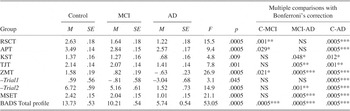
The ANCOVA showed significant differences between groups in all six subtests. Post hoc analyses, revealed that all subtests of the BADS were significantly different between AD and controls, while several subtests showed significant differences between the other group comparisons (C-MCI and MCI-AD; see Table 2).
ANCOVA for BADS tests and total profile score

Note
ANCOVA = analysis of covariance; BADS = Behavioral Assessment of Dysexecutive Syndrome; MCI = mild cognitive impairment; AD = Alzheimer’s disease; C = control; RSCT = Rule Shift Cards Test; APT = Action Program Test; KST = Key Search Test; TJT = Temporal Judgment Test; ZMT = Zoo Map Test; Trial 1 = Trial 1 from ZMT; Trial 2 = Trial 2 from ZMT; MSET = Modified Six Elements Test; M = mean; SE = standard error; NS = p ≥ .05.
* p < .05.
** p ≤ .005.
*** p ≤ .0005.
We also analyzed the six individual subtests of the BADS to determine whether there were differential patterns of sensitivity among the tests and the patient groups. The logistic regression model to classify MCI and control subjects was statistically significant (χ2 = 26.75; p < .001), and two significant variables were included: the Rule Shift Cards Test (p = .049) and the Action Program Test (p = .029). This model successfully discriminated 72.2% of the MCI subjects and 82.0% of the controls, yielding a positive predictive rate of 80.4% and a negative predictive rate of 74.3%. Similarly, the model obtained to classify the AD patients relative to the controls was also statistically significant (χ2 = 53.72; p < .001). The model included the Zoo Map Test (p = .001), the Modified Six Elements (p = .038), and the Action Program Test (p = .018). This model discriminated 75.9% of the AD patients and 88% of the controls, yielding a positive predictive rate of 86.3% and a negative predictive rate of 78.6%. Finally, the model obtained to classify the MCI and AD groups was statistically significant (χ2 = 42.22; p = .0005). Two of the tests were included: the Zoo Map (p = .015) and the Modified Six Elements (p = .041). This model discriminated the 77.8% of the MCI subjects and the 75.9% of the AD patients, yielding a positive predictive rate of 80.0% and a negative predictive rate of 73.3%.
Using the total profile score from the BADS, statistically significant differences were found on performance among all three of the study groups (see Table 2).We used a logistic regression model to classify the AD patients relative to the controls, and this model was statistically significant (χ2 = 81.03; p < .001). The total profile score correctly classified 89.4% of the controls, and 84.9% of the AD patients, yielding a positive predictive rate of 84.0% and a negative predictive rate of 90%. Similarly, the model used to classify the MCI patients relative to the controls was also statistically significant (χ2 = 24.81; p < .001). The total profile score correctly classified 76.6% of the controls and 67.4% of the MCI patients, yielding a positive predictive rate of 72.0% and a negative predictive rate of 72.5%. Finally, the model used to classify the MCI group related to the AD patients was also statistically significant (χ2 = 45.57; p = .0005). The total profile score correctly classified 77.5% of the MCI patients and 86.0% of the AD patients, yielding a positive predictive rate of 81.6% and a negative predictive rate of 82.7%.
DISCUSSION
The data from the present study supports the existence of a specific profile of executive dysfunction in the MCI group, consistent with prior observations that impairment in domains other than memory may be detected in most amnestic MCI subjects (Alegret et al., Reference Alegret, Boada-Rovira, Vinyes-Junqué, Valero, Espinosa and Hernández2009; Nordlund et al., Reference Nordlund, Rolstad, Hellström, Sjögren, Hansen and Wallin2005). Moreover, we also show that the BADS is a useful tool to discriminate between cognitively normal, MCI, and mild AD subjects. Our study also emphasizes the importance of considering the use of behavioral assessments that mimic real-life situations to evaluate information-processing deficits in patients with neurodegenerative disorders.
The second major finding is that specific components of the BADS (the Zoo Map Test, the Rule Shift Card Test, Action Program Test, and Modified Six Elements Test) become progressively more impaired as a function of diagnostic group. While the Rule Shift Card and the Action Program test are sensitive indicators of MCI, the Zoo Map and Modified Six Elements tests are sensitive to discriminate between MCI and AD. That is, as patients transition from a state of normal cognition through MCI to dementia, their performance on these BADS tests becomes progressively more impaired.
This is not the first study to demonstrate executive deficits in dementia. Executive deficits are well documented in AD patients (Amieva et al., Reference Amieva, Lafont, Auriacombe, Rainville, Orgogozo and Dartigues1998, Reference Amieva, Lafont, Auriacombe, Le Carret, Dartigues and Orgogozo2002, Reference Amieva, Phillips and Della Sala2003; Brugger et al., Reference Brugger, Monsch, Salmon and Butters1996; Rainville et al., Reference Rainville, Amieva, Lafont, Dartigues, Orgogozo and Fabrigoule2002) and are also a component of the MCI syndrome (Bozoki et al., Reference Bozoki, Giordani, Heidebrink, Berent and Foster2001; Ritchie et al., Reference Ritchie, Artero and Touchon2001). Indeed, several studies using executive tests other than the BADS, such as the Stroop Test and Category Recall, the Trail Making Test, or the Tower of London, have revealed differences in performance between healthy control subjects and patients with AD or MCI (Amieva et al., Reference Amieva, Lafont, Auriacombe, Rainville, Orgogozo and Dartigues1998, Reference Amieva, Phillips and Della Sala2003, Reference Amieva, Lafont, Rouch-Leroyer, Rainville, Dartigues and Orgogozo2004; Boeve et al., Reference Boeve, McCormick, Smith, Ferman, Rummans and Carpenter2003; De Jager, Hogervorst, Combrinck, & Budge, Reference De Jager, Hogervorst, Combrinck and Budge2004; Rainville et al., Reference Rainville, Amieva, Lafont, Dartigues, Orgogozo and Fabrigoule2002), although observations are not consistent across all studies. Detailed analysis of a modified Card Sorting Task and the Stroop Test found that MCI patients have problems with specific aspects of executive function, specifically, response inhibition, task switching, and cognitive flexibility. In the present study, MCI patients had specific impairments on the tests that maximized planning and behavioral flexibility (e.g., the Rule Shift Card Test, Action Program Test, and Zoo Map Test). These tasks tend to be harder than the Key Search Test, Temporal Judgment Test, and Modified Six Elements Test, as they require the subject to organize a plan of action, and to show flexibility when their solutions fail (e.g., Action Program Test) or the rules of the task change (e.g., Rule Shift Card Test). Thus, planning deficits and behavioral rigidity may be one of the earliest manifestations of an evolving dementia. These findings, in combination with other studies strongly suggest that MCI may be identified in elderly subjects by using a more detailed assessment of cognitive functions than simply focusing on memory (Beversdorf et al., Reference Beversdorf, Ferguson, Hillier, Sharma, Nagaraja and Bornstein2007; Traykov et al., Reference Traykov, Raoux, Latour, Gallo, Hanon and Baudic2007).
Although memory deficits are an important component of dementia syndromes, Baddeley and colleagues reported in a series of studies the sensitivity of measures of executive function to the presence of Alzheimer’s disease (Baddeley, Logie, Bressi, Della Sala, & Spinnler, Reference Baddeley, Logie, Bressi, Della Sala and Spinnler1986; Baddeley, Bressi, Della Sala, Logie, & Spinnler, Reference Baddeley, Bressi, Della Sala, Logie and Spinnler1991a; Baddeley, Della Sala, & Spinnler, Reference Baddeley, Della Sala and Spinnler1991b). Other studies have demonstrated that the secondary memory deficit in AD could be distinguished from alterations in primary or working memory (Becker, Reference Becker1988; Becker, Lopez, & Wess, Reference Becker, Lopez and Wess1992), all of which suggest that our understanding of the cognitive systems affected in AD need to include a breakdown in executive functions very early in the process. More recent studies have also found impaired executive functions in AD patients such as difficulty developing logical strategies and executing complex predetermined plans on the Zoo Map test (Allain et al., Reference Allain, Chaudet, Nicoleau, Etcharry-Bouyx, Barré and Dubas2007; Piquard et al., Reference Piquard, Derouesné, Lacomblez and Siéroff2004). Consistent with our findings, AD patients have been found to have poorer performance on the Zoo Map and Modified Six Elements subtests, while patients with fronto-temporal dementia (FTD) were poorer on those tests as well as the Key Search Test. In addition, both AD and FTD patients had worse planning abilities than controls on the Tower of London (Piquard et al., Reference Piquard, Derouesné, Lacomblez and Siéroff2004).
Extending previous work, our AD patients showed more difficulties than normal elderly subjects in both the “high demand” and “low demand” test trials of the Zoo Map test. Interestingly, we found that MCI and AD patients performed worse in the first than in the second part of the Zoo Map Test (i.e., when they are asked to plan a route). However, MCI subjects, but not AD patients, improved their performance on the second part when a prespecified route was given. So, in MCI, spontaneous planning ability was similarly impaired as AD patients, but the MCI patients are able to follow an effective route with an externally imposed strategy.
The complete battery of the BADS tests may be difficult to complete for an elderly individual, especially in the context of a more comprehensive neuropsychological battery. Based on our data, we would suggest the use of the Zoo Map Test and Modified Six Elements as the best of individual components within the BADS to discriminate between AD and MCI. Similarly, the Rule Shifts Card Test and the Action Program Test may be particularly helpful in discriminating between normal aging and MCI. Because performance on the BADS was significantly correlated with both age and education, a finding which is consistent with other studies (Ardila & Rosselli, Reference Ardila and Rosselli1989; Ardila, Ostrosky-Solis, Rosselli, & Gómez, Reference Ardila, Ostrosky-Solis, Rosselli and Gómez2000; Daigneault, Braun, & Whitaker, Reference Daigneault, Braun and Whitaker1992; Lezak, Howieson, & Loring, Reference Lezak, Howieson and Loring2004), the BADS performance scores should be adjusted for both of these factors.
Deficits in executive functions likely have more effects in real-life situations than is currently appreciated, in part because the deficits may not be revealed with typical assessment measures (Levine, Reference Levine and Tulving2000). This is an important point in our understanding, diagnosis, and management of MCI, because executive functions are an important determinant of how individuals manage instrumental activities of daily living such as managing money or taking their medications (Carlson et al., Reference Carlson, Fried, Xue, Bandeen-Roche, Zeger and Brandt1999; Grisby, Kaye, Baxter, Shetterly, & Hamman, Reference Grigsby, Kaye, Baxter, Shetterly and Hamman1998; Sherod et al., 2009). Impairment of activities of daily living is a key defining characteristic of dementia. Therefore, we suggest that the use of the BADS, or a similar behavioral, ecologically relevant measure may be more effective in detecting executive dysfunction early in the course of a neurodegenerative disorder and identify those MCI patients who are more likely to progress to dementia. Further longitudinal studies are needed to address this question. Although it must be mentioned that there are substantial practice effects with executive tests, future longitudinal studies of healthy elderly individuals and those with MCI may be particularly helpful to detect changes in executive performance in an individual transition from normal cognition through to a state of dementia. Nevertheless, even from the cross-sectional perspective, our data suggest that the BADS provides unique information on executive functions performance with useful discriminative ability across a range of cognitive competence.
We cannot demonstrate that the BADS is more sensitive to executive deficits than other classic executive tasks, because other executive tests were not included for comparison. However, we have found differences between the three groups on some of the BADS subtests performances, including the Zoo Map Test, Rule Shift Cards Test, and Action Program Test. Moreover, from our clinical experience, we find that neuropsychological assessment tests such as the BADS allows a more “real world” approach of the patient’s experience and this seems to minimize negative reactions during tests, which may increase the validity of the assessment.
ACKNOWLEDGMENTS
The information in this manuscript and the manuscript itself has never been published either electronically or in print. Completion of this research did not involve any financial or other relationships that could be interpreted as a conflict of interest affecting this manuscript.