China’s rural tax and fee reform in the early 21st century significantly altered the relationship between the party-state and peasants. During the short transition period following the reform, the tax and service link between township and village cadres and villagers was broken.Footnote 1 Township governments started to depend on transfers from higher levels of government,Footnote 2 while grassroots cadres lacked incentives to engage with villagersFootnote 3 and began to withdraw from their everyday lives.Footnote 4 Township governments were increasingly seen as redundant, especially in poorer areas.Footnote 5
However, change did follow. The state re-penetrated rural areas by formulating a series of strategic projects, such as “Constructing a new socialist countryside,” targeted poverty alleviation and rural revitalization initiatives.Footnote 6 These projects also increased the administration of rural governance, turning rural cadres into agents of the party-state for controlling rural society. First, to re-engineer rural society, the party-state enhanced its management of village cadres, who were paid for by the township.Footnote 7 Second, state cadres were dispatched to participate directly in rural governance. This approach became widespread and was normalized after the 18th Party Congress in 2012; almost every village then had a township cadre.Footnote 8 Third, the merger of natural villages into administrative villages reduced costs but weakened the ties between village cadres and peasants.
The increased administration of rural governance de-localized rural cadres. Their ties with rural society weakened, and although some cadres were peasants, their behaviour was no longer peasant-oriented, which decreased peasant trust. Moreover, the grassroots government was pressured to implement the party-state’s policies, leading to peasants being forced to fulfil state tasks quickly. This undermined the government’s legitimacy.Footnote 9 Consequently, the party-state’s use of grassroots officials to govern the countryside became less effective than it once was.
The increased administration of rural governance damaged the state–peasant relationship. Grassroots cadres used coercion to implement state policies, which led to them losing their rural base and alienating peasants who began to reject and resist the programmes designed to boost party-state legitimacy. Recognizing these problems, the central government prohibited coercive methods.Footnote 10 Moreover, the party-state realized that a monopolized service delivery does not earn peasant gratitude; instead, it fosters apathy and complaints.Footnote 11 As a result, the party-state is now involving peasants in village governance, a condition which has become a core principle of rural work and a “hard indicator” for assessing the performance of grassroots governments. Thus, the party-state is working to correct the situation and enhance its legitimacy by further re-embedding itself into rural society and repairing its relationships with peasants. This raises the research question: how do grassroots cadres reconnect with peasants, and what structures do they construct to encourage the peasants to cooperate with the state?
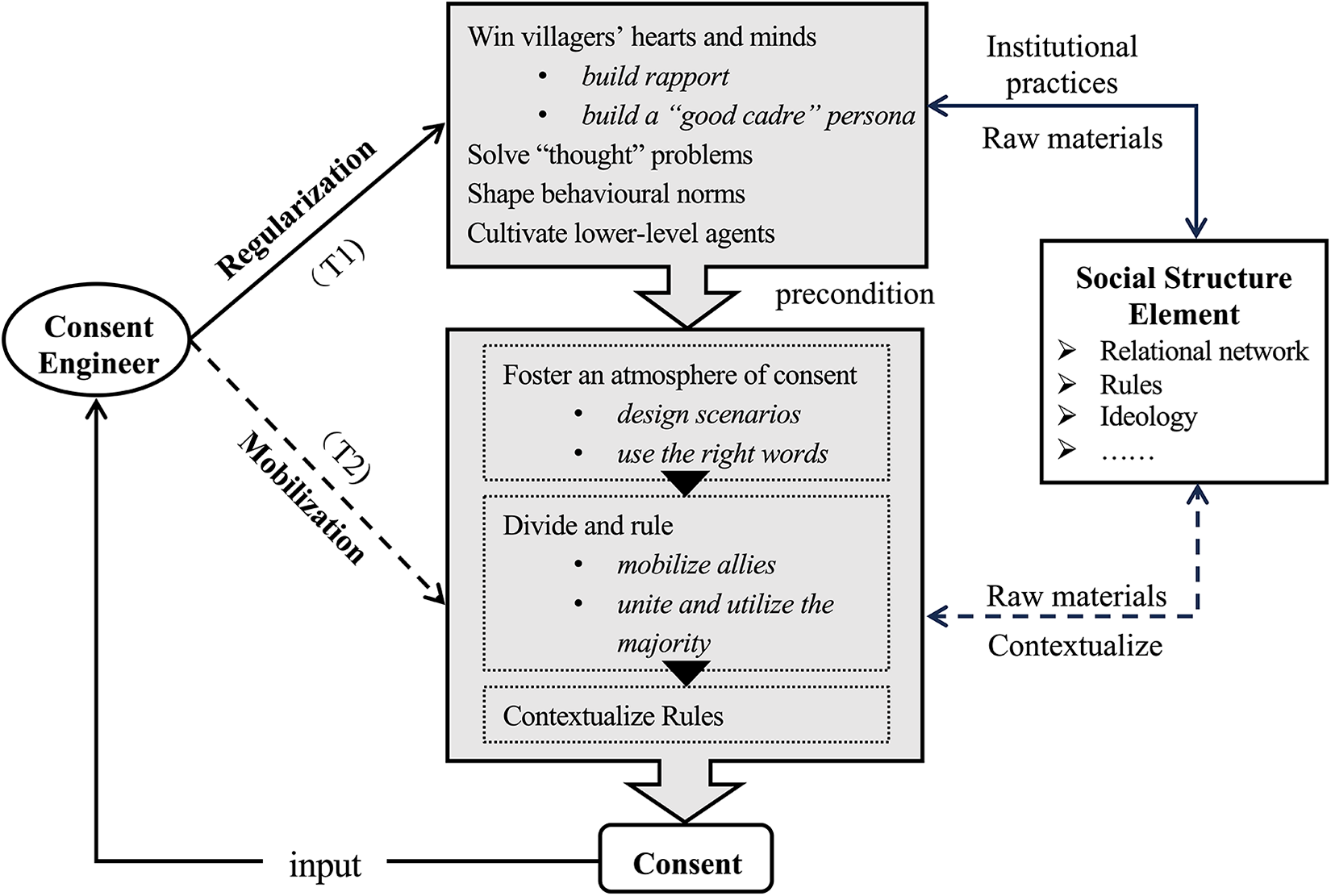
This paper argues that grassroots governments follow a “constructing consent” pattern to implement rural policies, re-embedding the state into the countryside and engineering rural society without provoking peasant resentment. Using the “rural construction” initiative (xiangcun jianshe xingdong 乡村建设行动) in Chuxi countyFootnote 12 – a poor county whose villages have completed numerous rural construction projects – as a case study, this study finds that the approach to constructing consent involves de-coercion and de-politicization; it is also a more everyday and continuous process than previous consent strategies. During the regularization of consent, grassroots officials reorganize rural society through institutional practices, including winning the hearts and minds of villagers, addressing ideological problems, shaping behavioural norms and cultivating lower-level agents. These practices combine to form a consensus-oriented institutional system. When a problem requiring consent emerges, grassroots officials adopt contextualized strategies to activate these pre-established institutional elements by fostering an atmosphere of consent, divide-and-rule and contextualizing rules to achieve desired outcomes.
Crude and fragmented ways of manufacturing consent do not work if the increasing administrative nature of rural governance reduces social contact between officials and peasants; constructing consent is seen as a better approach. Additionally, in the Xi era, the party-state is striving to re-establish its presence among peasants. In this context, the party-state is working towards realizing its political mission to “win and keep the hearts and minds of the people” (yingde minxin, shouzhu minxin 赢得民心, 守住民心) in rural areas by adopting more complex and sophisticated tactics, rather than merely implementing policy mandates. The concept of constructing consent exemplifies this paradigm shift.
Consent in Rural Governance
China, often viewed as an authoritarian regime that seeks citizen obedience through top-down control, is not a leviathan that rules only by high-handedness.Footnote 13 Such coercion is counterproductive and leads to conflicts and citizen resistance,Footnote 14 as it relies on “weapons of the weak,”Footnote 15 increasing the state’s legitimacy crisis. In particular, citizens now use media tools to confront coercion online,Footnote 16 undermining public trust in the state and threatening its stability. Consequently, the new political context emphasizes harmony and stability, discouraging local governments from relying on coercion. Instead, the state adopts strategies designed to obtain consent. Research has identified that grassroots governments use three main approaches to manufacture consent.
The first approach is emotional persuasion. The government uses favours, face-saving and guanxi 关系 to persuade peasants to cooperate with the government.Footnote 17 “State paternalism” is another emotion-based tool. Using the rhetoric of “the state knows best,” local governments try to persuade peasants to return favours by cooperating in state policy implementation.Footnote 18 The second approach is economic “purchasing,” such as “bargaining authoritarianism.”Footnote 19 This strategy is often used in resettlement programmes, as local governments convince “nail” households (dingzihu 钉子户) to accept demolition arrangements.Footnote 20 In some cases, local officials obtain consent by stopping official financial compensation policies.Footnote 21 The third approach is administrative absorption. Here, the state engages dissidents in lengthy administrative procedures to delay their requests, thereby depleting their capacity for mobilization and encouraging consent.Footnote 22 Although these measures do not employ violent actions, they can be threatening, as they leave peasants with no alternative.
Consent-manufacturing strategies have become more sophisticated in response to an increased demand for legitimacy. Several studies have shown that, especially since Xi came to power, the state has proactively designed more legitimate, subtle and refined methods in order to implement rural initiatives, such as “targeted poverty alleviation” and “rural revitalization” programmes.Footnote 23 Participatory mechanisms have received significant research attention. For example, when renovating a village in Guangzhou, a forum was established between professional planners and villagers, forming a “coalition of the willing.”Footnote 24 Through deliberative governance, state policies for transforming the countryside have become more flexible and resilient.Footnote 25 Another approach is service-based Party building, which mobilizes the masses by positioning service as a form of leadership, thereby generating political reciprocity.Footnote 26
The party-state demands policy implementation; however, rural grassroots governance is shifting, from pursuing simple consent towards using more legitimized approaches to manufacture consent. Some studies have implicitly assumed this shift but have not examined it directly. First, power perspectives continue to dominate research on state–peasant relations, focusing on policy domains with strong redistributive properties, such as migrant relocation and land acquisition. These policies combine consent with submission. Strong redistributive policies have, however, been reduced in rural China. Second, previous studies have viewed gaining consent as a diverse and dispersed set of tactics that rely on pre-existing rural social foundations. Yet, increased rural administration may render these strategies less effective or even counterproductive. Third, current research does not reveal the Xi administration’s approach to restoring harmonious state–peasant relations. In this context, how is consent constructed in grassroots governance?
Process Perspectives on Manufacturing Consent
Manufacturing consent or submission?
Consent is a widely used, controversial and inconsistently defined concept. Research generally recognizes that consent differs from submission. Consent reflects the foundation of legitimate political authority, and its exclusion of coercion provides distinctive moral and theoretical value. In contrast, submission represents the absence of choice under coercion, negates political order,Footnote 27 and invalidates consent.Footnote 28 Therefore, consent is the non-coercive acceptance of a practice, emotion or viewpointFootnote 29 and involves greater autonomy and initiative. The autonomy associated with consent, however, does not mean that consent spontaneously forms. Instead, producing consent is a complex, socially constructed process that can be managed, interfered with and nurtured.Footnote 30 Submission, on the other hand, is a straightforward process. Manufacturing consent is a complex, subtle and indirect form of social engineering, requiring carefully designed efforts.
Governments and companies both manufacture consent to gain legitimacy.Footnote 31 Antonio Gramsci’s theory of hegemony argues that the state’s power lies not only in its ability to exert force or coercion over the dominated classes but also in leading their moral direction.Footnote 32 The governance of a country is achieved by shaping faith and enthusiasm, i.e. manufacturing consent.Footnote 33 In Michael Burawoy’s ethnographic, workshop-based study, managers reproduce capitalism by involving employees in the game of “making out,” creating an internal labour market and consolidating an internal state. These strategies create concrete consent in the everyday labour process, replacing consent with capitalist production relations.Footnote 34 With the advancement of mass media, these outlets are now considered professional tools which are consciously used to influence citizens’ habits, emotional responses and public opinion to shape policy agendas.Footnote 35
Manufacturing consent as a process
Manufacturing consent is often conceptualized as a series of individual tactics. For example, Edward Bernays theorizes consent production as an eight-point method of engineering consent, arguing that consent can be manufactured based on scientific principles.Footnote 36 This paper argues that producing consent is not a checklist; rather, it is a more complex, dynamic and continuous strategic process.Footnote 37
Time is a key element of consent strategies. The process of manufacturing consent is conducted over time with specific strategies, which logically relate to each other in a temporal sequence. Past outputs are stored and transmitted over time and serve as inputs for future strategies. The effects of consent depend on the investment of time, and time itself provides value that distinguishes consent from submission – submission is less time-inclusive and pursues efficiency, while consent depends on time and uses it to increase legitimacy.
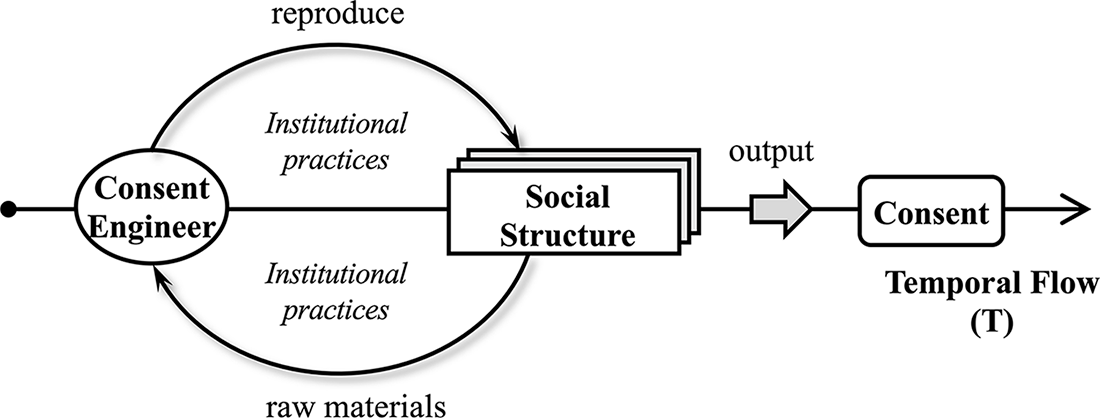
Producing consent also relies on social structures.Footnote 38 Social structures can structure individual capacity to consentFootnote 39 because social relations and institutionalized norms teach people how to feel.Footnote 40 Social structures also empower actors, particularly the engineers of consent, to construct consent. These engineers tend to be creative, knowledgeable and intelligent.Footnote 41 Consent engineers dismantle, reconstruct and distort social structures as needed, and formulate an institutional order and space to induce individuals to consent.Footnote 42 Continuous institutional practices connect consent engineers and social structures. Using institutional work, such as emotions, perceptions, rules and relations, the consent engineer sets up an institutional system and applies these elements to manufacture consent. Such institutional practices also review and reproduce the social structure. Therefore, manufacturing consent is a process of constructing an institutional space to induce consent, which is embedded into broader structural environments.
In summary, manufacturing consent is a coherent process involving the interaction between social structures and individual actors (see Figure 1). Consent engineers, positioned between structure and agency, continually develop institutional practices to ensure that the atmosphere of consent is always present, thereby facilitating the desired outcomes associated with that consent.
Conceptual Model for Manufacturing Consent

Methodology
Context and case
To explore the topic of manufacturing consent, this study focuses on a case study of the rural construction initiative in Chuxi county, China. In this context, consent is reflected in the local residents’ willingness to engage in local, state-initiated rural programmes. Manufacturing consent is illustrated as a process by which grassroots government cadres persuade and guide the masses to cooperate with these rural programmes.
Chuxi, a poor county in Hubei province, has seen the implementation of many government-sponsored projects in its villages over the past decade. At the same time, Chuxi has strengthened the management of its grassroots cadres. Village-level cadres are part of the grassroots government and are strictly supervised, through evaluation systems, by higher-level governments. In addition, many cadres have been dispatched from governments, enterprises and public institutions to serve as first secretaries (di yi shuji 第一书记) within the villages. Thus, many of the grassroots cadres in Chuxi lack local roots and have limited natural contact with peasants, making rural governance highly administrative in nature.
The Party’s Central Committee introduced the “rural construction” initiative in 2020. In 2022, the county government issued its “Chuxi county rural construction implementation plan (2022–2025),” which stipulated “peasant participation” as a guiding principle. Many of these rural programmes require peasants to contribute both money and labour. However, owing to the administration shifts in rural governance described above, persuading peasants to cooperate and participate in village programmes has been challenging. These factors make the rural programmes implemented in Chuxi an insightful case study.
Data collection and analysis
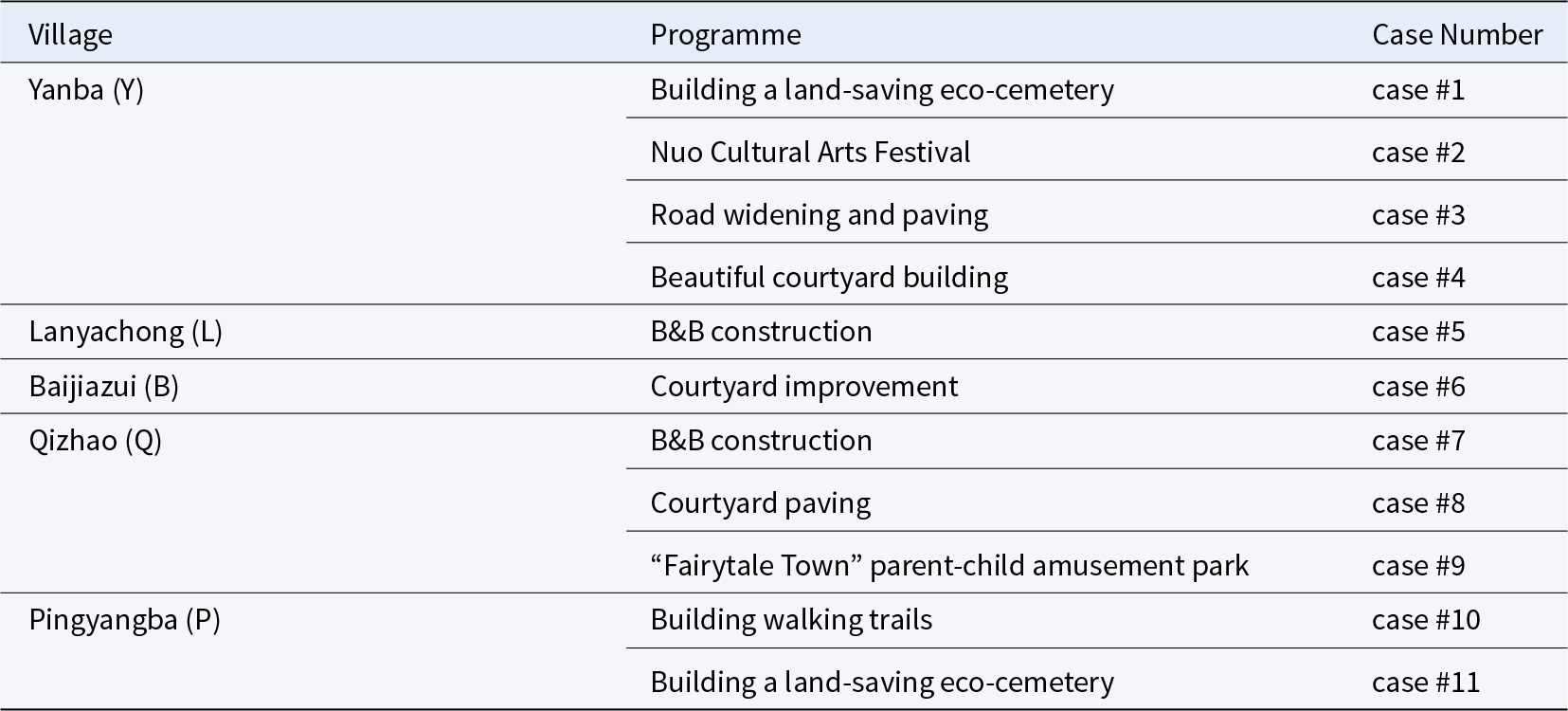
The research team undertook a month of fieldwork in Chuxi in mid-July 2023 and revisited the area for a week in August 2024 to supplement the data. After an initial screening of Chuxi’s villages, five were selected for in-depth fieldwork: Yanba (Y), Lanyachong (L), Baijiazui (B), Qizhao (Q) and Pingyangba (P) – all with grassroots cadres who have largely succeeded in securing peasant consent for specific construction projects (see Appendix A in the online supplementary material for more information on the five villages). For each village, one to four specific programmes were studied to collect targeted data, resulting in a total of 11 cases (see Table 1; the online Appendix B describes these 11 cases in detail). With respect to the selection and screening of case study villages, all villages are highly administrative in their governance. Four of the villages have limited resources, whereas the fifth, Qizhao, has comparatively more resources. Each village has one to three permanently stationed non-local cadres; labour is divided among village cadres, who carry out tasks delegated by township departments under strict supervision. Most village cadres proactively seek resources from the government. All 11 case programmes studied relate to the “rural construction” initiative; all had been completed or were nearing completion, and all were successful in securing villager consent.
Village Cases and their Rural Building Programmes

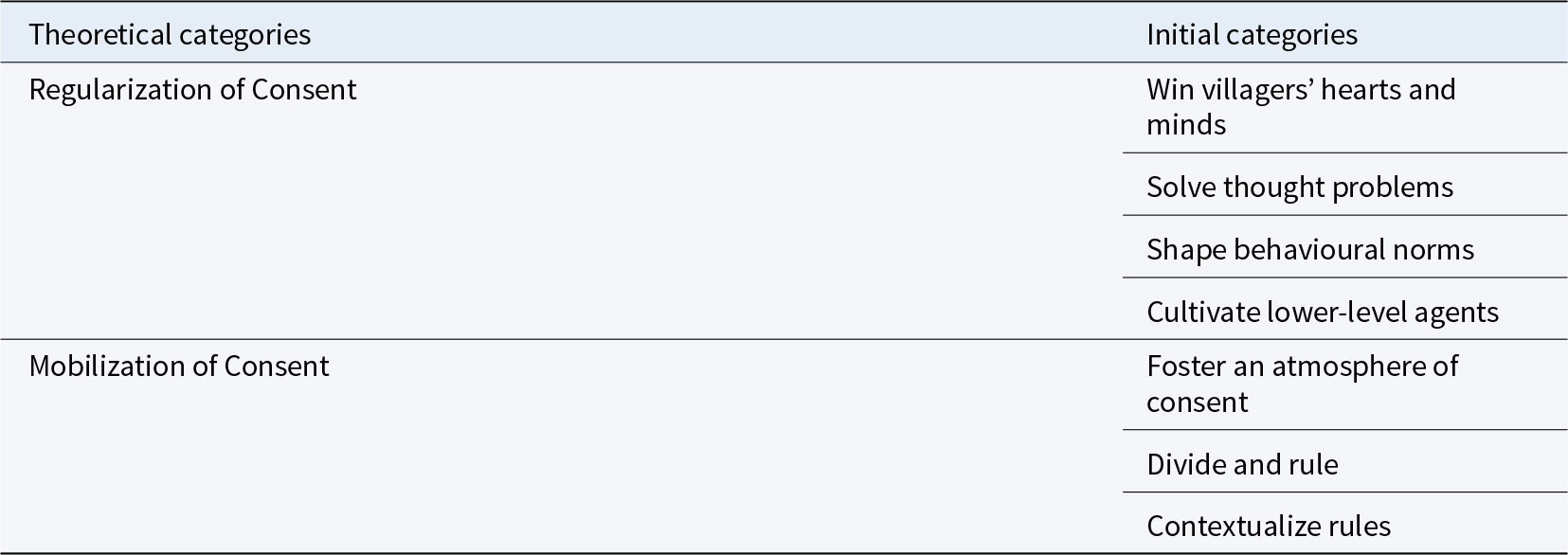
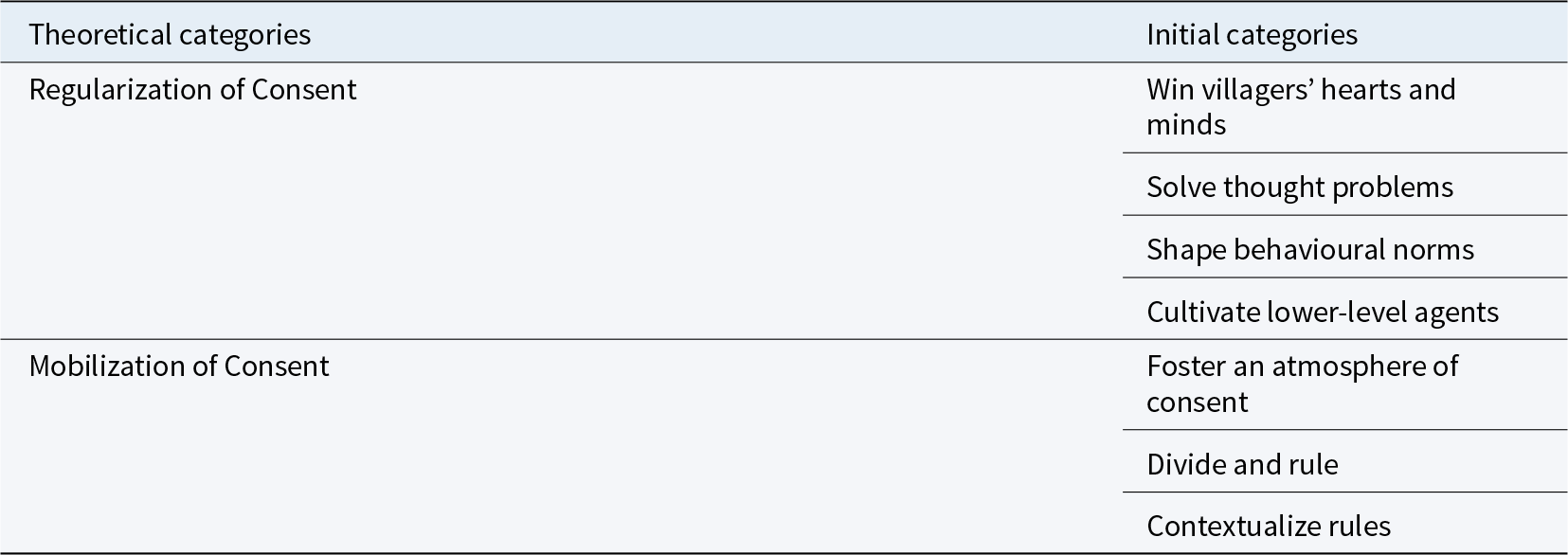
The research team obtained case details through 35 in-depth semi-structured interviews, each one lasting between 60 and 150 minutes long (see online Appendix C). These interviews generated more than 460,000 words of Chinese text, which were entered into Nvivo11 to create a database. Grounded theory was used to analyse the data.Footnote 43 Using a three-level coding process, researchers coded raw data from the 11 cases. The open coding phase generated 544 original expressions, 12 concept categories, and seven initial categories (see online Appendices D and E). After repeated comparisons, two theoretical categories were identified in the axial coding phase (see Table 2). The core and overarching research category was “grassroots officials constructing peasant consent,” which formed the basis for the model.
Initial Categories and Theoretical Categories
Results: Officials Construct Consent
Regularization of consent
Grassroots officials’ efforts to gain consent begin much earlier and occur more naturally than expected and permeate everyday interactions and daily life. Even when there is no mandate requiring consent, grassroots officials consistently work to piece together rural institutional systems oriented towards peasant consent, regularizing consent in everyday practices. As “consent engineers,” grassroots officials work flexibly and creatively with institutional practices, such as emotions, perceptions, rules and relations, to regularize consent. Specifically, they win over villagers’ hearts and minds, resolve their “thought” problems, shape behavioural norms and cultivate lower-level agents.
Winning villagers’ hearts and minds
Exclusionary and alienated relationships between officials and peasants are more likely to lead to opposition; in contrast, harmonious and close relationships help foster recognition. To co-opt peasants psychologically and emotionally, grassroots officials actively work to build rapport with them in their daily lives and cultivate a “good cadre” persona.
Building rapport
In the context of increased administration, grassroots officials consciously try to establish or maintain harmonious relationships with the villagers to deepen ties.Footnote 44 They intentionally set aside their cadre identity temporarily to “make friends” with villagers. This helps grassroots officials to gradually strengthen the cadre–peasant network in normal times, enabling them to gain consent at critical moments.
First, the grassroots officials visit villagers’ homes regularly to learn about their living conditions and develop beneficial policies that meet the villagers’ needs. These measures gradually draw in the villagers and help to build support for cadres from within the community. In particular, for villagers who were initially suspicious of the cadres and refused to cooperate with village projects, responding to hostility with good intentions (yidebaoyuan 以德报怨) proved particularly effective. The secretary of Yanba village related the following:
One household is indeed a bit obnoxious. Two elderly people with two grandchildren live in the village, and their son works outside. And they just do not support the village policy. I just use my heart to engage them. I was able to get low-income insurance for him. The two old people feed the chickens, and I help them sell the eggs. They are now slowly changing … Take care of them in normal times, and they will say “yes” when it is time for them to give back. These efforts have to be made in normal times. (Y3-25+46)
Second, grassroots officials build close relationships with peasants through sustained emotional engagement. They cultivate these connections through organizing activities and meetings, which create a ritual of interaction, in which cadres and the villagers share mutual concerns and emotional experiences, thereby enhancing the villagers’ identification with the village and creating a sense of collective solidarity.
Third, cadres often take proactive steps to defuse conflicts as they arise in an attempt to prevent the escalation of negative emotions. To illustrate this with an intuitive metaphor, they “hit hard and then offer comfort” (dayichui haiyao moyixia 打一锤还要摸一下). For instance, after reprimanding a villager for disrupting a meeting and sending him home, the secretary of the Yanba village visited the villager the next day:
I went to his home and found that he had fought with a neighbour over a minor issue, and he didn’t win. The people in his neighbourhood had befriended me, so he took his emotion out on me. I comforted him. He also said later that he had been drinking a little and that he wouldn’t dare to [behave that way] otherwise. We both laughed, and the grievance was resolved. If I didn’t go the next day, he would have had the conflict with me in his mind and would think I was so mean. (Y3-63)
Building a “good cadre” persona
To forge close relationships with peasants, grassroots officials try to cultivate an image of a “good cadre” in the minds of the villagers through their everyday actions in the belief that “the people see it all” (Q1-37).
This includes deliberately “packaging” their behaviour by, for example, adopting a stance and attitude that is focused on addressing village affairs and adopting certain characteristics and traits. Yanba villagers described their secretary, Yang, as fair, impartial, easy-going, low-key and truthful. Secretary Yang summarized his strategy as: “One has to do three bad things to make people afraid of you, and three good things to make people admire you” (Y3-21). To win the villagers’ hearts, he established a “cavalry of literature and art” (wenyi qingqibing 文艺轻骑兵) and sang at villagers’ homes during celebrations. Yang sometimes intentionally sacrificed his personal interests for others. For example, he directly contacted camping sites in Yanba to make bed and breakfast (B&B) arrangements for visitors. Although he also ran a B&B business, he regularly introduced customers to the other B&Bs in the neighbourhood and rarely took them to his own. He explained that “with this arrangement, they admire and support me. If I had business every day, and I had all the guests to myself, people would hate me. I wouldn’t be able to carry out future work” (Y3-50).
Professionally, grassroots officials are proactive and ambitious, working diligently to support the village’s development. They adopt a people-first attitude, fight for preferential policy treatment and effectively coordinate resources. Such efforts demonstrate professionalism and strength. For example, Wen, the secretary of Qizhao, proved his abilities by actively pursuing and applying for funds for projects – “running projects” (pao xiangmu 跑项目). Through his efforts, all the village roads were paved, and he won the support and recognition of the villagers: “People also felt that we were down-to-earth, and we were able to find resources. Then, they were supportive of our work. The people are also realistic” (Q1-5).
Solving “thought” problems
Consent is embedded within a broader ideological context. The manufacturing of consent involves shifting peasant perceptions, which requires the reshaping of the rural ideological landscape. By regulating, guiding and correcting peasants’ attitudes, local cadres try to align the peasants’ thoughts with the mainstream values of the party-state. In practice, this means framing peasants’ thoughts as “good” and “bad.” “Good” or “positive” thoughts are consistent with the values or interests of the party-state and the village. This gradual moulding of the rural ideological system is time-consuming and requires consistent, day-to-day influence.Footnote 45
One of the most relied-upon strategies used by grassroots cadres is ideological education. First, to ensure that the villagers’ thoughts align with the village’s “main theme,” grassroots officials continuously monitor the dynamics of villagers’ thoughts and learn about their mental states. Second, to keep the villagers informed of state requirements, outreach materials about relevant national policies are distributed at village meetings and conferences. Third, “gratitude education” is interspersed across time and place. For example, the success of the fight against poverty provided ample material for “gratitude education,” making “gratitude” tangible. According to the first secretary of Pingyangba village:
Over the years of targeted poverty alleviation, our infrastructure has really changed a lot, benefiting peasants. They are much happier and have changed a lot. We often say that the electricity you use, the water you drink, and the road you walk on today are made possible by the government, so you should support our policy, right? (P1-37+38)
Fourth, by repeatedly presenting village development plans, grassroots officials educate the villagers about the development orientation and expectations. Once the plans are established in the villagers’ minds, the officials involve them in the collective rural development efforts, thereby achieving “vision management.” For example, in Case #4, the “construction of beautiful courtyards” programme in Yanba, villagers explained their reasons for consent: “Our village is going to be developed for tourism. If we make the courtyard look better, visitors will come, and it will look comfortable” (Y6-5). They believed that tourism development would benefit their side businesses. This illustrates that with frequent briefings, the grassroots officials were able to instil the desirability and collective goal of tourism development in the villagers’ minds.
Shaping behavioural norms
By guiding and regulating behaviour, rules can shape an ideological system. During the regularization of consent, grassroots officials establish local rules and directives that guide villagers to act positively and ultimately identify with these rules in their daily activities. For example, all five villages constructed an incentive system, or point system (jifenzhi 积分制), similar to Burawoy’s “game of high-scoring.” This system, which is widely promoted using a top-down approach, serves as a rural governance tool that quantifies governance tasks using measurable indicators. It evaluates villagers’ daily behaviour using scores and offers them corresponding spiritual encouragement or material rewards. The system is aimed at civilizing the countryside and establishing a positive culture. The idea is to motivate villagers to cooperate and participate in the village’s development-oriented arrangements. Villagers exchange scores for household goods and honours, and those with the highest scores may be featured in official media. Meanwhile, villagers with low scores face public criticism by having their names posted on the “black list” (heibang 黑榜) in the village square.
Using daily score management, grassroots officials develop a system of moral norms in rural society that aligns with the concept of “positive energy” and judges villagers’ behaviour. This system guides and regulates everyday speech and actions and serves as the ideological basis for gaining villagers’ consent at critical times.
Cultivating lower-level agents
By cultivating some villagers as collaborative agents, grassroots officials can change the network of relationships within peasant groups as well as between officials and peasants. Grassroots officials can leverage these agents to build consent. Over a long collective life, villagers have developed complex social networks, with local elites placed in key “nodes” and holding significant influence in the village. Grassroots officials always draw on the local experience of the “non-state leaders,” such as the “five olds” (wulao 五老) (old Party members, cadres, teachers, sages and veterans), when undertaking rural tasks.Footnote 46 Additionally, in recent years, a younger cohort of “new elites” has returned to the countryside. These returnees are well-educated, have extensive market experience and tend to have a say in rural governance. Bringing these two groups of social elites on the side of the government helps the grassroots officials to manufacture villager consent when it is needed.
Grassroots officials have developed a set of sophisticated techniques to cultivate these “non-state leaders” as their “agents.” The officials absorb “non-state leaders” into village organizations and assign them roles and identities such as farmer Party members, village sages, group leaders and volunteer service members. Grassroots officials further outline the expectations that accompany such roles, such as “being consistent with village decision making, being fair and impartial, and daring to stand up and speak out when peasants impede village construction” (Y5-19). In addition, grassroots officials construct an identity for these rural elites within their community by generating identity symbols for them, identifying their duties and obligations, and reinforcing their roles by delegating “micro-power.”
For example, Yanba is divided into ten governance units called grids (wangge 网格). One villager from each grid is recruited as a manager to assist village cadres in managing the groups. The village committee provides each grid manager with notebooks, briefcases and law enforcement recorders, and posts a sign identifying them on the door of their house. In addition, village cadres often organize study tours to generate ideological support for the village committee. Cao, a villager from Yanba, was a highly successful transformer. Originally a village vagrant, he was co-opted into the Party organization, performed well and was eventually selected to be a grid manager. He supported village projects and actively persuaded grid members to cooperate with village requirements.
By building and strengthening connections with these “node” villagers, grassroots officials change the nature of their social relationships with villagers and those within villager groups, shaping them in ways that foster consent.
Mobilization of consent
Grassroots officials continuously work to regularize consent in everyday life. However, when a problem or need arises that requires consent, the process of manufacturing consent reaches a critical point. Administrative pressure adds urgency to this process. The regularized institutions for consent, which have been carefully developed over time, are put into action. During the mobilization phase, grassroots officials activate these institutional elements to generate peasant consent using three cascading strategies: fostering an atmosphere of consent, divide-and-rule and contextualizing rules.
Fostering an atmosphere of consent
The adjusted rural social structure can be used to create situations that encourage the villagers to give their consent quickly. The process involves grassroots officials carefully setting up scenarios and orchestrating discursive narratives, presenting the villagers with a “staged” performance that is designed to influence how they feel.
Designing scenarios
Villager consent can be more quickly secured by deliberately creating a favourable situational atmosphere. In the first step of mobilizing consent, grassroots officials design a live scenario that will rapidly elevate the atmosphere of consent.
Grassroots officials hold collective project mobilization meetings during which they act as both “actors” and “directors” to promote consent. As actors, they actively advocate by demonstrating their mastery of policies and expertise to convince villagers of the benefits of participation. In their role as “directors,” they orchestrate the scenario by arranging “actors” and designing behind-the-scenes plots to create momentum for gaining consent. The “actors” are frequently drawn from among the villager agents. For example, in Case #10, a proposal to build walking trails involved taking land from farmers’ tea plantations without offering any compensation. Before the meeting to seek villager consent, the first secretary of Pingyangba arranged for several influential villagers to lead the discussion:
I took the plan and showed it to them the first night. I said, if you think this is okay, then you should come out and take the lead at the meeting tomorrow. They were doing well. They said at the meeting: “What a great project! Look at our village; basically no projects came during the poverty alleviation period. Since the new work team came, the first project was put in our village. How long do we have to wait if we don’t support it and stand up for it now?” He drove everyone, and they all agreed. (P1-8)
Through such deliberate planning and performances, the mobilization meeting becomes a showcase. The meeting is carefully controlled. Grassroots officials strategically position the structure of social relations within a specific spatial and temporal context, and then amplify it. By managing both the on-stage and back-stage elements of the meeting, grassroots officials subtly guide the villagers to support the initiative, fostering an atmosphere in which most will consent to the project.
Using the right words
Discursive rhetoric influences villagers’ thoughts and networks, impacting rural social relations.Footnote 47 At the mobilization site, grassroots officials use rhetoric to create an atmosphere of consent. They frame the narrative structure around rhetoric (how it is said), character (who says it) and sequence (in what order it is said).Footnote 48 In practice, grassroots officials select structural elements and flexibly incorporate them into the narrative structure, establishing a logical link between consent issues and village structures.
When it comes to “how to say it,” grassroots officials commonly “speak the lingo.” In advocacy, policy discourse must be translated into language that the villagers can understand to make complex policies accessible and relevant to their local context. Rural social terms, such as the frequently used casual term “folks” (xiangqin 乡亲), are accepted by the villagers and create a societal space where the intimacy and trust accumulated during normal times can be leveraged. This subtly changes villagers’ perceptions. In addition, following the structure of rural social relations, officials use the rhetoric of “us and them.” For example, during a wave of village mergers, Qizhao village absorbed three other villages. However, the incorporated villagers retained a stronger sense of community and identity with their original village. In Case #8, which involved paving courtyards, village cadres leveraged their familiarity with village social relations by telling the villagers, “If you say you’re going to do it, do it; if you don’t, we’ll [redirect] the funds to another area [natural villages]” (Q1-11). The officials skilfully manipulated the villagers’ sense of competition by activating their social boundaries, thereby encouraging them to consent.
For “who says it,” grassroots officials often speak through other people, especially the villager collaborators who take on the role of neutral lobbyists. In Case #1, to persuade the villagers to consent to building a land-saving eco-cemetery in Yanba, the grassroots officials first undertook ideological work by enlisting the support of the locally renowned feng shui master (fengshui dashi 风水大师). They used his “trusted voice” to promote the site as a “feng shui treasure land” (fengshui baodi 风水宝地).
It is important to consider “what to say first” as the order of discourse affects villagers’ attitudes. The rearranged rural social structures serve as repertoires for persuading peasants to consent. Grassroots officials contextually select and reorganize these repertoires, establishing logical linkages that form a persuasive narrative that induces villagers to consent. For example, in convincing villagers to approve the courtyard improvement programme, the secretary of Baijiazui did not start directly with the project; instead, he began by applying to build a municipal-level rural civilization pilot village. He explained:
No one cares about you if you don’t create a pilot, there is no funding for that. After talking about the pilot, the courtyard improvement programme was the main headline when we applied for the pilot. Everyone understands it better when you put it that way. (B1-7+16)
Resource shortages have created a bottleneck in Baijiazui, an issue that has been deeply ingrained in villager minds through frequent “positive energy” education. Introducing a “municipal-level rural civilization pilot” changed the villagers’ thoughts.
Divide and rule
Regular consent practices shape normalized power relations between different villagers and grassroots officials, forming a circular structure centred on village cadres. When developing an atmosphere of consent, the cadres leverage the existing inequalities among the villagers to facilitate consent.
Mobilizing allies
Local cadres manufacture consent through their established relationship networks, beginning with their closest villagers. Before mass mobilization, they work privately with activists to obtain their consent for the programme and to enlist their help in securing others’ consent. This tactic aligns with the Chinese proverb, “keep an army for a thousand days and use it for an hour” (yangbing qian ri, yongbing yishi 养兵千日, 用兵一时).
Daily efforts to strengthen the relationship between officials and villagers change officials’ requests for cooperation into genuine requests for help from friends to gain the cooperation of other villagers. At critical moments, grassroots officials employ various strategies to activate close relationships with “node” villagers and to mobilize consent. For example, grassroots officials might invite a villager for a meal as a show of their friendship, making it difficult for the villager to openly dissent. This taps into the emotions built up during everyday life, creating a space where relationships can influence cooperation. Grassroots officials “flatter” villager agents by overstating and overvaluing their contributions and personalities, encouraging their consent.
Unlike other villagers, “node” villagers’ behaviour is influenced by their constructed social identities, such as Party member or grid manager. Grassroots officials can use the villager agent’s identity and position to persuade them to take the lead. Village cadres often entreat the “node” villagers to cooperate by saying: “You are the group leader/Party member/grid member, you should take the lead first” (L2-1).
In addition, grassroots officials use “small favours” to buy off villager agents. Case #2 offers an illustration of this tactic. Yanba had limited collective funds, so to successfully host the town’s Nuo Cultural Arts Festival, the grassroots officials needed to persuade farmers to donate money, materials and labour, and to provide accommodation. In the end, Yanba managed to hold the festival at a cost of only 9,000 yuan from the collective funds, rather than the 70,000 yuan market price. However, there was one B&B owner who did not support the festival. Although he was a village representative, mobilization of his village identity did not result in gaining his explicit consent. So, Secretary Yang offered him “small favours” to get him on board, saying: “Many tourists come to our village camping site every year, and I arrange accommodation for them. If you support me this time, I will definitely take care of your business more in the future” (Y3-46).
This strategy was also mentioned by the first secretary of Pingyangba: “You can compensate them by giving them awards as model individuals and model families in rural revitalization. You make them feel good in a roundabout way, and they will support your work” (P1-40).
Uniting and utilizing the majority
Despite all the efforts of grassroots officials, a minority may still withhold consent. In such cases, grassroots officials collaborate with villager agents to suppress these minority groups by creating intra-group divisions and mobilizing the majority forces.
In Case #3, which involved fund-raising for road expansion, grassroots officials initially devised a three-tier fund-raising scheme. This approach aligned with each household’s interest and thus secured the consent of the majority. Next, village cadres reframed any potential conflict between officials and villagers as a conflict between the majority and minority. Leveraging the majority support, the villagers were tasked with convincing the minority opponents. To persuade the two households that did not agree to the fund-raising, other villagers, particularly the villager agents, volunteered to encourage them to consent:
We just said he is old and isn’t thinking straight. It’s a good thing to widen and harden the road; it doesn’t cost much, only two thousand yuan. It’s also easier for you to seek help from others in the future. Many people did work on him, and he’s gradually coming round. (Y17-2)
Because rural affairs often require collective consent, individual villagers’ attitudes are influenced by collective opinion. Furthermore, the enduring legacy of community spirit in contemporary rural China encourages most villagers to align with prevailing opinion to maintain a sense of conformity. Grassroots officials described this strategy as “unite the majority, utilize the median, and isolate the minority” (P1-21).
Contextualizing rules
Mass mobilization does not always elicit the consent of everyone. For the few “nail households” who resist, grassroots officials conduct further work by contextualizing rules. The village rules devised by grassroots officials during normal times are flexible and resilient, allowing innovative application at critical moments. “Stretching” the rules is a common tactic used by grassroots officials, whereby they continually expand the scope of the rules to address the issues requiring villagers’ consent. An example of this is the use of the “game of high-scoring.” Grassroots officials incorporate the pertinent consent needs into a score management system. By getting villagers to agree to the score rules, officials effectively secure their consent for new initiatives linked to those scores. In Case #4, Yanba village incorporated the “beautiful courtyard building” programme into the rural civilization campaign and set a certain number of scores as incentives. This led many villagers to set aside their objections.
In addition, grassroots officials frequently link the requirement for consent to village rules, especially those concerning welfare distribution. Villagers who are uncooperative risk being excluded from receiving village welfare benefits. Villagers in model or industrial villages with high levels of welfare benefits are very conscious of this linkage. For example, in Qizhao – a typical industrial model village – villagers receive generous annual benefits. Using this to his advantage, the village secretary took action against villagers who did not cooperate with the courtyard improvement programme (Case #8):
Business owners in our village come back and donate tens of thousands a year. I also used my cooperative organization to apply for green manure from government departments. I brought this in on my own, not in the village’s name. I said, if you don’t support my work, you won’t get these benefits. (Q1-43)
In Case #10, Pingyangba used the same tactic on villagers who requested compensation for land lost to the walking trails:
I told them, “If you don’t support me in such a simple matter, I will not feel comfortable helping you in terms of policies [tied to your interests] in the future. You get the policy benefits you can apply for. If you can’t apply for them by yourself, I am not willing to do my best to help you fight for them.” He thought this was reasonable and agreed. (P1-14)
Given concerns about legitimacy and public opinion, the link between welfare and consent can be seen as rhetorical or even a “bluff.” By “stretching” existing rules or linking them to benefits/punishments, grassroots officials integrate the construction of consent into the everyday governance of the village. This “linkage” may appear illusory or even imagined. However, when villagers consent to these rules in their daily actions, it translates into concrete consent at critical moments.
Discussion: Constructing Consent
The increased administration of rural governance in China following the rural tax reform in the 2000s distanced the state from peasants. Grassroots officials, who previously acted as mediators between the party-state and peasants, lost their “grassroots character” and functioned as state agents. This change weakened their natural rural base, making some consent strategies that had relied on social advantage ineffective. In addition, involving peasants has become a normative requirement in rural governance. Thus, the tension between failed consent strategies and current policy requirements makes securing peasant consent increasingly important.
Given this context, this study examines rural construction initiatives in five villages in Chuxi county. It concludes that grassroots governments are gradually developing an advanced version of manufacturing peasant consent, referred to as “constructing consent.” Existing studies describe disparate consent tactics, framing them as a fragmented, ad hoc “toolbox.” However, constructing consent is a continuous, evolving and constantly revised process. Even before an issue emerges that requires consent, grassroots officials are creating that consent. Grassroots officials slowly produce rural institutions orientated towards consent through institutional practices, such as emotions, perceptions, rules and social relations. This is done by winning the hearts and minds of villagers, solving thought problems, shaping behavioural norms and cultivating lower-level agents. In this process, the rural institutional settlements, including relational networks, rules and ideologies, are also slowly reorganized. These efforts are deeply embedded in the trajectory of everyday rural life and further reproduce and recreate the structures of rural society, building support for concrete consent at critical moments.
When problems requiring consent arise at critical moments, grassroots officials use contextualized and flexible strategies to activate the village’s pre-established institutional elements, thereby mobilizing villagers’ consent. The mobilization of consent differs from grassroots officials’ institutional efforts in normal times, as the content is contextualized and improvised. During the mobilization phase, grassroots officials invoke the choreographed and regularized consent institutions in three steps. First, they use discourse and scenarios to foster a consent-oriented atmosphere in the field. The scenario openly amplifies the social structure’s presentation while the discourse flexibly selects and improvises the village social structure. Second, following the structure of villager relationships, grassroots officials first mobilize the consent of villager agents, then they work with the agents to isolate a small number of villagers to obtain maximum consent. Third, when needed with specific households, grassroots officials contextualize rules by “stretching” and correlating them, linking the village structure to the problem requiring consent and orienting the structure towards the desired outcome.
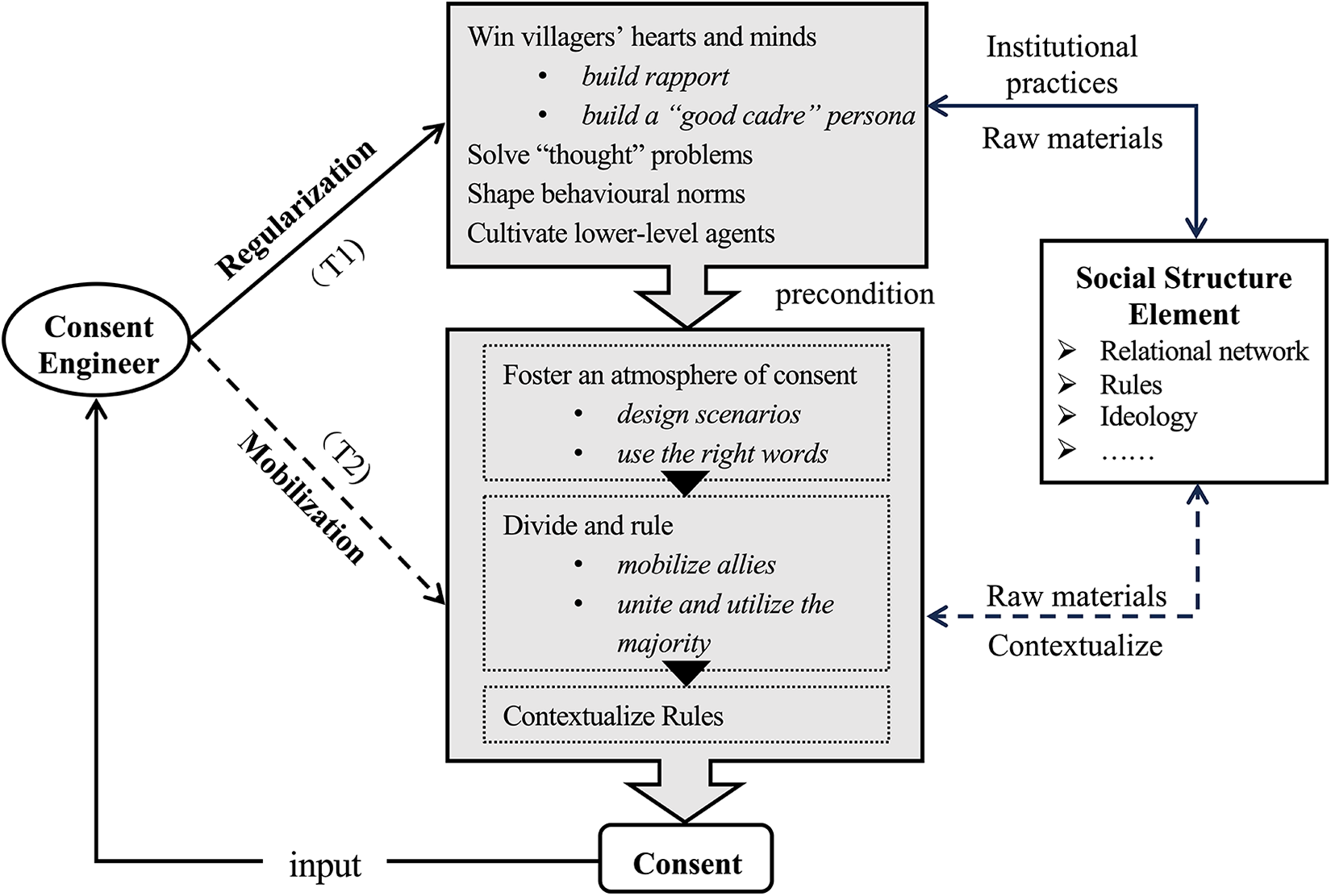
In general, there are two different phases to “constructing consent” – “regularization” and “mobilization.” During the regularization phase, grassroots officials engage in institutional practices designed to cultivate emotions, perceptions and relationships to support the future production of specific consent. The construction of consent can be accelerated when needed, by creating inducing situations in the mobilization phase. These two phases do not represent a one-time or one-way relationship. Preparing for consent is an ongoing, long-term process, and the outputs of consent also serve as inputs (see Figure 2). Furthermore, the interaction between “regularization” and “mobilization” is embedded in the interaction between actors and rural social structures. Social structures are part of the grassroots officials’ strategic toolkits to produce consent. These officials elicit consent using these structural elements and their derivatives, emotions and perceptions. Officials also reproduce these structural elements to create context for producing consent. The structural, institutional and day-to-day practices of these local officials naturalize consent production and make the consent interaction more realistic. Permanence and invisibility give the “constructing consent” a moral advantage, producing peasant consent in a way that is flexibly placed into an extended time framework, without leaving a trace.
Grassroots Officials’ Strategies for Constructing Peasant Consent
Conclusion
“Constructing consent” is a novel practice in rural governance and reveals the complexity of generating peasant consent. Previous research conceptualizes consent production as a series of loosely related contingency tactics, activated at critical moments when there is an explicit problem requiring consent. This study shows that the process of constructing consent takes longer, is implicit and more natural. This shift informs a re-examination of state–peasant relations.
In the Xi era in China, the party-state’s actions extend beyond merely obtaining peasant consent to a specific rural policy; rather, the goal is to penetrate rural society and foster an overall and broader sense of consent. Under the Xi administration, the party-state has steered society more subtly and covertly.Footnote 49 The actions taken by grassroots officials to construct consent illustrate this shift. They also demonstrate China’s authoritarian resilience in addressing growing demands for legitimacy,Footnote 50 without transforming the power structure.Footnote 51 Grassroots officials use complex and interactive persuasive techniques to gain cooperation and support for policies in a friendly and invisible manner.
Furthermore, the party-state seeks to significantly transform and tighten its control over rural society. Under administrative rural governance, cultivating peasant consent is necessary to realize the state’s vision of “building a beautiful countryside” without triggering peasant resistance. By fostering peasant consent, the party-state generates conditions that promote a harmonious relationship between the state and the countryside, effectively embedding the state in rural society. Unlike James Scott’s posited “simplistic and explicit” transformation, the state’s construction of consent transforms rural society in a subtle, gradual and less visible way.Footnote 52 Instead of relying on violence and radicalization, this approach permeates everyday life. It also aims to restructure rural society by changing its power structures, social relations and the ways in which peasants think. Constructing consent is grounded in everyday emotional relationships with peasants and is characterized by “socialized governance.” Shaping peasant consent by exploiting local social norms blurs the boundary between state commands and social integration and reduces resistance at the grassroots level.Footnote 53
Transforming rural society is primarily a top-down process, while constructing consent is a grassroots-level political art, which has a largely unknown impact on rural communities. Future research should consider whether this strategy leads to division among peasants, fractures rural societies, creates internal antagonism, or disrupts the harmonious order in rural areas. Studies should also explore whether excessive reliance on manipulating peasant emotions to construct consent leads to “emotional exhaustion,” thereby complicating subsequent efforts. These questions are worth exploring further.
This study does have some limitations that need to be addressed in future research. First, constructing consent is a developing governance practice. Despite considerable data collection and analysis, the study may have missed some mechanisms and strategies. Second, this study uses the case study of the rural construction initiative to study constructing consent; other policy contexts may differ. Future research should further explore the diverse strategies used by grassroots governments to manufacture peasants’ consent across different policy contexts and examine the nuanced shifts in the relationship between the party-state and peasant.
Supplementary materials
The appendices are available online at https://doi.org/10.1017/S0305741025100714.
Acknowledgements
This study was supported by the National Natural Science Foundation of China (Grant/Award No. 72474075).
Competing interests
None.
Lei YANG is an assistant professor at the College of Public Administration, Huazhong University of Science and Technology. He earned his doctoral degree at the College of Public Administration, Huazhong University of Science and Technology, China. His research interests include urban and rural development and local governance in China.
Yuanmin SUN is a PhD candidate at the College of Public Administration, Huazhong University of Science and Technology. Her research focuses on local governance in China, and politics and policy in China.
Changkun CAI is an assistant professor at the College of Public Administration, Huazhong University of Science and Technology. He earned his doctoral degree at the School of Public Administration and Policy, Renmin University of China. His research interests include politics and policy in China, public service delivery and institutional analysis.