


Introduction
One of the two most common reasons for sickness absence is stress and anxiety (the other is musculoskeletal problems) (Health & Safety Executive, 2013). The financial cost of stress-related sickness absence has been estimated as £1.4 billion per annum (NHS Employers, 2014). This figure represents only a quantitative estimate of the loss of employee time. There is also a detrimental impact on the quality of care and treatment delivered by the NHS where there are high levels of sickness absence. Poorer outcomes for patients/service users are found where there are high levels of temporary staffing often due to sickness absence (Needleman et al. Reference Needleman, Buerhaus, Pankratz, Leibson, Stevens and Harris2011).
By contrast, organizations where staff members feel valued are more successful (e.g. Foresight Mental Capital and Wellbeing Project, 2008). Mortality in patients in healthcare organizations that have a culture of staff development is lower. Sickness absence is also lower (West & Dawson, Reference West and Dawson2012).
The impact on the individual who is off sick with stress and anxiety is considerable. It is known that individuals who are off on prolonged absence are much more likely not to return to work (Black & Frost, Reference Black and Frost2011). This has a detrimental impact on their well-being over the long-term. Unfortunately, management and occupational health input often only start after the individual is off sick for a specified period of time and while these can be successful in enabling individuals to return to work, they are reactive to a problem rather than proactive and preventative. Health and well-being initiatives promote a more holistic approach – preventative as well as interventionist.
There are a number of key drivers that support the development of well-being in work. The Black report into health and work (Black, Reference Black2008) indicated the need to have holistic approaches to health at work and improving the health of the population to enable them to work. The Boorman report into the NHS (Boorman, Reference Boorman2009) indicated the need for health and well-being interventions for its staff. This was restated by the Department of Health (DoH) in the ‘Health and well-being improvement framework’ (DoH, 2011). Available evidence and guidance (NICE, 2009) suggests that interventions to manage or prevent stress have beneficial effects in improving health and work outcomes (Graveling et al. Reference Graveling, Crawford, Cowie, Amati and Vohra2008).
More recently, the report following the public enquiry into Mid Staffordshire NHS Foundation Trust (Mid Staffordshire NHS Foundation Trust Public Enquiry, 2013), known as ‘the Francis Report’ identified staff behaviours that contributed to the appalling experiences of patients. The development of ‘Compassion in practice’ (DoH, 2012) identifying the six ‘C’s: Care, Compassion, Competence, Communication, Courage, Commitment, has been a response to this in aiming to improve staff behaviour. Similar approaches have been found with person-centred care approaches (e.g. The Health Foundation, 2014), these seek to put the patient at the heart of NHS care. They are important in describing the framework in which care and treatment should be delivered. They do not in themselves provide the skills and competences to enable staff to deliver the expected high quality of care.
Proposals such as Schwartz Rounds (Lown & Manning, Reference Lown and Manning2010) are focused on reflection and the sharing of difficult experiences and emotions. The format of Schwartz Rounds includes a case presentation around a theme that enables a multi-professional group of staff to share and understand the emotional experiences of delivering care. The evidence base in the UK to date has shown that staff members attending the Rounds have felt supported and that relationships between staff and their patients improve (Goodrich, Reference Goodrich2011). They do not focus on the individuals’ own methods of managing their own experiences in difficult situations and therefore may not enable all staff to improve their compassionate care.
Many NHS organizations have also sought to improve the process around care and treatment by the introduction of quality improvement/management systems (e.g. Lean approaches, Jones & Mitchell, Reference Jones and Mitchell2006). These seek to reduce inefficiencies but do not always directly aim to improve care or staff well-being.
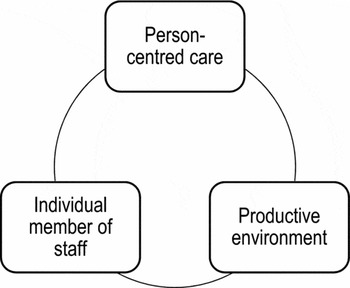
One area that is lacking in these approaches is the member of staff themselves in this environment and how they conduct themselves. Their ability to manage themselves within their daily environment is a key component of care. This is illustrated in Figure 1.
Link between staff well-being, person-centred care and productivity.

Focusing on staff well-being is a key component in the delivery of high-quality care. This also promotes a preventative approach to staff sickness. Interventions focusing on staff well-being have focused on stress management techniques which can be of benefit in identifying and managing unhelpful coping strategies and behaviours. Given the current context of challenging economic circumstances and the need to deliver public services with constrained finances, there is a need to support staff enabling them to deliver high-quality services under these pressures. Well-being approaches are recognized as having a beneficial effect (Edwards & Burnard, Reference Edwards and Burnard2003).
Mindfulness approaches have also been noted to be of some benefit but are resource-intensive to deliver and require significant commitment to maintain mindfulness practice. An 8-week mindfulness course requires attendance at 2-hour sessions per week with an hour of practice daily to acquire and maintain competence but they do not suit everyone (Perez-De-Albeniz & Holmes, Reference Perez-De-Albeniz and Holmes2000).
Cognitive Behaviour Therapy (CBT) has been used widely and successfully for people with anxiety and/or depression as well as a number of other mental and/or physical health problems. CBT also has demonstrable benefits on mental well-being in the workplace (Graveling et al. Reference Graveling, Crawford, Cowie, Amati and Vohra2008). Approaches have tended to focus on the individual's difficulties and identifying unhelpful patterns of thoughts and behaviours and seeking to modify these.
In relapse prevention work within the therapeutic model, strengths-based approaches have been used in relapse prevention (Tarrier, Reference Tarrier2010). These have sought to identify helpful coping strategies that individuals can use to maintain the improvement in their emotional well-being. These include identifying thoughts and behaviours that promote emotional well-being and have been used successfully therapeutically for depression and anxiety.
The development of the positive psychology literature describes interventions designed to increase ‘wellness’ and ‘happiness’ by focusing on these rather than the ‘disorder’ or ‘deficit’ approach typified within health service provision. Positive psychology principles are used to build strengths and positive experiences to enable individuals to manage their own emotions to enhance their well-being. Guided imagery approaches have been used to enable individuals to utilize previous positive experiences and/or construct positive templates for the future (see Hackman et al. Reference Hackman, Bennett-Levy and Holmes2011). These principles are not restricted to only those who present with mental health problems but can be applied to a variety of situations by a diverse range of populations. There is an opportunity to develop strengths-based approaches for staff members that will enable them to recognize and manage difficulties during their working day. Clearly, these may also generalize to their personal lives.
If staff members are able to improve their emotional self-management and thus their emotional well-being, they will then be able to function more effectively and develop greater resilience to the challenges of the working environment. Therefore, offering these approaches to a staff-based group would potentially enable better staff well-being and better outcomes for patients.
What does a strengths-based CBT approach involve? It would involve: familiarization with the cognitive behavioural model (thoughts, feelings, behaviours, sensations and environmental context), followed by identifying situations where an individual is managing well and seeking to enable translation to more difficult settings. The strengths-based CBT intervention, while focused at promoting better coping strategies at work, is intended to be generalizable to activities outside work. Better management of home tasks and activities will also improve the capacity of staff to manage both difficult work situations and those that are part of their daily workload. Positive psychology principles contribute to this approach by building on strengths and positive experiences enabling individuals to manage their own emotions enhancing their well-being. Guided imagery approaches have been used to enable individuals utilize previous positive experiences and construct positive templates for the future. The Looking After Me Looking After You (LAMLAY) programme was developed to enable staff to acquire these skills within a workplace setting within a comparatively short period of time.
LAMLAY includes the CBT model and positive imagery approaches enabling staff to identify strengths and utilize these to develop self-management strategies in more challenging settings. The LAMLAY programme has been delivered over 18 months within an NHS organization. This evaluation reports on the participants’ ratings of well-being and satisfaction with the course.
Methods
Participants
Participants were self-selected via advertising in the organizational newsletter. They were either employed within an NHS Mental Health and Community Trust or the local Strategic Health Authority. The advertising promoted the use of cognitive-behavioural techniques and positive imagery to improve well-being.
For the follow-up survey, participants were included in the sample where valid email addresses were available.
Measures
Participants completed a measure of well-being before and after completion of the LAMLAY course. This was completed directly before the start of session 1 and at the end of the final session. In keeping with the positive focus of the programme, a well-being measure was selected to measure for overall changes in well-being. The Warwick–Edinburgh Mental Well-Being Scale (WEMWBS; NHS Health Scotland, University of Warwick and University of Edinburgh, 2006) is a population-based measure of well-being that was initially developed for use with the adult population of Scotland. It has been used in a range of populations to assess overall well-being including parenting interventions (Simkiss et al. Reference Simkiss, Snooks, Stallard, Kimani, Sewell, Fitzsimmons, Anthony, Winstanley, Wilson, Phillips and Stewart-Brown2013), students (Davoren et al. Reference Davoren, Fitzgerald, Shiely and Perry2013), older people (Cooper et al. Reference Cooper, Stafford, Hardy, Aihie Sayer, Ben-Shlomo, Cooper, Craig, Deary, Gallacher, McNeill, Starr, Kuh and Gale2014), carers of people with dementia (Orgeta et al. Reference Orgeta, Lo Sterzo and Orrell2013) and also as a measure of change in mental health interventions (Collins et al. Reference Collins, Gibson, Parkin, Parkinson, Shave and Dyer2012; Maheswaran et al. Reference Maheswaran, Weich, Powells and Stewart-Brown2012). It comprises 14 positively worded statements on well-being which the individual rates on a 5-item scale (none of the time, rarely, some of the time, often, all of the time) on how much they think the statement applies to them. It was selected as a validated measure of well-being within a non-clinical population (Tennant et al. Reference Tennant, Hiller, Fishwick, Platt, Joseph, Weich, Parkinson, Secker and Stewart-Brown2007; Stewart-Brown et al. Reference Stewart-Brown, Tennant, Tennant, Platt, Parkinson and Weich2009) that is also sensitive to change (Maheswaran et al. Reference Maheswaran, Weich, Powells and Stewart-Brown2012).
Participant satisfaction was also measured at each session via three 4-point Likert scales focusing on participants’ perceptions of the course. The questions were: ‘How helpful has this session been for you?’; ‘How easy to understand has the information in this session been?’; and ‘How much have you enjoyed this session?’ Participants were also encouraged to provide comments on the course.
The follow-up survey was conducted in June 2013 and participants from the first nine courses were included. These courses ran from March 2012 to March 2013 so the follow-up period ranged from 3 months (course 9) to 15 months (course 1). Measures included the WEMWBS in order to assess for further changes in well-being in the participants. Participants were also asked about their use and frequency of use of the techniques learned during the LAMLAY course. The five questions asked about frequency of use of: the techniques learned; challenging thinking; positive image; positive image of work; and positive image and challenging thinking together.
LAMLAY course
LAMLAY is delivered as a group-based intervention for staff over either three 3-hour sessions or four 2-hour sessions. These sessions are intended to take place weekly at a regular time, day and venue. Training methods include the provision of didactic information, group exercises and homework exercises. The LAMLAY course (three-session version) includes the following:
-
• Introduction to the cognitive behavioural model (session 1)
Use of the five-factor model (Greenberger & Padesky, Reference Greenberger and Padesky1995)
-
• Positive imagery (sessions 1, 2 and 3)
Participant-generated positive images to improve mood.
-
• Identifying thoughts, feelings and behaviours and their impact on work (sessions 1 and 2)
Rating emotions and identifying factors that impact on these.
-
• Identifying positive images of work (sessions 1 and 2)
Participant-generated positive images of a work situation and the impact on mood.
-
• Identifying and challenging negative thoughts (sessions 2 and 3)
Describing negative thoughts and identifying alternatives including participant-generated examples.
-
• Linking thinking and imagery (sessions 2 and 3)
How images and thoughts can affect perceptions of situations.
-
• Using thoughts and images for work situations (session 3)
Using cognitive and imagery techniques to manage potentially challenging work situations.
-
• Identifying social networks and support (session 3)
Participant exercises to identify their own networks and support.
-
• Using the resources in the future (session 3)
Identifying resources.
Data analysis
All data were entered into Excel and descriptive and statistical analyses performed either via Excel (t test) or via SPSS (ANOVA).
Results
Nine courses were delivered to 117 participants (92.3% female). The completion rate was 77.8% (missing one session at most). Seventy-five participants (83% of completers) completed both the WEMWBS pre-course and post-course (see Table 1). A paired t test showed significant improvements in well-being (t = 9.32, d.f. = 74, p<0.0001, Cohen's d = 0.82).
Pre- and post-course WEMWBS comparisons (WEMWBS completed pre and post by course completers)

WEMWBS, Warwick–Edinburgh Mental Well-Being Scale.
Satisfaction ratings taken at each session from each participant (total n = 374) indicated high approval levels with mean scores a minimum of 3.70 out of a possible 4 on each measure (Table 2).
Participants’ satisfaction ratings (n = 374)

Comments by the participants were also extremely positive including the following:
‘Particularly enjoyed positive imagery because I could feel the calm the image brings.’
‘Excellent, very interactive. Challenge to think differently (less black and white). Think about cause and effect.’
‘It has been very helpful in getting me to step back and look at things from a different perspective – and I will use the things I have learned.’
The online follow-up survey was conducted in June 2013. The survey link was sent to all who had completed the course. The opt-in rate was 37.4% based on the valid email addresses (n = 99). Analysis of the WEMWBS scores at the three time points (pre-course, post-course, follow-up survey) (see Table 3) using ANOVA showed that improvements on the WEMWBS were sustained post-course (F 2,223 = 17.04, p<0.001, η2 = 0.13). The average time since course attendance was 7.5 months (range 3–15 months). Post-hoc analysis using Tukey's honestly significant difference test found a significant difference (p<0.001) between the pre-course and post-course WEMWBS scores and the pre-course and follow-up WEMWBS scores but not between the post-course and follow-up WEMWBS scores (Table 4).
WEMWBS comparisons pre-course, post-course and follow-up survey (all data)

WEMWBS, Warwick–Edinburgh Mental Well-Being Scale.
Tukey's honestly significant difference post-hoc analysis

WEMWBS, Warwick–Edinburgh Mental Well-Being Scale.
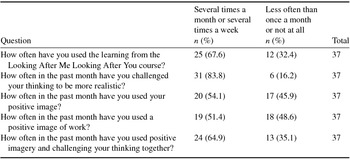
Survey feedback on the use of learning indicated that the majority (64.9%) of participants continued to rate the course as very helpful and used their learning several times a month or more frequently. The majority of participants used the techniques several times a month or more frequently (see Table 5). Statistical analysis was not undertaken due to the small sample size.
Survey feedback on use of learning

The results indicate that the LAMLAY course was well-received given the low drop-out rate and high satisfaction ratings. In addition, the participants’ self-rated well-being was sustained at follow-up. The average follow-up interval was 7.5 months post-course. Large to modest effect sizes were found as indicated by the Cohen's d statistic and η2 (Tabachnik & Fidel, Reference Tabachnik and Fidel1996). Self-rated reports of the frequency of usage of techniques learned indicated that the majority of follow-up survey participants continued to use these several times a month or more frequently.
Discussion
This study shows that staff who attended the LAMLAY course improved in psychological well-being after completion of the course. The follow-up survey completed by a third of the participants showed that this improvement was sustained over an average post-course follow-up interval of 7.5 months.
The LAMLAY course was also well-received by staff with positive ratings of its perceived helpfulness, ease of understanding and enjoyableness. This is supported by the low drop-out rate. The majority of the participants who completed the follow-up reported that they used the techniques learned several times a month or more frequently.
It appears that the LAMLAY course does have a positive impact on those who attended it. However, this investigation into the LAMLAY programme did not have a control group. Therefore, it cannot be concluded that the LAMLAY course was the key factor in improving participants’ well-being. The participants’ well-being could have also been affected by both related and unrelated events over the period of time the participants attended the course. These could include having the time within work to reflect and engage in training increasing the individual's rating of their own well-being. It is also possible that participants’ work environments improved for the better by the end of the course. However, this may be unlikely given the spread of participants across a large NHS community and mental health trust.
For the participants who completed the follow-up, they may have been more inclined to complete the follow-up survey because they had found the course useful with the remaining non-participants likely to have positive, negative and neutral perceptions. There may have been fluctuations in well-being between the end of the course and the follow-up point but on average the follow-up participants’ well-being scores were not significantly different from the end of course scores. If the non-participants were assumed to have gained no lasting benefit from the course then it can still be concluded that a third of participants demonstrated sustained improvements in well-being on average. This may well be subject to the same caveats of attribution and further investigation is required to determine the relationship between LAMLAY and improved psychological well-being.
This study was conducted only with the limited cohort of course participants and the current service provision did not enable the use of control groups or participant randomization to determine the impact of LAMLAY more robustly. Consequently, the characteristics of the participants as being typical of the population of healthcare staff were not determined in this study. It is not known how many self-selected on the basis of their own perceived stress levels or were encouraged to attend by their managers. This would benefit from further investigation. A future study would include more demographic and workplace information on the participants to determine how representative they were of the wider health service workforce.
While this study has shown benefits to the individuals who have attended the course, the benefits to the organization and also to patient care were beyond the scope of the current programme. Further work in assessing sickness absence rates of the individual participants to determine whether the participant cohort were absent more frequently compared to organizational means is necessary. In addition, exploring whether there was a reduction in absence following the course would be helpful in determining organizational benefit. Given that stress and anxiety are among the most common reasons for absence with the NHS, it will be important to analyse this in future work. Absence rates can also serve as a proxy indicator for patient care in that organizations with lower numbers of temporary staff have better patient outcomes (Needleman et al. Reference Needleman, Buerhaus, Pankratz, Leibson, Stevens and Harris2011). A systematic roll-out of the LAMLAY course to individual teams and services would also enable evaluation of impact on patient care via the use of patient outcome measures and the Friends and Family test (NHS Employers, 2014).
Finally, while the techniques included in LAMLAY have a clear evidence base within therapeutic work, it would be helpful to investigate the mechanism of how LAMLAY contributes to improved well-being. Further work is required to elucidate the key aspects of the intervention that appear to contribute positively to staff well-being.
Despite these methodological limitations, it can be concluded that the teaching of cognitive behavioural and imagery techniques is favourably received by staff who also show improvements in well-being following the intervention although these cannot be wholly attributed to the LAMLAY course. It also contributes to staff health and well-being by being one of potentially a range of interventions that organisations can offer to help prevent distress and ill-health in staff. The course is also relatively cost-effective in that preliminary estimates would suggest that the costs of delivering the course in groups of up to 16 would cost approximately £60 per delegate for the 9 hours of training. Staff attendance costs have been estimated at £150–200 per delegate based on Agenda for Change bands 3–7. This compares favourably with the time and financial commitment required to attend 8-week mindfulness courses.
Cognitive-behavioural techniques are rarely offered to staff outside the context of occupational health referrals for therapy for specific work-related problems. There is evidence that these techniques are beneficial to individuals in managing workplace difficulties impacting on their mental health (Graveling et al. Reference Graveling, Crawford, Cowie, Amati and Vohra2008). However, there have been no reports of programmes that have used cognitive behavioural techniques with staff members who have not been formally involved in occupational health processes. Consequently, this study may be the first to report the successful use of these techniques with staff who are engaged in work and not defined or selected on the basis of their mental health. Furthermore, the positive imagery approaches have been offered successfully in both mental health relapse prevention (e.g. Tarrier, Reference Tarrier2010) and also in promoting performance in sport (Moritz et al. Reference Moritz, Hall, Martin and Vadocz1996) but again not within the context of everyday workplace practice.
This relatively small programme has been delivered over 18 months on an opportunistic basis within a large mental health and community NHS trust. Developing this approach more systematically in other settings would also enable identification of the key issues involved in scaling this up to a larger programme. This would also necessitate training other trainers to deliver the programme. Further work is planned to address these issues.
The importance of staff well-being is key in the post-Francis world and the pressure on staff to deliver high-quality services in a cost-constrained environment. This small-scale pilot programme has demonstrated that CBT and imagery techniques may have a lasting beneficial effect on well-being on a relatively small, self-selected group but further work is required to determine the effectiveness of this approach at scale and also the mechanism of change.
Key points
-
• Staff well-being is important in the delivery of high-quality person-centred care.
-
• Imagery and positive CBT can have a beneficial effect on staff well-being.
-
• The impact of the LAMLAY course was positive on ratings of well-being measured by WEMWBS.
-
• Improvements in well-being were sustained at follow-up.
Acknowledgements
This work received no specific grant from any funding agency, commercial or not-for-profit sectors.
Declaration of Interest
None.
-
(1) To find out about well-being and work.
-
(2) To learn how CBT techniques can be used to improve staff well-being.
-
(3) To learn how imagery techniques can be used to improve staff well-being.







Comments
No Comments have been published for this article.