

Introduction
Vitamins are essential in diets and form the most expensive feed ingredients in animal feed. However, most vitamins are not stable and can undergo significant deterioration during feed processing and storage (Scott, Reference Scott1972; Killeit, Reference Killeit1988; Coelho, Reference Coelho1991). Besides many other factors, trace minerals such as Zn, Cu and Fe have a detrimental effect on the stability of vitamins due to redox reactions, which is an important consideration in feed premixes containing both vitamins and trace minerals (Wornick, Reference Wornick1968; Shurson et al., Reference Shurson, Salzer, Koehler and Whitney2010). Research showed that 55% of vitamin B6 activity was lost when included in a multi-vitamin premix containing inorganic trace minerals which was stored at 36.7°C for three months, compared to a 24% loss in a similar premix containing no trace minerals (Adams, Reference Adams1972). It was reported that free metal ions are the most reactive and destructive to vitamins in premixes, followed by sulphates, carbonates and oxides (Creek et al., Reference Creek, Carrick, Hauge and Parker1960; BASF, 1999; Coelho Reference Coelho2002). Some in vitro observations have indicated that chelated minerals have a less destructive effect on the vitamin stability than inorganic forms (Luo et al., Reference Luo, Ji, Lin, Steward, Lu, Liu and Yu2005; Lu et al., Reference Lu, Wang, Zhang, Steward, Luo and Liu2010). This is possibly due to the structure of chelation that protects active free metal ions from reactions with other compounds, such as vitamins. There is little information about vitamin stability in premixes with organic mineral chelates in current literature. In order to investigate the effect of different mineral premixes (inorganic or organic) on the activity of vitamins in the premix, a marginal level of vitamins (30% commercial level as reported by Chadwick et al., Reference Chadwick, Malheiros, Ferket and North2018), was used in the current trial. Besides the analysis of vitamin activity in the premix after storage, growth performance and bone characteristics of broiler chickens were observed.
Materials and Methods
Chickens and diet
One-day-old male broiler chicks from a local hatchery (Cobb-Vantress, Monticello, KY) were used. Chickens were housed in floor pens (122 × 183 cm) with room temperature following the current management guidance for Cobb 500. Light was provided at 20L: 4D daily. Chickens were given ad libitum access to feed and water. All procedures were approved by the University of Kentucky Institutional Animal Care and Use Committee.
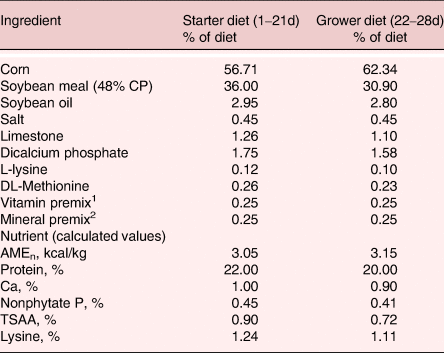
A corn-soybean meal basal diet (Table 1), fed in mash form, was used and formulated to be adequate in all nutrients (National Research Council, 1994). Minerals were added to the diet as either inorganic mineral salts or organic mineral proteinates (Bioplex® mineral, Alltech Inc. Nicholasville, KY) for Zn, Cu, Mn and Fe (Table 1). Organic Se (Sel-Plex®, Alltech Inc., Nicholasville, KY) at 0.3 mg/kg of diet was used to replace sodium selenite at 0.3 mg/kg of diet in control diet.
Ingredients and nutrient composition (as-fed basis) of the basal diet

1Supplied per kg diet for all diets: 9900 IU of vitamin A (retinyl acetate), 2750 IU of vitamin D3, 1.98 mg of vitamin K3, 1.98 mg of thiamine, 6.6 mg of riboflavin, 44 mg of niacin, 11 mg of Ca pantothenate, 3.96 mg of vitamin B6 (pyridoxines), 0.11 mg of biotin, 1.32 mg of folic acid, 495 mg of choline, 19.8 μg of vitamin B12 (cyanocobalamin).Vitamin E (DL-α-tocopheryl acetate): 33 IU/kg.
2Supplied per kg diet for the diets containing inorganic salts: 45 mg Fe as FeSO4·H2O, 100 mg Mn as MnSO4·H2O, 10 mg Cu as CuSO4·5H2O, 100 mg Zn as ZnO, 0.35 mg I as KIO3, and 0.30 mg Se as sodium selenite. Supplied per kg diet for the diets containing organic minerals: 11 mg Fe as Bioplex Fe, 40 Mn as Bioplex Mn, 4 mg Cu as Bioplex Cu, 40 mg Zn as Bioplex Zn, 0.35 mg of iodine as KIO3, and 0.30 mg Se as Sel-Plex.
Experimental design and sampling
A randomised, complete block design was used in this study, with blocks based on physical location of the pens within the room. Treatments were a 2 x 2 factorial arrangement with two levels of vitamins (100 or 30% commercial level) and two forms of minerals (inorganic mineral premix at a commercial level or organic mineral premix at recommended level by the company). The vitamin premix was provided by DSM Nutritional Products, Inc. (Parsippany, NJ). The low level of vitamins (30% commercial level) was used to represent a marginal level under research conditions based on findings reported by Chadwick et al. (Reference Chadwick, Malheiros, Ferket and North2018). The four treatments were: (1) corn-soy basal diet containing 100% vitamin levels and inorganic minerals; (2) corn-soy basal diet with 100% vitamin levels and organic minerals; (3) corn-soy basal diet with 30% vitamin levels and inorganic minerals; (4) corn-soy basal diet with 30% vitamin levels and organic minerals. The premixes containing 30% vitamin level with an inorganic minerals (MV1) and 30% vitamin level with organic minerals (MV2) were stored in room temperature for 90 days before feeding.
A total of 1056, one-day old chicks were randomly assigned to one of four dietary treatments to give 12 replicate pens of 22 chicks. The experiment lasted for 28 days. Chickens and feed were weighed at the beginning of the trial and then weekly. Feed conversion ratio was calculated and corrected for mortality. On d 21, one chicken from each pen (12 chicks per treatment) was randomly selected and euthanised using argon gas followed by cervical dislocation. The tibia and femur were taken for the analysis of breaking strength and ash content. Right side tibias and femurs were cleaned and used for the assay of breaking strength by using an Instron Testing Instrument (Instron Ltd, Norwood, MA, USA). Left tibias were boiled in deionized water for 15 min, cleaned of all soft tissue and dried at 60°C for 72 h. Following this, tibias were extracted in petroleum ether for 72 h and dried for 12 h at 105°C before ashing at 600°C overnight in a muffle furnace. The defatted dry weight and ash weight of the tibia was recorded and used for the calculation of ash percentage.
Statistical methods
Data were subjected to ANOVA as a 2 × 2 factorial design using the linear model of Statistix V. 9 (Analytical Software, 2008). Mean differences were determined using Fisher's LSD test. The group averages of all birds (22) per pen were used for analysis of growth performance data while the averages of 12 randomly selected birds per treatment were used for analysis of bone breaking strength and ash content.
Results and discussion
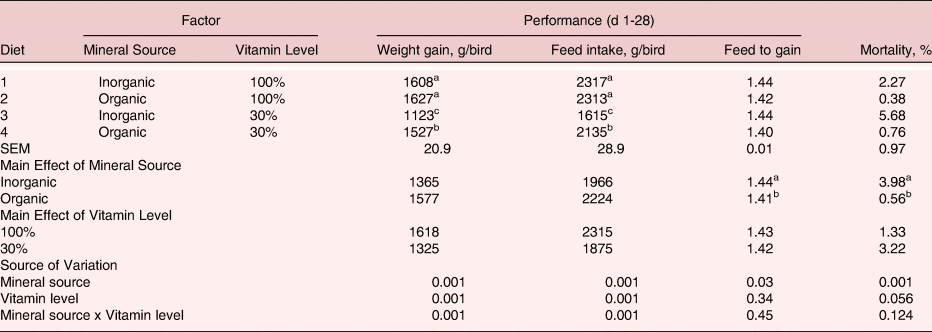
The effects of dietary treatments on the growth performance of broiler chickens are shown in Table 2.
Effects of dietary treatments on the performance of broiler chickens

Data represent means of 12 replicate groups of 22 chickens
a, b, c: P < 0.05
An interactive effect between vitamin level and mineral source on weight gain and feed intake of chickens was detected. Chickens fed diets containing 100% vitamin levels with either source of minerals had higher (P < 0.01) weight gain and feed intake than those fed the diet containing 30% vitamin levels with either source of minerals. However, the chickens fed the diet containing 30% vitamin levels with organic minerals had higher (P < 0.01) weight gain and feed intake than those fed the diet with inorganic minerals. Studies have indicated that inorganic trace mineral supplements, such as sulphate and oxide with copper, zinc and iron, were the most reactive and had a significant impact on vitamin stability in premixes (Creek et al. Reference Creek, Carrick, Hauge and Parker1960; Wornick, Reference Wornick1968; Christian Reference Christian1983; Shurson et al., Reference Shurson, Salzer, Koehler and Whitney2010). Chelated minerals, such as proteinates, are more stable and have a lower propensity for initiating formation of free radicals and, therefore, were the least reactive (Luo et al., Reference Luo, Ji, Lin, Steward, Lu, Liu and Yu2005; Lu et al., Reference Lu, Wang, Zhang, Steward, Luo and Liu2010). Chadwick et al. (Reference Chadwick, Malheiros, Ferket and North2018) reported that the growth performance and feed intake of chickens during a 42 d growing period were not affected by feeding 30% of normal commercial levels of vitamins under research conditions. The current results were different from previously reported findings, probably because the vitamin mineral premixes were stored at room temperature for 90 days before being mixed in the diets. Chickens fed the diet containing organic minerals had lower (P < 0.05) bird mortality and feed to gain ratio than those fed the diets containing inorganic minerals. Chickens fed the diet containing 100% vitamin levels tended to have lower (P = 0.056) mortality than those fed the diet containing 30% vitamins.
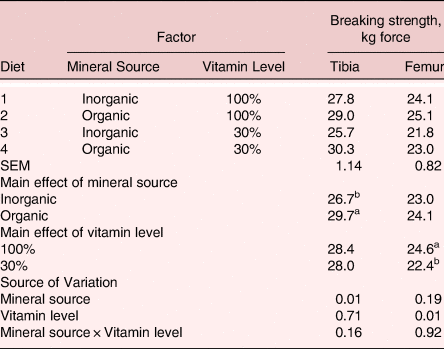
Table 3 lists the effect of dietary treatments on the bone breaking strength of chickens.
Effects of dietary treatments on the bone breaking strength of broiler chickens

Data represent means of 12 replicates (1 bird/replicate)
a, b: P<0.05
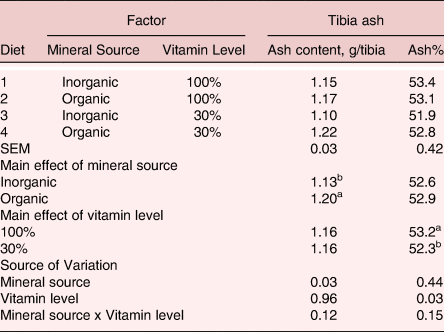
Chickens fed the diet containing organic minerals had higher (P < 0.01) breaking strength of tibia than those fed inorganic minerals, and those fed the diet containing 100% vitamin levels had higher (P < 0.01) breaking strength of femur than those fed the diet containing 30% vitamin levels. The effect of dietary treatments on the ash content of tibia is shown in Table 4.
Effects of dietary treatments on the tibia ash content of broiler chickens*

Data represent means of 12 replicates (1 bird/replicate)
* Tibia was fat free
a, b: P<0.05
Chickens fed the diet containing organic minerals had higher (P < 0.01) ash content than those fed inorganic minerals. Chickens fed the diet containing 100% vitamin levels had higher (P < 0.01) ash percentage than those fed the diet containing 30% vitamin levels. Vitamins such as vitamin D and vitamin K are important to bone development and health. Current results indicated different ash content of tibias from chickens fed different forms of mineral premixes. This is possibly due to the different impact of mineral premixes on the stability of vitamin premix.
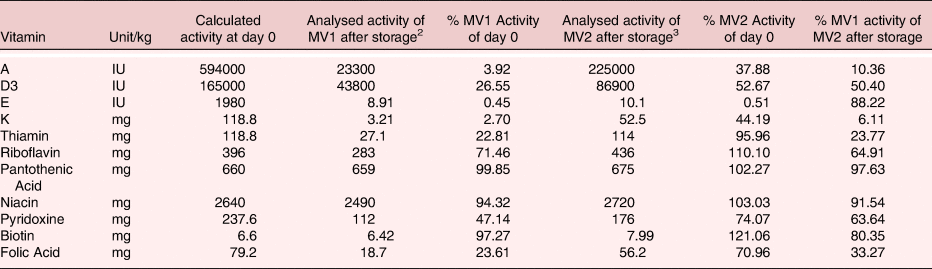
Table 5 shows the effect of different mineral premixes on the stability of vitamins in broiler diet premixes after 150 days of storage.
Effects of different mineral premixes on the storage stability of vitamins in broiler diet premixes1

1 the vitamin mineral premix was analysed after animal trial. The total storage time is 150 days
2 MV1: vitamins with inorganic mineral premix
3 MV2: vitamins with organic mineral premix
Compared with the calculated activity of vitamins at day 0, all vitamins except pantothenic acid, niacin and biotin in MV1 and thiamin, riboflavin, pantothenic acid, niacin and biotin in MV2 lost a significant portion (>25%) of their activity at the end of the storage period. Overall, the vitamins in MV1 lost more activity than those in MV2; for example, the activity of vitamin A and vitamin K in MV1 was only 10.36 and 6.11% of the activity in MV2 respectively. The activity of thiamin and folic acid in MV1 was only 23.77% and 33.27% of the activity recorded in MV2. The activity of vitamin D3 in MV1 was reduced by almost 50% compared with that in MV2. The activity of riboflavin and pyridoxine in MV1 lost 35% compared with that in MV2. These results were consistent with and reflected the performance and bone characteristic results from the broilers, whereby chickens fed MV1 which lost more vitamin activity had significant lower growth rate and feed intake and weaker bones than those fed diets with MV2.
Conclusions
The growth performance and bone characteristics of broiler chickens combined with the analytical results of vitamin activity indicated that total replacement of inorganic trace minerals with organic minerals can increase the storage stability of vitamins in feed premixes containing both vitamins and trace minerals.