


%20--%3e%3c!DOCTYPE%20svg%20PUBLIC%20'-//W3C//DTD%20SVG%201.0//EN'%20'http://www.w3.org/TR/2001/REC-SVG-20010904/DTD/svg10.dtd'%3e%3csvg%20version='1.0'%20id='Layer_1'%20xmlns='http://www.w3.org/2000/svg'%20xmlns:xlink='http://www.w3.org/1999/xlink'%20x='0px'%20y='0px'%20width='64px'%20height='64px'%20viewBox='5.5%20-3.5%2064%2064'%20enable-background='new%205.5%20-3.5%2064%2064'%20xml:space='preserve'%3e%3cg%3e%3ccircle%20fill='%23FFFFFF'%20fill-opacity='0'%20cx='37.785'%20cy='28.501'%20r='28.836'/%3e%3cpath%20fill='%23595959'%20d='M37.441-3.5c8.951,0,16.572,3.125,22.857,9.372c3.008,3.009,5.295,6.448,6.857,10.314%20c1.561,3.867,2.344,7.971,2.344,12.314c0,4.381-0.773,8.486-2.314,12.313c-1.543,3.828-3.82,7.21-6.828,10.143%20c-3.123,3.085-6.666,5.448-10.629,7.086c-3.961,1.638-8.057,2.457-12.285,2.457s-8.276-0.808-12.143-2.429%20c-3.866-1.618-7.333-3.961-10.4-7.027c-3.067-3.066-5.4-6.524-7-10.372S5.5,32.767,5.5,28.5c0-4.229,0.809-8.295,2.428-12.2%20c1.619-3.905,3.972-7.4,7.057-10.486C21.08-0.394,28.565-3.5,37.441-3.5z%20M37.557,2.272c-7.314,0-13.467,2.553-18.458,7.657%20c-2.515,2.553-4.448,5.419-5.8,8.6c-1.354,3.181-2.029,6.505-2.029,9.972c0,3.429,0.675,6.734,2.029,9.913%20c1.353,3.183,3.285,6.021,5.8,8.516c2.514,2.496,5.351,4.399,8.515,5.715c3.161,1.314,6.476,1.971,9.943,1.971%20c3.428,0,6.75-0.665,9.973-1.999c3.219-1.335,6.121-3.257,8.713-5.771c4.99-4.876,7.484-10.99,7.484-18.344%20c0-3.543-0.648-6.895-1.943-10.057c-1.293-3.162-3.18-5.98-5.654-8.458C50.984,4.844,44.795,2.272,37.557,2.272z%20M37.156,23.187%20l-4.287,2.229c-0.458-0.951-1.019-1.619-1.685-2c-0.667-0.38-1.286-0.571-1.858-0.571c-2.856,0-4.286,1.885-4.286,5.657%20c0,1.714,0.362,3.084,1.085,4.113c0.724,1.029,1.791,1.544,3.201,1.544c1.867,0,3.181-0.915,3.944-2.743l3.942,2%20c-0.838,1.563-2,2.791-3.486,3.686c-1.484,0.896-3.123,1.343-4.914,1.343c-2.857,0-5.163-0.875-6.915-2.629%20c-1.752-1.752-2.628-4.19-2.628-7.313c0-3.048,0.886-5.466,2.657-7.257c1.771-1.79,4.009-2.686,6.715-2.686%20C32.604,18.558,35.441,20.101,37.156,23.187z%20M55.613,23.187l-4.229,2.229c-0.457-0.951-1.02-1.619-1.686-2%20c-0.668-0.38-1.307-0.571-1.914-0.571c-2.857,0-4.287,1.885-4.287,5.657c0,1.714,0.363,3.084,1.086,4.113%20c0.723,1.029,1.789,1.544,3.201,1.544c1.865,0,3.18-0.915,3.941-2.743l4,2c-0.875,1.563-2.057,2.791-3.541,3.686%20c-1.486,0.896-3.105,1.343-4.857,1.343c-2.896,0-5.209-0.875-6.941-2.629c-1.736-1.752-2.602-4.19-2.602-7.313%20c0-3.048,0.885-5.466,2.658-7.257c1.77-1.79,4.008-2.686,6.713-2.686C51.117,18.558,53.938,20.101,55.613,23.187z'/%3e%3c/g%3e%3c/svg%3e)
%20--%3e%3c!DOCTYPE%20svg%20PUBLIC%20'-//W3C//DTD%20SVG%201.0//EN'%20'http://www.w3.org/TR/2001/REC-SVG-20010904/DTD/svg10.dtd'%3e%3csvg%20version='1.0'%20id='Layer_1'%20xmlns='http://www.w3.org/2000/svg'%20xmlns:xlink='http://www.w3.org/1999/xlink'%20x='0px'%20y='0px'%20width='64px'%20height='64px'%20viewBox='5.5%20-3.5%2064%2064'%20enable-background='new%205.5%20-3.5%2064%2064'%20xml:space='preserve'%3e%3cg%3e%3ccircle%20fill='%23FFFFFF'%20fill-opacity='0'%20cx='37.637'%20cy='28.806'%20r='28.276'/%3e%3cg%3e%3cpath%20fill='%23595959'%20d='M37.443-3.5c8.988,0,16.57,3.085,22.742,9.257C66.393,11.967,69.5,19.548,69.5,28.5c0,8.991-3.049,16.476-9.145,22.456%20C53.879,57.319,46.242,60.5,37.443,60.5c-8.649,0-16.153-3.144-22.514-9.43C8.644,44.784,5.5,37.262,5.5,28.5%20c0-8.761,3.144-16.342,9.429-22.742C21.101-0.415,28.604-3.5,37.443-3.5z%20M37.557,2.272c-7.276,0-13.428,2.553-18.457,7.657%20c-5.22,5.334-7.829,11.525-7.829,18.572c0,7.086,2.59,13.22,7.77,18.398c5.181,5.182,11.352,7.771,18.514,7.771%20c7.123,0,13.334-2.607,18.629-7.828c5.029-4.838,7.543-10.952,7.543-18.343c0-7.276-2.553-13.465-7.656-18.571%20C50.967,4.824,44.795,2.272,37.557,2.272z%20M46.129,20.557v13.085h-3.656v15.542h-9.944V33.643h-3.656V20.557%20c0-0.572,0.2-1.057,0.599-1.457c0.401-0.399,0.887-0.6,1.457-0.6h13.144c0.533,0,1.01,0.2,1.428,0.6%20C45.918,19.5,46.129,19.986,46.129,20.557z%20M33.042,12.329c0-3.008,1.485-4.514,4.458-4.514s4.457,1.504,4.457,4.514%20c0,2.971-1.486,4.457-4.457,4.457S33.042,15.3,33.042,12.329z'/%3e%3c/g%3e%3c/g%3e%3c/svg%3e)
Introduction
People with substance use disorders (SUD), particularly those with opioid use disorder (OUD), are at high risk of hospitalization for infections. Reference Wurcel, Anderson and Chui1,Reference Ronan and Herzig2 For example, hospitalizations with injection-related endocarditis increased twelve-fold from 2010 to 2015, and as many as 20% of patients with injection opioid use may die of endocarditis. Reference Marks, Munigala, Warren, Liang, Schwarz and Durkin3–Reference Barocas, Eftekhari Yazdi and Savinkina5 Injection-related infections may include conditions such as bacteremia, septic arthritis, osteomyelitis, endocarditis, and skin and soft tissue infections. Reference Bassetti, Hoffmann, Bucher, Fluckiger and Battegay6,Reference Binswanger, Kral, Bluthenthal, Rybold and Edlin7 A hospitalization for a serious infection can be an opportunity to engage or reengage in SUD care. However, many patients with SUD do not receive SUD treatment during their hospitalization, leading to missed opportunities for SUD care engagement, readmissions, and increased healthcare costs. Reference Walley, Paasche-Orlow and Lee8–Reference Rosenthal, Brokus and Sun11 Many injection-related infections require long-term parenteral antimicrobial therapy, often provided postdischarge as outpatient parenteral antimicrobial therapy (OPAT). Patients with SUD receiving OPAT versus patients without SUD tend to have longer lengths of stay, more patient-directed discharges (PDD), and increased readmissions. Reference Robbins, Ard, Wakeman, Alves and Nelson12
Most patients on OPAT receive parenteral therapy in their home with assistance from home infusion therapy. Reference Hamad, Lane, Beekmann, Polgreen and Keller13 Patients on OPAT often prefer receiving treatment at home, where they can be in more comfortable and familiar surroundings, when compared to skilled nursing facilities (SNF). Reference Mansour, Arbaje and Townsend14 While studies of patients with SUD suggest that many can be safely treated in the home with central venous catheters (CVCs) with appropriate addiction treatment, Reference Price, Solomon, Johnson, Montgomery, Martin and Suzuki15,Reference Appa and Barocas16 many home infusion agencies have policies that preclude patients with SUD from being treated in their homes, due to concerns for misuse of the CVC. Reference Kimmel, Rosenmoss, Bearnot, Larochelle and Walley17 Meanwhile, patients receiving OPAT in SNFs are more likely to experience process failures such as non-receipt of laboratory monitoring and poorer follow-up than those receiving OPAT at home, possibly related to communication barriers, and potentially as a result, are more likely to be readmitted within 30 days of hospital discharge. Reference Hamad, Lane, Beekmann, Polgreen and Keller13,Reference Mansour, Arbaje and Townsend14,Reference Keller, Ciuffetelli and Bilker18,Reference Huck, Ginsberg, Gordon, Nowacki, Rehm and Shrestha19 Understanding outcomes among patients with SUD requiring OPAT discharged to SNF is important in making decisions about appropriate locations to receive OPAT (eg, home, SNF, residential treatment facility, infusion clinic, etc.), as well as whether other options for infectious disease management may be appropriate (eg, long-acting injectable antimicrobials, oral antimicrobials, etc.). In this work, we aimed to compare engagement in SUD treatment at 30 days and other outcomes among patients with SUD discharged on OPAT to SNF compared to other locations.
Methods
In this retrospective cohort study, we reviewed records from patients with SUD who were discharged on OPAT from two academic medical centers in Baltimore, Maryland from April 2020 through April 2024. The Johns Hopkins University School of Medicine Institutional Review Board declared the work quality improvement/non-human subjects research (IRB00389870).
The OPAT Program encompasses both hospitals, and includes infectious diseases specialty physicians, pharmacists, and nurses, as well as pharmacy technicians and medical assistants. The OPAT Program manages patients discharged on OPAT to home, SNF, hemodialysis, prison or jail, infusion clinics, or other settings. A subset of patients with SUD, including those with a recent history of injecting drugs, can receive OPAT in a home setting via one home infusion company if there was insurance coverage, the patient would otherwise qualify for home infusion, the patient has a safe home setting, the patient is engaged in SUD care, and the patient is agreeable to home-based OPAT.
Both hospitals also have addiction consult services (ACS) comprised of addiction medicine providers, pharmacists, social workers and peer recovery specialists (PRS). PRS are individuals with lived experience of substance use and recovery who provide recovery support and connect patients to SUD treatment and other community-based resources patients can access posthospitalization. ACS clinicians provide recommendations on medication for opioid use disorder (MOUD) initiation or dose titration, as well as other medications for addiction treatment.
Patients included in this study were those who had received an infectious diseases consultation and diagnosed with an infection requiring OPAT, who also had a SUD diagnosis on their electronic problem list (eg, alcohol use disorder, OUD, stimulant use disorder, cocaine use disorder, tobacco use disorder, cannabis use disorder, or other illicit SUD; in remission or ongoing) in the electronic health record (EHR) and confirmed upon chart review. Patients discharged on long-acting injectable antimicrobial agents, patients discharged on complex oral outpatient antimicrobial therapy (COpAT), patients with PDD from the hospital prior to arrangement of OPAT, and children under the age of 18 were excluded.
The primary exposure was receipt of OPAT in a SNF. Demographic and clinical information regarding the patient’s infection and treatment including indication, SUD history and treatment, and discharge location to SNF or to other settings (eg, to home with or without additional support for SUD, to hemodialysis, to prison or jail, etc.) were abstracted. We further stratified SUD as ongoing (ie, within the last six months) or in remission. SUD treatment engagement could include medication-assisted or non-medication-assisted treatment in the community (eg, mutual aid organizations, inpatient treatment, outpatient treatment, residential treatment, intensive outpatient treatment, etc.). Charts were abstracted by three physicians (A.H., S.K., M.B.) and a trained research assistant (R.A.G.); a random sample of 20% of charts were re-reviewed by a physician.
Outcomes included all-cause readmissions within 30 days of discharge or between 31 and 90 days of discharge, ED visits within 30 days of discharge, length of hospital stay, receipt of required laboratory tests by the OPAT team, infection relapse within 90 days, Reference Keller, Wang, Salinas, Williams, Townsend and Cosgrove20 catheter complications, Reference Keller, Wang, Salinas, Williams, Townsend and Cosgrove20 OPAT-related adverse drug events, Reference Keller, Wang, Salinas, Williams, Townsend and Cosgrove20 and engagement in SUD treatment at 30 days. We also reported PDD from SNF as noted in the EHR and as recorded by the OPAT Program (who track down labs and manage appointments, and who attempt to call each SNF at least weekly). For engagement in SUD treatment at 30 days, if no documentation of community SUD treatment (including medication-assisted or non medication-assisted treatment) was in the chart, the patient was considered to not be engaged in treatment.
Descriptive statistics were used to assess characteristics of those discharged to SNF compared to those not discharged to SNF. Comparisons between groups of interest were tested using χ2 or Fisher’s exact tests for categorical variables and t-tests or Wilcoxon rank-sum tests for continuous variables. We also performed multivariate analyses examining the predictors of being engaged in SUD treatment 30 days postdischarge, focusing on patients discharged to SNF versus to other locations. Variables were considered for inclusion in the multivariate analysis via backward elimination. All analyses were conducted in Stata Ver. 15 (Stata Inc, College Station, TX).
Results
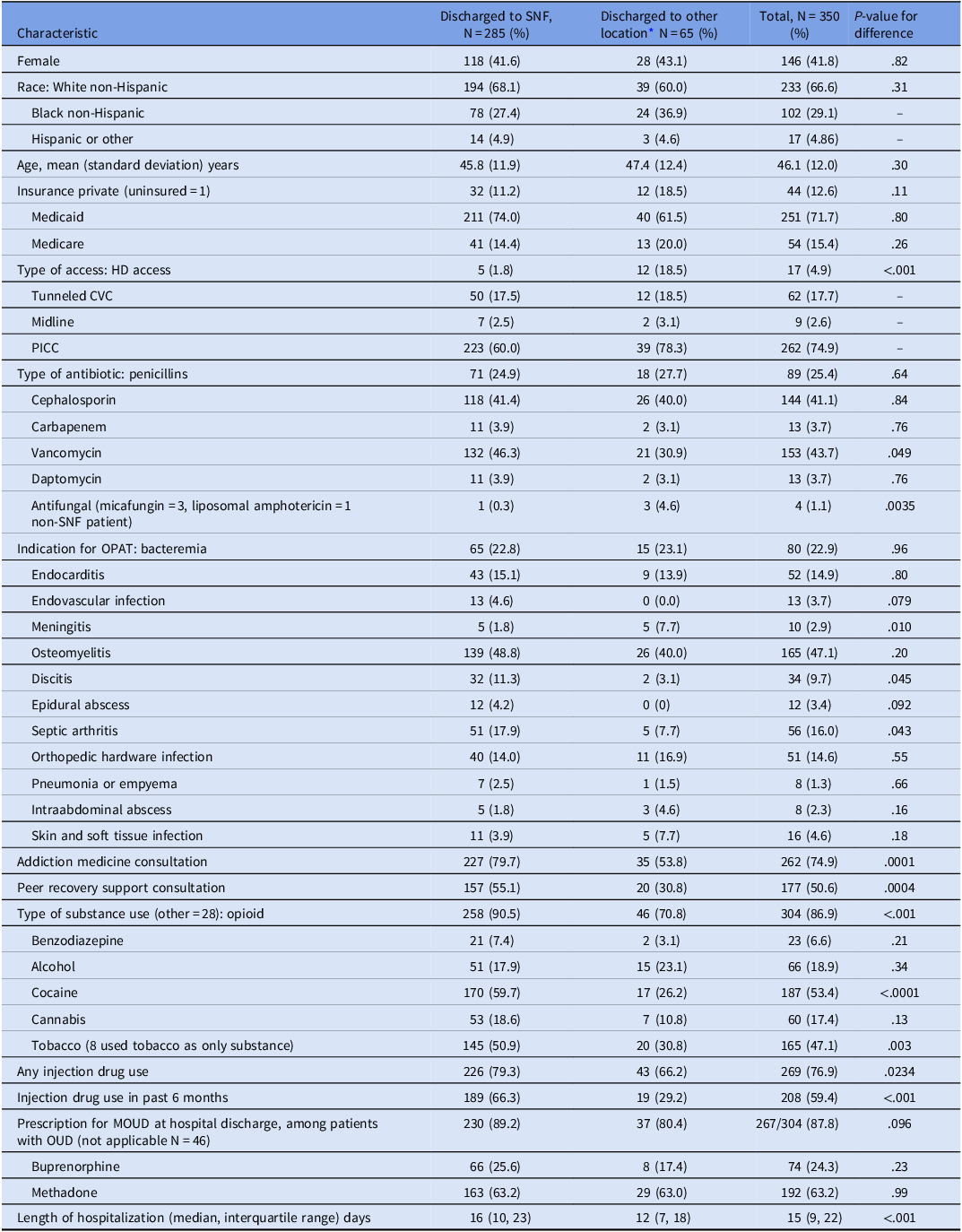
We reviewed records from 350 patients with SUD who were discharged on OPAT. Of these, 285 (81.4%) were discharged to a SNF while 65 (18.6%) were discharged to other locations including 4 (1.1%) discharged to a substance use residential treatment facility, 38 (10.9%) to a home-based OPAT program designed for patients with SUD, 9 (2.6%) to home without a specific program for patients with SUD, 13 (3.7%) to hemodialysis, and 1 (0.3%) to prison (Table 1). Fewer patients discharged to SNF had HD access (1.8% vs 18.5%, P < .001). More patients discharged to SNF were discharged on vancomycin (46.3% vs 30.9%, P = .049), while fewer patients discharged to SNF were discharged on a parenteral antifungal (0.3% vs 4.6%, P = .004). More patients discharged to SNF had reported any prior injection drug use (IDU, 79.3% vs 66.2%, P = .023) and IDU within the prior six months (66.3% vs 29.2%, P < .001). More patients discharged to SNF used opioids (90.5% vs 70.8%, P < .001), cocaine (59.7% vs 26.2%, P < .001) and tobacco (50.9% vs 30.8%, P = .003). More patients discharged to SNF had been seen by the ACS (79.7% vs 53.8%, P < .001) or PRS (55.1% vs 30.8%, P = <.001).
Descriptions of patients living with substance use disorders requiring OPAT receiving OPAT at SNF vs other location

* Substance use residential treatment facility: N = 4, 1.1%; Home with OPAT program for patients with SUD: N = 38, 10.9%; Home without OPAT program for patients with SUD: N = 9, 2.6%; Prison: N = 1, 0.3%; Hemodialysis facility: N = 13, 3.7%.
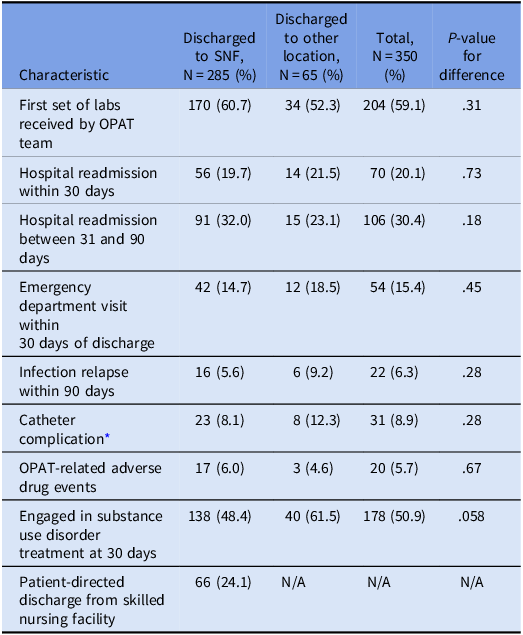
Outcomes were similar between the two groups (Table 2). There were no statistically significant differences in hospital readmission within 30 days (19.7% vs 21.5%, P = .73), hospital readmission between 31 and 90 days (32.0% vs 23.1%, P = .18), emergency department visits within 30 days (14.7% vs 18.5%, P = .45), infection relapse within 90 days (5.6% vs 9.2%, P = .28), catheter complications (8.1% vs 12.3%, P = .28), or adverse drug events related to OPAT (6.0% vs 4.6%, P = .67). However, median length of hospital stay was longer in the group discharged to SNF (16 d vs 12 d, P = .001). Almost one in four (24.1%) patients discharged to SNF experienced a PDD.
Outcomes among patients requiring OPAT with SUD discharged to SNF or to other locations

* Catheter complications include catheter fracture (N = 1), exit site infection (N = 1), occlusion (N = 3), venous thromboembolism (N = 1), catheter-related bloodstream infection (N = 5), bloodstream infection (N = 4), inadvertent removal (N = 5), catheter tampering (N = 12).
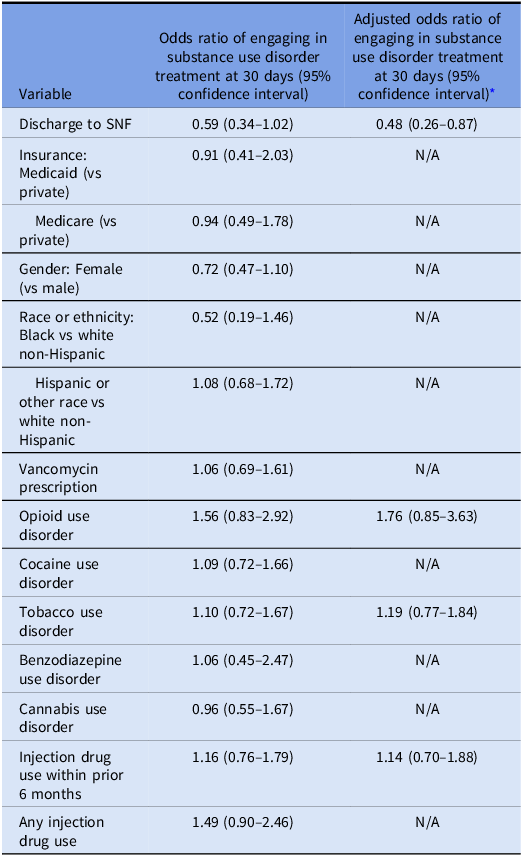
We also investigated likelihood of engaging in SUD treatment at 30 days postdischarge (Table 3). We found that when adjusted for OUD, tobacco use disorder, and IDU within the prior six months, being discharged to a SNF was associated with a lower likelihood of engaging in SUD treatment at 30 days postdischarge (adjusted odds ratio: 0.48, 95% confidence interval: 0.26–0.87).
Associations with engaging in substance use disorder treatment at 30 days

* Multivariate model included discharge to SNF, opioid use disorder, tobacco use disorder, and injection drug use within prior 6 months.
Discussion
We found that among patients with SUD requiring OPAT, there were no statistically significant differences in hospital readmission, emergency department visits, infection relapse, or complications for patients discharged to SNF compared to patients discharged elsewhere. However, length of hospital stay was prolonged in the group going to SNF, and patients discharged to SNF were less likely to be engaged in SUD treatment 30 days postdischarge.
Prior work has also suggested that patients with SUD requiring OPAT who were discharged to SNF experience high rates of healthcare services use, including 30-day hospital readmissions as high as 29%. Reference Langenstroer, Crnich, Jolles, Furuno, Noble and Bailey21 Our work adds to this by being one of the first to directly compare patients with SUD requiring OPAT discharged to SNF versus other locations (primarily home), and further suggest that patients with SUD may have similar outcomes whether they are discharged to SNF or not. One other study similarly failed to show a difference in outcomes in patients discharged to SNF on OPAT, Reference Robbins, Ard, Wakeman, Alves and Nelson12 but that study only followed 52 patients.
Other data suggest that patients discharged to SNF on OPAT have higher rates of non-receipt of laboratory monitoring and poorer follow-up than those receiving OPAT at home. Reference Keller, Ciuffetelli and Bilker18,Reference Huck, Ginsberg, Gordon, Nowacki, Rehm and Shrestha19 In our OPAT Program, we focus on obtaining laboratory test results from all locations patients are discharged to, which may have made us more successful in receiving laboratory test results from SNF. A strong OPAT program may mitigate some struggles noted with laboratory test result receipt in prior studies. Reference Hamad, Lane, Beekmann, Polgreen and Keller13 However, in our workflows, receiving laboratory test results from SNFs is extremely time-consuming.
In this study, patients with SUD requiring OPAT discharged to SNF versus to other locations had longer lengths of hospital stay. Some of this is likely due to the additional logistical work needed to identify an accepting SNF, although the extended length of hospital stay may also partially reflect infection severity and medical complexity. Previous work has shown that patients with SUD have lower rates of SNF acceptance and a higher likelihood of being accepted to lower quality facilities. Reference Kimmel, Rosenmoss, Bearnot, Larochelle and Walley17,Reference Kuye, Prichett, Stewart, Berkowitz and Buresh22,Reference Kimmel, Rosenmoss and Bearnot23 Taken together, these data suggest that patients with SUD requiring OPAT may have similar infection-related outcomes and shorter lengths of stay if they are discharged to a location other than a SNF if they otherwise qualify for a location other than a SNF.
In addition, we noted that patients discharged to SNF were less likely to still be receiving SUD treatment at 30 days posthospital discharge. This is not surprising, as there are multiple barriers that preclude arranging long-term SUD treatment until completion of the SNF stay, leading to delayed entry to SUD treatment. Patients discharged to SNF may have also had fewer social or economic resources to support ongoing engagement in SUD treatment. In our experience, most SNFs do not provide any SUD support or treatment. Reference Kuye, Prichett, Stewart, Berkowitz and Buresh22 Mean length of stay at SNFs in one study was 21 days; Reference Byrd, Stark and Head24 it is possible that some patients in our study may have then engaged in SUD treatment after discharge from SNF, but most SNFs also do not provide coordination services to ensure SUD care after discharge from SNF. At our hospitals, hospital-based PRS do not have capacity to support patients after hospital discharge, and cannot make direct referrals to community-based SUD treatment for patients being discharged to SNF, other than for outpatient treatment programs for continuation of methadone. In our clinical experience, the SNF stay often is a time when SUD treatment is lacking, with no treatment besides continuation of medication started in the hospital (ie, unlikely to have dose adjustments of MOUD), and no groups or other supports as well as risks of gaps in MOUD. A previous pilot included grant funding for a SNF-embedded PRS showed promise for increased uptake of MOUD during and after SNF stay, but more sustainable solutions are required. Reference Tassey, Ott, Alvanzo, Peirce, Antoine and Buresh25 We are exploring opportunities to fill this gap and better support continued SUD treatment by including outpatient PRS in care prior to discharge, and this remains an important area of study.
We also noted that one in four patients with SUD on OPAT discharged to SNF experienced a PDD. Other studies have shown that patients with SUD requiring OPAT frequently experienced PDD from SNF (20%) or otherwise left a SNF prior to the scheduled completion of therapy (16%). Reference Ashraf, Hoff and Brown26 Further investigations should explore whether and why patients with SUD requiring OPAT frequently experience PDD from SNF. Of note, we may have underestimated PDD in this analysis, as we did not have access to all of the SNF records and instead relied on OPAT Program members documenting that patients had experienced PDD when reaching out to SNFs for care coordination purposes.
Our study had limitations. We performed a retrospective review of medical records at two medical centers in one health care system with an ACS and an OPAT program, and some of the patients who received OPAT at home were enrolled in a program with a focus on SUD. It is possible that these results may not be easily translated to other health care systems. Similarly, our study only included patients who required OPAT, not including patients on complex outpatient antimicrobial therapy (COpAT) or long-acting injectable antimicrobials. However, for many patients with SUD requiring OPAT, alternatives to OPAT (such as COpAT, or long-acting injectable antimicrobial) may be more appropriate. We also may have underestimated SUD treatment engagement, as well as PDD, although the OPAT Program had ongoing communication with SNFs that allowed some of this data to be captured. The study population also did not include patients who experienced PDD from the hospital prior to initiating OPAT. There were fewer patients in the non-SNF group which may have limited the power to detect differences. We lacked data on housing status and other socioeconomic factors such as access to transportation that might influence postdischarge treatment options and the ability to engage in ongoing SUD or OPAT treatment. We did not include data on ACS in the final multivariate analysis of engagement in care as we felt that this was on the pathway of treatment rather than a confounder; however, it is important to note that more patients going to SNF had an inpatient addiction consultation. We used approaches to confirm engagement in care, but may not have fully counted all patients engaged in care. Finally, there is likely a difference between patients who may require SNF versus those who may not require SNF (eg, medical complexity, severity of infection, increased needs, unstable housing or housing status), and there is likely a subset of the patients attending SNF who would not have been eligible for OPAT at other locations even in the absence of SUD. This may have led to selection bias.
Our data adds to the growing literature reflecting a lack of increased risk of poor outcomes for selected patients with SUD who may be able to receive OPAT in other settings (eg, the home, infusion centers, addiction treatment centers, or hemodialysis), and patients receiving OPAT in other settings may have decreased lengths of hospital stay. Some barriers may exist; for example, lack of housing may preclude home OPAT as a treatment option. Ongoing partnerships with SUD treatment facilities may also present an option for OPAT delivery. In addition, as patients may be more likely to be engaged in SUD treatment if they do not go to a SNF, and as a significant proportion of patients with SUD discharged to SNF on OPAT in our study experienced PDD, there may be occasions when patients with SUD requiring OPAT would benefit from not going to a SNF. We suggest that decisions about the best treatment approach should be patient centered and multidisciplinary, accounting for the risks and benefits of each treatment location for the individual patient. More health systems-based work, including embedding OPAT into residential addiction treatment facilities and expanding access to home-based OPAT for patients with SUD, is needed to expand access to patient-centered options for completion of required antimicrobial therapy for patients with SUD.
Data availability statement
Data available upon request.
Acknowledgements
None.
Financial support
None reported.
Competing interests
All authors report no conflicts of interest relevant to this article.
Administrative, technical, or material support
Biostatistics, Epidemiology, and Data Management (BEAD) Core, Johns Hopkins School of Medicine, Baltimore, MD.
Patient consent statement
This study did not include factors necessitating patient consent.

 Open access

