Introduction
In middle-ear surgery, bone cement has been shown to provide equivalent or better auditory outcomes than conventional ossicular reconstruction materials.Reference Babu and Seidman 1 – Reference Wegner, van den Berg, Smit and Grolman 3 Its usefulness has also been shown in revision stapes surgery.Reference Wegner, van den Berg, Smit and Grolman 3 , Reference Van Rompaey, Claes and Somers 4
To improve the fitting of the reconstruction, the auditory ossicle surface must be completely dry prior to the application of bone cement. We report a new technique that allows the easy and safe removal of ossicle mucosa prior to bone cement application, and we present the auditory results of partial ossiculoplasty and revision stapes surgery cases.
Materials and methods
This retrospective study analysed all patients operated on between 2007 and 2012 in our centre by one surgeon. The surgeon utilised hydroxylapatite bone cement (OtoMimix; Olympus, Tokyo, Japan), using an auditory ossicle surface drying technique optimised by the authors. Surgery consisted of partial ossiculoplasty (in chronic otitis media without cholesteatoma cases) or revision stapes surgery.
Intra-operative reports and surgical technique data were collected. Pre- and post-operative audiometric averages (in dB) of pure tone air and bone conduction audiometry, at frequencies of 0.5, 1, 2 and 3 kHz, were calculated and reported.
Surgical technique
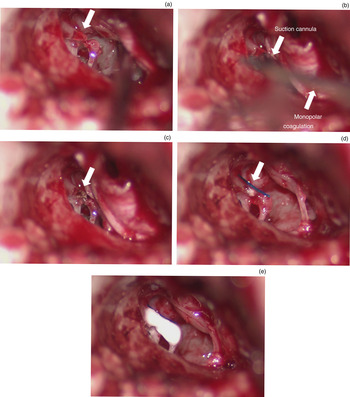
Prior to cement application, ossicle mucosa was removed with brief 3–5 W monopolar electrocoagulation (using an Erbe ICC 350 electrosurgical diathermy unit; Erbe Elektromedizin, Tubingen, Germany). Current was applied through a suction 2.0 mm cannula on the long process of the incus or the head of the stapes (Figure 1a, b). With this instant coagulation, the ossicles are dried. This allows proper application of the cement (Figure 1c). In addition, it prevented hazardous manipulations of the ossicles at risk of luxation.
Surgical steps showing reconstruction of the right incudostapedial joint destroyed following necrosis of the long process of the incus: (a) long process of the incus necrosis (arrow); (b) monopolar coagulation (arrow) through a suction cannula (arrow); (c) mucosa of remnant incus coagulated using brief 3 W coagulation (arrow); (d) short piece of non-absorbable size 5–0 suture (arrow); and (e) hydroxylapatite cement used to reshape incudostapedial joint.

Cement was then applied onto the ossicles. Specifically, the components of the cement were mixed for 45 seconds until it reached a viscous consistency. A droplet was applied to reshape the ossicular joint, modelled with a curved tip and left to completely dry (about 5 minutes). Particular attention was paid to this process to avoid any blood or fluid contamination.
In patients undergoing revision stapes surgery and in whom the long process of the incus was lysed, the prosthesis was placed on the remnant of the long process and stabilised using a drop of cement. During partial ossiculoplasty, the long process of the incus and the head of the stapes were bridged with a drop of cement (Figure 1e). In cases where destruction of the long process prevented direct contact, a piece of non-absorbable suture (Prolene® size 5–0) was used to bridge the incus and stapes prior to reconstruction (Figure 1d).
Results
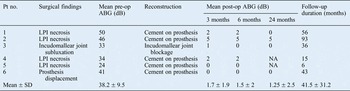
The study included six revision stapes surgery patients (mean age, 48.5 ± 8.5 years). The average pre-operative audiometric air–bone gap (ABG) was 38.2 ± 9.5 dB (Table I).
Cases of revision stapes surgery with hydroxylapatite bone cement

Pt no. = patient number; pre-op = pre-operative; ABG = air–bone gap; post-op = post-operative; LPI = long process of the incus; NA = not available; SD = standard deviation
During surgery, we identified necrosis of the long process of the incus in four of the six patients. One other patient had incudomallear joint subluxation and one had dislocation of the prosthesis with an intact incus (Table I).
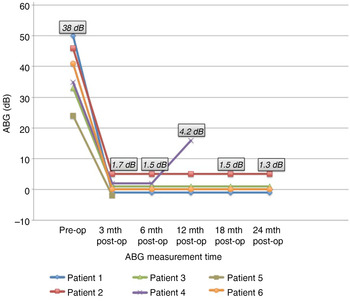
The mean ABG for these patients at 3, 6 and 24 months was 1.7 ± 1.9 dB, 1.5 ± 2 dB and 1.25 ± 2.5 dB, respectively (Figure 2). The mean follow-up period was 41.5 ± 31.2 months, with an average final ABG of 4.1 ± 6.5 dB, reflecting a significant hearing improvement (p = 0.03, Wilcoxon signed-rank test).
Audiological results at 3, 6, 12, 18 and 24 months following revision stapes surgery with hydroxylapatite bone cement (p = 0.03). ABG = air–bone gap; pre-op = pre-operative; mth = months; post-op = post-operative

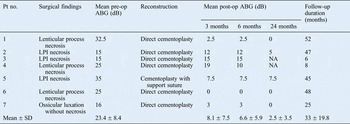
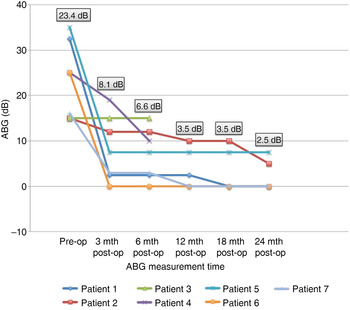
The study also included seven partial ossiculoplasty patients (mean age, 46.3 ± 21.7 years). The average pre-operative audiometric ABG was 23.4 ± 8.4 dB (Table II).
Cases of ossicular chain reconstruction with hydroxylapatite bone cement

Pt no. = patient number; pre-op = pre-operative; ABG = air–bone gap; post-op = post-operative; LPI = long process of the incus; NA = not available; SD = standard deviation
During surgery, we found circumscribed necrosis of the lenticular incus process in three of the seven patients. Three of the remaining patients had larger necrosis of the long process of the incus and one patient had ossicular luxation without necrosis (Table II).
The mean ABG for these patients at 3, 6 and 24 months was 8.1 ± 7.5 dB, 6.6 dB ± 5.9 and 2.5 ± 3.5 dB, respectively (Figure 3). The mean follow-up period was 33 ± 19.8 months, with a mean final ABG of 5.7 ± 5.5 dB, reflecting a significant hearing improvement (p = 0.03).
Audiological results at 3, 6, 12, 18 and 24 months following partial ossicular reconstruction with hydroxylapatite bone cement (p = 0.03). ABG = air–bone gap; pre-op = pre-operative; mth = months; post-op = post-operative

Facial nerve stimulation was occasionally observed (in one-third of cases), but no complications, such as facial palsy, sensorineural hearing loss due to heat diffusion, or weakness, were observed.
In the revision stapes surgery group, one patient was lost to follow up (patient number five, Table I) and one patient underwent revision surgery after 15 months because of an ABG re-opening (patient number four, Table I). In this last patient, we observed complete necrosis of the long process of the incus.
In the partial ossiculoplasty group, one patient was lost to follow up (patient number three, Table II), and one patient underwent tympanoplasty after six months because of pre-existing chronic otitis worsening, with a severe retraction pocket, without an ABG (patient number four, Table II).
Discussion
The benefits of using cement in revision stapes surgery and partial ossiculoplasty for chronic otitis media have been investigated previously, with encouraging long-term results.Reference Babu and Seidman 1 , Reference Galy-Bernadoy, Akkari, Mathiolon, Mondain, Uziel and Venail 2 , Reference Van Rompaey, Claes and Somers 4
Among the reported cases of bone cement reconstruction failure, a loosening of the bone cement was frequently observed,Reference Babu and Seidman 1 , Reference Van Rompaey, Claes and Somers 4 related to insufficient removal of the mucosa covering the ossicles. Preservation of this mucosa reduces the area of cement application and lengthens the drying time, thus interfering with reconstruction quality. Moreover, chronic otitis media induces chronic inflammation, which causes a humid atmosphere, hindering proper cement hardening.
We removed this mucosa with monopolar coagulation, which is a common surgical technique utilising a widely available tool. We performed a ‘soft’ coagulation, between 3 and 5 W; at this power, proteins are denatured and tissues shrink without electric arcs. This procedure permits drying of the mucosa, with no burning of the surrounding tissue. It also prevents heat diffusion to the facial nerve and the cochleovestibular system. Laser-guided coagulation of the mucosa has also been proposed,Reference Hamilton 5 but it is a costly procedure that presents a risk of ossicle damage if not properly performed.
Necrosis of the long process of the incus is caused by an osteoclastic reaction. This might be a reaction to the loop of the prosthesis after stapes surgery, or induced by pro-inflammatory metalloproteinases implicated in chronic media otitis. It does not seem to be a consequence of altered blood supply.
-
• Bone cement is used for middle-ear surgery
-
• Its efficient use requires cautious removal of ossicle mucosa, for enhanced stability and lasting results
-
• There is no consensus regarding the correct technique to apply bone cement
-
• This paper reports an easy, safe technique, and describes clinical and audiological outcomes at 24 months
The audiological outcomes reported in this study are similar to or better than those of previous publications.Reference Wegner, van den Berg, Smit and Grolman 3 We impute these satisfying results to the reliability of the reconstruction provided by our method. With regard to the two unfavourable cases, we consider one (revision stapes surgery patient number four) to be the result of an unsuccessful procedure and the other (partial ossiculoplasty patient number four) to be due to the evolution of an underlying chronic disease.
Conclusion
Bone cement is an efficient material to reconstruct the ossicular chain. Outcomes of bone cement use depend on the conditions of its application (i.e. dry and mucosa-free ossicles). Soft monopolar coagulation is an easy, fast and safe way of removing this mucosa, enabling reliable ossiculoplasty and ultimately leading to improved audiometric results.