Introduction
Depression is one of the most common psychiatric disorders in older people, especially among those residing in nursing homes. It is estimated that 15% to 52% of these residents are affected by the condition in the forms of major depression, depressive symptoms and minor depression (Ames, Reference Ames1993; McSweeney and O’Connor, Reference McSweeney and O’Connor2008; Whelan et al., Reference Whelan, Gaughran, Walwyn, Chatterton and Macdonald2008; Snowdon, Reference Snowdon2010; Australian Institute of Health and Welfare, 2013a). However, poor assessment and management of depression in nursing homes has been frequently demonstrated in Australia (Snowdon and Fleming, Reference Snowdon and Fleming2008; Davison et al., Reference Davison2012) and internationally (Teresi et al., Reference Teresi, Abrams, Holmes, Ramirez and Eimicke2001; Cohen et al., Reference Cohen, Hyland and Kimhy2003). One of the barriers to appropriate management of depression in nursing homes relates to the availability and validity of assessment tools. Existing tools for identifying depression in older people do not necessarily take into account the unique challenges that nursing homes staff confront in their day to day work, which is distinguished by a large proportion of residents having dementia and other multiple, complex health conditions, a severe shortages of skilled nurse clinicians, and no specialist mental health professionals/services available on site (Snowdon and Fleming, Reference Snowdon and Fleming2008; Sansoni et al., Reference Sansoni, Marosszeky, Fleming and Sansoni2010). In this less than optimal situation a valid and reliable screening tool for depression is needed that is applicable to residents with normal cognitive functioning, as well as to those with dementia, and one that requires minimal staff training and clinical expertise.
The geriatric depression scale
The GDS is a self-report tool designed specifically for screening of depression in the elderly (Yesavage et al., Reference Yesavage1983). Initially, 100 items were generated by clinicians and researchers and the pool was reduced to 30 items to be included in the final GDS based on high item-total correlations (Sansoni et al., Reference Sansoni2007). Its dichotomous (yes/no) response format makes completion of the scale relatively easy. The GDS takes into consideration of the fact that some somatic symptoms such as sleep disturbance and weight loss that are indicative of depression in young people may occur in the elderly as a normal processes of aging or a result of a medical condition (McDowell, Reference McDowell2006). Focusing on the affective aspects of depression rather than somatic symptoms reduces the likelihood of false positives produced by the scale (Sansoni et al., Reference Sansoni2007). The GDS is widely used in various settings including hospital (e.g. Mondolo et al., Reference Mondolo, Jahanshahi, Granà, Biasutti, Cacciatori and Di Benedetto2006; Dennis et al., Reference Dennis, Kadri and Coffey2012), community (e.g. Dunn and Sacco, Reference Dunn and Sacco1989; Nyunt et al., Reference Nyunt, Fones, Niti and Ng2009), and residential care facilities (Lesher, Reference Lesher1986; Marc et al., Reference Marc, Raue and Bruce2008). Although the GDS has been treated as a one-dimensional scale with a global score calculated for indications of depression, Adams et al. (Reference Adams, Matto and Sanders2004) proposed a five-factor model of the GDS-30 (26 items were used for the final model) based on the results of a confirmatory factor analysis. They further suggested that the use of these distinctive sub-dimensions (Dysphoric Mood, Withdrawal–Apathy–Vigor, Hopelessness, Worry, and Cognitive Impairment) as subscales for scoring purpose might improve the accuracy and utility of the GDS.
Shorter versions of the GDS have been adapted from the original 30-item scale (GDS-30) using 15, 10, 8, and 4 items (GDS-15, GDS-10, GDS-8, and GDS-4) (Sheikh and Yesavage, Reference Sheikh and Yesavage1986; D’Ath et al., Reference D’Ath, Katona, Mullan, Evans and Katona1994; Shah et al., Reference Shah, Herbert, Lewis, Mahendran, Platt and Bhattacharyya1997; Jongenelis et al., Reference Jongenelis2007). These versions were developed to further reduce the burden of test fatigue in physically frail or cognitively impaired persons. The detection properties of the various versions of the GDS seem to vary depending on the settings. Meta-analysis of 69 studies on the criterion validity of the GDS against gold standard measures (semi-structured interview such as DSM and ICD) found a sensitivity of 81.9% and a specificity of 77.8% for the GDS-30 and a sensitivity of 84.3% and a specificity of 73.8% for the GDS-15 across settings, including nursing homes (Mitchell et al., Reference Mitchell, Bird, Rizzo and Meader2010). The diagnostic accuracy of the GDS-10 has been reported as only adequate in medical settings, with a sensitivity of 85% to 88% and a specificity of 68% to 75% (Shah et al., Reference Shah, Herbert, Lewis, Mahendran, Platt and Bhattacharyya1997; Almeida and Almeida, Reference Almeida and Almeida1999). Although the GDS-4 has been found to be highly efficient in medical settings (Pomeroy et al., Reference Pomeroy, Clark and Philp2001), Allgaier et al. (Reference Allgaier, Kramer, Saravo, Mergl, Fejtkova and Hegerl2013) suggested that the GDS-4 was not suitable for nursing home residents due to its low specificity (53%). For the development and validation of the GDS for nursing home residents, items of the GDS-15 were rated by three clinically experienced and trained interviewers based on the reactions of residents observed during the interview, more specifically, the extent to which the items caused confusion, misunderstanding or irritation (Jongenelis et al., Reference Jongenelis2007). After removing the items deemed less appropriate for nursing home residents, the authors reported good internal consistency (α = 0.80–0.86) and diagnostic accuracy (AUC = 0.75–0.89) of the GDS-8 against the Schedule of Clinical Assessment in Neuropsychiatry. However, the validity of the GDS-8 has not been tested against a more conventional gold-standard diagnosis such as the DSM-IV.
While there is some evidence supporting the use of the GDS in older people with mild to moderate dementia (Lach et al., Reference Lach, Chang and Edwards2010), other studies suggest the utility of the GDS measures depends on the level of cognitive capacity (Debruyne et al., Reference Debruyne2009; Conradsson et al., Reference Conradsson, Rosendahla, Littbranda, Gustafson, Olofsson and Lövheim2013). Debruyne et al. (Reference Debruyne2009) found that the GDS-30 was reliable for detecting depressive symptoms in individuals with mild cognitive impairment but not those with Alzheimer's disease. Another study examining the use of the GDS-15 in older people with various levels of cognitive functioning found that it had poor criterion validity among those who scored lower than 10 on the Mini-Mental State Examination (MMSE) (severe cognitive impairment) and the rate of incompletion was high in this group (Conradsson et al., Reference Conradsson, Rosendahla, Littbranda, Gustafson, Olofsson and Lövheim2013). Given the uncertainty of the accuracy of depressive symptoms reported by individuals with cognitive impairment, the use of the GDS as a screening tool for depression in nursing homes may not be warranted, since a high proportion of these residents will have dementia.
The collateral source version of the GDS
To overcome the limitation of the GDS as a self-completed tool, an alternative rating scale – the Collateral Source version of the GDS (CS-GDS) – was developed by Nitcher et al. (Reference Nitcher, Burke, Roccaforte and Wengel1993), which uses information derived from an informant who is cognitively intact. The 30- and 15-item versions of CS-GDS (CS-GDS-30 and CS-GDS-15) use the same items of the GDS-30 and the GDS-15, respectively, with the questions rephrased to be answered by an informed collateral source (Nitcher et al., Reference Nitcher, Burke, Roccaforte and Wengel1993; Brown and Schinka, Reference Brown and Schinka2005). For example, the wording of the question “Are you basically satisfied with life?” is changed to “Is he/she basically satisfied with life?” in the CS-GDS. Studies on older outpatients with and without cognitive impairment, found the CS-GDS to have good internal consistency and test-retest reliability, and moderate to high diagnostic accuracy (Burke et al., Reference Burke1997; Brown and Schinka, Reference Brown and Schinka2005; Chang et al., Reference Chang, Edwards and Lach2011). In these studies, most collateral sources responding to the CS-GDS were close relatives of the patient, such as an adult child and/or a spouse. It is uncertain whether the reported psychometric properties of the CS-GDS can also be obtained in the nursing home setting, where the scale is most likely to be completed by care staff. Nitcher et al. (Reference Nitcher, Burke, Roccaforte and Wengel1993) found that The CS-GDS and the GDS correlated significantly for children and spouses of the care recipients, but not for other relatives or friends, suggesting that the validity of the CS-GDS was affected by the closeness of the relationship between the CS and the care-recipient. If the validity of the CS-GDS can be established in nursing homes, it has the potential to be widely utilized to screen for depression, as it requires no training or clinical skill to complete and imposes no burden on older nursing home residents.
Study aims
The aim of our study was to examine the screening accuracy of the various versions of the self-rated and proxy-rated GDS among residents with and without dementia in nursing homes. This Australian study is one of three components of the Assessment of Depression for Quality Care Study that was designed to develop a valid, reliable, and practical screening tool for the assessment of depression in nursing homes.
Methods
We assessed the criterion validity of the GDS and its variations against the gold standard (i.e. clinician diagnosed depression using the DSM-IV derived questionnaires).
Recruitment
Following approval from the University of Sydney Human Research and Ethics Committee (HREC Ref No: 12898) and other participating organizations, participants were recruited from 14 nursing homes in Sydney, New South Wales and Brisbane, Queensland, Australia. All facilities were fully accredited by the Aged Care Accreditation Agency. Any residents who have recently been assessed for depression by nursing home staff using the Cornell Scale of Depression in Dementia (CSDD) were eligible. Residents who could not read or speak in English were excluded from the study. Written informed consent was obtained from 92 older residents. For those residents unable to provide their own informed consent, proxy informed consent was obtained from a close family member or guardian. Four residents did not complete the assessments for unstated reasons and were excluded from the study, leaving a total sample of 88. The 88 residents were also rated by a collateral source (usually a care staff, sometimes a family member) who completed the 30-item CS-GDS.
Measures and procedures
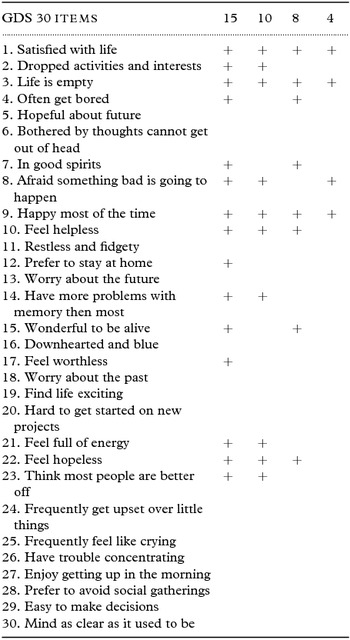
As described earlier, the original GDS has 30 items and each item is answered with either “yes” or “no.” Scores from 0–9, 10–19, 20–30 indicate normal, mild depressive symptoms and severe depressive symptoms, respectively. Participants’ scores on the GDS-30 were computed for the 15-, 10-, 8-, and 4-item GDS. The cut-off scores for the various shorter versions were >5, >2, >2, and >0, respectively, based on the original validation studies of each instrument (Sheikh and Yesavage, Reference Sheikh and Yesavage1986; D’Ath et al., Reference D’Ath, Katona, Mullan, Evans and Katona1994; Shah et al., Reference Shah, Herbert, Lewis, Mahendran, Platt and Bhattacharyya1997; Jongenelis et al., Reference Jongenelis2007). Table 1 provides a snapshot of the item allocation in the variations of GDS. The most commonly used items are: item (1) “Are you basically satisfied with your life?,” item (3) “Do you feel that your life is empty?,” and item (9) “Do you prefer to stay at home, rather than going out and doing things?.”
Items in the GDS-30, 15, 10, 8 and 4 variations

Similarly, scores on the CS-GDS-30 were computed for the 15-item scale. Studies suggest that collateral sources tend to report more depressive symptoms in the older person than do the care-recipients themselves, therefore higher cut-off scores are recommended: 18 and above for the CS-GDS-30 and 9 and above for the CS-GDS-15 (Burke et al., Reference Burke1997; Chang et al., Reference Chang, Edwards and Lach2011). For ease of administration, the GDS-30 was verbally presented to residents by a care staff member who had been given instructions on its use. As a collateral source, care staff who provided ongoing care of the participating resident or a frequently visiting family of the resident completed the CS-GDS-30. No other criteria for the selection of the collateral source were used.
The SCID (American Psychiatric Association, 2000) was used to establish a gold standard diagnosis of depression for residents without dementia. For residents with dementia we used the PDCdAD (Olin et al., Reference Olin, Katz, Meyers, Schneider and Lebowitz2002). The PDCdAD is equivalent to the DSM-IV in many ways except that it takes account of depressive features within the course of dementia per se. These include symptoms of irritability and social isolation/withdrawal that are not featured in the DSM-IV. Further, concentration problems, listed as a symptom of depression in the DSM-IV, are omitted in the PDCdAD as these are often associated with dementia (Olin et al., Reference Olin, Katz, Meyers, Schneider and Lebowitz2002). Prior to the study, training was provided to the clinicians to establish a high level of agreement in diagnosis of depression (κ = 1.0). These two experienced specialist clinicians (one in Sydney and one in Brisbane) who were blinded to the GDS and CS-GDS results, reviewed the resident's medical chart and interviewed the resident and a staff informant of the resident following the protocol for the SCID. Using the SCID protocol as a guideline, the clinicians determined the diagnosis of depression based on their clinical judgment.
Classification of dementia was determined using the MMSE (Folstein et al., Reference Folstein, Folstein and McHugh1975) and the Global Deterioration Rating Scale (GDRS) (Reisberg et al., Reference Reisberg, Ferris, de Leon and Crook1982), since our clinical experience is that dementia is not always accurately documented in residents’ medical records in Australian nursing homes. The MMSE is the most widely used measure for testing cognitive functions such as arithmetic, orientation, and memory. Missing values on the MMSE due to sensory impairment were prorated using the mean of the remaining items. The GDRS provides an overview of the stages of dementia, consisting of 7 stages, with stages 4–7 indicating the loss of cognitive and other functions experienced by persons with dementia. To meet the criteria for dementia in this study, residents were required to have a score of 4 and above on the GDRS and a score of 23 and below on the MMSE.
Data analysis
All analyses were conducted using SPSS version 20 (IBM Corp., 2011) except those for ROC curves. Cases missing more than 20% of the items on the various versions of the GDS and the CS-GDS were excluded from the ROC curve analyses. For the remaining cases scores on missing items were replaced using the mean of the remaining items for that resident.
MedCalc version 12.7.7 (MedCalc Software, 2013) was used for ROC curve analysis. The screening accuracy for each instrument was calculated as the area under the ROC curve (AUC). The value of the AUC ranges from 0.5, 50% chance of correctly identifying depression, to 1.0, 100% rate of distinguishing depressed cases from non-depressed cases. The standard error of the AUC was calculated using the method of Hanley and McNeil (Reference Hanley and McNeil1982) and a z-test was used to compare the AUC to the null hypothesis (AUC = 0.5). As a general rule for interpreting AUC values, a test with an AUC greater than 0.9 has high accuracy, 0.7–0.9 has moderate accuracy, and values below 0.7 indicate low accuracy (Fischer et al., Reference Fischer, Bachmann and Jaeschke2003). The Youden index J (Youden, Reference Youden1950) provides an indication of the optimal cut-off score for depression, as it maximizes the differentiating ability of the instrument when equal weight is given to sensitivity and specificity. For a screening test, however, more weight is usually given to sensitivity, as the purpose is to rule in potentially diagnosable cases with few false negatives (Kumar and Indrayan, Reference Kumar and Indrayan2011). In the current study both approaches were considered when determining the cut-off scores. Analyses were conducted for all residents, then separately for residents with and without dementia.
Results
Demographics
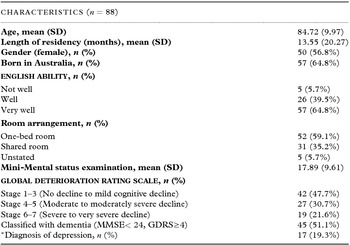
The demographic and other characteristics of the residents are shown in Table 2. The majority were women (56.8%) and born in Australia (64.8%). A small number of residents (n = 5) stated that they spoke English “not well,” but their reading comprehension and spoken English were sufficient enough to take part in the study. Forty-five residents met the classification for dementia set out for the current study (MMSE <24 and GDRS ≥4). Overall, 17 residents (19.3%) were diagnosed with depression according to the clinician's assessment, either by the DSM-IV or the PDCdAD criteria. The 54 Sydney and 34 Brisbane nursing home residents did not differ in terms of depression diagnosis (χ2 (1, n = 88) = 0.76, p = 0.39) or dementia classification (χ2 (1, n = 88) = 3.69, p = 0.06).
Demographic and other characteristics of the study participants

*Diagnosis of depression is based on DSM-IV-TR or PDCdAD depending on whether resident had dementia or not.
GDS and CS-GDS scores
Twenty residents were unable to complete the GDS due to varying stages of cognitive impairment. These 20 residents scored below 24 on the MMSE and all except for one person with stage 3 “mild cognitive decline,” had stage 4 or above on the GDRS. Among the collateral sources, 76 were care staff, 7 were residents’ relatives, and the rest did not state their relationship with the resident. We included the data with a valid score on at least 80% of the items on the corresponding instrument.
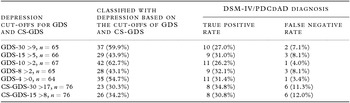
Table 3 shows the number of residents classified with depression based on the cut-off scores established in the literature for each version of the GDS and CS-GDS and the accuracy of the classifications when compared to the gold standard diagnosis of depression based on the DSM-IV/PDCdAD. According to the GDS instruments, 43% to 63% of the residents met the depression cut-off, which were higher than 30% for CS-GDS-30 and 34% for CS-GDS-15. Only 26.2%–34.8% of GDS and CS-GDS cases were true positives (i.e. meeting the gold standard diagnosis for depression). False negative rates ranged between 3.4% and 11.3% (i.e. GDS or CS-GDS defined depression not confirmed by clinician diagnoses). The 30- and 15-item CS-GDS produced more false negatives than the GDS instruments.
Comparison of depression classification between the various versions of the GDS and CS-GDS and the gold standard diagnosis using the DSM-IV/PDCdAD

Pearson's correlation coefficients between the scales are shown in Table 4. The five versions of the GDS strongly correlated with each other (r > 0.80), as did the two versions of the CS-GDS (r = 0.96). The correlation between the GDS and the CS-GDS measures were moderate (r = 0.50–0.61).
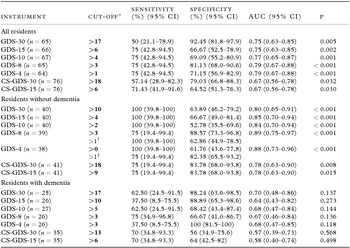
Diagnostic performance of the GDS and CS-GDS at relevant cut-off scores

*Cut-off scores are the optimal cut-offs determined using the Youden index J.
†An alternative cut-off that maximizes sensitivity.
‡An alternative cut-off with a more balanced sensitivity and specificity.
The ROC curve analysis
For residents without dementia, the 8- and 4-item GDS had the best discrimination accuracy. At the optimal cut-off (>0), GDS-4 had 100% sensitivity and 62% specificity. The optimal cut-off score for GDS-8 was three, at which point the sensitivity (77%) and specificity (89%) reached its maximum on the ROC curve. Using a more conservative cut-off (>1), the sensitivity of the GDS-8 reached 100% whilst specificity dropped to 63%, similar to those of GDS-4. For residents with dementia, however, none of the GDS and CS-GDS measures performed above chance in detecting depression. Overall, the GDS correctly identified 80% to 89% depression cases among residents without dementia (p < 0.001), and 75% to 79% depression cases among all the residents who had completed the scale (p < 0.01). See Table 4 for the comparisons.
Discussion
Completion of the GDS requires a certain level of cognitive functioning and was difficult to complete for cognitively impaired residents, even with assistance. For those with dementia who managed to complete the scale, their GDS scores performed no better than chance in identifying depression against the clinician's diagnosis. These non-significant results were consistent with those reported by Debruyne et al. (Reference Debruyne2009) and Conradsson et al. (Reference Conradsson, Rosendahla, Littbranda, Gustafson, Olofsson and Lövheim2013) in people with Alzheimer's disease and moderate to severe cognitive impairment, respectively. However, among residents without dementia, the 4-, 8-, 10-, 15- and 30-item GDS all showed high levels of screening accuracy (AUC ≥ 0.80) that were compatible with scores established in community and medical settings (Mitchell et al., Reference Mitchell, Bird, Rizzo and Meader2010).
Notably, the GDS-8 was constructed to be especially applicable and suitable for nursing home residents (Jongenelis et al., Reference Jongenelis2007). It included six items from the Dysphoric Mood subscale and two items (feel helpless and feel situation is hopeless) from the Hopelessness subscale of the five-factor model proposed by (Adams et al., Reference Adams, Matto and Sanders2004). Based on a study of the classification efficiency of the GDS items among older residents in congregate housing (Adams, Reference Adams2011), all of the GDS-8 items had an item hit rate of greater than 60%, suggesting good discrimination against the clinical diagnosis using the Mini-International Neuropsychiatric Interview. According to the scale developers, the GDS-8 accurately identified 89% of the major depression cases using the Schedule of Clinical Assessment in Neuropsychiatry (Wing et al., Reference Wing1990) and 75% of the minor depression cases among nursing home residents with a MMSE score of 15 and above (Jongenelis et al., Reference Jongenelis2007). Use of the GDS-8 in the current study showed similar screening accuracy for residents without dementia to those reported by the scale developers. The optimal cut-off (>3) was slightly higher than the cut-off of >2 reported by Jongenelis et al. (Reference Jongenelis2007), with relatively balanced sensitivity and specificity. For screening purposes, a lower cut-off (>1) would maximize the sensitivity, making sure that all potential depression cases are flagged.
The GDS-4 is the shortest version of the GDS. It included three Dysphoric Mood items that were also included in the GDS-8, and one item (afraid something bad will happen) from the Worry subscale (Adams et al., Reference Adams, Matto and Sanders2004). Allgaier et al. (Reference Allgaier, Kramer, Saravo, Mergl, Fejtkova and Hegerl2013) found the 4-item scale was not as accurate as the GDS-15 in detecting depression in nursing home residents, having a low specificity of 53% at the optimal cut-off >0. However, according to the Youden index, the optimal cut-off for the GDS-4 was the same in our study, with a higher specificity (62%) and 100% sensitivity. Based on our results, the 4-item GDS was just as accurate as, if not better than, longer versions of the scale. The screening performance of the GDS-4 was compatible with that reported by Pomeroy et al. (Reference Pomeroy, Clark and Philp2001) in elderly medical patients.
Shorter scales have several advantages over the more widely used longer GDS, including reduced respondent burden, shorter administration time and less staff time required to help complete the scale. These advantages are particularly prominent in nursing homes, where residents are frail and dependent, and the workforce capacity tends to be low. In Australia, the majority of aged care residents are 80 years or older and having a diagnosis of dementia, with many reported to also have depression (Australian Institute of Health and Welfare, 2013b). The care of residents with depression is further challenged by the shortage of skilled clinicians and the lack of specialist mental health consultants in the sector. Research suggests that routine screening can improve the detection and treatment of depression among nursing home residents (Davison et al., Reference Davison2012), but systematic screening is difficult when staff are constrained by time pressures and inadequate expertise. The use of a brief highly sensitive depression instrument, such as the 8-item or 4-item GDS that does not require administration by a specialist health practitioner can, therefore, potentially facilitate the routine practice of depression screening in the nursing home. Nevertheless, the study results showed that the validity of the GDS measures was limited to residents without dementia, suggesting the need for an alternative depression tool for residents with dementia.
The CS-GDS was developed to derive information from an informant, providing a means to indirectly assess those who were unable to self-administer the GDS. Contrary to our expectations, the 15-item and 30-item CS-GDS failed significantly to identify depression in residents with dementia. These results were incongruent with those obtained in the community and medical settings, where the collateral source was usually a close relative of the care-recipient (Nitcher et al., Reference Nitcher, Burke, Roccaforte and Wengel1993; Burke et al., Reference Burke1997; Brown and Schinka, Reference Brown and Schinka2005; Chang et al., Reference Chang, Edwards and Lach2011). Research suggests that multiple factors can influence the reliability of proxy-based ratings, including the nature of the relationship between the care-recipient and the proxy rater, access to information, cognitive schemas endorsed by the rater, and the rater's knowledge of the assessed construct (Snow et al., Reference Snow, Cook, Lin, Morgan and Magaziner2005). In the current study, the majority of CS-GDS ratings were completed by care staff at the nursing home facility and there were no criteria to determine the closeness of the relationship between the care staff and the residents prior to administering the scale. It is likely that there was variation in how well the residents were known by their collateral sources, given the traditionally high staff turnover rate and irregular scheduling of workforce in residential aged care (Watson et al., Reference Watson, Zimmerman, Cohen and Dominik2009). Further, caregiver rating bias can be associated with caregiver burden (Chang et al., Reference Chang, Edwards and Lach2011; Pfeifer et al., Reference Pfeifer, Drobetz, Fankhauser, Mortby, Maercker and Forstmeier2013). Since we did not measure care burden among the collateral sources, it is uncertain if caregiver rating bias contributed to the poor screening performance of the CS-GDS measures for residents with dementia.
The failure of the CS-GDS to detect depression in these residents also emphasized the difficult nature of depression assessment in the course of dementia. Other structured approaches, such as the CSDD, also yielded questionable results, especially in the hands of relatively inexperienced care staff (Watson et al., Reference Watson, Zimmerman, Cohen and Dominik2009; Jeon et al., Reference Jeon2014a; Reference Jeon2014b). Notably, the CSDD is part of the mandated Aged Care Funding Instrument (ACFI), which is being relied on to allocate government care service subsidies to aged care providers in Australia (Australian Government Department of Health and Ageing, 2011). Our findings point to another possible mechanism for assessing depression in older persons without dementia in the nursing home setting.
The study has several limitations. First, the sample size was relatively small and this was reflected in the wide range of the 95% confidence intervals for the AUC, sensitivity and specificity. Caution needs to be used when interpreting the ROC curve results, especially for the sub-group of residents with dementia. The small sample size also limited our ability to explore other factors such as English ability that might have affected the GDS performance. Second, the shorter versions of the GDS were extracted from the 30-item scale. Further study is needed to test the validity of the GDS-4 and GDS-8 independently. Third, there was variability in the proxy sources for completion of CS-GDS, which reflects the non-standardized use of the instrument in the Australian nursing home setting. Finally, the classification of depression as determined by our research team using gold standard criteria may be questioned. However there is no better gold standard and the raters had extensive clinical experience, were highly trained in using a standardized protocol, the SCID, and established 100% inter-rater reliability.
Conclusion
The self-administered GDS inherently eliminates observer bias that is prone to occur with the proxy-based measures and reflects the subjective experience of the resident's mood which is often under-appreciated in nursing homes. The two very short versions, GDS-4 and -8, proved to be just as good as, if not better than, the longer versions of the scale in detecting depression in self-report. However, since the completion of the self-report GDS required the resident to be capable of understanding and answering the items, its validity was limited to residents without dementia. Although the CS-GDS allowed us to collect information from care staff (collateral source) when the resident was unable to answer items directly, it did not have adequate validity in detecting depression among residents with dementia. Further research is needed on the informant selection and other factors that can potentially influence the validity of proxy-based depression measures in the nursing home setting. More importantly, the utility of proxy-based measures that require consistent, quality collateral source information, is inherently limited in the nursing home setting.
Declaration of conflicting interests
None.
Description of authors’ roles
ZL contributed to data analysis, data management, and drafting and editing of the Article. Y-HJ secured funding, led the study and contributed to study design, supervision for data collection and management, identification of relevant research, development of the Article, writing and editing of the Article. L-FL contributed to study design and critical revisions and editing of the Article. LC, DO, and EB contributed to critical revisions and editing of the Article. HB contributed to study design, training specialist clinicians, and critical revision and editing of the article. All authors were involved in the finalization of the Article.
Acknowledgment
This study was funded by the Dementia Collaborative Research Centre–Assessment and Better Care, University of New South Wales as part of an Australian Government Initiative. Queensland University of Technology funded data collection in Brisbane. The authors express appreciation to the aged care providers for their participation, registered nurses Ms Eesa Witt and Dr Judy McCrow for data collection, and psychologists Ms Kim Burns and Dr Leander Mitchell for conducting the clinical assessments for our participants.