Few historians in the United States take the subject of bicycles seriously. After all, bikes are fun: in the United States, they are associated with childhood, and are thought of as toys rather than as meaningful components of transportation networks or economic development. As such, there is a tendency among historians to romanticize the American bicycling craze of the 1890s as a somewhat ridiculous fad reflective of changes in technology, class, and culture, but with no lasting impact on political institutions or the built environment. However, there is a largely overlooked episode in bicycle history that illuminates serious questions concerning tax policy, a changing definition of the public good, and an important period in state formation. It also shows the incredible importance of early decision points for persistent infrastructure: turn-of-the-century policies facilitated the current dependence upon the automobile and now complicate attempts to reintroduce pedestrians and cyclists to auto-centric streets.
This forgotten episode was known as the sidepath movement. For a brief moment at the end of the 1890s, an alternative vision of the future of American transportation flickered to life, and then faded. Bicyclists dissatisfied with the haphazardly maintained, locally financed, and unpaved roads of the nineteenth century first proposed to build their own recreational paths through private, voluntary efforts. But by the end of the decade, supporters of the sidepath movement imagined cities and towns connected not only by roads but also by a separate, bicycle-specific network of improved paths. These paths were to be protected by state law and funded by innovative public/private cooperation on the county and local level, combining earlier voluntary efforts with an institutionalized user-fee model. In a now-forgotten national magazine, some sidepath promoters concentrated on the recreational aspects of interurban paths, while others emphasized the possibilities for personal transportation and practical commuting within cities before the existence of an affordable and reliable automobile.Footnote 1 Sidepath networks were built first by taxing cyclists at the county level in northwestern New York, but the passage of user-fee legislation in 1899 provided a template adopted by states across the nation. Sidepath building briefly flourished in Chicago, Minneapolis, Portland, and elsewhere, leading excited cyclists to imagine a network of paths allowing them to “go from New York to any point in Maine, Florida or California on smooth roads made especially for them.”Footnote 2 While these dreams were expansive, the movement was severely limited by the persistent problem of convincing politicians and the populace that the construction of infrastructure for a small number of individuals was a “public good.” Development floundered by 1905, as fewer cyclists made voluntary contributions to the project. Most sidepath advocates then threw their lot with farmers and other powerful stakeholders in a combined-use Good Roads movement, abandoning their separate system. When the automobile later came to dominate those combined-use roads, cities slowly became increasingly auto-centric throughout the twentieth century. Had it been successful, a separate sidepath system would have changed American history. But it was a sidepath not taken.
In fact, the sidepath movement has been so fully forgotten it is as if it never existed. For example, the word “sidepath” does not appear at all in Bob Mionske’s 2007 Bicycling & The Law, an authoritative overview of the rights of cyclists.Footnote 3 Bicycle advocates and academic historians have similarly missed the sidepath; none of the many popular and academic histories cited in this article ever mention the word “sidepath,” and only a few discuss historical bicycle paths of any sort. The exceptions are local accounts, which do not discuss national or political implications.Footnote 4
This forgotten alternative should be of interest to environmental historians and those committed to creating a more sustainable city. Today, many American urbanites are attempting to reintroduce the bicycle to their auto-centric streets, but a century of decisions privileging the car makes it difficult. New York City’s contentious attempts to add bicycle lanes are only the beginning, as cities across the nation think about “Copenhagenizing,” making “sustainable” cities, or rebuilding roadways as “Complete Streets” that attempt to integrate pedestrian, cyclist, public transport, and automobile usage. Many of these solutions include adding bicycle lanes to existing roadways or building physically separated bicycles paths.Footnote 5 In so doing, cities are addressing a problem that sidepath advocates proposed to solve, and that the combined-use road created, more than a century ago.
This article focuses on policy aspects of the forgotten sidepath movement, including taxation and growing state power, but especially examining debates over defining the boundaries of the “public good.” While these issues surfaced in the sidepath fights, demarcating public and private goods has been a long-term project, and this historical analysis inevitably ends up using policy terminology developed after the fact. Half a century after the sidepath movement, academics in the field of economics began to classify some goods and services within a conceptual matrix. This approach posited that a “public good” was any shared resource or project whose benefits could not justifiably be denied to any subset of the entire populace, and whose consumption by some did not overly inconvenience the rest. Clean air, the safety provided by military defense, the navigational assistance provided by a lighthouse—these could be described as public goods, and most societies approve of state support for their provision to all. In contrast, private goods could justifiably be limited to a select few who paid, in one way or another, for additional access to a limited resource. Today, the academic terminology of excludable resources, nonrivalrous usage, and free riders is applied to debates over public expenditures, though without clearly solving disagreements. But long before the development of this language, Americans struggled with the underlying issues. They fought to define the boundaries of the public good in their state legislatures and local newspapers, and bicycle paths became an unlikely battleground in that conflict.Footnote 6
This turn-of-the-century debate over the public good and the limits of government power is inescapably familiar. Whether over public roads, public schools, or the public option in health care, today’s debates feature similar rhetoric and results. Both the failed sidepath and the successful Good Roads movements were situated within larger debates over the propriety or morality of collecting payment from larger groups for the benefit of some; the fact that one failed and one succeeded indicates the changing contours of the definition of “the public” at the turn of the century, and a transition in the balance of state power.
The Bike Boom and the Limitations of Bad Roads, 1890–1898
Since the sidepath movement originated in the 1890s bike boom, a brief summary of the technological and social aspects of the literature covering the boom is useful. The 1890s boom was the last of a series of waves of bicycle adoption, each situated around different technologies, and each expanding the audience for the bike. Earlier experiments in the 1820s and 1860s preceded the high-wheel or “ordinary” bikes of the 1870s.Footnote 7 While the “safety” bike of the 1890s was the centerpiece of the biggest of the bicycle fads, that boom had multiple causes, including the entrepreneurial acumen of boosters, an urbanizing nation, and popular reception with upwardly mobile and vitality-obsessed consumers.Footnote 8 Still, the new design was clearly a factor in the surging popularity. The safety combined pneumatic tires, chain-driven rear wheels, tire sizes, and frame geometry that would be recognizable to modern eyes. Named for its most obvious advantage over the precarious high-wheels, the safety opened cycling up to both men and women.Footnote 9 Additionally, the proliferation of domestic cycle manufacturers, early developments in mass production, and competition in a mass market pushed bicycle prices into affordability for many. While most riding was for leisure and recreation, the popularity of the bike boom was extending into practical and utilitarian transportation. In a world before cars, the bicycle looked for a moment to be the future of technology, briefly eclipsing horse-drawn trolleys, omnibuses, carriages, wagons, and steam trains—at least for personal transport. “No fact is brought more forcibly or more frequently to our attention than the extent to which bicycles are now employed as a means of conveyance,” noted the justices of the New York Supreme Court in 1899, continuing to observe that “they have, to a large extent, superseded the ordinary methods of travel.”Footnote 10
The safety was embraced by a variety of social groups, but the most outspoken and organized of the Golden Age cyclists were the middle class and professional men who adopted cycling as a recreational and social activity. As members of local clubs and chapters of the national League of American Wheelmen or LAW, these men found in cycling a number of virtues, including male companionship, a desirable association with advanced technology and modernity, and athletic endeavors that were still considered refined and class-appropriate.Footnote 11 While smaller in number, cycling women also found an exhilarating freedom on the bike, although that liberation was accompanied by debates over the propriety of unchaperoned and bloomer-clad females.Footnote 12
Together, these groups enabled a burgeoning manufacturing and repair industry, in what historian David A. Hounshell has described as the first significant example of mass production. By the mid-1890s, American manufacturers were producing between one and three million bikes a year—in a nation of 63 million people.Footnote 13 These new cyclists were riding in increasingly concentrated cities, as farming became less central to American life and an ever-larger number of shopkeepers, clerks, and professionals came to dominate society.Footnote 14
While these forces all fueled the success of the bike boom, the condition of the roads was the most significant limitation on that success. Rural American roads in the nineteenth century were almost all unimproved. Their unpaved surfaces lacked adequate drainage, were built without surveying or engineering, and were nearly impassable after rain or snow. The dirt roads of the era were obviously an immense source of frustration for cyclists: the LAW wrote as much about road building as bicycles. In its Bulletin and an occasionally separate monthly, Good Roads Magazine, the LAW spent decades pushing for better roads.Footnote 15
As historian Clay McShane has explained, the unimproved state of nineteenth-century roads was a symptom of an underlying institutional cause: an essentially local, decentralized system of financing road materials and labor, itself partly resulting from limited municipal governments and a distrust of public works. Put simply, before the twentieth century, few roads were directly built by the state. Most urban roads in the nineteenth century were only paved when adjoining property owners—abutters—clubbed together to choose paving materials and set their own costs in special assessments they paid off themselves. Rural roads were built by the occasional “working out” of road taxes, where nearby property owners were required to provide a week or so of their own labor in a work gang under the supervision of a county “pathmaster.” The road-gang or “statute labor” system appealed to cash-poor farmers and kept decision-making local, but it had obvious limits; historian Michael Fein has called it “quasi-feudal.” Often derided by reformers as a “neighborhood picnic,” such gangs lacked engineering or surveying skill, specialized equipment, or much in the way of incentive. Most repair work consisted of piling up loose dirt in the center of the roadbed in the hopes that it might level itself. The results were predictable: a winding skein of randomly built and poorly maintained dirt roads. As usual, Mark Twain summarized the situation best, claiming that if he ever went to hell, then he would want to go by a bad road, so that he would at least be glad when he got to his destination.Footnote 16
Beginning in the 1880s, the poor condition of these roads was the central concern of Good Roads reformers. Historians have described these groups as early examples of Progressive reform, and they had the qualities of many other such groups. They were urban, middle-class, efficiency-minded, professionally organized individuals, promoting technocratic solutions over messy and graft-fueled governments, in occasionally antidemocratic or antipopulist reform movements.Footnote 17 The Good Roads movement began and had its first victories before the internal-combustion automobile even existed, let alone transcended its early status as an expensive curiosity and broke through to popular adoption. Instead, road reform began with the bicycle, pedestrian, and horse-drawn vehicle in mind. The great political difficulty with such reform, as always, concerned who would pay. Farmers feared that, following the traditional mode, they would be forced to pay for road improvement near them; in contrast, urban dwellers objected to paying for rural roads they would never see. When Good Roads reformers succeeded in passing new state-level legislation funding roads in the first decades of the twentieth century, they would begin a process that fundamentally transformed state commitment to public roads, and that marked the expanded power and capacity of governments.Footnote 18
But before that later success, cyclists in the 1890s looked to create their own alternative to unimproved dirt roads: separate bicycle paths with packed gravel or cinder surfaces. The first projects created short leisure paths, financed by popular subscription. Cyclists in Chicago proposed “a sort of bridle path, such as is provided for equestrians, except of course with a different surface” in the parks of the city and alongside Douglas Road. Denver cyclists funded their own fifty-mile path to Palmer Lake entirely by subscription. Riders in Portland, Oregon, started with a thousand feet of path along Riverside Road in 1896, while cyclists in North Adams, Massachusetts, paid a $1 club membership “devoted exclusively to the construction of sidepaths,” while in Boston cyclists proposed paths across the Common itself.Footnote 19
The Twin Cities of Minneapolis and St. Paul, Minnesota, saw the most successful of the national path-building projects outside of New York. The Minneapolis city engineer began preliminary work in 1895, resulting in nearly six miles of paths financed entirely through private funds but built by city workers.Footnote 20 Construction was continued in 1896 with a path connecting the two cities along Marshall Avenue, with additional construction within parks, along streets, and toward Lake Minnetonka. While there were some unspecified contributions from individual city wards, the work was mostly funded through charity: “Several efforts have been made . . . to set aside a special fund,” reported the city engineer, “but the public demand for lower taxation has invariably defeated the proposition.”Footnote 21 By 1897, the city engineer was pushing for a general tax of all citizens: “While . . . the custom is to build cycle paths by subscription in different cities, this appears to me a hardship. . . . This should be borne by the people as a whole.”Footnote 22 At the same time, St. Paul was experiencing success with blended public and private funding. Nearly $4,000 was raised in 1897 and 1898, evenly split between private donations raised by the St. Paul Cycle Path Association and the governments of the city of St. Paul and Ramsey County. This partnership built fourteen miles of paths in 1897.Footnote 23
Cycle clubs constructed these paths at the height of the bicycle boom, capitalizing on public support. But the paths had many limitations. They were intended for recreational purposes, and most were built following their own routes across parks, forests, or fields, only occasionally linking with roads. Most important, these paths were paid for by cyclists themselves, through fund-raising, donation, and club dues. It was thus a limited project, and eventually some found it “a slow and unsatisfactory method.”Footnote 24
Early Experiments in Sidepath Funding, 1896–1897
The success of these small paths, and dissatisfaction with the pace and scope of improvement, triggered further experiments. Beginning in 1896, counties across the Midwest and Northeast began exploring ways to institutionalize and fund not just individual paths but also networks of bicycle-specific paths alongside roads, within the existing right-of-way. The first of these countywide experiments inspired all that came after and earned the sobriquet “father of the sidepath movement” for its originator.
Charles T. Raymond was an avid cyclist and successful businessman in the industrial city of Lockport, not far from Niagara Falls, in Niagara County, New York. In 1890, Raymond had helped to organize the Niagara County Sidepath League, an organization that built short paths funded by club dues for all cyclists to use freely. But this approach seemed unfair to Raymond, and thus he “adopted and promulgated the doctrine that ‘what all use, all should pay for,’” according to a laudatory biographical article. With that goal in mind, Raymond drafted an 1896 state law permitting Niagara county supervisors to tax all bicycle owners and build paths with the proceeds.Footnote 25 When that system of taxation proved successful, Raymond drafted a bill allowing counties statewide to follow suit by taxing all bicycles—much to the displeasure of the state chapter of the LAW, whose leaders called “upon all wheelmen to strenuously oppose the passage of any such bills.”Footnote 26
At the time, LAW leaders were generally opposed to sidepaths as distractions from the matter at hand: building good roads. According to LAW officer Isaac Potter, “A special cycle path can be asked for with justice and reason only in those cases where our road officers have failed to provide a roadway of such quality as to make it fit for the use of all classes of travelers.”Footnote 27 With that reasoning, members of the New York chapter helped defeat Raymond’s 1897 bill, and opposed another in 1898, fearing that the latter threatened the passage of their own Higbie-Armstrong roads bill. As such, complained a sidepath advocate, the LAW “went to Albany and spent time and money till the defeat of the Raymond bill was assured.”Footnote 28 Division among cyclists diluted their clout, and few counties followed Niagara’s lead in securing meaningful sidepath legislation before 1898.Footnote 29
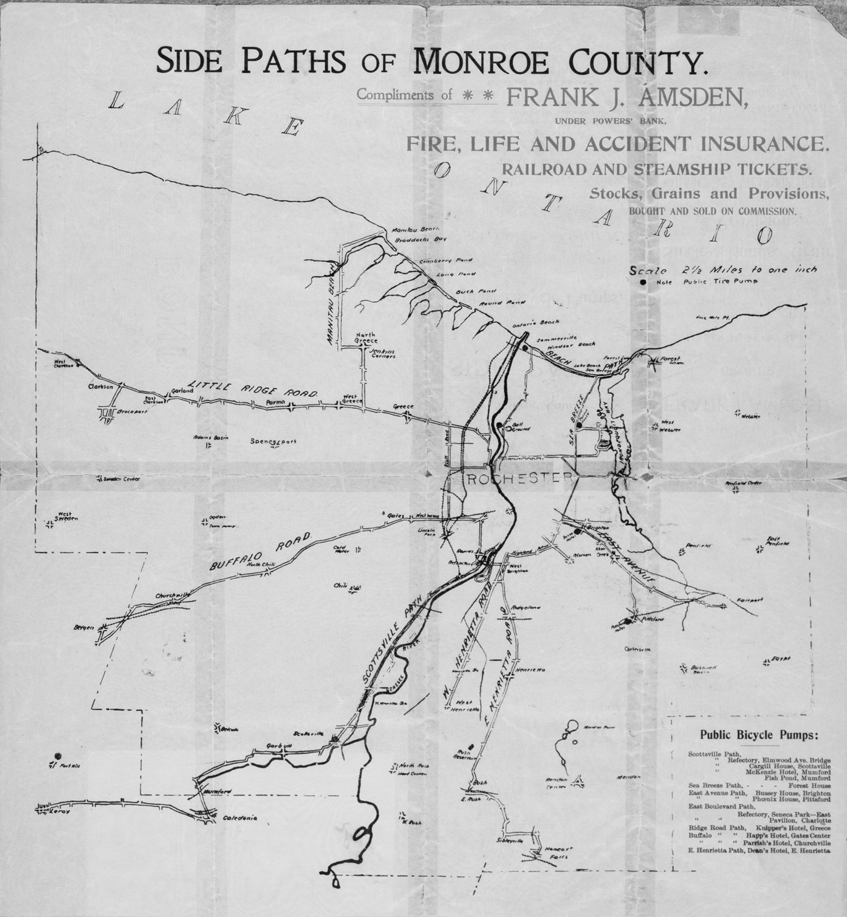
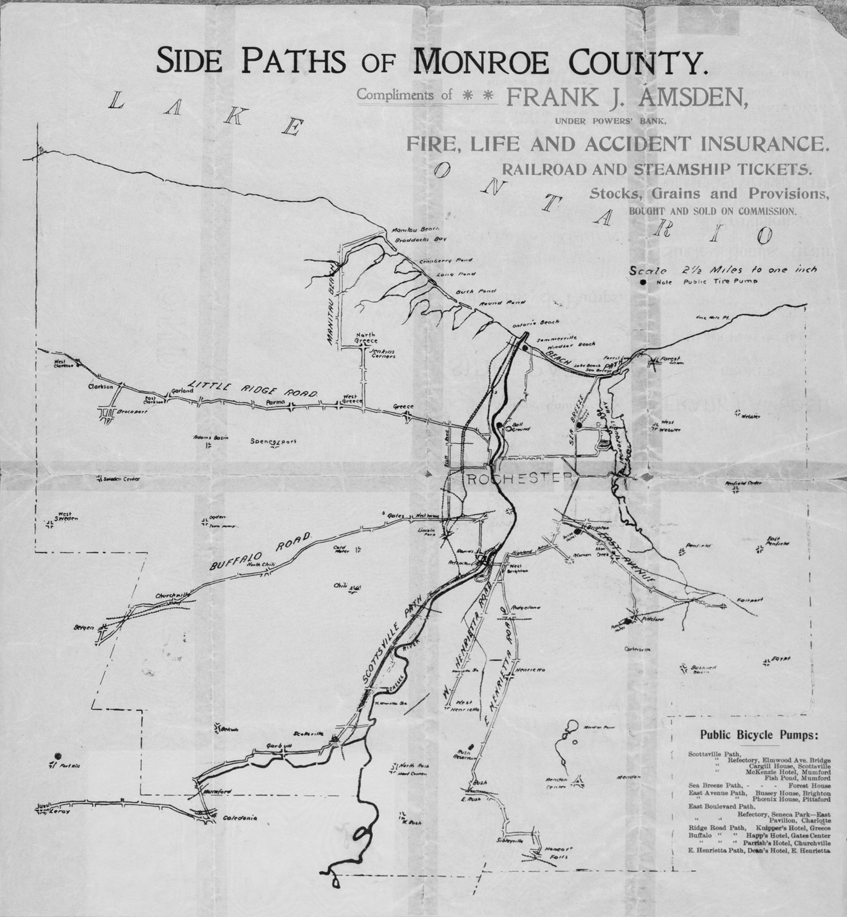
What happened next would be crucial to both the immediate success and eventual failure of sidepaths. Two counties away from Charles Raymond’s successful experiment in Niagara, Monroe County was embarking on its own initiative, and it was not going to be as collegial. Much like Lockport in Niagara County, Rochester in Monroe County was a booming industrial city in the 1890s and supported an extensive bicycling culture (see Fig. 1). Indeed, the Union Advertiser declared in 1895 that Rochester was “the greatest bicycle town in the country,” and that a visitor “would think the whole place moved on wheels.”Footnote 30
Side Paths of Monroe County, 1896, Local History Collection, Rochester Public Library, Rochester, New York. This map shows paths built by charitable subscription before the passage of statewide legislation enabled county sidepath commissions. The map shows both urban paths built alongside streets and rural recreational paths alongside the Genesee River and extending radially into the county. City streets without sidepaths are omitted from this map. Courtesy Rochester Public Library, Local History Division.
But when a law was proposed in 1896 to allow Monroe to tax all cyclists $1 and build paths that only some cyclists might use, there was significant backlash. The editor of the Post Express claimed that cyclists “regard the tax as an outrage” because it unfairly allowed cycle path riders “to reap substantial benefits at the expense of others, including women and children.”Footnote 31 The “vicious principle” of “class taxation” was the central problem, claimed the writer: “There is no more reason why the bicyclists should be taxed for cinder paths than that owners of vehicles should be taxed for the construction of better highways.”Footnote 32 Complaints against the taxation of many for the benefit of a few was a common refrain: “Twenty thousand wheel owners ought not to be taxed for the benefit of a few hundred,” argued the Post Express.Footnote 33 Dr. E. B. Angell of the Rochester Wheelmen’s League attempted to defend the bill, declaring that “the roads of the county . . . are unrideable except by expert wheelmen,” and that without sidepaths it would take “five to ten years before Monroe county can expect to have good . . . roads through state legislation.”Footnote 34
County resident Franklin Smith’s response epitomized the opposition, as he took the bully pulpit of a national magazine to summarize the debate in Monroe and to settle scores. The language gets fairly heated for a discussion of bicycling; Smith railed against “the most ignorant” minds involved, their “perverted opinions” and “amazing exhibition of selfishness.” He appeared to be targeting Dr. Angell when he criticized an unnamed “distinguished physician, equally destitute of a keen appreciation of the rights of those bicyclists that might never have time to take an excursion into the country.”Footnote 35
Smith was not arguing against the sidepaths themselves, which he described as an obvious improvement, but against the political philosophy of taxation for the general welfare. Citing a prominent proponent of Social Darwinism, he noted that “[Herbert] Spencer’s social philosophy teaches that the improvement shall be undertaken voluntarily by those alone that desire it,” he wrote. “What [it] forbids is that they should ever resort to the argument of coercion to secure the aid of others.” Given this sort of opposition, it was not surprising that the mayor and the common council failed to adopt the state’s enabling legislation.Footnote 36
Instead of financing their paths with a $1 tax on all cyclists, Monroe County instead turned to voluntary associations and subscriptions.Footnote 37 In the wake of the tax bill’s defeat and with leadership from the Post Express, cyclists raised money through donations, subscriptions, and an annual “Calithumpian Parade” and trade show. Smith found this charitable approach praiseworthy. From this success, he felt justified in generalizing that “no practical problem of social reform has been or can be suggested that can not be solved by voluntary effort.” In other words, beyond the subject of bicycle paths, Smith felt that there was never a need for governmental intervention in society.Footnote 38
This was the state of the sidepath movement before 1899, as the pushback against other funding schemes left the idea as largely voluntary. While California, Washington, New Jersey, and the Province of Ontario passed state-level sidepath laws before 1899, they were quite limited, merely allowing sidepaths to exist but not funding them or delegating power to counties to build them.Footnote 39
The Sidepath Boom and Its Discontents, 1898–1902
As of 1898, six distinct New York State acts allowed for the creation of sidepath commissions in six upstate counties. In 1897, Chautaqua County could allow paths to be built, but not raise revenue for the purpose; Columbia and Cattaraugus received similar laws the following year.Footnote 40 By that time, Niagara, Monroe, and Albany counties were all operating under individual laws that allowed some form of taxation or licensing, and other counties were clamoring for their own. Out of such confusion, the time seemed ripe for unified statewide legislation. Following a November 1898 convention of sidepath advocates in Rochester, Frank J. Amsden and Charles Raymond collaborated to draft just such a law.Footnote 41 The resulting legislation would spark a nationwide sidepath boom, with varying degrees of success.
New York’s General Sidepath Act of 1899 allowed a county judge, “upon the petition of fifty wheelmen of the county,” to appoint a commission of five or seven persons, “each of whom shall be a cyclist,” to represent the cities and towns of the county. These commissioners were “authorized to construct and maintain sidepaths along any public road, or street” with the approval of elected officials. As such, the sidepath commissioners sidestepped the authority of traditional “pathmasters,” or county officials charged to oversee the work gangs on public roads; Good Roads reformers had dismissed these political appointees as lazy and corrupt.Footnote 42
Before most roads were widened and paved, and before cities required (or assessed) abutters to install concrete sidewalks and curbing, advocates took advantage of the transitional state of the built environment to insert sidepaths into the urban landscape. The proposed paths “shall not be less than three feet or more than six feet wide . . . and shall be constructed within the outside lines and along and upon either side of such public roads and streets.” While they were to be built within the already-established legal right of way, the sidepaths were segregated from both the adjoining road and from sidewalks: already-existing pedestrian paths were not to be subsumed or inconvenienced. Later court decisions made it clear that wagons, carts, and horses were excluded from the paths. They were to be a separate network, set apart from foot and vehicle traffic, solely for bicycles.Footnote 43
The sidepath commission itself was a strange hybrid of public and private spheres and had at least two noteworthy aspects. First, in creating a special commission or agency staffed with appointed, unpaid bicycle proponents, the counties were creating a quasi-state entity, mediating between the variable demands of the bicycle-crazed public and the more staid institutions of courts, corporations, and government. Like a parks commission, the sidepath commissioners were intended to be leaders of the community, virtuously volunteering their time in the pursuit of social good. In function, these types of groups can be seen as safety valves for public demand, mediations between civil society and formal institutions of government, or as alternative modes of action to accomplish what politicians might not wish to touch themselves.Footnote 44 Second, sidepath commissions seemed to be early examples of public authorities, which historian Gail Radford has described as “quasi-governmental units responsible for public services such as water, sewage, parks, and irrigation” and empowered to engage in commercial activities otherwise out of bounds for municipalities. The sidepath commissions might have been meant as a means to skirt objections over taxation for the public good and distance the action from coercive government. After all, it was not the state power directly extracting a tax; instead, it was a quasi-state entity made up of appointed members of the public commissioned to collect fees from users.Footnote 45
The 1899 New York State law, and its 1900 revision, provided a ready template for the rest of the nation, and Charles T. Raymond received much of the credit. While his original Niagara law was tax-based, the blowback in Monroe appeared to convince him that “the license system was more equitable and would be more popular.”Footnote 46 Thus the state law was based on licensing those who chose to ride on the path (what later policymakers would call a “user-fee model”) rather than taxing all cyclists, or all county property owners.Footnote 47 Commissions were to “adopt a form of license, badge, emblem, or device suitable to be affixed to a bicycle.” The yearly license would cost at least 50 cents, and the proceeds (along with any charitable donations) were to be the entire operating budget of the commission. Such funds were to be used to purchase land and materials, to build and maintain sidepaths, to keep order on them by sending scofflaws and speeding bikers to county court, and to plant “shade trees along such paths” where appropriate.Footnote 48
It seemed fortunate to national sidepath advocates that Charles Raymond had abandoned taxation in the statewide act, as legislation based on his original Niagara county legislation or taxing all cyclists led to problems in three states. Oregon’s 1899 law—allowing counties to tax all bikes if they wished—funded the creation of nearly fifty-nine miles of six-foot-wide gravel path throughout the city of Portland.Footnote 49 But the tax itself was challenged by a city cyclist, who refused to pay the $1.25 tax and subsequent $1 fine when the Multnomah County Sheriff seized his bike for nonpayment. Both the county judge and the state Supreme Court agreed with the aggrieved cyclist, finding the bicycle tax violated three sections of the state constitution, and that it “constituted double taxation” of personal property.Footnote 50 For slightly different reasons, in 1901 the Washington Supreme Court declared its own state’s 1899 law unconstitutional. Unlike Oregon’s law, Washington’s skipped the creation of county sidepath commissions. Instead, cities could require all bicycle owners to pay for a license, create a “Bicycle Road Fund” with the proceeds that could be used to build either paths or roads, and fine owners of unlicensed bikes who attempted to take to the city roads. But when the small town of Hoquiam tried to prosecute a scofflaw, their actions were overturned by the state Supreme Court, as the justices found that “the streets of the town are, nevertheless, public highways, common to all the citizens of the state,” and access could not be denied to unlicensed cyclists.Footnote 51
The tax in Pennsylvania’s April 1899 act also proved controversial. The legislation allowed sidepath commissioners to “levy a tax not to exceed one dollar on each [bicycle] annually.”Footnote 52 The first challenge came in Bradford County, where the commissioners appointed in April 1899 attempted to immediately begin collecting taxes. The county commissioners objected, noting that by law the sidepath commissioners’ tenure did not begin until January 1900 and that the impatient sidepath proponents had no legal power to tax until then. When the sidepath commissioners brought suit, the courts instead agreed with the county; no matter how excited, a small group of citizens could not forcibly extract money from the entire county without the legal power to do so.Footnote 53 This early disagreement in Bradford County led to disaster for the state law, as the same county commissioners—once they were forced against their apparent desires to collect the tax after January 1—successfully brought suit against the sidepath commission’s very existence. The county Court of Common Pleas found the entire idea repugnant to the state constitution, which declared that “the General Assembly shall not delegate to any special commission . . . any power . . . to levy taxes or perform any municipal function whatever.” As such, in the opinion of the court, “there are no such officers as sidepath commissioners authorized by law and with power to receive funds raised by a tax on bicycles,” and that all monies previously collected had been unconstitutional seizures.Footnote 54 When a similar disagreement between county and sidepath commissioners from Erie County reached the state Supreme Court in 1901, the court found a catch-22: if the sidepath commission was a “special commission,” then it was unconstitutional, and if its commissioners were instead “officers with new municipal powers and duties . . . [then] the mode of their selection by appointment” was likewise prohibited. Sidepath by taxation in Pennsylvania had two flat tires, and the legislature had to follow up in 1907 to return remaining proceeds to the general fund.Footnote 55
While legislation taxing all bicycles was defeated elsewhere, the user-fee model of New York State was encountering varying levels of success in a bicycle-mad world. More New York counties, mostly upstate, took steps to create bicycle paths. In addition to the first six, Cortland, Fulton, Genesee, Oneida, Schenectady, Seneca Falls, Steuben, Suffolk, Warren, and Yates counties all set out to build sidepaths. The scale of these projects varied widely, with Niagara and Monroe counties dwarfing all others; Warren reported collecting only $300 in 1901, a tenth of Niagara County’s budget for 1900.Footnote 56 Fulton had a budget of $1,465, and Seneca Falls $1,055 in 1900, the same year that Monroe County’s sidepath commissioners reported paying out $11,143 for labor, materials, and four salaried positions.Footnote 57 With their early starts, Monroe and Niagara were the obvious success stories, with Monroe completing 150 miles of paths by 1900.Footnote 58
Genesee County, neighboring Monroe, serves as a useful median of these varied experiences. Genesee’s residents were not in the forefront of cycling adoption, and were only a moderate success in sidepath construction. A rural, agriculturally focused county, without significant paving projects or major urban centers, Genesee is nonetheless representative of the mainstream of the 1890s bike boom, with young and professional men in towns adopting the safety bike and creating social groups to promote riding.
As elsewhere, sidepath building in Genesee began as a charitable project. In what would become a rite of spring for years, in May 1897 the cyclists of the county began to organize themselves. Raising $115 from club members and $50 from a hotel owner at the far end of the path, the bikers of Le Roy gathered with their own tools and donated materials to build a path to Caledonia, six and a half miles away. That same year, other clubs were working on their own path sections, with the intent of forming a countywide network. The next year, riders in the county’s largest town, Batavia, attempted to connect to Le Roy’s path, ten miles away. Newspaper writers claimed a broad base of political support: “A number of Batavians, not all of whom are riders, have taken an interest,” said one story. The writer cheekily suggested that the path was so obviously advantageous that farmers would volunteer to build the path themselves.Footnote 59
The project was aided by the passage of the state’s enabling legislation in 1899, and county residents soon had a commission empowered to charge sidepath-riding cyclists for the purchase of licenses. This transition did not change the essentially volunteer nature of the project: much of the path was still built with donated materials, tools, and labor. Construction depended upon a farm implement donated by a Batavian, with “all of the farmers along the route [offering] to furnish teams free of charge and to aid in the work as much as possible,” according to optimistic journalists.Footnote 60 Still, the paths were to be better engineered than the dirt roads they paralleled, since their construction predated attempts to surface or pave the roads themselves.Footnote 61 By the end of 1900, paths linking Batavia and Le Roy had nearly been completed, and another to East Pembroke was begun. Like many other New York counties, by the turn of the century Genesee cyclists enjoyed the use of a network of well-surfaced bicycle-specific paths.Footnote 62
By 1900, success stories like Genesee County’s contributed to a nationwide boom as state after state followed the example of New York’s sidepath law. Avoiding the difficulties of Oregon, Pennsylvania, and Washington, all subsequent state laws were modeled on New York’s 1899 act, with legislatures enabling county-level sidepath commissions to raise funds through license sales. Maryland, Ohio, and Rhode Island passed their state sidepath laws in 1900, and the next year Connecticut, Florida, and Minnesota followed suit.Footnote 63 Massachusetts, New Hampshire, Vermont, and Wisconsin were all reported to be considering, or nearly passed, New York–style sidepath bills in 1900 and 1901.Footnote 64 Nor was the sidepath boom limited to the United States. The Canadian provinces of Ontario and Manitoba were reported to be working on their own cycle-path licensing laws in 1900, and Manitoba’s was passed in 1901, allowing the city of Winnipeg to create a Cycle Path Board and assess a license fee of 50 cents. Ontario’s proposed Cycle Path Commissioner’s Act was very similar to New York’s, with county judges throughout the province empowered to appoint commissions of cyclists, license riders, and build or maintain bicycle-specific paths with the proceeds.Footnote 65
The existence of these state acts did not necessarily equate to the physical reality of paths themselves. Florida’s law was functionally identical to the others, but there is no evidence that any sidepath commissions were active. In contrast, individual cities or counties could create their own license system or experiment with path building without the aid of state legislation. Salt Lake City, Utah; Keene, New Hampshire; Spokane, Washington; and Portage County, Ohio, all licensed bicycles or built paths of their own without backing from their state legislatures.Footnote 66
Minneapolis and St. Paul pursued different approaches in defending sidepath infrastructure as a public good. While a number of paths had already been built through voluntary contributions in both cities, the perceived problem was that even though the existing charitable system had too many “free riders,” it would be unjust to force anyone to pay for the resource. As a journalist worried in 1900, “The cost of side paths is not equally shared. . . . A small number do all the work. Last year 2,300 St. Paul wheelmen contributed . . . while 7,500 received the same benefits without lending any assistance whatever.” However, the mayor quickly vetoed the first city ordinance intended to create “an equitable distribution of the cost of the cycle paths.”Footnote 67 Approving of the move, the editors of the St. Paul Globe described the ordinance as “radically obnoxious” and objected to the aspects of the plan that smacked of “class legislation”: “The public thoroughfares are public property, and their use should be free and unrestricted,” wrote the editor. “If it is proposed to tax the owners of bicycles, that is another proposition; but to exclude them from the use of the cycle paths because they have not paid a fee is clearly unjust discrimination and against all true public policy. . . . As long as our streets are not private property, we hope never to see” laws that prohibit the use of public roads for any group.Footnote 68
This debate over defining a public versus a private good appeared in venues both large and small, in heated exchanges highlighting the lack of clear solutions. A Bemidji Pioneer journalist argued against others’ view that “inasmuch as cyclists are the only ones who benefit by paths they should bear the expense.” Quite the contrary, he observed, “the bicycle is just as much a means of locomotion as is the carriage, whether the object of its use be business or pleasure. Such being the case, the cycle path should be regarded as part of the highway and maintained as such.”Footnote 69 In contrast, a St. Paul journalist continued to argue for a user-fee model, even while admitting the deficiencies of the voluntary system: “The cycle tag in St. Paul has represented little more than an individual expression of appreciation,” complained the Globe. “The problem is how to make it more than that without invoking compulsory public agencies.” If voluntary contributions were not enough to support the goal, mandatory taxes on all cycle owners were considered unfair, compulsion to purchase tags was ridiculed as “class legislation,” and the public could not be convinced to pay for a benefit limited to only one part of society, what could be done?Footnote 70
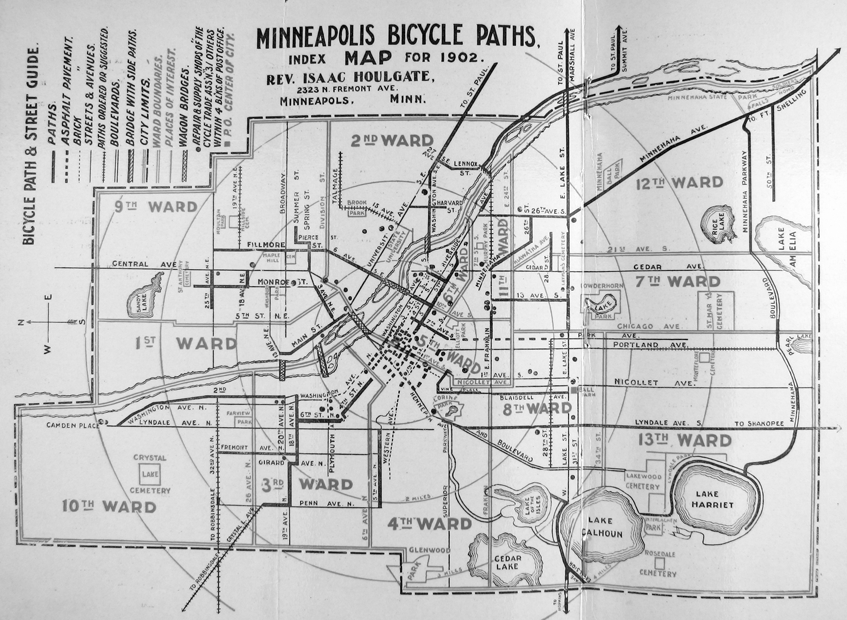
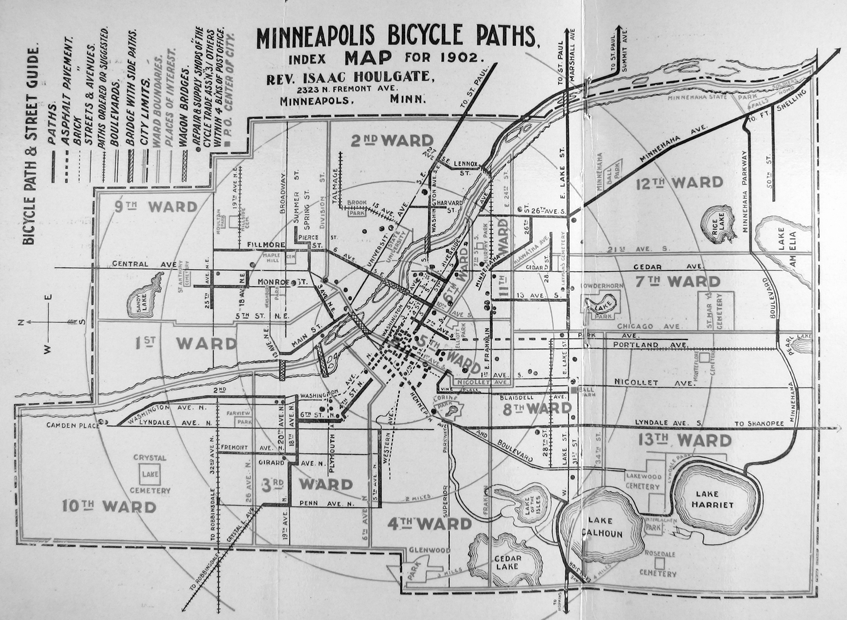
The New York user-fee model was seen as a middle-ground solution, and while the Globe predicted incorrectly in 1900 that legislators would soon take up “a law taxing the bicycles in every county,” journalists did foresee that legislation would build paths “under the direction of a side path commission similar to the New York commission.”Footnote 71 The resulting 1901 bill enabled user-fee funded sidepath commissions in the largest three counties of the state.Footnote 72 The Globe felt that the transition addressed the “free rider” problem: “Considerable money has been raised [already], but it was a noticeable fact that the tags were only bought by the enthusiastic wheelmen, and that a great many wheelmen did not think [it] necessary to pay a dollar for a tag,” a writer pointed out.Footnote 73 By 1902, the private St. Paul Cycle Path Association had declared itself defunct and transferred its funds as well as its officers to the new county sidepath commission.Footnote 74 By contrast, Minneapolis chose not to cede authority to a sidepath commission, and instead stuck with its previous ad-hoc alliance of multiple governments, agencies, and the volunteer cycle path association.Footnote 75 By 1902, both approaches appeared successful: St. Paul boasted an incredible 115 miles of paths built for the use of a reported 12,000 cyclists. Building was supported by club dues, sidepath tags, and government subsidies.Footnote 76 Selling tags through the city clerk rather than a county commission, Minneapolis built a network of more than fifty miles of sidepaths in 1902 (see Fig. 2), growing to seventy-four miles of paths within the city “and perhaps as much more outside the limits” by 1906.Footnote 77 Together, the two cities demonstrated that the sidepath movement could be both urban and rural, connecting paths alongside city streets with those in the county.
Isaac Houlgate, “Guide to Minneapolis Bicycle Paths,” 1902, Minnesota Historical Society Library, St. Paul, Minnesota, shows both paths on or alongside urban streets and radial paths in the direction of parks, lakes, and toward St. Paul. Unlike St. Paul, Minneapolis paths were not built under a county sidepath commission enabled by state law, but instead by collaboration between private and municipal institutions. Courtesy Minnesota Historical Society.
For the many states that had passed enabling legislation, emulating New York’s user-fee model looked like a good choice, since commissions designed to avoid taxation appeared to be acceptable to the courts. Helene M. Ryan, the owner of what was then rural property in Suffolk County, brought suit in 1901 against the construction of a path along South Country Road near Bay Shore, on Long Island. But the court found that the path did not “impose an additional burden on the highway, and is not a use of the highway for which the abutting owner is entitled to compensation,” and was thus constitutional. The next year, the same court also supported the powers of the Suffolk County sidepath commissioners against the objections of a different landowner.Footnote 78
With success across the nation, the first years of the new century were the high point of the sidepath movement, fostering fever-dreams of a two-wheeled future. Newspapers dreamed of a network of bicycle-only paths stretching uninterrupted “from New York to Buffalo and between Detroit, Chicago, Milwaukee and Minneapolis,” thus creating a “transcontinental highway” of sidepaths, putting Europe to shame and making the United States “pre-eminently the country for tourists.”Footnote 79 It was not entirely hot air, either: Monroe County boasted two hundred miles of networked bicycle-specific paths in 1901, and cyclists in counties throughout the nation seemed to be pedaling in that direction.Footnote 80 Oneida County Sidepath Commissioner W. S. Mackie was prepared to claim victory: “The building of side paths, which was started as a matter of sentiment by public spirited citizens through voluntary subscriptions, has passed the experimental stage, and is now a matter of business,” he declared at the 1900 sidepath convention in Utica.Footnote 81Sidepaths magazine, originating from the cycling center of Rochester, New York, supported this sense of a burgeoning, nationwide movement. The twenty-page, twice-monthly magazine brought news of good-roads advocacy and sidepath legislation. An advertisement for the magazine declared it “the only paper covering this new field,” and “instructor for every Sidepath League in the country,” with an 1899 circulation of “5,000 and growing.” By December 1900, its writers were in a cheery mood. That the movement “could reach its present magnitude in such a short time was not dreamed of and no one predicted such success that has been reached,” they crowed.Footnote 82
By the end of the century, even the LAW seemed to overcome its previous concerns that sidepath organizing would steal the limelight from good-roads legislation. The group had still been hedging its bets in 1898, when the LAW president grudgingly committed to “the construction of cycle-paths in those parts of the country where good roads are not found and cannot reasonably be looked for in the near future.” But by the end of that year, the group was praising “the reasonableness and practicality of cycle paths.” After 1900, sidepath and good-roads advocacy existed side by side in LAW publications; one proclaimed that “within five years this country will possess a system of sidepaths that will extend almost everywhere.”Footnote 83 And why wouldn’t they believe in the possibility of such a transformation? Sidepath advocates had just lived through a century in which massive investments in railroads, canals, and steamships had utterly revolutionized transportation and thus the nation.Footnote 84
The Sidepath Not Taken: 1902 to the Present
But the dream of a sidepath nation was already fading. From their height just after the turn of the century, sidepath commissions withered away through the rest of the decade. Like a receding tide revealing rotten piers, by 1905 the decline of the exuberant bike fad left the sidepath movement exposed and unable to support itself. The disappearing public interest exposed the inherent weakness in the movement’s institutional structure as essentially charitable funding streams proved incommensurate with the needs of permanent infrastructure for stable and incremental investment.
The mismatch was obvious in Genesee County from the start, when the sidepath commissioners organized a public auction for the first batch of licenses in 1899. While the commissioners themselves ponied up, offering $5 for license #1 (ten times its face value), “The auction wasn’t the complete success that was hoped for.” Just eighteen tags out of the planned one hundred were purchased.Footnote 85 The signs of faltering support continued throughout 1900. While that auction sold more tags than the previous year, there were fewer high bids, and the Daily News mourned that the “total proceeds [were] not as much.” At the event, Commissioner James A. Le Seur tried alternating appeals and threats: “You people don’t act as though you wanted these tags very badly,” he hectored the crowd. “You want sidepaths, but you must know that they can’t be built without money, and I want to say right here that cyclists who attempt to ride on them without tags will be called on to pay a visit to a Justice.”Footnote 86
La Seur’s words were not enough: the sidepath commission ran out of funds at the very beginning of the summer construction season, bringing a halt to work on June 14. The Daily News tried to put a good face on it: “As soon as the Commissioners secure additional funds the path from Le Roy east to the county line . . . will be completed.”Footnote 87 But when work resumed the next year, it was clear that nothing else had happened in 1900 due to lack of funds, and the commissioners had a grand total of $1.78 in the bank to start 1901. They scaled back both fund-raising and operations, cancelling the fund-raising auction “as so little interest was manifested in that scheme.” They also declared that “no new paths should be undertaken at the outset, or at any time during the season, unless the sales of tags warranted.” Instead, any funds raised would be spent on repair and maintenance.Footnote 88 It got worse; by May, there were not enough cyclists purchasing tags to finance even the newly restrained commission. “The wheelmen seem to take little interest,” mourned the Daily News before transitioning into blatant politicking: “Without funds the Sidepath Commission can do no work on the paths, and there is no way to get money except from the sale of tags. The paths . . . are not in firstclass condition and cannot be improved until coin is obtained. . . . It rests with wheelmen to decide whether the necessary improvements shall be made.”Footnote 89 It would appear that the decision was in the negative: after 1901, there are no additional stories about either the sidepath commissioners or their creations in the pages of the Daily News. In Genesee and elsewhere, the much-ballyhooed sidepath network was falling apart.
The last gasp of the sidepath movement attempted to rectify the institutional problem at the root of the decline by reintroducing the idea of taxation. While some counties were still successful with licenses, lamented Fulton County’s Gloversville Daily Leader, “In many the receipts are largely expended in repairs, and few extensions are being made, and in some counties the commissioners have given up and resigned in despair.” Because of this, reported that paper, movement founder Charles Raymond was prepared to return to taxation. At a state convention of sidepath commissioners, Raymond argued that “the time has arrived, when a part of the construction should be borne by the entire community and not thrown upon the shoulders of a few wheelmen.” Road building offered a handy comparison: “No one would think of attempting to build all the roads in the state from the proceeds of a license on vehicles using them,” argued the paper. “The slogan of Mr. Raymond would be ‘What is of benefit to all, all should pay for.’” With that change, opined the newspaper, the state could still be “gridironed with a perfect system of sidepaths.”Footnote 90 But Raymond’s new proposal never made it to the state legislature.
With sidepath commissions weakened, their paths eventually disappeared under newly paved roads. The Brooklyn Daily Eagle, after describing the exhaustion of the long-suffering and often-sued Suffolk County Sidepath commissioners in 1907, worried that “it is possible that when the state engineer comes along” to survey for newly funded state roads, that “he will demand that the entire width of the roadways where sidepaths now are, be graded, which would cut out the sidepaths.” With prescience the newspaper opined that “it is to the interest of everybody, school children especially, that the sidepaths be allowed to stand, as it is too dangerous in these days of automobiling for a bicyclist to be compelled to ride in the road.”Footnote 91 But that appears to be exactly what happened: where sidepaths existed at the turn of the century, new, state-funded, hard-surfaced roads were built in the coming decades. These widened roads expanded their surfaces over the top of the adjoining sidepaths. In Monroe County, the roads that were improved and paved in the first decades of the twentieth century were the same roads that had been chosen for accompanying sidepaths just a few years before; comparing maps indicates that paths simply disappeared under the widened roadbeds.Footnote 92 At the time, many cyclists were delighted by the newly paved roads; few knew then that automobiles would eventually threaten their travel on this combined system.
For example, despite all of the effort that turn-of-the-century Genesee County cyclists put into funding a purpose-built path, segregated for cyclists’ use, there is no separate path linking Batavia and Le Roy today. The road that linked those two cities then is known now as state highway NY-5. Despite the fact that it is a designated bike route, there is occasionally no shoulder and certainly no separate sidepath. With up to four lanes of heavy traffic traveling at highway speeds, it can be an unnerving place to ride a bicycle. This outcome would have been inconceivable to the Daily News journalist who confidently predicted in 1900 that the paths would never disappear since legal sources assured him that “a strip of land ‘once a sidepath, would always be a sidepath.’”Footnote 93 No one seemed to anticipate that the paths would simply be paved over.
Of course, when bicycling returned to popularity for adults in the late twentieth century, new on-street lanes, recreational trails converted from abandoned railroad lines, and even bicycle-specific roadside paths came with them. Today, Minneapolis boasts “84 miles of dedicated bike paths,” not even counting on-road bike lanes, according to a 2010 Bicycling magazine article declaring it the premier cycling city in the nation.Footnote 94 But in that article celebrating the impact of present-day bicycle paths in Minnesota, the word “sidepath,” and the history of sidepath building, is entirely absent. In fact, few if any of the original Twin Cities sidepaths remain; while many of the current bike lanes are situated along the same routes, the physical infrastructure of the original sidepath network is long gone.Footnote 95 While Minnesota has paths but little memory of the sidepath movement, the rest of the nation has neither. In 1901, Monroe County boasted two hundred miles of bicycle-specific paths crisscrossing the county; but in 2012, Monroe County had only a few miles of recreational trails along the Erie Canal, and no separate paths alongside roads at all.Footnote 96 According to newspaper accounts, in June 2011 Monroe County townships were commissioning feasibility studies “to create a system of connected trails in the Rochester region. Their hope was that the trails would form a transportation network for bicyclists and pedestrians.”Footnote 97 There is no indication that anyone knew that just such a network had already been built and abandoned over a century before.
Conclusion: Sidepath Dependency
Recovering the history of the forgotten sidepath movement allows for a number of interesting observations concerning shifting philosophies of taxation, the boundaries of a public good, and a critical moment in the growth of state power. It also helps explain current conflicts in transportation policy in cities. Together, these are arguments to take bicycle history seriously, both as an overlooked subject in the conflict over state power and as an explanation of the built environment in the United States.
The story of the sidepath movement supports the observations of historians Robin Einhorn and Christopher Wells, who have separately argued for the significance and lasting implications of tax policy in shaping history. In Property Rules, Einhorn argued for “the foundational significance of taxation in the study of political history,” observing that “the tax system, in effect, fixed the boundaries of the municipal public sphere.” Tax policy likewise predetermined the successes and failures of infrastructural projects. Where sidepaths were hobbled from the start by a weak and fluctuating funding stream, Wells observes that the interstate highway system was successful because of the ingenuity and invisibility of its financing, hiding the cost from end users and protecting it from the depredations of marauding legislators.Footnote 98 When it comes to infrastructure, it seems, the funding mechanism is destiny.
In the case of sidepaths, the funding mechanism was shaped by competing claims over whether paths were a public good. The LAW employed language that claimed the benefit of roads for all, arguing that the prior “work gang” system of rural road building was an “injustice” to the general populace. “Equality of taxation is a familiar principle,” argued one Good Roads advocate, “yet nothing would be more unequal than to tax farm property alone for the construction of roads which ultimately benefit the entire community.”Footnote 99 While such arguments had already seen success in funding public schools, they failed in the case of sidepaths and were only slowly gaining traction for roads. It was just too difficult to argue that “cyclists” and “the public” were one and the same; paths could thus not be considered a public good. As such, the failure of the sidepath movement was primarily one of social class, and secondarily one of timing. The movement began with urban and elite cyclists becoming fed up with rural opposition to road improvement. “Why should the bicyclist carry the farmer like a millstone around his neck? What has the farmer, the man most interested, done for good roads when left to himself?” complained a cyclist in 1896.Footnote 100 But such distinctions poisoned the success of later appeals for public support. In Monroe County, attempts to tax all cyclists to build sidepaths proved disastrous, susceptible to arguments that an elite group of middle- and upper-class men were unfairly benefiting from a tax base that included “the shop girls, the mechanics and laborers, the servant girls and messenger boys, and the impoverished invalids” of the county.Footnote 101 The LAW fought against such accusations for more than a decade, attempting to claim that the interests of urban and rural, rich and poor, were combined in good roads. But according to Michael Fein, the association of the technologically advanced and occasionally-expensive bicycle with the urban upper class “threatened to scuttle the campaign for better roads,” leading the group to “downplay their cycling interests when they discussed highway politics” after 1900.Footnote 102
This is an example of the sidepath movement’s unfortunate place in the chronology of evolving state power. The movement was just too early for its own good, before widespread adoption of state-supported funding mechanisms might have made path building possible. As such, it is a signpost marking the transition from the private cities of the nineteenth century to the more powerful states of the twentieth. The sidepath movement seems to be both evidence of the limits of state power and a budding desire to overcome those limitations.Footnote 103 It also seems to be an example of nonobvious routes taken by an expanding state. Gail Radford specifically declares that “dramatic growth during the twentieth century of government-launched semiautonomous revenue-financed agencies, created to fulfill professedly public purposes” demonstrates a stronger state than political historians have often described.Footnote 104
The failed sidepath movement also demonstrates that voluntary funding streams were insufficient for the construction and maintenance of serious infrastructure. In proclaiming that “no practical problem of social reform . . . can not be solved by voluntary effort,” Monroe county resident and Herbert Spencer aficionado Franklin Smith was in fact wrong. Like roads, sewers, and waterworks, the sidepath project required large-scale physical infrastructure demanding a steady and long-term investment. Voluntary funding was neither of these things. The electorate is of course free to judge that such projects are not in the interest of the public; but if the electorate does approve an expenditure, infrastructure projects require a meaningful and sustained fiscal foundation in order to succeed. Weak, partial funding for infrastructure might as well be no funding at all.
But the most illuminating corollary to rediscovering sidepaths is related to the concept of path dependency, or the understanding that current decision points are constrained to a subset of options by the commitments of the past. In recovering the history of sidepaths, it becomes obvious that cyclists experimented first with a separate transportation network before throwing in their lot with noncyclists in committing to a shared, combined system of roads. As such, it becomes clear that in the present day when cyclists and drivers compete over rights to the combined system, the bicyclist’s political investment in that road system came first, before automobiles ever existed. When automobiles came to dominate later in the twentieth century, the bicyclists’ contribution to that shared road was erased: physically subsumed when new roads paved over sidepaths, rhetorically removed when the LAW chose to scrub references to cycling from Good Roads rhetoric, and dropped from memory when the sidepath movement was not included in the narrative of road history. Because of this elision, cyclists must now beg to reenter the busy roadway that they helped build, asking meekly for automobiles to “share the road.”Footnote 105
Thinking about path dependency includes consideration of what was not built. When the combined road network widened to overtop existing sidepaths, an incredible opportunity to shape the physical contours of American cities disappeared. Even if the sidepath movement had not succeeded in its grandest dreams, if the paths themselves had continued to exist, they might have offered alternative suburban and interurban commuting options throughout the twentieth century. As cities and towns of America expanded, the suburbs would have bloomed along the sidepath networks linking them back to the urban center. The persistence of sidepaths might have provided some American cities with a built-in radial network of bicycle paths throughout the twentieth century—the very network that many are now trying to build or accommodate, with great difficulty, in the twenty-first. But urban cycling is path-dependent; the choice against the maintenance of a separate sidepath constrained all future choices to a subset of options requiring bikes and cars to share a single road. The lack of separate paths thus made it difficult for cyclists to compete when automobiles became a popular alternative, crowding bikes out of the combined road system.Footnote 106
In fact, our situation at the beginning of the twenty-first century is strangely similar to the end of the nineteenth century. Cyclists then, as now, want to take to the road. In the 1890s, cycling’s safety, utility, and success was limited by the infrastructure of rutted, unpaved roads that were not designed with bikes in mind. Today, cycling’s safety, utility, and success are limited by the infrastructure of crowded, fast-moving roads that are also not designed with bikes in mind. The wheel has turned full circle: we want to ride someplace, but can’t, because of the condition of the road.