In English and other languages, nouns are an important, if not the predominant, category among children's early words (e.g. Gentner, Reference Gentner and Kuczaj1982b). Although these early nouns are mostly monomorphemic, such as dog, cup or ball, complex words such as toothbrush, bedroom or fire truck also appear in children's productive vocabulary before age 1 ; 6 (e.g. Dale & Fenson, Reference Dale and Fenson1996; Gentner, Reference Gentner and Kuczaj1982b). How do children learn what nouns such as ball or toothbrush refer to when there is, in principle, no limit to what they might refer to (see problem of indeterminacy of reference in Quine, Reference Quine1960)? To constrain possible word meanings, children might be biased to interpret novel words in particular ways. They assume, for instance, that nouns refer to whole objects rather than properties or parts of objects (Markman, Reference Markman1989). In the case of artefacts, children often focus on perceptual features, especially the object's shape (e.g. Gentner, Reference Gentner and Gardner1982a; Merriman, Scott & Marazita, Reference Merriman, Scott and Marazita1993; Smith, Jones & Landau, Reference Smith, Jones and Landau1996; Tomikawa & Dodd, Reference Tomikawa and Dodd1980).
Complex words such as noun–noun compounds (e.g. orange juice or toothbrush) add another dimension to the problem of indeterminacy of reference. To fully understand the meaning of compounds, it is not only necessary to determine the meaning of the constituents (e.g. orange and juice), but also to infer a relation between the constituents (juice MADE OF oranges, brush FOR teeth). While it has often been argued that the number of ways in which constituents can be related to each other is potentially infinite (e.g. Bauer, Reference Bauer1983; Downing, Reference Downing1977; Gleitman & Gleitman, Reference Gleitman and Gleitman1970), most compounds can be paraphrased using a small set of relations (see Downing, Reference Downing1977; Levi, Reference Levi1978; Warren, Reference Warren1978, for various proposals of what these relations might be). Examples of relations are FOR (hairbrush), HAS (apple pie), MADE-OF (snowman), LOCATED (farm animals), PART (chicken leg) and IS (toy car). Consistent with these proposals, various empirical studies have suggested that when adults are presented with an unfamiliar compound (e.g. apple ring), they usually concur on a small set of relations and often have a strong preference for a single relation (ring MADE OF apple; see Krott, Gagné & Nicoladis, Reference Krott, Gagné and Nicoladis2009; Štekauer, Reference Štekauer2005).
Research to date suggests that children's interpretations of novel compounds start to resemble adults' interpretations from early on, but that they take years to become fully adult-like. For instance, adults expect compounds to express habitual, i.e. stable, relations rather than accidental relations between objects (Downing, Reference Downing1977; Gleitman & Gleitman, Reference Gleitman and Gleitman1970; Levi, Reference Levi1978). They do not expect, for example, owl house to refer to a house that an owl flew by (Gleitman & Gleitman, Reference Gleitman and Gleitman1970). A study by Clark, Gelman & Lane (Reference Clark, Gelman and Lane1985) suggests that young children have this expectation as well. They found that children as young as 2 ; 0 prefer to use compounds to label objects that are inherently related (e.g. a house made of a pumpkin) rather than being temporarily or accidentally together (e.g. a chair with a spider on it). Although there might be some understanding in two-year-olds that compounds tend to refer to two objects that are not accidentally together, this understanding develops slowly. Nicoladis (Reference Nicoladis2003) showed that when children are asked to choose between two referents of a novel compound (e.g. sun bag), one with inherently related objects (e.g. a bag with suns on it) and one with objects simply next to each other (a bag and a sun next to each other), they mostly chose the inherently related objects. However, three-year-olds were more likely than four-year-olds to choose objects that were simply next to each other. And even six- to nine-year-olds occasionally interpret compounds as two objects that are not inherently related, but as two objects located next to each other, explaining a book magazine as ‘a big magazine next to a little book’ (Parault, Schwanenflugel & Haverback, Reference Parault, Schwanenflugel and Haverback2005).
The slow development of children's understanding of compounds might be due to a possible word learning constraint for compounds that became apparent in Krott et al.'s (Reference Krott, Gagné and Nicoladis2009) study. Comparing children's explanations of unfamiliar compounds with adults' explanations revealed that children overused the relations HAS (e.g. ‘a seat that HAS snow on it’ for snow seat) and LOCATED (e.g. ‘a seat IN the snow’). At the same time they underused the function relation FOR. For example, children interpreted an egg bag as ‘an egg with a bag’ or ‘a bag what got pictures of eggs on it’, while adults interpreted it as a bag FOR eggs. These findings are especially remarkable because the FOR relation appears to be the dominant relation in children's compound vocabulary. An investigation (Krott et al., Reference Krott, Gagné and Nicoladis2009) of all 629 noun–noun compounds occurring in all types of transcripts of all British children in the CHILDES database (MacWhinney, Reference MacWhinney2000) revealed that about 40% of these compounds contain a FOR relation, while HAS and LOCATED each occur in less than 10% of the compounds (for more details see Krott et al., Reference Krott, Gagné and Nicoladis2009). If this estimate correctly reflects children's compound vocabulary and children's understanding of relations in novel compounds was primarily based on how often compounds embodying that relation are encountered, then they should have rather overused than underused the FOR relation. Instead, their overuse of HAS and LOCATED relations might be due to a developmental bias. This bias would also explain why other studies have found that children's interpretations become adult-like so slowly.
One feature that HAS and LOCATED relations have in common and that distinguishes them from a FOR relation is that both HAS and LOCATED relations are concrete relations that refer to object combinations in which the two objects are both perceptually available, which is not necessarily the case for the FOR relation. For instance, while the clock and tower of clock tower (a tower that HAS a clock) and the farm and animals of farm animals (animals LOCATED at a farm) are perceptually available because the two objects always (or typically) occur together, this is much less the case for lips of lipstick (stick FOR lips) because lipsticks often occur without being near lips.
Krott et al.'s (Reference Krott, Gagné and Nicoladis2009) finding that children overused HAS and LOCATED and underused FOR could be due to metalinguistic skills, because participants were asked to explain the meaning of novel compounds. Consequently, it might have been easier for children to explain HAS and LOCATED relations than the FOR relation because the FOR relation is more abstract. Thus, children might have been aware of both interpretations, but opted for the simpler HAS or LOCATED explanations. The present study examines children's preference for HAS/LOCATED relations using a forced choice task that requires little, if any, metalinguistic skills, which can therefore potentially rule out whether the HAS/LOCATED bias arose because of the demands of an explanation task. Participants were asked to choose between two possible referents of a novel compound, one using a HAS or LOCATED relation and the other a FOR relation. Because FOR relations are not easily accessible in a static presentation, we acted them out. We expected HAS and LOCATED relations to behave very similarly in such a task because of their similarity in perceptual availability that distinguishes them from FOR relations.
The present study investigates whether: (a) the preference for HAS/LOCATED is still detectable for four- and five-year-olds, when an alternative FOR interpretation is made more accessible than in an explanation task; and (b) whether the preference is stronger for younger children and decreases with age, which would be in line with the assumption that we are dealing with a word learning bias. If only children but not adults show a preference for HAS/LOCATED interpretations in this task, it would suggest a constraint on compound interpretation that is relevant for children only.
To examine this issue, we used an experimental paradigm with the following design characteristics. While in Krott et al. (Reference Krott, Gagné and Nicoladis2009) participants were presented with novel compounds constructed from two familiar nouns (e.g. snow seat or lemon box), we chose to present novel nouns that referred to novel objects. This was done to remove any effect of previous experience with the names on participants' responses because Krott et al. (Reference Krott, Gagné and Nicoladis2009) found that children's interpretations of compounds with familiar constituents were strongly affected by their knowledge of other compounds containing one of the same constituents. For example, children were more likely to interpret the novel compound lemon box as a box FOR lemons the more other box compounds they knew that had a FOR relation (postbox, toolbox or lunch box, etc.). Another reason for using novel objects is that the children were not able to base their compound interpretations on knowledge about the objects. While in Krott et al. (Reference Krott, Gagné and Nicoladis2009) they might have encountered a box with lemons before and used this knowledge to interpret lemon box, in the present study they were only able to use the information about the objects that we provided them with.
Furthermore, we decided to provide participants with some linguistic scaffolding by explaining the object relations to them. Linguistic scaffolding might have made it easier for children, especially the younger ones, to recognize the difference between the ways the objects were related. We conducted two studies that differed slightly in terms of these descriptions. In Experiment 1 we described the function relations with various verbs to enrich the linguistic information (e.g. ‘pushes’, ‘holds’, ‘opens’), while in Experiment 2 we described all functions using the same expression (‘is for’).
We chose to test two- to five-year-olds and adults to investigate any development in children's preferences. Age 2 ; 0 is the youngest age at which children have been shown to understand the function of compounding and know about the internal structure of compounds, i.e. the roles of heads and modifiers (e.g. Clark, Reference Clark and Deutsch1981; Clark & Berman, Reference Clark and Berman1987; Clark et al., Reference Clark, Gelman and Lane1985). Our paradigm should thus be suitable for even the youngest participants in our study. Five-year-olds were the oldest children we tested because we were interested in whether the preference for HAS/LOCATED interpretations is present in this age group when an alternative FOR interpretation is made much more accessible. We added adults to the participant group because our paradigm had not been used before and we needed to establish how adults, who did not show a preference for HAS/LOCATED relations in an explanation task, would perform in a forced-choice experiment.
If the preference for HAS/LOCATED relations is a word learning bias, then it should be visible in children's responses. It should be strongest in two-year-olds and slowly decrease in older ages. This is also expected given earlier indications that children's understanding of relations in compounds develops gradually over the preschool years (Nicoladis, Reference Nicoladis2003). Five-year-olds preferred HAS/LOCATED in Krott et al.'s (Reference Krott, Gagné and Nicoladis2009) study. Because the present study required little or no metalinguistic skills, and because both options were made equally available, five-year-olds were expected to show a much weaker bias towards HAS/LOCATED or no bias at all. Adults did not show a preference for HAS/LOCATED in the explanation task in Krott et al. (Reference Krott, Gagné and Nicoladis2009). It is not unusual for novel compounds to have both a HAS or LOCATED interpretation and a FOR interpretation (e.g. a rabbit bowl could be equally well a bowl that HAS a picture of a rabbit on it or a bowl FOR rabbits). We therefore expected adults to show no strong preference for either interpretation in the present study.
EXPERIMENT 1
In Experiment 1, participants were asked to choose between two interpretations of novel compounds (HAS/LOCATED versus FOR), while their understanding of the constituent relations was enhanced using specific verbal expressions.
METHOD
Participants
Thirty two-year-olds (mean age 2 ; 5, SD=0 ; 3, 15 males), 30 three-year-olds (mean age 3 ; 6, SD=0 ; 3, 13 males), 28 four-year-olds (mean age 4 ; 4, SD=0 ; 3, 17 males), 33 five-year-olds (mean age 5 ; 5, SD=0 ; 3, 15 males) and 22 adults (mean age 19·5, SD=1·1, 10 males) took part in the study. The children were recruited from six primary schools and nurseries around Birmingham, United Kingdom. The adults were undergraduate students from the University of Birmingham, United Kingdom. All participants were monolingual English speakers. All children were normally developing.
Materials
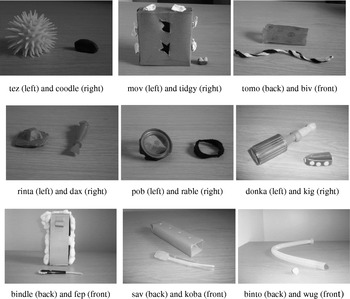
We chose five familiar objects to be used as distracters to test children's knowledge of the names for the novel objects: a toy car, a ball, a book, a teddy bear and a spoon. For the experimental items, we used eighteen novel objects (see Figure 1 and Appendix A). We randomly assigned eighteen novel names to the objects, which were all one or two syllables long, easily pronounceable and resembled English words (e.g. wug, donka or kig, see Figure 1 and Appendix A). The names were judged by five native British adult speakers to be nonce words. Objects were paired so that each pair could be combined in two ways, one of which was always a FOR relation and the other a HAS or LOCATED relation (six HAS relations and three LOCATED relations). In addition, both combinations could be referred to by the same compound. For example, for the compound kig donka, a kig was either glued to a donka (HAS) or a donka was used as a container for a kig (FOR). For the compound bindle fep, a fep was located inside a bindle (LOCATED) or a fep was used to open a bindle (FOR). To avoid any effects of name–object pairings, we swapped the names for the two objects within a pair for half of the participants in each age group. There were always three exemplars of each object pair, one to introduce the objects individually, the other two to present the two relations.
Pairs of novel objects used in experiments.

Procedure
All participants were tested individually by an English native speaker. The procedure for each object pair consisted of three parts. Each participant was familiarized with the two objects of the object pair and their names to make it easier to relate the names with the objects when presented with the compounds. A brief memory test ensured that the participant remembered which object is which. Immediately after the presentation of an object pair the actual compound test followed, in which participants were shown the two combinations (HAS/LOCATED and FOR) for the object pair, introduced to the modifier–head relations of the two combinations, and asked which combination the compound refers to. Procedures for children and adults differed slightly for the familiarization and memory test, but not for the compound test. After participants responded to the compound, the next object pair was introduced.
Child participants
For child participants, the experimenter first asked each child, ‘Do you want to play a game with me? I'll show you some funny objects and then tell you their names. Shall we do that?’ She then showed the first object (always the head of the compound first, independent of which noun was used as head or modifier in the compound) and said ‘This is a(n) X. Do you see the X? Can you say X?’ (e.g. ‘This is a donka. Do you see the donka. Can you say donka?’). If the child pronounced the word correctly, she/he was praised by ‘Yes, it is a(n) X!’ (e.g. ‘Yes, it is a donka!’). Otherwise the child was asked to pronounce the name again until the pronunciation was correct. None of the children needed more than two attempts to correctly produce the novel names. Subsequently the second object of the pair was introduced in the same way, e.g. ‘This is a kig. Do you see the kig? Can you say kig? – Yes, it is a kig!’ Immediately after the introduction of an object pair, the child's memory for the new name–object pairings was tested, by presenting three objects: the two novel objects and one familiar object, serving as a distracter object. The experimenter asked the child to identify one of the two novel objects by saying ‘Where is the X? Can you remember which one is the X?’ If the child pointed to the correct object, she/he was praised, if not then the experimenter pointed to the correct object, removed all objects from the table, and repeated the task with a different distracter object until the child responded correctly. None of the children needed more than two attempts to pick the correct object. The procedure was then repeated for the second object.
Adult participants
In case of adult participants, the participant was sat down at a table and told that the purpose of the experiment was to study language acquisition and how people learn novel names for novel objects. One object of the first object pair was presented and the participant was told the novel name of the object, e.g. ‘This is a donka’. The second object of the pair was then shown and named in the same way, e.g. ‘This is a kig’. As for child participants, the head of the compound was always introduced first. The participant was then asked ‘Which one is the kig?’ or ‘Which one is the donka?’, with half of the participants responding to the first question, the other half to the second question. None of the adults ever picked the wrong object.
All participants
For the compound test, the table was cleared of all objects and the participant was told ‘I will now show you more of these toys’. The experimenter placed both types of combinations (HAS/LOCATED and FOR) on the table. She introduced each combination, while explaining the relation between the two objects of the combination. For example, for the condition of the FOR relations, the experimenter said ‘This is a donka that holds a kig’ and acted out the function (the kig was placed into the transparent donka). For the condition of the HAS/LOCATED relations, the experimenter said ‘This is a donka that has a kig’ (see Appendix B for details on the relations and exact wordings for each object pair).Footnote 1 The experimenter also pointed to each object while explaining the relation, reminding the participants of the names. Which condition was shown first (the FOR relation or the HAS/LOCATED relation) was counterbalanced across trials and participants. Apart from the function combination of the coodle tez, where an opaque tez covered a coodle, both objects always remained visible to the participants. In addition, after the introduction the two objects of both options were physically contiguous. Once both relations were explained, the experimenter asked ‘Which one is the kig donka?’. Participants responded by pointing to the chosen object pair. This procedure was then repeated for the remaining pairs. In order to keep up the attention of the children, they were praised after each response and were given breaks as necessary. Once a child responded to all items, he/she was praised and rewarded with a sticker.
RESULTS AND DISCUSSION
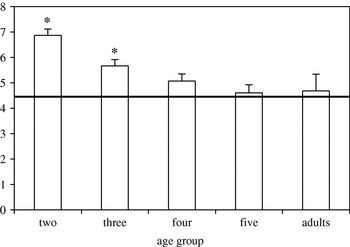
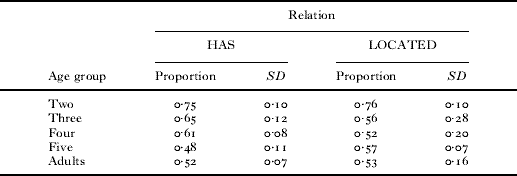
Apart from one occasion, when one three-year-old refused to choose an object in the compound test, all children and all adults made a decision and chose one of the combined objects. As expected, combinations with either HAS or LOCATED relations showed very similar results (see Table 1). We therefore collapsed these two relations for further analyses. Figure 2 shows the number of choices for HAS/LOCATED relations for the five age groups. When averaging responses over items, an analysis of variance with age group (adults, five-, four-, three- and two-year-olds) as independent variable and number of HAS/LOCATED responses as dependent variable showed an effect of age group (F(4, 138)=7·4, p<0·001, ηp2=0·177). Tukey HSD post hoc tests revealed that the responses of two-year-olds differed significantly from those of four-year-olds (p=0·003), five-year-olds (p<0·001) and adults (p=0·001). No other differences were significant. Furthermore, children's performance across compounds was very similar. The number of children choosing the HAS/LOCATED interpretation was not significantly different among the nine items in any of the age groups: two-year-olds (χ 2 (8, N=196)=2·83, p=0·945), three-year-olds (χ 2 (8, N=167)=1·18, p=0·162), four-year-olds (χ2 (8, N=147)=5·88, p=0·661), five-year-olds (χ2 (8, N=152)=5·38, p=0·716) and adults (χ 2 (8, N=102)=3·18, p=0·923).
Mean number of HAS/LOCATED choices (out of nine) for the different age groups in Experiment 1. Horizontal line represents chance level and numbers different from chance are marked by *.

Mean proportions and standard deviations of HAS and LOCATED responses in Experiment 1 for all age groups

Comparing numbers of HAS/LOCATED responses against chance (4·5) showed that two-year-olds (t(29)=9·4, p<0·001, d=1·71) and three-year-olds (t(29)=4·7, p<0·001, d=0·87) chose HAS/LOCATED relations more often than predicted by chance. Five-year-olds' and adults' choices, on the other hand, did not differ from chance (all ts <1) and four-year-olds were at the borderline (t(27)=2·0, p=0·053, d=0·38). Thus, two- and three-year-olds clearly preferred HAS/LOCATED relations over FOR relations when asked to identify the referent of a compound. Because five-year-olds and adults did not exhibit a preference for either relation, they perceived both interpretations as being equally plausible. Four-year-olds appear to be at a transition stage. Importantly, they do not show a clear preference for HAS/LOCATED relations.
In this experiment, participants were exposed to quite a number of novel objects together with their functions. Young children might have been overloaded with so much new information, especially function information. It might therefore be possible that children revealed a bias towards HAS/LOCATED interpretations because they were overloaded with function information. To rule out such an interpretation, we compared participants' responses for the first four and the last four compounds for each age group (Bonferroni-corrected α=0·05/5=0·01). We found that, for most age groups, responses did not significantly differ for the first and last four compounds (two-year-olds: 3·13 vs. 2·97, t(29)=0·84, p=0·407; four-year-olds: 2·36 vs. 2·11, t(27)=0·94, p=0·355; five-year-olds: 1·88 vs. 2·12, t(32)=−0·98, p=0·332; adults: 2·18 vs. 1·86, t(21)=1·20, p=0·246) except for three-year-olds, who chose HAS/LOCATED interpretations more often for the first four compounds than for the last four compounds (2·80 vs. 2·23, t(29)=2·89, p=0·007, d=0·64). This rather suggests that three-year-olds started off with a preference for HAS/LOCATED interpretations, but considered FOR relations as plausible interpretations more often in the latter half of the experiment. This might have been caused by an increasing number of function relations presented to them as candidates for compound interpretations. Importantly, it is very unlikely that the overall preference for HAS/LOCATED interpretations in two- and three-year-olds is due to them being overloaded with function information.
The linguistic descriptions of the relations in this experiment were chosen to clearly capture the specific relations of the objects in order to enhance children's understanding of the relations. However, the young children in our experiment might not have fully understood all the verbs that we used to describe the relations (e.g. ‘lifts’ and ‘stores’) and therefore might have chosen the easier understandable HAS/LOCATED relations. In addition, Appendix B shows that the use of different verbs for the FOR relations led to unequal distributions of verbal expressions. FOR relations were expressed by a variety of verbs (e.g. pushes, holds, opens), while HAS/LOCATED relations were more consistently expressed by using either has (six times) or is in (three times). Adult studies have shown that the interpretation of a novel noun–noun combination (e.g. student vote) is affected by whether the preceding phrase uses the same relation (e.g. Gagné, Reference Gagné2001). If children are affected in the same way, the dominance of HAS/LOCATED relations in our material might have primed children's preference for these relations. While we know of no a priori reason to expect that younger children might have been more strongly affected by priming, it is a logical possibility. Because of these reasons we conducted a second experiment, in which we kept the verbal expressions for the two choices equally frequent over all trials, replacing the verbal expressions for the FOR relation with a simpler ‘is … for’ and only using HAS relations and not LOCATED relations.
EXPERIMENT 2
In Experiment 1, the verbal descriptions of the relations were not used equally often for each of the two relation types; for example, the word has appeared for six out of the nine HAS/LOCATED items, whereas a variety of verb was used for the FOR items. Therefore, Experiment 2 investigated whether (young) children prefer HAS relations over FOR relations when verbal expressions are kept equally frequent for the two interpretations. We compared responses of two- to three-year-olds with those of four- to five-year-olds in order to compare the performance of children who showed a clear bias towards HAS/LOCATED interpretations in Experiment 1 with the performance of children who did not show such a clear bias or no bias at all.
METHOD
Participants
Twenty-one two- to three-year-olds (mean age 3 ; 2, SD=0 ; 6, 10 males) and 21 four- to five-year-olds (mean age 4 ; 7, SD=0 ; 4, 6 males) took part in the study. The children were recruited from a nursery and a primary school in Birmingham. All were monolingual English speakers and were normally developing. None had participated in Experiment 1.
Materials
The novel objects and names were a subset of those of Experiment 1, namely the six object pairs that were combined with a HAS relation (see Appendices A and B). We used different familiar objects to test that participants remembered the names of the novel objects: a water bottle, a cup, a toothbrush, a toy train, a ruler and a cap.
Procedure
The procedure was the same as that of Experiment 1, apart from the explanations used in the compound test phase. HAS relations were introduced as before with ‘This is a(n) X that has a(n) Y’ (e.g. ‘This is a donka that has a kig’). FOR relations were introduced consistently with ‘This is a(n) X that is for a(n) Y’ (e.g. ‘This is a donka that is for a kig’).
RESULTS
As in Experiment 1, none of the children needed more than two attempts to correctly produce the novel names or to pick the correct object when presented with a distracter object. The number of HAS responses were very similar to the HAS/LOCATED responses of Experiment 1, namely 3·8 (SD 1·03) for two- to three-year-olds and 3·29 (SD 1·42) for four- to five-year-olds. Comparing number of HAS responses against chance (3) showed that two- to three-year-olds chose HAS relations more often than predicted by chance (t(20)=3·6, p=0·002), while this was not the case for four- to five-year-olds (t(20) <1, n.s.). Thus, as in Experiment 1 for HAS/LOCATED relations, only younger children had a clear preference for HAS relations.
GENERAL DISCUSSION
Our findings indicate that when young children interpret a novel noun–noun compound, they have a bias towards interpreting the referents of the compound's constituents as being related by a HAS or LOCATED relation as compared to being related by a FOR relation. This preference was not affected by the verbal expressions used to describe the compound's relations. In the current set of experiments, the preference was present for two- and three-year-olds, but not for five-year-olds or adults.
The findings for five-year-olds contrast with those of an earlier compound explanation task, in which they preferred HAS/LOCATED interpretations (Krott et al., Reference Krott, Gagné and Nicoladis2009). However, the present study used a forced choice task; FOR and HAS/LOCATED interpretations were presented as equal alternatives, and the FOR interpretations were made concrete, which made them strong competitors. In addition, responses did not require many metalinguistic skills, which means there was no reason to avoid the more difficult to explain FOR relations. Finally, we used compounds composed of novel words rather than compounds composed of existing words (as in Krott et al., Reference Krott, Gagné and Nicoladis2009). Our finding therefore shows that in these circumstances five-year-olds do not exhibit a HAS/LOCATED bias. Because adults had not shown this bias in an explanation task, they were not expected to show it in the present paradigm either. Because our results revealed a gradual decrease of the HAS/LOCATED bias from age two on, it is in line with the assumption that we are dealing with a word learning bias that gradually disappears when children become older. This bias might be the reason that children's compound interpretations become adult-like very late, so that even six- and nine-year-olds occasionally reveal it (Krott et al., Reference Krott, Gagné and Nicoladis2009; Nicoladis, Reference Nicoladis2003; Parault et al., Reference Parault, Schwanenflugel and Haverback2005).
What remains unanswered is what exactly is the constraint on interpretations of novel compounds that makes young children prefer HAS/LOCATED interpretations over FOR relations. It is unlikely that children prefer HAS and LOCATED relations because they do not understand or remember the presented FOR relations. Even infants aged 1 ; 6 and younger are sensitive to the function of objects (e.g. Barnat, Klein & Meltzoff, Reference Barnat, Klein and Meltzoff1996; Booth & Waxman, Reference Booth and Waxman2002; Madole, Oakes & Cohen, Reference Madole, Oakes and Cohen1993) and it has been shown that at least three-year-olds understand and remember simple functions of novel objects, similar to the ones used in our experiment (e.g. Diesendruck, Markson & Bloom, Reference Diesendruck, Markson and Bloom2003; Smith et al., Reference Smith, Jones and Landau1996). What distinguishes HAS and LOCATED relations from FOR relations is that they are concrete and tend to be perceptually stable because they link referents that tend to be permanently physically contiguous, while FOR relations are more abstract, not always perceptually available because they link referents that are not continuously physically contiguous. For example, an apple pie always HAS apples and zoo animals are typically LOCATED in a zoo. A baby bottle (bottle FOR babies), however, is not continuously used to feed a baby, nor does a teacup (cup FOR tea) continuously hold tea. It is therefore more difficult to associate baby with baby bottle or tea with teacup and it might be more difficult to create a conceptual representation that denotes the relation (FOR) between the constituents baby and bottle. In other words, these compounds, although transparent to adults, might initially be seen as opaque from the child's perspective, similar to the opaque contribution of straw to a strawberry. We chose a paradigm that made the relations more equal in that both HAS/LOCATED relations and FOR relations were visually perceivable and in both cases the constituents were permanently visible. Acting out the FOR relation might have drawn more attention to the FOR relations. However, the latter did not seem to be the case because no age group preferred FOR interpretations. An important difference that remained between the two object combinations was that objects related by HAS and LOCATED relations were permanently physically contiguous and therefore perceptually stable, while the FOR relations were not perceptually stable because the function was presented for a short time and the physical relationship, for example the physical distance, between the two objects changed. Because young children preferred HAS/LOCATED interpretations, they might have preferred interpretations with permanent physical contiguity. Older children had revealed a bias towards HAS and LOCATED interpretations when asked to explain the meaning of unknown compounds (Krott et al., Reference Krott, Gagné and Nicoladis2009). In the present study, they might have benefited from viewing a concrete depiction of the two interpretations for the compound, which might have made a FOR interpretation more plausible. Alternatively, not needing to explain the FOR relations might have made it easier to respond with a FOR interpretation.
The bias towards HAS and LOCATED relations and against FOR relations resembles another word learning bias that concerns perceptual features, namely children's focus on the shape of artefacts (e.g. Gentner, Reference Gentner and Gardner1982a; Landau, Smith & Jones, Reference Landau, Smith and Jones1998; Merriman et al., Reference Merriman, Scott and Marazita1993; Smith et al., Reference Smith, Jones and Landau1996; Tomikawa & Dodd, Reference Tomikawa and Dodd1980). Both biases can overrule function information, both rely more heavily on perceptually stable features of an object than does the function (or FOR relation) and both are more prominent in two-year-olds than five-year-olds. As mentioned, it can be ruled out that their common source is the problem with understanding functions as such because much younger children have been shown to be sensitive to the function of objects (e.g. Barnat et al., Reference Barnat, Klein and Meltzoff1996; Booth & Waxman, Reference Booth and Waxman2002; Madole et al., Reference Madole, Oakes and Cohen1993). The difficulty with function seems to arise in the context of word learning (e.g. Deák, Ray & Pick, Reference Deák, Ray and Pick2002; Landau et al., Reference Landau, Smith and Jones1998). Both biases might therefore have a common source, namely children's attention to and reliance on stable perceptual features of objects.
Note that it is not the stability itself that distinguishes perceptual features such as shape or HAS/LOCATED relations from function. The intended function of an object or the function relation within a compound is stable as well. This is in accordance with the observation that compounds as a whole tend to be used to express stable (i.e. habitual) relations rather than accidental relations (Downing, Reference Downing1977; Gleitman & Gleitman, Reference Gleitman and Gleitman1970; Levi, Reference Levi1978). But in contrast to features such as shape or HAS relations, which tend to be both perceptually and conceptually stable, functional stability lies at a pure conceptual level. For example, while the shape of a key remains both perceptually and conceptually stable, the function of a key is not always perceivable, but it remains stable at a conceptual level. Similarly, the HAS relation in clock tower (tower that HAS a clock) is perceptually and conceptually stable, because the tower always has a clock. In contrast, the function of a baby bottle is not perceptually stable because one cannot always see that a baby bottle is used to feed a baby, but it remains stable at a conceptual level. It therefore appears to be a perceptual stability rather than a pure conceptual stability that young children initially focus on when interpreting the meaning of artefact nouns and compound nouns. As children gain more experience with words and their referents, they appear to be able to infer a more abstract stability that underlies word meaning, such as function.
But what leads young children to focus on perceptual stability? One account that tries to explain children's biases toward perceptual features is Smith and colleagues' ‘attentional learning account’ (ALA). The ALA argues that such biases are attentional biases that arise from the learning of statistical regularities in children's early noun categories (e.g. Gershkoff-Stowe & Smith, Reference Gershkoff-Stowe and Smith2004; Graham, Williams & Huber, Reference Graham, Williams and Huber1999; Jones, Reference Jones2003; Smith et al., Reference Smith, Jones and Landau1996; Smith & Samuelson, Reference Smith and Samuelson2006). For example, children are drawn to the shape of objects, while they should focus on their function instead, because they have learned from artefact nouns they know that artefacts refer to ‘things in categories organized by shape’ (Smith & Samuelson, Reference Smith and Samuelson2006). The emergence of the shape bias is also understood as being closely linked to vocabulary growth. Smith (Reference Smith and MacWhinney1999) showed that children's shape bias emerged after the number of count nouns in their vocabulary reached fifty or more. Similarly, Gershkoff-Stowe & Smith (Reference Gershkoff-Stowe and Smith2004) showed in a longitudinal study of eight children that the emergence of a shape bias coincided with an acceleration of the children's noun vocabulary. Furthermore, the vocabulary of children aged 1 ; 3 to 1 ; 7 has been shown to accelerate due to training of categories that are organized by shape (Samuelson, Reference Samuelson2002; Smith, Jones, Landau, Gershkoff-Stowe & Samuelson, Reference Smith, Jones, Landau, Gershkoff-Stowe and Samuelson2002).
Extending the ALA to compounds would mean that children learn from the compounds they know that compounds refer to two (or more) objects that are related by HAS or LOCATED relations, and that this bias develops with an early increase in compound vocabulary size. For that, HAS and LOCATED relations would need to be the preferred interpretation within their vocabulary. It is not clear whether this is the case, though. As mentioned in the introduction, adults' interpretations of compounds occurring in the CHILDES database suggest that FOR is the dominant relation in children's compound vocabulary, which would appear to rule out such an explanation.
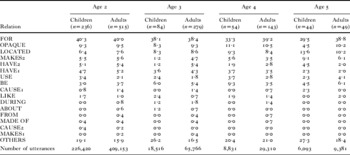
The question arises whether the FOR relation is less dominant in the vocabulary of younger children and increases with age. Similar to the survey in Krott et al. (Reference Krott, Gagné and Nicoladis2009), we investigated this question by gathering noun–noun compounds in the British-English transcripts in the CHILDES database (MacWhinney, Reference MacWhinney2000), focusing on the child and child-directed speech of two-, three-, four- and five-year-olds (911 transcripts of 66 two-year-olds, 162 transcripts of 68 three-year-olds, 37 transcripts of 23 four-year-olds and 23 transcripts of 18 five-year-olds). We then added the codings of modifier–head relations of these compounds gathered for the study by Krott et al. (Reference Krott, Gagné and Nicoladis2009). Those were based on the majority coding of five British native speakers using the relations listed in Appendix C, which are inspired by Levi's categories (Levi, Reference Levi1978). Table 2 provides an overview of the relations occurring in compounds produced by children and adults, together with their percentage within the compound vocabularies at different ages. The distributions of relations are very similar to that of all British-English transcripts in CHILDES, as presented in Krott et al. (Reference Krott, Gagné and Nicoladis2009), and do not differ much between the different age groups. The distributions are very skewed, with a few relations making up the majority of compounds, among which are the relations of interest, i.e. FOR, HAVE1 (which is equivalent to the HAS relation in our study), and LOCATED. FOR relations are the most dominant relations, equally prevailing in both child speech and child-directed speech (about 30–40%), and importantly this dominance is very similar for all age groups, including adults (χ 2 (7, N=1404)=2·83, p=0·900). HAVE1 and LOCATED relations occur each in less than 10% of the compounds. Similar to the FOR relations, the occurrence of LOCATED and HAVE1 relations does not differ across age groups, including adults (LOCATED: χ 2 (7, N=1404)=3·49, p=0·836; HAVE1: χ 2 (7, N=1404)=2·50, p=0·927).
Percentage of modifier–head relations in CHILDES compounds in children's and adults' speech at ages 2, 3, 4 and 5 (n=number of compounds produced)

Given these distributions, if children's preference in compound interpretations was based solely on patterns in their compound vocabulary, then one would expect a preference for FOR interpretations rather than HAS or LOCATED interpretations. However, young children might not understand all relations the way adults do. For example, they might understand a teapot as a pot that HAS tea in it instead of a pot that is used FOR tea. Similarly, they might think a handbag is a bag LOCATED in a hand, not a bag that is carried by hand. These interpretations are not completely incorrect, but they are not how adults would define them. If young children ‘misunderstand’ a lot of function relations, then the bias for HAS/LOCATED interpretations might indeed originate in statistical regularities within children's vocabulary. Older children, i.e. five-year-olds, might have a better understanding of functional relations in compounds and therefore see functional interpretations and HAS/LOCATED interpretations as equally plausible when both interpretations are presented to them, as in the present study. It is possible that a critical mass of compounds with a FOR relation in children's vocabulary is necessary for children to consider the FOR relation as a possible relation when interpreting novel compounds. In sum, the ALA could in principle account for a HAS/LOCATED bias, but one would need to know more about young children's understanding of relations in familiar compounds. In addition, one would need to investigate whether the HAS/LOCATED bias is closely linked to children's growing compound vocabularies.
To conclude, we have shown that young children prefer HAS/LOCATED interpretations over FOR interpretations for novel compounds. We have suggested that this preference arises because HAS/LOCATED relations are more concrete and perceptually stable than the FOR relation. In the current studies, which provided a concrete depiction of the objects, older children (i.e. five-year olds) did not exhibit a preference for the HAS/LOCATED interpretation. Together with studies on children's interpretations of simple objects, our findings suggest that children might be biased to focus on stable perceptual features when interpreting unfamiliar words. The particular reason for such a bias remains unclear, although statistical regularities in the vocabulary, as suggested by the ALA, is a viable possibility.
APPENDIX A: NOVEL OBJECTS
- binto:
glitter pipe with purple shape sticking out of end.
- wug:
cotton wool ball painted blue.
- biv:
green water wiggle with spirals drawn on it.
- tomo:
two different coloured pipe cleaners twisted together.
- donka:
game pen with yellow and orange plasticine covering the pen nib and a transparent compartment.
- kig:
piece of plastic with yellow dots stuck on it and filled with purple plasticine.
- sav:
toothpaste box covered in orange card, with one end open and the other shaped into a pyramid plus four pen-shaped holes on top of the box.
- koba:
four glowsticks glued together at the top with orange plasticine.
- tez:
orange spiky hollow ball.
- coodle:
shape made from plasticine.
- dax:
pink glue spreader.
- rinta:
plasticine shaped by a mould.
- bindle:
large cereal box covered in green card and with pink, white and blue cotton wool stuck on it. Front of box pulls down and has small loop on front to act as a handle.
- fep:
purple modelling tool.
- mov:
cereal box covered in blue card with shape cut out.
- tidgy:
shape made of plasticine.
- pob:
spinner covered in black material.
- rable:
pipe cleaner shaped into circular loop.
APPENDIX B: INTRODUCTIONS TO NOVEL COMPOUNDS USED IN BOTH EXPERIMENTS
wug binto
FOR: ‘This is a binto that blows a wug.’ (a binto used to blow a wug)
HAS: ‘This is a binto that has a wug.’ (a wug glued to a binto)
tomo biv
FOR: ‘This is a biv that pushes a tomo.’ (a biv used to push a tomo)
LOCATED: ‘This is a biv that is in a tomo.’ (a biv in a tomo, sticking out on both sides)
kig donka
FOR: ‘This is a donka that holds a kig.’ (a donka is opened and a kig is placed inside)
HAS: ‘This is a donka that has a kig.’ (a kig glued to a donka)
koba sav
FOR: ‘This is a sav that stores a koba.’ (a sav is put into a koba)
HAS: ‘This is a sav that has a koba.’ (a koba attached to the top of a sav)
tidgy mov
FOR: ‘This is a mov that holds a tidgy.’ (a tidgy is placed into a hole of a mov)
HAS: ‘This is a mov that has a tidgy on it.’ (a tidgy glued on top of a mov)
coodle tez
FOR: ‘This is a tez that covers a coodle.’ (a tez (which is hollow) is put over a coodle)
HAS: ‘This is a tez that has a coodle on it.’ (a coodle glued to surface of a tez)
rinta dax
FOR: ‘This is a dax that changes the shape of a rinta.’ (a dax is rolled over a rinta)
HAS: ‘This is a dax that has a rinta.’ (a rinta is attached to end of a dax)
bindle fep
FOR: ‘This is a fep that opens a bindle.’ (a fep is used to open a bindle)
LOCATED: ‘This is a fep that is in a bindle.’ (a fep inside a bindle, but visible)
rable pob
FOR: ‘This is a pob that lifts a rable.’ (a pob is used to lift a rable)
LOCATED: ‘This is a pob that is in a rable.’ (a pob inside a rable, but visible)
APPENDIX C: RELATIONS AND EXAMPLE COMPOUNDS BASED ON MAJORITY CODES PROVIDED BY FIVE BRITISH CODERS
The category OTHERS is used for compounds that did not fit into any of the other categories and compounds, for which there was no majority coding among the five coders.