Introduction
The 11th revision to the World Health Organization's International Classification of Diseases (ICD-11) (WHO, 2018) includes two distinct sibling conditions, post-traumatic stress disorder (PTSD) (code 6B40) and complex PTSD (CPTSD) (code 6B41), under a general parent category of ‘Disorders specifically associated with stress’. PTSD is comprised of three symptom clusters including (1) re-experiencing of the trauma in the here and now, (2) avoidance of traumatic reminders and (3) a persistent sense of current threat that is manifested by exaggerated startle and hypervigilance. ICD-11 CPTSD includes the three PTSD clusters and three additional clusters that reflect ‘disturbances in self-organisation’ (DSO); (1) affect dysregulation, (2) negative self-concept and (3) disturbances in relationships (Maercker et al., Reference Maercker, Brewin, Bryant, Cloitre, Reed, van Ommeren, Humayun, Jones, Kagee, Llosa, Rousseau, Somasundaram, Souza, Suzuki, Weissbecker, Wessely, First and Saxena2013). These disturbances are proposed to be typically associated with sustained, repeated or multiple forms of traumatic exposure (e.g. genocide campaigns, childhood sexual abuse, child soldiering, severe domestic violence, torture or slavery) (Karatzias et al., Reference Karatzias, Shevlin, Fyvie, Hyland, Efthymiadou, Wilson, Roberts, Bisson, Brewin and Cloitre2017), reflecting loss of emotional, psychological and social resources under conditions of prolonged adversity (Cloitre et al., Reference Cloitre, Garvert, Brewin, Bryant and Maercker2013).
The qualitative distinction between PTSD and CPTSD symptomatology has been supported in different trauma samples (see Brewin et al., Reference Brewin, Cloitre, Hyland, Shevlin, Maercker, Bryant, Humayun, Jones, Kagee, Rousseau, Somasundaram, Suzuki, Wessely, van Ommeren and Reed2017) including those experiencing interpersonal violence (Cloitre et al., Reference Cloitre, Garvert, Brewin, Bryant and Maercker2013), rape, domestic violence, traumatic bereavement (Elklit et al., Reference Elklit, Hyland and Shevlin2014), survivors of institutional abuse such as that occurring within foster care and religious organisations (Knefel et al., Reference Knefel, Garvert, Cloitre and Lueger-Schuster2015) and refugees (Hyland et al., Reference Hyland, Ceannt, Daccache, Abou Daher, Sleiman, Gilmore, Byrne, Shevlin, Murphy and Vallières2018). The distinction between PTSD and CPTSD has also been confirmed in samples of young adults (Perkonigg et al., Reference Perkonigg, Höfler, Cloitre, Wittchen, Trautmann and Maercker2016) and children (Sachser et al., Reference Sachser, Keller and Goldbeck2016). The second-order factorial structure of CPTSD in which the disorder is comprised of both PTSD and DSO has also been supported in previous research (e.g. Karatzias et al., Reference Karatzias, Shevlin, Fyvie, Hyland, Efthymiadou, Wilson, Roberts, Bisson, Brewin and Cloitre2016; Hyland et al., Reference Hyland, Murphy, Shevlin, Vallières, McElroy, Elklit, Christoffersen and Cloitre2017a, Reference Hyland, Shevlin, Brewin, Cloitre, Downes, Jumbe, Karatzias, Bisson and Roberts2017b; Shevlin et al., Reference Shevlin, Hyland, Karatzias, Roberts and Bisson2017).
To date a number of meta-analyses and systematic reviews have investigated the effectiveness of PTSD treatments in general (Callahan et al., Reference Callahan, Price and Hilsenroth2004; Pelekis and Dahl, Reference Peleikis and Dahl2005; Bisson and Andrews, Reference Bisson and Andrew2007; Bisson et al., Reference Bisson, Ehlers, Matthews, Pilling, Richards and Turner2007; Taylor and Harvey, Reference Taylor and Harvey2009, Reference Taylor and Harvey2010; Barrera et al., Reference Barrera, Mott, Hofstein and Teng2013; Bisson et al., Reference Bisson, Roberts, Andrew, Cooper and Lewis2013; Sloan et al., Reference Sloan, Feinstein, Gallagher, Beck and Keane2013; Watts et al., Reference Watts, Schnurr, Mayo, Young-Xu, Weeks and Friedman2013; Ehring et al., Reference Ehring, Welboren, Morina, Wicherts, Freitag and Emmelkamp2014; Roberts et al., Reference Roberts, Roberts, Jones and Bisson2015). Overall, previous meta-analyses have supported the efficacy of trauma-focused psychological treatments, such as cognitive behavioural therapy (CBT) and eye movement desensitisation and reprocessing (EMDR), for the treatment of DSM-IV PTSD, a condition of three clusters of symptoms including re-experience, avoidance of the traumatic reminders and hyperarousal. CBT and EMDR target patients’ memories of their traumatic events and the personal meanings of the trauma and typically include repeated in vivo and/or imaginal exposure to the trauma, reappraisal of the meaning of the trauma and its consequences, or some combination of these techniques (e.g. Bisson et al., Reference Bisson, Roberts, Andrew, Cooper and Lewis2013). These approaches have been identified as efficacious for a range of PTSD survivors, including rape victims, survivors of childhood abuse, refugees, combat veterans and victims of motor vehicle accidents (Foa et al., Reference Foa, Keane, Friedman and Cohen2009), although most existing evidence on these interventions concerns single adult traumas (e.g. Bisson et al., Reference Bisson, Roberts, Andrew, Cooper and Lewis2013). There is disagreement whether trauma-focused treatments are optimal for more complex traumatic presentations such as CPTSD. For complex traumatic presentations, a phase-based model, originally proposed by Herman (Reference Herman1992), has been suggested as the preferred treatment option (Cloitre et al., Reference Cloitre, Courtois, Ford, Green, Alexander, Briere, Herman, Lanius, Stolbach, Spinazzola, Van der Kolk and Van der Hart2012).
Phased interventions address DSO and related problems in day-to-day functioning (e.g. improving safety, emotion regulation and social skills) first, while explicit exploration of the trauma (e.g. exposure) is subsequently introduced (Cloitre et al., Reference Cloitre, Petkova, Wang and Lu Lassell2012b). The rationale for this sequencing is twofold; firstly to increase emotional, psychological and social resources to improve functioning in daily life, and secondly, to use these resources to enhance the effectiveness of trauma-focused work. Whilst there is some support for this approach (e.g. Cloitre et al., Reference Cloitre, Stovall-McClough, Nooner, Zorbas, Cherry, Jackson, Gan and Petkova2010), it is uncertain if a stabilisation phase is necessary and it might lead to unhelpful delays in using more trauma-focused interventions (De Jongh et al., Reference De Jongh, Resick, Zoellner, van Minnen, Lee, Monson, Foa, Wheeler, Broeke, Feeny, Rauch, Chard, Mueser, Sloan, van der Gaag, Rothbaum, Neuner, de Roos, Hehenkamp, Rosner and Bicanic2016). Another approach to managing complex traumatisation focuses on treating symptoms that are co-morbid with PTSD. Empirical investigations have generally demonstrated the feasibility and effectiveness of these approaches. Examples include PTSD with substance use disorder (SUD) (Mills et al., Reference Mills, Teesson, Back, Brady, Baker, Hopwood, Sannibale, Barrett, Merz, Rosenfeld and Ewer2012) where SUD and PTSD interventions are integrated and implemented relatively simultaneously and PTSD with borderline personality disorder (BPD) (Harned et al., Reference Harned, Korslund and Linehan2014) where ideally the BPD and PTSD interventions occur concurrently (but only once the patient has developed the emotional and behavioural control to tolerate the PTSD intervention). However, it is important to emphasise that CPTSD is not identical to PTSD and its co-morbidity but is rather a distinct disorder with a specific symptom profile.
Considering that ICD-11 CPTSD is a new condition, it will take a substantial amount of time before an evidence base accumulates regarding its treatment. However, there is evidence on interventions that addressed at least partially the symptoms of CPTSD, including those of DSO. The aim of this systematic review and meta-analysis was to synthesise the evidence on effectiveness of treatments for the symptoms of CPTSD and identify therapies that look most promising for treating the symptoms of CPTSD. To achieve this goal, we examined evidence from trials for PTSD where participants were also likely to have clinically significant levels of one or more CPTSD DSO symptom clusters at baseline, and where usable data on the effect of interventions on these symptoms were reported. We also aimed to explore the moderating effect of RCT quality, the developmental timing of traumatic exposure (childhood v. adulthood), phased v. non-phased interventions and individual v. group interventions on treatment outcome. Our ultimate goal was to create a list of research priorities to inspire future research in the treatment of ICD-11 CPTSD.
Method
Protocol registration
A protocol for this systematic review and meta-analysis was pre-registered (CRD42017055305) on February 2017. Changes to the protocol are listed in the online Supplementary material.
Search strategy and study selection
The search process was conducted in three main phases. First, MEDLINE, PsycINFO, EMBASE and PILOTS databases were searched for studies published from database inception to October 2017 using the following search terms: (‘PTSD’ or ‘posttrauma*’ or ‘psychological stress*’ or ‘combat’ or ‘post-trauma*’ or ‘gross stress reaction’ or ‘stress disorder*’ or ‘trauma*’ or ‘psychological trauma’) AND (‘randomised’ or ‘randomized’ or ‘randomised controlled trial’ or ‘randomized controlled trial’ or ‘RCT’) AND (‘therapy’ or ‘psychological therapy’ or ‘psychological intervention’ or ‘intervention’ or ‘treatment’). The only limiter applied in this search was language (English only). Second, to update the search, the same databases were searched for studies published from database inception to January 2018 using similar search terms: (‘PTSD’ or ‘posttrauma*’ or ‘psychological stress*’ or ‘combat’ or ‘post-trauma*’ or ‘gross stress reaction’ or ‘stress disorder*’ or ‘trauma*’ or ‘psychological trauma’) AND (‘randomised’ or ‘randomized’ or ‘RCT’) AND (‘therapy’ or ‘intervention’ or ‘treatment’). Limiters applied in this search were language (English only), humans, age group (adolescence, defined as between 13 and 17 years old, and adulthood, defined as 18 years and older), treatment and prevention, and randomised controlled trials (RCTs). Third, the reference lists of earlier systematic reviews and meta-analyses of clinical trials for PTSD were screened for additional studies (Bradley et al., Reference Bradley, Greene, Russ, Dutra and Westen2005; Bisson et al., Reference Bisson, Roberts, Andrew, Cooper and Lewis2013; Imel et al., Reference Imel, Laska, Jakupcak and Simpson2013; Ehring et al., Reference Ehring, Welboren, Morina, Wicherts, Freitag and Emmelkamp2014; Cusack et al., Reference Cusack, Jonas, Forneris, Wines, Sonis, Middleton, Feltner, Brownley, Olmsted, Greenblatt, Weil and Gaynes2016; Kline et al., Reference Kline, Cooper, Rytwinksi and Feeny2018). Three independent investigators (AB, SR and PM) carried out the search. Any discrepancies between search results were discussed and resolved with members of the research team (PHU and TK). As a final step, unpublished data were identified through contacting investigators and searching clinical trial registries (ClinicalTrials.gov and the UK Clinical Trials Gateway).
Studies were eligible for inclusion if they were RCTs reporting the effects of an individual or group-based psychological intervention for adults (mean age ⩾16 years) with PTSD (ICD-10 and/or DSM-III-IV criteria), if participants experienced at least one of the additional CPTSD criteria at baseline (affect dysregulation, negative self-concept and disturbances in relationships, as defined in ICD-11), and if participants were free from developmental or intellectual disability, neurodegenerative disorders and acquired and/or traumatic brain injury. Studies where participants had comorbid substance misuse difficulties or other mental health conditions were included, but studies where participants had a primary diagnosis of substance misuse disorder were excluded. Case studies, uncontrolled trials and crossover trials were not included.
To establish whether participants had clinically significant levels of one or more of the additional CPTSD symptom clusters at baseline, any published clinical cut-offs relating to the CPTSD syndrome or individual CPTSD DSO symptoms were referred to in the first instance. If these were not available, any original validation study of the CPTSD index was referred to in order to try to identify relevant healthy norms; if the mean of the participants was more than one standard deviation (s.d.) away from the mean of these norms (in the direction of impairment), participants were considered to have clinically significant levels of the relevant CPTSD index. If there was no original validation study or if studies did not contain relevant healthy norms, studies that contained such norms were then searched for; if there were multiple studies, those with the largest sample sizes were prioritised. If the above clinical cut-offs or relevant norms could not be obtained, a decision about clinical significance was made on a case-by-case basis (e.g. if the participants’ mean on a CPTSD DSO symptom indicated that they were closer to being intact than impaired, they were not considered to have clinically significant levels of the relevant CPTSD symptom).
We defined a ‘psychological intervention’ as a talk-based intervention delivered by a trained therapist who adapted the treatment to patients on the basis of a therapeutic relationship (i.e. no delivery of a non-modifiable standard protocol, e.g. progressive muscle relaxation) (Benish et al., Reference Benish, Imel and Wampold2008), and met at least two of the following four criteria: (a) a citation to an established school or approach to psychotherapy; (b) a description of the therapy that contained a reference to a psychological process (e.g. operant conditioning); (c) a reference to a treatment manual that was used to guide the delivery of the treatment; (d) the identification of active ingredients of the treatment and citations for these ingredients. Some of the face-to-face interventions we included did not meet these criteria (e.g. mindfulness, yoga); however, we decided to report their effects in the interests of completeness. Online or other non-face-to-face interventions, even though they may meet these criteria, were excluded because of their different method of delivery and in an effort to reduce heterogeneity.
We further categorised psychological interventions into four different groups: (a) CBT (see definition below); (b) exposure therapy alone (i.e. psychological interventions, which were not better defined as CBT, emphasizing exposure to the trauma memory as the principal active treatment component, such as PE and imaginal exposure); (c) EMDR (i.e. psychological interventions consistent with the manual by Shapiro, Reference Shapiro1995); (d) other psychological interventions (e.g. mindfulness). As per NICE guidelines, CBT was defined as a discrete psychological intervention where service users: (i) establish links between thoughts, feelings or actions with respect to the current or past symptoms, and/or functioning; (ii) re-evaluate their perceptions, beliefs or reasoning in relation to the target symptoms (National Collaborating Centre for Mental Health, 2014). To be categorised as CBT, the intervention also had to focus on at least one of the following: (iii) service users monitoring their own thoughts, feelings or behaviours with respect to the symptom or recurrence of symptoms; (iv) promotion of alternative ways of coping with the target symptom (National Collaborating Centre for Mental Health, 2014). Given this broad definition of CBT, psychological interventions which involved cognitive/imagery modification with or without exposure therapy were considered to be CBT in nature.
We compared psychological intervention(s) to each other or to a control condition, which could be treatment as usual (TAU; also included ‘waiting list control’), or TAU plus a non-specific therapeutic intervention (i.e. befriending, counselling).
Outcomes and data extraction
Our primary outcome was the standardised difference between groups at end of treatment in severity of (a) PTSD symptoms (as per ICD-11, DSM III-IV criteria) and (b) affect dysregulation, negative self-concept and disturbances in relationships. These were also used to calculate the associated number needed to treat (NNT) for clinically significant response, based on different estimates of response rates in the control condition.
Two reviewers (PHU and AB) extracted data relating to study characteristics, including details on participants, interventions received and outcomes assessed. Three reviewers (PM, AB and SR) also completed independent assessments of whether participants’ mean baseline scores on measures of CPTSD symptoms were within the clinical range, which were then discussed and approved by two other reviewers (TK and PHU). Study authors were contacted in every case where CPTSD-relevant outcomes appeared to have been assessed but not reported. To assess outcomes, we extracted means and s.d. where possible. If s.d. were not reported, then these were derived from standard errors (s.e.), confidence intervals, p-values or t-values where possible, following Cochrane Handbook procedures (Higgins and Green, Reference Higgins and Green2011).
Analysis
We used Comprehensive Meta-Analysis software (version 3) for the meta-analyses. We first calculated the post-intervention standardised mean difference (Hedges’ g) and s.e. for each individual study on each outcome (PTSD, affect dysregulation, negative self-concept, disturbances in relationships). Hedges’ g was selected as the effect size measure because it accounts for variation in sample size and sample variance (Deeks et al., Reference Deeks, Altman and Bradburn2001). A composite effect was also computed for each study by combining PTSD and any available CPTSD DSO outcome data. To do this, we computed the average Hedges’ g and associated s.e. across the outcomes. The range of measures used to assess these meant it was not feasible to adjust the composite estimate for the between-outcome correlation, we had to instead assume this was zero. When the number of participants (N) contributing data to each domain differed, we used the smallest N for the composite estimate. When there were sufficient data (at least two studies), we calculated the differences between interventions and controls on PTSD, affect dysregulation, negative self-concept and disturbances in relationships individually, using DerSimonian and Laird (Reference DerSimonian and Laird1986) random-effects meta-analyses. We then pooled data from studies reporting PTSD plus (a) one, two or three CPTSD DSO outcomes, (b) two or three CPTSD DSO outcomes, and (c) all three CPTSD DSO outcomes. The estimates were expressed in units of Hedges’ g with associated 95% confidence intervals. Between-group differences in clinically significant change were derived from the Hedges’ g estimate and an assumed control event response rate (CER) using the Furukawa method (Furukawa, Reference Furukawa1999; Furukawa and Leucht, Reference Furukawa and Leucht2011; http://rpsychologist.com/d3/cohend/) and presented as NNT for benefit or harm. Morina et al. (Reference Morina, Wicherts, Lobbrecht and Priebe2014) report a CER of 44% for PTSD; however, because CPTSD is assumed to have a poorer prognosis, we estimated what the NNT to benefit or harm would be if we halved this value to 22%. We also estimated what the NNT would be if the natural remission rate in the control conditions was either very high (50%) or very low (10%). Using the relative group difference and a range of assumed CERs to compute NNT is the method recommended by the Cochrane Handbook, since this ‘helps users to understand the important impact that typical baseline risks have on the absolute benefit that they can expect’ (Higgins and Green, Reference Higgins and Green2011).
The potential impact of publication bias was assessed using funnel plots, Egger's test and Duval and Tweedie's Trim-and-Fill procedure (random-effects) (Egger et al., Reference Egger, Smith, Schneider and Minder1997; Duval and Tweedie, Reference Duval and Tweedie2000), but only for analyses derived from at least 10 studies (Higgins and Green, Reference Higgins and Green2011). Cohen's (Reference Cohen1988) established conventions (small = 0.2, moderate = 0.5, large = 0.8) were used to interpret individual and meta-analytical estimates of Hedges’ g. Statistical significance was inferred when p-values were below 0.05, although values between 0.01 and 0.09 were downgraded for imprecision. Heterogeneity was assessed using the I 2 statistic, and compared with thresholds specified in the Cochrane Handbook (<40% low; 30–60% moderate; 50–90% substantial; 75–100% considerable) (Higgins and Green, Reference Higgins and Green2011).
Assessment of study and outcome quality
Individual study quality was assessed using the Cochrane Collaboration Risk of Bias tool (Higgins et al., Reference Higgins, Altman, Gøtzsche, Jüni, Moher, Oxman, Savovic, Schulz, Weeks and Sterne2011) and meta-analytical estimates were assessed using the GRADE approach (Guyatt et al., Reference Guyatt, Oxman, Vist, Kunz, Falck-Ytter, Alonso-Coello and Schünemann2008) (see online Supplementary material). The GRADE approach considers the quality of studies contributing to each analysis, the consistency, directness and precision of the pooled estimate, and the risk of publication bias.
Cochrane Risk of Bias ratings were completed by two reviewers independently (PM and AB), and checked by a third (PHU). An overall individual study quality rating was also produced (see online Supplementary material for criteria). GRADE ratings were performed by one reviewer (PHU) and checked by two others (PM and TK). An overall GRADE assessment is provided alongside each outcome to inform the interpretation of these findings.
Moderator analyses
We combined all studies into a single dataset to conduct a series of pre-specified univariate moderator analyses, and one multivariate analysis, again using Comprehensive Meta-Analysis software (version 3). The outcome for each meta-regression analysis was the post-treatment group difference in CPTSD symptom severity. For this we used, in order of preference, the composite estimates of differences in (1) PTSD plus the three CPTSD DSO symptom clusters; (2) PTSD plus two CPTSD DSO symptom clusters; (3) PTSD plus one CPTSD DSO symptom cluster or (4) PTSD alone.
Pre-specified univariate analyses included the relevant Cochrane Risk of Bias parameters (sequence generation, allocation concealment, detection bias, reporting bias, attrition bias), onset of trauma (childhood v. adulthood), degree to which sample met CPTSD criteria (i.e. whether data on PTSD plus three, two, one or no CPTSD DSO symptom clusters were used) and therapy format (individual v. group). There were insufficient data to support pre-specified analysis of phased v. non-phased interventions. We also examined the effect of therapy type [individual CBT, group CBT, EMDR, exposure alone (EA), group IPT] and the effect of using a non-specific control condition (i.e. v. a usual care/waiting list control group). To ensure that all studies with three or more arms could be included without double-counting of participants, we split the sample size of any shared treatment or control arms in half for these comparisons, as recommended in the Cochrane Handbook (Higgins and Green, Reference Higgins and Green2011), and revised the individual study effect sizes accordingly. To ensure power for the multivariate analyses, we limited this to five variables: study quality, therapy type, degree to which sample met CPTSD criteria, trauma onset and use of a non-specific control condition.
Results
Study selection
The search returned 28 521 results, of which 28 310 were excluded on the basis of title or abstract (see Fig. 1). Following title and abstract screening, the full texts of the remaining 211 articles were examined. One hundred and forty-one full-text articles were excluded. A further 19 full-text articles were excluded primarily because they described studies that did not include clinically significant levels of one or more CPTSD DSO symptom clusters at baseline. Fifty-one studies met full inclusion criteria and were included in the current study. Of these, 35 studies had a CBT arm, 11 had an exposure only arm, nine had an EMDR arm and nine assessed the effect of other interventions, including interpersonal psychotherapy (IPT), mindfulness, trauma management training, dialogical exposure therapy, dialectical behaviour therapy, CBT plus emotion regulation training and stabilisation therapy. Figure 2 provides an overview of studies contributing to each analysis. A table of included study characteristics and a table of excluded studies, with reasons for exclusion, are provided in the online Supplementary material.
PRISMA diagram.

Overview of studies contributing to each analysis. AD, affect dysregulation; CBT, cognitive behavioural therapy; CPTSD, complex post-traumatic stress disorder; DBT, dialectical behaviour therapy; DET, dialogical exposure therapy; DR, disturbances in relationships; DSO, disturbances in self-organisation; EMDR, eye-movement and desensitisation and reprocessing therapy; ER, emotion regulation (training); IPT, interpersonal psychotherapy; NSC, negative self-concept; PTSD, post-traumatic stress disorder; PTSD + 1, 2 or 3, PTSD + 1, 2 or 3 CPTSD (DSO) outcomes; PTSD + 2 or 3, PTSD + 2 or 3 CPTSD (DSO) outcomes; PTSD + 3, PTSD + all 3 CPTSD (DSO) outcomes; SC, supportive counselling; STBT, stabilisation treatment; TAU, treatment as usual; TMT, trauma management therapy; WL, waiting list.

Quality assessment
The results of the Cochrane Risk of Bias assessment are shown in the online Supplementary material and GRADE ratings for each meta-analytical outcome are shown below and in the far right column of Tables 1–4 and online Supplementary Table J.1. Just over half of the included studies used appropriate methods to generate a random sequence to allocate participants to groups, but poor reporting limited our assessment of this domain. A slightly smaller proportion had a low risk of bias for allocation sequence concealment, but again poor reporting prevented a clear assessment of this domain. The majority of studies had a low risk of detection bias because assessors were unaware of the group that participants had been allocated to. Most also had a low risk of attrition bias with acceptable rates of missing post-intervention data (<25%). However, most had a high risk of reporting bias primarily due to a lack of a preregistered protocol. The risk of performance bias was unavoidably high across all studies due to the nature of the interventions, which precluded blinding of participants. Overall, we rated the majority of studies as high in methodological quality.
Meta-analytical outcomes
Cognitive behavioural therapy
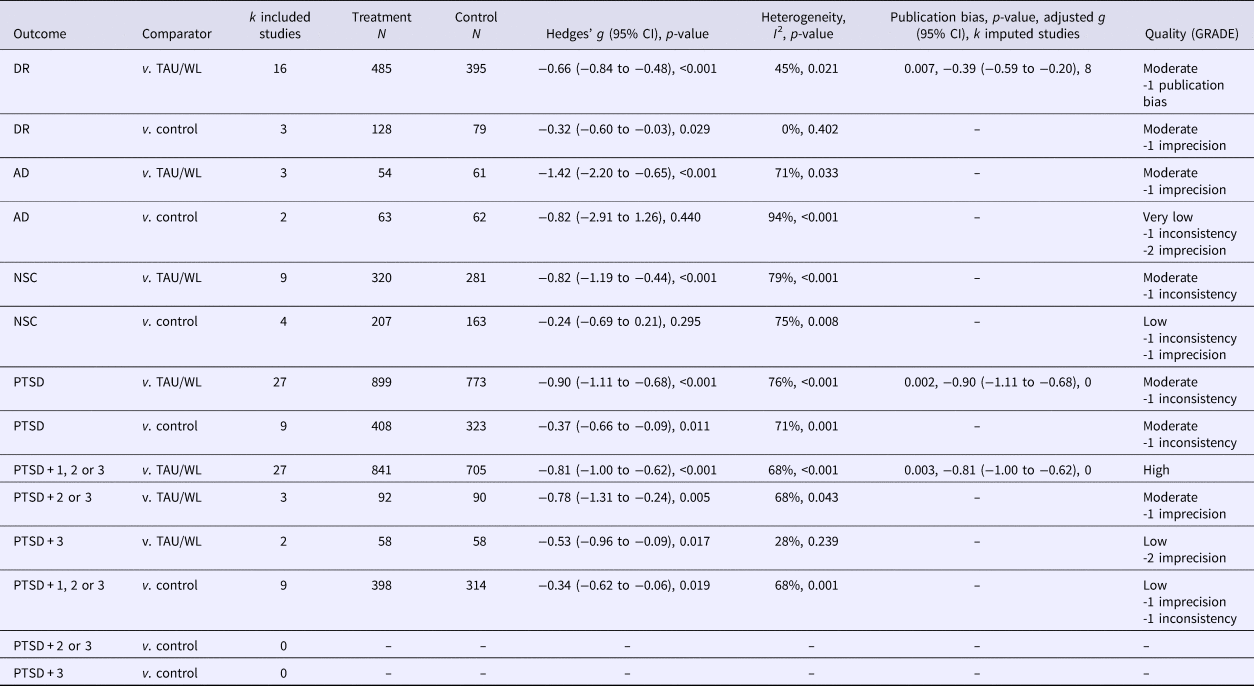
As shown in Table 1, compared with usual care, CBT had a moderate–large effect on disturbances in relationships (k = 16, g = −0.66; 95% CI −0.84 to −0.48) and large effects on affect dysregulation (k = 3, g = −1.42; 95% CI −2.20 to −0.65), negative self-concept (k = 9, g = −0.82; 95% CI −1.19 to −0.44) and PTSD symptoms (k = 27, g = −0.90; 95% CI −1.11 to −0.68) (all moderate-quality evidence), with the NNT varying from 2 (affect dysregulation assuming CER of 22%) to 6 (disturbances in relationships assuming CER of 10%) (Table 1 and online Supplementary material). Moderate-to-large effects were also observed on the composite estimates of PTSD and CPTSD DSO symptoms (low- to high-quality evidence), with NNTs of between 3 (PTSD + 1, 2 or 3 CPTSD DSO outcomes assuming CER of 50%) and 8 (PTSD + 3 CPTSD DSO outcomes assuming CER of 10%). However, few studies measured more than one type of CPTSD DSO symptom. Significant publication bias was detected whenever there were sufficient studies to assess this; however, only the estimate for disturbances in relationships was reduced when trim-and-fill analysis was applied. Compared with non-specific control interventions, CBT had a small effect on disturbances in relationships (k = 3, g = −0.32; 95% CI −0.60 to −0.03) and a small–moderate effect on PTSD symptoms (k = 9, g = −0.37; 95% CI −0.66 to −0.09) (moderate-quality evidence), with NNTs varying between 7 (PTSD assuming 50% CER) and 15 (disturbances in relationships assuming 10% CER). Although there was no evidence it had significant effects on affect dysregulation and negative self-concept, few studies reported usable data. When we pooled effects from all nine studies reporting data on PTSD and at least one CPTSD DSO domain, a small effect was observed (k = 9, g = −0.34; 95% CI −0.62 to −0.06; low-quality evidence), with NNTs of between 8 (50% CER) and 14 (10% CER), but no studies measured more than one domain.
Cognitive behavioural therapy with or without exposure v. TAU/WL or non-specific control

AD, affect dysregulation; CPTSD, complex post-traumatic stress disorder; DR, disturbances in relationships; DSO, disturbances in self-organisation; NSC, negative self-concept; PTSD, post-traumatic stress disorder; PTSD + 1, 2 or 3, PTSD + 1, 2 or 3 CPTSD (DSO) outcomes; PTSD + 2 or 3, PTSD + 2 or 3 CPTSD (DSO) outcomes; PTSD + 3, PTSD + all 3 CPTSD (DSO) outcomes; TAU, treatment as usual; WL, waiting list.
Exposure therapy alone
As shown in Table 2, compared with usual care, exposure therapy alone had a moderate effect on disturbances in relationships (k = 4, g = −0.59; 95% CI −1.12 to −0.07; moderate-quality evidence), a moderate–large effect on negative self-concept (k = 3, g = −0.73; 95% CI −1.03 to −0.43; moderate-quality evidence) and a large effect on PTSD symptoms (k = 6, g = −1.05; 95% CI −1.52 to −0.58; low-quality evidence), with NNTs of between 3 (PTSD – all assumed CERs) and 7 (disturbances in relationships, assuming 10% CER) (Table 2 and online Supplementary material). No studies examined whether exposure alone was superior to usual care in relation to affect dysregulation. Moderate-to-large effects on the composite outcomes of PTSD and CPTSD DSO symptoms were observed (low- to high-quality evidence), with NNTs ranging from 3 (PTSD + 1, 2 or 3 CPTSD DSO outcomes, CERs of 22% and 50%) to 7 (PTSD + 2 or 3 CPTSD DSO outcomes, assuming 10% CER); however, only one study provided usable data on more than one type of CPTSD DSO symptom. There was no evidence that exposure alone was superior to non-specific therapies in relation to disturbances in relationships, but only one study provided usable data. No studies reported whether exposure alone was superior to non-specific therapies in relation to either affect dysregulation or negative self-concept. Two studies found no effect of exposure alone on either PTSD data, or the composite outcome of PTSD plus CPTSD DSO symptoms (low-quality evidence). No studies provided data on more than one CPTSD DSO symptom.
Exposure only v. TAU/WL or non-specific control

AD, affect dysregulation; CPTSD, complex post-traumatic stress disorder; DSO, disturbances in self-organisation; DR, disturbances in relationships; NSC, negative self-concept; PTSD, post-traumatic stress disorder; PTSD + 1, 2 or 3, PTSD + 1, 2 or 3 CPTSD (DSO) outcomes; PTSD + 2 or 3, PTSD + 2 or 3 CPTSD (DSO) outcomes; PTSD + 3, PTSD + all 3 CPTSD (DSO) outcomes; RoB, risk of bias; TAU, treatment as usual; WL = waiting list.
Eye movement and desensitisation and reprocessing therapy
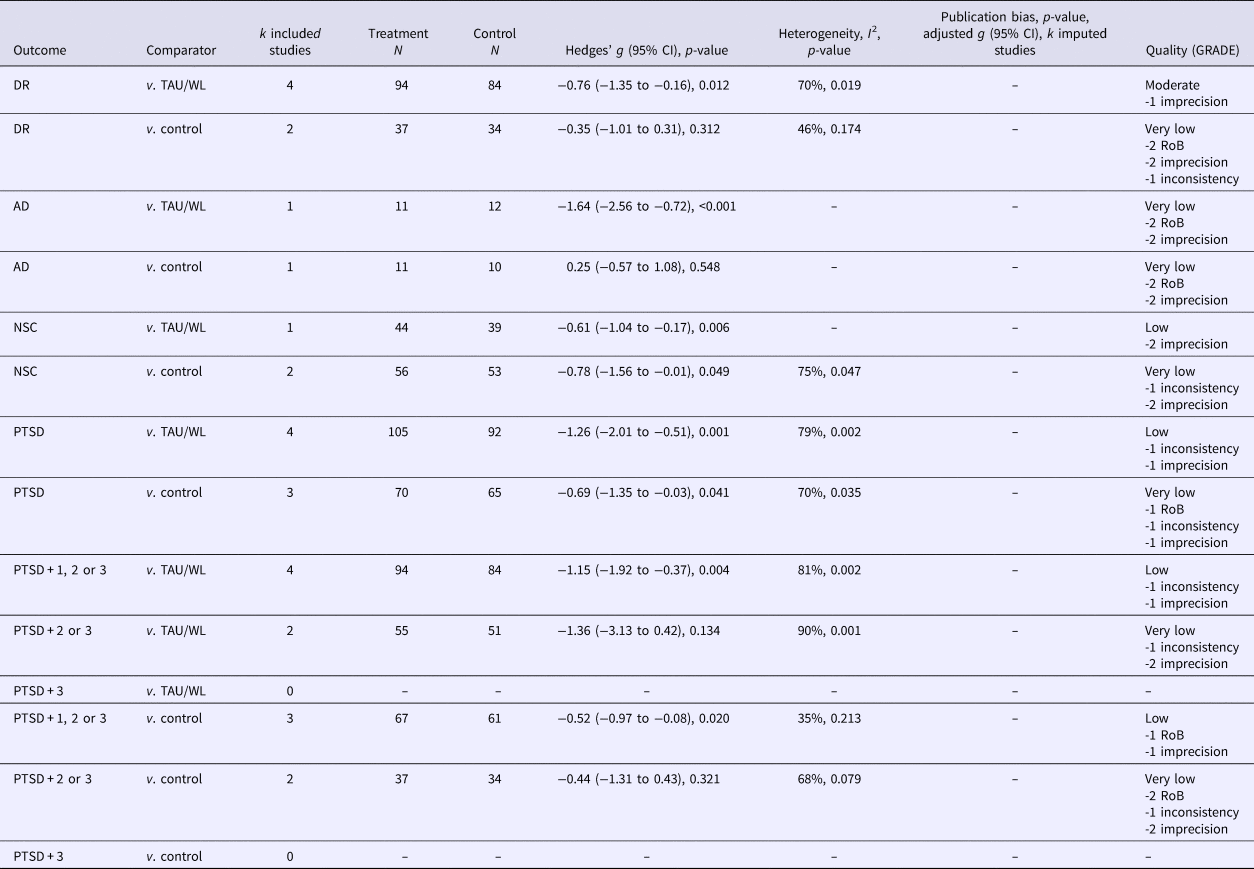
As shown in Table 3, compared with usual care, the few available studies suggested EMDR had a moderate effect on negative self-concept (k = 1, g = −0.61; 95% CI −1.04 to −0.17; low-quality evidence), a moderate–large effect on disturbances in relationships (k = 4, g = −0.76; 95% CI −1.35 to −0.16; moderate-quality evidence) and large effects on affect dysregulation (k = 1, g = −1.64; 95% CI −2.56 to −0.72; very low-quality evidence) and PTSD symptoms (k = 4, g = −1.26; 95% CI −2.01 to −0.51; low-quality evidence), with NNTs ranging from 2 (affect dysregulation, all CERs) to 7 (disturbances in relationships, assuming CER of 10%) (Table 3 and online Supplementary material). EMDR also had a large effect on the composite outcome of PTSD and at least one CPTSD DSO symptom (k = 4, g = −1.15; 95% CI −1.92 to −0.37; low-quality evidence), with NNTs of 2 (CER of 22%) or 3 (CER of 10% or 50%), but it did not have an effect on the composite outcome of PTSD and more than one CPTSD DSO symptom (very low-quality evidence). There was no evidence that EMDR was superior to non-specific interventions in relation to disturbances in relationships or affect dysregulation (very low-quality evidence). Although moderate–large effects on negative self-concept (k = 2, g = −0.78; 95% CI −1.56 to −0.01) and PTSD symptoms (k = 3, g = −0.69; 95% CI −1.35 to −0.03) (very low-quality evidence) were observed, with NNTs of between 4 (negative self-concept, all CERs) and 6 (PTSD; CER of 10%), these analyses were based on only 2–3 studies. A moderate effect on the composite outcome of PTSD and at least one CPTSD DSO symptom was observed (k = 3, g = −0.52; 95% CI −0.97 to −0.08; low-quality evidence), with NNTs of between 5 (CER 50%) and 8 (CER 10%), but no effect was found on the composite outcome of PTSD and more than one CPTSD DSO symptom (very low-quality evidence).
EMDR v. TAU/WL or non-specific control

AD, affect dysregulation; CPTSD, complex post-traumatic stress disorder; DR, disturbances in relationships; DSO, disturbances in self-organisation; EMDR, eye-movement and desensitisation and reprocessing therapy; NSC, negative self-concept; PTSD, post-traumatic stress disorder; PTSD + 1, 2 or 3, PTSD + 1, 2 or 3 CPTSD (DSO) outcomes; PTSD + 2 or 3, PTSD + 2 or 3 CPTSD (DSO) outcomes; PTSD + 3, PTSD + all 3 CPTSD (DSO) outcomes; RoB, risk of bias; TAU, treatment as usual; WL, waiting list.
Comparison of CBT, exposure and EMDR
As shown in Table 4, there was very limited evidence that EMDR had a small–moderate advantage over CBT in relation to PTSD symptoms (k = 2, g = 0.37; 95% CI 0.03–0.71; low-quality evidence), with an NNT of 7–12, but no differences between CBT, exposure alone and EMDR were observed for any other outcomes (Table 4 and online Supplementary material).
Comparison of CBT, exposure and EMDR

AD, affect dysregulation; CPTSD, complex post-traumatic stress disorder; DR, disturbances in relationships; DSO, disturbances in self-organisation; EMDR, eye-movement and desensitisation and reprocessing therapy; NSC, negative self-concept; PTSD, post-traumatic stress disorder; PTSD + 1, 2 or 3, PTSD + 1, 2 or 3 CPTSD (DSO) outcomes; PTSD + 2 or 3, PTSD + 2 or 3 CPTSD (DSO) outcomes; PTSD + 3, PTSD + all 3 CPTSD (DSO) outcomes; RoB, risk of bias.
Other comparisons
As shown in online Supplementary Table J.1, one small study (Krupnick et al., Reference Krupnick, Green, Stockton, Miranda, Krause and Mete2008) found IPT had an advantage over usual care in reducing PTSD plus disturbances in relationships (k = 1, g = −1.02; 95% CI −1.65 to −0.39; very low-quality evidence), with an NNT of 3–4, and another small study (Azad Marzabadi and Hashemi Zadeh, Reference Azad Marzabadi and Hashemi Zadeh2014) found mindfulness was more effective than usual care in relation to disturbances in relationships (k = 1, g = −1.60; 95% CI −2.43 to −0.77; very low-quality evidence), with an NNT of 2–3. Several other small studies compared various psychotherapeutic interventions to other interventions, or to CBT, exposure or EMDR. We found no evidence to favour any particular intervention in relation to the composite outcome of PTSD plus CPTSD DSO symptoms (very low- to low-quality evidence).
Moderator analyses
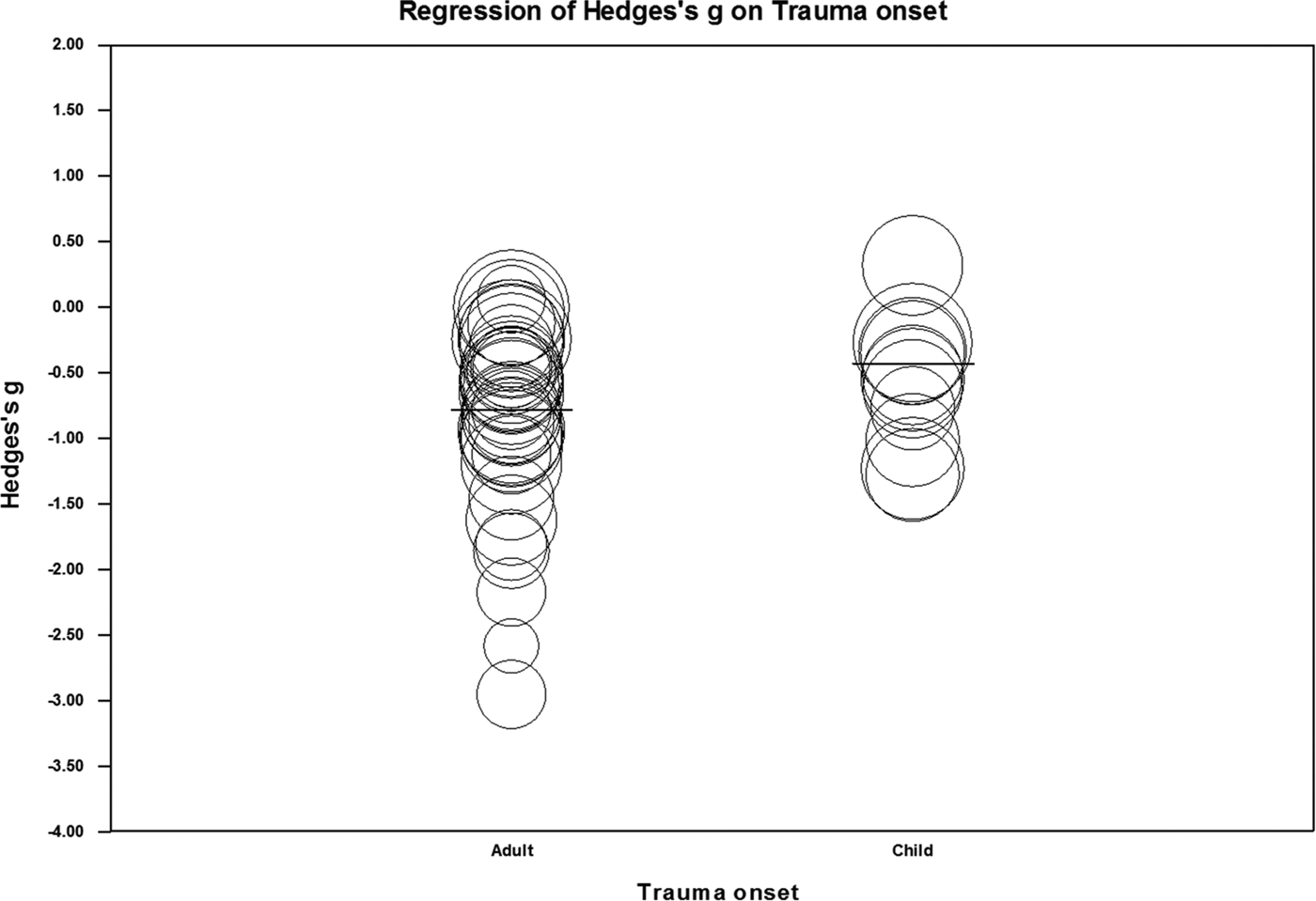
As shown in online Supplementary Table L.1, use of a non-specific control condition rather than usual care or waiting list was associated with a smaller benefit of psychological therapy in univariate meta-regression, with a reduction in Hedges’ g of 0.48 (95% CI 0.18–0.77). No other moderators were significant when examined individually. As shown in online Supplementary Table M.1, the effect of using a non-specific control condition was larger in multivariate meta-regression, with a reduction in Hedges’ g of 0.69 (95% CI 0.39–1.00) in this analysis. Study quality and age of trauma onset also emerged as significant moderators of therapy effects in this analysis. Low-quality studies were associated with a significantly lower effect size, with a reduction in Hedges’ g of 0.30 (95% CI 0.00–0.61). Studies where participants had predominantly childhood-onset trauma were associated with a reduction in Hedges’ g of 0.35 (95% CI 0.02–0.69), when compared with trials where most participants had adult-onset trauma (Fig. 3).
Bubble plot of trauma onset (adult v. child) by Hedges’ g, controlling for study quality, degree of CPTSD symptom severity, type of comparator and type of treatment in multivariate meta-regression.

Discussion
We examined evidence from RCTs of psychological treatments for PTSD where participants were also likely to have clinically significant levels of one or more CPTSD DSO symptoms at baseline, and where usable data on the effect of interventions on these symptoms were reported. A total of 51 studies met inclusion criteria. Overall, results indicate that when compared with usual care, CBT, exposure alone and EMDR perform relatively equally for symptoms of PTSD and the DSO symptoms of negative self-concept and disturbances in relationships. While the quality of this evidence was moderate for CBT, it ranged from low to moderate for exposure alone and EMDR. Few trials reported the effectiveness of psychological therapies for symptoms of affect dysregulation. Low-quality evidence suggests that EMDR has a small–moderate advantage over CBT in relation to PTSD symptoms, but there was no evidence of any differences between CBT, exposure alone or EMDR for the other outcomes including DSO symptoms. Univariate and multivariate meta-regression confirmed that the effectiveness of psychological therapies was considerably lower when compared with non-specific therapies, which suggests that non-specific effects may account for a large proportion of therapeutic change in symptoms of CPTSD in these trials. The multivariate meta-regression also found that treatment outcome may be moderated by the developmental time of the onset of psychological trauma, with childhood trauma being associated with smaller effects of psychological therapies on CPTSD symptoms.
The data are encouraging in that the accumulation of evidence suggests that there are specific interventions that work for several of the CPTSD symptom clusters. The data also suggest that no particular type of intervention (exposure, cognitive re-appraisal, bilateral stimulation) is necessary to resolve any one symptom cluster. A critical question is whether current treatments devised for PTSD are equally effective for those who will be diagnosed with CPTSD. Our results replicate earlier findings that individual trauma-focused treatments show large effect sizes. Although the evidence is at a very early stage, we found that some non-trauma-focused therapies, such as mindfulness and IPT, may also reduce PTSD and/or disturbances in relationships, suggesting alternative options. Importantly, childhood abuse was found to moderate all outcomes across all types of treatments, suggesting those with a history of childhood trauma may experience less improvement, and that current treatments for this patient population can be improved. These results have implications for the treatment of CPTSD as those with childhood abuse are at risk for CPTSD and in this meta-analysis may represent those more likely to have the full symptom profile.
Research is needed to determine how to optimise treatment outcomes for those with childhood abuse and other populations at risk for CPTSD. This includes identifying which treatment interventions are most effective for specific symptom clusters, which are most acceptable to patients, in what order to present interventions and the optimal duration of different types of interventions. Considering current debates in the literature, it would have been useful to explore the usefulness of phased v. non-phased interventions and individual v. group interventions for CPTSD. Unfortunately, we did not find adequate evidence to enable further analysis of these treatment outcome moderators. There is substantial evidence indicating that CPTSD and PTSD represent distinct patient populations with different symptom profiles (Brewin et al., Reference Brewin, Cloitre, Hyland, Shevlin, Maercker, Bryant, Humayun, Jones, Kagee, Rousseau, Somasundaram, Suzuki, Wessely, van Ommeren and Reed2017), suggesting the value of developing treatments that more precisely and effectively resolve the differing effects of trauma exposure by systematically testing type, order and duration of interventions specific to each disorder and taking into account patient preferences across both disorders (Cloitre, Reference Cloitre2015).
Our meta-analysis has a number of strengths. We minimised the risk of bias by pre-registering the review, and we minimised errors and omissions by having two or more reviewers conduct comprehensive searches, assess study quality and extract descriptive data. We considered a range of treatments from different countries and included participants with a range of backgrounds and types of psychological trauma including military, civilian and childhood trauma. Many studies have used qualified therapists and considered assessments of adherence to the protocol. However, most of the research was conducted in western countries, thus limiting the extent to which the findings may generalise to non-western countries. Furthermore, the evidence we have reviewed as part of this meta-analysis was predominantly on DSM-IV PTSD. Most studies did not present data on multiple traumatisation which typically results in CPTSD (Karatzias et al., Reference Karatzias, Shevlin, Fyvie, Hyland, Efthymiadou, Wilson, Roberts, Bisson, Brewin and Cloitre2016). Even when the index trauma that was targeted occurred in adulthood in included studies, it would be useful to assess lifetime traumatic history and consider the accumulative effect of multiple traumatisation. In relation to outcomes, we have only considered therapeutic gains at post-treatment. Future research should explore long-term outcomes of these interventions. Furthermore, for this meta-analysis we have used proxy measures for the CPTSD constructs. It might well be the case that a number of studies that included people with CPTSD have not been included in the study as they have not reported outcomes on relevant constructs or reported outcomes have not met clinical thresholds or our definition of ‘clinical significance’. It might also be the case that the measures employed in included studies do not accurately reflect the corresponding DSO clusters, thus introducing some measurement bias. Moreover, while the quality of the meta-analytical evidence was high or moderate for some of the outcomes (e.g. when CBT was compared with usual care or non-specific control interventions), it was low or very low for most of the outcomes. Related to this, there was substantial heterogeneity for just over half of the outcomes. Thus, there is some uncertainty in the conclusions that can be drawn. It is also worth noting that we did not downgrade the meta-analytical outcomes for indirectness, as indirect evidence of psychological interventions for CPTSD was the focus of this review. If, on the other hand, we had been interested in direct evidence of psychological interventions for CPTSD, most if not all the outcomes would have been downgraded for indirectness.
There is clearly a need for further well-designed trials of psychological therapies that incorporate appropriate methods of randomisation, blinding of assessors, long-term follow-up and appropriate training of therapists and monitoring of treatment adherence. We have identified a set of research priorities to benefit people with CPTSD in the future that might directly or indirectly result from the findings of this review:
• Effectiveness of phased v. non-phased interventions for CPTSD: very few included studies in this meta-analysis have incorporated a phased approach to treatment and it was not possible to address this question.
• Effectiveness of trauma-focused treatments v. non-trauma-focused treatments. Existing evidence is predominantly focused on trauma-focused treatments.
• Head-to-head comparisons between trauma-focused treatments for CPTSD. Most studies explored the effectiveness of interventions against standard care or no treatment.
• Exploring safety of trauma-focused therapies for CPTSD. It is essential that future research in this area provides information on adverse effects.
• Investigation of whether diagnosis of CPTSD moderates outcomes when compared against those who do not meet diagnosis in standard treatments. Clinical reality suggests that many people do not meet full diagnostic criteria but still suffer from a number of debilitating symptoms that relate to that condition.
• Appropriateness and effectiveness of trauma-focused treatments for CPTSD following childhood trauma. In this meta-analysis, childhood trauma was found to negatively moderate the effect of trauma-focused interventions.
• Comparing pharmacotherapy v. psychotherapy for CPTSD. In this meta-analysis, we did not address the effectiveness of pharmacotherapies alone or in combination with psychotherapy.
• Considering the nature of the three DSO factors, it is worth exploring the effectiveness of attachment-based interventions and relational therapies as limited evidence is currently present for these interventions.
• Exploring the effectiveness of individual v. group interventions for CPTSD. We found no evidence addressing this question for people with CPTSD.
• Exploring the effectiveness of interventions that tackle all CPTSD symptom clusters in a single study using as a primary outcome of CPTSD based on a dedicated measure. The present review extracted proxy data from existing trials that measure the CPTSD constructs.
In conclusion, this meta-analysis is the first step in identifying effective treatments for CPTSD. Findings regarding the usefulness of trauma-focused interventions look promising but less so for CPTSD symptoms following childhood trauma. Further research is needed to explore and develop existing and new treatments for CPTSD.
Supplementary material
The supplementary material for this article can be found at https://doi.org/10.1017/S0033291719000436.
Author ORCIDs
Thanos Karatzias, 0000-0002-3002-0630.