Introduction
To navigate an increasingly turbulent marketplace, enhancing enterprise resilience is crucial (Wulandhari, Budhwar, Mishra, Akbar, Do, & Milligan, Reference Wulandhari, Budhwar, Mishra, Akbar, Do and Milligan2022). Enterprise resilience refers to the capacity to pursue long-term development and adapt strategies in response to crises, enabling organizations to cope with external shocks (Branzei & Abdelnour, Reference Branzei and Abdelnour2010; Hamel & Välikangas, Reference Hamel and Välikangas2003). Executives play a pivotal role in guiding organizations to comprehend evolving situations and make informed decisions (Combe & Carrington, Reference Combe and Carrington2015; Crossan, Vera, & Nanjad, Reference Crossan, Vera and Nanjad2008). Consequently, researchers have begun to investigate the microfoundations of enterprise resilience from the executive perspective, emphasizing managers’ personalities and psychological resources (Buyl, Boone, & Wade, Reference Buyl, Boone and Wade2019; Fang, Prayag, Ozanne, & Vries, Reference Fang, Prayag, Ozanne and Vries2020; Sajko, Boone, & Buyl, Reference Sajko, Boone and Buyl2020).
Among various executive factors, managerial cognition is a significant element influencing decision-making, strategic choice, and organizational performance (Johnson & Hoopes, Reference Johnson and Hoopes2003; Levy, Beechler, Taylor, & Boyacigiller, Reference Levy, Beechler, Taylor and Boyacigiller2007). Prior research indicates that positive-focused managerial cognition – such as the perception of opportunities and entrepreneurial alertness – enables executives to seize opportunities and enhance organizational dynamic capabilities (Durán & Aguado, Reference Durán and Aguado2022). For instance, prioritizing new product development (e.g., research and development) can help reverse performance declines (He, Huang, & Yang, Reference He, Huang and Yang2021), while a focus on proactive environmental strategies can drive innovation (Yang, Wang, Zhou, & Jiang, Reference Yang, Wang, Zhou and Jiang2019). Conversely, negative-focused cognition, which emphasizes threats and potential failures, is often linked to detrimental emotions such as self-blame and catastrophizing (van Wijk-herbrink, Andrea, & Verheul, Reference van Wijk-herbrink, Andrea and Verheul2011) and has been criticized for potentially stifling innovation (Plambeck, Reference Plambeck2012). However, recent research has revealed that managers’ attention to negative signals can be crucial for problem prevention and enhancing proactivity (Gao, Liu, Zhao, Fu, & Schriesheim, Reference Gao, Liu, Zhao, Fu and Schriesheim2024). Therefore, it is essential not to dismiss negative-focused managerial cognition outright. The key consideration is the ability to manage negative signals from a vigilant perspective, using them as a basis for proactive and well-prepared responses.
As enterprise resilience relies on long-term, future-oriented capabilities to prepare for potentially disruptive events (Duchek, Reference Duchek2020; Sanchis, Canetta, & Poler, Reference Sanchis, Canetta and Poler2020; Sanchis & Poler, Reference Sanchis and Poler2019), executives must consider potential negative outcomes and prepare before crises arise. This approach aligns with traditional philosophies, such as ‘forewarned is forearmed’ (derived from the Latin proverb praemonitus, praemunitus) and the Chinese philosophy of ‘being vigilant in peacetime’, which emphasizes the importance of considering potential future crises rather than adopting blind optimism. These philosophies underscore vigilance, which has been historically significant and offers valuable insights for modern managers. Research indicates that executives’ vigilance can foster a shared mindset focused on alertness, mindfulness, and precaution – qualities essential for developing resilience (Lengnick-Hall, Beck, & Lengnick-Hall, Reference Lengnick-Hall, Beck and Lengnick-Hall2011). This mindset can also ensure continuity in enterprise operations during disruptions (Sincorá, Oliveira, Filho, & Ladeira, Reference Sincorá, Oliveira, Filho and Ladeira2018). Thus, the positive relationship between vigilance cognition and enterprise resilience suggests that negative-focused managerial cognition can yield beneficial effects.
The concept of ‘vigilance’ in managerial cognition research is still in its nascent stages. While existing studies have examined leaders’ vigilance through vigilant leadership behaviors (Gao et al., Reference Gao, Liu, Zhao, Fu and Schriesheim2024), they often focus on microlevel teams, lacking an exploration of how executive vigilance contributes to overall enterprise resilience. Although scholars have identified executives’ cognitive capacity as a significant predictor of firm performance (Partlow, Medeiros, & Mumford, Reference Partlow, Medeiros and Mumford2015; Vries, Reference Vries2012), there remains a gap in understanding what constitutes vigilant managerial cognition and its impact on enterprise resilience. Therefore, this study aims to explore whether and how vigilant managerial cognition contributes to enterprise resilience, providing new insights into its antecedents. Additionally, recognizing that executives’ managerial cognition is often implicit and may encounter organizational resistance, including rigid cognitive frameworks, this study will also investigate the boundary conditions of the relationship between vigilant managerial cognition and enterprise resilience. A critical factor in this relationship is the role of institutions that support managerial decision-making (Leroy, Segers, Van Dierendonck, & Den Hartog, Reference Leroy, Segers, Van Dierendonck and Den Hartog2018). The extent to which executives’ intentions can be translated into actions depends on the institutional support available. Specifically, internal controls – comprising efficient communication, resource coordination, and supervision mechanisms – are essential. Effective internal controls enable executives to execute strategic transformations in a timely and efficient manner (Vogus & Sutcliffe, Reference Vogus and Sutcliffe2007). Thus, this study will also examine the role of internal controls in the relationship between vigilant managerial cognition and enterprise resilience.
This study contributes to the understanding of managerial cognition in organizational functioning in several key areas. First, we conceptualize executives’ vigilant managerial cognition, demonstrating that a negative-focused perspective can positively impact enterprise resilience. Second, we investigate the antecedents of enterprise resilience through the interaction of managerial cognition and institutional factors, emphasizing that internal controls serve as a critical institutional contingency influencing the relationship between vigilant managerial cognition and enterprise resilience. Third, we offer an empirical contribution by developing a novel quantitative measure of vigilant managerial cognition utilizing machine learning and textual analysis. Finally, the findings provide practical implications for enhancing managers’ cognitive capabilities in crisis response and clarify the dynamic managerial skills executives must cultivate to effectively anticipate and manage potential crises.
Theoretical Background and Hypotheses Development
Vigilant Managerial Cognition
Managerial cognition encompasses the beliefs and mental models that inform managerial decision-making (Adner & Helfat, Reference Adner and Helfat2003). Research indicates that executives develop subjective psychological representations of their environment, shaping their strategic decisions and organizational actions (Nadkarni & Barr, Reference Nadkarni and Barr2008). Studies have highlighted that a positive focus on managerial cognition correlates with improved innovation and performance (Durán & Aguado, Reference Durán and Aguado2022; Yang et al., Reference Yang, Wang, Zhou and Jiang2019). This perspective aligns with Teece, Pisano, and Shuen (Reference Teece, Pisano and Shuen1997), who argued that a firm’s capabilities depend on available opportunities and resources, with managers’ cognition influencing the types of resources they seek (Danneels, Reference Danneels2011).
Conversely, the significance of negative-focused managerial cognition has been less explored, though some suggest that minimizing attention to negative information may be advantageous (Plambeck, Reference Plambeck2012). However, other viewpoints assert that a top management team’s awareness of threats and negative signals is crucial for driving organizational change (Staw & Dutton, Reference Staw and Dutton1981). This awareness is vital for organizations to respond effectively to turbulent environments and crises (Duchek, Reference Duchek2020). Therefore, negative-focused cognition should be viewed dialectically, suggesting that its effectiveness relies on managers’ ability to interpret and respond to negative signals appropriately. Rather than adopting passive strategies in response to challenges, vigilance and proactive preparation are essential. Recent studies indicate that leaders’ vigilance can aid organizations in preemptively addressing potential issues (Gao et al., Reference Gao, Liu, Zhao, Fu and Schriesheim2024). This suggests that examining managerial cognition in relation to vigilance may yield new insights into the beneficial aspects of negative-focused cognition.
Vigilance has long been a focus within academia. Some studies define vigilance in terms of maintaining attention on management practices, such as decision vigilance (Tsai, Reference Tsai2015) and attention vigilance (Rhee, Reference Rhee2024), emphasizing managers’ external behaviors in specific contexts. Other research explores vigilance from leadership perspectives, aiming to characterize the enduring vigilance of managers. For example, Day and Schoemaker (Reference Day and Schoemaker2006, Reference Day and Schoemaker2008) introduced the concept of vigilant leadership, while Manuel (Reference Manuel2018) proposed ‘leadegilance’, which merges leadership and vigilance to highlight a managerial style focused on monitoring organizational compliance. However, these concepts often lack rigorous academic definitions and theoretical frameworks regarding how vigilant traits impact organizational objectives. Gao et al. (Reference Gao, Liu, Zhao, Fu and Schriesheim2024) formally introduced vigilant leadership, distinguishing it from existing concepts and establishing a novel leadership style. Nonetheless, this concept remains concentrated on microlevel team management, addressing behaviors between managers and immediate subordinates rather than serving as a psychological foundation influencing strategic changes and dynamic capabilities at the enterprise level. Given that managerial cognition is recognized as a microfoundation of dynamic capabilities (Helfat & Martin, Reference Helfat and Martin2015), a focus on vigilance within managerial cognition, particularly regarding potential threats, represents a key advancement in explaining organizational resilience.
The primary objective of introducing the concept of vigilant managerial cognition is to clarify its essence (Copi, Cohen, & Rodych, Reference Copi, Cohen and Rodych2019). Helfat and Martin (Reference Helfat and Martin2015) summarized managerial cognition’s fundamental components, which include knowledge structures, cognitive capabilities, and emotional regulation. Knowledge structures influence leaders’ biases and heuristics, affecting their anticipation, comprehension, and responses in dynamic environments. Cognitive capabilities pertain to the ability to engage in cognitive activities, while emotional regulation is essential for guiding behavioral responses in management. In summary, vigilant managerial cognition emerges from the interplay between managerial vigilance and dynamic managerial capabilities (Gao et al., Reference Gao, Liu, Zhao, Fu and Schriesheim2024; Helfat & Martin, Reference Helfat and Martin2015). According to dynamic capability theory, enterprise resilience is a form of dynamic capability (Duchek, Reference Duchek2020; Hamel & Välikangas, Reference Hamel and Välikangas2003). Since dynamic managerial capabilities, such as managerial cognition, form the microfoundations of dynamic capabilities (Helfat & Martin, Reference Helfat and Martin2015), examining vigilance through the lens of managerial cognition offers a more effective explanation of the relationship between vigilance and resilience than other concepts.
Vigilant managerial cognition distinguishes itself from other forms of managerial cognition, such as managerial hubris (Li & Sullivan, Reference Li and Sullivan2020) and sustainability orientations (Lei, Wu, & Fu, Reference Lei, Wu and Fu2019), by its specific emphasis on vigilance. The Latin root of ‘vigilance’, vigilia, reveals interconnected aspects: wakefulness and watchfulness (Lewis & Short, Reference Lewis and Short2002). Semantically, it connotes precaution and proactive responses to signals of potential threats or crises. This connotation suggests three essential attributes of vigilant managerial cognition: it is negative-focused, future-oriented, and precaution-oriented.
Building on existing descriptions of leaders’ vigilance (Gao et al., Reference Gao, Liu, Zhao, Fu and Schriesheim2024), we define vigilant managerial cognition as the managerial cognition that supports managers’ awareness, detection, and precaution toward negative signals that may indicate future crises, including problems, threats, dangers, challenges, and setbacks at both strategic and individual employee levels. The functionality of vigilant managerial cognition aligns with the sensing-seizing-reconfiguring framework (Teece, Reference Teece2007) and incorporates three key components of managerial cognition (Helfat & Martin, Reference Helfat and Martin2015; Helfat & Peteraf, Reference Helfat and Peteraf2014). First, knowledge structures serve as mental templates for processing external information, enabling managers to detect potential threat signals (sensing). Second, managerial cognitive capabilities facilitate the mental processing of these signals (seizing). Third, emotional reactions – where individuals typically act based on their emotions at the time of decision-making – prompt managers to implement reconfiguration as a precaution against potential threats (Hodgkinson & Healey, Reference Hodgkinson and Healey2011). In summary, vigilant managerial cognition encompasses the full spectrum from detecting potential issues to implementing precautionary measures.
It is important to clarify that vigilant managerial cognition pertains to managers focusing on negative signals, rather than reflecting an inherent negativity about themselves. This distinction aligns it with other existing negative-focused concepts, such as prevention focus (Crowe & Higgins, Reference Crowe and Higgins1997), and allows it to coexist with positive-focused concepts. For example, while positive-focused managerial cognition, such as vision articulation, encourages opportunity-seeking, negative-focused cognition, such as vigilance, facilitates the navigation of potential pitfalls during opportunity-seeking (Gao et al., Reference Gao, Liu, Zhao, Fu and Schriesheim2024). These two types of managerial cognition are not mutually exclusive; rather, they can coexist and collaboratively contribute to optimal outcomes.
The concept of vigilant managerial cognition is distinct from existing frameworks. Table 1 illustrates the differences between vigilant managerial cognition and related concepts such as prevention focus, pessimism, transformational leadership, attention vigilance, and management-by-exception. First, while both vigilant managerial cognition and prevention focus emphasize negative outcomes, prevention focus is limited to basic goals, such as responsibility (Crowe & Higgins, Reference Crowe and Higgins1997; Freitas, Liberman, Salovey, & Higgins, Reference Freitas, Liberman, Salovey and Higgins2002), and relies on an avoidance strategy characterized by lower openness to change (Liberman, Idson, Camacho, & Higgins, Reference Liberman, Idson, Camacho and Higgins1999). In contrast, vigilant managerial cognition adopts a precautionary strategy that prepares for worst-case scenarios, prompting managers to implement changes in anticipation of future crises (Gao et al., Reference Gao, Liu, Zhao, Fu and Schriesheim2024). Consequently, although both focus on negative signals, the nature of their concerns differs. Managers with a prevention focus worry about the negative consequences of not meeting responsibilities, leading them to maintain the status quo. Conversely, those with vigilant managerial cognition are concerned about the risks of failing to change, which motivates them to alter the status quo to prepare for crises. Thus, prevention focus tends to evade crises without altering conditions, while vigilant managerial cognition actively promotes precautionary measures.
Comparing vigilant managerial cognition with other concepts

Second, while vigilant managerial cognition and pessimism both concentrate on negative signals, they differ in outlook. Pessimism tends to lack hope for the future, fixating on negative aspects. In contrast, individuals with high vigilant managerial cognition acknowledge negative signals but maintain a proactive belief in addressing future crises. Therefore, pessimism does not positively influence organizational resilience, whereas vigilant managerial cognition fosters it. Third, both vigilant managerial cognition and transformational leadership are future-oriented; however, their focuses diverge. Vigilant managerial cognition prioritizes negative signals that may indicate future crises, while transformational leadership emphasizes positive signals and motivates subordinates through charisma and vision (Bass, Reference Bass1985; van Knippenberg & Sitkin, Reference van Knippenberg and Sitkin2013). The former encourages risk management and precautionary changes, while the latter promotes changes aimed at achieving ideal goals. Despite empirical evidence suggesting their coexistence (Gao et al., Reference Gao, Liu, Zhao, Fu and Schriesheim2024), their impact processes are rooted in different organizational aspects. Fourth, vigilant managerial cognition may be confused with attention vigilance. The primary distinction is that attention vigilance allocates attention to various signals, whereas vigilant managerial cognition concentrates on future-oriented negative signals. This leads to divergent impacts: in adverse conditions, attention vigilance encourages comprehensive situational understanding, which is often beneficial (Rhee, Reference Rhee2024). Conversely, the effectiveness of vigilant managerial cognition may be more pronounced during periods of growth than during stagnation or decline (Gao et al., Reference Gao, Liu, Zhao, Fu and Schriesheim2024). Thus, possessing vigilant managerial cognition prior to a crisis is often more critical than employing it post-crisis, contrasting with the effectiveness of attention vigilance during crises. Finally, vigilant managerial cognition differs from management-by-exception, a component of transactional leadership (Bass, Reference Bass1985). Management-by-exception prompts leaders to respond to current or impending problems. In contrast, leaders exhibiting vigilant managerial cognition possess the cognitive ability to identify weak and ambiguous signals of future threats during stable periods, preparing for potential issues. Unlike those who passively await problems, vigilant managers actively target and address possible negative situations before crises arise. Therefore, management-by-exception typically responds when a crisis first emerges, while vigilant managerial cognition is proactive in crisis anticipation. In summary, vigilant managerial cognition is characterized by its unique focus on and response to future negative probabilities, distinguishing it from other management cognition constructs.
Executives’ Vigilant Managerial Cognition and Enterprise Resilience
Teece’s (Reference Teece2007) sensing-seizing-reconfiguring model clarifies the impact of vigilant managerial cognition on enterprise resilience. Executives’ ability to sense future-oriented negative signals, seize relevant information, and reconfigure resources shapes this resilience. Any disruption in this cognitive flow impedes the formulation of preventive measures against potential crises and undermines enterprise resilience. Vigilant managerial cognition comprises three components: knowledge structures, cognitive capabilities, and emotions (Helfat & Martin, Reference Helfat and Martin2015).
Executives identify latent threat signals through their knowledge structures, which serve as mental templates for organizing information within an environment (Walsh, Reference Walsh1995). These structures enable executives to interpret complex information, thereby facilitating the processing of future-oriented negative signals (Helfat & Martin, Reference Helfat and Martin2015). The subsequent seizing of organized negative information relies on cognitive capabilities, allowing executives to interpret and derive meaning from these signals, thus maintaining a focused perception of potential crises (Weber & Johnson, Reference Weber and Johnson2009).
The reconfiguring aspect of vigilant managerial cognition predominantly involves emotional processes. Managers’ emotions significantly influence organizational attention and responses. Decision-making is often driven by emotions experienced during choices, informed by mental images of potential outcomes (Hodgkinson & Healey, Reference Hodgkinson and Healey2011). Managers with vigilant managerial cognition possess precaution-oriented goals, generating emotional responses that facilitate the integration and reconfiguration of organizational resources in anticipation of crises. As Helfat et al. (Reference Helfat, Finkelstein, Mitchell, Peteraf, Singh, Teece and Winter2007) discuss in their examination of ‘asset orchestration’, executives are crucial in resource allocation. Thus, vigilant managerial cognition motivates executives to act within established routines, effectively addressing gaps and enhancing enterprise resilience.
Overall, vigilant managerial cognition encapsulates the full framework of sensing-seizing-reconfiguring, with knowledge structures, cognitive capabilities, and emotion regulation forming its foundation. This cognition impacts enterprise resilience by guiding the reception, processing, and response to signals, thereby enabling effective reconfiguration in the face of threats. However, a concern arises regarding the potential overkill effect of vigilant managerial cognition, wherein an excessive focus on negative threats may hinder executives’ recognition of other information. This study posits that vigilant managerial cognition enhances executives’ understanding of potential threats while maintaining their capacity to process diverse information. Stronger cognitive capabilities enable executives to manage an increased volume of threat-related information without detracting from their ability to process other relevant data. Furthermore, knowledge structures aid in assessing the urgency and severity of threats, allowing executives to identify critical issues effectively and prepare proactively. While over-preparation may lead to resource constraints, vigilant executives should consider this risk in their planning. Hence, this study posits a linear relation between vigilant managerial cognition and enterprise resilience. Thus, the first hypothesis is:
Hypothesis 1 (H1): Executives’ vigilant managerial cognition positively relates to enterprise resilience.
Moderating Role of Internal Controls
The effectiveness of executives’ vigilant managerial cognition in shaping enterprise resilience largely depends on leaders’ preparedness prior to a crisis. While preparedness plans can enhance crisis response, their impact is often limited. Enterprise resilience is influenced by a diverse set of mechanisms that integrate management activities and institutional frameworks (Helfat & Martin, Reference Helfat and Martin2015; Huy & Zott, Reference Huy and Zott2018). Strong institutions can expedite consensus-building among leaders and followers regarding necessary adjustments during crises (Carrington, Combe, & Mumford, Reference Carrington, Combe and Mumford2019). Internal controls serve as institutional arrangements that mitigate business risks by optimizing resource allocation (Haelterman, Reference Haelterman2020), thus enhancing the impact of executives’ vigilant managerial cognition on enterprise resilience. Specifically, internal controls comprise a comprehensive system that includes the internal environment, risk assessment, control activities, information disclosures, and internal supervision (Li, Wang, Wu, & Zhou, Reference Li, Wang, Wu and Zhou2021). A rational arrangement of these elements promotes executives’ efficient sensing, seizing, and reconfiguring of latent threat signals.
In the context of vigilant managerial cognition, executives engage with the external environment primarily through initial signal sensing and final reconfiguration. Internal controls reinforce this cognition within organizational institutions, particularly during these two stages, facilitating a more effective and flexible environment for information input and behavioral output. Although all five components of internal controls strengthen these stages, each has distinct emphases. Effective risk assessment and internal supervision significantly enhance signal transmission to executives. Risk assessment entails a comprehensive mechanism for identifying, analyzing, and tracking risks. Internal supervision includes daily oversight, identification and disclosure of internal control defects, and evaluation of controls. Rigorous risk assessment and supervision reveal misconduct, especially amid imminent or ongoing crises (Haelterman, Reference Haelterman2020), enabling executives to detect hidden threats and make informed decisions.
Moreover, a favorable internal environment and robust control activities empower executives to reconfigure resources and strategies effectively. The internal environment encompasses governance structures, audit processes, cultural values, and social responsibility policies. Control activities relate to management’s capabilities in job allocation, authorization, accounting, asset protection, performance evaluation, and major risk management. A strong governance environment and control system reduce resistance for executives when integrating resources and strategies (Ge, Li, Liu, & McVay, Reference Ge, Li, Liu and McVay2020), significantly enhancing actions taken in response to threat signals and thereby boosting enterprise resilience. Additionally, information disclosures – which include internal and external communication, application of information technology, anti-fraud mechanisms, and grievance procedures – are crucial for both information input and behavioral output for executives. Effective communication enhances transparency and reduces information asymmetry within the enterprise (Doyle, Ge, & McVay, Reference Doyle, Ge and McVay2007), allowing executives to access high-quality information and improve understanding accuracy. Furthermore, information interchange provides institutional support for aligning overarching goals across different organizational units (Helfat & Peteraf, Reference Helfat and Peteraf2014).
Consistent handling of potential threat signals helps executives communicate vigilance throughout the organization, facilitating upward influence from management-level cognition to enterprise-level strategic transformation. Overall, internal controls represent a composite system of interdependent components; the absence of any single component can compromise the effectiveness of other institutional arrangements. These components complement one another, enhancing the accuracy of signals perceived by executives and promoting effective reconfiguration. Consequently, the impact of vigilant managerial cognition is more pronounced within a robust internal control system. We, hence, propose the second hypothesis:
Hypothesis 2 (H2): The relationship between executives’ vigilant managerial cognition and enterprise resilience is more positive with sound internal controls.
Methods
Sample
We utilized the COVID-19 pandemic as our research context. It triggered the worst global recession since World War II (Saif & Ruan, Reference Saif, Ruan and Obrenovic2021), resulting in complex economic challenges with far-reaching consequences. Crises typically exhibit five characteristics (Fishman, Reference Fishman1999): unpredictability, significant threats to organizational values, unexpectedness, urgency, and complex dynamics involving multilateral relationships. The COVID-19 pandemic embodies all these characteristics, indicating its representativeness. Reports indicate that COVID-19 began to materially impact Chinese enterprises in mid-January 2020 (Huang, Chen, & Nguyen, Reference Huang, Chen and Nguyen2020).
Following DesJardine, Bansal, and Yang (Reference DesJardine, Bansal and Yang2019), who employed a 12-month observation period post-crisis to measure enterprise resilience through stock prices, we analyzed stock prices from January 15, 2020 to January 15, 2021. This period accounts for the seasonality of COVID-19, characterized by higher infection rates in winter and lower rates in summer, along with seasonal population movements such as Spring Festival travel, which intensified epidemic control measures. We assessed executives’ vigilant managerial cognition using data from the 2019 annual reports of China’s listed companies. Given the time lag between the annual report content and the onset of COVID-19 in early 2020, the pandemic did not uniformly affect all industries. For instance, the healthcare sector absorbed many social resources, while the popularity of remote work and online education spurred growth in internet-related industries. Thus, we selected enterprises from eight severely affected industries – agriculture, mining, manufacturing, energy, construction, wholesale and retail, transportation, and accommodation and catering – based on the industry classification provided by STOCKSTAR, a Chinese stock-data website.
Data processing involved four steps: (1) We consulted the management discussion and analysis (MD&A) sections of the annual reports for A-share listed companies from 2005 to 2019 using WinGo, a Chinese financial data platform. This dataset trained our study’s machine-learning model to extract text indices related to vigilant managerial cognition. (2) We employed crawler software from houyicaiji.com to obtain stock codes and names of listed companies from STOCKSTAR, calculating the vigilant managerial cognition indices based on the 2019 annual reports. (3) We used Tushare, a Python package for financial data acquisition (www.tushare.pro), to obtain stock prices and other financial data (e.g., total assets and liabilities) for the observation period. (4) After calculating enterprise resilience and other relevant variables from the raw data, we eliminated samples with missing values, resulting in 1,644 valid samples. The data, syntax, and study materials are available on the Open Science Framework at https://osf.io/hjzye/?view_only=8196c9f7b938432b9bd1ca40fd9bfae0
Measures
Executives’ vigilant managerial cognition
Existing studies indicate that natural languages can reflect leaders’ cognition (Pennebaker, Mehl, & Niederhoffer, Reference Pennebaker, Mehl and Niederhoffer2003). This perspective has led to several fruitful findings in the literature (Cao, Yang, & Liu, Reference Cao, Yang and Liu2021; Caserio, Panaro, & Trucco, Reference Caserio, Panaro and Trucco2019; Davis & Tama–Sweet, Reference Davis and Tama-Sweet2011). More recently, researchers have utilized the MD&A corpus to evaluate executives’ cognitive capabilities (Certo, Jeon, Raney, & Lee, Reference Certo, Jeon, Raney and Lee2022). Drawing on prior research regarding executives’ vigilant managerial cognition (Day & Schoemaker, Reference Day and Schoemaker2008; Gao et al., Reference Gao, Liu, Zhao, Fu and Schriesheim2024) and the characteristics of the MD&A Chinese corpus, this study employed Word2Vec machine-learning technology to develop a Chinese word set that reflects the vigilant managerial cognition of executives. Subsequently, we constructed a text index using this word set. The machine-learning approach offers several advantages, including the following: It mitigates subjectivity from artificial definitions and weak correlations from synonym-screening tools; The model, trained on the MD&A corpus, fits the context well and possesses good validity; and machine learning efficiently processes large text datasets, ensuring scalability.
A critical section of a company’s annual report is the MD&A, which contains executives’ analyses of significant historical information and outlines business plans, opportunities, risks, and challenges for the coming year. This study captured vigilant managerial cognition in the MD&A sections of the 2019 annual reports of listed companies in China. The research process included the following steps: First, we developed a Chinese seed-word set reflecting three central aspects of vigilant management: awareness, detection, and precaution. Second, we trained our machine-learning model using the MD&A corpus and Word2Vec technology, specifically the Skip-Gram model, with Python-based training code. Except for a training window size of 200 words, other hyperparameters were set to default values. Given that China revised MD&A content standards in 2005, we incorporated MD&A data from the annual reports of listed companies from 2006 to 2017. Additionally, we included interim annual report data to ensure sufficient data for model training. We segmented the MD&A corpus using Python’s Jieba for Chinese word segmentation and filtered out stop words. The resulting text was converted into word vectors for storage. The use of machine-learning techniques allowed us to train the model and ultimately obtain a machine-learning framework (Mikolov, Chen, Corrado, & Dean, Reference Mikolov, Chen, Corrado and Dean2013). Finally, we calculated vector similarities to identify words similar to the seed-word set, following the principle that ‘words with the same context contain similar semantics’. This yielded word vectors with higher cosine similarity for semantically related words in Euclidean space (Mikolov et al., Reference Mikolov, Chen, Corrado and Dean2013). The cosine similarity formula is as follows:
 \begin{equation*}\cos \theta = \frac{{\mathop \sum \limits_{i = 0}^n \left( {{x_i} \times {y_i}} \right)}}{{\sqrt {\mathop \sum \limits_{i = 0}^n {{\left( {{x_i}} \right)}^2}} \times \sqrt {\mathop \sum \limits_{i = 0}^n {{\left( {{y_i}} \right)}^2}} }} = \frac{{X\cdot Y}}{{\left| X \right| \times \left| Y \right|}},\end{equation*}
where  $X = \left[ {{x_1},{x_2},{x_3}\ldots{x_n}} \right]$ and
 $Y = \left[ {{y_1},{y_2},{y_3}\ldots{y_n}} \right]$ respectively represent two-word vectors. Considering both similarity and vocabulary size, this study selected an initial word set comprising words with a cosine similarity of 0.60 or higher. Ultimately, 12 seed words were selected, producing an average of 40.17 words per seed word, resulting in a total of 482 words. After removing duplicates, 267 unique words were retained.
Third, we invited two academic experts and two doctoral students in management to participate in the screening and validation of the initial word set. Each participant completed the screening individually, followed by a discussion of the results. This process identified 176 dictionary words that reflect vigilant managerial cognition (see Appendix A). To quantify executives’ vigilant managerial cognition, we calculated the ratio of vigilant managerial vocabulary in each MD&A text. A higher index value indicates stronger vigilant managerial cognition among executives. Some firms may employ vigilance-related terms as a structured communication strategy. To mitigate potential interference, we conducted topic modeling analysis on sentences containing vigilant vocabulary in the MD&A, identifying nine clusters (see Appendix H). We calculated frequency vectors of topic words in the MD&A text from semi-annual and annual reports in 2019. The mean cosine similarity of these two vectors was 0.769, and a one-sample t-test revealed a significant difference from 0.8 (Δ Mean = − 0.031, N = 2113, 95% CI = [−0.040, − 0.022]). Thus, executives often discuss different themes when using vigilant vocabulary, rather than adhering to a structured communication strategy.
Enterprise resilience
We adopt the methodology of Ilseven and Puranam (Reference Ilseven and Puranam2021) to assess enterprise resilience by examining stock price fluctuations in response to the COVID-19 pandemic. Initially, we employ Holt-Winters exponential smoothing to model the historical stock prices of a company from 2017 to 2019. This model then forecasts stock performance during the pandemic observation period, representing the expected trend had the pandemic not occurred. Ilseven and Puranam (Reference Ilseven and Puranam2021) propose measuring resilience by comparing the predicted stock price curve with the actual curve – where irregular, non-linear trends are approximated as linear trends – and calculating the integral of the area between these curves. However, this method sacrifices accuracy by treating non-linear curves as linear. Moreover, the stock trends of many companies do not conform to the patterns assumed in their framework, complicating the application of their approach.
To address this limitation, we utilize computational techniques to calculate the daily differences between the predicted and actual curves during the observation period, thereby achieving an integration-like effect (as described by Ilseven and Puranam, when the actual value is lower than the predicted value, the difference is negative; conversely, when the actual value exceeds the predicted value, the difference is positive). This methodology mitigates inaccuracies associated with approximation. In instances where stock prices are not disclosed daily, we substitute missing values with the most recent non-empty stock price.
Internal controls
We utilize the internal control indexes compiled by DIB, which measure the quality of internal controls in listed enterprises and are widely cited in academic research (Hao, Qi, & Wang, Reference Hao, Qi and Wang2018; Li, Zheng, Liu, & Sial, Reference Li, Zheng, Liu and Sial2018; Zhu & Song, Reference Zhu and Song2021). The index comprises five indicators – internal control evaluation, internal environment synthesis, risk assessment, control activities, and information disclosures – further divided into 31 secondary indicators and 87 tertiary indicators, providing a comprehensive overview of a company’s internal controls. To reflect the internal control quality prior to COVID-19, we select the 2019 internal control indexes from DIB. To simplify the data and enhance distribution, we apply the natural logarithm to the internal control indexes, following Yang, Qin, Gan, and Su (Reference Yang, Qin, Gan and Su2020).
Control variables
The financial health of enterprises prior to the crisis may significantly influence their performance during it. Drawing from the research of DesJardine et al. (Reference DesJardine, Bansal and Yang2019) and Hu, Song, and Guo (Reference Hu, Song and Guo2020), both of whom employed stock prices as a measure of enterprise resilience, we include eight fundamental control variables: enterprise size, age, profitability, financial leverage, capital intensity, operational efficiency, intangible assets, and fixed assets. Additionally, we recognize that pre-pandemic conditions could affect stock trends post-pandemic; therefore, we incorporate environmental uncertainty and stock crash risk as control variables. Environmental uncertainty, linked to resilience performance, is measured using the method proposed by Ghosh and Olsen (Reference Ghosh and Olsen2009), while stock crash risk is assessed through negative conditional return skewness (NCSKEW), as introduced by Kim, Li, and Zhang (Reference Kim, Li and Zhang2011).
Finally, as the dependent variable in this study relates to executives, the stability and heterogeneity of the executive team may impact a company’s operations and resilience. We include stability, measured as per Crutchley, Garner, and Marshall (Reference Crutchley, Garner and Marshall2002), and heterogeneity – encompassing age, occupation, and education diversity. Age heterogeneity is quantified using the coefficient of variation, while occupation and education heterogeneity are measured using the Herfindahl-Hirschman index. Table 2 details the specific variable measurements.
The measures of study variables

Results
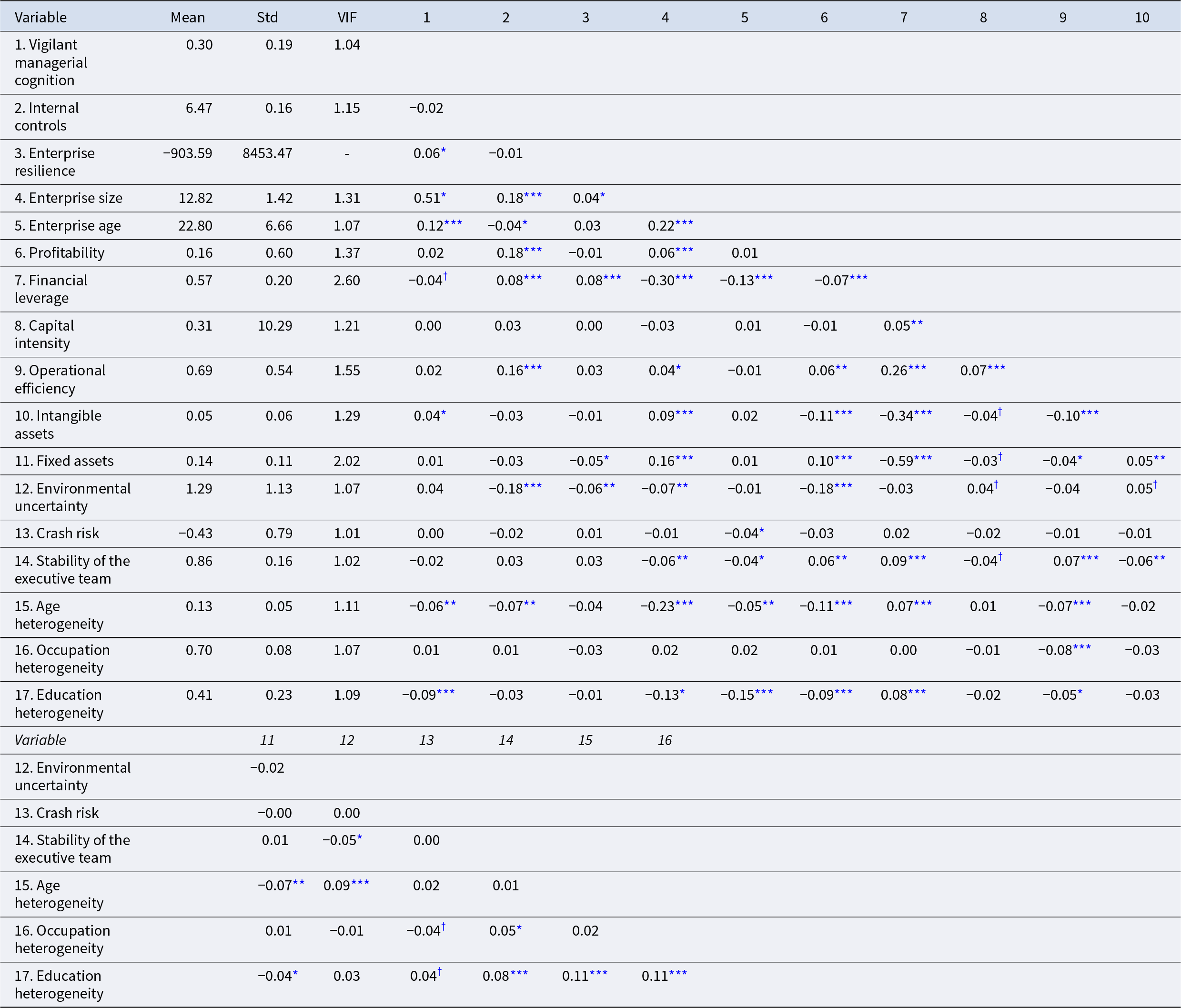
Table 3 presents descriptive statistics and correlations for all variables. The average value for vigilant managerial cognition is 0.30, indicating that vigilance-related vocabulary constitutes 0.30% of the total vocabulary in MD&A texts. The average value for internal controls is 6.47. Additionally, the average value for enterprise resilience is − 903.59, suggesting that the average stock performance of enterprises is below expectations. Vigilant managerial cognition is positively correlated with enterprise resilience (r = 0.06, p < 0.05).
Descriptive statistics and correlations

* Notes: †p < 0.10. p < 0.05. **p < 0.01. ***p < 0.001. The variance inflation factor (VIF) values for each variable derived from the baseline regression.
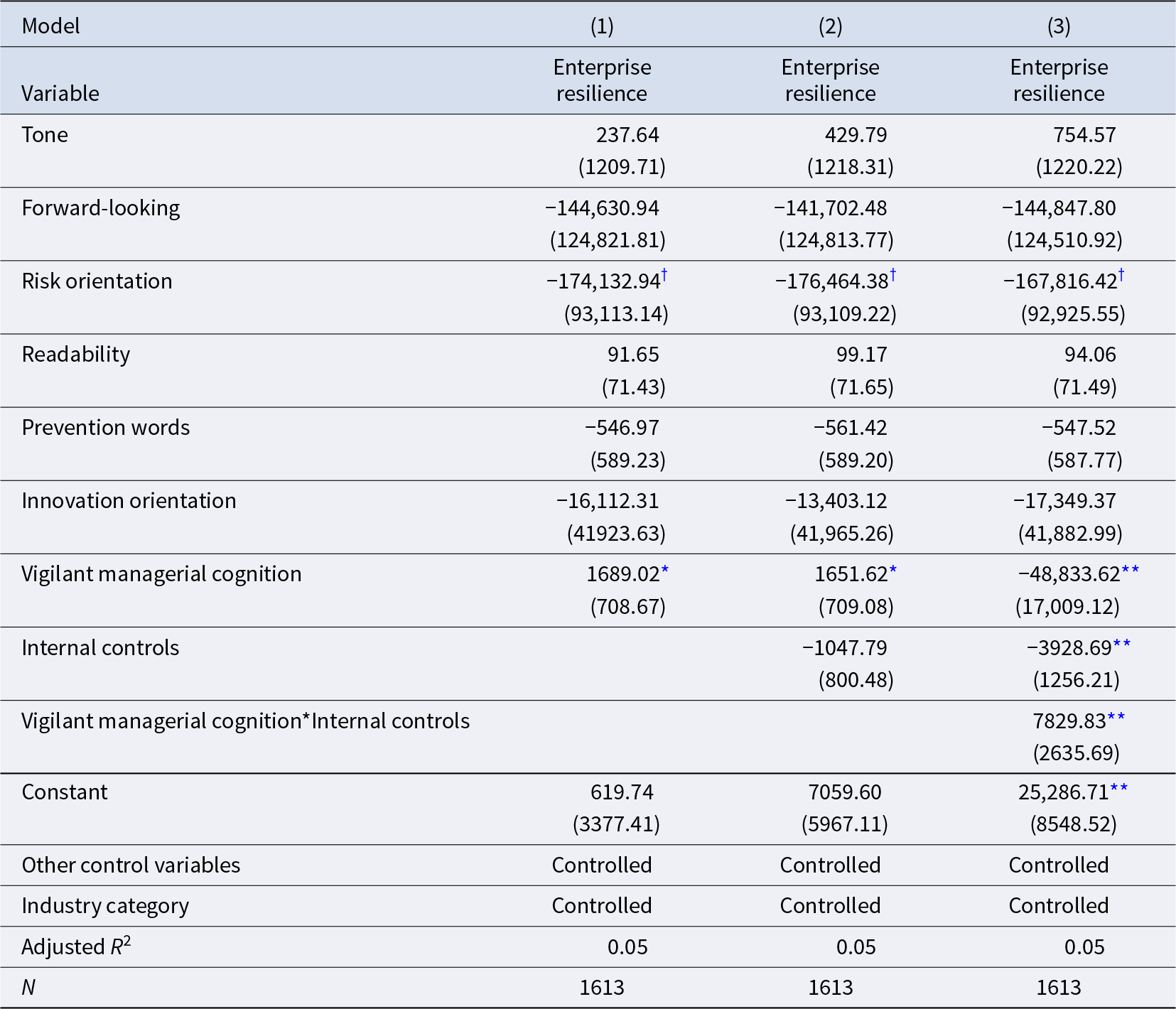
Table 4 reports the results of the multiple regression analysis. Model 1 reveals a positive relationship between vigilant managerial cognition and enterprise resilience (β = 1371.40, p < 0.05). This coefficient indicates the change in a company’s stock price resilience (i.e., cumulative losses during the 12-month observation period) when the frequency of vigilant words increases by one percentage point. Model 3 shows a positive relationship between the interaction term of internal controls and vigilant managerial cognition with enterprise resilience (β = 7823.57, p < 0.01). These findings support H1 and H2, demonstrating that higher-quality internal controls enhance the positive effect of vigilant managerial cognition on enterprise resilience.
Multiple regression analysis

* Notes: Standard errors are in parentheses; p < 0.05. **p < 0.01. ***p < 0.001.
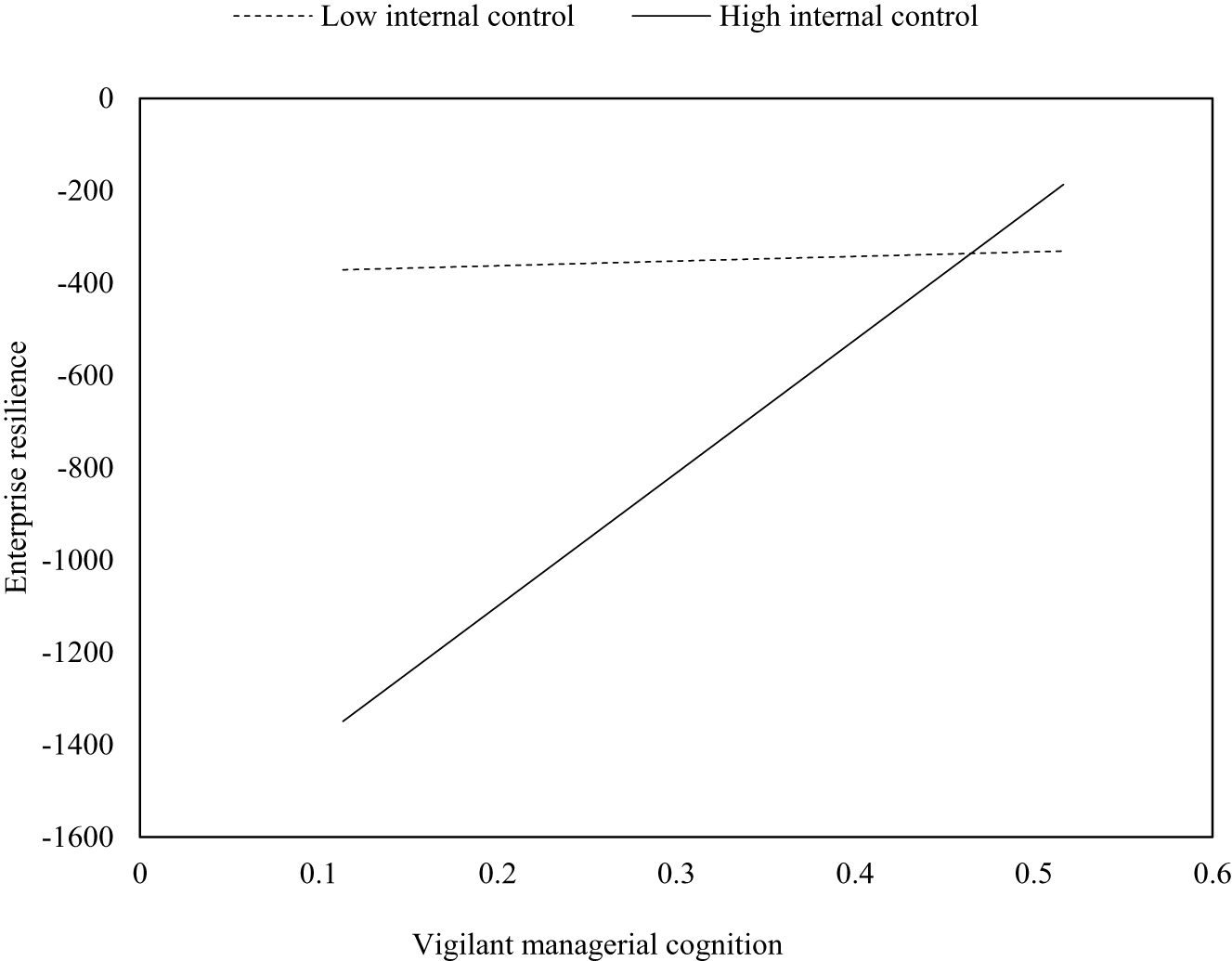
Bootstrap analysis, a resampling technique, involves randomly drawing multiple subsets from the original dataset and modeling each subset to provide unbiased and stable estimates of performance metrics. We employed this method to further examine the interaction effect. Based on 20,000 bootstrap analyses using the SPSS plugin Process, results indicated that when internal control is at a low level (mean – standard deviation), the effect of vigilant managerial cognition is not significant (β = 100.60, 95% CI = [−1376.51, 1577.72]). Conversely, when internal control is at a high level (mean + standard deviation), the effect of vigilant managerial cognition is positively significant (β = 2884.47, p < 0.001, 95% CI = [1294.60, 4474.34]), as illustrated in Figure 1. This finding suggests that when internal control is inadequate, vigilant managerial cognition fails to exert a significant influence.
Moderating effect of internal controls

Robustness Checks
We conducted eight robustness checks. First, in the main analysis, we used 2019 annual reports to extract our study’s independent variables. Although these reports present 2019 financial data, most were published between January and April 2020. Consequently, COVID-19 may have influenced the text index of vigilant managerial cognition. To address potential endogeneity, we followed Boubaker, Gounopoulos, and Rjiba (Reference Boubaker, Gounopoulos and Rjiba2019) and performed a two-stage least squares (2SLS) analysis. In the first stage, the text index from the 2018 annual reports acted as an instrumental variable (vigilant(t-1)). In the second stage, the regression-fit value from the first stage acted as an independent variable (Vigilant_fit) for our analysis of enterprise resilience. Results presented in Appendix B are consistent with our overall empirical analysis, alleviating concerns regarding reversed causality.
Second, we examined whether our findings held in a different context, specifically during the second wave of the COVID-19 outbreak in early 2022 in Shanghai, China. This setting was comparable in scope and severity to our main research context. We measured enterprise resilience by predicting and comparing stock prices. The first wave in 2020 may have contaminated historical data used for predictions. Therefore, we utilized data on confirmed COVID-19 cases in China, selecting stock data from May 1, 2020, when cases stabilized, to March 1, 2022, when the Shanghai government announced control policies, as training data for Holt-Winters exponential smoothing. We then calculated enterprise resilience for the observation period from March 1 to December 7, 2022, when China officially reopened and the stock market experienced new fluctuations. Regression analysis based on second-wave data, shown in Appendix C, aligns with our main study findings.
Third, we controlled for interference from other textual variables. This study extracts vigilant managerial cognition from the MD&A corpus using text analysis methods that may be influenced by various text features. We selected potentially relevant variables from the WinGo database as controls and repeated the baseline regression. Specifically, we included (1) text tone, reflecting the degree of positive or negative semantic meaning; (2) risk orientation, indicating the proportion of vocabulary related to risk concepts; (3) forward-looking vocabulary; (4) readability, reflecting text complexity; (5) innovation orientation; and (6) prevention words, determined by translating the English dictionary into Chinese (using the first definition from Google Dictionary). Among these variables, prevention words (Gamache, Mcnamara, Mannor, & Johnson, Reference Gamache, Mcnamara, Mannor and Johnson2015), risk orientation (Qiu, Hu, Liang, & Dow, Reference Qiu, Hu, Liang and Dow2022), forward-looking language (Hu & Xue, Reference Hu and Xue2018), and innovation orientation (Hu, Zhang, & Li, Reference Hu, Zhang and Li2018) reflect executive characteristics similar to vigilant managerial cognition, such as prevention focus and transformational leadership. Controlling for these variables mitigates their potential influence on the results. Appendix D presents results consistent with the benchmark regression.
Fourth, to address the limitations of MD&A transcripts, which may not always be authored by executives, we compiled textual data from sample companies’ earnings call transcripts in 2019. These texts consist of direct statements by the executive team in response to journalists’ questions, providing a more accurate reflection of managerial cognition. We refined our independent variables based on these transcripts and conducted robustness checks, controlling for textual indicators similar to vigilant managerial cognition, such as prevention words, risk orientation, innovation orientation, and forward-looking language. Regression and moderation analysis results after substituting the independent variables are presented in Appendix E and align with the conclusions of this study.
Fifth, although the dependent variable in this study is measured by stock volatility, the influence of stock price levels remains relevant. To control for this, we retested the outcome variable by dividing it by the average stock price of the corresponding company in 2019 as a robustness check. Regression results and moderated effect test results are shown in Appendix F. Following this substitution, the findings are consistent with the conclusions of this study.
Sixth, this study measures enterprise resilience by computing the difference between stock prices and predicted values, which may lead to overfitting. To address this concern, we recalculated the dependent variable using Ilseven and Puranam’s (Reference Ilseven and Puranam2021) linear formula and conducted repeated tests. Detailed results are provided in Appendix G and support the study’s hypotheses.
Seventh, to examine endogeneity issues related to potentially omitted variables, we employed the impact threshold of confounding variables (ITCV) analysis method. Results are detailed in Appendix I. The ITCV value for vigilant managerial cognition is 0.0101, while the maximum absolute impact coefficient of control variables on enterprise resilience is −0.0092 for risk orientation, which is less than the ITCV value. Assuming the representativeness of the selected control variables, if all impact coefficients are below the ITCV value, it is unlikely that omitted variables will exceed this threshold. Thus, endogeneity issues related to omitted variables in this study are not significant.
Finally, to reduce the impact of outliers, we utilized the classical statistical outlier detection method known as the PauTa criterion (3σ rule). Per this rule, the probability of a variable falling within the normal range [μ − 3σ, μ + 3σ], where μ is the mean and σ is the standard deviation, is 0.9973. Therefore, samples outside this range are considered outliers (Zhao, Shi, Ren, & Jiao, Reference Zhao, Shi, Ren and Jiao2020). To mitigate sample loss from indiscriminate deletions, we employed winsorization, replacing outliers below μ − 3σ and above μ + 3σ with the 1st and 99th percentiles, respectively. After applying this treatment, we repeated the regression tests, and the results, presented in Appendix J, support the study’s conclusions.
Discussion
This study conceptualizes executives’ vigilant managerial cognition and develops a theoretical model illustrating its positive effect on enterprise resilience. By employing textual analysis and machine learning, we constructed a measurement index based on a comprehensive collection of MD&A texts. The empirical results indicate that executives’ vigilant managerial cognition significantly enhances enterprise resilience, suggesting that organizations should cultivate this quality among their leaders. Furthermore, the findings support the idea that interactions between executives’ vigilant managerial cognition and internal controls can influence enterprise resilience. Specifically, higher-quality internal controls amplify the positive effect of executives’ vigilant managerial cognition on resilience.
Theoretical Contributions
This study has significant theoretical contributions. First, it conceptualizes executives’ vigilant managerial cognition and examines its influence on enterprise resilience, particularly via the lens of negative-focused managerial cognition. This perspective enhances the understanding of enterprise resilience and advances the theoretical framework surrounding managerial cognition. While previous research has explored executives’ roles in enhancing enterprise resilience (Buyl et al., Reference Buyl, Boone and Wade2019; Fang et al., Reference Fang, Prayag, Ozanne and Vries2020), it has largely neglected the significance of negative-focused managerial cognition, which entails precaution against potential future crises (Duchek, Reference Duchek2020). Utilizing Teece’s (Reference Teece2007) sensing-seizing-reconfiguring framework of dynamic capability, we define vigilant managerial cognition as a proactive response to potential threats, allowing for establishing a link between vigilant managerial cognition and enterprise resilience.
Second, we investigate the interplay between vigilant managerial cognition and internal controls in fostering enterprise resilience. Prior studies have acknowledged the importance of institutional factors in shaping executives’ managerial cognition (Yang et al., Reference Yang, Wang, Zhou and Jiang2019); however, the interaction between leaders’ vigilance and institutional factors remains underexplored. Effective enterprise resilience necessitates coordinated efforts across departments, and leaders must often navigate organizational resistance (Helfat & Peteraf, Reference Helfat and Peteraf2014). Thus, in addition to cultivating executives’ vigilant managerial cognition, it is essential to leverage this cognition to engage the entire organization. Our findings suggest that internal controls serve as a catalyst in the relationship between executives’ vigilant managerial cognition and enterprise resilience, thereby enriching the literature on the interaction between managerial cognition and institutional factors and clarifying the boundary conditions affecting managerial cognition’s effectiveness.
Practical Implications
In light of escalating international trade frictions and slowing global economic growth, enterprises must enhance their resilience. Our findings yield two key practical implications for leaders aiming to foster enterprise resilience. First, enterprises should prioritize the vigilance of their management teams by developing dynamic managerial capabilities and remaining alert to negative signals and potential crises. When selecting and training management teams, organizations should emphasize the cultivation of executives’ vigilant managerial cognition, which includes recognizing danger signs and implementing preventive measures. Targeted training should enhance executives’ abilities in risk identification and opportunity recognition, covering areas such as strategic risk management, market analysis, and competitive positioning. Additionally, clear goal and reward mechanisms, such as stock options and career advancement for effective risk management, should be established to motivate managers to proactively identify and address potential threats.
Second, we emphasize the importance of high-quality internal controls. Managerial cognition significantly influences effective management, relying on accurate signal detection and timely reconfiguration, which necessitates robust internal controls to support decision-making. Enhancing internal controls involves several strategies: (1) Strengthening internal supervision through regular assessments and audits and implementing multi-party evaluations of managerial decisions to create a sound governance environment; (2) Utilizing advanced techniques such as big data analytics and market monitoring, combined with diverse risk mitigation strategies, to bolster risk assessment; (3) Implementing independent and flexible approval mechanisms for asset movements and business adjustments to enhance executive control over operations; (4) Improving information dissemination among executives and departments by establishing effective communication platforms, facilitating information sharing, and enhancing digital integration within business operations; (5) Instituting oversight mechanisms for management decision-making, including standardizing reporting systems for identifying and addressing internal control deficiencies and forming committees for ongoing monitoring and review of corrective actions. These measures collectively reinforce the management framework necessary for cultivating enterprise resilience.
Limitations and Future Research
The findings of this study should be considered in light of several limitations. First, we did not explore the mechanisms that may mediate the relationship between executives’ vigilant managerial cognition and enterprise resilience. Although it has been proposed that dynamic managerial capabilities can be transformed into dynamic capabilities (Helfat & Martin, Reference Helfat and Martin2015), the specific mechanisms underlying this transformation remain unclear. Further research could investigate mediators from the perspectives of leadership behavior and organizational-level cognition. Second, more complex mechanisms may underlie the causal relationship between vigilant managerial cognition and enterprise resilience, particularly as prevention focus and future orientation may intertwine with vigilant managerial cognition (Gao et al., Reference Gao, Liu, Zhao, Fu and Schriesheim2024). Subsequent studies could analyze the unique effects of vigilant managerial cognition on enterprise resilience and the complexities involved. Third, the study’s design limits the ability to establish causality between vigilant managerial cognition and enterprise resilience. Future research would benefit from a longitudinal design to clarify the causal relationship between these constructs. Fourth, while this study examines enterprise resilience in the context of the COVID-19 pandemic, there is ongoing debate about whether the pandemic exemplifies general crises. Previous studies on resilience have addressed large-scale crises, such as influenza (Rao & Greve, Reference Rao and Greve2017), the 9/11 attacks (Gittell, Cameron, Lim, & Rivas, Reference Gittell, Cameron, Lim and Rivas2006), and the 2008 financial crisis (DesJardine et al., Reference DesJardine, Bansal and Yang2019), indicating a need for more research on resilience in broader crisis contexts. Finally, while using stock prices as a measure of resilience is common, their inherent unpredictability and volatility render them imperfect indicators. Future research may consider employing alternative methods, such as surveys, to provide a more nuanced understanding of the phenomenon under investigation.
Data availability statement
The final dataset that support the findings of this study are available at https://osf.io/hjzye/?view_only=8196c9f7b938432b9bd1ca40fd9bfae0
Acknowledgements
We would like to express our sincere gratitude to Senior Editor Kenneth G. Huang and the three anonymous reviewers for their dedicated efforts and valuable insights that significantly contributed to the refinement of this paper. This research was supported by the National Natural Science Foundation of China (Grant Nos. 72172017, 72272148), Ministry of Education in China (Grant No. 21YJC630170) and Beijing Municipal Natural Science Foundation (Grant No. 9222023).
Appendix A. Seed Words and Their Corresponding Word Sets
The seed-word set was selected based on three key factors: (1) it pertains to three central aspects of vigilant management: awareness, detection, and precaution; (2) certain words were excluded given their rare occurrence in the corpus. For instance, terms such as ‘警醒, ‘谨防, and ‘戒备’ returned ‘Key “戒备” not present’ in our model. Although these terms are common in everyday language, they are infrequently used in Management Discussion and Analysis sections, rendering them ineffective for our purposes; and (3) some words yielded numerous irrelevant results. For example, the top 20 results for ‘小心’ (be cautious) illustrate this issue.

While a few terms reflect vigilant managerial cognition, many are unrelated. Additionally, vigilant managerial cognition can be expressed through various terms, such as ‘警惕’ (be cautious). To minimize data noise, we chose not to include seed words exhibiting this problem. The seed words and their corresponding word sets are presented in the table below:

Appendix B. Robustness Check Based on Two-Stage Least Square Analysis
Two-stage least square analysis

Notes: Standard errors are in parentheses; *p < 0.05. **p < 0.01. ***p < 0.001.
Appendix C. Robustness Check Based on the Second Observation Period
Multiple regression analysis for the second observation period

* Notes: p < 0.05. **p < 0.01. ***p < 0.001.
Appendix D. Robustness Check with Other Textual Variables Controlled
Multiple regression analysis with other textual variables

* Notes: Standard errors are in parentheses; †p < 0.10. p < 0.05. **p < 0.01.
Appendix E. Robustness Check Based on Earnings Call Corpus
Multiple regression analysis

† Notes: Standard errors are in parentheses; p < 0.10. **p < 0.01.
Effect of vigilant managerial cognition on resilience under different conditions

Appendix F. Robustness Check After Dividing the Dependent Variable by the Average Price
Multiple regression analysis

* Notes: p < 0.05. **p < 0.01. ***p < 0.001
Effect of vigilant managerial cognition on resilience under different conditions

Appendix G. Robustness Check with the Independent Variables Calculated by the Linear Method
Drawing on the insights of Ilseven and Puranam (Reference Ilseven and Puranam2021), we posit that each intersection between the predicted and actual curves forms a triangular region. For example, two intersections create three triangular regions (2 + 1 = 3) before the lines become parallel, while no intersection results in one triangular region (0 + 1 = 1). We anchor the timing in Ilseven and Puranam’s formula to the time points of each intersection and the moments when actual values reach their extremum following each intersection. By measuring half of the product of the time distance between consecutive intersections and the difference between actual and predicted values at the extremum, we quantify the area of each triangular region. For the final triangular region, which occurs between the last intersection and the subsequent parallelization of the curves, we approximate this area using the difference between them at the end of the observation period and the elapsed time since the last intersection. The sum of these areas serves as the dependent variable, being negative when actual values fall below predictions and positive otherwise. Regression results and tests of moderating effects are presented in Tables D1 and D2 following the substitution of the dependent variable.
Multiple regression analysis

* Notes: p < 0.05. **p < 0.01.
Effect of vigilant managerial cognition on resilience under different conditions

Appendix H. Themes of Sentences Containing Vigilant Vocabulary
Themes of sentences containing vigilant vocabulary and example terms

Appendix I. Robustness Check Based on the Impact Threshold of Confounding Variables
Impact threshold of confounding variables (ITCV) examination

Appendix J. Robustness Check for Outliers
Multiple regression analysis

* Notes: p < 0.05. **p < 0.01. ***p < 0.001
Effect of vigilant managerial cognition on resilience under different conditions

Chen Zhao (chenmendrey@bupt.edu.cn) is a full professor at the School of Economics and Management, Beijing University of Posts and Telecommunications, Beijing. He received his PhD in management from Tsinghua University. His research interests include human resource management, talent management, and change-oriented leadership. He has published widely in international scholarly journals, including the Journal of Applied Psychology, British Journal of Management, International Journal of Human Resource Management, Journal of Managerial Psychology, and Psychology & Marketing.
Chen Lin (lauterate@foxmail.com) is a doctoral candidate of the School of Economics and Management of Beijing University of Posts and Telecommunications. His research interests include human resource management practice, digital economy, digital talent management, and digital literacy.
Yonghong (Tracy) Liu (y_liu24@uncg.edu) is an associate professor of management at the University of North Carolina at Greensboro. She received her PhD in organizational behavior from the University of Miami. Her research interests include leadership, team management, and corporate social responsibility. Her research has been published in premium journals such as Journal of Applied Psychology, Journal of Business Ethics, The Leadership Quarterly, and Journal of Occupational and Organizational Psychology.
Zhonghua Gao (gaozhh@cass.org.cn) is a full professor at the Institute of Industrial Economics, Chinese Academy of Social Sciences, Beijing. She received her PhD in management from Renmin University of China. Her research interests include the development and motivation of scientific and technological innovation talents, promotion and cultivation of craftsmanship, and vigilant leadership and HRM under the platform transformation. Her research has published in such journals as Journal of Applied Psychology, British Journal of Management, International Journal of Human Resource Management, and Journal of Managerial Psychology.