1. Introduction
Until recently, the fossil record of asterozoans (asteroids or starfishes, and ophiuroids or brittle and basket stars) in the Antillean region consisted solely of disarticulated plates or ossicles (Donovan, Reference Donovan2001), unlike certain adjacent regions where well-documented complete specimens are locally common (e.g. Jones & Portell, Reference Jones and Portell1988; Oyen & Portell, Reference Oyen and Portell2001; Blake & Portell, Reference Blake and Portell2009, Reference Blake and Portell2011). Asteroid and ophiuroid ossicles are widely distributed in the Upper Cretaceous and Cenozoic of the Antilles; they deserve further study, but have received little attention by systematists. In general, the echinoderm endoskeleton rapidly disarticulates into its component ossicles after death. As a result, articulated asterozoan skeletons are exceptional fossils as they require rapid and effective post-mortem burial to preserve the ossicles in place (Ausich, Reference Ausich, Jangoux and Lawrence2001). Dissociated asterozoan plates may occur abundantly as microfossils, but only very few palaeontologists are expert in the systematics of these plates. Despite being diverse in the extant, shallow- and deep-water faunas (e.g. Hendler et al. Reference Hendler, Miller, Pawson and Kier1995 and Lyman, Reference Lyman1883, respectively), Antillean fossil asteroids and ophiuroids therefore remain essentially unknown and have almost exclusively been recorded in open nomenclature, when noted at all. The first ‘starfish bed’ to be recognized from the region is therefore significant. Its interpretation as a deep-water occurrence of asterozoans has important implications for our understanding of the taphonomy and evolution of Antillean echinoderms. From this deposit, new species of nominal fossil asteroid and ophiuroid are described.
The specimens described herein are deposited in the Naturalis Biodiversity Center, Leiden (NBC RGM) and the Florida Museum of Natural History, Gainesville (UF).
2. History of research
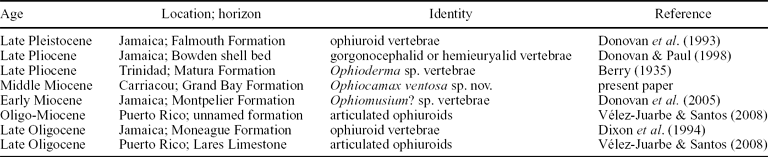
Echinoids are the only common and well-documented echinoderm fossils in the Mesozoic and Cenozoic of the Antillean region. Although disarticulated ossicles of asteroids, ophiuroids and crinoids do occur, they are uncommon, are rarely recognized by palaeontologists in the field and have received little attention in the scientific literature (Donovan, Reference Donovan2001). Despite being the most diverse group of echinoderms in modern shallow-water environments of the Caribbean (Hendler et al. Reference Hendler, Miller, Pawson and Kier1995, pp. 89–195), ophiuroids (Table 1) and asteroids (Donovan & Schelfhorst, Reference Donovan and Schelfhorst2012, table 1) are almost unknown as fossils from the Antilles. The only other articulated specimens hitherto reported are from the Oligo-Miocene of Puerto Rico (Vélez-Juarbe & Santos, Reference Vélez-Juarbe, Santos, Ausich and Webster2008); these have not yet been formally classified and described.
The fossil record of Cenozoic ophiuroids in the Antillean region.

Our limited knowledge of the distribution of fossil asteroids and ophiuroids is undoubtedly highly biased, particularly towards Jamaica, where one of us (SKD) and his research students have been collecting fragmentary echinoderms since 1986. Known occurrences of asteroid and ophiuroid ossicles in Jamaica are from units in which considerable research effort was expended in collecting echinoderms; these are not the Upper Cretaceous and Eocene formations that yielded most of the fossil echinoids from Jamaica in the 1920s and 1930s (Hawkins, Reference Hawkins1923, Reference Hawkins1924, Reference Hawkins1927, Reference Hawkins1930; Arnold & Clark, Reference Arnold and Clark1927, Reference Arnold and Clark1934; Donovan, Reference Donovan, Burke, Mladenov, Lambert and Parsley1988, Reference Donovan, Wright and Robinson1993), particularly the Lower–Middle Eocene Yellow Limestone Group. We therefore have the paradoxical situation that no ophiuroid ossicles are known from the unit that has yielded the greatest diversity of fossil echinoderms in Jamaica, although asteroid marginal plates have been recorded (Donovan, Reference Donovan2001, table 5).
That asterozoans remain almost unknown in the Antilles has an obvious taphonomic explanation. Ophiuroids and asteroids generally have a low preservation potential and disarticulate rapidly upon death (e.g. Blake, Reference Blake, Jangoux and Lawrence1989; Donovan, Reference Donovan and Donovan1991). Unlike other echinoderm groups which have some ossicles that are large and obvious to the naked eye, such as cidaroid spines, isocrinid columnals and goniasterid marginal plates, even the largest ophiuroid ossicles, that is, vertebrae, lateral arm plates and radial shields of the disc, can only be recognized by micropalaeontological analysis of poorly lithified sedimentary rock. The same is true for the majority of the diagnostic plates of asteroids. A micropalaeontologist will likely not be interested in echinoderm fragments and most echinoderm workers concentrate their collecting effort on macrofossils. The macroscopic specimens described here are not just the first Antillean fossil ophiuroid and asteroid to be named, but the first Antillean fossil ophiuroid and asteroids that were easy to find.
3. Locality and horizon
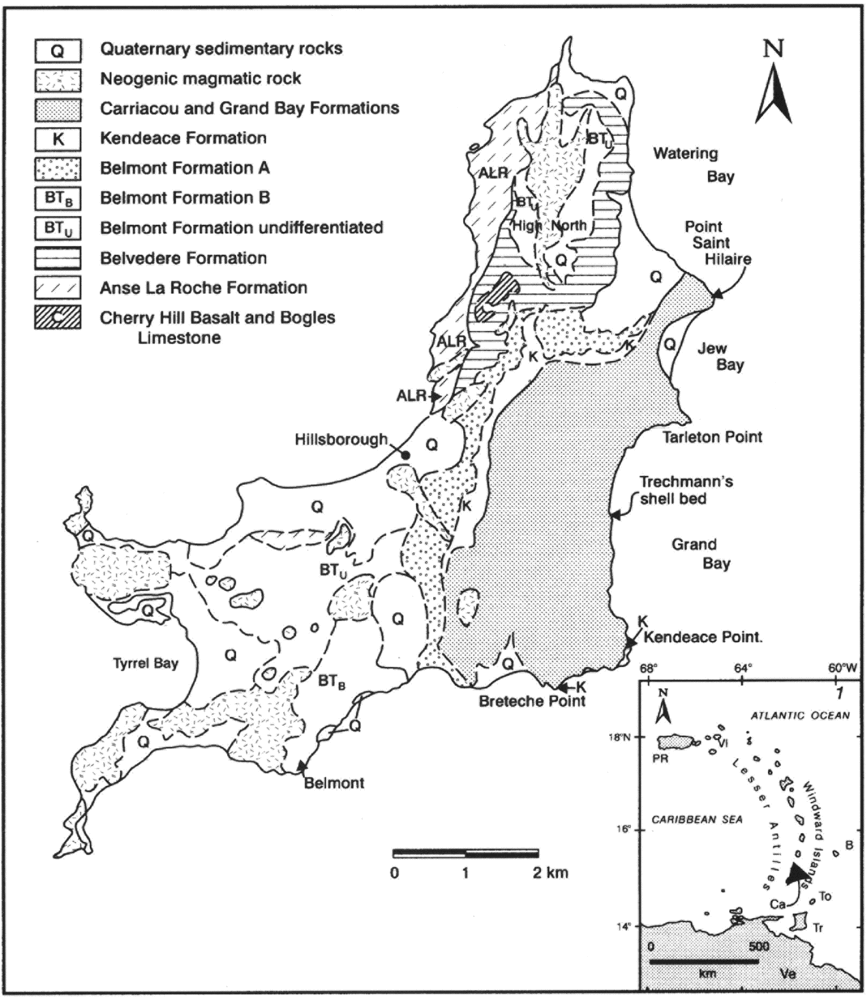
The specimens described below come from a channel-fill-sandstone in the Middle Miocene Grand Bay Formation exposed on the east coast of Carriacou, The Grenadines, Lesser Antilles (Fig. 1). The following account is adapted from Donovan et al. (Reference Donovan, Pickerill, Portell, Jackson and Harper2003). The Middle Miocene Grand Bay Formation is comprised principally of beige to light brown, fine- to coarse-grained volcaniclastic sandstones with intercalated horizontally and finely laminated to massive silty and sandy mudstones and calcareous mudstones, and associated with sporadically developed volcanogenic pebbly sandstones and conglomerates. The strata are abundantly fossiliferous, dominated by diverse assemblages of molluscs, but also including, among other taxa, scleractinian corals, brachiopods, echinoids, crinoids, decapod crustaceans, barnacles, algae and vertebrates (Donovan et al. Reference Donovan, Pickerill, Portell, Jackson and Harper2003).
Simplified geological map of Carriacou, after Donovan et al. (Reference Donovan, Pickerill, Portell, Jackson and Harper2003, fig. 1), and modified after Speed et al. (Reference Speed, Smith‑Horowitz, Perch‑Nielsen, Saunders and Sanfilippo1993, fig. 7) and T.A. Jackson (unpub. M.Sc. thesis, University of West Indies, 1970, map), showing principal localities mentioned in text. The starfish bed is at the south end of Jew Bay, north of Tarleton Point and beneath the Quaternary cover. Inset map of Lesser Antillean region shows the position of Carriacou (arrowed). Key: B = Barbados; Ca = Carriacou; PR = Puerto Rico; To = Tobago; Tr = Trinidad; Ve = Venezuela; VI = Virgin Islands.

Brief descriptions and palaeoenvironmental interpretations of the strata were presented by Jung (Reference Jung1971) and Speed et al. (Reference Speed, Smith‑Horowitz, Perch‑Nielsen, Saunders and Sanfilippo1993), who differed radically in their conclusions. Based on comparison with extant molluscan and scleractinian coral faunas, Jung (Reference Jung1971, pp. 158–60) concluded that the Grand Bay Formation was a relatively deep-water sequence. In contrast, Speed et al. (Reference Speed, Smith‑Horowitz, Perch‑Nielsen, Saunders and Sanfilippo1993, p. 55) speculated that it was a shallow-water succession. Donovan & Harper (Reference Donovan and Harper1999, Reference Donovan, Harper, Brunton, Cocks and Long2001), based on the occurrence of stalked crinoids, brachiopods and the ichnofossil Zoophycos, and Donovan et al. (Reference Donovan, Pickerill, Portell, Jackson and Harper2003), referring to the data supplied by sedimentology, ichnology and a wider set of palaeontological observations, emphatically supported Jung's conclusion. Sedimentological evidence suggests that the Grand Bay Formation was deposited in relatively deep water, and certainly below fair weather and storm wave base, as the strata do not contain any evidence of wave activity. In addition, the presence of channels and slump horizons in the essentially turbiditic sequence suggests penecontemporaneous erosion and the presence of some form of slope. Based on various lines of evidence, the depth of deposition was at least 150–200 m (Jung, Reference Jung1971; Donovan & Harper, Reference Donovan and Harper1999, Reference Donovan, Harper, Brunton, Cocks and Long2001; Donovan et al. Reference Donovan, Pickerill, Portell, Jackson and Harper2003) and probably deeper (Donovan, Reference Donovan and Schelfhorst2012). At this water depth taxa typically found in modern bathyal settings, such as articulated brachiopods and stalked crinoids (Donovan & Veltkamp, Reference Donovan and Veltkamp2001), thrived in the Caribbean and continue to do so.
Recently published geochemical analyses have demonstrated a single source for the various volcanic grains incorporated in this turbiditic deposit (Jackson et al. Reference Jackson, Scott, Donovan, Pickerill, Portell and Harper2008), but the volcanic centre from which it originated remains unknown. This combination of turbidite basin deposition in a region of active volcanism led to the formation of a rare sedimentary deposit: a starfish bed. This starfish bed is the only one known from the Antilles and the sole deposit in the region to yield both an articulated asteroid (Figs 2, 3) and an articulated ophiuroid (Figs 4–6) although, admittedly, both specimens are incomplete.
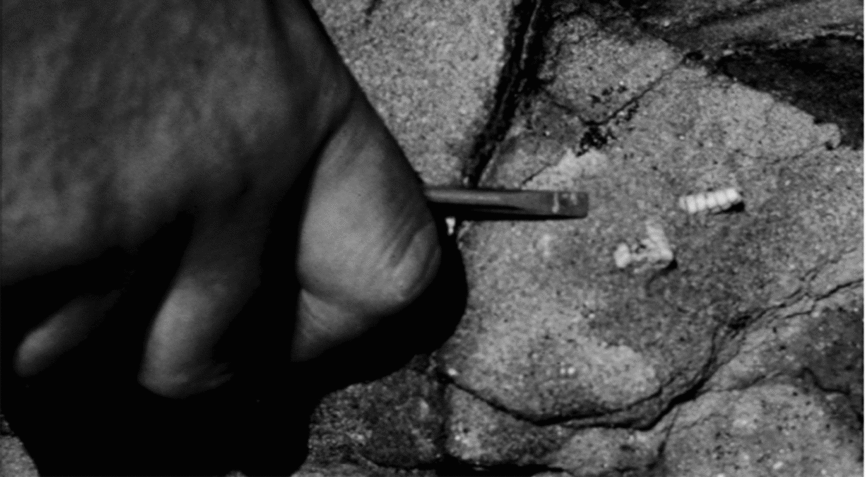
In situ asteroid, Paragonaster(?) haldixoni sp. nov., UF 114750, holotype, in the Middle Miocene starfish bed of the Grand Bay Formation of Carriacou.

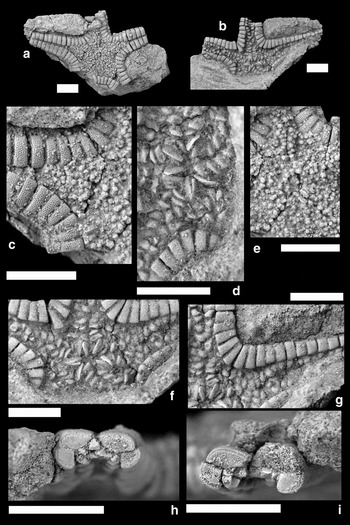
Paragonaster(?) haldixoni sp. nov., UF 114750, holotype, Middle Miocene starfish bed, Carriacou, The Grenadines. (a) Abactinal (dorsal) surface. (b) Actinal (oral) surface. (c, e) Details of marginal frame and abactinal plating, respectively. (d, f, g) Details of the mouth frame, actinal plating and marginal frame, respectively. (h, i) Arms in section. Specimen coated with ammonium chloride. All scale bars represent 10 mm.

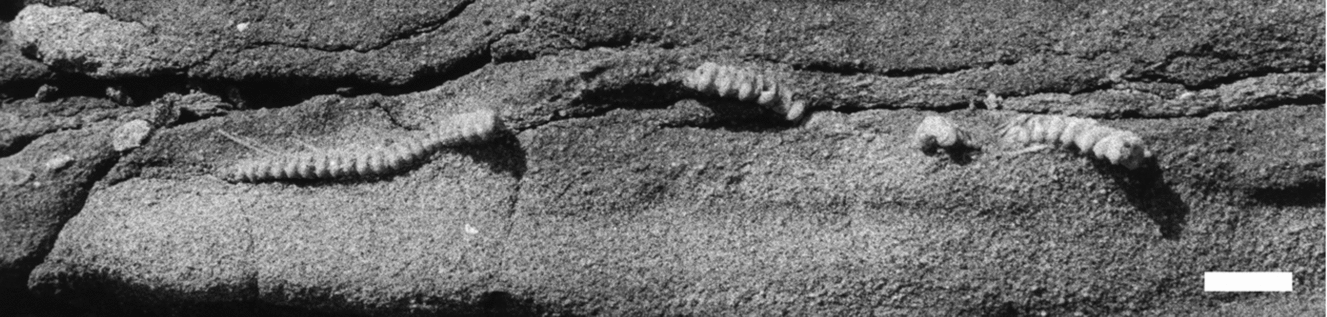
In situ ophiuroid, Ophiocamax ventosa sp. nov., NBC RGM 791 150, holotype, in the Middle Miocene starfish bed of the Grand Bay Formation of Carriacou. Scale bar represents 10 mm.

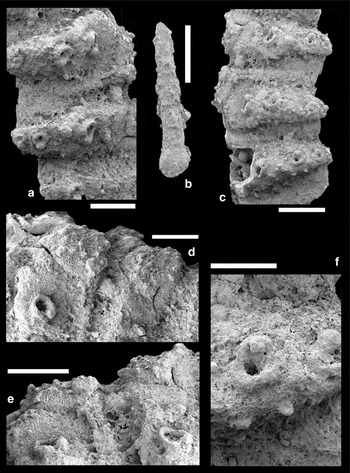
Ophiocamax ventosa sp. nov., NBC RGM 791 150, holotype, Middle Miocene starfish bed, Carriacou, The Grenadines. (a) Oblique lateral view of arm; (b) spine; (c) lateral view of arm. Scale bar represents 1.5 mm. (d) Latero-dorsal view of arm; (e) latero-dorsal view of arm; (f) close-up of arm spine base. Scale bar represents 0.6 mm. All scanning electron micrographs. Scale bars represent 1.2 mm, unless stated otherwise.

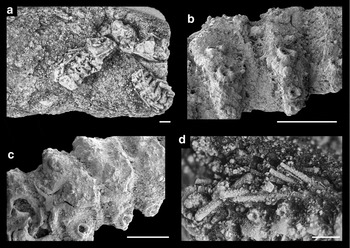
Ophiocamax ventosa sp. nov., NBC RGM 791 150, holotype. (a) Disc with proximal portions of arms in dorsal view; (b) proximal arm segments in lateral view; (c) proximal to median arm segments in dorsal view; (d) arm spines attached to proximal arm segments in dorsal view; note numerous planktonic foraminifera in matrix. Scale bars represent 2 mm.

The starfish bed is to the north of Tarleton Point in Jew Bay (Fig. 1), to the north of the stream and in the area of Jung's (Reference Jung1971) localities 10706–10723 (GPS 12° 29′ 25″ N, 61° 25′ 30″ W). This horizon is exposed beneath the angular unconformity with the overlying Quaternary Carriacou root beds (Donovan et al. Reference Donovan, Pickerill and Portell2002). The fossil asterozoans are higher in the succession than the measured section of Harper & Pickerill (Reference Harper and Pickerill2008, fig. 2). Although grant support was forthcoming to support further research of this deposit, problems of access prevented our return.
4. Systematic palaeontology
Class ASTEROIDEA de Blainville, Reference Blainville1830
Subclass NEOASTEROIDEA Gale, Reference Gale1987
Order VALVATIDA Perrier, Reference Perrier1884
Family Goniasteridae Forbes, Reference Forbes1841
Genus Paragonaster Sladen, Reference Sladen, Wyville Thomson and Murray1885
Type species. Paragonaster ctenipes Sladen, Reference Sladen1889, by subsequent designation of Fisher (Reference Fisher1919).
Diagnosis. Goniasterid with stellate body form; abactinal ossicles paxilliform, covered with rounded granules; one median row of abactinals extending to terminal, usually somewhat rectangular in shape and wider than long; adambulacral furrow margin angular; apical oral spine unpaired; no pedicellariae (modified from Clark & Downey, Reference Clark and Downey1992, p. 255).
Range. Middle Miocene (the present record) to Recent (Clark & Downey, Reference Clark and Downey1992).
Paragonaster(?) haldixoni sp. nov.
Figures 2, 3
?2001 unidentified marginal ossicles; Donovan, table 5.
2003 Astropecten sp. nov.; Donovan et al. p. 264.
Reference Donovan, Harper, Portell, Pickerill, Jackson, Jagt and Lindsay2008a goniasterid asteroid; Donovan et al. p. 52.
Reference Donovan, Jackson, Portell, Pickerill, Harper and Jagt2008b goniasterid asteroid; Donovan et al. p. 18.
Etymology. For our late colleague and co-author, Harold L. ‘Hal’ Dixon, formerly of the Department of Geology, University of the West Indies, Mona, in recognition of his contribution to Caribbean invertebrate palaeontology.
Holotype. UF 114750, the only specimen known.
Related material. Disarticulated asteroid marginal ossicles occur rarely in the basal part of the Grand Bay Formation, in association with crinoid ossicles (Donovan & Veltkamp, Reference Donovan and Veltkamp2001), and at other horizons in this unit (NBC RGM 188 797 and 188 798). Larger collections are required before it is possible to determine if they are conspecific with the present taxon. The type locality of Paragonaster(?) haldixoni sp. nov. has yielded two other asteroid specimens belonging to different species; one of these disintegrated soon after it was collected and the other represents a fragment of a spinose arm (NBC RGM 188 799).
Type locality and horizon. A channel-fill sandstone in the Grand Bay Formation (Middle Miocene) on the east coast of Carriacou, The Grenadines, Lesser Antilles. The locality is to the north of Tarleton Point in Jew Bay (Fig. 1), to the north of the stream and in the area of Jung (Reference Jung1971) localities 10706–10723 (GPS 12° 29′ 25″ N, 61° 25′ 30″ W). The ophiuroid/asteroid-bearing bed is exposed beneath the angular unconformity with the overlying Quaternary Carriacou root beds (see above).
Preparation. The specimen was collected in two main pieces, broken through the proximal area of one arm, with some separated ossicles. The two large parts were joined with a viscous solution of Paraloid B72 (a copolymer of ethyl methacrylate and methyl acrylate in acetone) after the joint surfaces were consolidated with Paraloid B72 diluted in butan-2-one. Ossicles were re-attached to the ends of one arm.
Most of the asteroid was enclosed in the matrix, which consisted of fine-grained sandstone with granular fragments, but the distal ends of the arms were already visible. The matrix was soft enough to remove with a hand-held tungsten carbide needle, but responded more readily to preparation using an airbrasive (Texas Airsonics HP series) with 50 microns grade sodium bicarbonate powder. Powder flow and air pressure were adjusted to avoid damage to the fossil calcite. Preparation commenced on the apical side and this surface was wholly exposed before the oral surface was addressed. The matrix was completely removed from one of the interradial areas, but left attached on other margins to allow handling and to support the adhesive joint. A dilute solution of Paraloid B72 in butan-2-one was applied to the exposed fossil surface to cement the ossicles in place.
Diagnosis. Medium-sized goniasterid of stellate, flat form; arms long, slender and pointed; abactinal ossicles paxilliform; single row of abactinals, longer than wide, extending to arm tip; R/r = > 3.2/1; uniform granulation on superomarginals and inferomarginals; large oral plates and robust, angular adambulacrals.
Description. Disc of medium size; major radius (R) > 37.4 mm (arm tips missing); minor radius (r) 11.6 mm; R/r = > 3.2/1; flat, stellate, arms long and pointed (although incompletely preserved), five in number; gradually tapering distally; interradii moderately narrow with rounded angles; superomarginals low, recumbent on abactinal surface, much wider than long interradially and along arm bases (W/L ratio c. 3.6), more distally W/L ratio decreases to 1.6; interradial superomarginals slightly cuneate; more distally, superomarginals almost meet adradially, being separated by a single row of rectangular abactinal ossicles; ornament of numerous (>80), close-set round granules, of comparable size along disc and arms; distal and proximal facets flat to slightly concave, bordered by well-developed articulation ridge, parallel to ossicle curvature and bordered by shallow groove. Number of superomarginals, counted from centre of interradius to arm tip (as preserved) >15.
Inferomarginals low, regularly curved on actinal surface, much wider than long interradially and along arm bases (W/L ratio c. 3.3), more distally W/L ratio decreases to 1.25 and less; interradial inferomarginals clearly cuneate, equalling width of corresponding superomarginals; more distal inferomarginals longer than wide, their width equalling half (or less) of corresponding superomarginal width; ornament apparently less coarse than that of superomarginals, with comparable round granules.
Abactinal ossicles numerous, paxilliform, of more or less uniform size; ornament of few granules; madreporite not distinguished; a single row of rectangular abactinals extends to end of arm (not preserved).
Oral (actinal) surface collapsed; mouth central, small, defined by ten relatively large, prominent oral plates; no apical oral and suboral spines preserved; adambulacral ossicles robust, angular, no spines preserved.
Discussion. Although details of inferomarginal, oral and adambulacral granulation and spination cannot be assessed, the present specimen would appear to be close to the genus Paragonaster, although the rectangular abactinals of the single row that extends to the arm tip are longer than wide, rather than wider than long. For that reason, the new species is assigned to that genus with a query. Clark & Downey (Reference Clark and Downey1992, pp. 255–7, pl. 62A–D) recorded two extant species of Paragonaster from the Atlantic, P. grandis H. L. Clark, Reference Clark1941 and P. subtilis (Perrier, Reference Perrier1881). The former, known from relatively shallow waters (257–540 m) off Cuba and northern Brazil, has an R/r ratio of 3.0/1 (i.e. close to the Carriacou form), but possesses more superomarginals and abactinal ossicles extend further into the arm base. In UF 114750, superomarginals at the arm base are first separated by a single row of rectangular abactinals from number 6; these are longer than wide. The second extant species, which occurs in deep-water settings (1845–4700 m) of the North American basin (off New York to Norfolk, Virginia), Gulf of Mexico, Azores and Rockall Trough to the Gulf of Guinea, has very long and attenuate arms and an R/r ratio of 5.1/1. This, and the fact that it has more angular granules on inferomarginal ossicles and abactinals that are wider than long in the distal arm portion, differentiates it from P.(?) haldixoni sp. nov.
Remarks. Antillean fossil asteroids are known from six islands, ranging in age from Late Cretaceous to Pleistocene (Donovan, Reference Donovan2001; Donovan & Schelfhorst, Reference Donovan and Schelfhorst2012), but only from disarticulated marginal plates that have not received adequate study. The two nominal fossil asteroid taxa from the region are from Cuba; these are the goniasterid Nymphaster miocenicus Valette, Reference Valette1926, and the stauranderasterid Stauranderaster sanchezi Valette, Reference Valette1926. These are either of Early Miocene (Valette, Reference Valette1926, pp. 25, 26) or Early Eocene age (Sánchez Roig, Reference Sánchez Roig1949, pp. 294, 295). The poor line drawings of dissociated marginal ossicles that accompany the original descriptions show enough detail to confirm that they are utterly different from the new Carriacou species (Valette, Reference Valette1926, pl. 1, figs 1, 2). Other published illustrations of marginal ossicles from the Middle Cenozoic of the region include the Lower Miocene (Donovan et al. Reference Donovan, Portell and Veltkamp2005), and the Pliocene of Jamaica and Curaçao (Donovan & Paul, Reference Donovan and Paul1998; Donovan & Schelfhorst, Reference Donovan and Schelfhorst2012); neither provides a convincing match.
Any environmental signal from this fossil is uncertain. Extant asteroids from the tropical western Atlantic occur at a multiplicity of water depths. The Grand Bay Formation, although undoubtedly deposited in deeper water, contains a range of benthic fossils and ichnofossils indicative of a range of palaeoenvironments, from terrestrial to deeper water (Donovan & Harper, Reference Donovan and Harper1999; Donovan et al. Reference Donovan, Pickerill, Portell, Jackson and Harper2003); such mixed assemblages are typical of oceanic islands with steep shelves (Donovan, Reference Donovan2002; Donovan et al. Reference Donovan, Portell and Waveren2011). While it is tempting to suggest that the asteroids of this deposit were channel dwellers living in deep water that were overcome by a turbidity current, they may equally represent shallow-water taxa carried with the sediment mass flow into deeper water. However, the evidence provided by the associated deep-water ophiuroid Ophiocamax ventosa sp. nov. suggests that this is unlikely.
It is difficult to interpret the evolution of the Asteroidea within the Caribbean on the basis of the limited fossil evidence. The modern fauna is diverse. Hendler et al. (Reference Hendler, Miller, Pawson and Kier1995) recorded 13 asteroid species from shallow water (30 m or less, that is, scuba depth), and Downey (Reference Downey1973) noted 95 species belonging to 56 genera from the Caribbean and Gulf of Mexico (see also Clark & Downey, Reference Clark and Downey1992). The Antillean fossil record is largely limited to disarticulated marginal ossicles; a single, nominal Miocene asteroid seemingly adds little to the picture. It has been suggested elsewhere that the ‘modern’ echinoid and (less confidently) crinoid faunas of the region mainly evolved from those taxa that survived the Eocene–Oligocene extinction events or migrated into the region soon afterwards (Dixon & Donovan, Reference Dixon and Donovan1994; Donovan, Reference Donovan2001). It is largely speculation at present to postulate a similar pattern in the Asteroidea.
Class OPHIUROIDEA Gray, Reference Gray1840
Order OPHIURIDA Müller & Troschel, Reference Müller and Troschel1840
Suborder Ophiurina Müller & Troschel, Reference Müller and Troschel1840
Family Ophiacanthidae Ljungman, Reference Ljungman1867
Genus Ophiocamax Müller & Troschel, Reference Müller and Troschel1840
Type species. Ophiocamax vitrea Lyman, Reference Lyman1878, by original designation (see Spencer & Wright, Reference Spencer, Wright and Moore1966).
Diagnosis. Ophiacanthid with large, stout radial shields and well-developed, small disc plates covered by thin skin; oral papillae spine-like and arranged in multiple rows; cluster of spine-like apical papillae; basal tentacle scales erect; dorsal and ventral arm plates commonly with thorns; arm spines long and thorny; second or third dorsal-most spine articulation often enlarged.
Range. Lower Miocene (Ishida, Reference Ishida, Féral and David2001) to Recent (Spencer & Wright, Reference Spencer, Wright and Moore1966).
Ophiocamax ventosa sp. nov.
Figures 4–6
Reference Donovan, Harper, Portell, Pickerill, Jackson, Jagt and Lindsay2008a ophiothricid(?) ophiuroid; Donovan et al. p. 52.
Reference Donovan, Jackson, Portell, Pickerill, Harper and Jagt2008b ophiacanthid ophiuroid; Donovan et al. p. 18.
Etymology. From Latin, ventosus (-a), meaning ‘windy,’ but also ‘fickle,’ in reference to its geographic provenance and the alternation of spine articulations on lateral arm plates.
Holotype. A fragmentary disc and proximal portions of five arms, NBC RGM 791 150. The only specimen known.
Type locality and horizon. A channel-fill sandstone in the Grand Bay Formation (Middle Miocene) on the east coast of Carriacou, The Grenadines, Lesser Antilles. The locality is to the north of Tarleton Point in Jew Bay (Fig. 1), to the north of the stream and in the area of Jung (Reference Jung1971) localities 10706–10723 (GPS 12° 29′ 25″ N, 61° 25′ 30″ W). The ophiuroid-bearing bed is exposed beneath the angular unconformity with the overlying Quaternary Carriacou root beds (see above).
Diagnosis. A species of Ophiocamax with large radial shields, equalling or exceeding half the disc diameter in length; proximal dorsal arm plates irregularly pentagonal, slightly wider than long, devoid of lateral wings and uniformly covered by coarse thorns; arm spines cylindrical with numerous small thorns, loosely arranged in irregular longitudinal rows.
Description. Disc fragmentary, exposing the dorsal side, reconstructed disc diameter c. 17 mm; radial shields large, nearly triangular, slightly longer than half the disc diameter, contiguous; remaining dorsal disc plates poorly preserved; no disc spines or granules discernible; ventral side of disc unknown. Arms large (5.5 mm wide at base), preserving proximal and median portions; ventral arm plates not preserved; lateral arm plates strongly constricted, higher than wide in proximal segments, as high as wide in median ones; outer surface without conspicuous ornament or spurs on the proximal edge; up to five very large, ear-shaped to near-circular spine articulations with well-developed sigmoidal fold; size of spine articulations and gaps separating them strongly increasing in size dorsalwards; largest spine articulation dorsalmost on some segments, second or third dorsalmost on other segments, resulting in alternating pattern along the arm; spine articulations freestanding on broad, sharply elevated ridge in the middle of the distal half of the plate; dorsal spine articulations conspicuously facing dorsalwards or dorso-distalwards. Dorsal arm plates slightly wider than long in proximal segments, nearly as wide as long in median segments, irregularly pentagonal, with convex distal edge, straight proximalwards converging lateral edges and obtuse to nearly right proximal angle; entire outer surface of dorsal arm plates beset with scattered coarse, low thorns; dorsal arm plates in contact on all observable arm segments, separating dorsal tips of lateral arm plates. Arm spines very large, at least as long as three arm segments, cylindrical, finely reticulate with numerous small distalward-pointing thorns irregularly arranged in several longitudinal rows.
Remarks. The very large arm spines positioned on spine articulation with a well-developed sigmoidal fold clearly place this specimen in the family Ophiacanthidae. Within this family, large radial shields in combination with thorny arm spines and dorsal arm plates are typically found in the genus Ophiocamax. Detailed comparison of the morphology of lateral arm plates in extant ophiacanthids further suggests that nearly circular arm spine articulations positioned on a broad, sharply elevated ridge in the middle of the distal half of the plate, rather than at its distal edge, and an alternating pattern in the position of the largest spine articulation (varying between arm segments from dorsalmost to second or third dorsalmost), as observed in the above-described specimen, are exclusive features of Ophiocamax. Assignment to this extant genus is therefore warranted, although we could not confirm the presence of other diagnostic characters of this genus such as the cluster of apical papillae, the spine-like oral papillae arranged in multiple rows and the erect basal tentacle scales.
The genus Ophiocamax currently includes 11 accepted species (Stöhr & O'Hara, unpub. data, http://www.marinespecies.org/ophiuroidea/). Among these, the Antarctic species Ophiocamax gigas Koehler, Reference Koehler1900, O. applicatus Koehler, Reference Koehler1922 and O. drygalskii Hertz, Reference Hertz1926, the North Atlantic O. patersoni Martynov & Litvinova, Reference Martynov and Litvinova2008, the western Pacific O. nominata (Koehler, Reference Koehler1930), and O. brevicetra Baker, Reference Baker1974, from off New Zealand differ from the Carriacou specimen in having considerably smaller radial shields. The Atlantic species O. dominans Koehler, Reference Koehler1906, and O. fasciculata Lyman, Reference Lyman1883, have smooth, triangular dorsal arm plates. Ophiocamax vitrea Lyman, Reference Lyman1878, differs in having much wider dorsal arm plates displaying lateral projections.
Similarities are greatest with O. hystrix Lyman, Reference Lyman1878, and O. austera Verrill, Reference Verrill1899, which are widespread in the Gulf of Mexico and, in the case of the former, in the Caribbean (Stöhr & O'Hara, unpub. data, http://www.marinespecies.org/ophiuroidea/). Although O. austera and the Miocene Carriacou specimen share very similarly shaped dorsal arm plates, the former differs in having thorns restricted to the distal edge of, rather than covering, the entire surface of the dorsal arm plate. In addition, the arm spines of O. austera generally display very large thorns arranged in few regular longitudinal rows rather than a multitude of small thorns, loosely arranged in numerous rows. In O. hystrix, the dorsal arm plates display uniformly scattered thorns on their outer surface, as in the Miocene specimen, but the shape of the dorsal arm plates markedly differs. Thus, although rather limited, the morphological information extracted from the Carriacou specimen cannot be reconciled with the diagnoses of currently accepted species of Ophiocamax.
We therefore propose the new species O. ventosa sp. nov. for the Carriacou specimen. It is the first fossil species of Ophiocamax to be described formally. The genus has been previously recorded from the Lower Miocene of Aichi, Japan and the Upper Miocene of Yamagata, Japan (Ishida, Reference Ishida, Féral and David2001) which, along with the Caribbean record described here, implies that Ophiocamax had attained much of its present-day, near-cosmopolitan distribution by the Middle Miocene. The striking morphological similarities between O. ventosa sp. nov. and the two extant, tropical western Atlantic species, namely O. hystrix and O. austera, suggests that the former might be the ancestor of one, or even both, of the latter. We must however concede that the similarities only pertain to the morphological features exposed on the fossil specimen. Characters which could not be observed, in particular those of the mouth skeleton, could well challenge the strong similarities to the two above-mentioned extant species. The Carriacou material suggests that Ophiocamax has been a typical deep-sea group at least since the Miocene, and that the origin of the two extant tropical western Atlantic species, O. hystrix and O. austera (or at least of one of them), most probably lies in the Caribbean. In making the latter declaration the assumption is, of course, that the strong morphological similarity of these extant species to Miocene O. ventosa sp. nov. implies phylogenetic proximity.
There are some similarities with the Late Jurassic Ophiothrix(?) royeri (de Loriol, Reference Loriol1872) (Hess, Reference Hess1960, pp. 396–401, figs 7, 8), known from articulated arm fragments and shown by Hess (Reference Hess1972) to be a junior synonym of Ophiurella bispinosa d'Orbigny, Reference Orbigny1850. In fact, the Jurassic form displays a conspicuous alternating pattern in the position of the largest spine articulation. Here, however, the largest spine articulation is always the dorsalmost, the position of which varies between arm segments, from close to the remaining spine articulations to separated from the latter by a large gap. In O. ventosa sp. nov., in contrast, the largest spine articulation varies in position because it is the dorsalmost in some segments and the second or third dorsalmost in others. Similarities to the Jurassic form are therefore superficial at most.
5. Discussion
Although largely limited to active continental margins, outcrops of fossiliferous, Neogene, deep-water deposits are reasonably common, yet articulated deep-sea asterozoans are rare fossils. The potential of asteroids and ophiuroids to be fossilized as articulated skeletons largely depends on the occurrence of sediment mass transport events resulting in quick and effective burial of the skeletons. However, in deep-sea offshore settings, sedimentation rates are generally low and large-scale displacements of sediment masses are exceptional events usually bound to downslope gravity flows and turbidity currents (e.g. Menzies et al. Reference Menzies, George and Rowe1973). It is therefore not surprising that articulated deep-sea asterozoan skeletons are even more rarely preserved than their shallow-water equivalents. As demonstrated by the Carriacou starfish bed, deeper-water deposits associated with islands in tectonically and volcanically active areas such as the Lesser Antilles hold the promise of further significant finds.
The discovery of these specimens suggests that rare, complete fossil specimens of other Caribbean echinoderm groups that are common at the present day, such as diadematoid echinoids (Donovan, Reference Donovan2005) and stalked crinoids (Donovan & Veltkamp, Reference Donovan and Veltkamp2001), may eventually be found; indeed, the first articulated ophiuroid from the Antilles was recently reported from Puerto Rico (Vélez-Juarbe & Santos, Reference Vélez-Juarbe, Santos, Ausich and Webster2008). Why no complete specimens of these taxa, otherwise only known from disarticulated ossicles, are known from the region remains uncertain. At least some of the deposits generated by mechanisms otherwise recognized as favourable to preservation, such as turbiditic (e.g. Pickerill et al. Reference Pickerill, Donovan and Dunn1995) and pyroclastic deposits (e.g. T.A. Jackson, unpub. M.Sc. thesis, University of West Indies, 1970; Jackson, Reference Jackson1980), are locally common in the Antillean rock record; indeed, the Carriacou starfish bed is preserved in a turbidite derived from a volcanic source (Jackson et al. Reference Jackson, Scott, Donovan, Pickerill, Portell and Harper2008). For comparison, there is a globally recognized paucity of articulated Cenozoic fossil crinoids (Hess, Reference Hess, Hess, Ausich, Brett and Simms1999). The only truly crinoid-rich deposits known from the Antilles underlies the Grand Bay Formation sensu stricto at Point Saint Hilaire (Donovan & Veltkamp, Reference Donovan and Veltkamp2001) (Fig. 1), yet the most complete specimens from these highly fossiliferous beds are rare short lengths of isocrinid pluricolumnals (<10 columnals). It is apparent that some taphonomic pathways in the Cenozoic of the tropical western Atlantic remain to be adequately explained.
The most abundant and best-studied Neogene occurrences of articulated deep-sea echinoderms have been reported from Japan (e.g. Oji, Reference Oji, Briggs and Crowther2001; Ishida, Reference Ishida, Féral and David2001; Ishida et al. Reference Ishida, Koike and Narita2009). Our study adds another record to the extremely rare fossil occurrences of articulated deep-sea echinoderms. The latter are the most important and unambiguous source of evidence to assess the evolutionary history of modern and ancient deep-sea echinoderm lineages.
Acknowledgements
Support for fieldwork in Carriacou was provided by National Geographic Society grants 5722-96, 6625-99 and 8445-08, which are gratefully acknowledged. Additional support for fieldwork was provided by the McGinty Endowment of the Florida Museum of Natural History (to R.W.P.) and the National Sciences and Engineering Research Council of Canada (to R.K.P.). The late Dr Roy Blackman helped in the field during 2001. We thank S.L. Jakobsen (Statens Naturhistorisk Museum, Copenhagen, Denmark) and B.W.M. van Bakel (Oertijdmuseum De Groene Poort, Boxtel, the Netherlands) for preparation of the disc and proximal arm portions and photographs of the ophiuroid, respectively. We thank the Photographic Unit, The Natural History Museum, London, for preparing the images in Figure 3. Scanning electron micrographs of the ophiuroid were produced by S.S. at Stockholm; J.W.M.J. gratefully acknowledges the financial support through the European Commission's (FP 6) Integrated Infrastructure Initiative programme SYNTHESYS grant system (SE-TAF-1530), which allowed him to work on extant ophiuroids at the Swedish Museum of Natural History, Stockholm (September 2006). This is University of Florida Contribution to Paleobiology 586. We thank Christopher R.C. Paul (University of Bristol) and a second, anonymous referee for their positive comments.