The concept of late development is a remarkable academic success story. Lars Magnusson writes that apart from Walt Rostow's The Stages of Economic Growth, Alexander Gerschenkron's research on late development has been ‘the most cited work on the industrial revolution’.Footnote 1 But while Rostow's theory has faded, Gerschenkron's ideas endure.
Political scientists use late development to explain the state's proactive role in late-industrializing countries. When Gerschenkron introduced the concept, modernization theory was the dominant view of politico-economic development, and many modernization theorists posited a fairly uniform path to democracy and capitalism. Modernizing countries that experienced prolonged periods of state authoritarianism, such as Japan, contradicted the theory. Late development offered a theoretical alternative that explained such anomalies, and this accounts for its appeal. As Richard Sylla and Gianni Toniolo write, Gerschenkron's ‘principal contribution . . . was to organize the deviations into coherent patterns built around his concept of “relative economic backwardness”’.Footnote 2 This article holds no brief for modernization theory, nor does it deny that states may play a big role in industrialization. It questions whether late development theories are an effective means to explain that role.
Japan has long been associated with theories of late development, and the terms ‘late-comer’, ‘late developer’, and ‘follower’ are common in Japan-related research.Footnote 3 As David Flath writes, ‘In the debates about industrial policy, advocates and critics alike have focused on Japan as the key example of a country that has a coherent one.’Footnote 4 Scholars have used late development to explain the state's allegedly assertive economic role from the onset of Japan's industrialization in the mid-late 1800s to the so-called economic miracle after World War II. Most agree that Japan's industrial revolution began over a century after Britain's, thus qualifying Japan as a late-comer. And thanks to Chalmers Johnson's research, in many circles Japan is synonymous with state-driven economic development. This view has many critics,Footnote 5 but the prominence of statist explanations makes Japan an important test for theories of late development. Among today's fully industrialized countries, Japan was one of the latest to begin industrializing and therefore one of the most relatively backward when it did so.Footnote 6 Consequently, the statist traits that late development theories associate with relative backwardness should be more conspicuous in Japan than they were in most European late-comers. This makes Japan a ‘crucial case’ for these theories, i.e., one ‘that must closely fit a theory if one is to have confidence in the theory's validity’.Footnote 7 The fact that Japan's initial industrialization coincided with that of Russia, which was Gerschenkron's main example of state-driven late development, adds to its relevance as a crucial case.
The theories of Gerschenkron and Amsden
Although Gerschenkron is the best-known theorist of late development, Alice Amsden expanded the term's application. Gerschenkron did not develop his theory in the detail that Amsden did, so both deserve attention.
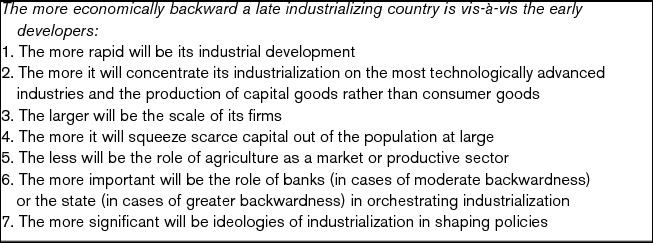
Gerschenkron's research focused on the mid-nineteenth century to World War I. He was an expert on Tsarist Russia but also studied Western and Central Europe. Table 1 summarizes his ideas. For Gerschenkron, the state's role in late industrialization depended upon the economy's relative backwardness vis-à-vis the early developers.Footnote 8 In a late-comer of moderate backwardness, like Germany, oligopolistic banks might orchestrate successful industrialization. But in countries of greater backwardness, like Russia, the state would have to lead. Gerschenkron based this claim on one core idea: successful late developers would not focus their efforts to industrialize upon light industries like textiles, as Britain had, but rather would strive to emulate the world's most advanced industries at the time they undertook industrialization.
Alexander Gerschenkron's theses regarding late development

Source: Revised from Alexander Gerschenkron, Economic Backwardness in Historical Perspective: A Book of Essays (Cambridge, MA: Harvard University Press, 1962), pp. 73, 353–4.
The early textile industry was comparatively labor intensive, decentralized in its reliance upon small-to-medium sized firms and a putting-out system, and technologically unsophisticated. It did not need heavy capital investment to develop. Consequently, the textile industry required minimal state support, and it tended to disperse wealth, making it conducive to democracy. But, according to Gerschenkron, late developers like Germany, Russia, and Japan would not launch their industrialization with textiles, as Britain had done. Although cheap labor might seem to give them an advantage in textile production, ‘industrial labor, in the sense of a stable, reliable, and disciplined group that . . . has become suitable for utilization in factories, is not abundant but extremely scarce in a backward society’.Footnote 9 Instead, these countries would try to emulate the most advanced industries at the time they began to industrialize. In the late nineteenth century, this meant industries like iron and steel. Unlike textiles, these industries were comparatively capital intensive, technologically sophisticated, and reliant upon large units of production. Since capital is also scarce in a backward economy, however, a powerful mechanism to accumulate and concentrate capital was needed if late-comers were to develop such advanced industries. In countries as backward as Russia and Japan, this mechanism could only be the state. To channel scarce capital to a few advanced producers, the state would have to curb consumption and squeeze capital out of peasants and workers. Both power and capital would be concentrated in a few hands by a strong, authoritarian regime.
By Gerschenkron's logic, this syndrome of statist late development would last only until a country's industrial revolution was complete, that is, until there were more workers in industry than agriculture, the economy depended more upon inanimate than animate sources of energy, and factories had eclipsed household production. Beyond these thresholds, institutions in civil society would be able to generate capital and new technology, rendering the state's continued intervention unnecessary. Thus Gerschenkron's theory was not meant to apply to a place like Britain in the early twentieth century, after it had completed its industrial revolution. By then German and US heavy industry had surpassed Britain, rendering it ‘relatively backward’ in that sense. But having completed its industrial revolution, Britain's civil institutions could presumably meet this challenge without extraordinary state action. The same logic would argue against the theory's applicability to Japan in the 1960s.
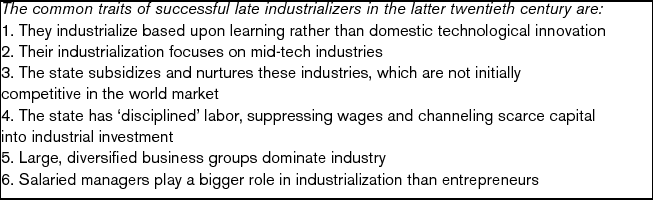
Alice Amsden studied mainly non-Western countries that began to industrialize after World War II (see Table 2). She referred to these countries, which included China, India, Indonesia, Malaysia, South Korea, Taiwan, Thailand, Argentina, Brazil, Chile, Mexico, and Turkey, as ‘the rest’.Footnote 10 Amsden began with a somewhat different premise from Gerschenkron, but she reached similar conclusions regarding the state's role in late development. Unlike Gerschenkron, she accepted that late developing countries might begin their industrialization with textiles, but she agreed with Gerschenkron that cheap labor would not suffice to make their textile industries and concomitant industrialization successful. Her reasons were two: First, the gap between the developed countries and the postwar ‘rest’ was so wide that cheap labor in the latter could not compensate for the superior production techniques of the former.Footnote 11 If one of ‘the rest’ built a textile industry in the 1970s, say, it would not produce better or cheaper products than France or Italy or Japan because their superior productivity would outweigh the late developer's advantage of cheap labor. A second reason for the textile industry's limited potential was that the existence of even poorer countries would always make the advantage of cheap labor temporary. Squeezed between the superior production techniques of the earlier developers and the cheaper labor of more backward countries, ‘the rest’ could not industrialize by developing mainly labor-intensive industries like textiles.
Alice Amsden's theses regarding late development

The only path open to ‘the rest’ was for the state to subsidize mid-tech industries, providing capital and protectionism so that they could operate at a loss until they caught up to the early developers, which could take many years. What made mid-tech industries so promising for ‘the rest’? These relatively capital-intensive, mid-tech industries would not have to compete against the cheap, labor-intensive production of more backward countries. Moreover, ‘the rest’ would find it easier to catch up to more advanced countries in mid-tech than in high-tech industries, since they could learn middle-level technology more easily than they could learn or invent more sophisticated techniques. Still, nurturing mid-tech industries would be hard, and the state would have to curb mass consumption until the task was complete.Footnote 12 So we are back to the authoritarian, developmental state, but now it is suppressing workers to build mid-tech rather than high-tech industries.
The advanced industries that Gerschenkron thought late developers would emulate in the late nineteenth century, and the mid-tech industries that Amsden believed would offer ‘the rest’ their best chance to succeed in the late twentieth century, were the same industries – iron, steel, the metal-bending industries. But in the period Gerschenkron studied, these were high tech, whereas in the period Amsden studied, they had become mid-tech.
While Gerschenkron confessed ignorance of Japan,Footnote 13 Amsden's treatment of Japan was equivocal. Defining a late-comer as a country that developed without generating original technology, she argued that both the US and Germany created enough technology in the nineteenth century to count as early developers, and she sometimes suggested that Japan, too, developed by means of technological innovation. But elsewhere she wrote that the state's special role in late industrializers was evident in both prewar and postwar Japan. She also referred to Japan as ‘unique’.Footnote 14 Unlike Gerschenkron, Amsden thought that the policies of the late developing state might also serve countries that had completed their industrial revolutions.
Internal gaps and flaws
Applying these theories to Japan is complicated by their internal deficiencies. The latter are not this article's primary concern, which is to use the Japanese case as an empirical test. Nonetheless, they do deserve mention. One difficulty is that economic historians disagree over how to date industrial revolutions, which is crucial to the task of identifying late developers. Scholars have dated the start of Britain's industrial revolution from the late 1500s to the 1790s, and those of Prussia and France from the mid-1700s to the mid-1800s.Footnote 15 Thomas Smith marks 1868–1880 as the start of Japan's industrialization, whereas Kazushi Ohkawa, Henry Rosovsky, Kozo Yamamura, and David Flath date Japan's industrialization from 1886, and others might date it from the opening of treaty ports in the late 1850s or even earlier.Footnote 16 Gerschenkron sought to solve the problem of dating industrial revolutions by arguing that late-comers would begin with an easily verifiable great spurt, but many have contested this claim.Footnote 17
Assertions about the state's role in theories of late development are problematic. Gereschenkron and Amsden agree that the late-developing state must play a distinctive role in shaping the industrial structure and promoting new technologies. Gerschenkron, however, does not detail the government's role in terms of specific policies, spending levels, or more qualitative criteria. Amsden, meanwhile, offers an exhaustive list of state investments and institutions that might promote late development, but without clarifying which are necessary or sufficient to place a country in ‘the rest’.Footnote 18 This makes it difficult to apply either theory to specific cases. Ambiguities concerning the state's role produce ambiguities regarding the differences between early developers, late developers, and non-developers. Regarding the divide between early and late developers, every Western case except Britain is in dispute. While Gerschenkron treats Germany as a moderately backward late developer, for instance, Amsden labels Germany an early developer. Gerschenkron contends that the difference is a country's degree of economic backwardness relative to the early developers at the time it starts its industrial revolution. In practice, he calculates backwardness by the amount of time that separates the start of a country's industrial revolution from that of Britain. But exactly how much time must elapse after Britain's launch to make another country ‘late’? By some accounts, the US began to industrialize about 50 years after Britain, Prussia 40–50 years later than the US, and Japan 30 years later still. What is the temporal basis for labeling one, two, or all three a late developer?
For Amsden, the main difference between early and late developers is their degree of reliance upon foreign learning versus domestic technological innovation. This resembles Gerschenkron's criterion in that technological backwardness is part of general economic backwardness, but rather than measuring backwardness by the timing of industrialization, Amsden measures it by the degree of reliance on foreign technology. This, however, creates parallel problems. How does one measure reliance on foreign and domestic technology, and where does one draw the line between early and late developers on that basis? Neither Gerschenkron nor Amsden examined the industrial policies of early developers, thus they left it unclear what policies or spending levels marked the cutoff between state-driven late industrialization and market-driven early industrialization. This leaves them vulnerable to the criticism of Ha-Joon Chang and others who maintain that a proactive industrial policy characterized the early industrializers as well as the late.Footnote 19 The theories also fail to differentiate clearly between late developers and non-developers. How rapidly or consistently must an industrial economy grow to qualify as a ‘developer’ at all?
Another gray area is the timing of comparisons. Do the theories claim that the late developer's state will play a bigger economic role than the early developer's state at the same point in historical time, or when the two are at similar levels of industrial development? Concretely, suppose one wished to test the proposition that the state played a bigger role in Japan's industrialization than it did in Britain's. Should one compare the state's role in both countries in the 1890s, when Japan's industrial revolution was starting but Britain's was already complete, or compare the Japanese state's role in the 1890s to the British state's role in the 1750s perhaps, when the GDP per capita and industrial structures of the two countries were more similar? By the logic of these theories, one might assume that the late developing state would be more powerful vis-à-vis society than the early developing state at both points in time. After all, since the market presumably accomplishes in the early developer what the state accomplishes in the late developer, by what logic would the early developer's state subsequently come to exceed the state's role in the late developer? Still, neither theory makes its position clear on this point.
Using national economies as units of analysis compounds the difficulty of applying these theories. In any sizable economy, there will be industries receiving state support and those that do not, industries that benefit from such support and those that languish in spite of it. The state's decision to support one industry may divert resources from another with economic consequences that are difficult to measure. How, then, does one differentiate between countries according to the degree or impact of state intervention in the industrial economy?Footnote 20 There has been a reluctance to specify empirical thresholds that might obviate disputes over these questions.
To summarize, problems internal to theories of late development include: (1) disagreements over how to date a country's industrial revolution, (2) ambiguity concerning the state policies that identify late industrializers, (3) the lack of clear empirical criteria for differentiating between early developers, late developers, and non-developers, (4) the question of how to time comparisons between early and late developers, and (5) complications arising from the use of national economies as units of analysis.
Testing the theories on Japan
The Japanese case has long been central to the debate over late development. But how well do the theories of Gerschenkron and Amsden fit the Japanese experience? The key points are these:
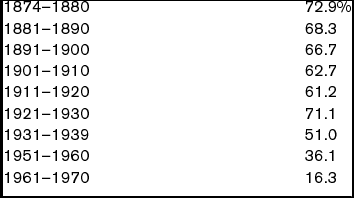
1. Japan's industrial revolution was built mainly upon the textile industry. By 1899, textiles accounted for 56.8% of Japan's industrial factories, 62.8% of factory workers, and 69% of factories using steam or water power.Footnote 21 Textiles constituted 33.6% of total industrial production in 1910, 33.6% in 1920, and 30.6% in 1930. Food processing accounted for 34.0%, 23.4%, and 25.0% in the same years, making the predominance of light industry crystal clear.Footnote 22 The combined value of steel and shipbuilding production came to only 22% of that of cotton production in 1909, 44% in 1919 (thanks to a wartime boom), and 38% in 1929.Footnote 23 This is despite the fact that ‘the shipbuilding and shipping industries received 75% of all Japanese government subsidies from 1897 to 1913’.Footnote 24 Textiles dominated Japanese exports into the 1930s (see Table 3).
Textiles as a percentage of Japan's total manufactured exports

Source: Ryōshin Minami, The Economic Development of Japan:
A Quantitative Study, 2nd edn (London: Macmillan, 1994), p. 175.
Cotton spinning was a more concentrated industry than silk reeling, but by 1900 both saw vigorous competition among many firms. The silk industry, initially built upon handicraft production and a putting-out system similar to Britain's early pattern, became the industrial leader when foreign trade began in the mid-1800s. By 1881, one silk producers’ association numbered 2,393 firms and there were 358 factories with over ten spinning reels each. There were 75 cotton spinning firms in 1899, 152 in 1913, and 245 in 1929.Footnote 25 Although Amsden notes that there were 80 new starts and 83 dissolutions of cotton mills between 1893 and 1911, she characterizes the industry as an oligopoly. It was nothing of the sort. The industrial combines (the zaibatsu) that dominated interwar heavy industry largely ignored textiles. Even in 1941, after the Great Depression and war-related policies had decimated small–medium sized producers, the nine largest zaibatsu held only 9.5% of the paid-up capital in Japan's textile industry.Footnote 26 And textiles led Japan's industrialization in more than just statistics. The form of the joint stock corporation first took root in banking, spinning, and mining, the latter two being labor-intensive industries using comparatively simple technology.Footnote 27
Contrary to theories of late development, Robert Cole writes, ‘the expectation that late-developers will adopt capital-intensive industries utilizing the latest techniques . . . in large production units was not met in Japan’.Footnote 28 Shinji Yoshino, an influential statist bureaucrat, wrote that the major contribution of small–medium sized producers was a distinctive trait of Japan's industrialization.Footnote 29 David Landes writes: ‘the Japanese pursued comparative advantage rather than the will-o’-the-wisp of heavy industry’, representing an ‘inversion of the late-follower model’.Footnote 30
Recent economic historians have found that Russia's industrialization, too, was led by textiles. Paul Gregory writes: ‘Despite Gerschenkron's claims that Russia's industrial structure was “top heavy” in favor of heavy industry, comparative statistics reveal that Russian industry was actually “top heavy” in light industry (particularly textiles) for a country of Russia's size and resource base’.Footnote 31 And Olga Crisp: ‘The share of producers’ goods industries whether measured in terms of employment or value of output, was easily outstripped by consumer goods industries, especially fibers and food-processing.’Footnote 32
Even Germany's industrialization, which by 1900 seemed to validate Gerschenkron's claim that late-comers developed the most technically advanced, capital-intensive industries, focused upon textiles up to the 1850s. W.O. Henderson writes: ‘From the point of view of units of production, manpower employed and exports, the textile industries were – apart from agriculture – the most important economic activity in Germany in the middle of the nineteenth century . . . In Prussia there were more large factories (each employing over five hundred workers) in the textile industries than in all other industries put together.’Footnote 33 Depending upon how one dates the industrial revolution of Prussia/Germany, then, even this case may belie the argument that an emphasis on heavy industry compels the state to take the economic lead in late-comers. As of 1963, textiles comprised the largest industry in Brazil, Chile, India, and South Korea, the second largest in Taiwan, Thailand, and Turkey, and the third largest in Argentina, Mexico, and Japan.Footnote 34 Amsden placed all but Japan among ‘the rest’.
Unless a late developer attempts a great leap from backwardness into technologically sophisticated industries, there is little in Gerschenkron's or Amsden's theories that would require a more powerful state in late industrializing countries. According to their research, as long as the basic institutions of modern industry were built upon a labor-intensive textile industry, the state need not play a dominant economic role. Since Japan's industrialization was rooted in textiles, ipso facto theories of late development should not apply to Japan. But these theories are so ensconced that even scholars such as Cole, Landes, and Rosovsky, who recognize the preeminence of textiles in Japan's industrialization, adhere to the statist predictions of the late development doctrine. That is, even after invalidating the one aspect of the theories that would require a state-driven pattern of industrialization, they still aver that Japan pursued a statist path because it was a late developer. A more thorough rebuttal is required.
2. Japan's success in textiles was owed mainly to cheap labor, not state support. Late development theories claim that the late-comer cannot industrialize successfully on the basis of cheap labor, but Japan did just that. Gerschenkron's claims to the contrary, factory labor was ‘relatively abundant’ in early modern Japan.Footnote 35 Textile production ranged from cottage handicrafts to machine factories. Both involved oppressive working conditions.Footnote 36 Over 1889–1930, young women constituted roughly 80% of the workers in textiles. In 1930, they still numbered 52.6% of the entire industrial workforce.Footnote 37 Many parents sold daughters into indentured servitude. Hanai writes: ‘As to the managerial basis of capital accumulation, the first thing to note is the low wages and long working hours of the women workers in silk manufacturing . . . In about 1900 (Meiji 33), in the silk machine-manufacturing districts . . . working hours ranged from 14 to 17 hours a day.’Footnote 38 Women workers were confined to dormitories or slept beside their work stations, and their wages depended upon their productivity relative to that of other workers, causing them to compete in a primitive form of Stakhanovism. A survey of 64 cotton spinning factories in 1897 found that in 24, over half the workers quit in the first six months, while in another 24, 30–50% quit. The principal means of leaving was ‘escape’ (tōbō).Footnote 39
Workers in the early textile mills of the US and Western Europe suffered similar abuse. Until the 1840s, most British factory workers in textiles were women and children laboring 12–16 hour days,Footnote 40 but by the time Japan's industrial revolution began, most Western states had curbed the worst abuses. Britain's Factory Act of 1833 regulated child labor in the textile industry, banning the employment of children under nine, limiting the working hours of children between nine and 13 to eight hours per day, and abolishing night work for children. Legislation in the 1840s further restricted the exploitation of women and children.Footnote 41 Other Western countries took similar steps in the mid-late nineteenth century, thus giving the more exploitative Japanese labor system a comparative advantage. By the late nineteenth century, even workers in British India (Japan's competitor in the cotton industry) were making almost double the wages of their Japanese counterparts and enjoyed the protection of tougher labor laws.Footnote 42 According to data from 62 Japanese textile firms and seven Indian firms in 1898, the average monthly wage in Japan was ¥4.67 compared to ¥8.63 in India.Footnote 43
Japanese bureaucrats pressed for labor regulations in the early 1880s, but no legislation passed until the Factory Law of 1911 banned employment of children under 12, and limited children under 15 and women to 12-hour days. However, due to opposition from industrialists, especially those in cotton spinning, children over ten who were already working were allowed to continue, and the provision limiting women to 12-hour days was not implemented until 1926.Footnote 44 A ban on night work for women and children was similarly delayed. Japan's Public Peace Police Law of 1900 banned the activities of trade unions, which otherwise might have lobbied for better conditions, but private entrepreneurs did more than the government to squeeze scarce capital out of the working class.
The state did promote the textile industry. It established three model factories for silk reeling before 1880, and two model cotton spinning factories shortly thereafter, which introduced Western technology.Footnote 45 In 1878, officials bought 20,000 British cotton spindles and sold them cheaply to Japanese investors. This eased the founding of about a dozen private cotton spinning firms, although these soon encountered difficulties.Footnote 46 Government banks facilitated the private bank financing of merchants by discounting commercial paper; merchants in turn provided some capital for the early cotton spinning industry.Footnote 47
These steps stimulated the activities of private industrialists but they were of limited long-term effect. The government's model factories lost money and 25 of them were sold between 1882 and 1896.Footnote 48 This was true even of the famous Tomioka silk thread factory (founded in 1872 and sold in 1893), whose advanced technology exceeded the adoptive capabilities of private operators in any case. Silk was Japan's export leader from late Tokugawa times, long before Tomioka's founding. The private Osaka Bōseki Kaisha proved a more influential model than the government's cotton factories.Footnote 49 The Bank of Japan ended its role as discount broker for domestic textile merchants in 1898.Footnote 50 The textile industry relied mainly upon private capital and by the century's end it was entirely under private ownership. Yamamura writes: ‘The cotton industry . . . depended not on long-term loans from banks, but on their own profits, internal reserves, share capital, and short-term loans. The cotton textile industry, which accounted for nearly 32% of total gross manufacturing output at the turn of the century, is known for its labor-intensive production and relatively low requirements for fixed capital.’Footnote 51 And David Flath: ‘The thirty or forty major cotton spinning companies were established as limited partnerships or joint-stock companies with the equity participation of hundreds of investors.’Footnote 52 Amsden's claim that Japan's silk industry flourished thanks to ‘more government and bigger business’ is unwarranted.Footnote 53
It is even questionable whether the state did more to help or to hurt the early textile industry. The government initially taxed raw cotton imports and imposed heavy tariffs on cotton and silk exports. It abolished the export tariff on cotton thread only in 1894, the import tariff on raw cotton in 1896, and the export tariff on silk in 1899. One must weigh the government's low-cost loans for the purchase of cotton spindles and the Bank of Japan's financial support against the 26% tariff on exports of cotton thread.Footnote 54 Until 1899, Japan's leading industry was ‘targeted’ more as a source of state revenues than an object of state investment.
Contrary to Amsden's theory of late development, Japan anchored its industrial revolution in a textile industry that prospered by sustaining cheaper labor than its foreign competitors, not by relying upon state subsidies. The state did little to protect the industry. Japan's lack of tariff autonomy before 1911 meant that its textile producers had to outdo competitors in more and less advanced countries with little state protection from market forces.
Those familiar with Japan's economic development in the mid-late nineteenth century may ask why we have ignored the state's positive steps to facilitate economic change. These fall mainly into two categories: measures to eliminate traditional barriers to a modern economy, and the building of social, political, and economic infrastructure. Regarding traditional barriers, the state ended national and regional monopolies, status restrictions on employment, commercial and crafts guilds, constraints on the sale of land and crop selection, and impediments to inter-regional trade and travel, among other things. Infrastructure included legal provision for limited liability companies and property rights, a mass school system, a national currency, a tax code that favored industry over agriculture, modern banking and transport systems, and a modern state bureaucracy and military. The state kept public peace at home and protected Japan from the Western powers. As Barry Supple writes: ‘Historically, the most important way in which the state stimulated industrial growth in a capitalist setting was . . . through its ability to create a capitalist setting in the first instance.’Footnote 55 All of these measures served that purpose.
Alas, none of these steps substantiates theories of late development. The theories themselves deemphasize such policies. For a late industrializer to succeed, theories of late development require that the state shape the industrial structure to favor systematically certain sectors over others (i.e., to favor Gerschenkron's high-tech or Amsden's mid-tech sectors over light industries like textiles). But all of the measures noted above (legal reform, the abolition of guilds, building of schools, etc.) by their nature benefit the entire industrial economy. They do not embody the discriminating role in shaping the industrial structure that Gerschenkron and Amsden describe as the state's special function in late development. Both writers recognize that such policies may spur industrial growth, but states have implemented such policies in all countries that have industrialized successfully, regardless of the timing of their industrialization, and thus such policies do not translate into a distinctive pattern of late industrialization.Footnote 56
The state played a big role in Japan's industrialization, but theories of late development do not explain accurately the content or timing of that role. The theories fail not only by missing the real dynamics of growth in the textile industry, but also by downplaying most of the state's truly vital contributions to Japan's industrial revolution.
3. Japan did not have a comprehensive, consistent industrial policy of the sort envisioned by theories of late development until 1931. The foremost historian of Japanese industry today, Hideaki Miyajima, and Japan's foremost official advocate of state economic intervention in the 1930s, Shinji Yoshino, agree that the state's economic role changed in 1931. Both see policy in the 1920s as relatively laissez-faire and policy in the early 1930s as introducing an expansive developmental program.Footnote 57 This is not what late development theories predict. According to the theories, the more backward the economy, the greater the state's role must be to ensure industrial success. Thus Japan's state should have promoted industry most actively in the late nineteenth and early twentieth century, and less actively as Japan closed the gap with the West in ensuing decades.Footnote 58 That is not what happened.
After selling off its uneconomical factories, the state began to legislate support for specific industries in the 1890s. One of the first laws promoted the shipbuilding industry in 1896 (Zōsen Shōrei Hō). There followed measures to support the manufacture of dyes and medical products in 1915, and the first law to bolster the iron and steel industry in 1917 (a step of ‘historic importance’ according to the Ministry of Commerce and Industry's in-house history).Footnote 59 Policy tools included tax exemptions, profit guarantees, direct subsidies, and the forgiveness of import tariffs on machinery. The state also produced armaments throughout the late nineteenth and early twentieth centuries, and its support for private firms in sectors like shipbuilding and steel also sprang partly from military concerns.Footnote 60 These are not trivial measures. But some selective policies of this sort had been undertaken by every country in Western Europe from the mercantilist era through early modern industrialization. Theories of late development require a systematic, comprehensive effort by the state to shape the overall industrial structure and to spread technology.Footnote 61 Japan lacked such a policy before 1931.
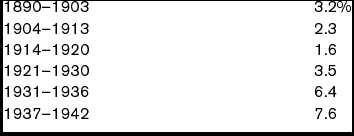
In the late nineteenth and early twentieth century, when Japan's relative backwardness was greatest, its state lacked the means to implement industrial policies of the sort championed by Gerschenkron and Amsden. To begin with, it had little money. Japan's import tariffs were limited by treaties with the Western powers until 1911, thus depriving the government of a potent tool for protecting industry and generating revenue. After 1868, the state was burdened with the foreign debts of the previous regime, financial obligations to former samurai elites, and the cost of suppressing reactionary rebels. From late 1867 to mid-1875, these expenses claimed 48% of the government's general expenditures, whereas investment in state industries (most of which failed) amounted to 6.6% and loans to private producers 5.4%.Footnote 62 State financial support for industry remained modest for many years (see Table 4).
Percentage of the state's general expenditures spent on the promotion of industry

Source: Miyajima, Sangyō Seisaku to Kigyō Tōji no Keizaishi, p. 34.
The government's only financial relief in the nineteenth century came with reparations from the Sino-Japanese War of 1894–95, but the money was spent on the military. Only 1% of the reparations went to industry (iron and steel, transport, and communications).Footnote 63 The Russo-Japanese War of 1904–05 left the state in its worst financial straits since the 1870s. Richard Smethurst writes: ‘Japan had in less than two years borrowed more than 2,000,000,000 yen, half of it abroad, an amount seven times larger than all of the central government's tax revenues in fiscal year 1905. Japan throughout the decade between the Russo-Japanese War and World War I, was highly leveraged.’Footnote 64
Thomas Smith warns against attributing too much coherence to policymaking during Japan's early industrialization.Footnote 65 The economic bureaucracy was chaotic. The first economic agency (the Shōhōshi) survived from 1868 to 1869, and its successor (the Tsūshōshi) from 1869 to 1871. The Kōbushō (1870–85) served mainly to oversee state-run industries that failed, and it did little for private businesses in most sectors. The Agriculture and Commerce Ministry (Nōshōmushō) emerged in 1881 to unify most economic policymaking in one agency and to promote private producers, but its activities soon overlapped with those of the Home Ministry. The Home Ministry oversaw several model textile factories, but spent much of its economic promotion budget on agriculture.Footnote 66
Policy strategies were also inconsistent. The founding of state corporations declined after 1880 but did not stop altogether. The state launched the Yawata Steel Works in 1901 and nationalized most railroads five years later. Even as the statist doctrines of Friedrich List gained some currency in the 1880s, however, the liberal market doctrines of Masayoshi Matsukata also swayed policy. In any case, given the foreign threat and unequal treaties with the Western powers, policy frequently embodied reaction rather than planning by fixed standards. An 1898 law to promote exports was revoked in two months due to protests from the Western powers.Footnote 67 It is hazardous to read a country's future into its past; Japan's industrial policymaking establishment of the late nineteenth century was not the efficient juggernaut described by Chalmers Johnson in the 1960s. Takafusa Nakamura writes: ‘It is often said that . . . the Japanese government bureaucracy is strong in comparison with that of other countries, but this was not necessarily the case in the prewar period. Such industries as spinning, for example, once prided themselves on their independence from the government. It was during the course of wartime controls that the ‘guidance relationship was established between firms and the bureaucracy, and between private banks and the Bank of Japan’.Footnote 68
The constant in early economic policy was not developmentalism per se but the desire to strengthen the military. Gerschenkron briefly mentions security as a motive for Russia's industrialization, but his argument that relative economic backwardness determines the state's role contradicts the idea that security is the driving force. If relative backwardness fixes the state's role, it should do so regardless of security concerns. And if security considerations drive industrial policy, these, too, might happen independently of a country's relative backwardness. As a less backward Japan demonstrated in the 1930s, states can intervene in industry to help cope with foreign threats at all levels of economic development. The evolution of industrial policy in interwar Germany and Italy illustrates the same point. Theories of late development are economistic and underplay the non-economic determinants of state action, including war. As such, these theories distort our understanding of the role of the Japanese state, which managed much of Japan's arms production directly and invested heavily and consistently in the military.Footnote 69
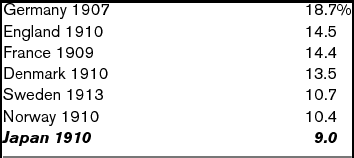
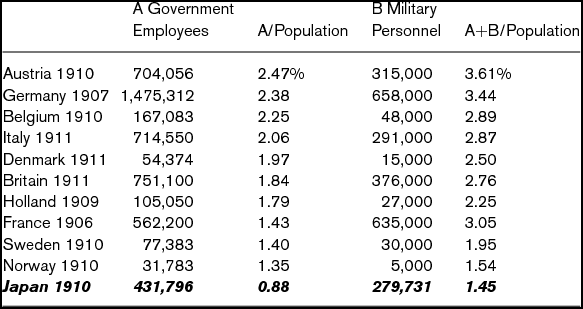
Tables 5 and 6 compare state finances and personnel in 1910. They reflect the Japanese state's modest economic footprint. The timing of the comparisons disadvantages my argument, since Japan's state budget in 1910 was much larger than it had been a few years earlier. During the Russo-Japanese War, the government had raised taxes on land, business, income, and sugar and alcohol consumption to two to three times their prewar levels. It had also introduced new taxes on clothing, oil consumption, transportation, and inheritance. None of these taxes was ever revoked, so all appear in the data for 1910. Consequently, the state's tax revenues rose from ¥133.9 million in 1900 to ¥317.3 million in 1910.Footnote 70 According to late development theories, Japan's state should have had a greater economic presence in society than the states of early developing countries, but the opposite was true. Japan's public expenditures as a percentage of net domestic product were 62% of those of England and France and less than half those of Germany.
Government expenditures as a percentage of net domestic product in Japan and the West, circa 1910

Notes: The figures include national and local government expenditures out of the general account. I have assumed that the term ‘seifu keijō shishutsu’ in the source for Japanese data is the equivalent of the term ‘general government expenditures’ in the source for European data. In the Japanese translation of the Flora volume, ‘general government expenditures’ was translated ‘ippan seifu shishutsu’. I have used German data for 1907 because the available figures for 1910 excluded social insurance expenditures, which were included in the data for the other countries.
Sources: Peter Flora et al., State, Economy, and Society in Western Europe, 1815–1975: A Data Handbook in Two Volumes (Frankfurt: Campus Verlag, 1983), vol. 1, chapter 8 for European data; Sōmucho Tōkeikyoku, Nihon Chōki Tōkei Sōran (Tokyo: Nihon Tōkei Kyōkai, 1988), 3:344, 348.
Comparative government personnel, Japan and Europe, circa 1910

Notes: Government employees include educational, postal, police, and transportation personnel at the national and local levels, but exclude workers in other state enterprises. Military personnel listed for Britain were labeled for England only.
Sources: Flora et al., State, Economy, and Society in Western Europe, 1815–1975, vol. 1, chapter 5 for European government personnel, chapter 6 for European military personnel, and vol. 2, chapter 1 for European population data; Sōmucho Tōkeikyoku, Nihon Chōki Tōkei Sōran, 1:48, 5:326–7, 337, 527–8 for data on Japan.
Japan's heavy industry advanced considerably during World War I, but this was owed to the temporary indisposition of its European competitors more than state promotion.Footnote 71 State spending to promote private industry hit a modern low during the war (see Table 4). The state failed to defend domestic industries from the postwar recession, even those it had previously targeted for support. Despite laws to encourage the dye and medical products industries and iron and steel production, for example, after the war over half of the firms in these sectors went bankrupt.Footnote 72 A lack of resources again plagued the government. The Tokyo earthquake of 1923 caused high inflation and a reversal in Japan's balance of payments; full recovery was not achieved until 1930. Meanwhile, the state had to cope with a recession beginning in 1927.
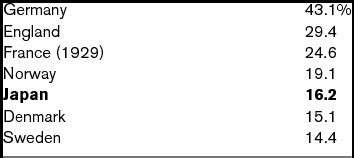
Table 7 compares budgetary data for 1930. Japan's state spending as a percentage of net national product was 37% of the level in Germany, 55% of the level in England, and 66% of the level in France. The order of spending in the early developers (England and France) and Japan is again the reverse of what late development theories predict. Moreover, for Gerschenkron it was the banks, not the state, that engineered Germany's industrialization, and for Amsden, Germany was an early developer free from the statist syndrome of late development. Thus neither explains Germany's comparatively high government expenditures any better than they do the data on Japan, England, and France. Late development theories posit that markets produce technological progress in early developing countries whereas states do so in late developing countries. Tables 5, 6, and 7 support the contrary hypothesis that technological progress causes the state's power and resources to increase in both early and late developers. This would explain why early developing Britain boasted a state of greater size and extractive capacity than did Japan in the early twentieth century.
Government expenditures as a percentage of net domestic product in Japan and Europe, circa 1930

Sources: Flora et al., State, Economy, and Society in Western Europe, 1815–1975, vol. 1, chapter 8 for European data; Sōmucho Tōkeikyoku, Nihon Chōki Tōkei Sōran, 3:348–9, 358–9.
The Great Depression and war radically reshaped the state's economic role by means of (1) the systematic use of cartels; (2) a rash of individual industry promotion laws; and (3) protectionism based upon a revised tariff policy and the exclusion of foreign direct investment. Prime Minister Osachi Hamaguchi, once Finance Minister in the more liberal mid-1920s, reacted to the depression by reducing state debt and adopting a tight money policy. Bureaucrats in the Ministry of Commerce and Industry (MCI) organized an Emergency Industrial Rationalization Bureau (Rinji Sangyō Gōrikyoku) in 1930 to explore other options. Its members included Shinji Yoshino (the director) and Nobusuke Kishi, both future MCI ministers. The bureau discussed topics such as a scientific management law, corporate financing, product standardization, promotion of domestic industries, and the creation of a state research institution. In December 1930, one month after a rightist assassin had incapacitated Hamaguchi, the committee issued a report on state control over industry that became a blueprint for the Important Industries Control Law (Jūyō Sangyō Tōsei Hō) of April 1931. Miyajima views this law as the launching pad for discretionary state authority over industry that prevailed during and after the war.Footnote 73
The 1931 law authorized official cartels. Previously cartels had been legal and firms had formed them at their discretion. This mirrored British practice in the nineteenth century.Footnote 74 With some exceptions, the state had been a neutral observer. Consequently, cartels were often thwarted by uncooperative members or powerful firms that refused to join. But the 1931 law permitted compulsory inclusion of firms in cartels, the government's right to interfere should they contravene the public interest, and reporting by cartels to the state.Footnote 75 The cartels had oversight bodies that included state officials, who might demand price controls, the brokering of mergers, or other steps to curb allegedly reckless competition. Officials strove to limit profits to a fixed margin above average production costs. Twenty-four cartels were recognized under the law in its first three years, covering industries such as cotton, silk, paper, carbide, cement, coal, copper, and steel.Footnote 76 The law's adoption impresses also for the fact that it overcame opposition from the zaibatsu and the powerful cotton spinners’ association. While German precedents inspired the new system, the British government also promoted cartelization in the 1930s.
The Industrial Association Law (Kōgyō Kumiai Hō), passed simultaneously in April 1931, also reflected a new ambition in industrial policy. It expanded a somewhat looser cartel system for small-medium sized producers. The government had passed a law in 1925 to encourage associations of small–medium sized firms to increase exports. A sister bill sought to standardize products and quality. Associations formed under these laws grew from 20 in 1925 to 152 in 1931, but according to the MCI's official history, their impact was modest.Footnote 77 The Industrial Association Law of 1931 expanded this system to all industries, not just export sectors. It authorized the state to inspect products, raw materials, and production, to give orders to the associations, and to impose sanctions for non-compliance. Over 1931–36, 739 associations were formed under the new legislation, and by 1936, 487 had implemented price agreements.Footnote 78 This system is noteworthy for the prominence of industrial rationalization policy. Whereas earlier state intervention had sought mainly to shape the industrial structure, the measures of the early 1930s also addressed product quality, standardization, and technology.
From 1933, the government enacted new industry promotion laws for iron and steel, petroleum, automobiles, fertilizer, maritime shipping, silk, warehousing, and other industries. The goals were more ambitious and regulation more penetrating than earlier examples of such measures. Under the Petroleum Industry Law of 1934, for example, officials had to approve imports, business plans, dissolutions, suspensions of production, and mergers. They could also regulate prices, and firms could not refuse government decisions to purchase their products.Footnote 79 Along with the tariff reform of 1932 and the subsequent exclusion of foreign direct investment, the goal of these laws was often self-sufficiency, reflecting an upsurge in war-related concerns that followed the London Naval Arms Limitation Treaty crisis of 1930 and the Manchurian Incident of 1931.
These are but the highlights of a complex story. The point is that the Great Depression and war elicited a quantitative and qualitative leap in state direction of industry. The new controls spanned the entire industrial economy, and state authority reached a level only infrequently and selectively observed earlier. Steps to regulate and promote industries were no longer isolated measures but part of a systematic policy framework. With Japan's relatively early recovery from the depression, war-related policies soon subsumed this new system. The ‘cartels’ of 1931 had evolved into ‘control associations’ by the decade's end. Officials dissolved hundreds of thousands of small–medium sized producers and claimed authority over prices, wages, profits, access to raw materials, and ultimately the rationing of all basic goods. Miyajima depicts 1937–49 as a period when economic planning displaced the market.Footnote 80 There is debate over how much residual influence large businesses retained within wartime mobilization,Footnote 81 but no debate over the fact that it represented a new extreme of state economic intervention, one not seen before or since.
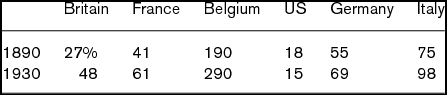
If ‘relative backwardness’ were the chief cause of industrial policy, the sequence of events in Japan should have been reversed. By 1930, Japan was much less backward vis-à-vis most early and late Western industrializers than it had been in 1890, so the state's role should have declined (see Table 8). Gerschenkron believed that during Russia's second industrial growth spurt of 1907–13 the state was already reducing its intervention thanks to industrial progress made since the first spurt of the 1890s.Footnote 82 By that logic, Japan's state should have been reducing its economic role in the 1930s, not expanding it, let alone building the near-totalitarian economy that followed passage of the State Total Mobilization Law (Kokka Sōdōin Hō) in 1938. Simply put, the Japanese record turns the theories on their heads. Sylla writes, ‘Once one moves beyond the initial phases of industrialization, the US and Japanese cases do not conform to the sequences that would be expected as backwardness was reduced.’Footnote 83 The factors driving Japan in a statist direction, namely, the Great Depression, the increasingly statist policies of the most industrialized Western countries, and, most importantly, total war have no place in theories of late development.
Gross domestic product of Japan as a percentage of the gross domestic product of western early and late developers, 1890 and 1930

Source: Angus Maddison, Monitoring the World Economy, 1820–1992 (Paris: OECD, 1995), Table C-16a, pp. 180–83. The raw data are standardized in terms of 1990 Geary-Khamis dollars.
4. Japan's industrial policies were used by many Western countries, regardless of the timing of their industrialization. Theories of late development argue that the state must take a more proactive role than it did in early industrializing countries. Specifically, the successful, late-industrializing state must shape the industrial structure and spread technology. But all of the Japanese government's policy tools of the late nineteenth and early twentieth century were already common in the West. They served early developers like France and Belgium, late developers like Italy and Russia, and countries like Prussia/Germany whose early/late status is debatable. Some scholars now argue that even Britain, the first developer, used some of the same policy tools during its industrial revolution.Footnote 84 Policies to strengthen industrial sectors have a long history, but they were especially widespread during the mercantilist period that predated Europe's industrial revolutions and during the early phases of modern industrialization itself.
States supported private producers with subsidies, cheap loans, tax advantages, or profit guarantees in Belgium, France, Prussia/Germany, Austria (where 843 firms received financing over 1881–1912), Italy, Sweden, Russia, and the US, among other countries. Governments sponsored model factories to spread new technology in France, Prussia/Germany, the smaller German states, Austria, and elsewhere. Belgium, France, Prussia/Germany, Sweden, and virtually every other continental country sent technical missions abroad and hired foreign, especially British, technicians in greater numbers than did Japan.Footnote 85 Public corporations were established in France, Belgium, Prussia/Germany, Sweden, Russia, and elsewhere, most often in strategic military industries or sectors where private capital was lacking.
Although Japan copied these policies, until 1911 its targeting effort was weak because it was unable to use tariffs to promote its industries. In an era when the state's ability to tax was limited, tariffs were the primary means of infant industry protection. From 1865, Japan's unequal treaties with the West limited its import tariffs on manufactures to 5%. In 1875, this compared to average tariffs of 40%–50% in the US, 15%–20% in Austria, Denmark, Russia, and Spain, 12%–15% in France, and 8%–10% in Belgium and Italy. Note that this list includes early and late developers. Even Britain imposed import tariffs of 45%–55% early in the nineteenth century, before it achieved industrial dominance.Footnote 86 Chang writes: ‘State activism in early modern Japan was limited due to external constraints . . . Given the importance of tariffs as a tool for industrial promotion at the time . . . its lack of tariff autonomy was a considerable handicap.’Footnote 87 From a different perspective, Bergsten, Ito, and Noland write: ‘Ironically, the “unequal treaties”, which until 1911 severely limited the Japanese government's ability to impose import tariffs, may have actually fostered Japan's development by forcing the country to specialize along the lines of its comparative advantage’,Footnote 88 – that is, to specialize in textiles. Contrary to late development theories, Japan did not practice industrial policies different from those of earlier developers. The exception was tariff policy, which it used less, not more, than its predecessors.
Late development theories paint a dichotomous picture. On one side are the early industrializers, whose states might undertake infrastructural improvements and remove traditional economic barriers, but which otherwise rely on the market. On the other side are the late industrializers, whose states (or oligopolistic banks) additionally employ targeting to shape the industrial structure. This is a false dichotomy. Although Britain's case may be sui generis in some ways, Europe's other industrializing countries used similar policy tools, regardless of when they began to industrialize, and regardless of their degrees of technological backwardness when they did so.
This does not mean that policies everywhere were identical. Prussia/Germany made more use of public corporations than did other states; Russia relied more than most upon foreign capital; Japan could not protect its industries with tariffs and minimized foreign direct investment. But industrial policies do not separate early from late developers along any consistent lines. Supple writes:
The ‘tool box’ of the state in relation to the encouragement of industrial growth was potentially very extensive. Moreover, virtually all of its contents – institutional reform, the provision of public services, financial support or protection to private business, public enterprise – had been created and used by European governments before modern industrialization began in the nineteenth century . . . In France, the precedents of the Colbertian policy of the late seventeenth century were continued through the manufactures royales (state-run enterprises) and manufactures previlégiées, with monopoly rights, fiscal privileges, subsidies, and the like, awarded in armaments, metallurgy and luxury industries. In Prussia, the government, notably that of Frederick the Great (1740–86), stimulated the establishment of ‘factories’ in textiles, glass, chemicals, metals, etc. – and itself promoted coal mines and iron works in Silesia. Similarly, other German states, and Austria under Maria Theresa (1740–80), pursued a policy of selective ‘industrialization’; while in Russia Catherine the Great (1762–96) revived the policies of Peter the Great through a wide range of factories, mines, and iron works using serf labour, and either wholly owned by the state or jointly sponsored with private businessmen’.Footnote 89
In sum, the notion that state policies differentiate early from late industrializers is false.
Conclusion
Japan's industrial revolution contradicts late development theories in these ways:
1. Japan did not focus on technically advanced industries, as Amsden (for mid-tech industries) and Gerschenkron (for high-tech industries) would predict. Japan's success, much like that of Britain, was owed mainly to labor-intensive, low-wage, light industry, which had to prosper in a competitive global market because the state could not protect it. The textile industry spearheaded Japan's industrial revolution into the 1930s with relatively little state support.
2. During Japan's first half-century of industrialization, the state's finances and manpower were meager compared to those of the early developing Western states, not more robust, as late development theories lead us to expect. The image of an especially strong state due to late industrialization is inaccurate.
3. Japan did not undertake industrial policies unique to countries undergoing late development, but rather mimicked policies used in virtually all other industrializing nations. These included steps to remove traditional obstacles to industrialization and efforts to build social, political, and economic infrastructure, both of which late development theories tend to slight. They also included industrial targeting, which late development theories over-emphasize in terms of their importance and distinctiveness in late developers. Of these various policies, targeting was the least significant in Japan because until 1911 it lacked tariff control, which was the principal tool of Western targeting in the nineteenth century.
4. The evolution of Japan's industrial targeting contradicts predictions based on relative economic backwardness. According to late development theories, the state's role in shaping the industrial structure should be greatest when the economy is relatively most backward, but Japan did not adopt systematic, comprehensive industrial targeting until the 1930s, after it had narrowed the gap with the Western states. The point of greatest state intervention came during World War II, some 50 years after the start of Japan's industrial revolution.
To repeat for emphasis, the issue is not whether the state mattered in Japan's industrialization. It did. The issue is whether late development theories explain adequately the timing and content of the state's role. They do not.
Late development theorists might be tempted to dismiss Japan as an exception, but they have no place to hide from this analysis. As one of the latest of latecomers to launch its industrial revolution in the nineteenth century, Japan should be a best case for Gerschenkron's theory, and although Amsden is wishy-washy in her treatment of Japan, she often associated it with state-driven late development. The analysis has cited numerous countries that paralleled Japan in their failure to conform to the theories. Many early and late developers practiced similar industrial policies, and Japan was not the only late developer to industrialize on the back of its textile industry. The prediction that the state's role should decrease as a country closes the gap with the most advanced economies fails to hold true of other countries besides Japan. The criteria by which Gerschenkron and Amsden differentiate early from late development simply do not survive comparative scrutiny.
Amsden's followers might argue that however backward Japan was in the late nineteenth century, it was not yet as backward vis-à-vis the earliest industrializers as ‘the rest’ were after World War II. Thus even if Japan could industrialize by developing competitive textile industries without extensive state intervention, this does not mean that Brazil, Mexico, or Argentina could do the same 80–100 years later. Even if the Japanese case failed to conform to theory, then, the statist syndrome of late development, as Amsden describes it, might still operate in ‘the rest’. But this argument overlooks the reasons why Japan's experience contravened the theories and how those reasons might apply even to countries that launched industrial revolutions much later.
Inferring from Japan's record, the main problem with late development theories is that they attempt to explain an immensely complex subject – the success or failure of industrial revolutions and the state's role in them – with the one factor of relative economic backwardness. No one element could possibly explain such a multifaceted phenomenon. Granted that the timing of industrialization matters in some cases, other factors that may also matter include historical legacies, domestic social conflicts, security threats and wars, depressions, natural resource endowments, the emulation of foreign models, ideologies, the caliber of leadership, and cultural traits, among other things. All might influence the success or failure of industrialization and the form and effect of the state's economic intervention. These factors occasionally enter the analysis of Gerschenkron and Amsden but they are not treated systematically or linked to relative backwardness in any consistent way. Most often they are referenced randomly to explain matters when relative backwardness falls short. There are bound to be many paths to industrial success or failure. Paradoxically, while Gerschenkron highlights the multifaceted character of industrialization and often warns against overly general and deterministic historical theories, his claims for relative backwardness are single-minded and highly deterministic.
In short, late development theories suffer grievously from ‘missing variable bias’. Advocates may hope that adding the many alternative factors influencing industrialization into the equation might resuscitate theories of late development by rendering them more sophisticated, but that is unlikely because the alternatives produce explanations and predictions that directly contradict those based upon late development. To offer just one example, late development theory and the emulation of foreign models produce incompatible interpretations of Japan's industrialization. According to late development theory, Japan should have embraced a more statist developmental program in the 1880s, when it was relatively more backward, than it did in the 1930s, when it was relatively more developed. But if the emulation of contemporary foreign models drove Japan's industrialization, then Japan should have embraced a more liberal developmental program in the 1880s, when the leading foreign models were comparatively liberal, and a more statist program in the 1930s, when the leading foreign models were more statist. There is no way to reconcile the two perspectives, and it should be clear to the reader at this point which presents the more accurate picture. Depressions, wars, cultural traits, and the many other factors that would have to enter a thorough analysis also explain Japan's industrialization in ways that differ from relative economic backwardness.
Given their shortcomings, how is one to understand the resilience of late development theories in scholarship? There are certainly more multifaceted analyses of the state in the industrial revolution. Alas, they seem impotent to overcome the incentives in social science to produce simple, parsimonious theories of any subject, no matter its inherent complexity. Granted, relative economic backwardness may be a more useful explanatory variable in some other countries than it is in Japan. But Japan's record cautions against the one-sided pursuit of evidence on behalf of late development theories without making an equally energetic search for evidence supporting other explanations. Japan is obviously not the only country to industrialize in which factors other than relative economic backwardness provide superior explanations of the state's economic role.
About the author
Gregory J. Kasza is Professor Emeritus of Political Science at Indiana University. He holds the PhD in political science from Yale University, and his scholarship analyzes Japanese politics from a broad comparative perspective. His interests include state–society relations, political institutions, war and politics, fascism, social welfare, and industrial policy. He is the author of The State and the Mass Media in Japan, 1918–1945 (1988), The Conscription Society (1995), and One World of Welfare: Japan in Comparative Perspective (2006). His research has been supported by fellowships from Fulbright-Hays, the Center for Global Partnership, the Japan Foundation, the National Science Foundation, and the Social Science Research Council.