Introduction
In the last decades, there has been a growing awareness of the importance of subjective perceptions of time and age (for a review, see Gabrian et al., Reference Gabrian, Dutt and Wahl2017). One of the most established and examined concepts refers to how old or young an individual feels (i.e. subjective age), as opposed to his or her chronological age. This concept is multi-dimensional in nature, and focuses on how young/old an individual feels from various health-related perspectives (e.g. physical, mental, cognitive; see Barak, Reference Barak2009; Hess et al., Reference Hess, O'Brien, Voss, Kornadt, Rothermund, Fung and Popham2017; Kastenbaum et al., Reference Kastenbaum, Derbin, Sabatini and Artt1972). In this regard, subjective age is subsumed under the umbrella term of ‘awareness of ageing’ that also includes self-perceptions of ageing, stereotypes regarding older adults and awareness of age-related change (Diehl et al., Reference Diehl, Wahl, Barrett, Brothers, Miche, Montepare, Westerhof and Wurm2014; see also Jung et al., Reference Jung, Cham, Siedlecki and Joppin press). Although subjective age is not a new construct (Kastenbaum et al., Reference Kastenbaum, Derbin, Sabatini and Artt1972), the relevance of this concept for physical and mental wellbeing has gained momentum in recent years. A vast amount of studies have shown that age identities are related to concurrent and prospective health outcomes (Kotter-Grühn et al., Reference Kotter-Grühn, Neupert and Stephan2015).
The large majority of research concerning health-related outcomes of subjective age has focused on societies which are more youth-oriented, and promote the beneficial outcomes of feeling and looking younger (for reviews, see reviews by Kotter-Grühn et al., Reference Kotter-Grühn, Kornadt and Stephan2016; Stephan et al., Reference Stephan, Sutin, Terracciano, Ryff and Kreuger2018). Therefore, there are relatively few studies which examined the effects of subjective age from a cross-cultural perspective. Moreover, studies which investigated these issues focused on differences between countries (e.g. Westerhof and Barrett, Reference Westerhof and Barrett2005; Hess et al., Reference Hess, O'Brien, Voss, Kornadt, Rothermund, Fung and Popham2017), which may greatly differ in the level of services available to older adults. Thus, to the best of our knowledge, there are no studies which examined how subjective age is linked with physical and psychological wellbeing among different cultural groups within a given society, which, at least from a governmental and legislative perspective, presumably offers the same benefits to all its members. Accordingly, the current study aims to examine cultural differences in the associations between subjective age and health among older adults. More specifically, the study aims to explore the associations between subjective age and three dimensions of health (objective physical health, subjective physical health and psychological health) among three sub-groups of older adults within the Israeli society: veteran Jewish Israelis, older adults who had immigrated to Israel from the former Soviet Union (USSR) and Arab citizens of Israel.
Subjective age and health dimensions
Research has consistently reported that individuals who hold a younger subjective age (i.e. feel younger than their chronological age) demonstrate a myriad of positive physical and psychological outcomes. For example, such individuals were found to exhibit better physical health and cognitive functioning (Stephan et al., Reference Stephan, Caudroit, Jaconelli and Terracciano2014, Reference Stephan, Sutin and Terracciano2015, Reference Stephan, Sutin, Terracciano, Ryff and Kreuger2018). In this regard, Westerhof et al. (Reference Westerhof, Miche, Brothers, Barrett, Diehl, Montepare, Wahl and Wurm2014) conducted a meta-analysis concerning the association between subjective age and physical outcomes, and found that longitudinal studies associated younger subjective ages with positive health outcomes and increased longevity. Moreover, several studies point to the associations between subjective age and various biological markers, such as telomere length (Lahav et al., Reference Lahav, Avidor, Stein, Zhou and Solomon2020) and grey matter volume in the frontal lobe (Kwak et al., Reference Kwak, Kim, Chey and Youm2018).
From a psychological standpoint, evidence has consistently demonstrated the association between subjective age and psychological distress. For example, younger subjective age was associated with reduced loneliness, anxiety and depressive symptoms among older adults (Choi and DiNitto, Reference Choi and DiNitto2014; Shrira et al., Reference Shrira, Bodner and Palgi2014; Ayalon et al., Reference Ayalon, Palgi, Avidor and Bodner2016). Moreover, feeling younger than one's chronological age was linked with increased flourishing mental health and reduced rates of major depressive episodes (Keyes and Westerhof, Reference Keyes and Westerhof2012).
It is interesting to note that despite the powerful associations between subjective age and both physical and mental health, theoretical explanations for these associations are somewhat lacking (see Choi and DeNitto, Reference Choi and DiNitto2014). It seems that a possible theoretical direction may be deduced from the stereotype embodiment theory (Levy, Reference Levy2009), and although this theory deals with the internalisation of negative age stereotypes, Wurm et al. (Reference Wurm, Diehl, Kornadt, Westerhof and Wahl2017) suggest that the pathways provided by this theory may also be relevant for additional perceptions of ageing. According to this theory, there are three main pathways which connect subjective views on ageing with health (Levy, Reference Levy2009; see also Marquet et al., Reference Marquet, Chasteen, Plaks and Balasubramaniam2019). First, on a physiological level, views on ageing may be linked to physiological stress responses, such as blood pressure and inflammation which, in turn, may be connected to the functioning of various bodily systems. Second, on a behavioural level, views may be associated with increased/reduced engagement in health-promoting behaviours and risky health behaviours, as age-related declines are perceived as unavoidable and irreversible, or alternatively, as preventable and reversible. Third, on a psychological level, such perceptions may be linked with the individual's ability to utilise personal resources, such as having a sense of control, meaning making and will to live, all of which may be important for maintaining health.
Subjective age and culture
While it is true that individuals may internalise age-related views and stereotypes, the relevance of these views to health may be subjected to cultural and societal differences. Early studies indicated that, generally speaking, the majority of individuals across societies and countries report feeling younger than their chronological age (e.g. Barak, Reference Barak2009). Recent studies, however, suggest that the relationship between subjective age and health is more complicated, and differs in its strength and value across cultures. While not much is known regarding this association, it seems that among members of individualistic cultures, the association between subjective age and health is more pronounced. For example, Hess et al. (Reference Hess, O'Brien, Voss, Kornadt, Rothermund, Fung and Popham2017) examined the links between different dimensions of functioning with regard to subjective age among individuals from China, Germany and the United States of America (USA), and found that the association between a younger subjective age and a more favourable perception of future health was found only among participants from the USA. Similarly, Westerhof and Barrett (Reference Westerhof and Barrett2005) reported a stronger relationship between subjective age and negative affect among American participants when compared to their German counterparts. Moreover, Westerhof et al. (Reference Westerhof, Miche, Brothers, Barrett, Diehl, Montepare, Wahl and Wurm2014) found a more powerful association between subjective ageing and health in countries in which state provisions of welfare are minimal, an effect which they attributed to the growing importance of personal and personality factors when societal resources are less accessible. However, as previously stated, there is a need to examine such differences among sub-cultures within a given society. Accordingly, the current work focuses on Israel as an exemplar for examining cultural differences in health-related aspects of subjective age.
Cultural differences: the case of Israel
Israel is a multicultural society, which is comprised of various social and cultural groups. According to Horenczyk and Bergman (Reference Horenczyk, Bergman, Sam and Berry2016), along with the Jewish Israeli majority group, there are two main minority groups: Jewish immigrants from the former USSR, which comprise 18.3 per cent of the older adult population in Israel, and Israeli Arab citizens, who comprise 8.5 per cent of this population (see Shnoor and Be'er, Reference Shnoor and Be'er2019). Research has shown that immigration may present unique challenges for older adult immigrants from the former USSR, such as language acquisition, employment and income security (Litwin, Reference Litwin1995, Reference Litwin2009; see also Khvorostianov and Remennick, Reference Khvorostianov and Remennick2015). With regard to Arabs in Israel, this population is characterised by lower socio-economic status, early exit from the labour force among men and low rates of employment among women (Azaiza and Brodsky, Reference Azaiza and Brodsky1997; Lowenstein and Katz, Reference Lowenstein and Katz2000). Moreover, the Israeli majority has been found to be more inviting and accepting towards immigrants in comparison to Arabs, due to their common Jewish heritage (Bourhis and Dayan, Reference Bourhis and Dayan2004).
As far as medical facilities and their utilisation is concerned, Shuval (Reference Shuval1990) claimed that access to medical care in Israel had been unequal in its coverage and its geographic distribution, and that a lack of health-care access was more pronounced in the Arab population, especially among older populations (see also Balicer et al., Reference Balicer, Shadmi, Lieberman, Greenberg-Dotan, Goldfracht, Jana, Cohen, Regev-Rosenberg and Jacobson2011). These ideas were corroborated by additional studies (for a review, see Chernichovsky and Anson, Reference Chernichovsky and Anson2005). Additionally, older Arab adults demonstrate reduced physical activity in comparison to their Jewish counterparts (Litwin, Reference Litwin2009; Netz et al., Reference Netz, Goldsmith, Shimony, Ben-Moshe and Zeev2011), and are less prone to visit specialists for their medical conditions (Baron-Epel et al., Reference Baron-Epel, Garty and Green2007). Regarding immigrants, there is little information about their utilisation of health care, but studies demonstrate that they report reduced use of primary care (Benyamini et al., Reference Benyamini, Blumstein, Boyko and Lerner-Geva2008) and visits to specialists (Gross et al., Reference Gross, Brammli-Greenberg and Remennick2001).
Consequently, it is feasible that among minority group members, the association between individuals’ subjective assessment of their age and their physical and psychological health may be more pronounced. This idea is in line with the suggestion of Westerhof et al. (Reference Westerhof, Miche, Brothers, Barrett, Diehl, Montepare, Wahl and Wurm2014) that individuals from countries which offer fewer social benefits and opportunities bear a greater responsibility for their wellbeing throughout life and, consequently, their subjective age may play a more prominent role in determining these outcomes. However, while Westerhof et al. compared the effects of subjective age vis-à-vis the social welfare status among different countries, little is known about sub-groups in a given country, which (at least de jure) are entitled to the same benefits.
Accordingly, two hypotheses were formed. First, we hypothesised that a younger subjective age would be associated with favourable outcomes in objective physical health, subjective physical health and psychological health. Second, we hypothesised that one's cultural group would moderate the effects of subjective age on the three types of health outcomes. More specifically, in light of the aforementioned ethnic disparities in health care, we hypothesised that the association between subjective age and the outcome variables would be more pronounced among the two minority groups (Arab older adults and former-USSR immigrants) in comparison with veteran Israeli Jews.
Method
Participants and procedure
The current study used cross-sectional data from the Israeli component of the sixth wave of the Survey of Health, Ageing and Retirement in Europe (SHARE-Israel), a survey of persons aged 50 and older (Litwin, Reference Litwin2009). It is collected as part of a panel survey in over 20 European countries, including Israel, which focuses on community-dwelling adults aged 50 and above and their spouses of any age (Börsch-Supan et al., Reference Börsch-Supan, Brand, Hunkler, Kneip, Korbmacher, Malter, Schaan, Stuck and Zuber2013; Börsch-Supan, Reference Börsch-Supan2019). SHARE is based on a generic questionnaire applied in all participating countries and collected by means of a computer-assisted personal interview. The survey also includes a drop-off supplement – a leave-behind paper-and-pencil questionnaire that each country can modify to explore unique topics of interest that are not included in the generic SHARE questionnaire (Litwin, Reference Litwin2009). SHARE-Israel received ethical approval from the Institutional Review Board of the Hebrew University of Jerusalem. Data for the current study was taken from the fourth Israeli wave, collected in 2015 (the fourth Israeli wave was collected in parallel to the sixth wave in Europe). This wave was chosen due to its implementation of a unique drop-off questionnaire, which was the first to include the item assessing subjective age. The current study utilised the drop-off questions, and physical health indices and additional items from the main SHARE questionnaire.
A total of 2,035 respondents participated in the fourth wave of SHARE-Israel, out of whom 1,810 (89%) filled the drop-off questionnaire. The current analysis included only respondents who filled the drop-off instrument, and were aged 50 and above at the time of the interview. Thus, the total analytic sample numbered 1,793 respondents, of whom 74.1 per cent (N = 1,295) were veteran Israeli Jews, 16.5 per cent (N = 289) were immigrants from the former USSR who had been in Israel for 8–26 years (mean = 20.37, standard deviation (SD) = 4.25) and 9.4 per cent (N = 164) were Arab citizens. The mean age was 69.65 (SD = 9.49, range = 50–105), 57.6 per cent were women, 74.3 per cent were married and the mean years of education was 12.54 (SD = 4.31).
It should be noted that upon examining socio-demographic characteristics of the three population groups, several significant differences were discovered. Former-USSR immigrants were significantly older than participants belonging to the other two groups, had a lower proportion of respondents who reported that they were in a relationship and were more educated. Moreover, veteran Jewish Israelis reported more years of education in comparison to Israeli Arabs (for means, SDs, and detailed statistical and post-hoc analyses regarding population group differences, see the online supplementary material).
We also conducted an attrition analysis comparing those who completed the drop-off to those who did not. This was done by creating a dummy variable which was coded as 1 for completing the drop-off and using bivariate difference analyses with various socio-demographic and health variables. t-Tests were conducted with continuous variables and χ2 tests for categorical variables. Effect sizes were assessed using φ, Cramer's V, and Cohen's d for χ2 and t-tests, respectively. Small, medium and large effects were considered for values of 0.1, 0.3 and 0.5, respectively, for φ and Cramer's V, and for values of 0.2, 0.5 and 0.8, respectively, for Cohen's d. With regard to the socio-demographic factors, respondents who completed the drop-off were more likely (p < 0.05) to be veteran Israeli Jews (Cramer's V = 0.17), and more likely to be younger (Cohen's d = 0.22), to be married (φ = −0.06) and to be more educated (Cohen's d = 0.29). With regard to the study variables, drop-off completers were higher in handgrip strength (Cohen's d = 0.34), self-rated health (Cohen's d = 0.30) and quality of life (Cohen's d = 0.37), while scoring lower on the depressive symptoms scale (Cohen's d = 0.24) and the assistance in daily activities scale (Cohen's d = 0.70). They did not differ from non-completers in terms of gender.
Measures
Subjective age was assessed by participants’ indication of how old they feel most of the time. The score was calculated by the difference between chronological age and felt age, divided by chronological age (see Stephan et al., Reference Stephan, Sutin and Terracciano2015). Higher subjective age values reflect a younger age identity, such that the deviation from the chronological age is expressed in percentiles. For example, a 50-year-old respondent who feels 45 has a subjective age score of 0.1 indicating that she or he feels 10 per cent younger than her or his chronological age, whereas a score of 0 reflects that an individual's subjective age is identical to her or his chronological age (cf. Stephan et al., Reference Stephan, Sutin and Terracciano2015). In line with previous studies (e.g. Stephan et al., Reference Stephan, Sutin and Terracciano2015), responses 3 SDs above or below the mean were considered outliers, leading to the exclusion of 42 participants.
Objective physical condition was examined by two measures. First, we examined difficulties in basic activities of daily living (ADL; adapted from Katz et al., Reference Katz, Downs, Cash and Grotz1970) and difficulties in instrumental activities of daily living (IADL; adapted from Lawton and Brody, Reference Lawton and Brody1969). ADL difficulties included six functions: dressing, crossing a small room, bathing, getting in or out of bed, eating and toileting. The IADL difficulties included nine functions: using a map, preparing meals, daily shopping, using the telephone, taking medications, doing housework, handling personal finances, leaving the house independently and accessing transportation services, and doing personal laundry. Difficulties in all disability functions were rated with a dichotomised answer (not having difficulties/having difficulties). Disability score was the sum of activities with reported limitation (the possible range was 0–15). For the combined scales, internal reliability measured by Kuder-Richardson's ρ was 0.93. Second, we examined maximum grip strength, which is the maximal result of four grip strength measurements, two for each hand, which were recorded using a dynamometer (Smedley, S Dynamometer, TTM, Tokyo; 100 kilogram (kg)). Values were recorded as missing if the measurement differed by more than 20 kg for one hand, or if only one measurement in one hand was obtained. Valid values were defined as greater than 0 and smaller than 100 kg. Values outside this range were also defined as missing (Andersen-Ranberg et al., Reference Andersen-Ranberg, Petersen, Frederiksen, Mackenbach and Christensen2009).
Subjective physical condition was also assessed by two measures. First, we examined participants’ subjective perception of health, which is measured by a single item (‘would you say your health is…’), rated on a scale ranging from 1 (‘excellent’) to 5 (‘poor’). The item score was reversed, and higher scores reflect better perceptions of health. Second, we examined subjective successful ageing by three items based on Pruchno et al. (Reference Pruchno, Wilson-Genderson and Cartwright2010), unique to the Israeli cohort, which asked participants to rate their agreement on a scale ranging from 1 (‘completely disagree’) to 4 (‘completely agree’) with statements which examine subjective perceptions of successful ageing (e.g. ‘I am ageing well’). A mean score was calculated, and higher scores reflect higher levels of successful ageing. Cronbach's alpha for this scale was 0.70.
Psychological condition was assessed by two different measures: first, we examined quality of life using the CASP-12 (Hyde et al., Reference Hyde, Wiggins, Higgs and Blane2003), which consists of 12 items that assess how often individuals experience different feelings and situations (e.g. ‘my age prevents me from doing the things I would like to do’) on a Likert scale ranging from 1 (‘often’) to 4 (‘never’). A sum was calculated, and items were recoded, so that higher scores represent higher levels of quality of life. This scale has demonstrated high internal consistency (Hyde et al., Reference Hyde, Wiggins, Higgs and Blane2003), and Cronbach's alpha in the current study was 0.74. Second, we assessed depressive symptoms via the Euro-D scale for late-life depression (Prince et al., Reference Prince, Reischies, Beekman, Fuhrer, Jonker, Kivela, Lawlor, Lobo, Magnusson, Fichter, Van Oyen, Roelands, Skoog, Turrina and Copeland1999). The scale is composed of 12 ‘yes’ or ‘no’ questions about symptoms experienced in the past month, such as feeling depressed or a loss of interest. The scale has a range of 0–12. This measure had good internal reliability in the current sample (Kuder-Richardson ρ = 0.75).
Data analysis
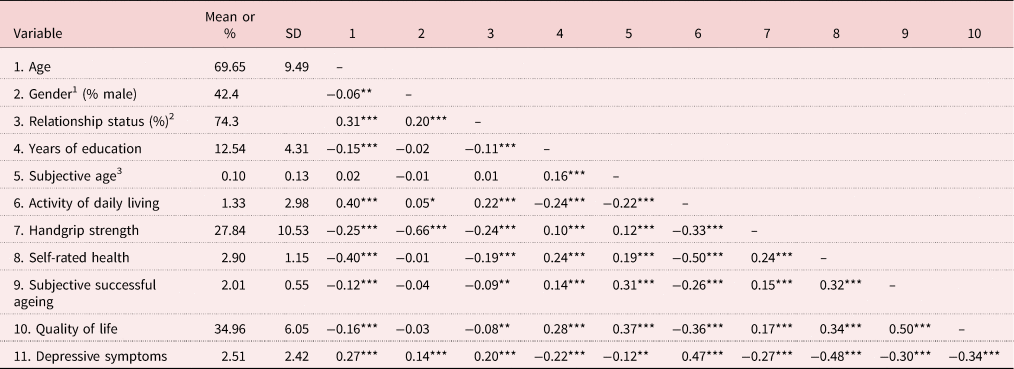
Prior to the examination of the hypotheses, initial group differences were examined using chi-square and analyses of variance (see the online supplementary material). Subsequently, correlations between the study variables were examined for the entire cohort (see Table 1). In order to examine the hypotheses, concerning both the main effect of subjective age on the six outcome variables and the moderating effect of one's cultural group, six identical hierarchical regressions were performed. In the first step, we inserted participants’ age, gender (male/female), relationship status (not in a relationship/in a relationship) and years of education; the second step included participants’ cultural group (veteran Jewish Israelis/former-USSR immigrants/Israeli Arabs); the third step included subjective age; and the fourth and final step included the interactions between cultural group and subjective age.
Means, standard deviations (SD) and Pearson correlations among study variables for the cohort

Notes: N = 1,793. 1. Male = 0, female = 1. 2. No relationship = 0, in a relationship = 1. 3. Higher scores reflect feeling younger.
Significance levels: * p < 0.05, ** p < 0.01, *** p < 0.001.
It should be noted that as the variable ‘cultural group’ is a nominal variable with three categories, it cannot be inserted as-is to the regression analyses. Accordingly, and in line with Hayes and Montoya (Reference Hayes and Montoya2017), we used Helmert coding, an alternative coding method for ordinal multicategorical variables. This coding generates regression coefficients, which quantify the difference between means for one group and all groups ordinally higher on the multi-categorical ordinal variable (for a complete description of how to generate Helmert codes, see Darlington and Hayes, Reference Darlington and Hayes2017). Accordingly, two dichotomous dummy variables were calculated: the first, D1, represents differences between the majority group (veteran Jewish Israelis) and both minority groups (Israeli Arabs and former-USSR immigrants). The second, D2, represents the differences between the two minority groups (Israeli Arabs versus former-USSR immigrants). The two dummy variables were regressed in the second step of the regressions, and were used to calculate the interactions for the fourth step. Significant interactions were probed using the PROCESS 3.1 macro for SPSS (Hayes, Reference Hayes2018).
Results
Prior to the examination of the study hypotheses, we conducted a correlation analysis for the study variables (see Table 1 for means, SD and correlation matrix for the cohort). The mean subjective age was 0.10 (ranging from −0.36 to 0.59), indicating that respondents felt, on average, 10 per cent younger than their chronological age. All in all, 16.07 per cent of the cohort (288 participants; 231 veteran Jewish Israelis, 29 former-USSR immigrants, 28 Israeli Arabs) felt older than their chronological age. Mean subjective ages were 0.10 for veteran Jewish Israelis (ranging from −0.36 to 0.59), 0.10 for former-USSR immigrants (ranging from −0.29 to 0.58) and 0.12 for Israeli Arabs (ranging from −0.32 to 0.42), and there was a small, albeit significant, difference in subjective age between veteran Jewish Israelis and Israeli Arabs (see the online supplementary material). Subjective age demonstrated weak to moderate correlations with the six outcome variables (0.12 ⩽ |r| ⩽ 0.37). Moreover, the outcome variables were all significantly correlated with one another, and demonstrated weak to strong correlations (0.15 ⩽ |r| ⩽ 0.50).
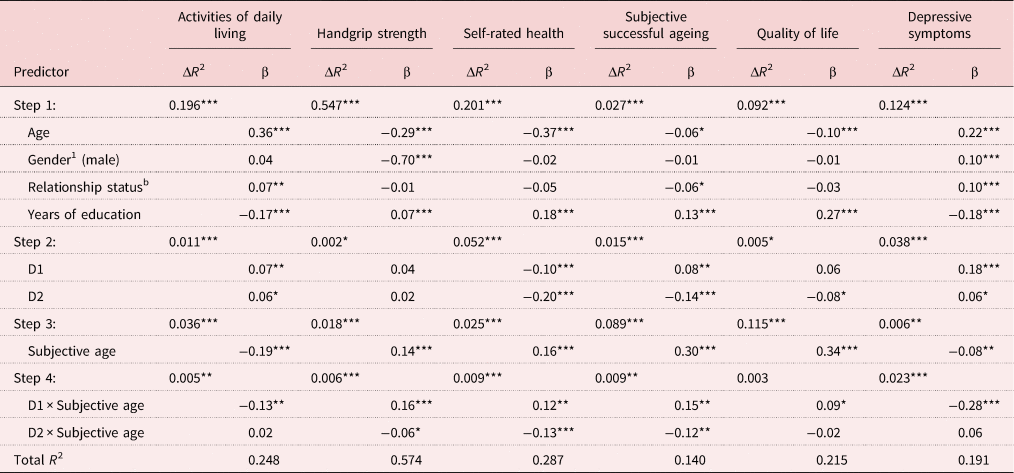
Table 2 presents the findings from the six regression analyses for the dependent variables. With regard to the objective physical condition variables (ADL and handgrip strength), feeling younger (i.e. higher scores in subjective age) was associated with reduced disability (β = −0.19, p < 0.001) and increased handgrip strength (β = 0.14, p < 0.001). As far as the subjective physical condition was concerned, feeling younger was connected with more positive perceptions of health (β = 0.16, p < 0.001) and higher subjective successful ageing (β = 0.30, p < 0.001). Finally, for psychological condition, feeling younger was associated with increased quality of life (β = 0.34, p < 0.001) and reduced depressive symptoms (β = −0.08, p < 0.01). It should also be noted that across the six regressions, the variance explained by subjective age with regard to the outcome variables ranged from 0.6 to 11.5 per cent.
Regression coefficients of the six dependent variables: activities of daily living, handgrip strength, self-rated health, subjective successful ageing, quality of life and depressive symptoms

Notes: D1: veteran Jewish Israelis versus two minority groups. D2: former-Soviet Union immigrants versus Israeli Arabs. 1. Male = 0, female = 1. 2. No relationship = 0, in a relationship = 1. 3. Higher scores reflect feeling younger.
Significance levels:
* p < 0.05.
** p < 0.01.
*** p < 0.001.
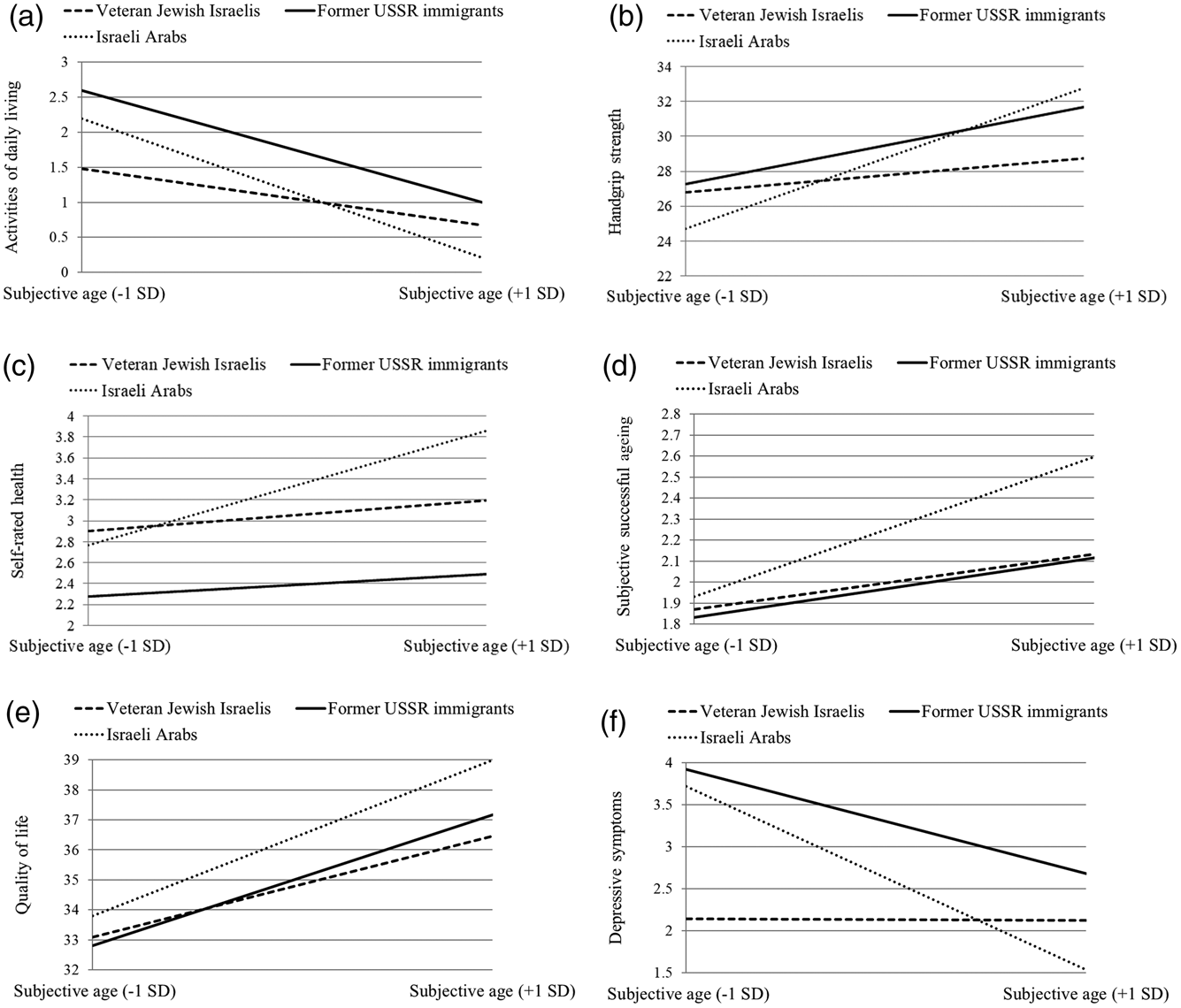
As Table 2 indicates, significant interactions were found for all outcome variables. The interactive effect of subjective age and D1 (veteran Jewish Israelis versus the two minority groups) was significant for all six outcome variables, whereas subjective age × D2 (former-USSR immigrants versus Israeli Arabs) was significant for handgrip strength, self-rated health and subjective successful ageing. Upon examining the differential connections between subjective age and health outcomes for the three values of the moderator (i.e. the three cultural groups), an interesting pattern emerges, which indicated that while many of the associations were significant, the positive effects of a younger subjective age on health were particularly prominent among Israeli Arabs (see Figure 1). For objective physical condition, feeling younger was significantly associated with decreased disability among veteran Jewish Israelis (β = −0.15, p < 0.001), former-USSR immigrants (β = −0.30, p < 0.001) and Israeli Arabs (β = −0.37, p < 0.001). Similar patterns were found with regard to handgrip strength (β = 0.10, β = 0.23 and β = 0.42, p < 0.001, respectively). With regard to subjective physical condition, feeling younger was associated with increased self-rated health among veteran Jewish Israelis (β = 0.14, p < 0.001) and Israeli Arabs (β = 0.53, p < 0.001), but not among former-USSR immigrants (β = 0.10, p > 0.05). Moreover, feeling younger was associated with higher subjective successful ageing among all three groups (veteran Jewish Israelis: β = 0.27, p < 0.001; former-USSR immigrants: β = 0.29, p < 0.001; Israeli Arabs: β = 0.68, p < 0.001). Finally, as far as psychological condition is concerned, feeling younger was associated with increased quality of life among the three groups (β = 0.31, β = 0.40 and β = 0.48, p < 0.001, respectively) and with reduced depressive symptoms among former-USSR immigrants (β = −0.28, p < 0.001) and Israeli Arabs (β = −0.50, p < 0.001), but not among veteran Jewish Israelis (β = −0.01, p > 0.05).
The connections between subjective age and the six outcome variables (activities of daily living (a); handgrip strength (b); self-rated health (c); subjective successful ageing (d); quality of life (e); depressive symptoms (f)) for the three values of the moderating variable (veteran Jewish Israelis, former-Soviet Union (USSR) immigrants and Israeli Arabs).
Note: SD: standard deviation.

Discussion
In line with our first hypothesis, a younger subjective age was positively linked with all six outcome variables examining objective health, subjective health and psychological health. These findings are in line with a large amount of research demonstrating the beneficial association between one's younger age identity and one's physical (Westerhof et al., Reference Westerhof, Miche, Brothers, Barrett, Diehl, Montepare, Wahl and Wurm2014; Shrira et al., Reference Shrira, Palgi, Hoffman, Avidor, Bodner, Ben-Ezra and Bensimon2018; Stephan et al., Reference Stephan, Sutin, Terracciano, Ryff and Kreuger2018) and psychological (Shrira et al., Reference Shrira, Bodner and Palgi2014, Reference Shrira, Palgi, Hoffman, Avidor, Bodner, Ben-Ezra and Bensimon2018; Ayalon et al., Reference Ayalon, Palgi, Avidor and Bodner2016) health. As previously stated, Levy's stereotype embodiment theory (Levy, Reference Levy2009) stipulates that holding negative age stereotypes may be harmful to older adults’ physical and psychological health. Moreover, holding a positive view of one's age and ageing has been linked with several biological, behavioural and psychological mechanisms (see Wurm et al., Reference Wurm, Diehl, Kornadt, Westerhof and Wahl2017), such as blood pressure and inflammation, as well as engagement in health-promoting behaviours and/or risky health behaviours, which may subsequently be connected with one's sense of control and sense that life bears meaning. Following Wurm et al., it is possible that the connections between a younger subjective age and the various health measures examined in the current study provide an additional indication of the importance of internalised views of age and ageing for older adults’ physical and psychological health (cf. Levy, Reference Levy2009).
In accordance with our second hypothesis, the individual's cultural group was a significant moderator among all six outcome variables. Once again, these findings are in line with previous research, which examined cultural differences in the effects of subjective age (Westerhof and Barrett, Reference Westerhof and Barrett2005; Hess et al., Reference Hess, O'Brien, Voss, Kornadt, Rothermund, Fung and Popham2017). However, while such research focused on examining differences between countries, the current study focused on existing sub-cultures within a given society. In line with the idea of Westerhof et al. (Reference Westerhof, Miche, Brothers, Barrett, Diehl, Montepare, Wahl and Wurm2014) that subjective age becomes a more powerful determining factor for wellbeing when societal resources are less available, our study suggests that this is also the case for sub-groups in a specific society. Accordingly, despite the inability for causal inference in the current study, our results indicate that the associations of subjective age with different health measures, while mostly significant, are less pronounced among the majority group of veteran Jewish Israelis in comparison to the two minority groups. This could stem from the fact that as the majority group, veteran Jewish Israelis have both increased access to, and better knowledge of, their benefits and privileges (see Remennick and Ottenstein-Eisen, Reference Remennick and Ottenstein-Eisen1998) and, consequently, their personal responsibility for their wellbeing in old age becomes less crucial. Moreover, even if members of this group feel older than their chronological age, they have better access to the health-care system (both physically and financially), in order to ameliorate the negative effects of an old-age identity.
Interestingly, our results also point towards marked differences between the two minority groups as far as age identity is concerned. While existing research did not allow us to hypothesise such an intricate effect, it seems that feeling younger is more beneficial among the Arab group in comparison to the immigrant group in three of the four variables pertaining to physical health. Moreover, it seems that in some cases, the significant differences between the majority group and the minority groups, addressed above, may have been the consequence of differences between veteran Jews and Arabs. The discrepancy between our results and existing literature could stem from the fact that the majority of research concerning health-care choices among immigrants was conducted during the 1990s, when the immigration wave was at its peak. Consequently, it is possible that during the last 20 years, former-USSR immigrants have undergone a positive acculturation process (see Horenczyk and Bergman, Reference Horenczyk, Bergman, Sam and Berry2016), which enabled them to familiarise themselves gradually with how the Israeli government and institutions provide for older adults, thereby reducing the health-related importance of age identity. However, this issue warrants further investigation.
In this regard, it is important to note that the Arab society is experiencing a transition, from a traditional household in which the family bears responsibility for the ageing parent, to smaller, more-independent network structures (see Khalaila and Litwin, Reference Khalaila and Litwin2012). Accordingly, community services, which are already available for Jewish Israelis, are becoming more accessible for Arabs as well (Khalaila and Litwin, Reference Khalaila and Litwin2012). Despite this positive trend, it seems that at this point in time, services which are available to older Arabs, and their choice and/or ability to utilise them when needed, are still below par in comparison to Jews in Israel. Consequently, the role of age identity among older Arab adults is more pronounced in both objective and subjective determinants of physical health.
Several limitations of the current study should be noted. First and foremost, the cross-sectional nature of the current study precludes us from establishing a causal link between subjective age and health. While the SHARE data enable longitudinal designs, the subjective age item was included only in the current wave, thereby precluding the option for such a design. Accordingly, it is possible that it is poor health which is a marker for subjective age or, alternatively, that the association between the two factors is a consequence of a third, unexamined, factor. For example, if one considers Israel to be a country which provides good access to health-related services, one cannot rule out that within this country, sub-groups which have less access to such services may demonstrate a more powerful association between subjective age and health. Despite the fact that several studies which employed a cross-lagged design indicated that subjective age affects health, rather than the opposite direction (e.g. Spuling et al., Reference Spuling, Miche, Wurm and Wahl2013), the general role of culture in this regard should be examined further, and additional possible moderating factors should be considered. Moreover, as the SHARE-Israel data assess subjective age by a single item, we could not examine multi-dimensional perspectives and effects of sub-types of subjective age. Accordingly, it is important that future studies employ more intricate instruments, which examine such dimensions of subjective age (see Kornadt and Rothermund, Reference Kornadt, Rothermund, Diehl and Werner-Wahl2015), and could deepen our understanding about the differential effects of feeling older than one's chronological age. Additionally, while sub-group members filled out the various scales in their native language (Hebrew, Russian or Arabic), it is possible that Hebrew proficiency, or cultural beliefs and values, may be important for interpreting the results. In this regard, future studies should also examine cultural variations with regard to other views on ageing, such as ageism, awareness of age-related changes or subjective nearness-to-death. Finally, our study did not include biological assessments of physical age-related changes, and it would be interesting to examine the manner by which cultural differences play a role on the association between subjective age and biomarkers of ageing.
Despite its limitations, the current study offers a unique perspective of cultural differences within a given society in the association between feeling younger or older than one's chronological age and health-related aspects. Using a nationwide randomised sample, this work demonstrates the associations between subjective age on six different markers of physical and psychological health. These results provide interesting directions for future research focusing on cultural aspects and their relationship to the association between subjective age and physical/psychological health among older adults. It seems important that future studies delve deeper into the underlying social and psychological mechanisms which comprise the individual's own cultural perception (e.g. values, beliefs, adherence to cultural norms), as well as those which characterise the culture itself (e.g. some societies are considered ‘tight’ societies, which hold strong social norms and low tolerance for deviant behaviours; see Gelfand et al., Reference Gelfand, Raver, Nishii, Leslie, Lun, Lim, Duan, Almaliach, Ang, Arnadottir, Aycan, Boehnke, Powski, Cabecinhas, Chan, Chhokar, D'Amato, Ferrer, Fischlmayr, Fischer, Fulop, Georgas, Kashima, Kashima, Kim, Lempereur, Marquez, Othman, Overlaet, Panagiotopoulou, Peltzer, Perez-Florizno, Ponomarenko, Realo, Schei, Schmitt, Smith, Soomro, Szabo, Taveesin, Toyama, Van de Vliert, Vohra, Ward and Yamaguchi2011), and examine these issues in the context of the current study's findings.
Supplementary material
The supplementary material for this article can be found at https://doi.org/10.1017/S0144686X20000707
Data
This paper uses data from SHARE Wave 6 (doi:10.6103/SHARE.w6.700), see Börsch-Supan et al. (Reference Börsch-Supan, Brand, Hunkler, Kneip, Korbmacher, Malter, Schaan, Stuck and Zuber2013) for methodological details. The SHARE data collection has been funded by the European Commission through FP5 (QLK6-CT-2001-00360), FP6 (SHARE-I3: RII-CT-2006-062193, COMPARE: CIT5-CT-2005-028857, SHARELIFE: CIT4-CT-2006-028812), FP7 (SHARE-PREP: GA No. 211909, SHARE-LEAP: GA No. 227822, SHARE M4: GA No. 261982) and Horizon 2020 (SHARE-DEV3: GA No. 676536, SERISS: GA No. 654221) and by DG Employment, Social Affairs & Inclusion. Additional funding from the German Ministry of Education and Research, the Max Planck Society for the Advancement of Science, the US National Institute on Aging (U01_AG09740-13S2, P01_AG005842, P01_AG08291, P30_AG12815, R21_AG025169, Y1-AG-4553-01, IAG_BSR06-11, OGHA_04-064, HHSN271201300071C) and from various national funding sources is gratefully acknowledged (see www.share-project.org).
Author contributions
Both researchers participated equally in the various parts of the study.
Financial support
This research received no specific grant from any funding agency, commercial or not-for-profit sectors.
Conflict of interest
The authors declare no conflicts of interest.
Ethical standards
SHARE-Israel received ethical approval from the Institutional Review Board of the Hebrew University of Jerusalem.