Introduction
The ageing of the population is a widespread, global phenomenon (Davies, Reference Davies2003). As a result, society will see an increasing number of cancer patients, knowing that one of the main diseases associated with aging is cancer (Balducci, Reference Balducci2019). Becoming elderly does not in itself imply a psycho-physical decay of this age group. Being old today is different from the past. Kluge et al. (Reference Kluge, Zagheni and Loichinger2014) argued that there may also be some benefits in an “old” world. For example, older people in today's society play a very important role in helping their families, managing their work commitments, and caring for their grandchildren.
Older people also play an active role in providing care to cancer patients; this was habitually carried out by an adult member of the family, especially women (Goldzweig et al., Reference Goldzweig, Schapira and Baider2019). Nevertheless, more women are increasingly engaged in work than in the past, and this has led to the need for a greater involvement of men in welfare activities, especially in smaller families (Sharma et al., Reference Sharma, Chakrabarti and Grover2016).
The multidimensional experience of the caregiver burden may differ between men and women. Numerous studies have found that women experience a higher burden of care than men, particularly higher levels of psycho-social distress (Ketcher et al., Reference Ketcher, Trettevik and Vadaparampil2020) and increased physical strain (Pinquart and Sörensen, Reference Pinquart and Sörensen2006). This was explained by considering the role of different mediation variables (such as time spent in caregiving, duration of caregiving, reason to provide care, and gender differences in personal-care tasks) (O'Hara, Reference O'Hara2010; Sharma et al., Reference Sharma, Chakrabarti and Grover2016), which could influence the perception of the burden differently.
Finding meaning in being a caregiver of a cancer patient involves a reduction of the negative outcomes commonly associated with this role (Applebaum et al., Reference Applebaum, Farran and Marziliano2014). According to the theory of social role (Eagly, Reference Eagly2009), mainly women are considered to be naturally responsible for care tasks. Gender stereotypes (i.e., beliefs about gender), determined by culture and social norms, tend to naturalize the meaning of “moral obligation” in women to be caregivers (Read and Wuest, Reference Read and Wuest2007), so that they are typically acknowledged as “just doing their duty” (Naldini et al., Reference Naldini, Pavolini and Solera2016).
Violations of these gender expectations are the subject of criticism and sanctions (Prentice and Carranza, Reference Prentice and Carranza2002). These stereotypes tend to be internalized and therefore self-imposed (Postmes and Speares, Reference Postmes and Speares2002). In this way, women tend to accept their role of female duty even when significant burdens occur (Williams et al., Reference Williams, Giddings and Bellamy2017). Asking or receiving help can result in not feeling capable in different situations, not being up to it and therefore experiencing a role conflict. Trends suggest that these differences may be diminishing over time in response to changing gender roles (Washington et al., Reference Washington, Pike and Demiris2015a). We are now faced with a historical process of redefining roles that does not accentuate the male/female distinction, but emphasizes the effects of what constitutes making and being a family today with a defined meaning that refers to human identity. The widespread impression is that we are moving towards a “feminization of males” and a “masculinization of females,” in which the crossings between the two male and female polarities predominate (Berger et al., Reference Berger, Levant and McMillan2005). In addition to this, healthcare professionals can also observe a new scenario with increased involvement of older family members in cancer care. This also happens in the context of palliative care. Although one of the demographic characteristics of caregivers that has received considerable attention in recent years is gender (Schrank et al., Reference Schrank, Ebert-Vogel and Amering2015; Washington et al., Reference Washington, Pike and Demiris2015a; Morgan et al., Reference Morgan, Williams and Trussardi2016), no study of our knowledge has focused on this topic in the older caregiver involved in family care at the end of life.
Based on these considerations, the aim of this study was to assess the caregiver burden among older family members who support patients with terminal cancer in order to identify their gender differences (male vs. female). Considering that hospice teams define patients and caregiver partners as a unique suffering unit (Masterson et al., Reference Masterson, Hurley and Zaider2015), we believe that a deeper knowledge of these issues can help modern palliative care to understand the impact of various changes and life transitions that occur in older age to improve quality care at the end of life.
Patients and methods
Design
A cross-sectional design was used for this study. Family caregivers aged ≥65-year-old hospice cancer patients (all kinds) were consecutively interviewed. The study sample was divided into two subgroups based on gender (male vs. female).
Setting/participants
Older caregivers were enrolled in three hospices in Italy: “San Carlo” Hospice (Potenza), “Casa di Betania” Hospice in Tricase (Lecce), and Grumo Appula Hospice (Bari) from June 2015 to January 2016. Participation was voluntary and inclusion criteria were as follows: being ≥65 years of age; having a relative with advanced cancer receiving end-of-life care in a hospice setting; patient's Eastern Cooperative Oncology Group (ECOG) performance status (PS) ≥3; having no diagnosis of cancer (or other severe health problems); having a normal cognitive function evaluated with Mini-Mental State Examination scoring >27 points; being the identified principal caregiver, either by the patient or self-identified; being proficient in the Italian language and providing a written informed consent.
One hundred and thirty-five caregivers meeting all inclusion criteria were approached by the physician and asked to participate in the study. Out of that number, 120 decided to participate and signed a consent form regarding the study protocol after a detailed explanation by the physicians. Non-respondent in the study was mainly caused by a sudden and unexpected deterioration in the patient's health condition or death. Eighteen caregivers refused to participate in the study for a series of practical aspects such as unfamiliarity with psychometric instruments, which is common in older people, and also due to sensory deficits such as reduced hearing and vision. Thus, a total of 102 elderly caregivers of patients with cancer completed the study protocol.
The research project was approved by the institutional review board of the San Carlo Hospital, Potenza, Italy (IRB approval no. 2014-15).
Measures
All caregivers were asked to complete the following questionnaires.
Sociodemographic schedule
Participants provided information about their gender and age, marital status, employment status, assistance timing, reason for assistance, type of relationship with the patient, and about the patient's age and gender. Some clinical variables (such as time from diagnosis) were also collected through an ad hoc record survey.
The caregiver burden inventory
This is a multidimensional questionnaire that is comprised of 24 closed questions divided into five dimensions: caregiver burden inventory (CBI)–time-dependence, which gives a measure of flexibility with time and caregiver's time restriction (e.g., “My care receiver is dependent on me”); CBI–developmental, which evaluates the caregivers’ feeling of being “off-time” in their development compared with their peers (e.g., “I feel that I'm missing out on life”); CBI–physical, a measure of the physical consequences of caregiving (e.g., “Caregiving has made me physically ill”); CBI–social, which assesses the impact on interpersonal and social relationships within the family and working environment (e.g., “I feel resentful of other relatives who could but do not help”); and CBI–emotional, which evaluates feelings of shame and embarrassment regarding the patient (e.g., “I feel angry about my reactions toward my care receiver”) (Novak and Guest, Reference Novak and Guest1989). Each item is given a score between 0 (not at all descriptive) and 4 (very descriptive), giving a total that ranges from 0 to 20 for each dimension, except for CBI–physical that ranges from 0 to 16. The total score (CBI–tot) ranges from 0 to 96, with higher scores indicating greater feelings of burden. The questionnaire was translated into Italian and validated by Marvardi et al. (Reference Marvardi, Mattioli and Spazzafumo2005) and has been used extensively in clinical trials (Novak and Guest, Reference Novak and Guest1992; Caserta et al., Reference Caserta, Lund and Wright1996).
Statistical analysis
Sociodemographic characteristics of caregivers by gender groups (male vs. female) and their ill relatives were reported using descriptive statistics. Sociodemographic baseline characteristics were compared between the two study groups by a Chi-Square test for discrete variables and univariate analysis of variance (ANCOVA) for continuous variables. To evaluate the differences between the two gender groups in terms of caregiver burden, a generalized linear model (GLM) was used to compare CBI scores controlling for patient and caregiver's baseline characteristics. No replacement method was used for missing data. Statistical tests were two-sided and a value of P ≤ 0.05 was considered as statistically significant. All analyses were performed using Statistical Package for Social Science (IBM SPSS Statistics for Windows, Version 21.0, IBM Corp., Armonk, NY).
Results
Sociodemographic characteristics
The characteristics of the two caregiver subgroups (male vs. female) are summarized in Table 1. The male group was composed of N = 40 caregivers (mean age + standard deviation [SD] = 72.7 ± 7.03), while the female group was composed of N = 62 caregivers (mean age + SD = 72.8 ± 5.36). There were no differences for some characteristics such as caregiver's age, patient's age, marital status (i.e., our sample study was mainly made up of married caregivers), caregiver's educational level, and diagnosis timing. Some differences emerged for: patient's gender (the male caregiver group assisted 27.5% of male patients and 72.5% of female patients, while the female caregiver group assisted 74.2% of males and 25.8% of female patients); caregiver's employment status (the male group was composed of 87.5% retired, 7.5% unemployed, and 5% employed, while the female group of 69.4% retired; 27.4% unemployed, and 3.2% employed; the reason for assistance (in the male group: 22.5% caregivers for need/requirement, 10%, for personal choice, 15% for family designation, and 52.5% for “other” reasons (e.g., “I have to do it because there is no one else”; “He is my father and that is enough!”); in the female group instead: 21.0% for need/requirement, 27.4% for personal choice, 25.8% for family designation, and 25.8% of “other”). Differences between the two groups also emerge for assistance timing as shown in detail in Table 1 and for the type of relationship of the caregivers with his/her family member. In particular, the male caregiver group was principally composed of patient's husband (60%) or son (20%), while the female group was composed of patient's wife (69.4%), other (e.g., sisters or daughter-in-law) (24.1%), or daughter (6.5%).
Sociodemographic characteristics of the patients and elderly caregivers (≥65 years) by gender groups (male vs. female caregivers)

Bold values indicates P-value equal or less 0.05.
a ANOVA P-value.
b Chi-Square test P-value.
Differences in the caregiver burden between gender groups of older caregivers
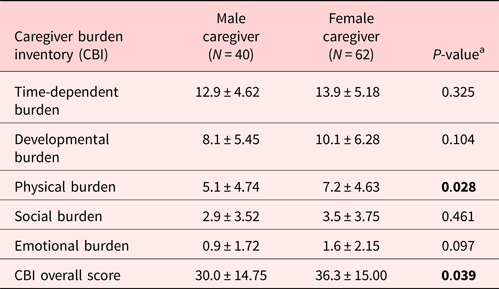
Compared with male caregivers, the female caregivers reported significantly higher scores in the CBI–physical subscale (P = 0.0028) and in the CBI overall score (P = 0.039). No further differences were found between the two gender groups in the other CBI section scores (time-dependent, developmental, and social and emotional burden; Table 2).
Psychometrics and statistical measures for CBI in the two subgroups

Bold values indicates P-value equal or less 0.05.
a ANOVA P-value.
General linear model
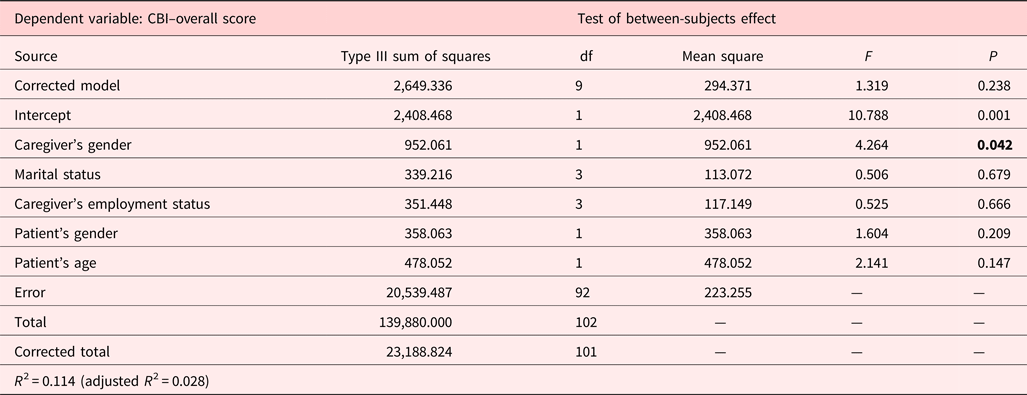
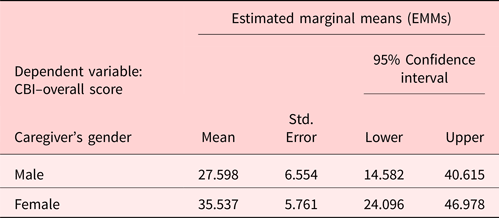
In our study, the GLM provides regression analysis and analysis of variance for the CBI–overall score as a dependent variable by four factors (caregiver's gender, marital status, caregiver's employment status, and patient's gender) and one covariate (patient's age). Factors and covariate were assumed to have a linear relationship to the dependent variable CBI–overall score (Table 3). A general linear model showed that the gender of caregiver had a significant correlation with the CBI–total score, as illustrated in Table 3 (P = 0.042). Model-adjusted R 2 was equal to 0.028. The estimated marginal means, adjusted for the covariate, are reported in Table 4. CI indicates 95% confidence interval. In fact, in the GLM model (pairwise comparisons), a significant difference (P = 0.042) between the two caregiver genders for the CBI–total score is confirmed with a difference in the marginal means equal to −7.939 (Table 5). The GLM analysis for the CBI–physical burden as the dependent variable, considering the same variables as in the previous model, confirmed the significance of the caregiver's gender for this CBI subscale (P = 0.05). The model reports a value of R 2 = 0.102.
General linear model for the CBI total score (dependent variable), with caregiver's gender, marital status, caregiver's employment status, patient's gender as a predictor and patient's age as a covariate

Bold values indicates P-value equal or less 0.05.
Estimated marginal means

Pairwise comparisons

Discussion
This study allows us to make some considerations. As already reported in the literature, our analysis shows that women are predominant providers of care for their oncological family members at the end of life (Schrank et al., Reference Schrank, Ebert-Vogel and Amering2015; Washington et al., Reference Washington, Pike and Demiris2015a). However, there is a growing number of men taking on caregiver roles, a trend that reflects the evolution of our customs. Our results are in accordance with other studies in which female caregivers reported a higher burden (Parker Oliver et al., Reference Parker Oliver, Albright and Washington2013), and caregiving had a greater impact on physical health in this gender category compared with men (Pinquart and Sörensen, Reference Pinquart and Sörensen2006). In a new perspective, these data confirm this trend even in old age.
In this regard, we assume that also older female caregivers, as well as adult women caregivers, play multiple roles (such as wives, mothers, or grandmothers) (Williams et al., Reference Williams, Dilworth-Anderson and Goodwin2003). Pressure to put these contrasting roles in place could create difficulties for older women (role strain). This could lead to captivity of the role, which refers to the feeling of assistants being trapped in their multiple tasks. Role-conflicts give rise to several adverse consequences for these caregivers such as physical problems, or depression and other emotional disturbance (i.e., feelings of resentment toward the patient), which could be somatized in order to be more “acceptable” (Wool and Barsky, Reference Wool and Barsky1994). In this process, we hypothesize a direct involvement of caregiving on physical health, considering that caregivers of this study were all “fit” older people without serious physical health problems as required by inclusion criteria of the study protocol. Moreover, as already reported by Navaie-Waliser et al. (Reference Navaie-Waliser, Spriggs and Feldman2002), women provided more intensive instrumental care resulting in greater physical stress than men. Husbands who provide palliative care often see their role in terms of job, applying a managerial order to their care, while wives tend to see themselves more as nurturers (Russell, Reference Russell2007). As a result, women are less inclined than men to rely on hospice formal care services.
As for the CBI–emotional burden subscale, it is interesting to note that the results presented here do not agree with those of other studies that have analyzed more discomfort and depression among adult women caregivers (i.e., daughters or wives) (Mystakidou et al., Reference Mystakidou, Parpa and Panagiotou2013; Parker Oliver et al., Reference Parker Oliver, Albright and Washington2013; Washington et al., Reference Washington, Demiris and Pike2015b). So, our study shows no difference between older women and men regarding mental health or psycho-social discomfort. As previously explained, we believe that while women tend to somatize negative emotions related to the role of caregivers making them more acceptable, men may instead tend to repress them by considering them not socially acceptable for their male role (Fromme et al., Reference Fromme, Drach and Tolle2005).
The crucial aspect of our study is to understand how these gender differences can or cannot be confirmed even among the elderly. It is known that it is difficult to assess the emotional aspects in this population because depression could have atypical presentations. Depressive disorders in older people could be “masked” by somatic symptoms, a phenomenon known as “masked depression” that represents a condition in which the language used by the subject to communicate his affective state refers to symptoms inherent in the body sphere (Shetty et al., Reference Shetty, Mane and Fulmali2018).
Concerning the social burden evaluated by the CBI–social subscale, we observed that both caregiver groups experience the same interference of caregiving-roles on their social life, probably more related to the experience of assistance than to gender. Older people are at greater risk of aging-related loneliness and social isolation, and the caregiver experience can exacerbate these aspects (Ettema et al., Reference Ettema, Derksen and van Leeuwen2010). In this regard, to explain the result in this subscale, we believe that this population may have benefited from interdisciplinary hospice care teams that provide social support to break down the sense of exclusion associated with illness and care.
No differences emerged between the two age groups regarding the CBI–time-dependent scores/burden. We consider that the burden of limiting the caregiver's time is mainly related to the patient's PS which appears similar in our study groups.
Looking at the CBI–developmental subscale, the burden showed similar characteristics between gender in older caregivers. Examining these data from the perspective of the Socioemotional Selectivity Theory by Carstensen (Reference Carstensen2006), we found that this is not a consequence of gender itself, but rather an age-associated change in the time perspective. The greater awareness that the time available is limited would motivate the elderly to giving priority to the search for positive meanings to attribute to life events.
The present study has several limitations: first of all, the lack of comparison between the two groups of caregivers and the different tumors. This was not possible due to the limited number of cases, given the small sample size. Furthermore, our study conceptualized gender as a binary construct, a practice that is increasingly challenged in favor of approaches that more adequately reflect the complexity of gender and gender expression. Many confounders were not considered such as measures of caregivers’ personality traits and belief systems, the meaning of caregiving, and variables related to their spiritual needs (Balducci, Reference Balducci2019). In addition, caregivers can find benefit by defining the meaning of caring in specific cultural contexts in which it occurs. Numerous studies (Menaca et al., Reference Menaca, Evans and Andrew2012; Del-Pino-Casado et al., Reference Del-Pino-Casado, Millàn-Cobo and Paolomino-Moral2014) have demonstrated the existence of a Mediterranean model of informal care characterized by a positive family attitude toward care and greater family involvement also in terms of coverage and services especially if they are women. Thus, in the Mediterranean context, like in Italy, the family can take on the care of the relative as an obligation and responsibility, meaning the cure as dedication to sacrifice, and sacrifice as a sense of moral duty or gratitude. Finally, our study examines only baseline data cross-sectionally. Future research would benefit from a longitudinal examination of gender differences in the elderly caregiver experience. Another consideration is that caregiver's experience of patients receiving hospice inpatient care might be different from the burden of a caregiver providing direct care at home. Despite the limitations, our results could be a source of strength pointing out the need to understand and recognize the importance of the caregiver's age and gender in defining burdens of care in the context of modern palliative care. In spite of the increasing emergence of older people as caregivers, research has not taken into account this trend. In addition to this, researchers continue to maintain their traditional focus on female caregivers, although the proportion of men providing care for cancer patients at the end of life is increasing and it appears that men approach caregiving differently.
In conclusion, our study demonstrated that older female caregivers had higher levels of burden and poorer physical health than men. However, there are also many similarities between the two groups. In this regard, we believe that the role of caregiver in the end of life context must be “de-feminized” from gender stereotypes. To this end, Meaning-Centered Psychotherapy (Breitbart et al., Reference Breitbart, Poppito and Rosenfeld2012, Reference Breitbart, Rosenfeld and Pessin2015; Applebaum et al., Reference Applebaum, Farran and Marziliano2014) may enhance the meaning of the universality of existential suffering in the end-of-life caregiving experience (Applebaum et al., Reference Applebaum, Kulikowski and Breitbart2015). Men and women in older age should be encouraged to shoulder the same caregiving responsibilities reappraising their gender and age-related beliefs so as to share a uni-gender profile in the meaning of caregiving at the end of life.
Funding
This research received no specific grant from any funding.
Conflict of interest
None declared.