Motivation
Didn’t the world learn enough? I am really sickened that there are people in the West asking these questions because that’s exactly what the Russians want. It’s our territory for God’s sake. They’re killing our people.
(Former Georgian President Mikheil Saakashvili, 2008)
[Russia continues to make] destructive moves [by signing a treaty with Abkhazia]. [Russia’s invasion of] Ukraine is not the isolated case. I hope our partners see all these developments in the big picture.
(Former Georgian Foreign Minister Tamar Beruchashvili, 2015)
Georgia must not follow any [of Russia’s] provocations and do its best not to give Russia a chance to use force against Georgia.
(President of Georgia Giorgi Margvelashvili, 2018)
How do emotions, threat perceptions and victimization influence foreign policy attitudes? Some of the most salient aspects of conflict are the psychological and emotional effects that accompany victimization. Since its independence in 1991, Georgia has fought a series of conflicts with Russia and Russian-backed separatists over its breakaway territories of South Ossetia and Abkhazia. These conflicts have led to more than 250,000 displaced persons (IDPs), and remain one of the major foreign policy issues facing Russia.Footnote 1 As the above quotes suggest, Georgian policy makers and the public are forced to balance their desire to rectify past perceived Russian aggressions, with the current threat of the more powerful Russian military. Past victimization, perceived threat and the emotions they engender form a crucial aspect of Georgian foreign policy attitudes.
The importance of victimization on conflict attitudes extends to other conflicts as well. As one Syrian father noted about the effect of Syrian Civil War violence on his son, ‘(he) wakes up afraid in the middle of the night. He wakes up screaming. […] A child was slaughtered in front of him, so he started to dream that someone is coming to slaughter him?’Footnote 2 The lingering effects of wartime violence on increased trauma and stress are well documented and do not end with the cessation of hostilities (Steel et al. Reference Steel, Chey, Silove, Marnane, Bryant and van Ommeren2009). Further, research suggests that the effects of violence and political conflict can have intergenerational consequences that can last far beyond the end of the hostilities (Acharya, Blackwell, and Sen Reference Acharya, Blackwell and Sen2016; Voigtländer and Voth Reference Voigtländer and Voth2012).
Conflict also changes how individuals view politics. Attitudes towards justice and the potential for reconciliation are shaped by previous experiences during the conflict. For instance, one victim of displacement by the Colombian FARC rebels who opposed an amnesty deal between the Colombian government and the rebels stated, ‘the FARC are a bunch of assassins and jail is the very least the guerrillas should get for all the suffering they have caused to so many people. Without that, there’s no peace.’Footnote 3 Recent research backs up this anecdote that conflict can harden political attitudes in the context of intergroup conflict (Hirsch-Hoefler et al. Reference Hirsch-Hoefler, Canetti, Rapaport and Hobfoll2016).
During ongoing, or intractable conflicts, attitudes towards the conflict become the main axis of political competition (Bar-Tal Reference Bar‐Tal2000). Past research focuses on two related phenomena: 1) the effects of exposure to violence, and 2) how emotions influence political behavior. Being exposed to violence can increase political participation (Bateson Reference Bateson2012; Blattman Reference Blattman2009) and altruism (Bauer et al. Reference Bauer, Blattman, Chytilová, Henrich, Miguel and Mitts2016; Zeitzoff Reference Zeitzoff2014). However, it may also increase hardline political attitudes (Canetti-Nisim et al. Reference Canetti-Nisim, Halperin, Sharvit and Hobfoll2009; Getmansky and Zeitzoff Reference Getmansky and Zeitzoff2014). Emotions in the context of intergroup conflict are particularly effective at motivating and shaping political attitudes and behavior, with threat perceptions and anger likely to increase negative attitudes towards the outgroup (Huddy et al. Reference Huddy, Feldman, Taber and Lahav2005; Young Reference Young2016).
What influences political attitudes in the shadow of conflict? To answer this question it is necessary to disentangle the effects of direct exposure to past violence from emotions stemming from past and future threats. Yet many previous studies use aggregate-level data (e.g. villages, municipalities, etc.) to look at how exposure changes aggregate outcomes (e.g. votes, political attitudes). Thus the effect of exposure is assumed to operate at a psychological level, i.e. ‘people got mad, or afraid and now vote or support x’. Others that do look at individual exposure to violence and political behavior first measure exposure to violence, and then observe some downstream outcome (such as political preferences, voting behavior, altruism, etc.), but do not directly test the psychological mechanisms.Footnote 4 Even those scholars that examine psychological mechanisms generally do so observationally (via mediation) and not by directly manipulating them.Footnote 5
Georgia represents an ideal case to explore the effects of different emotions and exposure to violence on foreign policy attitudes for three reasons. First, foreign policy and security issues are extremely salient. Georgia has faced numerous episodes of violence since its independence in 1991. It has fought a series of conflicts with Russian-backed separatists and with Russia in 2008, over the breakaway regions of South Ossetia and Abkhazia, that has led to over 230,000 internally displaced persons (IDPs). Second, there is considerable geographic and individual variation in exposure to violence and threat perception, with IDP settlements and areas closer to Ossetia and Abkhazia facing higher levels of exposure and threat. Finally Georgia’s military is much weaker compared to Russia’s. Unlike individuals in comparatively stronger military states, Georgians must weigh their desire for an aggressive foreign policy against the possibility of provoking Russia.Footnote 6
We explore how emotions and victimization influence foreign policy attitudes via a survey experiment conducted in Georgia in October and November of 2015. For our survey experiment we stratify on the presence of IDPs, and across regions of Georgia that experienced different degrees of exposure to past violence from the conflicts in South Ossetia and Abkhazia. In our survey experiment we randomly assigned people to one of four treatments: 1) a pure control condition (Control); 2) a prime to people about past and current Russian aggressive actions in the region (Pure Information Treatment); 3) a prime about past and current Russian aggressive actions designed to elicit anger about Russian actions (Anger Treatment); and 4) a prime about past and current Russian aggressive actions designed to elicit fear about it (Fear Treatment). Following the treatments we had subjects answer questions related to their level of perceived threat from and anger at Russian actions in the region, support for Georgia joining the NATO,Footnote 7 and willingness to recognize an independent South Ossetia and Abkhazia in exchange for reducing tensions with Russia.
We find – contrary to previous research and our own hypotheses – that any reminder of Russian aggression (receiving the Fear, Anger, or Pure Information treatments) leads Georgians to view Russia as more threatening, and makes them slightly angrier. It also leads respondents to be supportive of hardline foreign policies (supportive of Georgia joining NATO, and less supportive of independence of South Ossetia and Abkhazia). Finally IDPs and those exposed to past violence are more likely to view Russia as threatening, and are angrier at Russian actions in the region. Mediation results provide some evidence that the effect of exposure to violence on policy attitudes (Georgia joining NATO, or independence for Abkhazia or South Ossetia) operates indirectly, and is mediated via threat and anger. Our findings provide evidence that reminders of conflict and past victimization influence foreign policy attitudes through different channels. They further suggest that these reminders of past violence can serve as a catalyst for support of more aggressive foreign policies, and thus a mechanism for the continuation of conflict, even in states such as Georgia that are facing threats from much stronger adversaries.
Russian–Georgian Tensions
Since Georgian independence in 1991, Russian–Georgian relations have remained tense due to Russia’s support for the breakaway regions of South Ossetia and Abkhazia. Many argue that Russia’s actions stem from its concern over Georgia’s increasing closeness to NATO. Russia views post-Soviet space (often qualified as ‘near abroad’ in Russian political parlance) as part of its ‘privileged interest’ and threatened by any co-operation between NATO and post-Soviet republics (Cameron and Orenstein Reference Cameron and Orenstein2012). NATO’s expansion into these areas is viewed as a primary security threat to Russia.Footnote 8
Zviad Gamsakhurdia, the former Soviet dissident and first President elected in 1991, was noted for his strong anti-Russian stance, marginalization of non-Georgian minorities and authoritarian rhetoric (Jones Reference Jones2006). In 1992 Gamsakhurdia fell victim to a coup d’état organized by leaders of paramilitary groups, who then installed former Soviet foreign Minister Eduard Shevardnadze in power (Driscoll Reference Driscoll2015). While Shevardnadze incorporated Georgia in the Russian-led Commonwealth of Independent States (CIS) in 1993, Russian support for the separatist regions of Abkhazia and South Ossetia did not abate. In response Shevardnadze’s foreign policy became increasingly pro-Western. In 1999 Georgia became member of Council of Europe and joined NATO’s Planning and Review Process (PARP). The reformist wing of Shevardnadze’s elite, including future Rose Revolution leaders, Zurab Zhvania and Mikheil Saakashvili, were especially in favor of pro-Western policies.
In November 2003, a series of anti-incumbent protests known as the Rose Revolution, led by the American-educated former Justice Minister Mikheil Saakashvili, toppled Shevardnadze’s regime. Relations with Russia soured once it became clear that membership in the European Union and NATO were Saakashvili’s key foreign policy goals. Georgian political elites emphasized Russia’s ‘otherness’, and argued that Georgia’s more natural alliance was with Western and European civilization.Footnote 9 Tensions culminated in 2008 when Georgia lost the five-day-long war with Russia over the control of South Ossetia (2008 Russo-Georgian War). Following the war, and the increasing Russian military presence in South Ossetia and Abkhazia, President Saakashvili began to argue that Russia was an enemy, and not simply a threatening neighbor. Yet, the Georgian public remained less hawkish than Saakashvili’s government. A 2010 NDI poll showed 49 per cent of public disapproved (as opposed to 38 per cent approved) of Saakashvili’s foreign policy toward Russia.Footnote 10
Since Saakashvili’s party was voted out of office in October 2012, anti-Russian rhetoric has decreased, but Georgia has kept integration with the West as its top foreign policy priority.Footnote 11 Support for integration into NATO and EU is still strong. For example, according to an August 2015 public opinion poll, 69 per cent of respondents approved of Georgian government’s stated goal of joining NATOFootnote 12 and 58 per cent thought that Georgia should join European Union.Footnote 13 However attitudes towards Russia amongst the population are mixed. According to a 2016 IRI survey, even though 71 per cent considered Russia to be country’s biggest threat, 59 per cent strongly supported further dialogue with Russia,Footnote 14 and 70 per cent preferred Russia as a main economic partner.Footnote 15
Georgian attitudes towards Russia are closely tied to the history of the breakaway regions of Abkhazia and South Ossetia. Violence in South Ossetia and Abkhazia broke out in the aftermath of the breakup of the Soviet Union. Conflicts between the central government in Georgia and Abkhazia and South Ossetia stemmed from tensions on the political status of the autonomous republics, with ethnic Ossetians and Abkhaz threatened by Gamsakhurdia’s nationalistic policies following Georgian independence (Cornell Reference Cornell2002; George Reference George2009). The War in Abkhazia (1992–1993) claimed more than 25,000 lives, while 1991–2 South Ossetia War resulted in 1,000 civilian and military casualties (Derluguian Reference Derluguian1998, 263). The conflicts displaced large numbers of civilians, many former ethnic Georgian residents of South Ossetia and Abkhazia. Including the 2008 Russo-Georgian War, there are more than 250,000 IDPs, out of a total population of only 4.5 million (the exact figures of IDPs remain contested). Since their displacement in the early 1990s and again in 2008, the Georgian government has pursued a goal of ‘integration and return’.Footnote 16 The Georgian government has used the right of return for ethnic Georgian IDPs as both a promise, and as a threat of ‘demographic re-conquest’ of Abkhazia and South Ossetia (Toal and Grono Reference Toal and Grono2011, 656). After the 2008 Russo-Georgian War the possibility that Abkhazia and South Ossetia may never return to Georgia became widely accepted among the IDPs.Footnote 17
Before 2004 the conflicts in Abkhazia could be largely thought of as ‘frozen conflicts’ with Russian-brokered ceasefire and little progress on negotiations on conflict resolution (O’Loughlin, Kolossov, and Toal Reference O’Loughlin, Kolossov and Toal2014). Following the 2008 Russo-Georgian War, the Georgian government has increasingly lobbied for using the term of ‘Russian occupation’, as Russian troops increased their military presence in these territories and they patrol the South Ossetian and Abkhazian borders. Before the August 2008 the conflicts in Abkhazia and South Ossetia were characterized as ethnic conflicts (between Georgians and Abkhazians and Georgians and Ossetians) and at least partially (if not entirely) incited by Russian policies. After August 2008, the discussion of ethnic dynamics has substantially decreased and the conflict has been reframed strictly into Russia–Georgia standoff. Since 2008 Russia is listed as the number one threat in official documents issued by Georgian government (Minesashvili Reference Minesashvili2016). ‘Aggressor’, ‘occupier’ and ‘threat to Georgian statehood’ and ‘threat to the very meaning of Georgianness’ are the common ways Georgian politicians describe Russia (Naskidashvili Reference Naskidashvili2016).
Finally it is important to note that Georgians have closely followed Russian actions in the Ukraine, including the annexation of Crimea (March 2014) and Russian actions in the Donbass (April 2014–present). Many commentators have noted the similarities in the tactics used by Russia in Ukraine, and those they employed in the 2008 conflict with Georgia (rapid deployment of forces, misinformation and use of cyber campaigns).Footnote 18 More broadly, Russian actions in Ukraine have only heightened the threat felt by Georgia and other former Soviet countries from a resurgent Russia.Footnote 19
Exposure To Violence, Threat Perceptions, Emotions and Foreign Policy
International relations (IR) scholars have tended to focus on structural factors that shape the outbreak, duration and dynamics of conflict (Bueno de Mesquita et al. Reference Bueno de Mesquita, Morrow, Siverson and Smith1999; Fearon Reference Fearon1995; Fearon and Laitin Reference Fearon and Laitin2003; Powell Reference Powell1999; Schultz Reference Schultz1999). Thus explanations for conflict have focused on macro-level factors such as ethnic balance of power, and economic or opportunistic mechanisms (Blattman and Miguel Reference Blattman and Miguel2010; Cederman, Wimmer and Min Reference Cederman, Wimmer and Min2010). Yet many IR theories of conflict implicitly rely on micro-level processes, in particular describing individual motivations to support or participate in conflict (Humphreys and Weinstein Reference Humphreys and Weinstein2008; Kertzer Reference Kertzer2017). An important finding by conflict scholars is that past legacies of violence weigh heavily on present-day attitudes (Acharya, Blackwell and Sen Reference Acharya, Blackwell and Sen2016; Horowitz Reference Horowitz2001; Voigtländer and Voth Reference Voigtländer and Voth2012). In the context of intractable conflict, or during periods of uncertainty, past or current intergroup conflicts can become a focal rallying point for individuals or leaders (Bar-Tal Reference Bar‐Tal2000; Petersen Reference Petersen2002). Many times elites and political entrepreneurs strategically emphasize this history of violence for their own political gain (de Figueiredo and Weingast Reference de Figueiredo and Weingast1999; Gagnon Reference Gagnon1994; Tilly Reference Tilly2003; Wilkinson Reference Wilkinson2006). In periods of instability, or when adversarial groups or neighboring actors are engaged in (perceived) threatening behavior, elites can use these legacies of violence to further underscore the threat faced by ingroup members (Posen Reference Posen1993). Thus, past violence shapes how actors view and understand the current threat, which determines their susceptibility to past reminders of threat (Lake and Rothchild Reference Lake and Rothchild1996). Feelings of threat are likely to be even more acute among groups or countries facing stronger adversaries (such as Georgia versus Russia) (Gvalia et al. Reference Gvalia, Siroky, Lebanidze and Iashvili2013).
Reminders of past violence are not only the only way in which violence influences present-day attitudes. Exposure to the violence itself also plays a crucial role. It affects political attitudes and, at a more basic level, the way people think and behave. Individuals exposed to violence are more risk accepting and more altruistic (Bauer et al. Reference Bauer, Blattman, Chytilová, Henrich, Miguel and Mitts2016; Callen et al. Reference Callen, Isaqzadeh, Long and Sprenger2014; Gilligan, Pasquale, and Samii Reference Gilligan, Pasquale and Samii2014; Voors et al. Reference Voors, Nillesen, Verwimp, Bulte, Lensink and Van Soest2012; Whitt and Wilson Reference Whitt and Wilson2007; Zeitzoff Reference Zeitzoff2014). It also makes individuals more likely to engage in political participation (Bateson Reference Bateson2012; Blattman Reference Blattman2009). Yet this altruism does not extend to outgroup members, with findings suggesting that exposure to violence may increase discrimination (Bauer et al. Reference Bauer, Blattman, Chytilová, Henrich, Miguel and Mitts2016; Zeitzoff Reference Zeitzoff2018), and can also lead individuals to favor more hardline policies (Getmansky and Zeitzoff Reference Getmansky and Zeitzoff2014; Grossman, Manekin, and Miodownik Reference Grossman, Manekin and Miodownik2015; Hersh Reference Hersh2013). Overall, research suggests that exposure to violence reduces support for compromise.
What are the mechanisms by which past violence and conflicts influence present-day attitudes and conflicts? How do individuals respond to these appeals? Increasingly, emotions are recognized as powerful factors in shaping political attitudes and ethnic conflict (Albertson and Gadarian Reference Albertson and Gadarian2015; McDermott Reference McDermott2004). Leaders and political entrepreneurs use emotions strategically to draw support for their policy (McDermott Reference McDermott2010). The strategic use of emotions plays an even larger role in the context of intergroup conflict and threat. Two emotions that are central to understanding conflict are anger and fear (Bar-Tal, Halperin, and De Rivera Reference Bar‐Tal, Halperin and De Rivera2007; Young Reference Young2016). Both are considered core emotions, but they are hypothesized to have very different subsequent behavioral tendencies (Frijda Reference Frijda1988; Lerner and Keltner Reference Lerner and Keltner2001). Anger is considered an action-oriented emotion that reduces risk and threat perceptions, and increases the willingness to take action to reconcile the cause of anger. Conversely, fear increases risk and threat perception, and causes respondents to avoid the cause of fear (Lerner et al. Reference Lerner, Gonzalez, Small and Fischhoff2003; Young Reference Young2016).
Recent research underlines the key role that threat perception plays in how individuals evaluate foreign policy. Huddy et al. (Reference Huddy, Feldman, Taber and Lahav2005) show that higher threat perceptions increase support for harsh terror policies.Footnote 20 Others find that higher threat perceptions increase support for strong leaders and militant policies (Merolla and Zechmeister Reference Merolla and Zechmeister2009), and that emotions can amplify the effects of threat perceptions on support hawkish foreign policy (Gadarian Reference Gadarian2010).
Hirsch-Hoefler et al. (Reference Hirsch-Hoefler, Canetti, Rapaport and Hobfoll2016) in the context of the Israeli–Palestinian conflict further show that exposure to violence increases psychological distress, which in turn increases threat perception. Using mediation they tie this increase in threat perception to increased militancy and reduced support for compromise. Exposure to violence is likely to increase feelings of threat from outgroups (Riek, Mania, and Gaertner Reference Riek, Mania and Gaertner2006), and reduce support for compromise.
The previous literature suggests that threat perceptions are an important mechanism connecting exposure to violence and emotions to foreign policy attitudes. Crucially, priming fear and anger should have distinct effects on threat perceptions – with the former increasing threat perceptions, and the latter decreasing them. Our article tests the following three implications of this theory. 1) Does priming anger about past violence induce distinct levels of threat perceptions when compared to a fear prime, a pure information reminder, or a neutral control? 2) Are the effects of these emotional primes distinct from the effect of exposure to violence? 3) Finally, what are the effects of the emotional primes and violence exposure on threat perception, and in turn how do these differential effects on threat perceptions influence support for aggressive foreign policy attitudes?
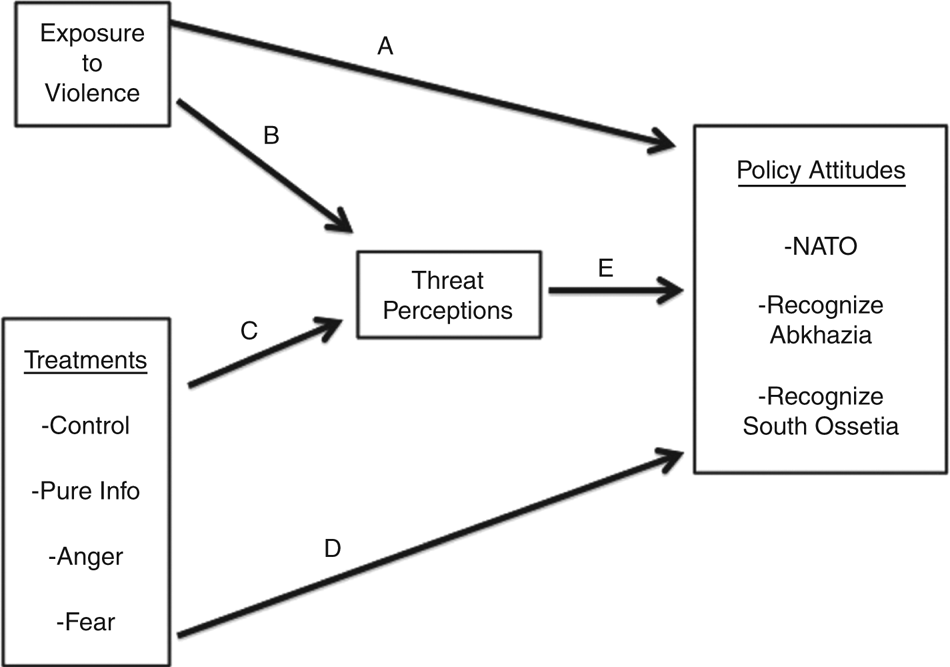
Past research would suggest that different experiences and emotions induce differential threat perceptions. In particular, the appraisal-tendency framework argues that anger should decrease threat perceptions, while fear should increase them (Han, Lerner, and Keltner Reference Han, Lerner and Keltner2007; Lerner and Keltner Reference Lerner and Keltner2001; Lerner et al. Reference Lerner, Gonzalez, Small and Fischhoff2003). Our survey experiment tests this proposed model shown in Figure 1. We first examine whether there is any correlation between perceptions of threat from Russia and foreign policy attitudes (pathway E in Figure 1). We then test whether exposure to violence and our experimental treatments of past Russian aggression influence the perceived threat from Russia (pathways B and C). Next, we test the effects of the treatments and exposure to violence on policy attitudes (pathways A and D). Finally we conduct mediation analysis to decompose how much of the effects of the treatments and exposure to violence are mediated via threat perceptions (pathway B through E, and pathway C through E).Footnote 21
Hypothesized causal chain

Our experiment tests the following hypotheses delineated below.Footnote 22
Hypothesis 1: Those exposed to higher levels of to violence will have higher perceptions of threat from Russia.
Hypothesis 2: Those exposed to higher levels of to violence will favor more hardline foreign policy towards Russia (more in favor of joining NATO), and take a harsher line towards the breakaway regions of South Ossetia and Abkhazia.
Hypothesis 3: Reminders about Russian actions and priming anger (Anger Treatment) will have differential effects relative to the other treatments – the Fear Treatment, Pure Information Treatment, as well the Control Condition.Footnote 23
Hypothesis 3A: Those who receive the Anger Treatment will have lower threat perceptions from Russia relative to the Fear Treatment, the Pure Information Treatment, as well as the Control Condition.
Hypothesis 3B: Those who receive the Anger Treatment will favor a harsher foreign policy towards Russia, and be less willing to recognize Abkhazia’s and South Ossetia’s independence relative to the Fear Treatment, the Pure Information Treatment, as well as the Control Condition.
4 Survey Design and Summary Statistics
The survey was fielded between October and November 2015 by the Caucasus Research Resource Center in Georgia (CRRC), a prominent research center that conducts the annual Caucasus Barometer survey.Footnote 24 Given our interest in exposure to past violence, our sample was designed to achieve geographic exposure to violence. We sampled across three geographic regions (strata): 1) Tbilisi, the capital and largest city, 2) Kutaisi, the third largest city in Georgia, and the location of the Georgian Parliament, and 3) those areas that were affected by the 2008 Russo-Georgian War (conflict-affected areas). Our sample was further restricted to ethnic Georgians.Footnote 25 Within each of these regions, we further oversampled areas that included IDP settlements. It is important to note that while our sample is representative within our given strata and PSUs, our sample was explicitly not nationally representative. Rather it was designed to efficiently achieve variation in exposure to conflict (IDPs and conflict-affected areas). Further discussion of our sample is contained in the Online Appendix (Table A.1 and Figure A.1).
Respondents were surveyed face to face. As part of a larger survey on political and corruption attitudes,Footnote 26 respondents were randomly assigned to one of four treatment conditions: 1) a pure control condition (Control); 2) a reminder about past and current Russian aggression (Pure Information Treatment); 3) a reminder about past and current Russian aggression designed to induce fear (Fear Treatment); and 4) a reminder about past and current Russian aggression designed to induce anger (Anger Treatment). Two important points about the treatment should be emphasized. First, the Anger and Fear Treatments explicitly build on the Pure Information Treatment, by including the same information about current and past Russian actions in the region, but also include an emotional induction, ‘Please describe and tell us what most makes you ANGRY/AFRAID about Russia’s actions’. Second, these emotion inductions are designed to induce the targeted emotion, and have been used extensive in psychology, political science, and economics (Albertson and Gadarian Reference Albertson and Gadarian2016; Callen et al. Reference Callen, Isaqzadeh, Long and Sprenger2014; Myers and Tingley Reference Myers and Tingley2016; Searles and Mattes Reference Searles and Mattes2015; Young Reference Young2016; Zeitzoff Reference Zeitzoff2018). The full wording of the treatments can be found in the Online Appendix.
Following the treatments, we then asked respondents their attitudes towards our five key dependent variables: 1) how much they consider Russia a threat to Georgia (Russia is a Threat); 2) how angry Russia’s foreign policy actions make them (Russia Angry); 3) whether they think Georgia should join NATO even if Russia threatens Georgia (Georgia Should Join NATO); 4) whether to reduce tensions with Russia Georgia should recognize an independent South Ossetia (Recognize South Ossetia); and 5) whether Georgia should recognize an independent Abkhazia (Recognize Abkhazia).
Given the role that psychological orientations have been shown to play in foreign policy (Kertzer et al. Reference Kertzer, Powers, Rathbun and Iyer2014; Rathbun et al. Reference Rathbun, Kertzer, Reifler, Goren and Scotto2016) we also measured individuals’ level of stress (Stress) and adherence to a culture of honor (Honor) (Nisbett and Cohen Reference Nisbett and Cohen1996).Footnote 27 Previous research finds that partisanship is an important determinant of foreign policy attitudes (Berinsky Reference Berinsky2007; Holsti Reference Holsti2004), so we also control for whether they support former Georgian President Mikheil Saakashvili. Saakashvili still remains a polarizing figure in Georgia politics, with his supporters favoring a more hardline foreign policy towards Russia (Saakashvili Support).Footnote 28
A key part of our research design is to understand how exposure to violence influences foreign policy attitudes. We measured exposure to violence in several ways. We compared individuals with official IDP status to those without IDP status (IDP). We also measured whether respondents knew someone who was murdered in Abkhazia or South Ossetia (Known Murder/Knew Someone Murdered). To construct a more experiential measure of exposure, we also created an index that summed whether individuals personally witnessed violence, were assaulted, extorted, knew someone who was murdered, etc. from the conflicts in South Ossetia and Abkhazia (Total War Exposure). We also disaggregated exposure by whether it came from South Ossetia (South Ossetia Exposure) or Abkhazia (Abkhazia Exposure). We also included region fixed effects, by controlling for whether the respondent lived in a conflict-affected region (one of our strata), or from Kutaisi (with Tbilisi being the base category). A list of the variables and how they are measured is provided in the Online Appendix.
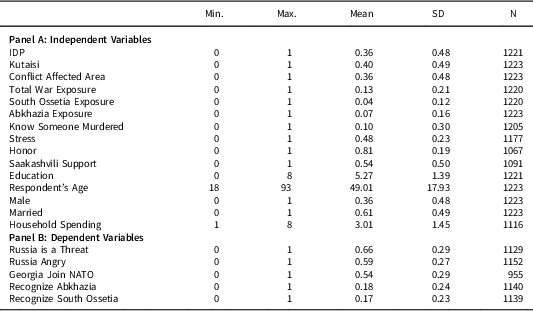
Table 1 (Panel A) presents the summary statistics for the independent variables. By design, about a third of our sample is from Con Affected areas, and a third of our sample is from Kutaisi and Tbilisi. We also oversampled IDPs, who make up a third of our sample as well.Footnote 29 Slightly over half of our respondents are Saakashvili supporters.
Summary statistics

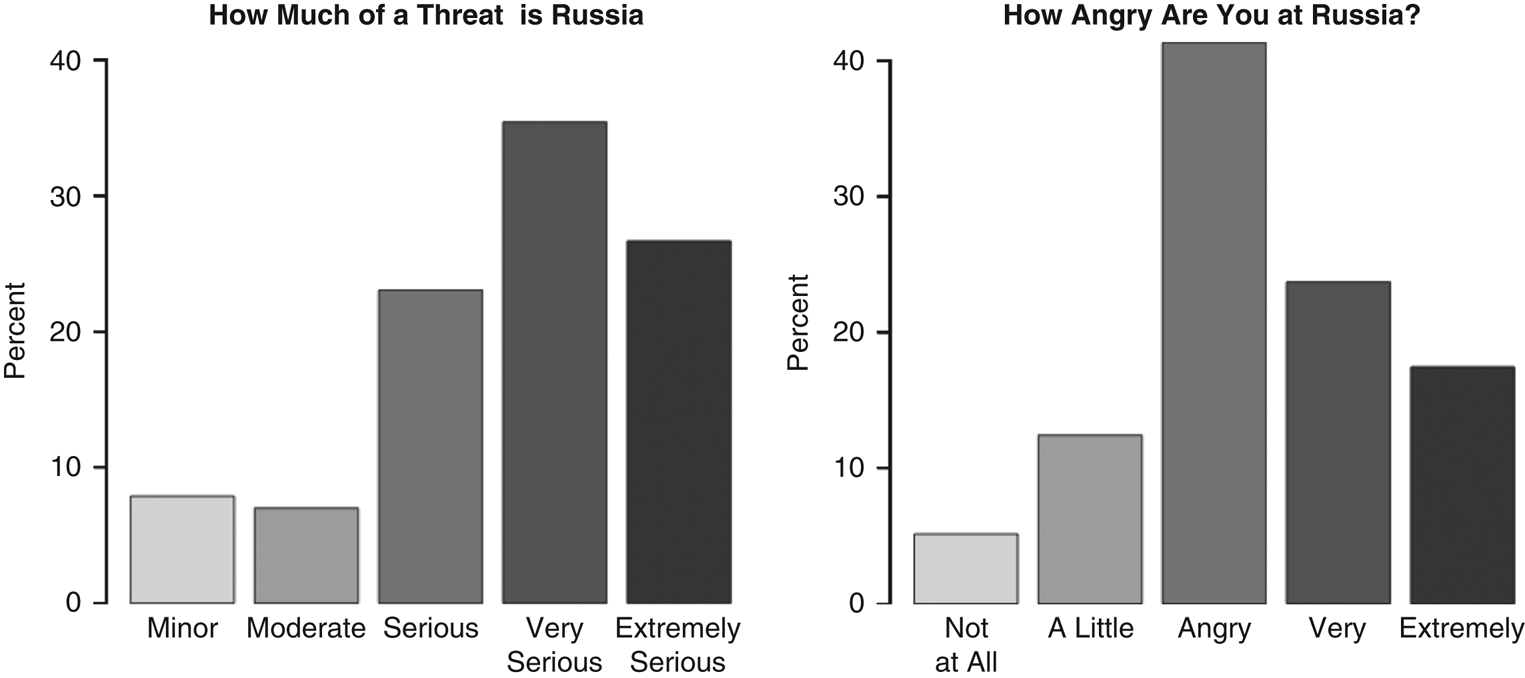
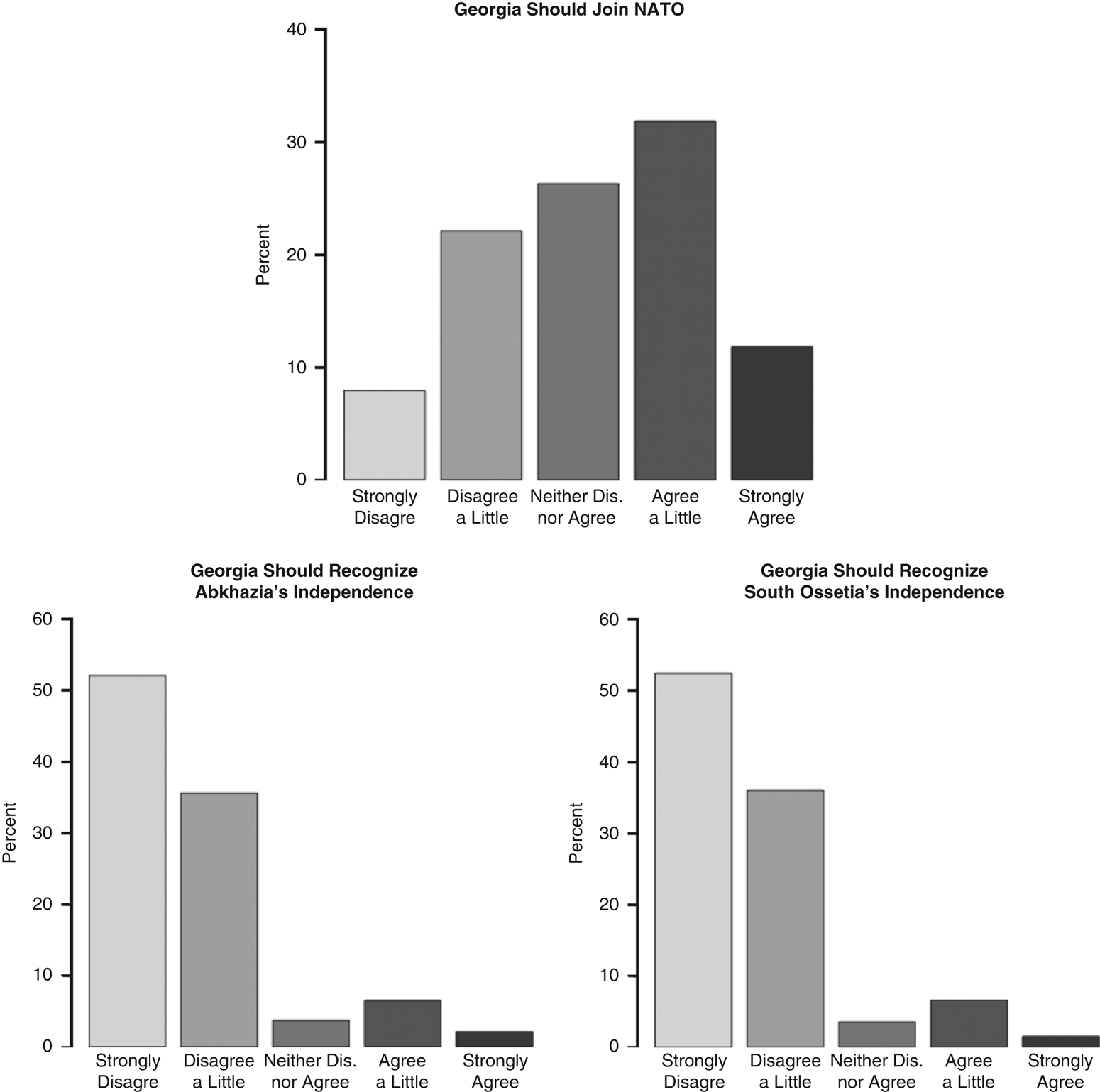
Figures 2 and 3 and Table 1 (Panel B) further shows that there is a fair amount of variation across our dependent variables.Footnote 30 In terms of emotions and threat perception, our average respondents view Russia as a very serious threat and are angry to very angry about Russia’s actions. In terms of policy, on average Georgians are supportive of Georgia joining NATO. Conversely, they are strongly opposed to recognizing both South Ossetia and Abkhazia as independent from Georgia, even if it were to reduce tensions with Russia.Footnote 31
Distribution of perceptions of threat and anger towards Russia

Distribution of attitudes on foreign policy preferences

Main Results
Our analysis proceeds as follows. We first explore how anger towards Russia (Russia Angry) and perceptions of threat (Russia Threat) are related to policy attitudes (joining NATO, and recognizing Abkhazia and South Ossetia as independent) and show that they are positively correlated. We then examine how exposure to violence and our treatments influence perceptions of threat and anger towards Russia. Next, we examine the effects of exposure to violence and our treatments on policy attitudes. Then we examine whether IDPs and non-IDPs respond differently to our treatments. Finally, we explore how past violence and our treatment effects on policy attitudes are mediated via anger towards and perceptions of threat of Russia.
All of our regressions are OLS with standard errors clustered at the voting-precinct level (the primary sampling unit). Our base regressions just include dummy variables to estimate average treatment effects (ATE). Others regressions include controls for geographic regions (Kutaisi and Conflict Affected areas), partisanship (Saakashvili support), explore various ways of measuring exposure to violence (IDP status, Total War Exposure, Known Murder, South Ossetia Exposure and Abkhazia Exposure), and include controls (Age, Sex, Marital Status, Education and Monthly Household Spending). To allow comparison of effect sizes, all of our key dependent variables and independent variables have been rescaled to lie between 0 and 1. Most of our results are presented graphically, additional regression results and robustness checks can be found in the Online Appendix.
Relationship Between Emotions and Attitudes
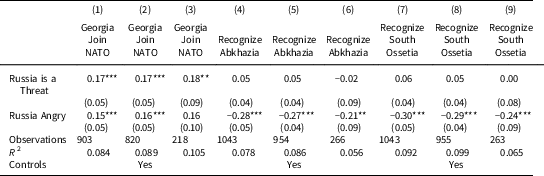
Previous research has found that threat and emotions, particularly anger, are powerful drivers of foreign policy attitudes. In Table 2 we see whether anger towards Russia and perceptions of threat of Russia are correlated with foreign policy attitudes. Columns 1–3 look at the correlations between anger and threat and joining NATO, columns 4–6 recognizing Abkhazia, and columns 7–9 recognizing South Ossetia. Since anger and threat, as well as policy attitudes, are all measured post-treatment (in that they were measured after respondents received our treatment), we also examine the correlation for only those respondents that were assigned to the Control Condition (columns 3, 6 and 9).
Correlations between emotions and support for different policies. Note that columns 3, 6 and 9 only contain respondents that are in the Control Condition

Standard errors in parentheses.
Controls include Age, Sex, Marital Status, Education, and Monthly Household Spending. Note standard errors clustered at the voting precinct-level (PSU).
*p < 0.10, **p < 0.05, ***p < 0.01.
Table 2 shows that anger (Russia Angry) and threat perceptions (Russia is a Threat) are strongly, and positively correlated with support for joining NATO (columns 1–3). This echoes previous findings that anger and threat can increase support for hardline foreign policy. Our findings hold even if when we only examine the control condition (column 3). Conversely, when examining attitudes recognition of independence of South Ossetia and Abkhazia (columns 4–9), we find that perceptions of threat from Russia are only weakly correlated with attitudes on independence. In contrast, anger is strongly positively correlated with harder-line attitudes against independence. This suggests that different foreign policies potentially have different emotional antecedents.
Table 2 establishes that anger and threat perception of Russia are correlated with policy attitudes (i.e. joining NATO versus recognition of independence of the separatist regions). Why the differential effects of anger and threat? We can only speculate, but it may be that NATO, as an alliance, is a way to manage the threat posed by Russia, whereas recognition of Abkhazia and South Ossetia stirs anger. Second joining NATO would be a new policy, whereas refusing recognition of Abkhazia and South Ossetia are the current status quo policies.Footnote 32
In the subsequent parallels we further disentangle the relationship between anger, threat and policy attitudes. We look at how exposure to violence and our treatments influence anger and perceptions of threat, and also how they influence these key policy attitudes.
Effect of the Treatments and Exposure to Violence on Anger and Threat
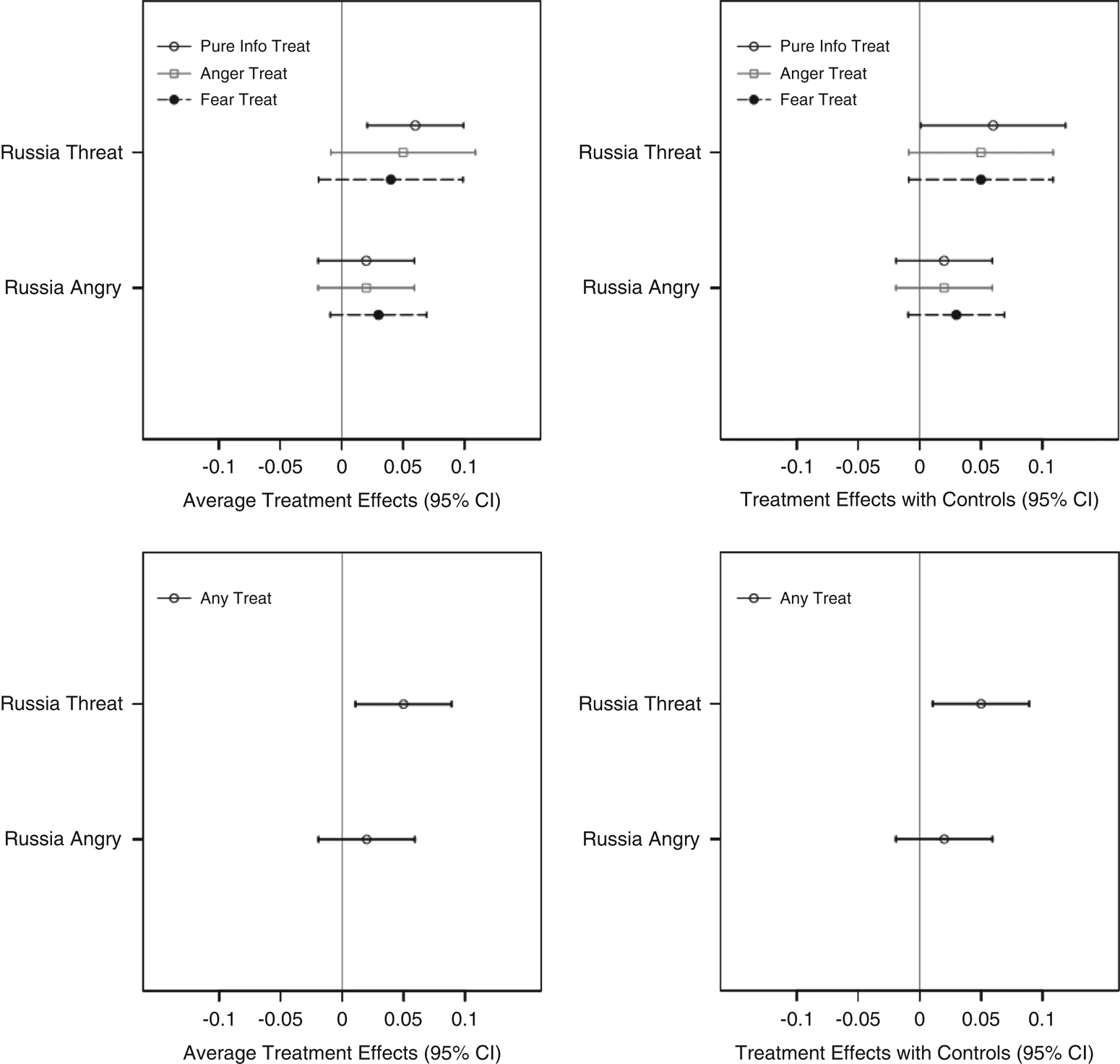
We first explore two key interrelated questions: how do reminders about past violence (our treatments) and actual exposure to violence influence perception of threat and anger? In Figure 4 we present results on the effects of our treatments on perceptions of Russia’s threat to Georgia (Russia Threat) and their anger at Russia (Russia Angry). The plots on the left-hand side are without controls, and those on the right include controls. Contrary to our hypotheses (H3), the Anger Treatment is not statistically different from the Fear Treatment or the Pure Information Treatment.Footnote 33 In fact all our treatments increase perceived threat relative to the Control Condition both with and without controls. In the bottom panel of Figure 4, we collapse the Fear, Anger and Pure Information treatments into a dummy variable (Any Treat). The effects are positive and statistically significant. The effect of receiving any one of the three treatments on perceptions of threat is as large as partisanship (being a Saakashvili supporter in Tables 1 and 2 in the Online Appendix).
Treatment effects on perceptions of threat and anger. Top plots include disaggregated treatments, while the bottom plots collapses all three treatments into a single dummy variable. Plots on the left side are average treatment effect (ATE), while those on the right side include controls (Kutaisi, conflict-affected, Saakashvili support, Age, Sex, Marital Status, Education and Monthly Household Spending). Based on regressions from Column 1 (no controls) and Columns 3 (with controls) from Tables 1, 2, 3 and 4 in Online Appendix

We also examine the effect of the treatments on respondents’ anger towards Russia’s foreign policy actions in Figure 4 (Russia Angry). Here are our findings are weaker. Again we find no statistical difference between the Anger, Fear or Pure Information Treatments. They all modestly increase anger levels, but the effects are not as strong or as significant as increased threat perception. The same is true when we collapse the treatments to a single dummy variable (Any Treat).
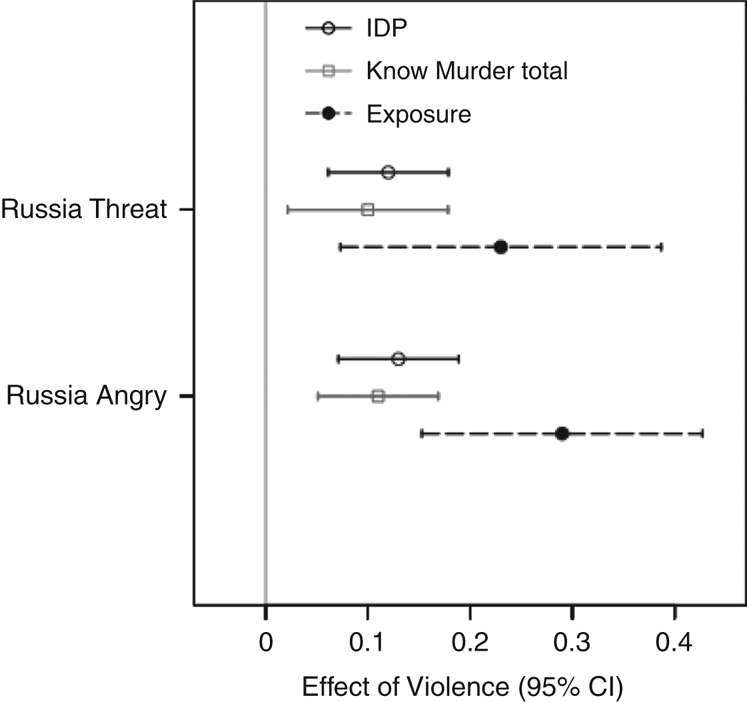
In Figure 5 we examine how different measures of exposure to violence are related to anger towards and threat perception of Russia. No matter how we measure exposure to violence, all of our exposure measures are associated with higher perceptions of threat (Russia Threat) and anger (Russia Angry) towards Russia. Whether comparing IDPs to non-IDPs (IDP), knowing someone who was murdered in South Ossetia or Abkahzia (Known Murder), or looking at an index of violence exposure across the conflict (Total War Exposure), they all increase perceptions of threat and anger.
Relationship between violence and perceptions of threat and anger. Based on regressions shown in Column 3 (IDP), Column 5 (Known Murder), and Column 6 (Total Exposure) in Table 2 (Russia Threat) and Table 4 (Russia Angry) of Online Appendix

In sum, the effects are strong and consistent. Receiving any one of the treatments that remind respondents about Russian aggression in the region strongly increases threat perception, and the substantive effects are as large as the effect of partisanship. Its effects on anger towards Russia are still positive, but comparatively weaker. This is contrary to our hypothesis that the different treatments would induce distinct effects on threat and anger (H3A). Yet we do find support for H1. Regardless of how it is measured – IDP status, knowing someone who was murdered, or the index of violence exposure – exposure to violence increases anger toward Russia and heightens threat perceptions.
Effect of the Treatments and Exposure on Policy Attitudes
How do reminders about Russian aggression (treatments) and exposure to political violence affect key foreign policy attitudes? These attitudes include support for Georgia joining NATO even if Russia threatens it militarily, and recognizing Abkhazia’s and South Ossetia’s independence to reduce tensions with Russia.
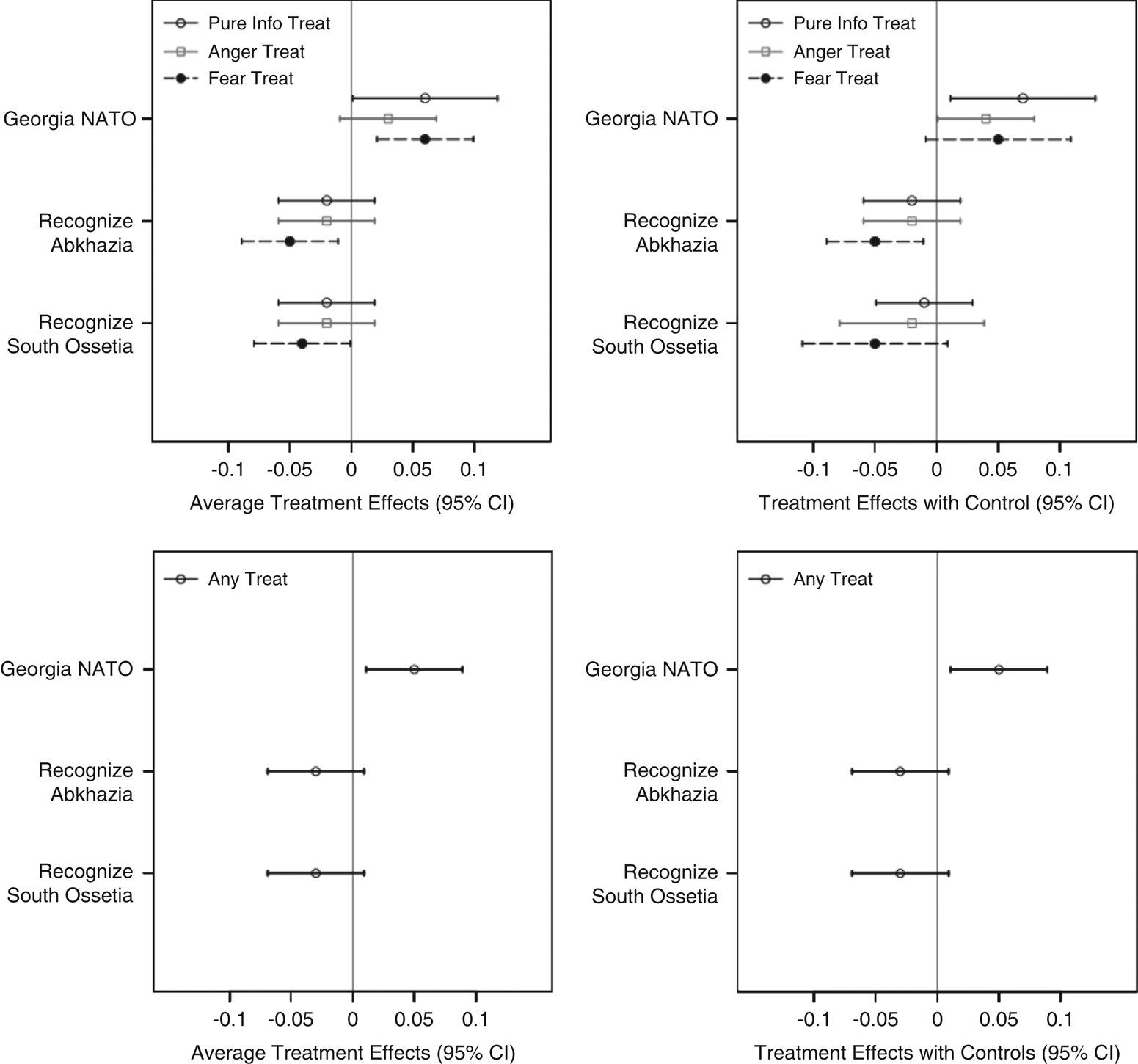
In Figure 6 we examine the effects of reminders about Russian aggression via the Anger Treatment, Fear Treatment and Pure Information Treatment relative to the Control Condition on foreign policy attitudes. The right panel of Figure 6 includes controls. Similar to the findings from the effects of the treatments on anger and perceptions of threat (Figure 4), and contrary to our hypothesis (H3B), the treatments are not statistically different from each other. In the bottom panel of Figure 6 we collapse the treatments to a single dummy treatment (Any Treat). Receiving any treatment reminding about Russian aggression strongly increases support for joining NATO. This is true regardless of whether the treatments are disaggregated (top panel) or collapsed (bottom panel), or the raw average treatment effects (left panel) or those with controls (right panel). The treatments also influence attitudes on independence of Abkhazia and South Ossetia. While not as large an effect, the findings are consistent with the treatments causing respondents to support a more hardline foreign policy. Receiving any one of the treatments reduces support for recognition of Abkhazia and South Ossetia. In sum, the treatments all increase support for a tougher foreign policy stance towards Russia and the breakaway regions.
Treatment effects on attitudes towards NATO, recognizing South Ossetia and Abkhazia. Top plots include disaggregated treatments, while the bottom plots collapse all three treatments into a single dummy variable. Plots on the left side are average treatment effect (ATE), while those on the right side include controls (Kutaisi, Conflict Affected, Saakashvili Support, Age, Sex, Marital Status, Education and Monthly Household Spending). Based on regressions from Column 1 (no controls) and Columns 3 (with controls) from Tables 5, 6, 7, 8, 9 and 10 (Online Appendix)

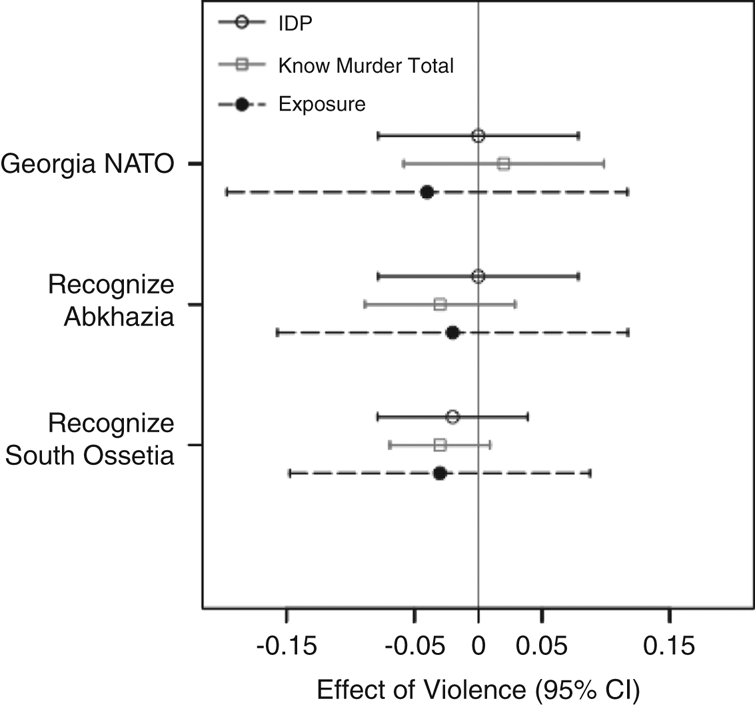
Figure 7 examines how exposure to violence influences attitudes on foreign policy. The effects here are quite different than those on anger and threat (Figure 5). Neither IDP status (IDP), knowing someone killed in Abkhazia or South Ossetia (Known Murder) nor an index measure of violence (Total Exposure) have any effect on foreign policy attitudes. It also should be noted that these findings differ from other research that has found that exposure to violence increases hardline policies, and from our own hypothesis (H2).
Relationship between violence on attitudes towards NATO, recognizing South Ossetia and Abkhazia. Based on regressions shown in Column 3 (IDP), Column 5 (Known Murder) and Column 6 (Total Exposure) in Table 6 (Georgia NATO), Table 8 (Recognize Abkhazia) and Table 10 (Recognize South Ossetia) of Online Appendix

The findings suggest that reminders of past violence (our treatments) have distinct and strong effects on policies relative to exposure to violence. All of the treatments increase support for a hardline foreign policy. Yet exposure to violence, while increasing perceptions of threat from and anger toward Russia, does not have an effect on policy attitudes. In the subsequent parallels we compare the effects of our treatments on IDPs versus non-IDPs, and also explore whether the effects of the treatments and exposure to violence on policy attitudes are mediated by perceptions of threat and anger.
Comparing Treatment Effects of IDPs Versus Non-Idps
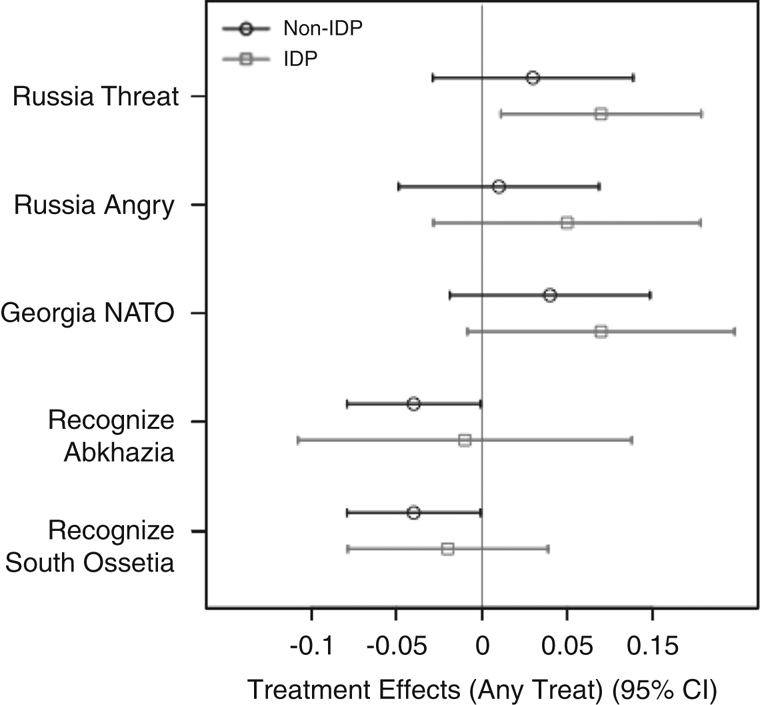
Perhaps those exposed to higher levels of violence responded differently to the treatments relative to those that are exposed to lower levels? To answer this question, in Figure 8 we compare treatment effects (receiving any treatment) for IDPs relative to non-IDPs for both anger and perceptions of threat towards Russia, as well as foreign policy attitudes. Whether looking at anger and perceptions of threat (Russia Threat and Russia Anger) or policy attitudes (Georgia NATO, Recognize Abkhazia and Recognize South Ossetia), there are no statistical differences in the response of IDPs and non-IDPs to our treatment. Thus it does not appear that exposure to violence significantly affects the salience of reminding individuals about Russian aggression.
Treatment effects on IDPs versus non-IDPs. Note it shows the effect of receiving any one of the treatments comparing IDPs to non-IDPs. Coefficient results are drawn from Panel B in Table 11

Mediation Effects
Our theory and previous research argue that threat perception is a key mechanism that connects exposure to violence and emotions to foreign policy attitudes. We started off our analysis showing the correlation between anger toward and threat from Russia with policy attitudes (Table 2). We also examined the (total) effects of exposure to violence and our treatments on emotions (threat and anger) and foreign policy attitudes. A key question remaining is how do the treatments and exposure to violence influence foreign policy attitudes via perceptions of threat (and anger), i.e. pathways B and C via E from Figure 1? Do threat and anger mediate the relationship between our key independent variables (treatments and exposure to violence) and foreign policy attitudes? To test this, we use the general approach to mediation in Imai, Keele, and Tingley (Reference Imai, Keele and Tingley2010).
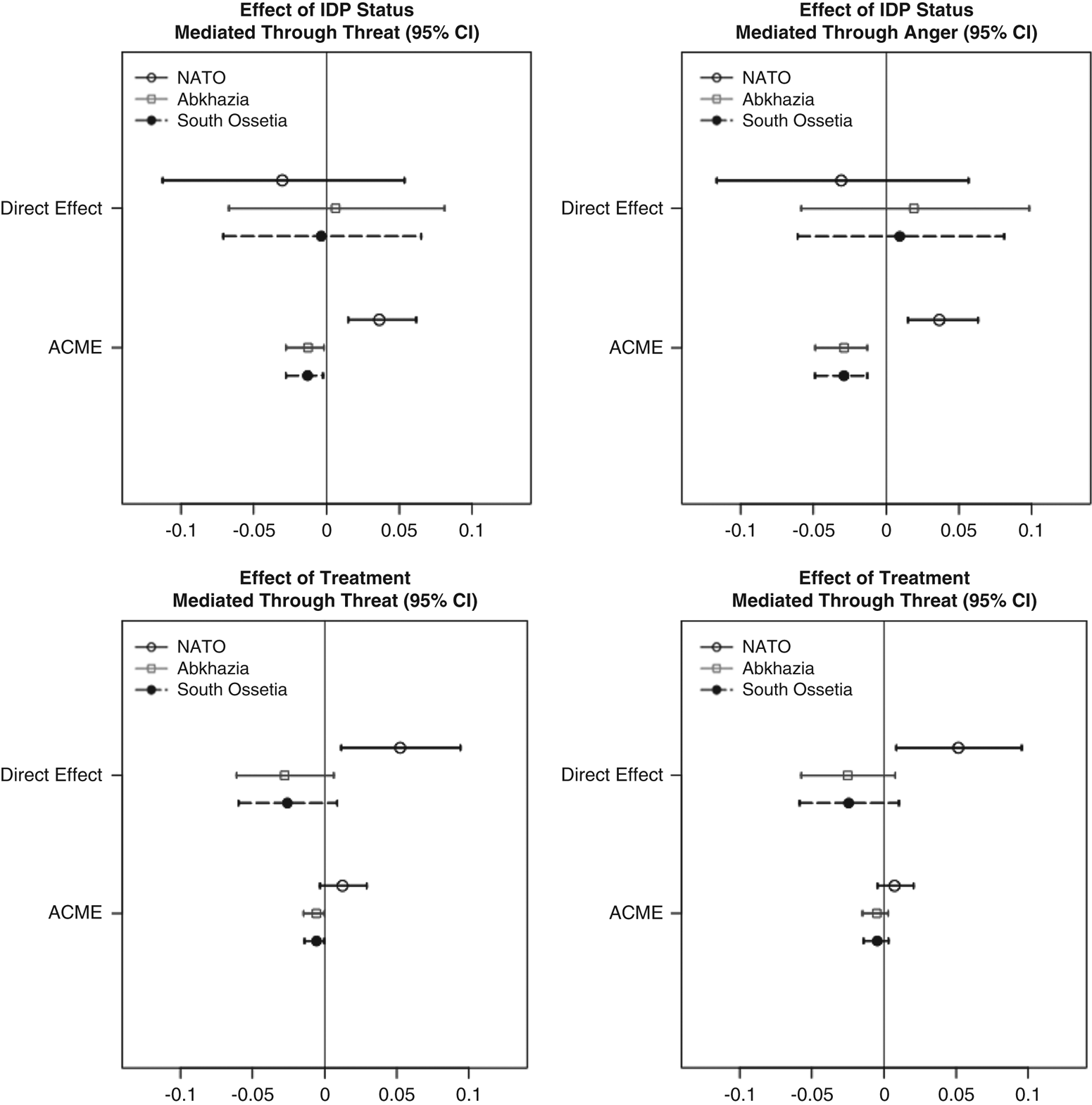
In Figure 9 we present the results of mediation analysis. The top panel examines the effects of IDP status on policy attitudes (support for joining NATO, and recognizing Abkhazia’s and South Ossetia’s independence) mediated via perceptions of threat (top left) and anger (top right). The direct effect is the effect of the IDP status on policy outcomes through pathways apart from threat perception or anger, while the average causal mediation effect (ACME) is the effect of IDP status through anger towards Russia (left) and perceptions of threat (right).
Mediation effects. Top panel looks at the effect of victimization (IDP status) as mediated through perceptions of Russian threat (left), and anger at Russia (right) on attitudes toward NATO, recognition of Abkhazia and recognition of South Ossetia. Bottom panel looks at the effect of the treatment as mediated through as mediated through perceptions of Russian threat (left), and anger at Russia (right) on attitudes toward NATO, recognition of Abkhazia and recognition of South Ossetia. All analyses include the following variables in both the first stage and second stage equations (any treatment, IDP status, Kutaisi, conflict-affected, Saakashvili support, Age, Sex, Marital Status, Education and Monthly Household Spending). Direct and average causal mediation effects (ACME) were calculated using 1,000 simulations using the medeff package in STATA (Imai, Keele, and Tingley Reference Imai, Keele and Tingley2010)

The direct effects of IDP status on policy outcomes are largely zero, echoing the findings from Figure 7 that there is no significant total effect between victimization and policy outcomes.
Yet the analysis shows that there is an indirect effect of exposure to violence on policy outcomes. The effects of victimization on policy preferences are mediated via anger and threat (ACME effect). Increased threat stemming from being an IDP increases support for joining NATO, and reducing support for recognizing Abkhazia and South Ossetia (top left). The effects of IDP status on anger (top right) largely match the effects of threat. These findings suggest that the effects of exposure to violence on policy outcomes operate through anger and threat, and in doing so, increase support for a hardline foreign policy. What does it mean for an effect to be only mediated (i.e. no significant total effect)? It points to the fact that victimization may only affect policy indirectly by changing emotions and cognitive appraisals (increased threat perceptions and anger), which in turn harden policy attitudes.Footnote 34
In the bottom plot, we examine the effects of the treatment on policy attitudes mediated via perceptions of threat from Russia (bottom left) and anger (bottom right). In contrast to the effects of exposure to violence (top), the direct effect of receiving any of the treatments significantly increases support for joining NATO, and reduces support for Akbhazia’s and South Ossetia’s independence. Conversely, the effect mediated through threat perceptions and anger (ACME) is much smaller, suggesting the treatments effects on threat and anger and are not driving the effect on foreign policy attitudes.
The mediation findings provide further nuance to how emotions and reminders of past violence influence attitudes. Given the somewhat strong assumptions necessary to make causal claims with mediation, it is important to be somewhat cautious interpreting these results.Footnote 35 Yet the results do suggest that exposure to violence and our treatments have distinct effects on foreign policy attitudes. Even though our treatments increase anger and threat (Figure 4), their effects on policy are not mediated via emotions. Rather our treatments all influence policy through an unmeasured pathway. The fact that our Pure Information Treatment has the same effect as the Anger and Fear Treatments (relative to the Control Condition) – boosting support for a harsh foreign policy – would suggest that our treatments effects are not driven by threat perceptions and anger. In contrast exposure to violence increases threat perceptions and anger (Figure 5), and its effect on policy attitudes is largely driven indirectly via mediation.
Substantive Interpretation
At a substantive level our findings question past research and our own initial hypotheses about the distinct roles of emotions (anger and fear) on threat perceptions and subsequent attitudes. Our treatments, whether designed to induce anger (Anger Treatment), fear (Fear Treatment) or just provide information (Pure Information Treatment), all increase anger towards and perceived threat from Russia, and there was no statistical difference between the treatments. The treatments also lead respondents to support a harsher foreign policy towards Russia. Again these findings go against our initial hypotheses that anger and fear would have distinct effects. This may be because the reminders of Russian aggression swamped the emotionally distinct components of our treatments. The lack of any mediated effects for our treatment via emotions on foreign policy attitudes would support this conclusion, but more research is needed to disentangle this effect.Footnote 36
Our findings on exposure to violence provide partial support for our hypotheses. We do find that exposure to violence increases perception of threat from and anger towards Russia. Yet we do not find a direct relationship between exposure to violence and foreign policy attitudes. Rather, it appears that the exposure to violence affects policy attitudes only indirectly via threat perceptions and anger. The finding that exposure to violence influences hardline attitudes largely through threat perceptions also echoes findings from the Israeli–Palestinian conflict (Hirsch-Hoefler et al. Reference Hirsch-Hoefler, Canetti, Rapaport and Hobfoll2016). Given the strong assumptions that undergird causal mediation we are hesitant to put too much weight on the mediation-only findings. But taken with the experimental and regression-based findings (Figures 4–7) they suggest that exposure to violence and reminders of past violence influence foreign policy attitudes in distinct ways.
A key unanswered question is what explains these disparate findings? Why does exposure to violence directly affect emotions and threat perceptions, but only indirectly affect attitudes? Why do reminders of past Russian aggression (our treatments) have such strong direct effects on attitudes? It is somewhat speculative, but we believe this is connected to other research that shows that victimization increases political participation and ingroup altruism, possibly due to these lingering emotional sentiments (Bauer et al. Reference Bauer, Blattman, Chytilová, Henrich, Miguel and Mitts2016; Blattman Reference Blattman2009). Yet those exposed to violence, especially IDPs, are more likely to be aware of the costs of any hardline policies.Footnote 37 In contrast, the treatments, by reminding people of Russian aggression, may be emphasizing the need to take policy action to manage this threat (joining NATO) and stay the course on South Ossetia and Abkhazia, and maintain non-recognition. Future research should attempt to disentangle what drives the differences between direct exposure to past violence and reminders of that violence on policy attitudes.
Conclusion
Using a survey experiment we examined how exposure to conflict and reminders about past and current aggression influence foreign policy attitudes. We have five key findings. First, we show that anger and threat perceptions are positively related to foreign policy attitudes. Second we show that exposure to violence increases perceptions of threat from and anger towards Russia. Contrary to our hypotheses, simply reminding respondents about Russian aggression increases perceptions of threat, and to a lesser extent anger. Third, our treatments further increase support for joining NATO, and decrease support for recognizing the breakaway regions of South Ossetia and Abkhazia as independent from Georgia. Fourth, contrary to previous research, and our own hypotheses, we do not find that exposure to violence has a direct effect on foreign policy attitudes. Finally, our mediation analysis suggests that exposure to violence and reminders of Russian aggression both increase support for hardline policies, albeit through different pathways. Reminders of Russian aggression increase support for hardline policies through channels other than anger and threat. Conversely, exposure to violence increases support for hardline foreign policy mostly via increased anger and threat perceptions (an emotional level).
There are several important implications from our findings. They bring nuance to the recent literature on the effects of exposure to violence. Many scholars have written how exposure to violence influences political behavior and attitudes (Bauer et al. Reference Bauer, Blattman, Chytilová, Henrich, Miguel and Mitts2016; Getmansky and Zeitzoff Reference Getmansky and Zeitzoff2014; Hersh Reference Hersh2013). We show that exposure to violence can increase anger and perceptions of threat and, in turn, can have an indirect effect (via anger and threat) on policy attitudes. This suggests that the causal chain between exposure to violence and political attitudes travels via emotions. Scholars and policy makers should not ignore the importance of emotions on political violence and ‘black-box’ the causal process of exposure to violence.
Our experimental findings show that reminders to the public about past and current aggression from external rivals can harden foreign policy attitudes. From a policy point of view this is particularly important. Given the importance of intractable conflicts, frozen conflicts and enduring rivalries that undergird much of the IR literature (Bar-Tal Reference Bar‐Tal2000; Goertz and Diehl Reference Goertz and Diehl1993; Petersen Reference Petersen2002), we provide two mechanisms through which these conflicts can endure. Hardline leaders and political entrepreneurs can use past conflicts as a rallying cry to strengthen their position and increase support for tougher foreign policies towards adversaries. Reminding the public of actions by more powerful adversaries leads to increased feelings of threat and anger, which further can increase support for a more confrontational foreign policy. Even in a militarily weak state such as Georgia, these feelings do not increase support for actions that may defuse the situation. Rather they spur a more confrontational foreign policy and taking actions that can ameliorate the threat (NATO), thus providing a mechanism for the continuation of the conflict.
Our research also sheds light on recent political trends in Eastern Europe and elsewhere. Even when the conflict in question has been settled, or occurred several generations in the past, debates over historical memories remain salient in politics. Many former Soviet and Eastern Bloc countries have begun to revisit historical legacies of violence during World War II and Communist rule. Poland passed a law recently that makes it a crime to accuse Poland of participation in Nazi crimes,Footnote 38 leading to tensions with Israel and the EU.Footnote 39 In Ukraine, politicians have considered a law making it a crime to deny that the Soviet famine 1932–3 (known as the Holodomor in Ukraine) was genocide, drawing the ire of Russia.Footnote 40 Many of the tensions in the South Korea and Japan stem from violence committed during Japan’s occupation of Korea (1910–45), and present-day failure to acknowledge it.Footnote 41 Our findings suggest that these reminders exhibit a powerful effect on the public. Strategic politicians are aware of this and likely make use of historical grievances for their own political gain.Footnote 42
Future research should further investigate the separate effects of emotions and exposure to violence on conflict attitudes and behavior. It should also pay attention to how leaders use these appeals strategically for their own benefit. Leaders’ strategic use of appeals to garner support and sway foreign policy is a crucial next step to better understanding conflicts, and potentially finding strategies to bring them to a peaceful resolution.
Supplementary Material
Replication data files are available in Harvard Dataverse at https://doi.org/10.7910/DVN/QS0CDY and the online appendix at https://doi.org/10.1017/S0007123418000479
Acknowledgements
We would like to thank the Caucasus Research Resource Centers (CRRC) for their excellent research assistance and implementation of the survey. We would also like to thank seminar participants at Harvard University, Yale University, and Stanford University for comments on a previous version of the article.