INTRODUCTION
The Santa Catarina coast located in southern Brazil, where there is a transition from warm tropical to colder water conditions, is regarded as a boundary to tropical marine fauna distribution. The area has been reported as a limit zone to some reef-fish species (Floeter et al., Reference Floeter, Guimarães, Rocha, Ferreira, Rangel and Gasparini2001), and, during the harsh years with very low temperature, the survival of many tropical species may be compromised (Barneche et al., Reference Barneche, Anderson, Floeter, Silveira, Dinslaken and Carvalho-Filho2009). Seasonal intrusion of South Atlantic central waters can go up to 20 m in depths (Carvalho et al., Reference Carvalho, Schettini and Ribas1998). The interaction of Subantarctic Shelf Waters transported by the Patagonian Current with Tropical and Subtropical Central Waters carried by the Brazil Current allow the mixing of tropical and temperate species in the area. Therefore, the region is considered to be a faunal transition zone, reinforced by the affinity of decapod species from the cold Argentinean coast with the Brazilian central coast until 23oS (Boschi, Reference Boschi2000).
Marine decapod biodiversity worldwide is threatened by fishing activities (Costello et al., Reference Costello, Coll, Danovaro, Halpin, Ojaveer and Miloslavich2010). They are one of the most species-rich groups of crustacean (Martin & Davis, Reference Martin and Davis2001), and an important group of the sublittoral benthic macrofauna on rocky reefs (Alves et al., Reference Alves, Cobo and Melo2006). Brachyuran crabs and stomatopods are active predators. They are also responsible for detritus recycling (Correa, Reference Correa1986; Spivak, Reference Spivak1997). Brachyuran crabs which act as an important predator on phytal ecosystems (Dubiaski-Silva & Masunari, Reference Dubiaski-Silva and Masunari2008), are also food items of top chain reef fishes and octopuses (Machado et al., Reference Machado, Daros, Bertoncini, Hostim-Silva and Barreiros2008; Leite et al., Reference Leite, Haimovici and Mather2009). Thus, they are good indicators of biodiversity in rocky shores (Smith, Reference Smith2005). The review by Lana et al. (Reference Lana, Camargo, Brogim and Isaac1996) showed that benthic crustaceans were poorly studied on the Santa Catarina coast. In this area, 86 species of Brachyura crabs and 27 species of Anomura have been observed by Melo Reference Melo(1996, Reference Melo1999) on the rocky shores, and at the continental shelf; while only nine species of stomatopods were reported (Gomes-Corrêa, Reference Gomes-Corrêa and Young1998). Knowledge about lobsters in Brazilian waters is related mainly to fishery important species (Fonteles-Filho, Reference Fonteles-Filho and Haimovici2007). 15 species of Paluniroidea lobsters were reported from the Brazilian coast, but only one was recorded in Santa Catarina State (Melo, Reference Melo1999). Nevertheless, the presence of other species was recorded by older fishermen or through illegal capture in Marine Protect Areas (MPAs) (Marcelo Kammers, personal communication).
A recent study in the MPA of Arvoredo Archipelago, southern Brazil, demonstrated eight new records of brachyurans and two of anomurans among 31 species observed (Bouzon & Freire, Reference Bouzon and Freire2007). New reports of invertebrates in the Arvoredo Archipelago MPA are increasing with current research (Rocha et al., Reference Rocha, Moreno and Metri2005; Bouzon & Freire, Reference Bouzon and Freire2007; Bouzon, Reference Bouzon2011). The increase in species richness had been associated with the weak amount of baseline studies in the area (authors, personal observations). However, this area is potentially fit for the ‘tropicalization process', i.e. the pole-ward migration of warm water acclimated species. Present investigations into the influence of global warming in the marine ecosystem can predict an increase of tropical species richness in communities at temperate latitudes since these waters may become suitable for them (Parmesan & Yohe, Reference Parmesan and Yohe2003; Bianchi, Reference Bianchi2007; Zenetos et al., Reference Zenetos, Pancucci-Papadopoulou, Zogaris, Papastergiadou, Vardakas, Aligizaki and Economou2009). Therefore, continuous studies on this region, monitoring the crustacean biodiversity are very important as the results could be signs of global warming effects. This study investigated the new crustaceans' records for this important South Atlantic zone.
MATERIALS AND METHODS
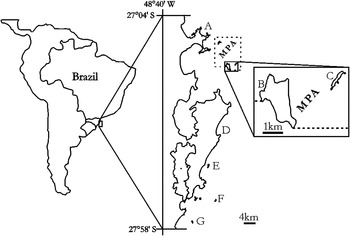
Samples were conducted between the years 2007 and 2010 in seven different sites in Santa Catarina State, Brazil: Arvoredo Island (27°16′S 48°22′W) and Deserta Island (27°15′S 48°19′W) inside Arvoredo MPA; Moleques do Sul Island (27°50′S 48°25′W); Prainha da Barra (27°34′S 48°25′W); Ribeiro beaches (27°08′S 48°29′W); Coral Island (27°56′S 48°31′W) and Armação Beach (27°44′S 48°29′W) (see Figure 1). Crustaceans were sampled by non-destructive visual census or by manual capture with autonomous diving (SCUBA) in the rocky bottom, between 5 and 12 m depth. In the calcareous algal bed of the Rancho Norte site (27°17′S 48°22′W) in Arvoredo Island, crustaceans were collected by SCUBA diving between 5 and 15 m depth, together with the algal rhodoliths. Only in the Coral Island and Armação Beach were the samples obtained by a fishing trawler over the 18 m sand bottom. Afterward, the collected crustaceans were identified at the species level following the identification methods used by Melo Reference Melo(1996, Reference Melo1999) and Correa (Reference Correa1986). Carapace width minimum, carapace width maximum and carapace length are denoted by min. CW, max. CW and CL, respectively. The specimens are all deposited in the Crustacea collection of the ECZ/Laboratório de Crustáceos e Plâncton, Universidade Federal de Santa Catarina, Florianópolis, Brazil (Coleção ECZ/ LCP/UFSC).
Map of the coastal islands of Santa Catarina State and sampling sites: (A) Ribeiro Beach; (B) Rancho Norte at Arvoredo Island; (C) Deserta Island; (D) Prainha da Barra Beach; (E) Armação Beach; (F) Moleques do Sul Island; (G) Coral Island. The dashed line indicates the Arvoredo Marine Biological Reserve (Marine Protected Area, (MPA)).

RESULTS
The 15 crustacean species recorded from the Santa Catarina coast are as follows:
SYSTEMATICS
Order STOMATOPODA Latreille, 1817
Suborder UNIPELTATA Latreille, 1825
Superfamily GONODACTYLOIDEA Giesbrecht, 1910
Family GONODACTYLIDAE Giesbrecht, 1910
Genus Neogonodactylus Manning, 1995
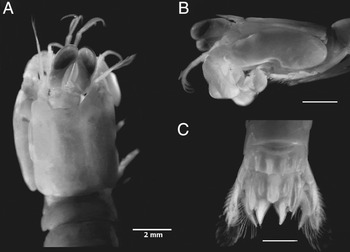
Neogonodactylus bredini (Manning, 1969)
(Figure 2A–C)
Neogonodactylus bredini. Male specimen from Rancho Norte (carapace length: 4.6 mm): (A) dorsal view of carapace; (B) lateral view of carapace; (C) telson in dorsal view. Scale bars: 2 mm.

MATERIAL EXAMINED
10 males, 5 females, 2 juveniles (ECZ/LCP/UFSC/63), min. CW 11.51 mm; max. CW 34.82 mm. Rancho Norte; 5, 10 and 15 m depth, coll. February and September 2008.
REMARKS
The southernmost occurrence of this mantis shrimp was reported from the south-eastern coast of Brazil, Rio de Janeiro State (23°13′S 44°12′W) (Young & Serejo, Reference Young, Serejo, Dutra, Allen, Werner and McKenna2005). Range expansion: 454 km from its last known limits.
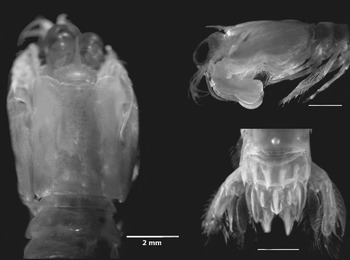
Neogonodactylus lacunatus (Manning, 1966)
(Figure 3A–C)
Neogonodactylus lacunatus. Female specimen from Rancho Norte. (carapace length: 4.12 mm): (A) dorsal view of carapace; (B) lateral view of carapace; (C) telson in dorsal view. Scale bars: 2 mm.

MATERIAL EXAMINED
2 males, 10 females, (ECZ/ LCP/UFSC/62), min. CW 11.93 mm; max. CW 32.99 mm, Rancho Norte; 5, 10 and 15 m depth, coll. February and September 2008.
REMARKS
The previous report of this mantis shrimp points to south-eastern coast of Brazil, Rio de Janeiro State (23°13′S 44°12′W) (Young & Serejo, Reference Young, Serejo, Dutra, Allen, Werner and McKenna2005). Range expansion: 454 km from its last known limits.
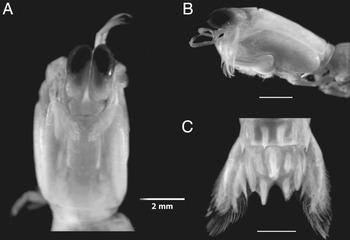
Neogonodactylus torus (Manning, 1969)
(Figure 4A–C)
Neogonodactylus torus. Female specimen from Rancho Norte (carapace length 4.12 mm): (A) dorsal view of carapace; (B) lateral view of carapace; (C) telson in dorsal view. Scale bars: 2 mm.

MATERIAL EXAMINED
1 female, CL 4.12 mm, (ECZ/ LCP/UFSC/61), Rancho Norte; 5 m depth, coll. February 2008.
REMARKS
The southernmost range of this species on the Brazilian coast was the north-eastern coast of Brazil, Bahia State (17°05′S 38°40′W) (Young & Serejo, Reference Young, Serejo, Dutra, Allen, Werner and McKenna2005). Range expansion: 1140 km from its last known limits.
Order DECAPODA Latreille, 1802
Suborder PLEOCYEMATA Burkenroad, 1963
Infraorder ANOMURA MacLeay, 1838
Superfamily GALATHEOIDEA Samouelle, 1819
Family PORCELLANIDAE Haworth, 1825
Genus Megalobrachium Stimpson, 1858
Megalobrachium soriatum (Say, 1818)
(Figure 5A)
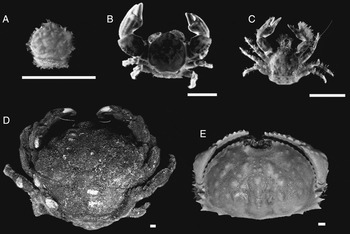
Five new occurrences of decapod crabs recorded at Santa Catarina State coast between 2007 and 2010: (A) Megalobrachium soriatum (Say, 1818), female, carapace width (CW) 2.54 mm; (B) Megalobrachium roseum (Rathbun, 1900), male, CW 6.30 mm; (C) Porcellana brasiliensis (Rodrigues da Costa, 1968), male, CW 4.14 mm; (D) Dromia gouveai Melo & Campos, Reference Melo and Campos1999, female, CW 99.54 mm; (E) Calappa ocellata Holthuis, 1958, male, CW 76.70 mm. Scale bars: 5 mm.

MATERIAL EXAMINED
4 females, (ECZ/ LCP/UFSC/64), min. CW 1.65 mm; max. CW 3.52 mm, Rancho Norte; 5 and 10 m depth, coll. September 2008.
REMARKS
The previous report of this anomuran points to the south-eastern coast of Brazil, São Paulo State (23°44′S 45°01′W) (Young & Serejo, Reference Young, Serejo, Dutra, Allen, Werner and McKenna2005). Range expansion: 397 km from its last known limits.
Megalobrachium roseum (Rathbun, 1900)
(Figure 5B)
MATERIAL EXAMINED
1 male, (ECZ/ LCP/UFSC/66), CW 6.34 mm, Prainha da Barra; 5 m depth, coll. March 2010.
REMARKS
The previous report of this anomuran points its range to the south coast of Brazil, Paraná State (25°51′S 48°32′W) (Masunari & Dubianski-Silva, Reference Masunari and Dubiaski-Silva1998). Range expansion: 203 km from its last known limits.
Genus Porcellana Lamarck, 1801
Porcellana brasiliensis (Rodrigues da Costa, 1968)
(Figure 5C)
MATERIAL EXAMINED
1 male, (ECZ/ LCP/UFSC/67), CW 4.59 mm, Ribeiro Beach; 5 m depth, coll. November 2009.
REMARKS
The latest record in the scientific literature of this anomuran crab range is from the São Paulo coast (23°59′S 46°22′W), Brazil (Micheletti-Flores & Negreiros-Fransozo, Reference Micheletti-Flores and Negreiros-Fransozo1999). Range expansion: 405 km from its last known limits.
Order DECAPODA Latreille, 1802
Suborder PLEOCYEMATA Burkenroad, 1963
Superfamily DROMIOIDEA de Haan, 1833
Family DROMIIDAE, de Haan, 1833
Genus Dromia Weber, 1795
Dromia gouveai Melo & Campos, Reference Melo and Campos1999
(Figure 5D)
MATERIAL EXAMINED
1 female, (ECZ/ LCP/UFSC/70), CW 86.43 mm, Armação Beach; 18 m depth, coll. September 2010.
REMARKS
This species was reported from São Pedro and São Paulo Archipelago (00°55′N 29°21′W), Bahia State (14°46′N 39°01′W), north-eastern coast of Brazil and São Paulo State (23°59′S 46°22′W) south-eastern coast of Brazil (Melo & Campos, Reference Melo and Campos1999). Range expansion: 390 km from its last known limits.
Order DECAPODA Latreille, 1802
Suborder PLEOCYEMATA Burkenroad, 1963
Superfamily CALAPPOIDEA Milne Edwards, 1837
Family CALAPPIDAE Milne Edwards, 1837
Genus Calappa Weber, 1795
Calappa ocellata Holthuis, 1958
(Figure 5E)
MATERIAL EXAMINED
1 male, (ECZ/ LCP/UFSC/59), CW 59.57 mm, Coral Island; 25 m depth, coll. August 2007.
REMARKS
The most recent record in the scientific literature of this species range is from the Rio de Janeiro coast (23°13′S 44°12′W), Brazil (Young & Serejo, Reference Young, Serejo, Dutra, Allen, Werner and McKenna2005). Range expansion: 527 km from its last known limits.
Order DECAPODA Latreille, 1802
Suborder PLEOCYEMATA Burkenroad, 1963
Superfamily LEUCOSIOIDEA Samouelle, 1819
Family LEUCOSIIDAE Samouelle, 1819
Genus Ebalia Leach, 1817
Ebalia stimpsoni A. Milne-Edward, 1880
(Figure 6A)
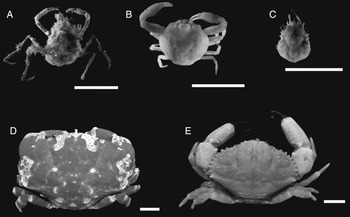
Five new occurrences of decapod crabs recorded at Santa Catarina State coast between 2007 and 2010: (A) Ebalia stimpsonni A. Milne-Edward, 1880, female, carapace width (CW) 4.36 mm; (B) Inachoides forceps Milne-Edwards, 1879, male, CW 4.77 mm; (C) Teleophrys ornatus (Rathbun, 1901) male, CW 2.90 mm; (D) Platypodiella spectabilis (Herbest, 1794), female, CW 28.15 mm; (E) Xanthodius denticulatus (White, 1847), male, CW 20.65 mm. Scale bars: 5 mm.

MATERIAL EXAMINED
2 males, 1 female, (ECZ/ LCP/UFSC/68), min. CW 3.94 mm; max. CW 4.85 mm, Deserta Island; 9 m depth, coll. April 2010.
REMARKS
The southernmost occurrence of this crab was reported from São Paulo (23°44′S 45°01′W) south-eastern coast of Brazil (Melo, Reference Melo2008). Range expansion: 393 km from its last known limits.
Order DECAPODA Latreille, 1802
Suborder PLEOCYEMATA Burkenroad, 1963
Superfamily MAJOIDEA Samouelle, 1819
Family INACHOIDIDAE Dana, 1851
Genus Inachoides H. Milne Edwards & Lucas, 1842
Inachoides forceps Milne-Edwards, 1879
(Figure 6B)
MATERIAL EXAMINED
1 male, (ECZ/ LCP/UFSC/69), CW 5.72 mm, Prainha da Barra; 5 m depth, coll. March 2010.
REMARKS
The southernmost range of this species on the Brazilian coast was Rio de Janeiro State (23°13′S 44°12′W) (Melo, Reference Melo2008). Range expansion: 530 km from its last known limits.
Order DECAPODA Latreille, 1802
Suborder PLEOCYEMATA Burkenroad, 1963
Infraorder BRACHYURA Latreille, 1802
Superfamily MAJOIDEA Samouelle, 1819
Family TYCHIDAE Dana, 1815
Genus Teleophrys Stimpson, 1860
Teleophrys ornatus (Rathbun, 1901)
(Figure 6C)
MATERIAL EXAMINED
1 male, (ECZ/ LCP/UFSC/65), CW 2.94 mm, Rancho Norte; 10 m depth, coll. February 2008.
REMARKS
The latter range of this brachyuran species was recorded previously on the São Paulo coast (23°44′S 45°01′W), Brazil (Alves et al., 2006). Range expansion: 397 km from its last known limits.
Order DECAPODA Latreille, 1802
Suborder PLEOCYEMATA Burkenroad, 1963
Infraorder BRACHYURA Latreille, 1802
Superfamily XANTHOIDEA MacLeay, 1838
Family PLATYXANTHIDAE Guinot, 1977
Genus Platypodiella Guinot, 1967
Platypodiella spectabilis (Herbst, 1794)
(Figure 6D)
MATERIAL EXAMINED
2 females, (ECZ/ LCP/UFSC/55), CW 28.80 mm, Rancho Norte and Saco D'água, Arvoredo Island; 5 m and 10 m depth, coll. February 2008.
REMARKS
The southernmost range of this species on the Brazilian coast was Rio de Janeiro State (23°13′S 44°12′W) (Melo, Reference Melo2008). Range expansion: 454 km from its last known limits.
Family XANTHIDAE MacLeay, 1838
Genus Xanthodius Stimpson, 1859
Xanthodius denticulatus (White, 1847)
(Figure 6E)
MATERIAL EXAMINED
1 male, (ECZ/ LCP/UFSC/60), CW 21.33 mm, Deserta Island; 11 m depth, coll. December 2009.
REMARKS
The southernmost occurrence of this crab was reported from São Paulo (23°44′S 45°01′W) south-eastern coast of Brazil (Alves et al., 2006). Range expansion: 393 km from its last known limits.
Order DECAPODA Latreille, 1802
Suborder PLEOCYEMATA Burkenroad, 1963
Superfamily PALINUROIDEA Latreille, 1802
Family PALINURIDAE Latreille, 1802
Genus Panulirus White, 1847
Panulirus argus (Latreille, 1804)
MATERIAL EXAMINED
3 adult individuals, Deserta Island; 12 m depth. Observed December 2009 (samples identified by visual census).
REMARKS
Species usually captured by illegal fishery activity in the Arvoredo MPA. The southernmost range of this species has been recorded so far on the coast of São Paulo (23°44′S 45°01′W), Brazil (Young & Serejo, Reference Young, Serejo, Dutra, Allen, Werner and McKenna2005). Range expansion: 393 km from its last known limits.
Panulirus laevicauda (Latreille, 1817)
MATERIAL EXAMINED
3 adult individuals, Moleques do Sul Islands; 15 m depth. Observed February 2009 (samples identified by visual census).
REMARKS
Species usually captured by illegal fishery activity in the Arvoredo MPA. The southernmost range of this species in the scientific literature was recorded previously on the Rio de Janeiro coast (23°13′S 44°12′W), Brazil (Melo, Reference Melo1999). Range expansion: 516 km from its last known limits.
DISCUSSION
Crabs, lobsters and mantis shrimp are observed with difficulty in the rocky bottom due to their mimicry of the habitat and their behaviour of hiding in crevices during the day. The use of new sampling methods for decapods can fill in the information gaps left by conventional methods (Mendoza et al., Reference Mendoza, Naruse, Tan, Chan, Forges and Ng2010). SCUBA diving is an efficient method to access their special microhabitats, which are not accessible by the conventional fishing trawlers and traps. This partially explains the fifteen new records reported in this study. Bouzon & Freire (Reference Bouzon and Freire2007) wrote the first scientific report of decapods from Arvoredo Island; in their study they registered approximately one new species per SCUBA dive. We found between three and six species per year through the visual census in the present study. These achievements clearly point to the importance of continuous efforts to expand the knowledge in this area. Additionally, two species were special cases. Dromia gouveai was recently described, and now recorded in the fourth site along the Brazilian coast. Neogonodactylus torus had a range expansion up to 1100 km, being previously reported north of 23oS in the warm Brazilian Province (Boschi, Reference Boschi2000). The present sighting suggests that warmer water conditions allowed the crustaceans to establish themselves in the studied area. Besides in the last seven years, the area has been impacted by uncommon cyclones and extreme floods, affecting the entire coastal zone with turbulence, currents anomalies, sediment and freshwater input. These environmental changes could have contributions in transforming the composition of the crab community. Thus, consistent and continuous census should improve and provide additional information to the current, weak baseline, follow the species assemblage changes, and verify the possible effect of global environmental changes in decapods range expansion. The present results improved the list of species in this area, and this study could be considered to be the start of such monitoring activities.
ACKNOWLEDGEMENTS
We thank everybody who helped during the fieldwork, especially, the biologists, C. Pascelli and H. Silva-Karam. Thanks also to M. Kammers from ICM-Bio (Brazilian Environment Agency) for fishery activity information, G.O. Longo and C.M. Sackmann for reading the earlier drafts and M.E. and P.P. Sackmann for reviewing our English language. Field trips were financed by FAPESC (Grant 14.021/2007 to A.S. Freire) and CNPq (Grant 475367/2006-5 to S.R. Floeter ECZ/UFSC). M.M. Teschima received a scholarship from CAPES.