

The question this article poses is: how do states attempt to mitigate the pressures of financial globalisation? The article argues that choices can be understood in terms of monetary regime choice. Monetary regime choice is the decision to either: (1) subordinate the national currency via unilateral integration; (2) share monetary authority via multilateral integration or, (3) go it alone and not integrate the national currency. Briefly, dollarisation would be an example of the first and currency union would be an example of the second, though other options are available within each category.
This monetary regime setup is different from what is seen in most of the discussions on exchange-rate regimes. There has been much discussion focusing on the trade-offs involved in choosing between fixed or flexible exchange rates. Both theoretical and empirical studies are common.Footnote 1 These works generally rely upon either a ‘Mundell-Fleming’ or ‘time inconsistency’ metric to ask why some states choose a fixed exchange-rate regime or a flexible exchange-rate regime (or something in between). The choice is essentially dichotomous.
The question of monetary regime shifts the focus away from this exchange-rate typology to ask more about the interaction between domestic and international politics involved in the monetary choices. In the more traditional exchange-rate typology, monetary regime choices as different as El Salvador's dollarisation, Estonia's currency board, and the West African Economic and Monetary Union (WAEMU) are all lumped together.
Clearly there is diversity among these arrangements. This article explicitly asks what accounts for that diversity. Panama has used the US dollar alongside token domestic coins since 1904. The Economic Community of Central African States monetary union in Africa has been in place since 1966. The euro was famously introduced in 1999. Meanwhile, a host of other countries maintain the one currency/one country model. What accounts for all these differences?
This article argues that the choice of monetary regime is determined by domestic political considerations. First, broadly defined domestic political regime – democracy or autocracy – is expected to matter for how states approach this choice. Second, factors that cut across regime types, like veto players, nationalism, and state capacity, are also expected to direct how states approach the choice. And third, the particular history of a country, its experiences and ideas, will shape how that country makes the choice. These factors will affect both the capacity and the interest in different approaches to mitigate the pressures of financial globalisation.
Often, investigations into monetary regimes are dominated by a strictly economic consideration of a dichotomous exchange-rate regime choice. But this view misses the different international politics involved in different monetary regimes. The politics cannot stop there, however. Once international politics are drawn into the picture, domestic politics become involved as well. In order to understand monetary regimes we must understand the international politics involved; in order to understand those international politics, we must understand the complexity of domestic politics implicated.
The significance of the question is what it says about our theories of how states react to the changing global financial climate and to the pressures they face from a systemic change of globalisation. To shoehorn the question into one about a simple economic exchange-rate choice between a dichotomous fix the currency or float the currency, is to miss how the domestic politics of each country in the world influences the global pattern of state interactions. It is important to understand that within the pressures of the international system, domestic politics is a fons et origo determining the health and stability of international economic relations.
The article proceeds as follows. First, a discussion of the different choices that fall under monetary regime choice and what makes them different. Second, an outline of how domestic factors affect how states approach those choices. Third, variables and indicators are discussed for empirical analysis. Fourth, an empirical analysis is presented, based upon a statistical model as well as two brief case studies. Finally, conclusions are offered. The story this article tells is that monetary decisions are best understood as international relationships. But to understand the international side of monetary relations, one must look to domestic political structures, histories and politics. States have interests and identities that combine to determine how those states make monetary regime choices in the face of increasing financial globalisation.
Monetary regime choices
State monetary regimes are a matter of integration.Footnote 2 One choice is no integration at all – to go it alone and maintain an independent currency. Another is multilateral integration – a relationship where monetary authority is shared. Exchange-rate unions and monetary unions are arrangements of this kind. A third is unilateral integration – a relationship where monetary sovereignty is delegated by one state to another stronger state. This type of relationship is one of explicit subordination, as for example in a currency board arrangement or with formal dollarisation.
This article focuses on de jure currency integration, though de facto integration is also possible. Some states may experience a significant degree of de facto monetary integration even if they continue to maintain an independent currency. This would include informal dollarisation, where governments seek to maintain an independent national currency as sole legal tender but the population prefers to use ‘hard’ currency as a store of value and a medium of exchange. Also in market economies with floating exchange rates a significant degree of de facto monetary integration might be due to economic dependence on a single major trading partner (which poses risks in terms of a country's fluctuating exchange rate with the larger economy). A country can also be exposed to the currency ‘carry trade’ (which may be associated with increased vulnerability of capital flows to changes in domestic and overseas interest rates). Further, de facto integration may result in cases where a significant proportion of a country's commercial bank credit is sourced from overseas capital markets. These sources of de facto integration are distinct from the monetary integration investigated in this article where states make purposeful de jure decisions to integrate or not integrate their currencies.
The Mundell-Fleming modelFootnote 3 suggests that with pegged rates and fully integrated financial markets, any attempt to pursue an independent monetary policy is almost certain to result in significant balance-of-payments disequilibrium, and thus provoke flows of speculative capital. To preserve exchange-rate stability, governments will be forced either to limit the capital movements or their own monetary policy autonomy. If they do not sacrifice either, then exchange-rate stability itself may have to be ceded. Over time the three goals cannot be attained simultaneously. Research on exchange rate regimes has largely been focused on this trade-off.
While a useful analytic device, this dichotomous taxonomy also has significant drawbacks. Both the binary fix/flex split and the continuum between pegging and floating miss an important distinction in how an individual state's exchange rate regime choices are related to other states. States with floating exchange rate regimes are clearly choosing not to integrate with other states. However, states with fixed exchange rates are not so easily described. In the traditional typology, exchange rate regime choices as diverse as El Salvador's dollarisation, Estonia's currency board, the WAEMU monetary union and Europe's Economic and Monetary Union are scrambled together. In reality, these choices are distinctly different. Dollarisation means that the state has chosen to forego any claim to monetary sovereignty, accepting the leadership of a dominant financial power, while a monetary union means that the state has chosen to pool its sovereignty in a collective effort. The political implications of each are starkly different from each other.
In a recent essay, one analyst stressed the anomalies associated with the traditional schema, ‘The classification of the exchange rate regimes within three broad categories – pegged, intermediate and floating – seems to be too general. Do currency boards belong in the same group as dollarisation and monetary union? […] Additionally, hard pegs and traditional pegs may be two very different regimes. Combining them within the same classification may be misleading.’Footnote 4 It is clear that the traditional set-up can lead to an uncomfortable analytic perspective.
The hypothesis is not without contention, moreover. Wesley Widmaier, for example, takes issue with the assertion that states cannot have all three facets: freely flowing capital, autonomous domestic monetary policy, and exchange rate stability.Footnote 5 Widmaier argues that:
[I]f state and societal agents had still believed in unqualified Keynesian fashion that guidelines could effectively fix expectations, the international system might again attain ‘three out of three.’ In such a setting, state and market agents would work to reconcile full employment and price stability, rather than render them ‘impossible.’ The impossible trinity is therefore itself best seen as a social construction.Footnote 6
Widmaier argues that the idea of the impossible trinity impedes the international cooperation necessary for reconciling capital movements, exchange rate stability and autonomous domestic policy. This is all to say that the strictures of the impossible trinity may be escapable. What it suggests is that international monetary cooperation may be one way of securing autonomous domestic monetary policy. Thus, between these different critiques, the Mundel-Fleming setup can be seen as problematic for understanding actual state behaviours in the face of financial globalisation in the world today.
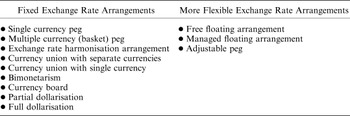
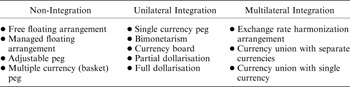
Table 1 shows the typical typology with each type of currency arrangement and category of exchange rate arrangement. The monetary sovereignty typology used here is shown in Table 2. Each currency arrangement and its sovereignty arrangement are shown.
Traditional typology

Table 2 shows the variety of each type of integration. One type of unilateral integration occurs when one country chooses to use the currency of another state in lieu of a currency of its own. This is typically called dollarisation (though it might involve a currency other than the US dollar, such as the euro). Full dollarisation occurs when a state adopts a single foreign currency exclusively and maintains no currency of its own. The foreign currency then is the legal tender of the subordinate country, serving all of the three traditional functions of money: medium of exchange, unit of account, and store of value. Ecuador is an example of a fully dollarised country. In September of 2000 the US dollar became the sole legal currency in Ecuador. Partial or near dollarisation, by contrast, occurs when a state relies upon a foreign currency but still maintains a token local currency. The local currency is a small portion of the local money supply, which is dominated by the foreign currency. Panama is the classic example of a partially dollarised country. Panama has used the dollar alongside nominal amounts of the local currency, the balboa, since 1904.
Monetary sovereignty typology

Also in the category of unilateral integration is a currency board. States with currency boards formally tie the supply and value of their currency to a foreign currency (an anchor) and permit free exchange of the two currencies at a fixed rate. In principle, a currency board has no discretion and can neither devalue its currency nor create any money on its own. The local currency comprises most or all of the domestic money supply but the local government has little monetary authority since the currency stock is tied tightly to the availability of the foreign anchor. Estonia is an example of a successful currency board, in place since 1992.
Bimonetarism represents another form of unilateral integration. Bimonetarism occurs when a state formally recognises a foreign currency as legal tender but also maintains a local currency. The two currencies circulate side by side. The subordinate state retains some monetary authority since the local currency is not firmly tied to the foreign currency as it is with a currency board. Instead, the local money supply is made up of both the foreign currency and the local currency. Bhutan is an example of a bimonetary country: the Bhutan ngultrum circulates alongside the Indian rupee. The least demanding form of unilateral integration is a single currency peg, such as China's peg to the US dollar.
A multiple currency (basket) peg might also be considered a low degree of unilateral integration since some amount of sovereignty is given up to the foreign countries, but the dilution of sovereignty is so limited that the choice is better classified as akin to non-integration. For analytical purposes, a line must be drawn somewhere. Since multiple currency pegs involve such a low degree of integration, they will be considered non-integrators in the analysis to follow.
Multilateral integration, by contrast, is based on an alliance between or among states and a sharing of monetary sovereignty. States do not become subordinate to each other; rather they delegate some degree of their sovereignty to a collective institution. The most radical form of multilateral integration is a currency union with a single currency in circulation. The two component unions of the CFA Franc ZoneFootnote 7 and the euro area are examples. Each state's existing currency is replaced with a single joint currency managed by a single joint institution (central bank). Less radically, states can form a monetary alliance in the form of an exchange rate union with separate currencies. In this type of arrangement, each state issues its own notes and coins but the values of participating currencies are all locked together. Examples are the Latin Monetary Union and the Scandinavian Monetary Union of the nineteenth century.
States may also choose to form an alliance that allows for more flexibility than a strict exchange rate union. Exchange rate harmonisation requires states to manage their economies in line with the goals set by the collective. This describes the Exchange Rate Mechanism of the European Monetary System that existed from 1979 until the birth of the euro. States have a greater degree of individual control in such an arrangement than with a currency union, but they do not have complete autonomy. State decision-making is curtailed in accordance with the objectives of the collective arrangement.
Finally, states may choose not to integrate at all. This may be a very costly choice for some states; nevertheless, a state can choose to adopt a strategy that aims to preserve its monetary sovereignty rather than integrate in any (de jure) way with others.
The question is: How do states choose among the three broad monetary regime options? What accounts for the diversity of state decisions? To date, inquiry into these questions has been limited. One exception is Benjamin Cohen,Footnote 8 whose work in this area has laid a foundation from which these questions can be addressed. Many answers, however, remain to be found.
The influence of domestic political factors
What domestic political factors are significant for how states choose to negotiate today's landscape of financial globalisation? Which states are more likely to pursue international monetary cooperation? What domestic political characteristics will lead to a state going it alone, or subordinating to a stronger state?
A first cut suggests that democracies will be more likely to choose multilateral integration than autocracies will. Other states are unlikely to want to share monetary sovereignty with an autocracy. Autocracies often do not operate with great transparency. This leaves them less able to make credible commitments to other nations.
The idea that democracies can make more credible commitments has been well explored in political science literature. As Mancur Olsen has said, ‘If [an autocrat] runs the society, there is no one who can force him to keep his commitments.’Footnote 9 James Fearon's work on domestic audiences and signalling expands upon these ideas.Footnote 10 Fearon argues that domestic audiences become a way of credibly communicating intentions to other states. Democracies have an advantage in this respect. Since domestic audiences have more power in democracies, the consequences of backing down from announced intentions are greater. As Fearon states, ‘stronger domestic audiences may make democracies better able to signal intentions and credibly to commit to courses of action in foreign policy than nondemocracies’.Footnote 11 For Fearon, democracies have an advantage in making credible commitments.
Kurt Gaubatz, Karen Remmer, Lisa Martin, Peter Cowhey and Andrew MacIntyre,Footnote 12 among others, build upon this reasoning. Gaubatz argues that because democracies must look to domestic audiences for approval of an international agreement, a commitment is made to both the domestic constituency and the foreign partner. He explains, ‘outsiders can observe linkages between commitments made to them and commitments made to the domestic audience. When a democratic leader makes a public commitment to a specific course of action, deviation from that course might bring domestic as well as international repercussions.’Footnote 13 He adds, ‘in the international arena, the ability to link external commitments transparently with internal commitments will allow democratic states to draw on domestic audiences to aid their international credibility’.Footnote 14 Remmer makes a similar argument, focusing specifically on economic commitments. She finds that democracy and democratisation boost the odds of economic cooperation.Footnote 15
Thus, democracies are expected to be more able to make credible monetary policy commitments than autocracies. The implication is that democracies will be more able than autocracies to enter into cooperative, multilateral arrangements. Multilateral arrangements require credible commitments and cooperation. Thus democracies will be better able to adopt multilateral arrangements.
The above argument implies that there are differences between the broad categories of autocracies and democracies in both their ability and desire to adopt multilateral and unilateral arrangements. Democracies are more able to adopt multilateral arrangements because they are more able to make credible commitments. Autocracies are less able to adopt multilateral arrangements because of their inability to make credible commitments.
Beyond the broad categories of regime types, other domestic political characteristics must be examined to understand how states use monetary policy to mitigate the pressures of financial globalisation. One way of dissecting domestic political regimes is by the number of veto players. Mark Hallerberg, referencing George Tsebelis, defines veto players as ‘institutions, organizations, and/or individuals that have the power to block change from the status quo’.Footnote 16 The status quo plays heavily in any discussion of the number of veto players since veto players are defined primarily by their ability to block change in policy rather than an ability to suggest or create policy. In terms of how states might use monetary policy, more veto players creates a tendency toward maintaining the status quo – a status quo bias. Fewer veto players allows states a greater ability to change course and pursue something different in how they might mitigate the pressures of financial globalisation.
A status quo bias means that once a state has made a choice, it is likely to stick with that choice. It also means that states are likely to maintain a non-integration position. New integration proposals, whether multilateral or unilateral, have greater difficulty getting adopted if there were greater veto player hurdles to get over. Once an integration proposal is adopted, it becomes the status quo and the bias leans toward maintaining it. But it is difficult to enact integration proposals in an environment of greater numbers of veto players. States with greater numbers of policy veto players respond to the pressures of financial globalisation by going it alone, while states with fewer veto players are more likely to integrate their currencies, either unilaterally or multilaterally.
Importantly, these formal regime characteristics are not the only factors that influence how countries respond to the pressures of financial globalisation. There are at least two other domestic influences on monetary policy decisions across different political regimes. One of these is political stability. The other is a country's level of economic development.
Political stability matters because a country's reputation for stability will influence the likelihood of other states to be willing to participate in a multilateral cooperative arrangement. States considering a multilateral arrangement are more hesitant to join an unstable state in a cooperative arrangement. On the other hand, an unstable state might have even more incentive to form some sort of unilateral arrangement. The monetary commitment of a unilateral integration arrangement can potentially substitute for political stability. Domestic political stability may be requisite for any successful economic policy and political stability may act as a substitute to the commitment mechanism of a unilateral arrangement. Therefore, more stable countries are less likely to adopt unilateral monetary commitments.
Also a country's level of economic development is related to its capacity and desire to adopt and maintain particular monetary regimes. For example, as a monetary policy option, dollarisation seems much more attractive to the governments of less-developed countries with lower institutional capacity to run an effective independent (or multilateral) monetary regime, whereas more developed countries with greater state capacity have a wider monetary policy choice set available to them regardless of whether these countries are classified as democracies or autocracies. The effect of development is in principle ambiguous. Higher levels of development have an effect on incentives (the attractiveness of arrangements like dollarisation) and upon capacity (the ability to adopt arrangements such as dollarisation). Under-developed states with low capacity are drawn toward international monetary integration as a solution to domestic incapacity. At the same time, under-developed states have less ability to form the domestic and international structures needed for an integration arrangement.
Among different types of regimes and among states with differing levels of development, the nature of the politicians in leadership will also influence how a state is likely to attempt to mitigate the pressures of financial globalisation. Specifically, governments lead by nationalists may react differently than other types of governments. Nationalist governments, with their dedication to the creation and maintenance of a national identity and protection of the homeland, are likely to be averse to the idea of sharing or subordinating monetary authority in some sort of international regime. Eric Helleiner suggests that having a national currency is a way of creating and maintaining national identity. When a country is dollarised or when a common currency is in place, the symbolic value of the currency is lost. Any political regime that has set out to pursue the elevation of a national identity through nationalism will be hesitant to give up the tool of a national currency. Ultimately, nationalist regimes are unlikely to pursue either unilateral or multilateral integration since these policies run counter to the values of nationalism.
The value of a national currency as ideational is an important factor to consider. Like Widmaier's assertion about the idea of the impossible trinity not being immutable, Helleiner suggests that the idea of a currency is flexible. A currency, like the impossible trinity, is a social construction. Thus, in order to understand changes in state behaviour toward international monetary policy, one must understand how the socially constructed ideas might change. This is the line of argument taken up in Kathleen McNamara's The Currency of Ideas. McNamara argues that ideas are important causal factors for understanding international monetary agreements, specifically European monetary integration. She suggests that her goal was ‘not to separate ideas and interests as competing causal factors but to show the inherent connection between the two’.Footnote 17 The empirical discussion below takes McNamara's goal into account.
Variables and indicators
The dependent variable has three possible outcomes – not integrating the national currency (going it alone), integrating unilaterally (such as dollarisation) or integrating multilaterally (in a cooperative arrangement). The variable was coded for 137 countries from the International Monetary Fund Annual Report on Exchange Restrictions and Exchange Arrangements for years 1981 to 2000. The Report provides information on monetary regimes for 185 countries for year-beginning 2000. A few of these are not entirely sovereign, such as the Netherlands Antilles. For others, such as Afghanistan in some years, data for some of the independent variables are not available. All together, there are 2369 observations. Of these cases, 1516 (64 per cent) are coded as non-integrators, 407 as unilateral integrators (17 per cent) and 446 (19 per cent) as multilateral integrators.
Regime type (autocracy versus democracy) is operationalised using the POLITY 2 score for each country. Drawn from the POLITY IV project,Footnote 18 the variable is calculated as the difference between the POLITY authoritarianism score and the POLITY democracy scores. The scale runs from −10 to 10 with positive numbers indicating more democratic. The stability measure is taken from the same dataset. It uses the durable variable as a proxy of stability. This variable represents the number of years since a major regime type change.
The veto players variable is measured as outlined by Philip Keefer in his Database of Political Institutions.Footnote 19 This dataset includes a measure of the number of different veto players, or checks and balances, on political decision making in each country. Also, the nationalist variable comes from the same data set. Keefer codes this dummy variable based on if, ‘A primary component of the party's platform is the creation or defense of a national or ethnic identity.’Footnote 20
State age is assessed as the number of years since a country joined the UN. This is a rough proxy since some countries delay their entry into the UN (Switzerland is an example of this). Finally, two economic variables, gross domestic product and gross domestic product per capita are included to account for the size of the state and economic development.
Empirical analysis
The statistical models executed for this study reveal the impact of the independent variables on the likelihood of choosing unilateral integration versus the other two choices, and horizontal integration versus the other two choices.
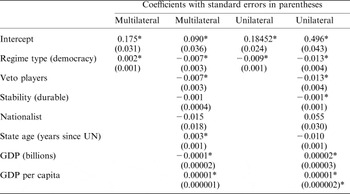
The models test the primary hypotheses for political regime type. Coefficients and standard errors are presented in Table 3. When democracy is the only regressor, the coefficient on democracy is positive and statistically significant for multilateral integration and negative and statistically significant for unilateral integration. Together, these two findings confirm the theoretical expectations. Autocracies tend more than democracies to choose unilateral integration and democracies tend more than autocracies to choose multilateral integration. These statistical findings support the idea that states have interests and identities that work together to determine how they make monetary regime choices in the face of increasing financial globalisation.
Panel logit results

* =p < 0.05
With a more complete model, the democracy variable is problematic. The issue is that democracy as a variable is so large, so broad, and so inclusive, it swamps and is collinear with many other variables. For example, when number of veto players is included with democracy as a variable, it becomes difficult to distinguish the effect of one separate from the other. Thus when a more complete statistical model is specified, democracy is excluded.
The coefficient for veto players is negative and significant for both multilateral integration and unilateral integration. That is, when a political regime includes more veto players, it is less likely to pursue either kind of monetary integration. This is directly in line with the theoretical expectations. Veto players can block new policy responses to financial globalisation. Even if it were in a state's otherwise tangible interests to do something like dollarise or join a currency union, greater numbers of veto players increase the likelihood that the state will go it alone and not integrate at all.
Stability is not a statistically significant factor for state choices on multilateral integration, but makes it less likely that a state will pursue unilateral integration. Stability does appear to act as a substitute for something like a pegged currency. When a country is more stable, it has less need to adopt a unilateral integration stance. With multilateral integration, the effect is ambiguous. It could be that the substitution effect is the same for multilateral integration – stable states have less incentive to integrate. But also it could be that stable states are more able to enter into multilateral arrangements. Thus the two effects of stabilisation will work in opposite directions for multilateral integration. For unilateral integration, only the one effect matters, since instable states do not face an impediment of forming an international agreement in order to pursue a unilateral arrangement.
Surprisingly, nationalist regimes appear to be neither more nor less likely to pursue either type of integration. State age, though, does seem to matter. Older states are more likely to be multilateral integrators and less likely to be unilateral integrators. This may be due to state capacity increasing over time or it may also be representative of a hierarchy of states. Older more established Western states are more able to pursue cooperative arrangements, like the Economic and Monetary Union in Europe, while younger states in Latin America pursue dollarisation arrangements.
On the other hand, gross domestic product per capita is significant and positive for both types of integration. Less economically developed states are less likely to pursue either multilateral or unilateral integration. The relationship between a country's economic development and its capacity to adopt and maintain particular monetary regimes is a positive one. As a monetary policy option, dollarisation is a much more attractive to the governments of less-developed countries with lower institutional capacity to run an effective independent (or multilateral) monetary regime; however these states have less institutional capacity to maintain such an arrangement. This capacity issue appears to be key: the empirical results suggest that when preferences and capabilities have different causal directions, capabilities win out over preferences.
It is important to note that these statistical trends operate as part of a broader causal fabric. On a conditional case by case basis, other factors can potentially be more salient. The role of ideas, support for integration as a political project, or the continuing significance of historical legacies all have the potential to influence currency regime choice beyond these statistical trends. For example, the statistical trend suggests that a country with more veto players will be more likely to resist integration, while a country with fewer veto players will be more likely to integrate. In the example of the euro, however, things would not appear to be this straightforward, at least in the case of the major EU economies. In terms of electoral systems, the UK – with a majoritarian electoral system and a unitary political system – is understood as having fewer veto players than a country such as Germany that has a proportional representation electoral system and a federal political system. Since Germany adopted the euro and the UK did not, this suggests that other factors were more salient in making those decisions.
Of course there are always exceptions to the trend, but the bigger point is that probable causal factors that influence monetary regime choice include one set of factors at the aggregate level identified by the statistical analysis, and also includes a range of different national particularities. These particular conditions especially include the roles of ideas, of history, and of specific national politics. These factors are not readily incorporated into a statistical model – a limitation of the statistical approach. But adding the aggregate statistical trends together with more nation-specific conditions of particular cases creates a richer causal tapestry. The example of Germany and the UK highlight the role of these possibilities. In this case, it is likely that history, ideas, and local politics had more to do with decisions to adopt the euro rather than broader aggregate international trends.
To make the statistical findings more tangible, consider the particular case of Estonia. The process of Estonian disentanglement from the Soviet Union was initially a complex one. But, following an attempted coup in Moscow in August 1991, Estonia unilaterally declared its independence and was quickly recognised by other countries. The final step for economic independence came in June 1992 with the introduction of a national currency, the kroon, to replace the Soviet ruble. The Estonian kroon was declared the sole legal tender in circulation and Eesti Pank the only regulator of monetary relations in Estonia.Footnote 21 As Rawi Abdelal explains, ‘Estonia […] exited the ruble zone as quickly as [it] could’ and ‘Estonians, who used to say they would live off potato peels if that were the cost of independence, celebrated their new currency.’Footnote 22
Right away, Estonia considered the adoption of a currency board arrangement.Footnote 23 The background to the idea was Argentina's recent experience with a currency board, which was believed to have contributed to monetary stability there. Estonian leadership was immediately attracted to the proposal because currency boards were associated with the same high degree of transparency and confidence as the gold standard. A currency board would also solve the problem of resisting demands for credit from the government. In short, a currency board arrangement effectively facilitated implementation of an independent monetary policy.Footnote 24
Estonia pegged to the deutschmark until 1999 when Germany joined the European Economic and Monetary Union (EMU) and adopted the euro. From that point, Estonia pegged the kroon to the euro. In November 1995, Estonia formally applied for membership to the EU. Two years later, in 1997, Estonia was invited to begin formal EU membership negotiations. And in March 1998, accession negotiations were started between Estonia and the European Union (EU) with the Accession Conference in Brussels. Negotiations were concluded in December 2002 with Estonia formally joining the EU in May 2004.
The main issue for many Estonians was the ‘return to Europe’. After years of Soviet domination, Estonians were eager to return to what was considered the mainstream of Europe. EU accession had been the highest political priority of every Estonian government since 1995. At first, it was seen mainly as a foreign policy issue but it soon came to be understood as having an all-encompassing nature and being central to domestic policy as well.
For Estonia, joining the EU necessarily implied preparing to join EMU. One of the requirements for joining EMU is to maintain membership in the European Exchange Rate Mechanism II (ERM II) for at least two years prior to adoption of the euro. In June 2005, representatives of the euro area countries, the European Central Bank and Denmark (which had been the only ERM II member) approved Estonia's application to join ERM II. Entry left the exchange rate of the kroon unchanged and left the currency board in place.
Public opinion in Estonia supports the euro, but not overwhelmingly so. In 2005, the Eurobarometer survey asked if respondents were for or against a common currency for Europe. Fifty-nine per cent of Estonians replied that they were for the common currency. However, there was some fear of losing the kroon. In another question in the same poll, fifty-five per cent of Estonians responded that they feared the disappearance of the kroon. In 2003, a more direct question was asked by the poll. The question asked if respondents were for a common European currency that would replace the Estonian kroon. Twenty-three per cent were very much against and twenty-six per cent were somewhat against. Thirty per cent were somewhat for, but only thirteen per cent were very much for a common European currency to replace the kroon. There may also be some differences between the 2003 and 2005 polls due to the recent introduction of the euro as a cash currency in January 2002. As the public got more used to the idea and as the euro settled in as a cash currency, public opinion may have shifted. In spite of this mixed public option, Estonia still appears to be on track to adopt the euro due to political leadership's desire to pursue membership.
A further example illustrates the findings: Sweden has the option to join a multilateral arrangement but has chosen not to. Sweden's currency history is quite different. After the breakdown of the Bretton Woods system of fixed exchange rates, in 1973 Sweden pegged its currency, the krona, to a trade-weighted currency basket in which the US dollar had a weighting double its trade proportion. In principle, Sweden had a fixed exchange rate. In practice, however, the krona was devalued five times in the period from 1976 to 1982 and depreciated from 1985 to 1987. In May 1991, the basket was redefined to equal the European Currency Unit for which the German mark was the primary currency. This, it was hoped, would foster monetary policy credibility and reduce inflationary expectations. Sweden did not formally join European Monetary System but did maintain a peg to the European Currency Unit from May 1991 to November 1992.
Departure from the peg was not voluntary. In September 1992, the krona came under massive attack by speculators as part of the general attack on the ERM.Footnote 25 The Riksbank attempted to defend the peg but was unable to ward off the speculative attacks. Following the fruitless defense of the krona, with huge interventions and marginal interest rates of up to 500 per cent, the Riksbank was forced to give up. In November 1992 the fixed exchange rate was abandoned and the krona was allowed to float. The krona has been freely floating since (for more on Riskbank intervention during this period, see Aguilar and Nydahl 2000).
The ruling Social Democrats commissioned an independent study to evaluate if Sweden should join EMU in 1999 along with other EU countries. The commission, made up of prominent academics and led by Lars Calmfors, recommended that Sweden not join EMU in 1999. The report stated, ‘There is a significant risk […] [T]his could lead to further increases in unemployment from today's high level.’Footnote 26
The Swedish public connected EMU and fiscal policy. Losing control over the ability to run budget deficits also was a potential threat to the welfare state in Sweden. The effective management of the welfare system and maintenance of low unemployment rates can sometimes require expansionary fiscal policy that would be prohibited by the Stability and Growth Pact.
The party situation was split. The Left, Green, Christian Democratic and Centre parties were all opposed to the EMU. The Moderate and Liberal parties, which are pro-business interests, were in favour. The ruling Social Democrats were divided, but in an extraordinary party congress in 2000 they joined the pro-EMU camp. Ultimately, the anti-EMU campaign was not a unified or coordinated effort; it was made up of leftists worried about the employment and the welfare state, greens worried about environmental policy, and nationalists worried about the loss of sovereignty.
In addition to the economic reasons given by different groups, some political elites cited political reasons for joining EMU. Anita Gradin, a Swedish EU commissioner, argued that the economic effects of being outside the EMU were noticeable, but in the end, the political price would be higher. Similarly, Minister of Finance Erik Asbrink stated, ‘Another reason why Sweden should join is to increase its influence in the EU.’Footnote 27 In 2001 Romano Prodi, then still president of the European Commission, said that Sweden would lose influence by staying outside the EMU.
Nevertheless, Swedish public opinion remained negative toward EMU membership. In the fall of 1995, the Eurobarometer polled public opinion on a common currency for Europe. Sweden was among the lowest with twenty-nine per cent in favour. The lack of public support was in striking contrast to elite political opinion. The prime minister, the centre-left ruling government party, the conservative opposition party, most Swedish economists, major firms, most businesses, and all of Sweden's major media supported monetary integration. But popular opinion did not match.
One main reason for the resistant stance of the public was that the economic reasons for EMU seemed unconvincing: in the early 2000s, the Swedish economy was growing faster than the average of EMU members, unemployment rates were lower, and interest rates in Sweden were no higher than in the EMU area. In 2003 Sweden was forecast to grow 1.5 per cent versus 0.5 per cent for the euro area and Swedish unemployment was 5.4 per cent compared with 8.9 per cent in the euro area.Footnote 28 For most of the public, the economic arguments in favour of EMU were unpersuasive.
But it was the politics that drove the anti-EMU side, not the economics. In a poll, opposition voters were asked to list the issues that had mattered most. The biggest worries were about democracy and sovereignty. National control of interest rates came third, and the welfare state came in fourth.Footnote 29
The prospective loss of democracy and sovereignty was key for the no side. EMU and the EU were seen as non-transparent, non-democratic, and dominated by larger states. In the words of one magazine, ‘the vote reflects a verdict on the economics of the single currency less than it expresses deeper suspicions about what the European project implies for Sweden's sovereignty and for the future of its democracy.’Footnote 30 Swedish voters saw the EMU vote as not just a vote on the common currency, but on political integration.
Ultimately the issue was decided in a referendum in which fifty-six per cent of the voters said no to EMU while only forty-two per cent said yes. EMU was rejected. Though Sweden was split on the issue, the no vote was decisive. The issue of EMU in Sweden is now dormant as Sweden continues to preserve the krona and its monetary sovereignty.
What do these two brief cases tell us about how states use monetary policy to mitigate the pressures of financial globalisation? Largely, these two cases are essentially in line with the theoretical expectations outlined above as well as with statistical results. Sweden is a democratic country so is more likely to be a multilateral integrator than a unilateral integrator. Also, Sweden is an older state with high state capacity, and thus is again more likely to be a multilateral integrator than a unilateral integrator. This is upheld by the narrative above – there does not appear to be any likelihood at all that Sweden will integrate unilaterally. Sweden might become a multilateral integrator, but not soon. Sweden clearly has a large number of veto players, many political participators. Involved in the decision to not join EMU were political leaders, elites and specialists, unions, political parties, and even a general referendum. This impels Sweden to continue to go it alone and not integrate its currency.
Similarly, though Sweden was not led by a nationalist party, nationalist sentiment did matter in the decision to not join EMU. The potential loss of authority and loss of sovereignty to the EMU collective weighed heavily in the minds of some Swedes. In the end, the case of Sweden does not provide a rigorous test of the expectations of this article, but it does illustrate as an example of how one kind of state uses its monetary policy to mitigate today's pressures.
Estonia, too, offers a good illustrative example. Estonia is a democracy, but a young one. It has some capacity to be a multilateral integrator, but not as much as an older established democracy. As it democratises more and builds state capacity, it will continue to be more likely to be a multilateral integrator. This is established by Estonia joining the ERM II as a step toward membership in EMU. ERM II is unilateral integration, but EMU is multilateral. For Estonia to make the transition, it will have to consolidate its institutional capacity and democratise further.
Estonia also has a similar experience with nationalism to Sweden. Estonia is reluctant to give up the kroon, a symbol of national identity. As Eric Helleiner suggests, having a national currency is a way of creating and maintaining national identity.Footnote 31 This is especially important for Estonia, a country that was under foreign control for much of the twentieth century. Creation of the kroon was an important symbol for a reasserted national Estonian identity. The citizens of Estonia will continue to be hesitant to give up this facet of their identity. This helps explain Estonia's current position vis-à-vis EMU – the state is more and more in the position to pursue multilateral integration, but still has domestic political and historical factors holding it back.
Conclusion
While much of the existing literature on monetary choices tends to focus on crises, on the role of hegemonic currencies, or on explaining general trends in monetary regime behaviour, this article has explored how states have used varying degrees of monetary integration to mitigate the pressures of financial globalisation. States have interests and identities which together shape how they make monetary regime choices in the face of increasing financial globalisation.
What the analysis in this article finds is that domestic political regimes affect the types of monetary regime available to a country. Results from a panel analysis – looking across countries as well as across time – indicate that democracies are more likely to be multilateral integrators and autocracies are more likely to be vertical integrators. Also, domestic characteristics like numbers of policy veto players, political stability and state capacity sway how states approach the choice of monetary regime in today's globalising world. More policy veto players makes either kind of integration less likely, making a non-integration go it alone strategy more likely. Greater political stability makes unilateral integration less likely. Greater state age (representing state capacity) makes multilateral integration more likely and unilateral integration less likely. While higher levels of economic development support both multilateral and unilateral integration – lower levels of economic development lead to non-integration.
Also, the stories of Sweden and Estonia show that ideational factors, like sovereignty and national identity, steer how states choose a monetary regime. These factors do not supplant the factors identified in the statistical analysis. As McNamara argued, ideas and interests are not ‘competing causal factors’ but can be inherently connected.Footnote 32 Indeed, the cases of Sweden and Estonia largely uphold the statistical findings. But they go further and show how identity and interests can go hand in hand.
Ultimately, monetary arrangements are best understood with their international component included. But to understand the international side of monetary relations, one must look to domestic political structures, histories and politics. Within the pressures of the international system, domestic politics is one fundamental source determining the health and stability of international economic relations.
Appendix: methodological note
The data are in panel form. That is, observations were collected both cross-sectionally and across time. There are two kinds of information in longitudinal data: the cross-sectional differences between subjects, and the within-subject changes over time. A mixed effects model is not appropriate here since many of the cases do not vary across time (a fixed effects model drops any case that is invariant across time). A mixed effects model estimates both the random and fixed effects. First order (between adjacent time periods) autocorrelation (also referred to as serial correlation) of residuals is present in the data set. This is accounted for by the model.
The analysis relies upon a set of generalised mixed models using the ‘lmer’ function of the ‘lme4’ package for the R statistical programming language. Several binary logits are estimated. These logits are equivalent to a single multinomial logit. As Scott Long states, ‘estimates from binary logits provide consistent estimates of the parameters of the [multinomial logit model] […] With three outcomes, multinomial logit is roughly equivalent to running three binary logits comparing outcomes 1 to 2, 1 to 3, and 2 to 3.’Footnote 33 Begg and Gray state that, ‘In general, the individualized method is highly efficient.’Footnote 34 And Alvarez and Nagler hypothesise that, ‘Multinomial logit is not necessarily better than successive applications of binary logit.’Footnote 35 They find that, ‘Multinomial logit offers almost no benefits over binary logit.’Footnote 36 And, ‘multinomial logit is no magic estimator compared to binomial logit. It offers efficiency gains, but it is computing estimates of precisely the same parameters as binomial logit.’Footnote 37 Thus, the coefficients estimated by the two binary logits are precisely the same co-efficients that would be estimated by a single multinomial logit.