“ . . . the supposition of universal venality is little less an error in political reasoning than the supposition of universal rectitude. There is a portion of virtue among mankind that can be the foundation of our hope…”
— Alexander Hamilton Footnote 1
I. Introduction
In making choices, some matters must be taken as given — the laws of nature; those aspects of the behavior of other agents over which you have no influence; the prevailing institutional arrangements that you have to treat as fixed for current purposes; the resources available, and so on. Some of the things you have to take as fixed may be of your own making, but even then, at the point of choice, you will have to treat your past actions as unchangeable. All of this works to determine the probabilities of the various outcomes associated with different actions available to you; and hence to what is feasible.
In the face of what is given, the challenge is to figure out which of the available options is best. Just what this involves depends on your view of what makes options better or worse. Standard in economics is to suppose that the relative ranking of options depends entirely on the relative strength of the agent’s preferences. Standard outside of economics, in explicitly normative contexts, is to suppose that the agent’s preferences may well matter (when satisfying them is valuable), but that many other considerations might matter as well: perhaps the preferences of others, or the well-being of all affected (where that may depend on things other than whether preferences are satisfied), or the importance of respect, or the demands of justice, to mention a few possibilities.
In all cases, though, the agent doing the choosing is confronted with an “optimization exercise.” On one side of that exercise lie the criteria in light of which the options might be ranked as better or worse. On the other side, lie the constraints, whatever they might be, that determine which options are actually feasible, given the circumstances.
Preferences, it is worth noting, can and usually do figure twice over. First, the preferences of the agent and others are often taken as important for determining the relative value of potential options. (Economists usually treat only the agent’s preferences as mattering in this way, while others often treat the preferences of all who might be affected as mattering.) Second, though, the preferences of the agent and others regularly make a difference (often a decisive difference) to what is feasible, since people’s preferences determine what they might willingly do, whether we are talking about cooperating with others, or buying some item, or complying with the law.
One useful model for thinking about the optimization exercise involves identifying a set of indifference curves indicating value-equivalent combinations of things that matter according to the relevant standards Footnote 2 and then determining which of the various value-equivalent combinations are actually feasible, given the agent’s circumstances. Footnote 3 Points along the feasibility frontier that touch the highest value indifference curve (there may be more than one such point) are the “best available” given the circumstances. When the agent’s choice is decisive in determining the outcome, optimization involves choosing one of those points. Otherwise, optimization — of expected value — takes place with the context fixed by the overall value of the available options and the limits set by what is feasible, and involves maximizing expected value, given facts about the different probabilities of various possible outcomes given the agent’s choice.
G. A. Cohen appeals to exactly this model at the close of a well-known paper. He observes:
Justice is not the only value that calls for (appropriately balanced) implementation: other principles, sometimes competing with justice, must also be variously pursued and honoured. And the facts help to decide the balance of due deference to competing principles: the facts constitute the feasible set that determines the optimal point(s) on a set of fact-independent indifference curves whose axes display . . . different extents to which competing principles are implemented. Footnote 4
The central theme of Cohen’s argument in this particular paper is that the indifference curves are indeed fact-independent — that the relevant normative principles (of justice, but also of all other values) can be expressed in terms that make no reference to facts about prevailing circumstances.
For our purposes here, we take Cohen’s claim — that normative principles are fact-independent — as given. Our focus is on what might be thought of as the “other side” of this issue — on whether the facts that determine the feasibility set are value-independent. We will argue that they are not, that people have reason to think that the normative properties of different possible options can and (sometimes) do have a crucial impact on their feasibility. In other words: facts about feasibility are partially dependent on Cohen’s “fact-free moral principles.”
We take it, in what follows, that the elements of normativity that might determine feasibility are those that people might recognize. Footnote 5 So we are thinking of normative features of situations as having their impact through the psychology of those who become aware of them. That said, it is important to keep in mind that the fact that their impact is mediated does not mean that they have no impact. Footnote 6
II. An Example
It will be useful to begin our discussion with an example taken from John Broome’s account of the climate change challenge as developed in his Climate Matters. Footnote 7 We think this approach helpful for three reasons:
-
1. Most generally, the “optimizing approach” to normative questions of policy that we mobilize is usefully illustrated through engagement with particular applications.
-
2. Broome’s analysis in Climate Matters raises a number of issues of philosophical and practical interest that deserve further exploration in their own right. Footnote 8
-
3. And in particular, Broome’s discussion is especially relevant because one of the issues he is concerned with relates directly to treating feasibility as independent of the normative credentials of the possible options.
Our strategy in what follows is to begin by arguing that Broome is mistaken, in the case he considers, to treat the normative credentials of the options as irrelevant to the feasibility of the options he thinks we face. In our view, he underestimates the impact normative advantages might have on feasibility and underestimates the costs of going first, as a matter of strategy, for a less just option on the grounds that it requires no sacrifice from anyone (whereas a more just option would require sacrifice from some).
The lessons to be drawn from this case, we argue, generalize in important ways to a defense of seeing the feasibility of options that agents might face as not always independent of the normative credentials of those options.
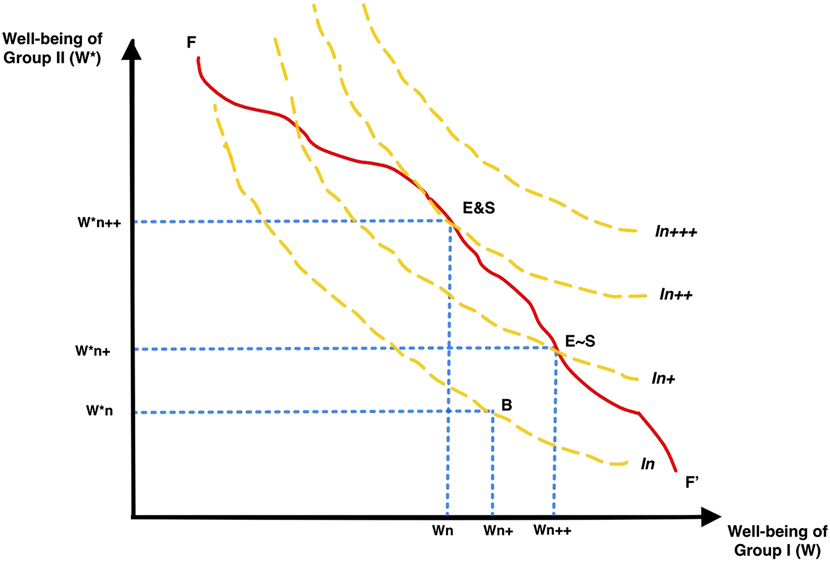
So, first, we turn to the Broome example. In order to clarify both Broome’s reasoning and the challenge we want to put to it, we exploit some simple diagrammatics. In Figure 1, we depict the well-being of two groups. The groups may be thought of as different generations (say those alive today and future generations), or as different countries (say, one rich, one poor). Footnote 9 In either case, both well-being and its distribution are taken to be matters of normative concern. Denominate the groups as I and II, and depict the well-being of I on the horizontal axis (as W) and the well-being of II along the vertical (as W*). Then the feasibility frontier labelled FF’ depicts the maximal combinations of W and W* that are available given various resource constraints, including the limited capacity of the atmosphere to absorb carbon dioxide and other “greenhouse gases.” The indifference map (comprised of a series of indifference curves, In, In+, In++, In+++) shows combinations of W and W* that are normatively equivalent, with indifference curves further from the origin showing higher levels of normative accomplishment.
Figure 1.

Now suppose that “business as usual” involves an inefficient point, B. This is what Broome assumes; and that assumption is not in dispute here. What it means to say that B is inefficient is that it is some way inside the feasibility frontier. As Broome puts it: “Inefficiency is pure waste; it does no one any good.” Footnote 10 He further states:“It is possible in principle to cure the externality of greenhouse gas without anyone’s making any sacrifice.” Footnote 11 The latter claim reflects the fact that increases in W or W*, or both, are available from B, without requiring decreases in either. Footnote 12 It is worth noting that, notwithstanding its inefficiency, B is a Nash equilibrium: it is an outcome that results when each party (whether individual or nation) is doing as well as possible given what others do. It should not therefore be taken for granted that even E∼S is feasible from B.
We can, on this basis, depict “efficiency without sacrifice” (E∼S), as illustrated: at E∼S both groups have increased well-being compared with B. Moving from B to E∼S is a move to an efficient point, made without any sacrifice. Well-being, W, increases from Wn+ to Wn++ and W* increases from W*n to W*n+. We can also depict “efficiency with sacrifice” (E&S), as illustrated: at E&S, one group (W) has decreased well-being while the other (W*) has increased well-being compared to B. Well-being, W, is reduced from Wn+ (at B) to Wn, while W* is increased — from W*n to W*n++. Moving from B to E+S is a move to an efficient point, but made with sacrifice on the part of one group.
Importantly, as shown (reflecting Broome’s claims), E&S is normatively superior to E∼S: E&S lies on a higher normative indifference curve (In++) than does E∼S (In+). Thus, while both E∼S and E&S are better than B, E&S is the best of the three.
This diagram is meant to capture the crucial elements of Broome’s understanding of the situation we are in concerning climate change. Specifically, our current situation is such that we could address (at least some of) the harm caused by climate change without anyone making any net sacrifice. Moving from B to E∼S would move us to a point from which no further improvement is possible, without some having to sacrifice. Our current situation, however, is also such that with sacrifice on the part of some (relative to B), we could move to a different point that, once achieved, would also be efficient (that is, such that there is no room for improvement, without sacrifice): E&S. This latter possibility, Broome argues and we agree, would be normatively superior, thanks to the distribution of the benefits and burdens of addressing climate change being more just. As things stand, restricting ourselves to E∼S involves having future generations, or the poor, bear a disproportionate share of the burdens (even though it would be a burden the bearing of which still leaves them better off than they would be were no move to efficiency made).
Strikingly, Broome recommends E∼S over E&S despite the latter being normatively superior. Why? Broome’s answer, it can seem, is: because FF’ is not the real feasibility frontier after all — there are more constraints to be taken into account than are dreamt of in our diagram. Once those constraints are appreciated, Broome argues, it becomes clear that E&S may well not be possible. This is because, Broome observes, “governments are very unwilling to impose sacrifices on their people,” as Copenhagen 2009 showed. Footnote 13 In light of this, he argues, we have “pragmatic grounds,” to shift our objective and opt for E∼S instead. To do otherwise is to let the (probably unobtainable) best be the enemy of the (achievable) good.
This claim suggests reinterpreting our diagram. The FF’ line does not, after all, show combinations of Group I’s and Group II’s well-being that are actually feasible. FF’, it seems, ignores factors that have an impact on feasibility: specifically, the preferences of those whose cooperation is needed to achieve something better, along with the significance to people of national boundaries, the necessity of international agreements, disagreements about how the costs of carbon emission reductions are to be borne among countries, and further issues about what proportion of those costs would be borne by those alive today and by the poor. FF’ just shows what levels of well-being would be consistent with total resources, leaving aside the willingness (or not) of people to deploy those resources in different ways.
Line FF’, on this understanding, reflects what we might call the “resource frontier,” not the “feasibility frontier.” Drawing the distinction between the resource and feasibility frontiers allows marking the fact that what resources might allow, the preferences of others (such as the leaders of various governments) might render infeasible. There is really no doubt that peoples’ preferences will here shape what is feasible; leaving them out of account would be a tremendous mistake. At the same time, however, the distinction between the resource frontier and the feasibility frontier cannot be a sharp one, since the available “resources” depend on how hard people choose to work and on whether the most creative people spend time inventing things that will have extensive benefits in the future rather than in the present (or in the poorer parts of the world rather than the richer). So while preferences matter to feasibility, it would be a mistake not to see them as both reflecting resources that are available and, crucially, as shaping the resources we might have going forward.
Our sense of Broome’s opting for E∼S, though, is not that he believes that E&S is clearly infeasible; rather he thinks opting for it is risky. The probability of achieving E&S is low enough, he seems to be thinking, that it may make sense to opt for E∼S, which is pretty clearly feasible. Recommending this interpretation is Broome’s equivocal endorsement of E∼S: he argues E∼S should be the aim in the first pass. Since E∼S is more readily available, he argues, aiming for that outcome “ . . . would get the political process moving” Footnote 14 and a more just distribution of resources, he suggests, can be pursued later. His claim is “it would be politically more effective to separate the two aims . . . ” — of preventing atmospheric deterioration on the one hand and improving morally the distribution of the world’s resources on the other. “Improving the distribution of resources . . . is not so urgent. It should be tackled separately.” Footnote 15 Broome’s view that the second aim should be tackled at all suggests that he thinks addressing it may well be possible, even if only by tackling it after the first. Footnote 16
Our response to this argument is not to claim that E&S is feasible after all, or that success in pursuing it is reasonably likely — we are in no position to make such claims. What we would emphasize is that, if E&S is infeasible (or improbable) from B, it looks to be a fortiori infeasible (and, in any case, even less probable) from E∼S. Footnote 17 The only circumstances under which “improving the distribution of the world’s resources” (either between generations or between rich and poor) is feasible is when there is a significant constituency in favor of securing a better distribution — which (given the facts of the case) requires some in Group I to be prepared to make a sacrifice of its own well-being in order to achieve the better distribution. Suppose there is such a constituency. For them, then, moving from E∼S to E&S involves a greater (potentially significantly greater) sacrifice in well-being than would be involved in moving from B to E&S: (Wn++ - Wn) is more than (Wn+ - Wn). Footnote 18
For that reason, it looks as if Broome’s argument for “separating” the issues of (a more just) distribution and (greater) efficiency is not so much an argument for separation as one for giving up on a more just distribution altogether. If we cannot get from B to E&S, we very likely cannot get to E&S from E∼S. Alternatively put, if E&S can be achieved from E∼S, then it seems a mistake to talk of the move from B to E&S as being “encumbered” by improving the distribution: the normative superiority of E&S should be seen as a positive asset that might be leveraged to convince those who care about justice that the required sacrifice is worth making (in a context in which the sacrifice involved is less from B than from E∼S).
Of course, if it is true that governments simply refuse to impose any sacrifices on their citizens, then E&S is not feasible, and E∼S may indeed be the best that can be hoped for: but Broome rightly does not claim this. Governments, he notes, are “very unwilling” to impose sacrifices on their citizens. But of course under some circumstances they do impose sacrifice. Moreover, they are likely to be more willing if they can achieve a significant benefit (say, for the future) at not too large a cost (in the present). What is to be emphasized here is that in the move from B to E&S there are two benefits not just one: the benefit of improved atmospheric quality and the benefit of a more just distribution of the world’s resources. Both benefits, once appreciated, might well make a huge difference to what people are willing to do. In fact, at least to the extent that people care about justice, and come to see one distribution as more just than another, the move to E&S may involve no reduction in overall preference satisfaction. So governments may find that whatever sacrifices they must impose, those sacrifices might be ones their citizens are willing to make, in light of the opportunity to establish greater justice.
In Figure 1, the measures of well-being include what we might think of as material well-being and the various benefits associated with a less damaged atmosphere. We are supposing, though, that the measures do not include any benefits accruing to the parties that are associated with living in a more just world, including the subjective benefits that those who care about the increase in justice would receive. Yet such benefits are neither negligible nor behaviorally irrelevant. In many contexts, not least political ones, the fact that people consider one option normatively superior to another makes a significant difference to what they are willing to do and what they are willing to sacrifice.
Once this is recognized, the fact that one option (say, E&S) is normatively better than another constitutes a consideration that might make achieving it more likely to be feasible (given the sacrifices involved) than it would otherwise be. If people care about justice and can be convinced that E&S is more just, those people, at least, will be more willing to make sacrifices and cast votes and change their behavior in other ways that might make E&S feasible.
III. The Behavioral Relevance of Normative Judgments
Needless to say, the fact that people’s normative judgments can and do make a difference to what is feasible because such judgments affect their behavior, is perfectly compatible with normative facts making no difference at all. After all, facts about people’s moral judgments are themselves value-neutral facts about their psychology.
Also, of course, people are often wrong in their normative judgments, and seriously misguided normative judgments, no less than right-headed ones, have an impact, often a dramatic one, on what people are willing to do, and so on what might be feasible. Normative judgements, misguided or not, often affect both the agent’s own ability to act and the ways in which others will respond to whatever the agent might choose to do.
Nonetheless, as we will now argue, we have reason to think the normative facts themselves can and do sometimes play a role in explaining people’s moral judgments. As a result, we have reason to think that those facts, through their impact on peoples’ normative judgments, have an impact as well on what is feasible. Although judgments concerning, say, value, justice, virtue, rightness, rationality, and so on, are often wrong, and some times wildly so, they are sometimes appropriately sensitive to the relevant normative facts. And when they are, the facts being as they are make a difference to the judgments people make. Footnote 19
There are two steps in our core claim:
-
(a) People’s normative judgments exercise some influence, and a distinctive influence, on their behavior, and so on what is feasible for them and for others;
-
(b) We have reason to think such judgments are sometimes explained by their truth — that is, by what actually is normatively desirable.
The first element (a) we regard as being a weak claim, though it is not entirely uncontested in certain circles. The second element (b) involves a much stronger claim — and is correspondingly more demanding to demonstrate. This second element, taken as a general claim, across cultures and contexts, may indeed be unsustainable. But at least in the extended example of the Broome discussion, and for many cultures and contexts, we think it holds. We consider the first claim in the remainder of this section and the second claim in the next.
In much of the economistic tradition within which the “optimization” conception of choice has operated most strongly, there has been no less a strong tradition of treating individuals as motivated exclusively by self-interest, rather narrowly defined. On this view, talk of moral considerations is talk of something that actually makes no difference to people’s choices, except, and to the extent that, it adjusts peoples’ sense of what is in their own interest.
As various writers — as widely different as David Hume, Amartya Sen, and Gary Becker Footnote 20 — have emphasized, there is a clear conceptual distinction between the assumption of exclusively egoistic motivations and the assumption of agent rationality. The former is an assumption about the content of preference; the latter is an assumption about the impact of an agent’s preferences on choice or action. So it is no justification of self-interest to observe that the preferences of an agent are the preferences of that agent, the expected satisfaction of which might be maximized. That observation tells us nothing about the content of those preferences. While the self-interest assumption might be a useful simplification in some settings, it is a simplification — and one that does violence to a vast array of behavior in settings of concern to economists, social scientists more generally, and normative theorists of all stripes.
One way of putting this point is to say that many individuals (we think almost all) have a preference for the right and the good. We do not mean by this that the preference is so strong that it would trump all others. Indeed, we suppose there is a lot of evidence that the preference is often in fact outweighed. The claim is just that goodness and rightness are among the “arguments” in the typical agent’s preference function; they figure among the contents of peoples’ preferences
Many economists might accept this claim, but then go on to remark that any such preference is a preference just like any other — not deserving of any special treatment. We think that this is a misguided move for five distinct reasons.
-
1. Concerning normative matters people characteristically engage in criticism, discussion, and argument. They call one another to account for behaving badly or doing something wrong. They regard moral and other normative considerations as providing reasons for action, and where there are serious differences of opinion as to which considerations matter, the differences tend to become matters of serious contestation. Where there are differences in conceptions of right and wrong, they argue, they accuse, they persist, and sometimes they punish. Moreover, people may come to be persuaded by arguments that something they were doing for moral reasons is not morally required at all, or they may become convinced that they ought to be doing something they were not doing, because it is morally required. Footnote 21 In contrast, differences in preferences concerning non-normative matters regularly prompt trade, along with the observation that “de gustibus non est disputandum” (“in matters of taste there can be no disputes”), rather than criticism, discussion, and argument.
-
2. Moral considerations in particular are distinctive in the kinds of emotional responses that they draw out of agents subject to them. For example, if an agent violates what she herself sees as a moral requirement she characteristically feels guilt or remorse. When she sacrifices what she thinks is morally required in order to have a little more income (or more of something that gives her non-moral satisfaction), she tends to feel guilty. This tendency, taken in prospect, serves as an incentive over and above that provided by the preference to do what is right, and taken in retrospect, serves as the cause of further actions that otherwise would not be performed. This is of course just a tendency; rationalizations work wonders in helping people avoid guilt, and transgressions that fall below a certain threshold matter differently to an agent’s behavior than do more serious violations. Still, this all contrasts sharply with the sort of choices common in economic textbooks, say between apples and oranges, where trading off the one against the other may prompt regret in not having more of one or the other (or of both), but not remorse or guilt. The general point is that moral preferences travel with specific and behaviorally salient attitudes that distinguish them from other preferences.
-
3. Normative considerations also often appear not so much as preferences guiding choice but as constraints restricting options. Footnote 22 Sometimes, moral considerations operate on one’s psychology by making certain actions “unthinkable.” In some cases, the adjective “unthinkable” might be applicable literally. The relevant action is one that the agent simply cannot entertain; prior normative considerations ensure that the particular option does not appear in the feasible set. Note that, if that is so, then there can be no trade-offs between moral consideration and others. There will be no sense in which the agent might forgo her moral principles if the cost of pursuing them is too great, because the principle is not even on the table. So familiar claims about the role of relative prices will be violated in any such case. If, as a matter of fact, the prospect is unavailable for consideration, then no price can be enough to induce you to act in that way. Now of course, it is an empirical matter whether a particular action is literally unthinkable in any given case. But our argument here does not require that unthinkability survive all possible scenarios however extreme. All that is required is that over a significant range, certain prospects are in fact simply ruled out. If that is so, then over that range those prospects will be wiped from consideration, and the agent will be totally unresponsive over that range to changes in opportunity cost. Footnote 23 In that case, normative judgments shape choice as a constraint on options, not as a preference over them.
-
4. Moral preferences regularly find outsized expression in contexts of voting, which are especially relevant to discussions of policy. Precisely because people realize that they are unlikely to make a difference to the outcome of large-scale elections, they are more likely, the evidence suggests, to vote their consciences, for predictable reasons. Consider this example: Suppose the voter is confronted with a choice in which one of the electoral options is a policy that she thinks is morally better, but that increases her tax liability by $5,000 per year. What is the expected cost to her of voting according to her conscience? Answer: not $5,000 per year in extra taxes, but rather that sum multiplied by the probability that her vote will be decisive. Footnote 24 And since that probability is standardly very small, the cost to her of voting her conscience is correspondingly very small. The contrast here is with the case of market-choice, Footnote 25 in which the decision to give $5,000 to some worthy cause will indeed cost the giver $5,000.
The resulting conjecture is that moral considerations are likely to play a more extensive role in democratic electoral settings than in other settings where the connection between action and outcome is more direct. The thought is that voting is rather more like cheering at a football game than like choosing an assets portfolio — and so the content of voter behavior will tend to reflect more extensively those things that the voter is prone to applaud than those things that are in the voter’s interests more narrowly conceived. Footnote 26 Among the things that voters are disposed to applaud must figure things the voter regards as “good” simpliciter — and equally, the voter will be disposed to oppose (that is, vote against) things that the voter regards as bad. Not all of these spontaneous “evaluative attitudes” will be normatively defensible of course. Voters may well be disposed to vote for candidates who are good-looking Footnote 27 or who have attractive voices or who have the capacity to render the voter’s prejudices in rhetorically persuasive terms. Nevertheless, it seems likely that specifically normative preferences will figure in political behavior to an extent that they do not in market choices.
In the “climate matters” setting specifically, many individuals may well vote for national carbon emission reduction policies that are not in those individuals’ interests (and indeed not in the national interest Footnote 28 ). Those voters may vote for national emission reduction because it is the “right thing to do” — even when the policy, if implemented, costs them much more than it benefits them. Footnote 29
-
5. When individuals make normative judgments of others, in settings where those evaluations are accessible to the person evaluated, the evaluations can have behavioral effects on the person evaluated, mediated through that latter person’s desire for esteem (or desire to avoid disesteem). Generally people like to stand high(er) in the evaluations of others and will often adjust their behavior to secure that end. Thorstein Veblen Footnote 30 is perhaps the economist who most emphasizes such effects in consumer choice — though in doing so he is largely echoing the observations of Adam Smith. Footnote 31 The desire for the approval of others plays a significant role in Smith’s account of human motivations — but of course Smith is hardly unique in that respect. A long line of social theorists from Aristotle through Hobbes, Hume, Kant, and Montesquieu have thought social esteem to be a central object of human aspiration.
To be sure, there are many sources of approval and esteem. You can be esteemed for your proficiency in tennis or your sartorial elegance or your “native smarts” as well as for your honesty, courage, professional conscientiousness and other more specifically moral attributes. Yet across the range, the approval follows on judgments of quality or value, that is, on normative judgments of one sort or another. Moreover, it is difficult to think that a person would hold a genuine normative “preference” and not approve of those who exhibit the corresponding traits or behavior. Even when, for example, it is costly to behave courageously (so you might not behave courageously yourself), you will more or less automatically approve of courage in others: that is part of what it means to regard courage as an aspect of “virtue.” At the same time, that attitude aggregated across other observers may well be sufficient to induce someone to act courageously, even when she might not have done so without the prospect of social approval. So if “normative preferences” predictably give rise to attitudes of esteem and disesteem, then those preferences may well have behavioral consequences that other kinds of preferences (between apples and oranges, say) do not have. Footnote 32
The point of this brief discussion is to suggest that normative preferences, along with the judgments that inform them, play a unique role in shaping people’s behavior. They are not simply an element in most agents’ preference functions; they operate in distinctive ways, have distinctive upshots and are likely to become differentially weighty in certain settings — of which the setting of the ballot box (critically relevant to climate change policy, but much more generally) is one important case.
IV. Do Normative Facts Matter?
We have, so far, been concerned with establishing that people’s normative judgments, and the attitudes, actions, and reactions to which those judgments give rise, are significant factors in determining what actions, policies, and outcomes are feasible, thanks to the impact of such attitudes, actions, and reactions, on what people are willing to do.
In making this claim, we oppose the idea that a hard-nosed realistic evaluation of what is feasible should treat normative judgments indiscriminately with other kinds of beliefs and preferences. Normative preferences and the normative judgments that inform them carry commitments and predictable behavioral upshots that call for special attention by those interested in what is feasible. Thinking that an action is wrong, or judging that a policy is irrational often amplifies people’s willingness to oppose it, in the same way as seeing something as demanded by justice, or as otherwise morally valuable, often amplifies their willingness to work to bring it about.
Yet in arguing this, we have not actually said anything about how normative facts — as opposed to people’s normative judgments — make a difference to what is feasible. It is to this task that we now turn.
The argument we have to offer is best viewed as an almost universal ad hominem argument. Although the argument is restricted to those who meet two conditions, our sense is that a huge number of people qualify. The first condition is that they in fact make normative judgments of actions, character traits, political institutions, or social policies. The second condition is that they think of some of their own judgments as justified — not simply in the sense that they think they have a moral right to those views but in the sense that they think that they have good grounds for thinking the views are correct. Anyone who holds substantive views about rationality, justice, virtue, evil, value, or rights, for instance, comes within the sweep of our argument, as long as they think they have good reasons for holding the views they do.
Such people need not think of all of their own normative judgments as justified in this sense. Some of their judgments, for instance, may be ones they suspect to be unduly influenced by self-interest, or bias, or lack of understanding. Other judgments may be such that, while they hold them, they also recognize that they can offer no argument in their defense — the views strike them as right but, at least for now, for no reason they can identify. We leave such normative judgments to one side, and focus on whichever normative judgments a person makes that she thinks are justified. Perhaps the judgments concern the rationality of maximizing value, or the wrongness of slavery, or the role equal treatment plays in a just society, or the value of public policies that contribute to human flourishing, or the importance of political constitutions, or the moral right to be free from certain forms of coercion. Which particular normative judgments are in play does not matter for our argument, as long as they are ones the person makes sincerely and thinks justified.
At the heart of the argument is the observation that believing that one’s judgment is justified requires holding that it is sensitive to the facts it concerns. To think otherwise is to think that the judgment, and the considerations offered in its defense, free-float from the facts.
People cannot both (i) think that in making their judgments those judgments are not sensitive to the truth and (ii) continue to think reasonably that those judgments are justified. Footnote 33 This is true of all judgments we might make, normative as well as not, as long as the judgments in question involve claiming that things are a certain way — irrational, immoral, hot, heavy, popular, made of copper, painful, and so on. Footnote 34 ) Thus, thinking your moral judgments (concerning, say, justice) are justified commits you to thinking those judgments are sensitive to the truth, that is, sensitive to what morality actually demands and allows when it comes to justice. To think otherwise is to give up on the idea that the judgments are justified. Footnote 35
This is not to say that people need to have a positive account of how their judgments succeed in tracking the truth in order for them to think their judgment is justified. Nor is it to require that they think their success, such as it is, must be unerring or even highly reliable. They just need to think that in some way their judgments and the considerations they rely on in making those judgments are (more or less) sensitive to the truth.
There are of course a lot of reasons to wonder about what normative facts must be like, and what we must be like, in order for our normative judgments to succeed in being justified. Some — nihilists, skeptics, and error theorists — have argued that normative facts are not as they would need to be, or that we are not as we would need to be. As a result, they conclude that normative judgments are not justified. Others — subjectivists and relativists — have argued that a proper understanding of the nature of normative facts shows normative truths to be as tractable as truths about how people feel or the nature of social practices. As a result, they conclude that there is no distinctive challenge in accounting for how our normative judgments might track the truth. Still others offer specific accounts of the nature of normative facts, or of us (and, say, the probative force of rational intuition), in an attempt to explain how our normative judgments might be appropriately sensitive to the truth. As a result, they conclude that while there is a distinctive challenge in accounting for how our normative judgments might track the truth, it is a challenge that their view meets. Finally, though, many people have no specific account of the nature of normative facts or of how it is that our judgments manage to be sensitive to them. Footnote 36
Our argument leaves to one side the nihilists, skeptics, and error theorists, all of whom reject the idea that their normative judgments are justified. But it speaks equally to all who remain, all who think that some of their normative judgments are justified. This group includes all who offer moral arguments (sincerely, and not as a simple attempt at manipulation), for or against various policies, programs, institutions, and political procedures, as well as those whose focus is less social but still moral. It includes as well those who steer clear of morality while nonetheless holding normative views (for example, about rationality, good evidence, or appropriate scientific method) that they believe to be justified. All such people are committed to thinking that their own judgments are sensitive to the relevant normative facts (as are we).
Yet to think one’s judgments are sensitive to the normative facts is to think that somehow those facts (and not just our normative judgments concerning them) make a difference somehow, under some circumstances, to our ways of reasoning about them and to the normative judgments we come to. To think of one’s normative judgments as justified, to think of the arguments that have been persuasive as the right way to think about the issue in question, commits one to thinking that in coming to the judgment, in being moved by those arguments, one is being sensitive to the relevant normative facts.
A tempting way to think of this sensitivity is in terms of counterfactual dependence. On this suggestion our judgments count as appropriately sensitive to the facts if, had the facts been different, then so too would be our judgments. Counterfactual dependence is certainly a way for the judgments to be sensitive to the facts. Yet complications emerge immediately. Specifically, for at least some of our normative judgments, there seems to be no sense to be made of the relevant facts being different. What would things be like if killing innocent babies for fun were morally required? If we cannot answer that, we cannot figure out whether our judgments would have been different under those conditions. As a result, there is no way to think about whether our judgments would be different if the relevant facts were different. The same problem comes out clearly concerning mathematical judgments. Consider the judgment that 27-13=14. We think this judgment is true and that we are justified in making it (and so that our judgment is appropriately sensitive to the truth of what it concerns). Yet there seems to be no sense to be made of the relevant facts being different. What would things be like if the judgment 27-13=14 were not true? If we cannot answer that, we cannot figure out whether our judgments would have been different under those conditions. The counterfactual dependence criterion finds no application here, even though (we take it) our mathematical judgments are often sensitive to the relevant facts.
When our mathematical judgments are appropriately sensitive to the mathematical facts they are about, this is thanks to those judgments being sensitive to those facts. The facts being as they are is, of course, only part of why we make those judgments. Other crucial elements are that we happen to have mathematical concepts, that we are paying attention, and that whatever our intellectual capacities might be, they extend far enough to allow us to calculate using relatively small numbers. Still, our sensitivity to the facts is an important part of why we make those judgment. The mathematical truth figures in part of the best of explanation of our making this judgment. Even if it is a mistake to say that our mathematical judgment would have been different had the mathematical truth been different (since, in this case, we are supposing, the truth could not have been different), our reasonably thinking our judgment is justified depends on holding that our judgment is in some way sensitive to the truth being what it is. Footnote 37 The fact that the truth of our judgment plays a role in the best explanation of our making the judgment is what matters here, not counterfactual dependence.
That point registered, it is important to keep in mind that many normative judgments concern matters that we can make sense of as being (potentially) different from the way we take them to be. Many things that we judge to be rational, or right, or good, or reasonable, we see as only contingently so. Had things been different in certain respects, we think, then what was rational, right, good, or reasonable would not, under those different conditions, have been the same. In these cases, it is fair enough to hold that our judgments being justified varies with it being true that such judgments would be different if things had been different normatively. To see our own judgments as insensitive to what the facts actually are (so that the moral facts do not figure in the best explanations of the judgments being made) is to see them as not actually justified.
So again, in the cases in which we do think of our normative judgments as justified, we are committed to thinking of those judgments as not free-floating from the normative facts they concern. That is, we are committed to thinking that our (justified) normative judgments are sensitive in some appropriate way to those facts being what they are. Given that, as we argued earlier, these judgments make a difference, often a big difference, to what is feasible, we are committed as well to thinking that the normative facts make a difference to what is feasible, if only (for all we have argued) thanks to our judgments being sensitive to those facts.
To say that our normative judgments must not free-float from the normative facts they are about is not to say that those facts need to cause our judgments. To see this, consider again the case of mathematics, where there is little temptation at all to hold that numbers are causes. We can nonetheless make sense of our mathematical judgments being appropriately sensitive to mathematical facts thanks to our relying on certain modes of reasoning, and not others, that reliably get things right. So too, one might hold, with our normative judgments. Even if rightness and wrongness do not serve as causes, we might nonetheless make sense of our normative judgments being appropriately sensitive to normative facts thanks to our relying on certain modes of reasoning, and not others, that reliably get things right. Moreover, just as numbers might play a role in some of our best explanations, without themselves being causes, so too might certain normative facts play a role in some of our best explanations, without themselves being causes. Footnote 38
There is considerable difference of opinion concerning what might be the right account of how our normative judgments might be appropriately sensitive to the normative facts that they concern. In this essay we have remained silent, on purpose, concerning our own views on this matter. We do not have a single specific argument, based on a substantive view of normative facts, or of the nature of normative truth, to offer. Rather, our argument takes on board the views of each to whom it is directed and is meant to show, simply, that whichever particular view people happen to have, if they think their own judgments justified, they are committed to seeing normative facts, and not just their normative judgments, as making a difference to what is feasible. How large the difference is, and in which contexts, we leave completely and utterly open. As to how significantly normative facts (and also, by the way, normative judgments) shape what is feasible in the face of money, power, greed and fear, not to mention physical obstacles, we have no settled view. But we think virtually all of us, and we definitely count ourselves in this group, are committed to thinking those normative facts have some impact, some times, under some circumstances.
Thus our argument is not that some particular view (of when and how our normative judgments are sensitive to the normative facts) is right and that, in light of that view, one can see that normative facts themselves, and not just normative judgments, make a difference to feasibility. Instead, we are arguing that as long as you hold that some of your normative judgments are justified, you are committed to thinking that those judgments are — somehow — sensitive to the normative facts being as they are, even if you do not know how they are.
This argument turns on a substantive — but we think hardly controversial — view of what it takes for someone to reasonably see his or her judgments as justified: the judgments need to be such that the person who makes them does not see them as free-floating from the truth. The judgments of course may in fact be free-floating from the truth; we certainly have not argued that they aren’t. And we think a fair number of people meet the condition we rely on, and are in fact (in light of their beliefs and experiences) justified in their judgments, even though, as it happens, their judgments do free-float from the truth. Our claim here is just that no one can reasonably hold of their own judgments both that they are justified and that they free-float from facts (normative or otherwise) that they are about.
Significantly, just as we are committed to seeing our own normative judgments as being sensitive to normative facts (if we think the judgments are justified), so too are we committed to seeing the judgments of others in the same way, to the extent that we share those judgments and see them as justified on the same grounds. Footnote 39
V. Feasibility
Is this good news? Is it reason to think morality — and the normative realm in general — can and does have an impact on what is feasible, if in no other way than through our normative judgments? Well, there is perhaps some reason for hope on this front. After all, those of us who hold normative views that they believe to be justified are committed to thinking that the normative facts have had some impact, at least on their own judgments (and presumably the judgments of some others).
Yet any optimism one might feel must be massively tempered by the recognition that a lot of people have wildly, horribly, dangerously, mistaken normative views. For all we have argued, most people’s normative views, most of the time, may well be terribly mistaken. Moreover, even when normative judgments are correct, the difference they may make to behavior may be the wrong one. So, for instance, a person might justifiably and correctly come to the view that some state of affairs would be ideal, and then, straightaway, pursue that ideal without taking proper account of the impact such a pursuit will have, thanks, say, to ignoring cost or feasibility. Or a person might justifiably and rightly see someone as admirable and, straightaway emulate her, without taking account of the ways in which that person’s situation differs relevantly from her own. Ideals without context may be inspiring but they are also dangerous. Footnote 40 Getting the underlying normative facts right is one aspect of proper normative view. But it’s not the only aspect. Other facts are relevant — not least, facts about the functioning of the social and political order.
Moreover, many people, certainly, are much more influenced by interest, fear, jealousy, lust, indoctrination and advertising, than they are by their normative judgments. That means that even when their normative judgments are appropriately sensitive to the truth, the impact those judgments have on people’s behavior, and so on what is feasible, will be seriously mitigated.
Taking all this into account, the impact of people’s normative judgments on their behavior may well reasonably be more a cause of fear than of solace. We are not aiming to comfort, here, but to argue that if it makes sense to think one’s normative views are justified, it makes sense too to regard normative facts as having an impact on feasibility, and so as providing a “foundation of our hope” that others might join the cause of virtue.
Return for a moment to our example. Although some of Broome’s detailed recommendations depend on claims about how political processes (and the international negotiations that reflect them) work, the central framework is normative. Broome thinks, as we do, that increased aggregate well-being is a good thing (or more accurately that seriously reduced aggregate well-being, which climate change threatens, would be a bad thing). He also thinks, as we do, that a more equal distribution of well-being across the world would be a good thing. And he thinks, as we do too, that people ought to act so as not to commit injustices. To a significant degree, he simply assumes that these claims are true, that they are widely shared (at least among people of good conscience), and that we have good grounds for accepting them. The ambition of his book is to persuade people who accept these basic normative judgments that reductions in carbon emissions (at both government and individual levels) are morally required, more or less immediately.
We think this exercise should be taken at face value. That means taking it that Broome himself believes that reducing carbon emissions is morally required and that he sees the reasons he offers as justifying that conclusion. This commits him, we have argued, to thinking that his own judgments, and the judgments of those he might convince by the arguments he thinks are good, are sensitive to the relevant moral facts. And to the extent that he sees those judgments making a difference to what people are willing to do, he is committed as well to seeing the relevant moral facts as making a difference to what is feasible. Taking the exercise at face value also involves a belief (or at least a reasonable hope) on Broome’s part that at least some readers can be persuaded to agree with him and will change their behavior as a result. If that latter belief were not in place, his efforts would be rather pointless. Footnote 41 But this projected hope implies that what Broome takes to be feasible is not independent of the normative facts on which his analysis depends. To the extent that the basic normative underpinnings can have purchase on people’s attitudes and hence on their behavior, Broome is committed to thinking that what is feasible cannot be independent of the normative truth.
This is, we think, generally true of work in substantive ethics and political philosophy. It all proceeds on the supposition that cases, examples, and arguments, carefully developed and explored, can get at the truth and can work to convince people in ways that will shift their behavior, and so make a difference to what is feasible.
VI. Bottom Line
The central objective of this essay has been to argue that normative considerations bear on feasibility. This proposition comes in a weak form and a strong form. The weak form is that individual behavior is influenced by normative considerations, as those individuals perceive them. Footnote 42 The strong form is that individual behavior is influenced by normative considerations as those considerations really are, that is, by the normative facts.
We have introduced our general argument in the context of an example, taken from John Broome’s Climate Matters. The example focuses on a “pragmatic” (that is, feasibility-oriented) argument Broome offers for forgoing a “better” outcome (“efficiency-with-sacrifice” in his terms) for a less good, but still good, outcome (“efficiency-without-sacrifice”). We think that Broome’s case for forgoing the better outcome fails to appreciate that going that route makes achieving the better outcome, as a second step, much harder, while also taking inadequate account of the role that the betterness of that outcome might play in making it feasible. As a result, we think his proposal that we decouple “efficiency” and “distribution” in addressing climate change is dubious.
Our central proposition here falls well short of that aspect of “ideal theory” under which all agents are taken to comply fully with the norms the theory invokes. But equally, it falls a long way from what is standard in a common rival to ideal theory, in which all individuals are taken to act exclusively out of self-interest or in some way that leaves them (inevitably) insensitive to the relevant normative facts. We seek to make concessions to both sides in this compromise. We do not doubt that self-interest is a powerful motive in many arenas of action. Yet we think scholars in that tradition often make too little allowance for the role that normative facts can and do play in influencing behavior. A certain “portion of virtue among mankind” is a resource that helps make significant improvements feasible. And a belief to that effect is one to which all sincere normative analysis is committed.