Introduction
Interaction between nursing-home residents and their professional care-givers is an important topic in the quality of care for older adults. Due to their frailty, the daily wellbeing of residents depends for a large part on interaction with and support from staff. Recently, several studies on daily care-giving interactions in nursing homes have been conducted (e.g. Finnema et al. Reference Finnema, Dröes, Ettema, Ooms, Adèr, Ribbe and van Tilburg2005; van Weert et al. Reference van Weert, van Dulmen, Spreeuwenberg, Ribbe and Bensing2005; Ward et al. Reference Ward, Vass, Aggarwal, Garfield and Cybyk2008). An important development has been the person-centred approach in which the individual resident with his or her experiences and emotions is central (e.g. de Lange Reference de Lange2004; Kitwood Reference Kitwood1997; Woods Reference Woods2001). However, the studies focused mostly on residents suffering from dementia. Only few pay attention to somatic patients, i.e. residents with physical illness and relatively intact cognition. These residents require a different approach than residents with dementia because of their higher cognitive skills. Therefore, we aim to obtain an insight into the quality of daily care interactions between staff and physically impaired residents.
Our study is based on self-determination theory, which holds that an individual's wellbeing depends on the fulfilment of his or her basic psychological needs (Ryan and Deci Reference Ryan and Deci2001). This theory is applied here in an observational study concerning care-giver support of residents' needs in relation to residents' wellbeing. Before describing the study, we start with an outline of previous observational studies on resident–staff interactions in nursing homes, followed by a description of the theoretical background of the present study.
Previous studies on interaction in long-term care
Although most studies on interactions in nursing homes focus on residents with dementia, some (also) include patients without severe cognitive impairment. These will be discussed in this section. Based on her review of the literature, Grainger (Reference Grainger, Nussbaum and Coupland2004) concluded that three main themes emerge from studies on communication and interaction with institutionalised older persons, namely absence of talk, task-oriented talk, and dependency-inducing talk. With respect to the first theme, she argues that ‘the knowledge that there is a paucity of social interaction in nursing homes for seniors should serve as a part of an entire picture in which any talk that does take place becomes all the more meaningful because of its rarity’ (Grainger Reference Grainger, Nussbaum and Coupland2004: 482).
The second theme is that most interactions are centred on care tasks around the residents' body. Grainger (Reference Grainger, Nussbaum and Coupland2004) cited different studies dating from the 1970s and 1980s which concluded that staff–resident interaction is mostly task oriented. Studies from the 1990s confirm that nursing care remains dominated by the biomedical model of ageing (Grainger Reference Grainger, Nussbaum and Coupland2004; Gubrium and Holstein Reference Gubrium and Holstein1999). Other studies show more positive aspects of interactions. A Dutch study on verbal and non-verbal communication between staff and somatic patients found a high amount of socio-emotional communication including personal talk, jokes, and non-verbal affective behaviour like smiling (Caris-Verhallen, Kerkstra and Bensing Reference Caris-Verhallen, Kerkstra and Bensing1999; Caris-Verhallen et al. Reference Caris-Verhallen, Kerkstra, van der Heijden and Bensing1998). Two recent studies in care homes also reported more nuanced results, namely that task-related and socio-emotional interactions may co-exist. Brown Wilson, Davies and Nolan (Reference Brown Wilson, Davies and Nolan2009) showed three types of relationships between staff and residents. Task-oriented talk is central in pragmatic relationships, whereas responsive relationships focus on the resident as a person and reciprocal relationships include negotiation and compromise between the needs of staff and residents. In a participant observation study, Ryvicker (Reference Ryvicker2009) concludes that although objectification of residents is an aspect of nursing care, staff also try to diminish this pattern by talking with residents about their personal interests and life histories.
A third theme in communication between residents and staff is the provoking of dependence in the older residents. Baltes (Reference Baltes1996) identified a behavioural pattern which contributes to dependent behaviour in residents. She discovered that ‘independence–ignore’ and ‘dependency–support’ scripts characterise the interaction between staff and residents: displays of independence in personal care and social behaviour by residents were largely ignored, whereas the need for assistance was rewarded with high levels of interaction.
Another way of provoking dependence in older people is infantilisation, which refers to treating residents as children and failing to recognise their life experience (Salari Reference Salari2002). This is found, for example, in so-called ‘secondary baby talk’. This kind of interaction is characterised by little eye contact, a high pitch and exaggerated intonation, and a directive or childish way of speaking (Caporael Reference Caporael1981). Studies show that the prevalence of secondary baby talk is high in nursing homes (e.g. Caporael, Lucaszewski and Culbertson Reference Caporael, Lucaszewski and Culbertson1983; Caris-Verhallen, Kerkstra and Bensing Reference Caris-Verhallen, Kerkstra and Bensing1997; Sachweh Reference Sachweh1998).
A final aspect of interaction that can be seen as dependency inducing or autonomy restricting is lack of choice. A recent publication by Schnelle et al. (Reference Schnelle, Bertrand, Hurd, White, Squires, Feuerberg, Hickey and Simmons2009) focused on this aspect during morning care activities. It was found that staff failed to offer choice for at least one in three activities during morning care.
The reported studies show diverse findings on different aspects of the quantity and quality of interaction between residents and nursing staff. Whereas these studies focused on specific behaviours, we assess care interactions from a more comprehensive perspective that takes into account the total quality of interactions between staff and somatic nursing-home residents. For this purpose we base our research on self-determination theory (Ryan and Deci Reference Ryan and Deci2001, Reference Ryan, Deci, Deci and Ryan2002), a basic psychological approach to the needs and wellbeing of the person. This approach enables the previously described aspects of interaction to be integrated within one observational, correlational study.
Self-determination theory
Wellbeing is a complex construct that has been treated in different ways. Two approaches can be distinguished, namely the hedonic and the eudaimonic viewpoint (Ryan and Deci Reference Ryan and Deci2001). The hedonic viewpoint focuses on subjective wellbeing, which is formally defined as more positive affect, less negative affect, and greater life satisfaction (Diener et al. Reference Diener, Suh, Lucas and Smith1999). The eudaimonic viewpoint focuses on meaning and self-realisation and defines wellbeing more broadly in terms of the fully functioning person (Ryan and Deci Reference Ryan and Deci2001). In this study, we combine these two approaches.
The authors of the self-determination theory (Ryan and Deci Reference Ryan and Deci2001, Reference Ryan, Deci, Deci and Ryan2002) state that three universal psychological needs are important for psychological growth and wellbeing. The first one is relatedness and refers to feeling connected to others or having a sense of belongingness. Autonomy refers to the experience that one can choose activities, make decisions, and regulate behaviour in accordance with one's own individual goals. Competence refers to feeling effective in pursuing and achieving these goals. According to self-determination theory, the fulfilment of the three basic needs is highly influenced by the social context. As nursing staff form one of the most significant aspects of the care environment, their interaction with residents is likely to have a strong influence, supporting or hindering the fulfilment of residents' needs.
Quality of interaction and residents' wellbeing
According to self-determination theory (Ryan and Deci Reference Ryan and Deci2001), the fulfilment of the three basic needs provides the background for further individual development and wellbeing. Research based on this theory, conducted in nursing homes, shows the fulfilment of these three needs indeed to be related to the wellbeing of residents (Kasser and Ryan Reference Kasser and Ryan1999; O'Connor and Vallerand Reference O'Connor and Vallerand1994). In our previous study (Custers et al. Reference Custers, Westerhof, Kuin and Riksen-Walraven2010) we asked residents about their need fulfilment in the relationship with their care-givers. They evaluated the fulfilment of relatedness, autonomy, and competence in the caring relationship rather high (mean=5.7 on a scale from 1 to 7). We also found relationships between fulfilment of the three needs and residents' wellbeing (depressive feelings and life satisfaction). These studies investigated subjective need fulfilment in relation to residents' wellbeing. However, the self-reports of residents might differ from less subjective measures due to, for instance, a reluctance to criticise their care-givers. In the present study we therefore investigate need fulfilment based on the observation of video-taped care-giver–resident interactions.
Quality of interactions and resident and care-giver characteristics
Knowledge of the factors that are related to the quality of interaction is necessary if improvements are to be made. Caris-Verhallen, Kerkstra and Bensing (Reference Caris-Verhallen, Kerkstra and Bensing1997) found in their review of literature that characteristics of the resident as well as the care-giver determine the quality or quantity of communication. Patient characteristics that seemed to be related to nurse–patient communication were level of mental alertness and level of physical ability. Concerning the care-givers, job satisfaction and education were of particular importance. Job satisfaction was positively related to sensitivity to patients' needs while training and education were related to the promotion of dignity, self-respect, choice and independence. A study by Davies et al. (Reference Davies, Slack, Laker and Philp1999) showed similar results: associations were found between educational preparation of staff and resident autonomy. In the present study we take a number of resident and care-giver characteristics into account.
Aim of the study
The aim of this study was to explore the quality of daily care interactions between staff and residents in somatic nursing homes. The following three research questions were addressed:
1. To what extent do care-givers support the nursing-home residents' needs for relatedness, autonomy and competence during care interactions?
2. Is there a relationship between care-giver support of relatedness, autonomy and competence needs during interactions and residents' wellbeing?
3. How are the characteristics of residents and care-givers related to the support of relatedness, autonomy and competence?
Methods
Participants
In the Netherlands, three types of nursing homes exist: those for somatic patients, those for psychogeriatric patients, and combined types with separate care units for both groups (Ribbe Reference Ribbe1993). In this study only combined homes participated, therefore we refer to the somatic care units within these homes. The respondents were residents and nursing staff of four nursing homes, living or working at long-term care units for somatic patients. There were 20 residents per unit, on average, with a staff–resident ratio of one care-giver per five or six residents during morning care. Residents of disease-specific and rehabilitation units were not included. Inclusion criteria were based on the procedures of the Amsterdam Groningen Elderly Depression Study (Smalbrugge et al. Reference Smalbrugge, Jongenelis, Pot, Eefsting, Ribbe and Beekman2006): participants had to be aged 50 years and over, speakers of Dutch, without communication problems due to severe aphasia or hearing loss, and without severe cognitive impairment (Mini Mental State Examination Score >15). Ethical approval for the study was obtained from the Ethics Committee for Behavioural Scientific Research (ECG) of the Radboud University Nijmegen, which acts in accordance with Dutch legislation. After receiving permission from the management of the nursing homes, the inclusion of individual residents was discussed with the psychologist or manager of the care units involved.
The residents who met the inclusion criteria received written information about the research. One week later, the first author visited them to explain the aim of the project and to answer questions about the study. After written informed consent was received from the participating residents, they completed a short questionnaire concerning socio-demographics. Of the 26 approached residents, 20 (eleven female, nine male) were willing to participate in the study. The mean age of the residents was 79.1 years (range 54–93). The length of stay in the nursing home varied from one to 72 months, with a mean of 1.5 years. Main reasons for admission to the nursing home were stroke (30%), serious physical impairment due to old age (20%) and Parkinson's disease (15%). Further physical syndromes were heart failure, muscular disease and rheumatism.
The unit managers informed the nursing staff about the project and handed them written information. The staff could ask questions about the study and the video-observations during a visit of the researcher. Written informed consent was received from all participating care-givers. They also completed a short questionnaire concerning aspects of work. Forty care-givers were invited and 31 of them (30 female, one male) were willing to participate. Their mean age was 38.7 years (range 20–60). On average they had 13.7 years of experience in the nursing home (range one month to 31 years) and they worked 28 hours a week (range 15–36 hours).
Video recording procedure
The video-observations were collected during morning care, because this is the time of day which provides the most information regarding the quality of interaction between residents and staff (van Weert et al. Reference van Weert, van Dulmen, Spreeuwenberg, Ribbe and Bensing2005). Interactions were recorded using a handheld camera. The duration of the interaction episodes varied from 10 to 40 minutes. At moments when the resident was undressed, the video camera was oriented on the residents' head or on the care-giver. The residents were allowed to stop the video-taping at any moment they wished. This was done, for example, when going to the toilet.
All 20 residents were videotaped on three occasions within a period of two weeks, each time with a different care-giver, resulting in a total of 60 video-observations. Nine care-givers were observed three times, 11 care-givers were observed twice and the remaining 11 care-givers were observed once.
Measures 1: The observation scales
Self-determination theory has been applied to different settings and domains across the whole lifespan including parenting, organisational, institutional and educational settings (Ryan and Deci Reference Ryan, Deci, Deci and Ryan2002). As there was no tool available for studying interaction based on this theory, we adapted a model on interaction between care-givers and children (Erickson, Sroufe and Egeland Reference Erickson, Sroufe, Egeland, Bretherton and Waters1985). This model shows high agreement with self-determination theory and has proven fruitful in various studies on interaction between children and their parents and professional care-givers (e.g. de Schipper, Riksen-Walraven and Geurts Reference de Schipper, Riksen-Walraven and Geurts2006; van Bakel and Riksen-Walraven Reference van Bakel and Riksen-Walraven2002).
Based on the literature on interactions as well as on clinical experience (first and second author) the seven-point rating scales for care-giver–child interactions were adapted to the situation in the nursing home. The resulting three seven-point rating scales for care-giver behaviour in this study measure the degree to which the care-giver contributes to the fulfilment of residents' three basic needs, i.e. relatedness, autonomy and competence, during care-giving interactions. The scale support of relatedness reflects the extent to which the care-giver shows warm interest, makes conversation, and provides emotional support to the resident. The scale support of autonomy reflects the extent to which the care-giver respects the residents' opinion, motives and perspective, and supports the residents' choices concerning, for example, the clothes he or she wants to wear. The scale support of competence reflects the extent to which the care-giver supports the resident in carrying out the morning routine as independently as possible, by adequately structuring the situation and by supportive behaviours such as handing a towel or asking the resident to help with washing or shaving. The three care-giver scales are seven-point scales, reflecting the level of support provided for the resident's needs: (1) very low, (2) low, (3) moderately low, (4) moderate, (5) moderately high, (6) high and (7) very high. Elaborated behavioural definitions of the scale points are given in the coding manual (Custers et al. Reference Custers, Kuin, Riksen-Walraven and Westerhof2009). For example, a very low (1) score on support of competence is defined as: The care-giver gives no explanation or suggestions about the structure of the morning care. She starts without announcement and takes over all actions the resident is able to perform independently.
Alongside the three scales measuring care-givers' supportive behaviour, three scales measuring residents' affect were developed by the authors for the purpose of the present study. Residents' positive affect (enthusiasm, cheerfulness, enjoyment), depressed affect (fear, tension, sadness) and negativity (irritation, anger) were also rated on seven-point scales, with higher ratings indicating higher levels of the observed emotions during the care routine.
The videotaped interaction episodes were independently rated by two observers (the first author and a master student) who had first been thoroughly trained together until reliability was reached. After observing an interaction episode, the observer rated the care-giver's behaviour and the resident's affect on the six scales, based on their behaviour/affect during the whole episode. Inter-rater agreement (based on 45 of the episodes), defined as the percentage of interaction episodes for which the scores of both raters agreed within one scale point, was as follows for the six scales: 87 per cent for support of relatedness, 74 per cent for support of autonomy, 83 per cent for support of competence, 83 per cent for positive affect, 78 per cent for depressed affect and 93 per cent for negativity. The interactions the observers disagreed on were observed once again together in order to determine the final ratings.
Measures 2: Questionnaires
Residents' subjective wellbeing was measured using an affective and a cognitive-evaluative component, congruent with prior work on this topic (Diener et al. Reference Diener, Suh, Lucas and Smith1999). The affective component of wellbeing was measured using the Dutch eight-item version of the Geriatric Depression Scale (GDS; Jongenelis et al. Reference Jongenelis, Gerritsen, Pot, Beekman, Eisses, Kluiter and Ribbe2007). This nursing home version contains items formulated in terms of positive and negative feelings and asks residents how they felt during the past week. Items were answered with ‘yes’ or ‘no’ and a sum score between 0 and 8 was computed with higher values indicating more depressive feelings. Previous research showed this scale to have good reliability and validity (Jongenelis et al. Reference Jongenelis, Gerritsen, Pot, Beekman, Eisses, Kluiter and Ribbe2007). In the present study, Cronbach's alpha was 0.78. The cognitive component of wellbeing was measured with the Dutch version of the five-item Satisfaction With Life Scale (SWLS; Pavot and Diener Reference Pavot and Diener1993; Steverink et al. Reference Steverink, Westerhof, Bode and Dittmann-Kohli2001), asking residents to evaluate their lives as a whole. Answers were given on a five-point Likert scale from strongly disagree to strongly agree. The mean across the five items was computed with higher scores indicating higher life satisfaction. Previous research showed this scale to be a valid and reliable measure of life satisfaction (Pavot and Diener Reference Pavot and Diener1993). In the present study, Cronbach's alpha was 0.71.
Subjective health of the residents was assessed by asking them to rate their overall health on a five-point scale from ‘very poor’ to ‘very good’. Residents' functional impairment was measured using six items of a commonly used functional impairment scale measuring limitations in activities of daily living (ADL) (Groningen Activity Restriction Scale; Kempen, Doeglas and Suurmeijer Reference Kempen, Doeglas and Suurmeijer1993). The residents rated the six items on eating/drinking, dressing, washing, and mobility on a four-point scale. Cronbach's alpha for this scale was 0.74. The average score was computed across the items with a higher score indicating more limitations. The residents' level of education was rated on a nine-point scale with a higher score indicating a higher level of education.
The care-givers completed questionnaires to assess their experience on the current care unit (months), nursing-home experience (years), number of working hours per week, level of education, job function, workload, and job satisfaction (questions derived from Landeweerd, Boumans and Nissen Reference Landeweerd, Boumans, Nissen, van Beek, van Dorsten and Stam1996). Care-giver level of education was rated on a three-point scale: (1) low educational level, comparable to elementary and/or high school, (2) medium education or professional training concerning the nursing profession, and (3) higher education, for example a bachelor degree in nursing. Most care-givers in this study (71%) were medium educated, 16 per cent were low educated and 13 per cent were high educated. Job function was also rated on a three-point scale. Care-givers at the lowest level (10% of the sample) provide plain care and domestic tasks and often assist the higher-level care-givers. Care-givers with medium-level job functions (68%) provide specialist care (like wound care) alongside the washing and dressing of residents. Care-givers in high-level job functions (22%) provide diagnostic and organisational tasks next to the daily care routines. Work load was rated on a four-point scale and job satisfaction was rated on a five-point scale by the care-givers, with higher scores indicating higher levels of work load and job satisfaction.
Results
Support of residents' basic needs
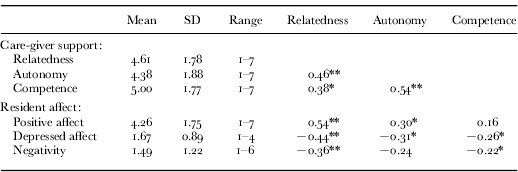
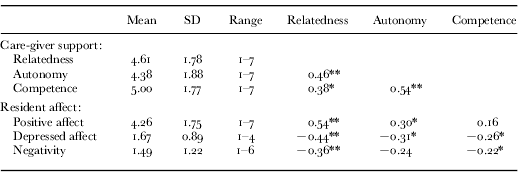
The first research question was to what extent care-givers support nursing-home residents' needs for relatedness, autonomy and competence during care interactions. Table 1 presents the mean scores and inter-correlations of the ratings on the scales for care-giver support and residents' affects across the 60 videotaped care episodes. The mean scores on the three scales for need support are all between 4 and 5, which indicates – according to the definition of the scale points – that the residents' needs are fulfilled to a moderate degree during their interactions with the care-givers. The wide range of scores (1–7) on all three support scales demonstrates the large variation of need fulfilment across care episodes. Further inspection of the score distributions indicates that high support of relatedness (score 5–7) was observed in 54 per cent of the care episodes, high support of autonomy in 57 per cent of the episodes, and high support of competence in 67 per cent of the episodes. Low support (scores 1–3) in contrast, was observed in 40, 33 and 25 per cent of the care episodes for the needs for relatedness, autonomy and competence, respectively.
Mean scores and intercorrelations for the support of residents' needs by care-givers and observed affects of residents
Notes: N=60 care episodes. SD: standard deviation.
Significance levels: * p<0.05, ** p<0.01.
Table 1 also shows significant correlations between fulfilment of the three needs during the care episodes (r values between 0.38 and 0.54). The correlations are only moderately high, however, indicating that fulfilment of one of the needs is not necessarily associated with fulfilment of the other needs.
To obtain an impression of how need fulfilment may vary for residents across care episodes, we also computed the range of scores for the fulfilment of the needs across the three care episodes (with three different care-givers) per resident. The differences between the highest and the lowest scores on the three scales for the three observations varied from 0 to 6, and the average variation was 2.65 scale points for relatedness and competence, and 2.30 for autonomy. These findings show that the extent to which different care-givers support the needs of an individual resident may differ considerably.
Calculation of the range of scores per care-giver (for those who were observed two or three times, N=20) showed that the consistency within care-givers is higher than the consistency within residents. The differences between the highest and lowest scores on the three scales varies from 0 to 4 and was on average 1.21 for relatedness, 1.58 for autonomy and 1.18 for competence.
Support of needs and residents' wellbeing
The second research question concerned the relation between need support and residents' wellbeing. First, we examined the relation between need support and residents' (observed) situational wellbeing, as reflected in the residents' affect during the interactions with their care-givers. The correlations between the scales for positive affect, depressed affect and negativity are moderately high (r values: −0.36, −0.47 and 0.46). Table 1 shows that the average level of positive affect of residents during the interactions was just above the midpoint of the scale (4.26 on a scale from 1 to 7), indicating that they had a moderately positive mood during care interactions. The mean scores for depressed affect (range 1–4) and negativity (range 1–6) were on average 1.67 and 1.49, respectively, indicating that residents showed few negative emotions during the morning care interactions.
To examine how the residents' affects varied across care episodes, we computed each resident's range of scores on the three affect scales across care episodes. The residents' negative affects were fairly consistent over the three observations (mean range depressed affect=1.2; mean range negativity=0.9). The mean range for positive affect was greater (2.5) and shows that positive affect could differ widely over the three observations.
The care-givers' support of the three needs was related to the wellbeing of residents during the morning care routine. In particular, the support of relatedness was related to more positive affect and to less depressed affect and negativity (Table 1).
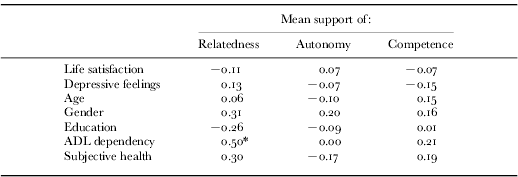
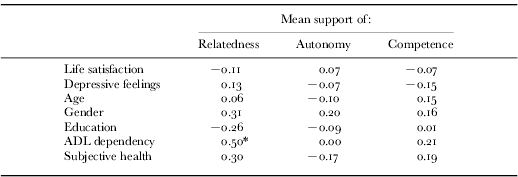
Next, we examined the relation between need support during care interactions and residents' (subjective) general wellbeing. The correlation between the scores for depressive feelings and satisfaction with life was significant (r=−0.61, p<0.01). Examination of the distribution of the resident's scores for depressive feeling on the GDS showed that the mean score for depressive feelings was 2.55 on a scale from 0 to 8. Based on a GDS cut-off score of 2/3 (Jongenelis et al. Reference Jongenelis, Gerritsen, Pot, Beekman, Eisses, Kluiter and Ribbe2007), eight of the 20 residents (40%) had an indication for further investigation of depression. The mean score for satisfaction with life, measured on the SWLS scale, was 3.50 on a scale from 1 to 5, indicating that the residents were moderately satisfied with their lives. Table 2 shows that the observed support of the three needs during the care episodes was not related to the residents' depressive feelings or life satisfaction.
Correlations of received support of the three needs (mean across three observations) with residents' general wellbeing and other resident characteristics
Notes: N=20 residents. ADL: activities of daily living.
Significance level: * p<0.05.
Support of needs in relation to resident and care-giver characteristics
The third research question was to what extent the support of the residents' three basic needs during care interactions is related to characteristics of the residents and care-givers. Table 2 shows the correlations between the mean scores for need support per resident, on the one hand, and residents' age, gender, education, ADL dependency and subjective health, on the other. As can be seen, only ADL dependency was significantly related to need support: residents with higher physical dependency received more support of their need for relatedness during care interactions than less-dependent residents.
Next, we examined the relation between care-giver characteristics and the extent to which they supported the needs of the residents during care interactions. For this purpose, scores for need support per care-giver were used; for care-givers who were observed more than once the scores were averaged over observation episodes.
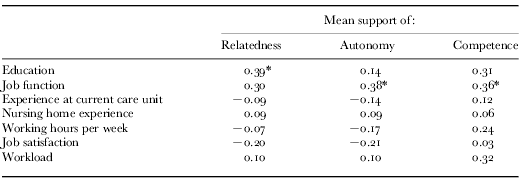
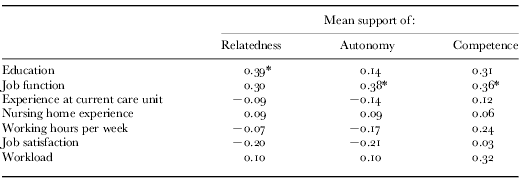
Table 3 presents the correlations between care-givers' scores on support of the three needs and care-giver characteristics. Higher education and higher job function were related to more support of residents' needs. In particular, positive correlations were found between educational level and support of relatedness and between job function and support of autonomy and competence. The extent to which care-givers supported the residents' needs was not related to their experience at the present care unit, experience in a nursing home, number of working hours, workload and job satisfaction.
Correlations between support of the three needs as provided by the care-givers (mean across observations) and care-giver characteristics
Notes: N=31 care-givers.
Significance level: * p<0.05.
Discussion
The purpose of this study was to explore the quality of daily care interactions between staff and residents of somatic nursing homes, defined as the support of residents' needs for relatedness, autonomy and competence. The results show that care-givers are moderately supportive concerning the fulfilment of the three basic needs during morning care. Many positive aspects of quality of communication were observed during the care interactions. However, we also observed interactions that scored low on one or more of the three observed aspects.
Remarkably, need support differed widely between the three observations of the same resident, whereas the variation within care-givers was much smaller. It seems that the quality of the interaction depends more on the care-giver working that day, than on the resident being cared for. The finding that characteristics of residents hardly play a role in the quality of interactions supports this conclusion, as does the finding that education and job function of the care-givers are related to supportive interactions.
Regarding the second research question, the results show a positive relationship between support of the needs and the observed situational wellbeing of the residents. The support of residents' autonomy, competence and in particular relatedness was associated with their mood during the interaction. This relation between need fulfilment and wellbeing is congruent with self-determination theory (Ryan and Deci Reference Ryan, Deci, Deci and Ryan2002) and the study of Kasser and Ryan (Reference Kasser and Ryan1999) who found autonomy and relatedness to be related to wellbeing. Because the present study was correlational, no conclusions can be drawn about the causal direction of this relationship. It is also possible that the feelings and expressions of the resident during the interaction influence the supportive behaviours of the care-giver. It might be easier to support needs when the resident is happy and satisfied than when the resident is irritated or angry. The correlation between need support by the care-givers and residents' situational wellbeing might also be the result of ‘third’ factors that are related to both variables, for example how well the care-givers and residents know and like each other, or the length of the working relationship in each dyad. In future research it is of importance to pay attention to these issues. By using a longitudinal design in which newly admitted residents are being followed for a certain time, changes in wellbeing and need fulfilment can be investigated.
Although support of the three needs during care-giving was related to the residents' situational wellbeing, it was not related to the residents' general wellbeing. This could possibly be due to other factors that may influence depressive feelings and life satisfaction such as important life events, personality, and the management and organisation of the nursing home. Apart from the role of these ‘other’ factors there are at least two other possible explanations for this finding. First, it is possible that the total observation time was too short (maximally 120 minutes per resident, and only in care situations) to provide a reliable picture of the residents' level of need support during interaction with care-givers in the nursing home. As noted before, the need support received by residents varied widely between observations. Future research may reveal whether ratings based on more extensive observations during the whole day better predict residents' general wellbeing. If the possibility for making video-recordings is not present, the observation scales can also be used during participating observation.
A second explanation for the lack of association between need support and general wellbeing lies in the fact that we related observed need support to subjective (self-rated) general wellbeing of the residents. In our previous study residents' self-reports of need fulfilment in the caring relationship were related to their subjective wellbeing (depressive feelings and life satisfaction) (Custers et al. Reference Custers, Westerhof, Kuin and Riksen-Walraven2010). It may be that the residents' subjective ratings of need support are better predictors of their subjective general wellbeing. Several studies have shown that subjective ratings of residents differ from observations. In a study concerning staff empathy and residents' depressive symptoms, Hollinger-Samson and Pearson (Reference Hollinger-Sampson and Pearson2000) reported that only low staff empathy as perceived by residents was associated with residents' self-rated depression. Future research should address these differences between observed and subjective fulfilment of needs and wellbeing. In a new study, we plan to ask residents and care-givers for their evaluations of need support and wellbeing directly after the observed morning care in order to have momentary subjective ratings. Furthermore, we plan to discuss videotapes of morning care with residents and care-givers in order to assess whether they judge the interactions in a different way than the researchers.
With regard to the third research question our results show that functional impairment was the only characteristic of the residents that was related to the need support they received from the care-givers. In particular, we did find that residents with more functional impairment received more support of relatedness. An explanation for this finding could be that it takes more time for the care-givers to care for residents with high physical impairment, so there is more time for them to engage in conversation. Residents with relatively intact abilities are often left alone for a while during care so that they can wash or dress themselves. Moreover, some care-givers in our study expressed their feeling that dependent residents are more in need of talk or attention because they are less likely to have friendships with other residents in the nursing home. They felt that the more physically independent residents have more opportunities to go out and make contacts on their own.
Concerning the characteristics of care-givers, it appeared that care-givers with a higher education level and job function scored higher on supporting the three basic needs. This means that they were not only task-oriented, but also paid attention to the psychological aspects of the interaction. Comparable results were found in other studies on communication in nursing care (Caris-Verhallen, Kerkstra and Bensing Reference Caris-Verhallen, Kerkstra and Bensing1997). Our findings are also similar to a study in dementia care, which showed that care-givers with more than basic education focused more on patients as individual persons with their own life history, values and self-identity (Normann, Asplund and Norberg Reference Normann, Asplund and Norberg1999).
Although the quality of communication was related to education and job function, no relations with work experience, workload and job satisfaction were found. We therefore argue that it might be responsibility in care that counts for the differences in need support. In the Netherlands, care-givers with higher job functions, who are also often more educated, have to account for the wellbeing of residents towards the nursing-home physician and the family of the resident. Therefore, they might feel more responsible for supporting the residents' needs than care-givers with lower job functions and fewer responsibilities. More research is needed concerning the exact role of education and the consequences of training for the quality of interactions between care-giver and resident.
Alongside the limitations of this study mentioned earlier in the discussion, a few other limitations should be mentioned. First, the video-observations were obtained during morning care only. It is possible that need support is different at other moments during the day. Moreover, we did not investigate the impact of morning care on residents' wellbeing later that day. For future research this would be an interesting question. Finally, our study was limited in that the results are tentative due to the relatively small sample size.
The results of this study suggest the importance of need support in the caring relationship for improving nursing-home care. Care-givers of somatic nursing-home residents should be educated in providing person-centred care by taking the three psychological needs of relatedness, autonomy and competence into account. Often they could learn to address these needs through small gestures or simple questions. For example, by engaging in conversations during care about a topic that interests the residents, like their (grand) children or the job they used to have (relatedness). Also, asking the residents what they would like to wear today (autonomy), asking them to wash their own face and complimenting them on that without patronising (competence) are examples of supporting these needs. The ideal situation would be one where there is a good match between the supportive behaviours of the care-givers and the (individual) needs of residents. In general, it is thought that it is preferable to have fewer care-givers taking care for one resident, to give some continuity in care. However, given the diversity in need support that residents receive from their care-givers in this study, one might expect that it would be more preferable to have more care-givers who differ in their need support than few care-givers who are less supportive. This is a topic which certainly needs more research, especially by taking into account residents' own opinions.
Acknowledgements
We would like to thank the residents and staff at the nursing homes who contributed to this study.