Peer relationships and social status are believed to reflect an individual's underlying social competence (Cillessen, Reference Cillessen, Rubin, Bukowski and Laursen2011; Ladd, Reference Ladd2005), and social status among peers is predictive of children's later social and psychological adjustment (Newcomb, Bukowski, & Pattee, Reference Newcomb, Bukowski and Pattee1993; Parker & Asher, Reference Parker and Asher1987). The influence of good peer relationships on students can result in feelings of ‘school connectedness’, which in turn has an impact upon students’ academic outcomes and personal growth (Ross, Shochet, & Bellair, Reference Ross, Shochet and Bellair2010; Thomas & Smith, Reference Thomas and Smith2004). International research literature reports high correlations between social competence, peer relations and academic success in Western cultures (Bukowski, Cillessen, & Velasquez, Reference Bukowski, Cillessen, Velasquez, Laursen, Little and Card2012; McClelland, Morrison, & Holmes, Reference McClelland, Morrison and Holmes2000; Powdrill, Reference Powdrill2004), and the same appears to hold true in Chinese studies (Chen, He, & Li, Reference Chen, He and Li2004; Chen, Huang, Chang, Wang, & Li, Reference Chen, Huang, Chang, Wang and Li2010). Social status is therefore an attribute that needs to be considered and fostered in the early years of schooling.
Background
Under the Hong Kong education system, young children normally study for 3 years at privately operated kindergartens before entering a primary school, where they then spend 6 years (Hong Kong Education Bureau, 2014a). The competition for first-year primary places, particularly in elite schools, is always intense, so kindergarten programs tend to be academically oriented, often limiting the amount of time children can spend in play. This is important, because children need to acquire appropriate social skills in order to settle easily into a new school environment (Eccles, Reference Eccles1999; Rodkin, Ryan, Jamison & Wilson, Reference Rodkin, Ryan, Jamison and Wilson2013). In addition, recent education reforms have placed increased emphasis on using collaborative project work in primary classrooms, and this means that children need even better social skills to work cooperatively (Hong Kong Education Bureau, 2014b).
Concern has increased in recent years that young children's social competence may be declining, and that this in turn adversely affects their adaptation as they move into primary school learning environments. This declining social competence has been observed in Hong Kong, due perhaps to limited chances for a child to play with siblings or peers in families with only one child. Though play is not the only means to develop social skills, playing provides the natural context where children can socialise through interacting with each other (Fleer, Reference Fleer2013; Newton & Jenvey, Reference Newton and Jenvey2011). Family size has been decreasing in recent years, from 3.1 in 2001 to 2.9 in 2011(Hong Kong Census and Statistics Department, 2012). Many parents also work long hours and so have less time to play with their children, and the children also seem to have less time to interact socially during recess at school (Estes, Reference Estes2005; Ng, Chao, Hui, Hong Kong Baptist University, & Playright Children's Play Association, Reference Ng, Chao and Hui2003; Yip, Reference Yip1999). There has been a rapid increase in solitary activities, such as the use of digital devices. For example, the Hong Kong Department of Health (2014) reported that some toddlers began using tablet computers at an average age of 16 months; and one in five primary and secondary students interviewed spent more than 3 hours a day with electronic devices. Such ‘addiction’ to these devices may be contributing to children's reduced social interaction with peers (Hirsh-Pasek & Golinkoff, Reference Hirsh-Pasek and Golinkoff2004; Shek, Tang, & Lo, Reference Shek, Tang and Lo2009). Social skills can only be gained and practised through interpersonal interactions (Csoti, Reference Csoti2009; Plummer, Reference Plummer2008) such as those offered by opportunities to mix and play with others (Fleer, Reference Fleer2013).
In Chinese culture, parents are generally more concerned about children's academic achievement than their social development, and they may be relatively unaware of a child's lack of social competence with peers at school (Chen et al., Reference Chen, He and Li2004; Chen & Jiang, Reference Chen and Jiang2002; Leung, Reference Leung2010). However, where children lack social competence, it is essential that some form of intervention is provided to increase their skills. Bloomquist (Reference Bloomquist2013) has rightly pointed out that children can only really work on social skills through opportunities to interact directly with peers. Under these circumstances, pre-schools and primary schools must endeavour to play a more proactive role in creating opportunities for social interactions among students.
Many young children may experience mild social difficulties for a short period ― for example, when transferring to a new environment ― but this does not reach a clinical level of severity requiring specific therapeutic intervention. Instead, the program described here is intended to prevent these young students from missing out socially through disengagement from group activities, or through inappropriate behaviour causing peer rejection. Such problems can result in delay in social development and academic difficulties (Guralnick, Reference Guralnick2011; Kjøbli & Sørlie, Reference Kjøbli and Sørlie2008).
Early Intervention
Early intervention is intended to enhance children's social competence and increase the likelihood of positive school experiences and learning outcomes (Palmen, Vermande, Dekovic, van Aken, Reference Palmen, Vermande, Dekovic and van Aken2011). Researchers have recommended school-wide social intervention for all children to prevent intensifying problems associated with social incompetence (Algozzine & Algozzine, Reference Algozzine, Algozzine, Clough and Garner2005; Lane, Wehby, Robertson, & Rogers, Reference Lane, Wehby, Robertson and Rogers2007).
Social intervention programs are relatively common in Western contexts (Cohen, Duncan, & Cohen, Reference Cohen, Duncan and Cohen1994; Margolin, Reference Margolin2001; Parton & Manby, Reference Parton and Manby2009), including some with a focus on social competencies for transition into formal schooling (Fabian & Dunlop, Reference Fabian and Dunlop2002). In the United States there are also early intervention programs to support children's peer-related social competence (Guralnick, Reference Guralnick2011; Pellegrini, Kato, Blatchford, & Baine, Reference Pellegrini, Kato, Blatchford and Baine2002).
When children do not have adequate opportunities to acquire and practise social skills in free play, they may require play-based social intervention to develop and reinforce these skills (Frost, Wortham, & Reifel, Reference Frost, Wortham and Reifel2005; Greene, Hariton, Robins, & Flye, Reference Greene, Hariton, Robins and Flye2011; Resiliency Resource Centre, 2011). In the West, social skills in young children are commonly developed through informal activities such as free play and unstructured games rather than through direct teaching or intervention (Macintyre & McVitty, Reference Macintyre and McVitty2003; Papalia, Olds, Feldman, & Martorell, Reference Papalia, Olds, Feldman and Martorell2012). However, for some children ― particularly those who may lack easy access to neighbourhood play opportunities, such as for children in Hong Kong where high-rise buildings and crowded streets are the norm ― a more structured and deliberate approach may be needed to enhance the social learning process.
Research Gap in Hong Kong Context
Peer status has been the focus of research attention in Western cultures for many years (Coie & Dodge, Reference Coie and Dodge1983; Crick & Ladd, Reference Crick and Ladd1990; Mayer, Lavergne, Tourigny, & Wright, Reference Mayer, Lavergne, Tourigny and Wright2007). Until recently, the topic was relatively neglected in Chinese settings, but there are now more studies emerging that have examined the impact of peer group on social competence (e.g., Chen, Chang, & He, Reference Chen, Chang and He2003; Chen et al., Reference Chen, He and Li2004; Xu, Farver, Yang, & Zeng, Reference Xu, Farver, Yang and Zeng2008). This has included research focused on preschoolers (Chen & Jiang, Reference Chen and Jiang2002), middle childhood (Xu et al., Reference Xu, Farver, Yang and Zeng2008; Schwartz, Chang, & Farver, Reference Schwartz, Chang and Farver2001), and longitudinal studies (Chen et al., Reference Chen, Huang, Chang, Wang and Li2010). However, locally, the studies have mostly targeted adolescents (Chang, Reference Chang2003; Ma, Shek, Ping, & Bun, Reference Ma, Shek, Ping and Bun2000) or have focused on the effects of peer status, rather than evaluating outcomes from social intervention to improve status (Chang et al., Reference Chang, Liu, Fung, Yan, Wen, Li and Farver2007; Schwartz, Tom, & Chang, Reference Schwartz, Tom and Chang2010). Studies on school-wide social programs are fairly limited, and those that exist have been concerned mostly with secondary schools (Shek et al., Reference Shek, Tang and Lo2009; Sun & Shek, Reference Sun and Shek2010; Tong & Zhan, Reference Tong and Zhan2012), sixth-grade students (Hui & Chau, Reference Hui and Chau2009), or with therapeutic approaches for children with special educational needs (Caldarella, Adams, Valentine, & Young, Reference Caldarella, Adams, Valentine and Young2009; Lak, Tsang, Kopelowicz, & Liberman, Reference Lak, Tsang, Kopelowicz and Liberman2010). None have explored the issue of improving social competence at first-year primary school level.
Purpose of the Study
The purpose of this study was to provide first-grade children with a program that encourages social competence by using group games as the training medium. The intention was to evaluate the outcomes by reference to any changes in each child's social status, as perceived by peers participating in the same group. To our knowledge, this is the first study evaluating a classroom-based social intervention program for first-grade students in Hong Kong.
Rationale
Playing games and interacting with peers is believed to help all children learn to get along together. This principle is underpinned by theories of child development (Piaget, Reference Piaget1970) and by social learning theory based on the work of Vygotsky (Reference Vygotsky1978). Within Vygotsky's theory, social interaction with adults and more competent peers helps children advance positively in their ‘Zone of Proximal Development’ (ZPD). Similarly, the notion of a ‘Social Play Continuum’ (Broadhead, Reference Broadhead2006) concurs with the concept of ZPD by depicting a progression of social development through play enhanced by adult intervention.
Play is a bridge connecting children socially, and has positive implications for their social competence and adjustment (Erikson, Reference Erikson1977; Fleer, Reference Fleer2013; Frost et al., Reference Frost, Wortham and Reifel2005). Erikson (Reference Erikson1977) suggested that in the early years, children naturally learn to cooperate with peers and adults, but those who experience social difficulties can be at long-term risk. Contemporary studies concur that children who lack interactive play with peers are impeded in their social functioning. This is true in both Western culture (Broadhead, Reference Broadhead2006; Leadbeater & Hoglund, Reference Leadbeater and Hoglund2009) and Chinese culture (Chen, Liu, Chang, & He, Reference Chen, Liu, Chang and He2008; Chen et al., Reference Chen, He and Li2004; Chen & Jiang, Reference Chen and Jiang2002).
The Social Program
The social program implemented in this study (Hong Kong Education Bureau, 2006) utilised the interactive nature of group games, structured with specific learning targets covering communication, interpersonal skills, cooperation and team building. The intervention was in accord with the concept of ‘eduplay’ (Leung, Reference Leung2010; Rao & Li, Reference Rao, Li, Pramling-Samuelsson and Fleer2009) ― that is, deliberately helping young children learn from their social experiences beyond simply participating in an activity. The program adopts a play approach that can include children from different ability levels in an inclusive setting. Through differentiation of activities, and by adding variations, the approach could meet the needs of the high-ability children as well as those who were less advanced (Renzulli & Reis, Reference Renzulli and Reis2008; VanTassel-Baska, Reference VanTassel-Baska2011). The activities were designed to create social opportunities for all children to interact very frequently with classmates.
Format of the Social Intervention
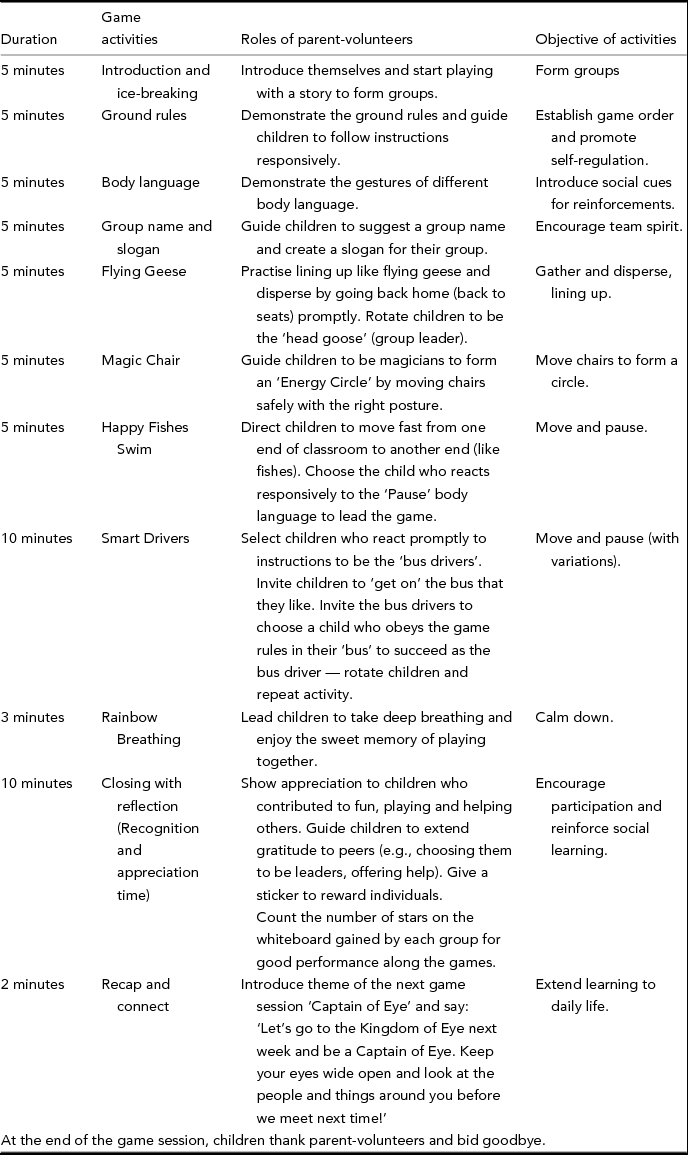
The intervention involved a block of 60 minutes of contact per week for 8 weeks in the children's own classrooms. Students played in groups immediately after the lunch period. Each classroom was cleared, with tables moved to the walls, leaving chairs arranged in a U shape surrounding a central area. The format of a 60-minute intervention is presented in Appendix A, using the first session as an example. The same general format was applied in all seven sessions.
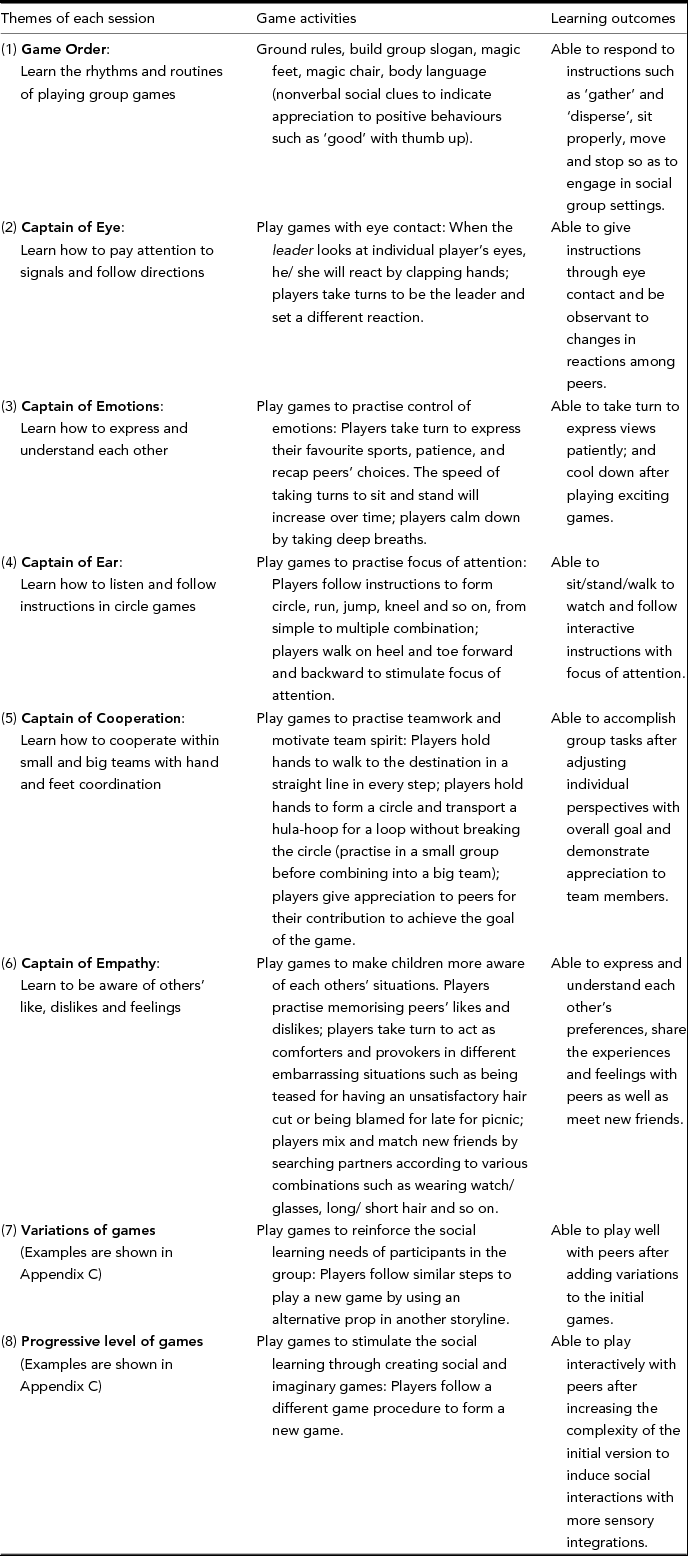
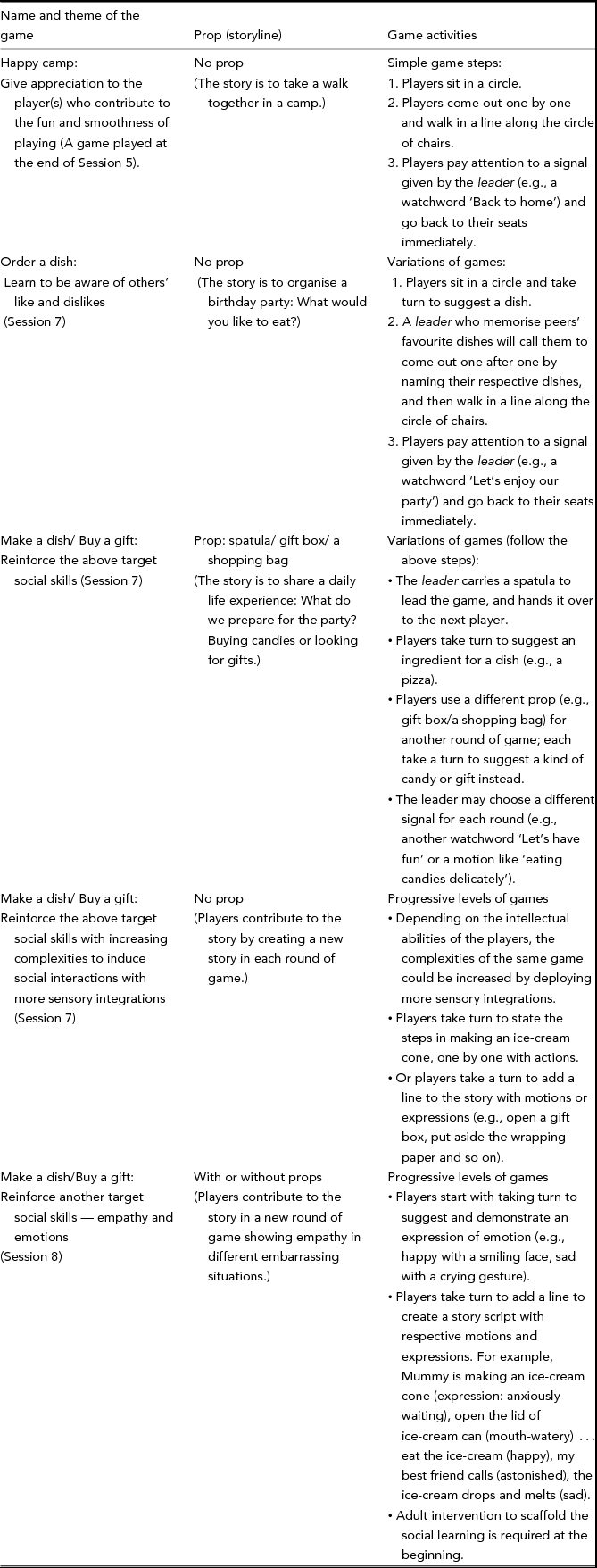
A key element in playing the group games was to maintain game order. Children took turns to lead a game, and all players learned to respect the leader. Gradually, children would adjust to the routines and rhythms of playing together, and more time would be spent on playing more rounds of games. The time spent on setting out game order (illustrated in Appendix A) would be reduced accordingly. The themes and activities implemented in each intervention session are described in Appendix B. Children first practised simple games by responding to instructions; then games were increased gradually in complexity, and were differentiated by adding variations, as illustrated in Appendix C.
Parent-Volunteers Scaffold Social Learning
The program deployed parents as volunteers to play group games with the young children. Before the intervention began, the parent-volunteers attended two half-day workshops where they learned how to conduct and manage group games to achieve the intended learning outcomes. During these training sessions they practised the activities described in Appendices A, B and C. Their two key roles were to encourage participation and to help children interpret and reflect upon meaning of social cues in their interactions with peers.
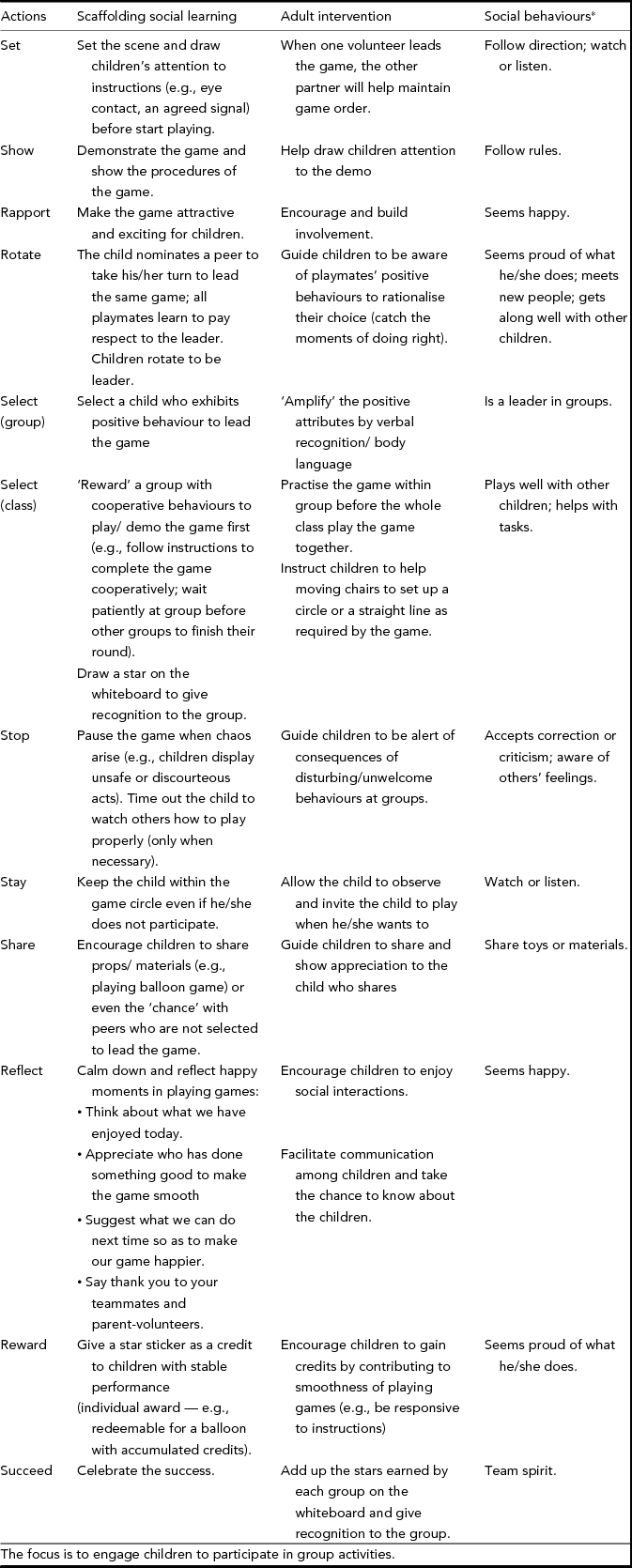
When playing with the children, parent-volunteers were also expected to recognise and reinforce children's use of positive social behaviours, such as sharing, taking turns, being helpful, expressing ideas and following rules. Parent-volunteers selected a child who exhibited positive behaviours to lead each game. This procedure is in keeping with the concept of ‘social modelling’ (Stephens, Reference Stephens1992), where children learn through observing and imitating others. In addition, the children were helped to understand that their desirable behaviours would be rewarded when performed (contingency management). Even without prior contingencies, parent-volunteers would also catch and praise the moments when children performed appropriate social or prosocial behaviours (social reinforcement: Stephens, Reference Stephens1992). The techniques were based on well-established reinforcement theories for building positive habits (Fisher, Piazza, & Roane, Reference Fisher, Piazza and Roane2011). Scaffolding of social learning through adult intervention in the program is illustrated in Appendix D.
The program was structured with different games to engage children with different learning styles and preferences, and to introduce different game skills. The parents were able to apply flexibility in choosing different games, as long as the intended social learning outcomes were met.
Playing group games naturally involved social interactions, during which positive behaviours were always reinforced. The practice of scaffolding social learning (Appendix D) was implemented in each session, regardless of the actual games being played. The program was structured in such a way that each session was based on a different theme and was self-contained. In other words, participation in a session was not dependent on having participated in a previous session; any children who were absent occasionally were thus not disadvantaged. The parent-volunteers recorded attendance figures for their groups. The rate of absenteeism was low during each intervention ― on average, fewer than three children were absent per class.
Method
The target school was selected because it had operated the social intervention program for every new cohort of first-grade students since 2006.
Participants
Students
All child participants in the intervention (N = 119) were first-grade Hong Kong students who had recently joined the school (age range 5.67 to 6.57 years, mean 74 months, SD = 3.48 months; 63 boys and 56 girls). Written parental consent was received from 119 (96.7%) out of 123 first-grade students invited to take part. Only one boy was absent during the nomination activity. The students were based in four primary classrooms (class size 30 to 31). The program operated as a classroom module during normal school hours, and attendance rate was above 90%.
Demographic variables for the participating children were similar in terms of socio-economic status (mainly middle class families), ethnicity (97.6% Chinese), and native language (96.7% Cantonese).
Trainers of parent-volunteers
A total of six trainers participated. They were experienced adults who had completed game-skills training. To maintain strict confidentiality and avoid bias or conflict of interest, trainers were not to be parents of any participating children. The trainers were also responsible for overall management of the program, and for conducting the one-to-one data collection interviews with the children.
Parent-volunteers
A total of 24 parents participated. They were volunteers from parents of first-grade students and were assigned to play group games with the students. These parent-volunteers always worked with their child's classmates, not directly with their own child. There were two parents in each group, and three groups in each of the four classes.
Procedure
Peer nomination by first-grade students
The data collected before and after the intervention comprised children's nominations of the three most-liked (ML) and three least-liked (LL) classmates to play with. This procedure followed that recommended by Coie, Dodge & Coppotelli (1982). The information was then analysed to identify five categories of social status (popular, rejected, neglected, controversial and average) after summing the ML and LL choices each child received from classmates. Social preference (SP) was obtained by the subtraction of LL score from ML score. Social impact (SI) was computed by the addition of ML and LL scores. Finally, five socio-metric status groups were formed: popular (SP > 1.0, ML > 0, LL < 0); rejected (SP < -1.0, ML < 0, LL > 0); neglected (SI < -1.0, ML < 0, LL < 0); controversial (SI > 1.0, ML > 0, LL > 0); and average (SP > -1.0, SI < 1.0). For interpretation purposes, popular children and average children are regarded as having positive social status (were relatively liked by peers). Rejected children and neglected children are regarded as having negative social status. ‘Controversial’ children are those with conflicting liked and disliked votes.
Data were collected at the beginning (Time 1) and at the end of the intervention period (Time 2) to evaluate outcomes for children's social competence and to identify any changes in their peer relations status. The academic year in Hong Kong runs from early September to June, so the initial data were collected in late September to allow students to become familiar with their classmates in different study and play scenarios. Prior to the study commencing, the school had arranged for all first-grade students to become well acquainted with each other by joining in ‘getting-to-know-you’ activities during an orientation week.
Qualitative data were collected from multiple informants for analysis. Informants included the trainers (n = 6), parent-volunteers (n = 24), and the first-grade students (n = 119). After the intervention, informants completed the same procedures.
Prior to individual interviews (Time 1), each participating student viewed photos of all classmates (n = 30 or 31) to become very familiar with names and faces. The photo chart was then used by the six trainers during the one-to-one interview when students were asked to nominate ‘most liked’ and ‘least liked’. Trainers used a standard script to ensure consistency of the procedure. The overall atmosphere enabled the children to enjoy the naming activity as if they were participating in a game. To increase the fun, a neon ring was used to circle the photo of each choice. Each child was also asked to give reasons to justify each ‘most liked’ choice, but not ‘least liked’ (for ethical reasons). Exactly the same activity was carried out after the 8 weeks of intervention (Time 2). Any change to an individual's status was noted.
The qualitative data from reasons given for ‘most liked’ choices were decoded and categorised according to 14 social indicators in the Early School Behavior Rating Scale (ESBS; Caldwell & Pianta, Reference Caldwell and Pianta1991), as well as from any unique reasons that came from children's stated justifications. Social indicators were descriptions such as: ‘X shares toys or materials’, ‘X helps with tasks at school’, ‘X likes to meet new people’, ‘X is a leader in groups’. All nomination reasons given by the children could fit into the 14 ESBS categories, except the item ‘play well on his/her own’.
Focus group interview
Focus group interviews with the six trainers were conducted after each peer nomination activity. During the interview, trainers reported their observation of children's responses (e.g., child's confidence level, speed of responding, any evidence of careful thinking rather than impulsive choosing). This information was used where relevant to complement the quantitative analysis of the nomination records.
Parent-volunteer nominations
After the second week of the program ― and without knowing the results of the first peer nominations ― the parent-volunteers began to use ESBS (Caldwell & Pianta, Reference Caldwell and Pianta1991) to identify the social behaviours of the individual children during group games and to identify those who did not play well in their groups. The social indicators were related to the interactive nature of group games such as: ‘Plays well with other children’, ‘Follows rules’ and ‘Sits still to watch or listen’. While at first glance ‘sitting still’ may not seem like a social skill, in this study ‘sits still’ at appropriate times is interpreted as a socially desired behaviour in a group-learning context. Children who sit still to watch and listen are demonstrating appropriate self-regulation necessary for successful participation in a cooperative group situation (Savina, Reference Savina2014). They are able to attend to instructions and can retain the rules of a game in memory. Less socially competent children tend not to sit still, and often have a poor attention span and impulse control (Newton & Jenvey, Reference Newton and Jenvey2011).
Results
At Commencement of Intervention (Time 1)
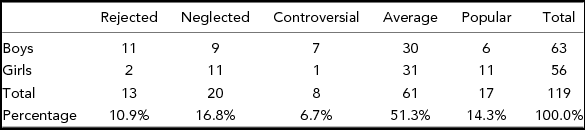
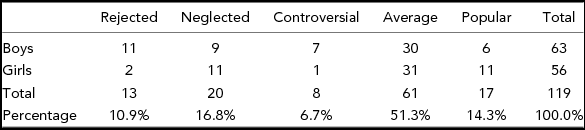
The socio-metric results (as shown in Table 1) indicated that within the total group of students, 10.9% were rejected, 16.8% were neglected, 6.7% were controversial, 51.3% were average, and 14.3% were popular. This distribution is not markedly different from the reference range suggested by Cillessen (Reference Cillessen, Reis and Sprecher2009, Reference Cillessen, Rubin, Bukowski and Laursen2011) for fixed nominations (i.e., 15% popular or rejected, 5–10% neglected or controversial, and 55% average). In this sample, the percentage rated as rejected was slightly lower, and those rated as neglected was slightly higher. Results also agree with Cillessen (Reference Cillessen, Reis and Sprecher2009, Reference Cillessen, Rubin, Bukowski and Laursen2011), who suggested that research reveals girls are more popular than boys (in the study reported here the ratio was 11 girls to 6 boys), and boys are more rejected than girls (here the ratio was 11 boys to 2 girls).
Social Status at Commencement of Intervention
Negative Social Status and Play Competencies
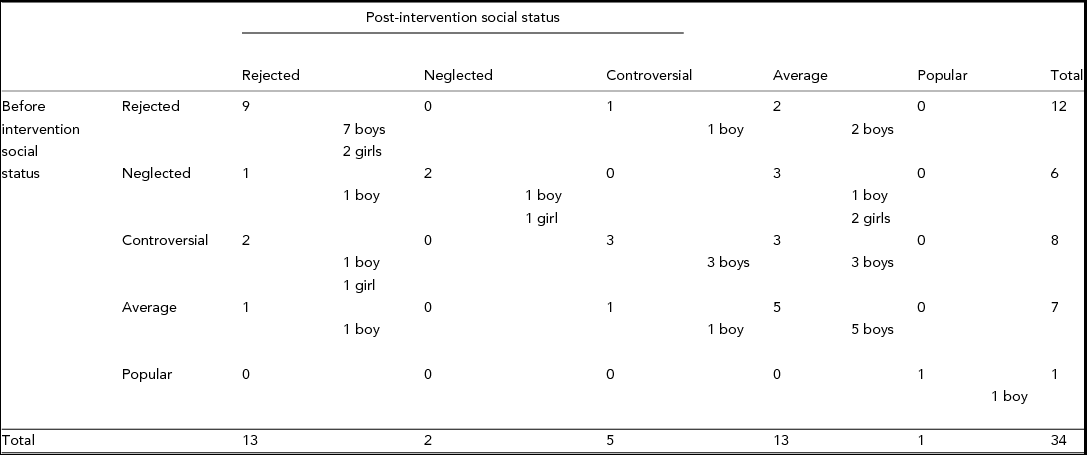
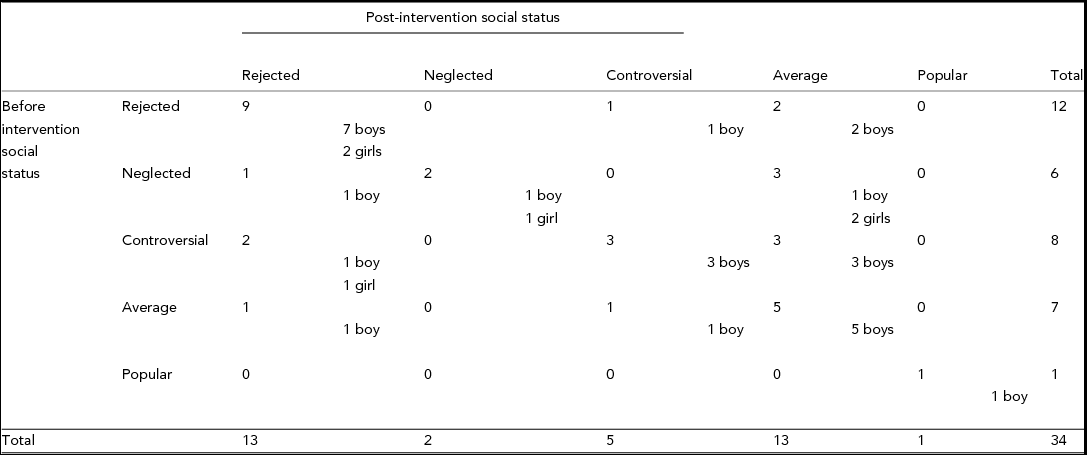
At Time 1, parent-volunteers identified 34 children (28 boys, 6 girls) out of 119 (28.6 %) as ‘inferior players’ who did not play well with other children or follow rules in group games (see Table 2). Results indicated that 12 out of 13 rejectees (92.3%) and all 8 controversial children (100%) nominated by their peers were identified as inferior players by parent-volunteers. Play competencies in group games were therefore highly correlated with rejected and controversial social status. Of all neglected peers (9 boys, 11 girls), only 6 were identified as inferior players, but more than half (2 boys and 9 girls) improved to positive status. All popular children at Time 1 had maintained a positive social status after intervention, except one popular girl who had changed to neglected status.
Following the intervention, one rejected boy (who was not an inferior player) performed well in the group activities and increased to positive social status. The only popular boy identified as an inferior player gradually began to play well, and thus maintained a popular status. Among the total of 34 inferior players, 26 were also rated as having negative social status (76.5%). Those rated as average increased from 7 to 13, while children of controversial status and neglected status decreased from 8 to 5 and 6 to 2 respectively. Out of the 8 controversial children (7 boys, 1 girl), 3 improved to average status (all boys). Attention was drawn to the 9 rejectees who remained at rejected status, and the 4 inferior players (2 controversial, 1 neglected, 1 average) who became rejectees. This had occurred even though most had shown some improvement in play performance during group games. It was clear that, for them, further interventions would be required.
Cross Tabulation of Changes in Social Status of Inferior Group-Games Players by Gender
After Intervention: Most Liked (ML) and Like Least (LL)
After intervention, only 3 students (2.5%) kept all nominations from Time 1 unchanged. In contrast, 31 students (26.1%) made three new ML choices, 60 students (50.4%) nominated 2 new ML peers, and 25 students (21%) voted 1 new peer. This trend may simply reflect that at this age, perceptions of others often change quite quickly as children get to know each other better. Results indicated that some children may meet new friends while keeping established friendships. Multiple friendship relationships were also noticed; that is, Child A played with B, and B liked to play with C, then A liked C. The social circle of each individual child was enlarging. According to the nomination record, after the program, 16 children out of 119 (13.4%) nominated only ‘like-most’ peers and did not name any ‘like least’ peers. In addition, one third of the children did not nominate all 3 LL peers.
Findings from Trainers
During the first nomination period (Time 1), children were observed to have difficulty giving perceptive reasons to justify their choices of ‘like most’ and ‘like least’, and took a longer time to come up with an explanation. There were 13 cases of children who nominated others but could not give reasons. Children generally gave a brief reason such as ‘we have recess together’ (23.7%), ‘same kindergarten’ [or] ‘knew her before’ (15.1%), and ‘on same school bus [or] in same group’ (13.3%). At Time 2, reasons were more perceptive and carefully considered, perhaps based on their increasing social experience and knowledge of the class members. At Time 2, only two students could not state a reason for a choice. They also resisted making ‘least liked’ choices, possibly because they had increased empathy for the feeling of others, or because basically they did not dislike anyone. Trainers reported that children explicitly related their justifications to their play experience in recess.
Trainers reported that at Time 2 all children except two could identify all classmates from the 30 to 31 photographs, again suggesting broader social awareness. Children also described experiences hinting at increasing informal social contacts across the class, such as chatting with X at the school bus stop, going to the library with Y, and so on.
Findings From Parent-Volunteers
Parent-volunteers reported their nominations of inferior players in their groups. They identified 34 children out of 119 as inferior players at Time 1. During the pre-intervention workshops, the parents had enjoyed rehearsing the games, but had then been very surprised to find out during the early weeks that children were not used to playing cooperatively together. They could not comprehend why the children were unable to cooperate, had poor attention spans, and did not listen to instructions. This situation caused some problems at first in establishing rules and game order. Additionally, progress would be hindered when too many inferior players were allocated to one group. The parent-volunteers found it was best to operate with no more than two inferior players in a group of 10 children. This ratio could allow the inferior players to learn from their competent peers with adequate adult intervention. The parent-volunteers reported that most inferior players engaged in group activities with their classmates by the fourth session.
Out of 14 social behaviours (Caldwell & Pianta, Reference Caldwell and Pianta1991), the parent-volunteers found that some social indicators were highly correlated with the interactive nature of group games ― ‘Plays well with other children’, ‘Gets along well with other children’, ‘Follows rules’, ‘Follows directions’ and ‘Sits still to watch or listen’. These specific skills were improved noticeably during intervention. When children became familiar with the rhythm of play in groups, they could interact positively and find group activities enjoyable. More social attributes could then be observed and reinforced, such as ‘Accepts correction or criticism’, ‘Is aware of others’ feelings’, ‘Seems proud of what he/she does’, ‘Is a good leader in groups’, ‘Likes to meet new people’ and ‘Seems happy’.
Discussion and Implications
Transition to School
This study involved the delivery of a games-based social intervention aimed at developing first-grade students’ social competence for a smooth transition to formal schooling. The program was an approach that enabled children of different ability levels to join in successfully. The intervention encouraged children to follow rules, listen to instructions, and cooperate within the group (Frost et al., Reference Frost, Wortham and Reifel2005; Papalia et al., Reference Papalia, Olds, Feldman and Martorell2012). The games were intended to facilitate social interactions among children and enhance the learning of positive social behaviours (Stephens, Reference Stephens1992). It was expected that between Time 1 and Time 2 most students would discover a great deal about their classmates through playing and working with them and forming friendships. The model could have value in schools for monitoring students’ social development and social status as it changes over time.
It is fully acknowledged that many factors other than the program content could have influenced changes in children's social status over the period between the Time 1 and Time 2 assessments. A study with a control group that did not experience the program would be required to discover whether the observed changes could be directly attributed to the intervention. The results above are therefore interpreted with some degree of caution.
Social Awareness
Improvements in social growth and awareness were most evident in the students’ increased ability at Time 2 to provide much more perceptive reasons for liking certain students more than others in the peer group. Most children at Time 2 could explain their preferences with multiple reasons to justify their social choices.
Self-Regulation
Findings during the early sessions of the program indicated that about one third of participants were identified as ‘inferior players’. There is some recent evidence in the research literature to support the use of ‘games with rules’ to promote self-regulation and positive social relations (Savina, Reference Savina2014); so, it was expected that as these children became familiar with the rhythm of play in groups they would acquire better social skills and competencies, and transfer them to other group settings.
Narrowing the Gender Difference
Results indicated a high proportion of rejected boys and controversial boys (n = 18 boys) relative to girls (n = 3) at the start of the intervention. This concurred with studies that young boys are more likely than girls to have social and behavioural problems (Barbu, Cabanes, & Le Maner-Idrissi, Reference Barbu, Cabanes and Le Maner-Idrissi2011; Cook & Cook, Reference Cook and Cook2009). After the intervention, six boys, including the rejected boy who was not an inferior player, had improved to positive status. These boys may have benefitted from the program by improving their self-regulation and their communication skills in the social setting (Savina, Reference Savina2014). The gender difference in social competence was therefore narrowed at Time 2.
Status of Neglected Children Improved
Overall, a high percentage of neglected children (9 girls and 2 boys out of 20) improved to a positive status by the end of the intervention. This was supported by the qualitative analysis of comments from parent-volunteers and trainers. Any intervention that can help neglected children gain notice and acceptance in the class is welcome, given that there is an unfortunate tendency for teachers, as well as peers, to overlook the needs of students who are ‘invisible’ (not assertive). Much of the work of Guralnick (Reference Guralnick2011) recognises that neglected children can benefit from social intervention.
Quality of Recess Play
The program of games may have facilitated and accelerated the pace at which children became familiar with their peers. They were better able to describe new social experiences they shared with other children. They enjoyed more social contact at recess time, during school and after school. In terms of transfer and generalisation of skills and behaviours, it is possible that the quality of recess play improved due to better interactive skills. When play or interactive opportunities arose, children were more socially competent to create their own games and engage in social and imaginative play, confirming the belief of Pellegrini et al. (Reference Pellegrini, Kato, Blatchford and Baine2002) that playing games at recess brings positive growth in social competence and peer relations. Playing competently clearly indicates social learning in first-grade students (Frost et al., Reference Frost, Wortham and Reifel2005).
Social Cohesiveness
Social cohesiveness among the young students appeared to be enhanced. For example, at Time 2 the total number of dislikes dropped, with one third of participants unwilling to make all three dislike choices. Perhaps some ‘like least’ votes were given at Time 1 simply because the children did not really know one another, although they knew names and faces. Playing group games together may have facilitated the mingling of classmates and established a sense of ‘community’. New friends were made while keeping one or two old friends, and the social network gradually developed through interaction among multiple friendships.
Play Competencies
In this study, competencies in participating in group games were positively correlated with participants’ social status. For example, 92.3% of rejectees and 100% of controversial children were also identified as inferior players (not able to listen or work cooperatively). Studies have indicated that rejected children actually love to play, but often lack the skills and behaviours needed to participate in groups (Erath, Pettit, Dodge, & Bates, Reference Erath, Pettit, Dodge and Bates2009; Hill & Merrell, Reference Hill and Merrell2004; Mayer et al., Reference Mayer, Lavergne, Tourigny and Wright2007). These students are often rejected because they display aggressive behaviours, or they are very passive. Both these traits affect peer acceptance and performance in group activities (Crick & Dodge, Reference Crick and Dodge1994; Schwartz et al., Reference Schwartz, Chang and Farver2001). Practising group games could thus help these inferior players learn self-regulation and re-establish social status (Savina, Reference Savina2014).
The data seem to indicate that the intervention may have had a positive influence on competencies in participating in group games. Eight inferior players improved to positive status after intervention, though they had not yet reached ‘popular’ level. If these children now practise and transfer social skills as they interact with others during recess and when play opportunities arise, they are likely to maintain or improve their status over time. Children who remained as inferior players and with negative social status might need more time to acquire group playing skills or, in a very few cases, might need more intensive social skills intervention. ‘Play therapy’ (which typically involves just a few participants under clinical supervision) could be considered as a further treatment following this intervention. The program as implemented here may well represent a natural screening procedure for identifying such children who are potentially socially at risk when they enter a new school.
Parent Involvement
The uniqueness of the program is its ability to involve parents for maintenance and continuity of training. If more schools introduce programs of this type it may increase the likelihood that families in Hong Kong will recognise the importance of creating play opportunities at home and outside school hours.
Conclusion
In this study, children's competencies in playing group games were highly correlated with their social acceptance among peers. The format of the intervention enabled all first-grade students to participate in a social intervention that exposed them to rules and codes of behaviour, and helped them become aware of the characteristics of their classmates in a games-playing situation. Early intervention of this type can also help teachers identify at-risk children who may require more intensive social skills training.
Limitations
The first limitation of the study is that it was based on a sample from a single school, where most children came from middle-class homes. The program may not be so easy to implement or have such apparently positive effects in schools that are regarded as ‘socially disadvantaged’. However, these disadvantaged schools do need to place great emphasis on developing children's social competence.
A second limitation is lack of a control group. It could be argued that some of the observed outcomes here are simply a result of the children's natural maturation between Time 1 and Time 2. It is important to point out that this study was exploratory and did not employ experimental methods. Instead, a large treatment group was used to gather initial data to guide future studies. This preliminary work was mainly concerned with accelerating the pace at which children became familiar with others in their peer group, and how this affected their social status. A control group should be included in future research in order to detect any significant effects from the intervention.
A third limitation applies to qualitative data collection. Parent-volunteers were asked to report observations on the children's social behaviour and development. Although care was taken to ensure that parents did not work with their own child, the parents’ evaluations could still be subjective (e.g., by overstating the progress that a ‘pleasant’ child has made; or being too critical of a child who sometimes behaved badly). A refinement would be to use independent observers to record changes in students’ social behaviours and social status.
Despite these limitations, the present study is the first to use this design to evaluate a school-wide social program for first-grade students in Hong Kong.
Future Research
There is a paucity of studies involving social development of elementary school children in Chinese settings. More effort should be devoted to evaluating social intervention strategies. Future studies could explore the feasibility of introducing a similar program in elementary schools that are regarded as disadvantaged.
A longitudinal study of first-grade students could explore ongoing changes in social status and social competence over time, and how this affects school performance. Is there a connection between academic achievement and early social status? Further research should certainly focus on the students who did not appear to benefit much from this program. What factors account for this? How can these students who lack social status and skills best be helped?
Acknowledgments
The article is based on Sylvia Liu's EdD research under the supervision of Mantak Yuen and Nirmala Rao.
Author Biographies
Sylvia Liu is an Ed.D candidate at the University of Hong Kong Faculty of Education. She has extensive experience in human resource management, educational program design, and delivery of train-the-trainers program for parents and teachers. Her research interests are in social competence, gifted education, parent education and career education.
Mantak Yuen, PhD, is Associate Professor and Director of the Centre for Advancement of Inclusive and Special Education in the Faculty of Education at the University of Hong Kong. He was trained as an educational psychologist at the University College London. He is a registered counselling and educational psychologist in Hong Kong. His research interests are in students’ life career development, self-efficacy, connectedness, gifted education, and inclusion in schools.
Nirmala Rao, PhD, is Serena H.C. Yang Professor in Early Childhood Development and Education in the Faculty of Education at the University of Hong Kong. She is a Developmental and Chartered (Educational) Psychologist. Her research program concerns the influences of home and preschool experiences on early child development, and the policies which affect them.
An Example: Format of Session One (1 Hour)

Game Activities and Main Intended Learning Outcomes
Case Illustration of Group-Games With Variations and Progressive Levels
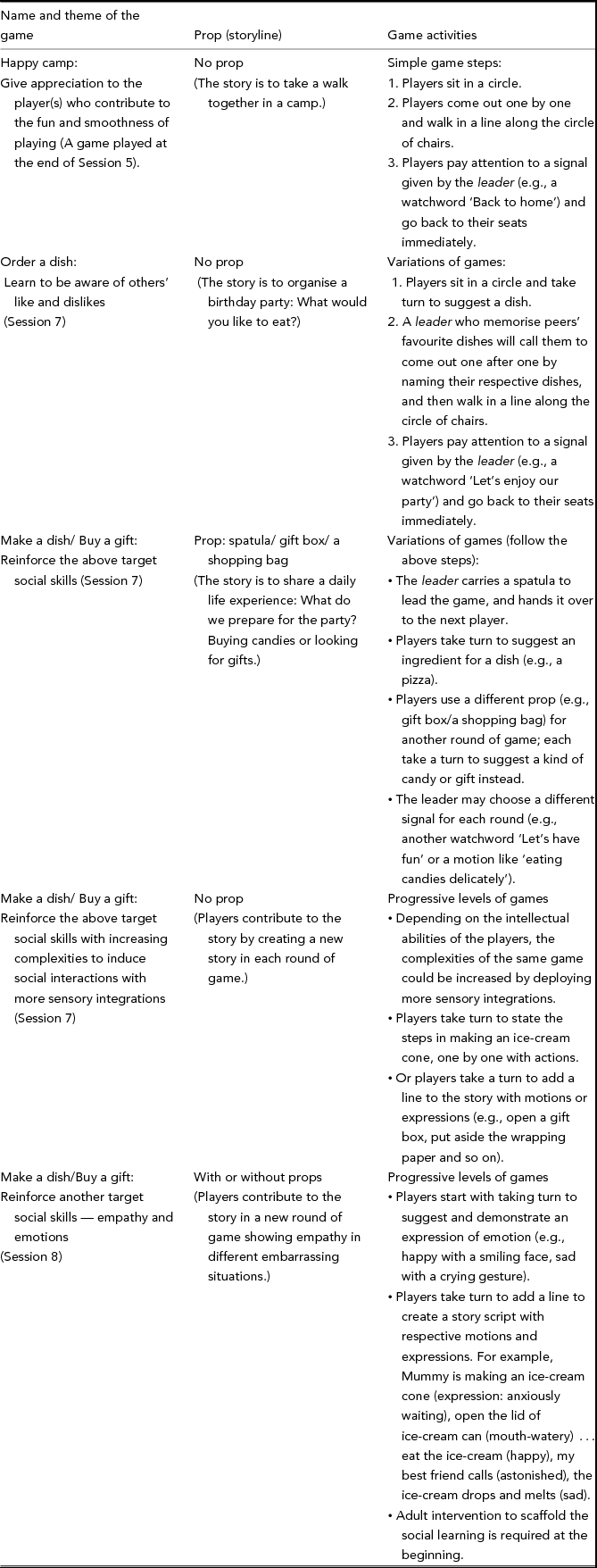
Illustration on Adult Intervention in the Social Program