An organism is healthy if its parts are all behaving and disposed to behave as they “should” behave. Pathology consists in some defect in the way that the parts of the body or mind are disposed to work. (To simplify, this essay will discuss only physical health.) How should these claims be understood?
One way is evaluative: according to authors such as Engelhardt (Reference Engelhardt1974), Nordenfelt (Reference Nordenfelt1987, Reference Nordenfelt2001), Reznek (Reference Reznek1987), or Cooper (Reference Cooper2002), the parts of an organism are disposed to behave as they should if and only if their capacities are good for the organism. In their view, poor human health consists in internal states that are bad for people or that doctors treat or that excuse behavior that would ordinarily be condemned or that call for sympathy and care from others. But these views conflict with the judgments of physiologists and pathologists.Footnote 1 Health deficits may be trivial or even good for people. Doctors treat conditions that are not pathological, such as fertility. Pathological states such as voluntary infertility need not excuse behavior that would ordinarily be condemned, and they do not call for sympathy or care. Evaluative views of health also make it difficult to see how the term “health” can be used univocally to refer to states of people, animals, plants, or, more debatably, ecosystems. Even though health is usually a very good thing both intrinsically and instrumentally, there seems to be no conceptual connection between health and benefit.
This essay explores the alternative view that health is a naturalistic, nonevaluative notion. What distinguishes defect from health is not whether the condition is good for a person or other organism or whether it is treated by doctors or a justification for sympathy but whether the condition contributes to the functioning of some directively organized system within the organism, where that system directly or indirectly typically promotes fitness.Footnote 2 This claim does not imply an etiological view of functions, which I reject. Natural selection selects for traits of organisms that enhance the transmission of genes of the kinds possessed by fitter organisms. Whether those traits are good for an organism in terms of any evaluative criterion is irrelevant. Whether a trait is in this sense beneficial is not a human evaluative choice; it is nature's “choice.” What natural selection “cares about” is fitness.
Pursuing this line of thought permits a naturalistic account of health, which I call the functional efficiency theory. The functional efficiency theory denies that there is any definitional connection between health and well-being or any moral or aesthetic good, but it concedes that evaluative considerations play an evidential role and influence people's judgments concerning what is healthy or pathological. Section 1 of this essay presents the best-developed naturalistic view of health, the biostatistical theory (BST) defended by Christopher Boorse (Reference Boorse1975, Reference Boorse1977, Reference Boorse, DeVeer and Regan1987, Reference Boorse, Humber and Almeder1997, Reference Boorse and Gifford2011). The functional efficiency theory is a modification of Boorse's theory. Despite important disagreements, it owes so much to Boorse's work that it might be regarded as a reinterpretation of the BST rather than an alternative to it. Section 2 develops objections to Boorse's view of pathology as statistically subnormal functional efficiency of some part or process. Section 3 examines the notion of functional efficiency and offers a truth condition for comparisons of functional efficiency. Section 4 discusses how the functional efficiency theory distinguishes between health and pathology. Section 5 responds to some objections to Boorse's account that apply to the functional efficiency theory, and section 6 concludes. Like Boorse, I rely on a goal-contribution view of functions rather than an etiological view, but much of the account could be revised so as to rest on an etiological view.
1. The Biostatistical Theory of Health.
The BST relies on a view of organisms as systems designed to transmit their genes. Phenotypes are organized hierarchical systems whose subsystems have their own goals. Achieving subsystem goals typically contributes to fitness, but some subsystems may not contribute to fitness or may even diminish fitness. The blood vessels in a lipoma (a benign soft-tissue tumor) have the function of providing oxygen and nutrients to the cells of the lipoma and removing wastes, even though the lipoma has no function. The same can be said of the blood vessels in a malignant tumor, even though this functioning diminishes the functioning of other systems and shortens the organism's life.
Boorse simplifies and takes the highest level goals of an organism to be its survival and reproduction. This simplification is not without its costs. As Elliott Sober pointed out to me, this simplification implies that biological altruism is pathological since it lessens the probability of survival or reproduction of the individual organism. Moreover, what promotes an organism's survival sometimes conflicts with what enhances its probability of reproducing, and without reference to fitness there may be no way to judge whether there has been a net improvement or decline in functioning. For the purposes of comparability and simplicity, I shall usually follow Boorse and take survival and reproduction to be the overall goals of organisms, but as some points I shall substitute inclusive fitness. The parts of organisms have specific goals, which generally, but not always, contribute to survival or reproduction. Physiologists study both what contribution systems within organisms currently make to the organism's survival or reproduction and what contribution the parts of systems within organisms make to the goals of those systems.
The contributions of traits and capacities to the goals of subsystems and ultimately to survival and reproduction of organisms are not uniform. A healthy caterpillar has different capacities from a healthy butterfly of the same species; healthy bucks differ from does, and healthy human infants differ from adults. What is at issue is the contribution to survival or reproduction or to lower-level goals of the parts and processes within “references classes” of organisms distinguished by factors such as sex and age.Footnote 3 These lower-level goals typically promote survival or reproduction, but some processes or parts (e.g., the human appendix) apparently make no contribution to the goals of any system or are even detrimental to some of them. This is a crucial point: how well a part or process in some system is functioning depends on the goals of the system, and if, as is often the case, the part or process belongs to more than one system, then its functioning must be relativized to a system. The blood vessels within a malignant tumor are promoting the goals of the tumor and, simultaneously, undermining the goals of other systems and of the organism.
On the goal-contribution view of functions I favor and Boorse defends (Reference Boorse1976, Reference Boorse2002), the functions of the parts of some “directively organized” system S with a goal G are the effects of the parts that make it more likely that S will achieve G. A directively organized system S is one that shows resilience in its pursuit of G, where that resilience is explained by the special structure of S, rather than by natural law. (This last condition explains why a boulder that persists in its careening path down a hill is not part of a directively organized system.) When physiologists ask what contribution the parts and processes within reference classes make to the achievement of the specific goals of some subsystem within some reference class or to the top-level goals of survival and reproduction, they are asking what are the functions of the parts and processes.
A further important complication is that the parts of organisms carry out their functions with differing “efficiencies.”Footnote 4 In congestive heart failure, the heart is still pumping blood, but it may be pumping so badly that the person can barely walk. Someone with back spasms may be able to do everything that a healthy person can do but not without pain. Poor health often involves “inadequate” functioning rather than a complete failure to function.
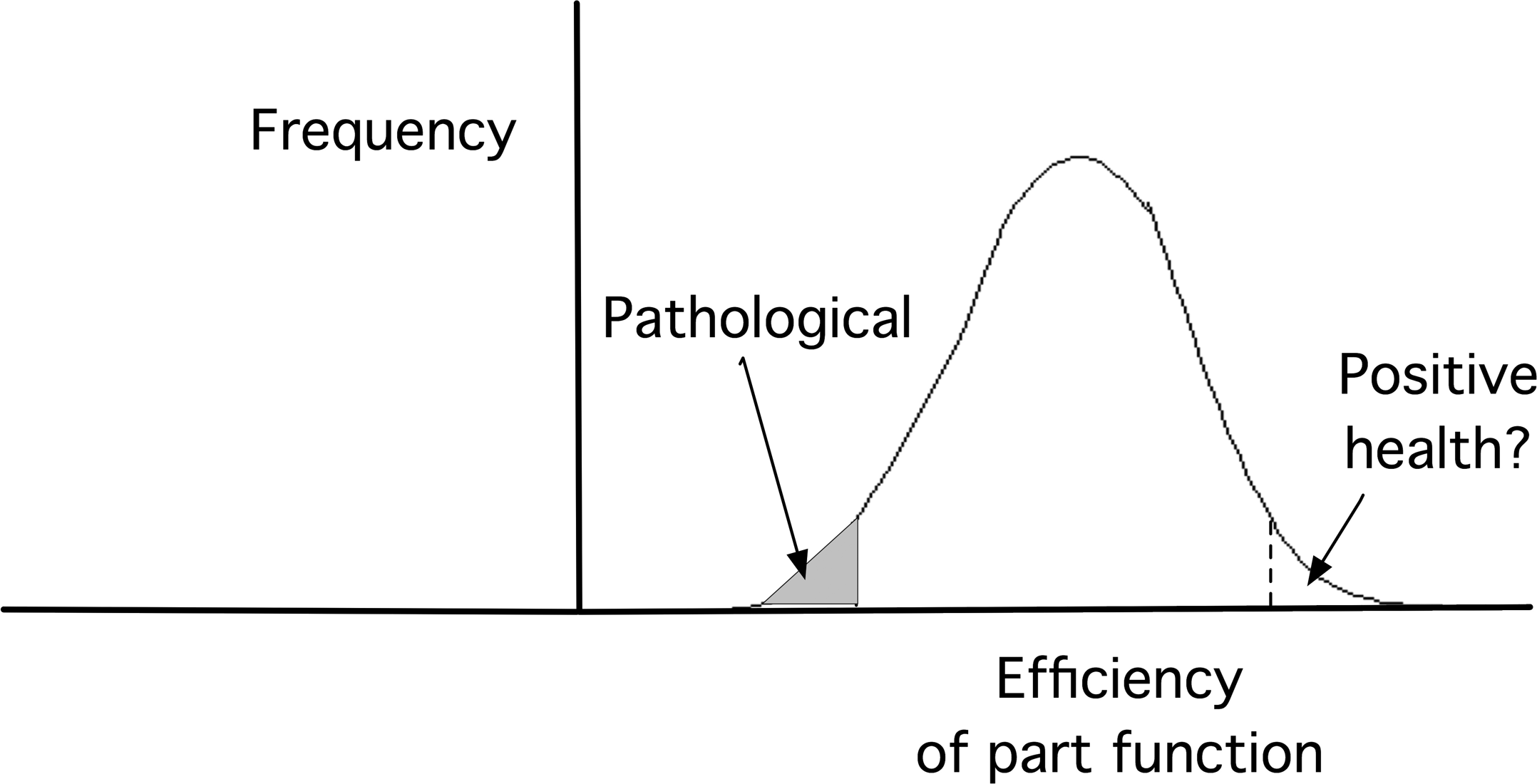
Within any given reference class, parts will function with differing efficiency. Boorse argues that pathology consists in statistically subnormal functional efficiency. To clarify what he has in mind, he draws a graph like that in figure 1 (Reference Boorse, DeVeer and Regan1987, 370; Reference Boorse, Humber and Almeder1997, 8).Footnote 5 The horizontal axis in figure 1 represents level of functional efficiency, while the vertical is the frequency of each level in a reference population. There is no reason why the distribution of functional efficiency should be normal, continuous, or single peaked. It could be the case that some part of an organism functions at a small finite number of levels of efficiency or even at just two levels, “on” and “off.” Regardless of how many levels of efficiency there may be, Boorse maintains that the distinction between pathological and nonpathological levels is statistical: the functioning of a part in a reference class is pathological if and only if its efficiency lies far into the lower tail of the distribution of functional efficiency in the reference class. Exactly where to draw the line between low-normal and pathological functioning is arbitrary. “Second, the lower limit on normal functional ability—the line between normal and pathological—is arbitrary. … The concept of a pathological state has vague boundaries—though the vast majority of disease processes involve functional deficits by any reasonable standard” (Reference Boorse, DeVeer and Regan1987, 371; see also Boorse Reference Boorse1977, 559). What, Boorse asks, apart from prevalence, would lead physiologists to conclude that 20:20 vision is healthy while 20:50 vision is not, rather than judging them both to be pathological as compared to the vision of an eagle (Boorse Reference Boorse2002, 102)? If everyone needed to urinate hourly, the need to urinate that frequently would not be pathological. On Boorse's view, statistically normal functional efficiency defines adequate functional efficiency.
Statistically subnormal part function.

It is helpful to distinguish three theses that together constitute the core of Boorse's view of health. I have numbered these theses and the summary statement of the view as a whole in the following quotation from Boorse: “[1] It is a virtual truism of medicine that health is normal function, and what is pathological is abnormal function. I believe that this truism, suitably analyzed, is the only correct definition of the normal-pathological distinction in medicine. … [2] Normality of function, in turn, is a statistical concept based on what is typical of a species (or subclass thereof). On this analysis, [3] the normal-pathological distinction is a naturalistic one: [4] the essence of the pathological is statistically species-subnormal part-function” (Reference Boorse, DeVeer and Regan1987, 370; the numbering is mine and the italics are Boorse's). Boorse's overall position, which is expressed by phrase 4, can be divided into three theses corresponding to the phrases numbered 1–3:
1. Part function: There is a pathology when a part of an organism is not functioning at least adequately.
2. Statistical normality: A part of an organism is functioning adequately if and only if it is functioning in a statistically normal way.Footnote 6
3. Naturalism: Whether a part of an organism is functioning adequately is a scientific rather than an evaluative matter.
The part-function thesis is logically independent of the statistical-normality and naturalism theses. The statistical-normality thesis entails the naturalism thesis—but not vice versa.Footnote 7 In my view, unlike Murphy's (Reference Murphy and Zalta2009), the most enlightening way to understand the disagreement between the naturalist and the nonnaturalist is to recast it as a dispute about the standards in terms of which the functioning of parts and processes is better or worse. Although nonnaturalists do not all endorse the part-function thesis, they should. The extent to which the part-function thesis matches the distinctions physiologists and pathologists draw provides an overwhelming reason to accept it. However, pathologists regard some statistically normal conditions as diseases, which is inconsistent with the statistical normality thesis. The central disagreement concerning naturalism boils down to contrasting views of how to assess the functioning of an organism's parts and processes.
2. Problems with the Statistical-Normality Thesis.
The part-function thesis supposes that there is, as it were, a set of blueprints specifying the functional design of a healthy organism in a reference class in relatively common and benign environments.Footnote 8 In general, the functioning of the parts of organisms is “adequate”—that is, it conforms to the blueprints. The naturalist thinks of the blueprints as having been drawn by evolutionary processes, which have created organisms with parts that were “designed” to function in some set of environments so as to enable the organisms to do a great many things that ultimately typically conduce to their survival and reproduction. The nonnaturalist, in contrast, thinks of these blueprints, at least in the case of human beings, as ideals of flourishing that need not be fully realized by biological processes.
Although statistically normal functioning usually coincides with adequate functioning (lest organisms fail to survive and reproduce), the coincidence need not be perfect. Processes of selection and development are not flawless, and, even if they were, organisms can only be healthy in some environments. In an environment without essential nutrients, no one would be healthy.
To see clearly that adequate functioning cannot be defined as statistically normal functioning, consider the following remarks Boorse makes in the course of distinguishing cultural variation in judgments of normality from the view that what is healthy is culturally relative: “one African tribe takes dyschromic spirochetosis (a skin disease) to be so normal that its absence is a disease making one unsuitable for marriage” (Reference Boorse, DeVeer and Regan1987, 378).Footnote 9 If one interprets “normal” statistically, as Boorse does, one could restate this claim as “one African tribe takes dyschromic spirochetosis [pinta] … to be so prevalent that its absence is a disease.” But that is an odd thing to say. Many prevalent conditions are diseases. No matter how prevalent the fevers caused by malaria have been, no group of people would take fevers to be healthy and their absence to be pathological. “Normal” in the original quotation cannot be interpreted as “statistically normal.” (Yet prevalence has some role, too. Whether pinta—unlike malaria—is a disease is not easy to ascertain. If it were rare, no one would think that its absence was a disease.)
Statistically normal function often coincides with adequate functioning, but one should not identify the two.Footnote 10 As Boorse recognizes, the statistical-normality thesis faces counterexamples in the existence of apparently pathological conditions such as tooth decay that are not statistically rare in common environments. One possible response is to maintain that highly prevalent diseases such as tooth decay represent the effects of unfavorable environmental factors. One might then explain away the apparent counterexamples by considering what would be statistically normal in some standard environment without so much sugar in people's diets. But Boorse instead argues that there are so few examples of highly prevalent diseases that pathologists should stick with his analysis and alter their judgment that conditions such as tooth decay are pathological. He suggests that only advanced or extreme tooth decay (which is rare) should count as pathological (Reference Boorse, Humber and Almeder1997, 103).
This suggestion fails to deal with two additional problems for the statistical-normality thesis that Peter Schwartz has recently pointed out (Reference Schwartz2007). Schwartz calls these the problems of “common diseases” and “healthy populations.” “Common diseases” are diseases that afflict a considerable minority of a population. For example, he points out that nearly a quarter of men over age 70 suffer from urinary dysfunction due to benign prostate hypertrophy (Schwartz 2007, 375). Hip dysplasia affects more than a third of some breeds of dogs. If, as Boorse maintains, the line between normal and pathological functional capacities lies far into the lower tail of the distribution of functional efficiency, then a majority of elderly men with urinary dysfunction, like a majority of dogs with dysplasia, are healthy. Cases such as these, of which there are many, suggest that levels of functional efficiency may be pathological even if they are not far into the lower tail of the distribution.
The other difficulty, which Schwarz calls the problem of “healthy populations,” shows that functional efficiency that is far into the lower tail of the distribution is not always pathological. If very rare subnormal levels of functional efficiency differ little from common levels, then even functioning that is less efficient than 99% of the reference class might still be healthy. For example, the average “ejection fraction” in adult human hearts (the percentage of blood the heart pushes out on each beat) is about 58%. If ejecting 56% rather than 58% enables other parts of the human body to function just as well, then an ejection fraction of 56% is not pathological. The distribution of ejection fractions in the population is irrelevant. Where to draw the line between pathology and healthy functioning is not a statistical question, and it is not arbitrary.
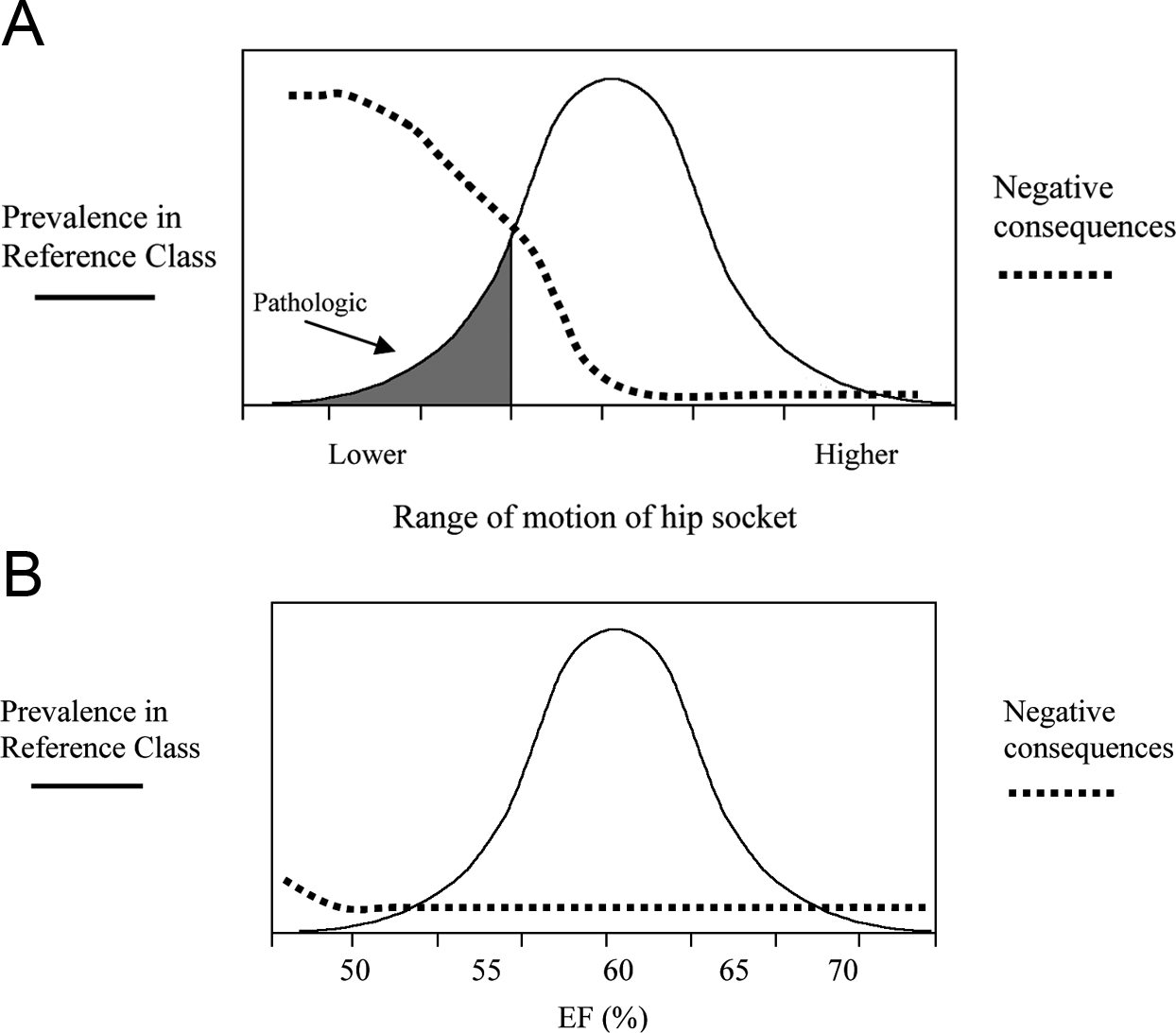
Schwartz concludes that the line between adequate functioning and pathological functioning depends on an evaluation of the consequences of the shortfall in functioning for standard activities. To illustrate what he has in mind, he draws two graphs (Reference Schwartz2007, 378) that depict cases involving common diseases (hip dysplasia in dogs) and healthy populations (ejection fractions in humans). These graphs (in fig. 2) are misleading in three regards. First, on the horizontal axis Schwartz has substituted a physical magnitude for functional efficiency. Every increase in range of motion or ejection fraction need not correspond to an increase in functional efficiency of hips and hearts (e.g., an increase in ejection fraction may come at a cost in energy consumption or susceptibility to arrhythmia). Second, the graphs suggest (although this is unintended) that the intersection of the two curves defines the boundary between what is pathological and what is healthy. In fact, the point of intersection—the point (or points: there could be many) where the magnitude of negative consequences equals the frequency of a particular level of functional efficiency—is meaningless. Schwartz's view is that whether there is a pathology depends mainly on the severity of the negative consequences.Footnote 11
A, Prevalence and negative consequences of canine hip functioning; B, prevalence and negative consequences of ejection fractions (EF) in healthy population.

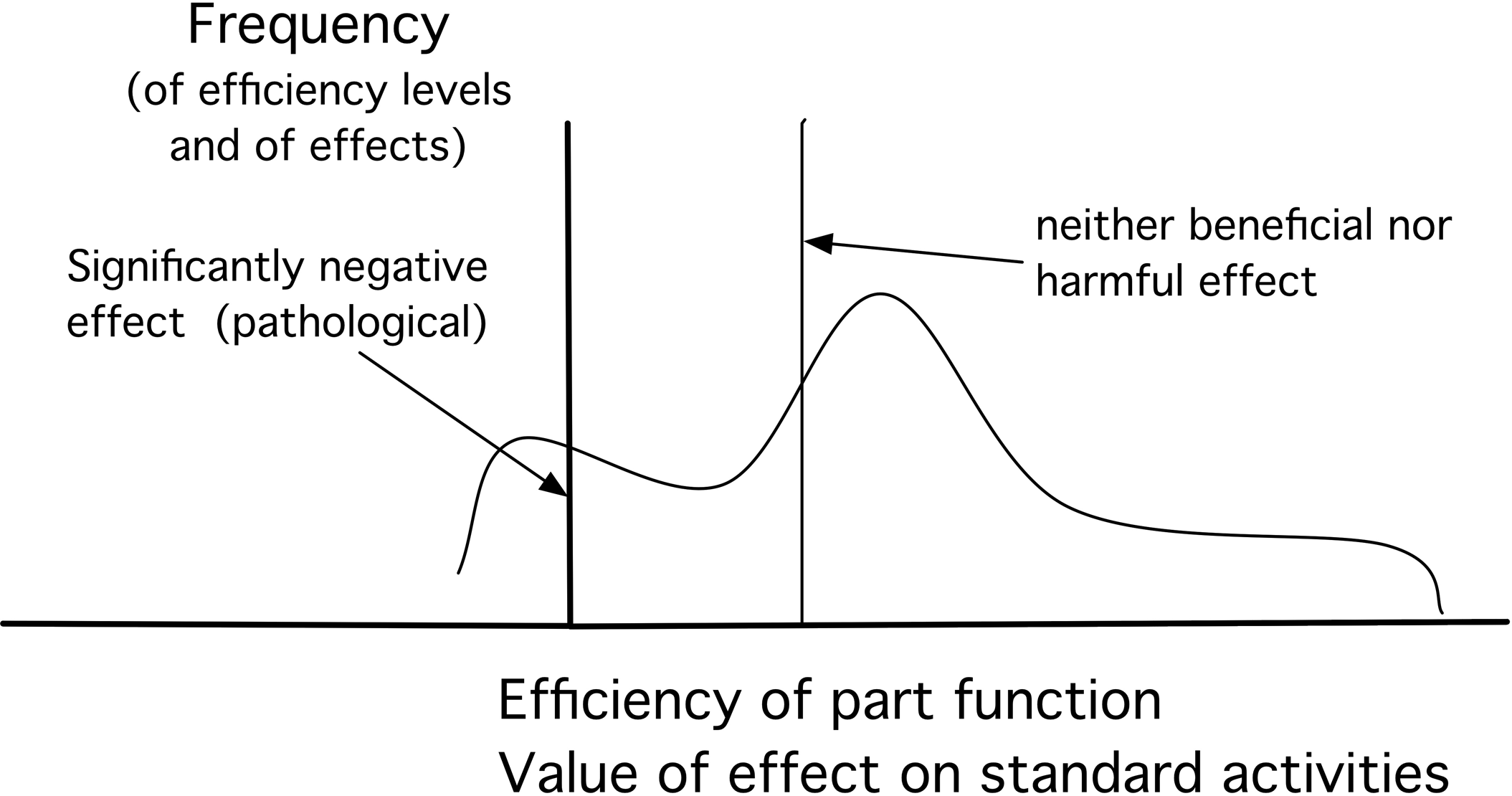
Third, the magnitude of negative consequences is not independent of functional efficiency. It would be less misleading to substitute for Schwartz's graphs something such as figure 3. In figure 3, both levels of functional efficiency and some evaluative measure of the consequences of those levels are represented on the horizontal axis, and the frequency of both is represented on the vertical axis. The shape shown is arbitrary, and whether there is a discrete number of levels of functional efficiency and of values of consequences or whether there is a continuous measure of both is also irrelevant to the argument. If one assumes, as will often be plausible, that each level of efficiency corresponds (in a given environment) to exactly one level of goodness of consequences, then, as shown in figure 3, the distribution of levels of functional efficiency will coincide with the distribution of the values of consequences, although the evaluative scales will differ. If more than one level of functional efficiency corresponds to a single value of consequences, a single taller bar in a discrete distribution of the values of consequences will replace two or more bars in the distribution of functional efficiencies. What determines whether a level of functional efficiency is pathological is its location along the horizontal axis, not its frequency. Frequency can, however, be used as a fallible indicator of that location if it diminishes as one moves to the left.
Distribution of efficiency and value of part function.

According to Schwartz's essay, levels of functional efficiency are pathological rather than healthy if the functional shortfall “significantly diminish[es] the ability of a part or process in the organism, or of the overall organism, to carry out an activity that is generally standard in the species and has been for a long period of time” (Schwartz 2007, 379). This proposal is ambiguous. Does it count the failure of one kidney as unhealthy because the kidney is not carrying out an activity that is generally standard for kidneys, or does it deny that the failure of the kidney is pathological on the grounds that it does not diminish the ability of the organism to carry out activities that are generally standard for the organism? If he means the latter, then he forfeits the advantage that Boorse claims for his account that it includes among pathologies “local part-dysfunctions [that] need not have any gross effects on disability or deformity or distress” (Reference Boorse, DeVeer and Regan1987, 371). But if he means the former, then parts may be pathological even if they do not have any negative consequences for the systems in which they are embedded. And in that case, Schwartz cannot respond to problems of healthy populations by pointing out that statistically rare subnormal functioning such as an ejection fraction of 56% has no negative consequences for the organism.
It is also questionable whether Schwartz's reference to activities that are “generally standard in the species and [have] been for a long period of time” captures what is relevant. Consider mild presbyopia (farsightedness due to hardening of the lens of the eye) that is nevertheless severe enough to make it impossible to read a phone book or thread a needle. For thousands of years before humans developed crafts requiring the ability to focus on small close-up objects, mild presbyopia might not have diminished people's abilities to engage in any activities that had been standard. People might not even have noticed the condition. Schwartz's view implies that mild presbyopia only became a pathological condition when human cultures came to include activities that required the ability to focus on small and close objects.
Schwartz points out that pathologists judge some statistically subnormal levels of functional efficiency to be healthy and that they judge some common or even statistically normal levels of functional efficiency to be pathologies. He suggests, quite plausibly, that the cutoff between levels of functional capacity that are adequate or inadequate depends on the consequences of those levels, but he provides little detail about this dependence, and an account of pathology must make room for a pathological part function that does not cause disability or distress. Prevalence seems to matter, too.
3. Functional “Efficiency.”
To find a way through this morass, it is crucial to address a question that has been lurking in the discussion above. What is “functional efficiency”? To judge how efficiently a (token) part is functioning is to judge how well the part is now able to serve the goals of the systems of which it is a part. What are the standards in terms of which parts differ in their capacities to function? Boorse says little about what defines efficiency and how its levels are to be distinguished, as they must be before one can talk about their frequency and draw a graph such as figure 1. Boorse writes: “To put it another way, the function of the thyroid is not merely to secrete hormones, but to secrete the right amount of them for current metabolic needs. For us there is no such thing as excessive function. But to keep the formulation unambiguous I use the term ‘efficiency’. … The population distribution to which the definition refers is the one for a function's efficiency” (Reference Boorse1977, 559; see also Boorse Reference Boorse, DeVeer and Regan1987, 371). In more recent work he says little more: “the function theory imposes a natural polarity on physiological processes. … The function of a physiological process is its contribution to physiological goals. By ‘deficiency’ of function, then, I mean simply less function, less contribution to the goals, than average. This is an arithmetic, not an evaluative, concept. An easy example is homeostatic functions like regulation of body temperature. … In general, whenever one knows the goal [function] of a process, one knows what is more or less function, and “deficiency,” in the context quoted, simply means much less than average” (Reference Boorse, Humber and Almeder1997, 21).
Despite what Boorse maintains, comparisons of functional efficiency are evaluations of functioning. Efficiency is not determined by prevalence, even though natural selection promotes efficiency and makes it unlikely that inefficient functioning of some part will be more common than more efficient functioning, at least within environments that are not changing rapidly. What explains why Boorse does not acknowledge the fact that claims about functional efficiency rest on assessments of functioning might be the frequent close correlation between functional efficiency and some biological indicator of functioning, as we saw above in Schwartz's figures 2A and 2B, which conflated the functional efficiency of hearts with their ejection fractions and the functional efficiency of hips with their range of motion. Despite its correlation with variables such as range of motion, functional efficiency cannot be identified with such variables.
For example, consider Boorse's own example of thyroid function. The human thyroid has multiple functions and a complex functional structure of its own. Among its effects are the regulation of the body's sensitivity to other hormones and the body's overall use of energy. The thyroid accomplishes this regulation mainly through the production of two hormones, triiodothyronine (T3) and thyroxine (T4). The thyroid also helps control growth in children, and it manufactures proteins that are needed by other parts of the body. Its functioning is in turn regulated by a hormone, TSH, which is produced by the pituitary gland. Thyroids differ in their output of T3 and T4 in response to levels of TSH. The statistically normal levels are .8 to 1.8 μg/l of serum T3 and 46–120 μg/l of serum T4. Although there is some individual variation in responses to T3 and T4, levels that are higher or lower than these lead to goiters, which can make it hard to breathe and swallow. High levels of T3 and T4 lead to diarrhea, muscle weakness, and weight loss. Low levels lead to obesity, fatigue, weakness, and fainting. How well the thyroid functions—that is, its functional efficiency—diminishes (other things being equal) as it produces levels of T3 and T4 that are increasingly above or below the normal ranges of serum T3 and serum T4 because increasingly high and low levels have increasingly “bad” effects. These effects (goiters, difficulties breathing and swallowing, weight loss, diarrhea, obesity, fatigue, muscle weakness, and fainting) are bad because they interfere with the functioning of other parts, processes, or systems, or they directly diminish the probability of survival and reproduction. To be sure, these effects also diminish well-being (with the possible exception of weight loss in a world where it is easy to overeat), and that fact has influenced judgments of functional efficiency.
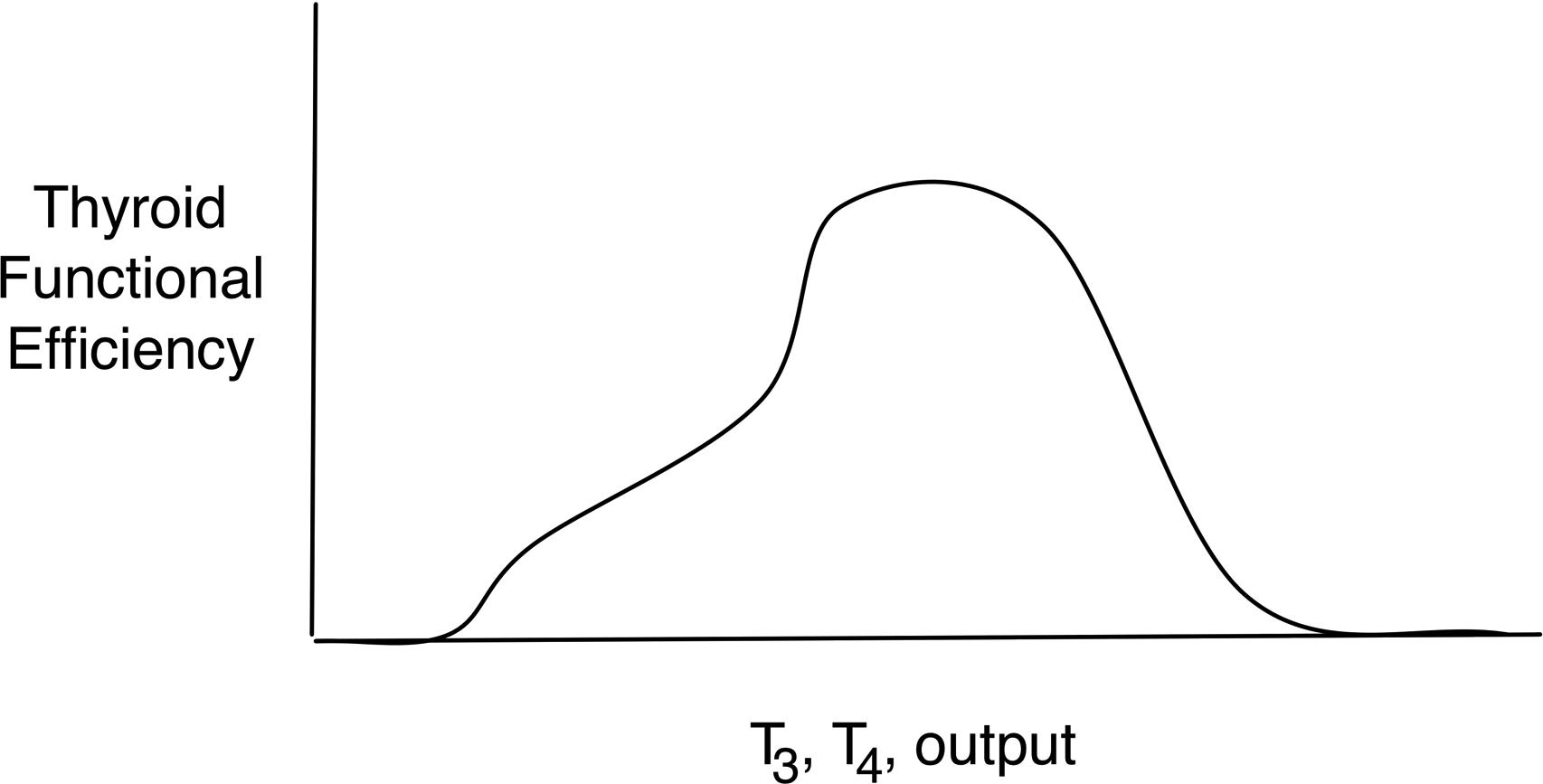
Figure 4 may help clarify the relationship between the output of T3 and T4 and the functional efficiency of the thyroid. Figure 4 relates the output of T3 and T4 to the functional efficiency of the thyroid in some specific environment given some specification of the functioning of other parts and processes. At very low levels or very high levels, the thyroid is not carrying out its functions at all. Over a certain range, it is functioning with maximum efficiency. The standards in terms of which physiologists and pathologists evaluate the capacities of a part are determined by the goals of the systems to which the part contributes or by their bearing on fitness. Neither statistics nor arithmetic tells physiologists what are appropriate levels of the thyroid's responsiveness to TSH. Levels of T3 and T4 above or below .8 to 1.8 μg/l of serum T3 and 46–120 μg/l of serum T4 would have the effects that they do regardless of their frequency. It is no more than a fortunate contingent fact, explained by evolutionary processes, that thyroids typically work as they should work. Contrary to Boorse's remarks, statistics do not tell pathologists how to draw figure 4 and hence whether the “efficiency” of Jack's thyroid, which is hyperactive, is greater or less than the “efficiency” of Jill's thyroid, which is hypoactive. To gather any statistics on how the levels of functional efficiency of the thyroid are distributed (as opposed to gathering statistics on levels of T3 and T4), physiologists and pathologists need to know whether one pair of T3 and T4 levels is better or worse than another. They need to know how to draw figure 4. Such knowledge is not easy to come by when, as in the case of the thyroid, there is no single quantitative variable whose value correlates with functional efficiency.
Functional efficiency.

Relationships like the one depicted in figure 4 depend on how other causally independent parts of the system are functioning, on the environment, and on changing circumstances. The output of T3 and T4, for example, depends on TSH levels produced by the pituitary. So a thyroid deficiency may result from a pituitary malfunction, and a thyroid that is pathologically overly responsive to TSH may fortuitously compensate for a pituitary deficiency. Statistical normality is the default assumption concerning the functioning of other parts, but that assumption can be revised.
How well a part is capable of functioning—the shape of the curve in figure 4—also depends on the environment. Someone with mild hyperthyroidism may be healthier overall than someone with a normal thyroid in an environment overpopulated with fast-food restaurants. Although they may not be explicit about doing so, physiologists and pathologists accordingly relativize their assessment of the functional efficiency of parts to the environment in which the organism lives—provided that the environment is “relevant.” In irrelevant environments (and in irrelevant circumstances) the part has nothing to contribute to the system or subsystem to which it may have a great deal to contribute in other environments and circumstances. For example, one does not assess the functional efficiency of human eyes in circumstances of complete darkness or at blinding levels of illumination. These are not relevant circumstances because eyes have nothing to contribute—no function—in those circumstances. (The curves relating functional efficiency to physical characteristics of eyes would lie flat along the horizontal axis.) It is often the case that a given capacity of a part has much the same level of efficiency across common relevant environments. When there is such uniformity, it is harmless to leave the relativization to environment implicit.
The functioning of a part of an organism also depends on the circumstances. Circumstances may change from minute to minute, unlike the environment, which I take to be relatively constant over the lifetime of an organism. (A rainstorm constitutes a change in circumstances rather than a change in environment.) Rather than relativizing the efficiency of actual functioning to circumstances as well as to environments, physiologists and pathologists focus on functional capacities or dispositions of parts or processes. Some parts of organisms are always active, while others, such as the immune system or the digestive tract, have tasks to accomplish only intermittently. Moreover, even those parts that always have something to do, such as the heart, typically need to adjust their activity to the circumstances (Kingma Reference Kingma2010). What constitutes functioning well or badly depends on details of the relevant circumstances in which an organism finds itself. To assign a level of functional efficiency to the capacities of some part or process is to assess its functional capacities in relevant environments, where the assessment of its capacities in turn depends on assessments of how it would function in relevant circumstances within those environments (Hausman Reference Hausman2011).
Speaking of the functional efficiency of a part thus presupposes an assessment of the functioning of that part with respect to what physiologists discover about the “engineering specifications” of the particular part and of the systems in which it has functions. When there is no physical variable whose value indicates the functional efficiency of some part, this assessment may be very difficult because there are multiple standards by which functional efficiency can be compared and because there are different kinds of malfunctioning, such as the hyper- and hypoactivity of the thyroid or the many different functional deficiencies to which human eyes are subject. How does one compare the extents to which color blindness or astigmatism or myopia affect the functional efficiency of the eyes? If one is comparing how well human eyes function, one needs in principle to compare the fitness consequences in a given environment of these different malfunctions. But one can also consider separately how different functional capacities bear on the different goals of the visual system. Aesthetic preferences and judgments concerning well-being are bound to play some role in prioritizing some comparisons over others. Presbyopia is a significant diminution of the eye's functional efficiency because of its consequences for a specific goal of the visual system that is now of more interest than it used to be, not because of its effects on fitness. As the range of human activities and hence the environment have changed, the demands placed on our bodies and some of the standards of functional efficiency have changed, too.
At the same time, greater understanding of human biological functioning provides better physical indicators of functional efficiency and diminishes the evidential role of aesthetic or well-being concerns. For example, contemporary medicine tells us that pinta is caused by Treponema carateum, which is similar to the organism that causes syphilis. Even though the Treponema carateum organism only affects the skin, it causes lesions in addition to the later discoloration that is so common and purportedly attractive to members of certain tribes. With respect to goals of the skin, such as sealing out contaminants, dyschromic spirochetosis is a pathology. Members of some tribes do not recognize this and take the prevalence and aesthetic value of the discoloration to show that it is not pathological. However, if the discoloration in fact enhanced reproductive success in that environment, then, with respect to the higher-level goal of reproduction, lacking the discolorations caused by pinta would be pathological. In these special environments, better skin functioning with respect to avoiding lesions would diminish fitness.
In summary, I propose the following characterization of the comparative functional efficiency of two sets of capacities C and C′ of a part within some organic system S with goal G. On the assumption that the other parts of the organism or systems whose activities do not depend on C or C′ are functioning adequately in a relevant environment,
The functional efficiency of C is greater than that of C′ in some system S with respect to some goal G if and only if C makes it more likely that S achieves G than does C′.Footnote 12
This account relativizes assessments of functional efficiency to relevant environments as well as to goals of the organism as a whole or to goals of systems within the organism. So it permits one to compare how well the blood vessels within tumors are functioning, even if their functioning is irrelevant to the fitness of the organism as a whole or even detrimental to it.
4. Pathology.
Once physiologists have figured out how to assign levels of efficiency to the capacities of some part or subsystem within a reference class in a relevant environment, it does not matter much theoretically whether they classify any particular level of functional efficiency within some system or within the organism as a whole as pathological or healthy.Footnote 13 Regardless of where the line between pathology and health is drawn, systems or organisms with higher levels of functional efficiency are, with regard to the particular part or process, healthier, and systems or organisms with lower levels of functional efficiency are less healthy. For example, if Joan's heart enables her to walk up stairs easily, while Jill's does not permit her to walk across the room without stopping to catch her breath, Joan's heart is healthier.Footnote 14 Typically, what contributes to systems achieving their goals also contributes to survival and reproduction, but when functional efficiency within a system clashes with functional efficiency within the organism, we can adopt different perspectives. Functional efficiency within the organism is usually of more interest and importance.
If the line between the pathological and the healthy is not as important theoretically as it may have initially appeared, then there may be no theoretical need to distinguish them. However, the distinction between health and pathology may be of practical importance. Distinguishing levels of functional efficiency of the eyes does not answer questions such as “Who needs glasses or other treatment of their eyes?” “Who can see well enough to drive a car?” “Whom should we criticize for picking so few strawberries?”Footnote 15 If someone's vision is adequate, he does not need the services of opticians or optometrists, and he can readily spot ripe strawberries. A single rough summary distinction between good and faulty vision may accordingly be useful.Footnote 16
There are several ways to distinguish healthy from pathological functional efficiency. First, just as we say that people are tall if they are taller than most of those in some reference class, so one might say that the functional disposition of a part is pathological if its efficiency is worse than most of those in the reference class (with respect to relevant environments).Footnote 17 One way to read Boorse is as defending a specific version of this suggestion: the functional disposition of a part is pathological if its efficiency is worse than the efficiency in some environment of all but a small percentage of parts in the reference class.Footnote 18 Although extrinsic, since the prevalence of a capacity does not determine its efficiency, Boorse's criterion often draws the line roughly in the right place (and there is rarely an exactly right place). One might thus read Boorse as addressing only the question of how to classify levels of functional efficiency as pathological or nonpathological and conclude that the functional efficiency supplements rather than challenges the BST.
Nevertheless, the functional efficiency theory, in contrast to the BST, denies that prevalence defines whether a level of functional efficiency is healthy or pathological. Although what is prevalent is typically healthy, the problems of common diseases and healthy populations show that this coincidence is not perfect. Tooth decay is not rare, yet it counts as a pathology because of some fact about the functional efficiency of decayed teeth. What is that fact?
Tooth decay is an exceptional case because there is an unambiguous optimal state of actual functioning (the possession of a complete set of teeth with no decay or other defects). This optimal state is, moreover, attainable by a nonnegligible number of human beings in some common environments, and it is set off by a salient difference from other levels of functional efficiency. (To see how exceptional these facts are, compare the absence of tooth decay to the disposition to resist developing cavities, which varies continuously and which need not be perfect for ideal actual functioning.) When there is a state of perfect part functioning, which is in some significant way different from other part behavior and moreover readily attainable in some common environments, then that state sets the standard of health, and any lesser functional efficiency counts as pathological (although possibly mildly so).
When, as is typical, there is no unique optimal level of functioning that the part or process in question can readily achieve in common environments, it will still be the case in benign and common relevant environments that some of the readily attainable levels of functional efficiency of parts and processes will be maximal. Let us call environments that are benign, common, and relevant “benchmark environments.”Footnote 19 There will usually be multiple functional dispositions with maximal efficiency in benchmark environments because there may be ties or noncomparability with respect to efficiency, because different functional dispositions may be more efficient in different environments, and, owing to the fact that the functional efficiency of one part depends on how the other parts are functioning, there may be a variety of combinations with maximal efficiency. So there will be multiple fully healthy states of parts and processes. Pathologists could decide to treat any functional capacities whose functioning is worse than any of the capacities with maximal efficiency as pathological, no matter how slight the difference. But drawing the line at the maximal levels would imply, implausibly, that pathological part functioning is ubiquitous rather than exceptional. Although it may well be the case, as the BST implies (Boorse Reference Boorse1977, 560), that it is typical for an organism to experience some pathology somewhere among its myriad parts and processes, the line between the healthy and the pathological functioning of individual parts and processes should be drawn so that in benchmark environments healthy part functioning is not rare.
A more sensible way to proceed when, as is typical, there is a gradual decline of functioning from maximal efficiency to levels in which functioning is clearly a pathology is to draw a line somewhere in-between. Since there may be no principled reason to draw the line at any specific level of functional efficiency, in many cases there may be no better policy than to follow Boorse and distinguish healthy from pathological levels of functional efficiency in terms of statistical normality.
According to the functional efficiency theory, there remains a nonstatistical difference between healthy and pathological levels of functional efficiency of parts and processes. The following characterization, which summarizes the discussion above, seems to me roughly right. First, if a level of functional efficiency is “maximal”—that is, at or above one of the highest levels readily attainable in some benchmark environment—then it is healthy. Second, if a level of functional efficiency is significantly worse than a maximal level, then it is pathological. This last section explained what it is for one level of functional efficiency to be worse than another in some given relevant environment. What counts as “significantly” worse than maximal functioning in some benchmark environment is inevitably vague and context dependent. When there are discrete and salient differences in functioning, such as the difference between no cavities and some cavities, those often define nontrivial differences. In the absence of differences such as these, differences that seem worthy of note because of their consequences for valued traits and activities, that make large differences in the functioning of other systems, or that make large differences in the probability of survival and reproduction count as significant.
These separate sufficient conditions for the health and pathology of parts and processes constrain where the line between health and pathology should be drawn, but they do not determine its location. Within those constraints, it is reasonable to rely on frequencies to locate the cutoffs. Among various levels of functional efficiency that are neither healthy nor pathological by the above standards, those that are prevalent are healthy, and those that are both worse and rare are pathological.Footnote 20
5. Against “Species Design.”
Boorse's account has been the object of many criticisms. Some of these, such as Schwartz's, are answered by the functional efficiency theory. But other criticisms of the BST apparently also apply to the functional efficiency theory. Although I cannot attempt a comprehensive defense of the functional efficiency theory in this essay, I would like to address the objection that, like Boorse's view, the functional efficiency view relies on an outmoded and indefensible understanding of biology.
Boorse maintains that physiologists construct “ideal types of [healthy] organisms: the frog, the hydra, the earthworm, the starfish, the crocodile, the shark, the rhesus monkey, and so on.” He continues, “The idealization is of course statistical, not moral or esthetic or normative in any other way. For each type a textbook provides a composite portrait of what I will call the species design, i.e. the typical hierarchy of interlocking functional systems that supports the life of organisms of that type. Each detail of this composite portrait is statistically normal within the species, though the portrait may not exactly resemble any species member” (Reference Boorse1977, 557).Footnote 21 In my view, in contrast to Boorse's, the idealizations are not purely statistical, and it need not be the case that “each detail … is statistically normal within the species” in contemporary environments.
Despite these differences, the functional efficiency view still relies on some notion of how the parts and processes contribute (within relevant environments) to the achievement of the goals of the systems within which they are embedded. Is a notion of goals and, hence, implicitly of how things are “supposed to work” legitimate? Some philosophers of biology, such as Ereshefsky (Reference Ereshefsky2009), have argued that the concept of a species design is a remnant of an indefensible Aristotelian view of biology. They argue that a phylogenetic view of species, which implies that members of a species do not share a common nature or essence, renders Boorse's notion of species design obsolete. They also maintain that the notion of a species design ignores the diversity among members of a given species and the ways in which the parts of organisms adapt to one another in the course of development (Amundson Reference Amundson2000).
If one conceives of physiology as a science devoted to discovering natural laws and describing the essences of species as natural kinds, then these criticisms of the BST are decisive. But not all sciences need to be like that. Boorse maintains (Reference Boorse1977, 577; Reference Boorse, Humber and Almeder1997, 32–41) that uniformities in structure and functioning in typical environments are facts. Although the “designs” biologists infer from these uniformities permit variation and are changing on an evolutionary timescale, many are accurate approximations on the shorter timescale that is relevant to health. Evolutionary biology does not imply that physiologists cannot make informative generalizations about the traits of organisms. Ereshefsky and Amundson might, however, be questioning how much uniformity there is in fact. Whether the generalizations that the BST and the functional efficient theory rely on are useful is an empirical question. I think it is obvious that some are and that this fact is enough to justify inquiries into the functioning of parts and processes.
There is nothing in Boorse's theory or mine that implies that there is some single “correct” set of functional capacities, which the environment merely facilitates or frustrates. Neither view denies that there is considerable phenotypic variation, some of which depends on genetic differences and a great deal of which depends on the environment, especially during the course of development. As Sober argues (Reference Sober1980, esp. 374–78), the “blueprints” for organisms are mappings from environments to differing phenotypes: they are “norms of reaction” rather than sketches of a single healthy exemplar of the species.
Healthy phenotypic variation might appear to pose problems for the BST because functioning may be unusual without being pathological. But the problem is merely apparent. For example, only a small percentage of human beings have blood type AB, but type AB blood is still a normal variant, not a pathology, because the functional efficiency of type AB blood is no worse than the functional efficiency of more common blood types. Norms of reaction often result in differing functional capacities of the parts and processes within phenotypes in different environments. Some of these, such as darker skin, are healthy variations, and some of these, such as scurvy, are diseases.Footnote 22 Statistically normal functional capacities of organisms in benchmark environments will typically be highly efficient. In less hospitable environments, statistically normal functional capacities that are nevertheless pathological will be more common. In judging whether functional capacities are pathological, pathologists compare them to the capacities that are readily achievable in benchmark environments. Darker skin has the maximal readily attainable functional efficiency in some benchmark environments, while lighter skin is maximally functionally efficient in others. They are thus healthy variations. However, the functional efficiencies of many of the parts of those who have scurvy are pathological because they are much worse than maximal in any benchmark environments.Footnote 23
6. Conclusion.
The crucial step in understanding health, which Boorse takes for granted, is the assessment of the functional efficiency of the parts and processes within organisms. The standards employed in that assessment are naturalistic: contributions to fitness and to goals of systems within organisms. Although evaluative considerations such as usefulness and attractiveness have influenced judgments of functional efficiency and the distinction between health and pathology, what defines greater health is greater functional efficiency—that is, enhancement of the probability of survival and reproduction or of the probability that systems within organisms achieve their goals. Statistical normality remains a useful—indeed a crucial—guide to the distinction between health and pathology, but it does not define the difference, and, in any case, for theoretical purposes, the distinction does not need to be drawn at all.