Introduction
Clinical studies in humans have established that C20:5n-3 and C22:6n-3 exert anti-thrombotic and anti-arrhythmic properties and may reduce cardiovascular disease risk (Simopoulos, Reference Simopoulos1999; Tapiero et al., Reference Tapiero, Nguyen, Couvreur and Tew2002; Wijendran and Hayes, Reference Wijendran and Hayes2004). In humans, diet is the major source of C20:5n-3 and C22:6n-3 since endogenous synthesis via C18:3n-3 is limited (Williams, Reference Williams2000; Burdge and Calder, Reference Burdge and Calder2005; Williams and Burdge, Reference Williams and Burdge2006). Therefore, there has been increasing interest in enhancing the concentrations of long-chain (C20+) n-3 fatty acids in food, including those derived from ruminants, which are consumed more regularly in Western diets compared to the traditional source of long-chain n-3 fatty acids, namely oily fish.
Forages such as grasses and legumes contain lipids predominating in C18:2n-6 (20% of total fatty acids) and C18:3n-3 (40% of total fatty acids). However, following ingestion polyunsaturated fatty acids (PUFA) are extensively hydrogenated in the rumen (biohydrogenation) resulting in the formation of C18:0 as the major end-product, in addition to a wide range of biohydrogenation intermediates including trans-C18:1 fatty acids and isomers of conjugated linoleic acid (CLA; Doreau and Ferlay, Reference Doreau and Ferlay1994). In contrast to other forage species, the PUFA in red clover are more resistant to biohydrogenation resulting in higher flows of these fatty acids at the duodenum (Lee et al.,Reference Lee, Connelly, Tweed, Dewhurst, Merry and Scollan2003 and Reference Lee, Harris, Dewhurst, Merry and Scollan2006) and a higher incorporation into milk fat (Dewhurst et al., Reference Dewhurst, Evans, Scollan, Moorby, Merry and Wilkins2003). Reduced biohydrogenation of C18:3n-3 for red clover has been shown to be associated with the activity of polyphenol oxidase (PPO). PPO indirectly reduces the hydrolysis of fatty acids from the glycerol backbone in cell and organelle membranes (Lipolysis; Lee et al., Reference Lee, Parfitt, Scollan and Minchin2007a) which, is a prerequisite for biohydrogenation of dietary PUFA (Tamminga and Doreau, Reference Tamminga and Doreau1991).
Inclusion of fish oil (FO), in the diet of ruminants, enhances the concentration of C20:5n-3 and C22:6n-3 in milk (Offer et al., Reference Offer, Marsden, Dixon, Speake and Thacker1999; Shingfield et al., Reference Shingfield, Ahvenjärvi, Toivonen, Arölä, Nurmela, Huhtanen and Griinari2003; Loor et al., Reference Loor, Doreau, Chardigny, Ollier, Sebedio and Chilliard2005a) and muscle (Scollan et al., Reference Scollan, Choi, Kurt, Fisher, Enser and Wood2001a; Kook et al., Reference Kook, Choi, Sun, Garcia and Myung2002). FO is also known to inhibit the complete biohydrogenation of C18 PUFA to C18:0 resulting in an accumulation of trans-11 C18:1 (Shingfield et al., Reference Shingfield, Ahvenjärvi, Toivonen, Arölä, Nurmela, Huhtanen and Griinari2003, Lee et al., Reference Lee, Tweed, Moloney and Scollan2005, Loor et al., Reference Loor, Ueda, Ferlay, Chilliard and Doreau2005b). This particular fatty acid is consequently available for endogenous conversion to cis-9, trans-11 CLA via the action of stearoyl-CoA desaturase in the mammary gland (Griinari et al., Reference Griinari, Corl, Lacy, Chouinard, Nurmela and Bauman2000; Palmquist et al., Reference Palmquist, Lock, Shingfield and Bauman2005) and explains FO’s effect in enhancing cis-9, trans-11 CLA concentration in milk (Offer et al., Reference Offer, Marsden, Dixon, Speake and Thacker1999; Chilliard et al., Reference Chilliard, Ferlay and Doreau2000; Shingfield et al., Reference Shingfield, Ahvenjärvi, Toivonen, Arölä, Nurmela, Huhtanen and Griinari2003). Enhancement of CLA in ruminant products (meat and dairy) through dietary manipulation is an important contributor towards the recommended intake of 3 g/day (Roche et al., Reference Roche, Noone, Nugent and Gibney2001) as part of a complete diet approach.
Combination of red clover and FO represent unique feed ingredients that alter biohydrogenation via distinct and different mechanisms, which when fed in combination, may act in a synergistic manner. To test this hypothesis, the effects of incremental amounts of FO on biohydrogenation were examined in steers fed sole forage diets based on ensiled grass or red clover.
Material and methods
Diets
Secondary growth of perennial ryegrass cultivar Fennema (Lolium perenne) was cut on 20th December 2003 and harvested after a short wilt to a final dry matter (DM) content of 280 g/kg DM, with a disc mower fitted with rubber rollers, and ensiled in big bales. Regrowth of a monoculture red clover cultivar Milvus (Trifolium pratense) was cut on 15th November 2003, wilted to 320 g/kg DM and ensiled in big bales. A biological additive (Ecosyl; Ecosyl Products Ltd., Stokesley, Yorkshire, UK) was applied to all fresh herbage at a rate of 1.5 l/tonne fresh weight (FW). Salmon (Salmo salar) oil was sourced from the International Fishmeal and Fish oil Organisation (IFFO, St Albans, Hertfordshire, UK), which contained 200 ppm polyhydric alcohols (sorbitol and mannitol) to act as antioxidants.
Animals and experimental design
All animal procedures were licensed, regulated and inspected by the UK Home Office under the Animals (Scientific Procedures) Act of 1986. Eight Hereford × Friesian steers (300 ± 5.1 kg live weight), fitted with a rumen cannula and simple ‘T’-piece cannula in the proximal duodenum located after the pylorus and prior to the common bile duct (Jarrett, Reference Jarrett1948) were offered one of two forage diets of red clover or grass silages at 90% of ad libitum intake (~6.5 kg/day) determined from the last 3 days of intake during the adaptation period. Forage-based diets were supplemented with FO as a free oil mixed on top of the morning silage allowance at a rate of 0, 10, 20 or 30 g/kg diet DM. Steers were housed in a well-ventilated building with continuous fluorescent strip lighting and free access to fresh water. Daily feed rations were offered as equal meals at 0900 h and 1600 h along with 50 g at each feeding of a commercial vitamin and mineral supplement (Maxcare Cattle GP + Cuprex 5, Trouw Ltd., Cheshire, UK). Feed refusals, if any, were collected at 0845 h.
Statistical design for this study was derived from an extra-period Latin-square change-over design of Lucas (Reference Lucas1957). Eight treatments (2 forages × 4 FO levels) were allocated to the eight fistulated animals at random. Due to the risk of the unknown extent of carry-over effects, animals remained on their allocated FO level throughout the experiment. Thus, there were two animals per FO level, one on grass silage and the other on red clover silage. In period 2, grass silage animals switched to red clover silage and red clover silage animals switched to grass silage. Period 3 was the repeat of period 2 without any change of diets and formed the extra period (Lucas, Reference Lucas1957). Periods 1 and 2 were 28 days in duration and consisted of a 21-day adaptation period prior to the start of digesta collection, whereas period 3 was 21 days in duration with a 14-day adaptation period, since animals were fed the same diet as the preceding period. Samples of rumen fluid (10 ml) were collected hourly over a 12-h interval starting at 0845 h on day 22 (periods 1 and 2) or day 15 (period 3). Duodenal digesta (100 ml) was collected at 4-h intervals over a 24-h period on days 27 and 28 (periods 1 and 2) or on days 20 and 21 (period 3). The flow of DM at the duodenum was estimated using ytterbium acetate (YbAc) and chromium ethylene diamine tetra-acetic acid (CrEDTA) as particulate and liquid phase markers, respectively (Faichney, Reference Faichney1975). YbAc (199 mg/day) and CrEDTA (1856 mg/day) were infused into the rumen via separate lines at a rate of 24.9 and 25.5 ml/h, respectively, over an 8-day period starting on day 20 (periods 1 and 2) or day 13 (period 3).
Sample preparation and chemical analysis
Daily samples (100 g FW) of fresh silage were collected during the sampling of duodenal digesta, whereas representative samples of the vitamin and mineral supplement and FO were composited for each period (200 g FW). Sub-samples of silage were freeze-dried, ground and retained at −20°C for chemical analysis. Samples of duodenal digesta were composited, thoroughly mixed and separated into whole, solid and microbial fractions by centrifugation according to Lee et al. (Reference Lee, Harris, Moorby, Humphreys, Theodorou, MacRae and Scollan2002). All samples were subsequently freeze-dried and stored at −20°C until analysed for chemical composition. Rumen pH was measured immediately after the samples were withdrawn using a Hydrus 400 pH probe (Fisher Scientific UK, Loughborough, Leicestershire, UK). Thereafter, samples of rumen fluid (10 ml) were acidified with 100 μl 2.5 M sulphuric acid and stored at −20°C until submitted for laboratory analysis. Chemical composition of feeds and digesta was determined using previously described procedures (Lee et al., Reference Lee, Harris, Moorby, Humphreys, Theodorou, MacRae and Scollan2002). Feed fatty acid content was determined using heneicosanoic acid methyl ester as an internal standard (Sigma-Aldrich Co, St Louis, MO, USA) and a one-step extraction–transesterification procedure (Sukhija and Palmquist, Reference Sukhija and Palmquist1988).
Purine and pyrimidine bases were used as microbial markers in the centrifuged digesta samples and were determined using the HPLC method of Cozzi et al. (Reference Cozzi, Bittante and Polan1993). Lipids in digesta were extracted from 1 g of freeze-dried sample by adding 5 ml of chloroform : methanol (2 : 1, v/v) and 100 μl (15 mg heneicosanoic acid methyl ester/ml chloroform) as an internal standard, this was vortexed for 10 s (Whirlimixer, Electro Ltd., Weston-Super-Mare, Avon, UK) and then centrifuged at 900 × g for 5 min. The aqueous layer was then transferred into a clean tube and the pellet resuspended in a further 5 ml of chloroform : methanol, vortexed and centrifuged as before, the aqueous layer being bulked with the first extraction before the procedure was repeated for a third time so that three extractions were carried out. Following drying at 50°C under nitrogen gas, lipid extracts were dissolved in 1 ml of hexane and converted to fatty acid methyl esters (FAME) using a base–acid catalysed transesterification procedure by incubation at 50°C with methanolic sodium hydroxide (0.5 M NaOH in methanol; 15 min) followed by incubation with methanolic hydrochloric acid (5% HCl in methanol; 1 h) at 50°C (Kramer et al., Reference Kramer, Cruz-Hernandez and Zhou2001).
FAME were separated and quantified using a gas chromatograph (CP-3800, Varian Inc., CA, USA) equipped with a flame-ionisation detector, automatic injector, split injection port and a 100 m fused silica capillary column (i.d., 0.25 mm) coated with 0.2 μm film of cyanopropyl polysiloxane (CP-Sil 88; Varian Inc., CA, USA) using hydrogen as the fuel and helium as the carrier gas. The total FAME profile in a 1 μl sample at a split ratio of 1 : 30 was determined using a temperature gradient programme described by Lee et al. (Reference Lee, Tweed, Moloney and Scollan2005). Peaks were identified by comparison of retention times with authentic FAME standards (ME61; Larodan Fine Chemicals, Malmo, Sweden; S37; Supelco, Poole, Dorset, UK). Samples of FAME were evaporated under nitrogen gas, dissolved in heptane and isomers of CLA methyl esters were separated using a HPLC system (Model 1090; Hewlett-Packard, Wilmington, Denver, USA) equipped with autosampler, photodiode array detector, heated column compartment and four ChromSpher 5 lipid analytical silver-impregnated silica columns (4.6 mm i.d. × 250 mm, stainless steel, 5 μm particle size; Varian Ltd., Walton-on-Thames, UK) coupled in series. Chromatography was achieved under isocratic conditions at 22°C using a flow rate of 1 ml/min and a mobile phase of 0.1% acetonitrile in heptane (v/v) and monitoring column effluent at 233 and 210 nm (Shingfield et al., Reference Shingfield, Ahvenjärvi, Toivonen, Arölä, Nurmela, Huhtanen and Griinari2003). Identification of CLA isomers was carried out using a commercially available CLA methyl ester standard (O-5632, Sigma-Aldrich), chemically synthesized trans-9, cis-11 CLA (Shingfield et al., Reference Shingfield, Reynolds, Hervas, Griinari, Grandison and Beever2006), and cross-referencing with the elution order reported in the literature (Shingfield et al., Reference Shingfield, Ahvenjärvi, Toivonen, Arölä, Nurmela, Huhtanen and Griinari2003) using cis-9, trans-11 CLA as a landmark isomer.
Statistical design, analysis and calculations
Data were subjected to analyses of variance of the extra-period change-over design (Payne et al., Reference Payne, Murray, Harding, Baird and Soutar2002). Due to confounding of the main effect of FO with squares, no significance test was possible. Significance of forage effect and forage × FO interaction are presented. Interaction effect was partitioned into linear and quadratic polynomial contrasts in order to determine the shape of response to FO increments within each forage.
Digesta flows were calculated after mathematical reconstitution of true digesta (Faichney, Reference Faichney1975). Fibre and OM digestibility were calculated as the proportional loss of NDF and OM, respectively, across the rumen ((intake – duodenal flow)/intake). Apparent ruminal biohydrogenation of dietary unsaturated fatty acids was determined as the difference between daily intake and duodenal flow (g/day) as a proportion of daily intake.
Results
Diet composition
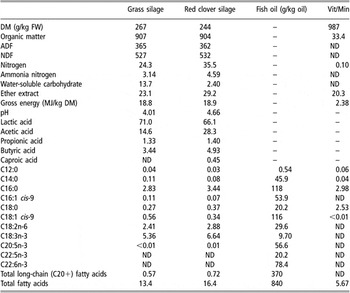
Experimental silages were typical of well-preserved grass and red clover silages from pH and fermentation acid profiles. Chemical composition of silages were comparable, with the exception of a higher nitrogen and lower water soluble carbohydrate content in red clover compared with the grass silage (Table 1). FO was relatively rich in C14:0, C16:0, C18:1 cis-9, C20:5n-3, C22:5n-3 and C22:6n-3, whereas both silages contained relatively high proportions of C18:2n-6 and C18:3n-3 (Table 1).
Chemical composition of dietary ingredients (g/kg DM, unless otherwise stated)

DM = dry matter; Vit/Min = vitamin and mineral supplement; FW = fresh weight; ND = not detected; – = not measured.
Rumen characteristics
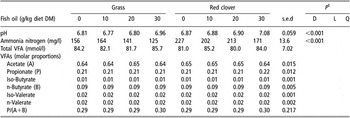
Red clover silage increased (P < 0.001) rumen pH and ammonia-N concentrations compared with grass silage (Table 2). FO in the diets had no effect on rumen pH but decreased rumen ammonia-N concentrations when added at 30 g/kg diet DM (Table 2). Irrespective of the forage fed, FO supplements had no effect (P > 0.10) on total volatile fatty acid (VFA) concentrations or VFA molar proportions (Table 2).
Effect of incremental levels of fish oil in the diet on rumen fermentation characteristics in steers fed red clover or grass silage

DM = dry matter; s.e.d. = standard error of the difference within each fish oil (FO) level; VFA = volatile fatty acid.
1Significance test of the main effect of fish oil was not possible as it was confounded with the effect of squares and so P refers to the significance of forage type (D) and D × FO interaction with polynomial contrasts into linear (L)/quadratic (Q) effects; only P values less than 0.1 are reported.
Intake and duodenal flow of nutrients and fatty acids
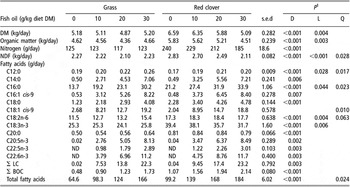
DM, organic matter (OM), and NDF intake in steers fed grass silage were comparable across FO level, but decreased in steers offered red clover silage (Table 3) with linear (forage × oil) interaction effects (P = 0.004). In general, steers fed red clover silage had higher intakes than those offered grass silage, except at the highest rate of FO inclusion. Owing to the higher DMI, the intake of other nutrients including the major fatty acids were also enhanced for red clover compared with grass silage, other than C12:0 and C18:1 cis-9. FO level in the diet resulted in similar responses for both basal silage diets with the exception of C12:0, C16:0, C18:2n-6 C18:3n-3 and total fatty acids which had significant linear or/and quadratic interaction effects.
Effect of incremental levels of fish oil in the diet on nutrient intake of steers fed red clover or grass silage

DM = dry matter; LC = long-chain fatty acids C20+; BOC = branched- and odd-chain fatty acids; s.e.d. = standard error of the difference within each fish oil (FO) level; ND = not detected <0.005 g/day.
1Significance test of the main effect of fish oil was not possible as it was confounded with the effect of squares and so P refers to the significance of forage type (D) and D × FO interaction with polynomial contrasts into linear (L)/quadratic (Q) effects; only P values less than 0.1 are reported.
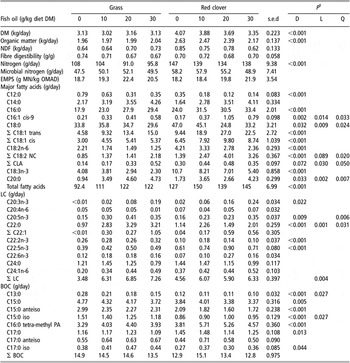
Flows of DM, OM and N at the duodenum were increased (P < 0.001) in steers offered red clover silage compared with grass silage, whilst FO in the diet on either forage had no effect on duodenal flow of these nutrients (Table 4). Dietary treatments had no effect (P > 0.10) on the flow of NDF or microbial-N, extent of NDF digestion or on the efficiency of microbial protein synthesis (EMPS). Flows of C16:0, C18:2n-6, C18:3n-3, trans-C18:1, cis-C18:1, non-conjugated C18:2, non-conjugated isomers of C18:2 other than C18:2n-6 (NC), C20:3n-3, C22:5n-3, C16:0 tetra-methyl (phytanic acid; PA) and total fatty acids were higher (P < 0.001), and that of C12:0, C22:2, C13:0, C15:0, C15:0 anteiso, C15:0 iso were lower (P < 0.001) on red clover compared with grass silage (Table 4). Supplementing the diet with FO resulted in linear and quadratic interaction effects between forage type for C16:1, C18:0, CLA, C20:0, C20:5n-3, C22:0, sum of long-chain fatty acids (C20+), C13:0 and C15:0 iso.
Effect of incremental levels of fish oil in the diet on the flow of nutrients at the duodenum and microbial protein synthesis in steers fed red clover or grass silage

DM = dry matter; MN = microbial nitrogen; OMAD = organic matter apparently digested; NC = non-conjugated dienes; LC = long-chain fatty acids C20+; BOC = branched- and odd-chain fatty acids; PA = all iso-forms of 3,7,11,15-tetramethyl-hexadecanoic acid (phytanic acid); s.e.d. = standard error of the difference within each fish oil (FO) level; EMPS = Efficiency of microbial protein synthesis.
1Significance test of the main effect of fish oil was not possible as it was confounded with the effect of squares and so P refers to the significance of forage type (D) and D × FO interaction with polynomial contrasts into linear (L)/quadratic (Q) effects; Only P values less than 0.1 are reported.
Duodenal flow of C18:1, C18:2 and conjugated linoleic acid isomers
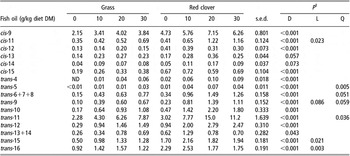
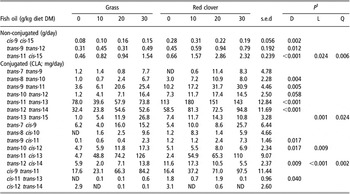
Silage type altered the flow of C18:1 (Table 5), CLA and NC at the duodenum (Table 6). Differences due to forage type were characterised as higher flows of most C18:1 and C18:2 isomers in steers fed red clover silage. Supplementing diets with FO resulted in linear and quadratic interaction effects between forage type for cis-11 C18:1, trans-5 C18:1, trans-6+7+8 C18:1, trans-9 C18:1, trans-11 C18:1, trans-15 C18:1, trans-16 C18:1, trans-11 cis-15 NC, trans-13 trans-15 CLA, trans-10 cis-12 CLA, trans-12 cis-14 CLA.
Effect of incremental levels of fish oil in the diet on the flow of C18:1 fatty acids at the duodenum of steers fed red clover or grass silage (g/day)

DM = dry matter; s.e.d. = standard error of the difference within each fish oil (FO) level.
1Significance test of the main effect of fish oil was not possible as it was confounded with the effect of squares and so P refers to the significance of forage type (D) and D × FO interaction with polynomial contrasts into linear (L)/quadratic (Q) effects; Only P values less than 0.1 are reported.
Effect of incremental levels of fish oil in the diet on the flow of C18:2 fatty acids at the duodenum of steers fed red clover or grass silage (mg/day)

DM = dry matter; s.e.d. = standard error of the difference within each fish oil (FO) level.
1Significance test of the main effect of fish oil was not possible as it was confounded with the effect of squares and so P refers to the significance of forage type (D) and D × FO interaction with polynomial contrasts into linear (L)/quadratic (Q) effects; only P values less than 0.1 are reported.
Ruminal biohydrogenation of dietary unsaturated fatty acids
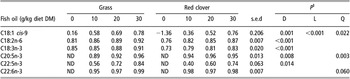
Apparent ruminal biohydrogenation of cis-9 C18:1, C18:2n-6, C18:3n-3 and C22:5n-3 were lower (P < 0.05) on red clover than grass silage diets, whilst the extent of ruminal C22:6n-3 biohydrogenation was comparable between forages (Table 7). FO inclusion resulted in different patterns of response between the two diets for C18:1 cis-9, C20:5n-3 and C22:6n-3 biohydrogenation (Table 7).
Effect of incremental levels of fish oil in the diet on apparent ruminal biohydrogenation of dietary unsaturated fatty acids in steers fed red clover or grass silage

DM = dry matter; s.e.d. = standard error of the difference within each fish oil (FO) level.
1Significance test of the main effect of fish oil was not possible as it was confounded with the effect of squares and so P refers to the significance of forage type (D) and D × FO interaction with polynomial contrasts into linear (L)/quadratic (Q) effects; only P values less than 0.1 are reported.
Discussion
Rumen function
Red clover silage resulted in higher rumen pH and ammonia-N concentrations compared with grass silage which is consistent with previous findings (Merry et al., Reference Merry, Lee, Davies, Dewhurst, Moorby, Leemans, Scollan and Theodorou2006). Irrespective of the forage fed, FO in the diet had no effect on rumen pH but lowered ammonia-N concentrations. Earlier studies have reported that lipids, often have no effect (Boggs et al., Reference Boggs, Bergen and Hawkins1987; Schauff and Clark, Reference Schauff and Clark1989; Elliott et al., Reference Elliott, Overton and Drackley1994), whilst in some cases, particularly with marine lipids reduce rumen ammonia-N concentrations (Scollan et al., Reference Scollan, Dhanoa, Choi, Maeng, Enser and Wood2001b; Shingfield et al., Reference Shingfield, Ahvenjärvi, Toivonen, Arölä, Nurmela, Huhtanen and Griinari2003; Lee et al., Reference Lee, Tweed, Moloney and Scollan2005). FO in the diet had no effect on molar VFA proportions as reported previously (Scollan et al., Reference Scollan, Dhanoa, Choi, Maeng, Enser and Wood2001b; Lee et al., Reference Lee, Tweed, Moloney and Scollan2005).
Food intake and nutrient flow to the duodenum
Intakes of DM (kg/day) were higher in steers fed red clover silage than grass silage, except for the 30 g FO/kg DM treatment. A higher intake potential of red clover silage compared with grass silage is in line with earlier observations (Lee et al., Reference Lee, Harris, Dewhurst, Merry and Scollan2003; Merry et al., Reference Merry, Lee, Davies, Dewhurst, Moorby, Leemans, Scollan and Theodorou2006). FO had no effect on DM intake or on the flow of DM at the duodenum in steers fed grass silage with a mean ruminal DM digestibility coefficient of 0.39, a value in close agreement with previous findings (Lee et al., Reference Lee, Harris, Dewhurst, Merry and Scollan2003). However, at the highest level of FO inclusion on red clover silage diets, nutrient intake and DM flow at the duodenum were decreased, responses that were accompanied by a reduction in apparent ruminal DM digestibility from 0.38 to 0.34 and significant DM intake linear interaction effects between forages. Similar observations have been reported previously (Doreau and Chilliard, Reference Doreau and Chilliard1997; Shingfield et al., Reference Shingfield, Ahvenjärvi, Toivonen, Arölä, Nurmela, Huhtanen and Griinari2003), suggesting that the negative impact of FO on DM intake may be related to the effects on rumen function.
Differences in nitrogen intake reflected the inherent differences in forage crude protein content and intake potential, resulting in higher N flows at the duodenum in steers fed red clover silage. Previous studies have, in some cases, reported no differences in microbial-N flow and EMPS between red clover silage and grass silage (Lee et al., Reference Lee, Harris, Dewhurst, Merry and Scollan2003), whilst in others the flow of microbial-N has been significantly lower on red clover silage diets (Merry et al., Reference Merry, Lee, Davies, Dewhurst, Moorby, Leemans, Scollan and Theodorou2006). Decreases in microbial-N flow have been attributed to the action of PPO, an active enzyme in red clover, which has been shown to lower protein losses in silo (Jones et al., Reference Jones, Muck and Hatfield1995) and also enhance the flow of dietary-N to the duodenum (Merry et al., Reference Merry, Lee, Davies, Dewhurst, Moorby, Leemans, Scollan and Theodorou2006) due to the formation of complex protein–phenol matrices (Igarashi and Yasui, Reference Igarashi and Yasui1985). Whilst there were no significant differences in the duodenal flow of microbial-N or EMPS between animals offered red clover silage and grass silage in the present experiment, the proportion of microbial-N in total N at the duodenum was higher on the grass silage diets compared with red clover silage diets (0.50 v. 0.40), suggesting a higher contribution of dietary-N to total N flow in steers fed red clover silage. Inclusion of FO had no effect on microbial-N flow or EMPS as reported in the review by Doreau and Ferlay (Reference Doreau and Ferlay1995).
Fatty acid intake, duodenal flow and C18 PUFA biohydrogenation
The relationship between intake and duodenal flow of total fatty acids for both forages are similar, namely: net synthesis for 0 and 10 g FO/kg DM supplementation and net disappearance for 20 and 30 g FO/kg DM supplementation, in accordance with what is commonly observed (Doreau and Ferlay, Reference Doreau and Ferlay1994). A tendency for FO to decrease net synthesis of fatty acids in the rumen may reflect FO-induced reductions in DM intake (Shingfield et al., Reference Shingfield, Ahvenjärvi, Toivonen, Arölä, Nurmela, Huhtanen and Griinari2003; Loor et al., Reference Loor, Ueda, Ferlay, Chilliard and Doreau2005b) coupled with an associated increase in ruminal retention time (Huhtanen and Kukkonen, Reference Huhtanen and Kukkonen1995).
Differences between fatty acid intake and the flow of fatty acids at the duodenum are a reflection of lipolysis and biohydrogenation in the rumen. A low apparent biohydrogenation of cis-9 C18:1 is a common feature of sole forage diets (Lee et al., Reference Lee, Connelly, Tweed, Dewhurst, Merry and Scollan2003 and Reference Lee, Harris, Dewhurst, Merry and Scollan2006; Scollan et al., Reference Scollan, Lee and Enser2003). This can be attributed to a partial isomerisation of other C18:1 isomers to cis-9 C18:1 (Proell et al., Reference Proell, Mosley and Jenkins2002), an endogenous contribution to cis-9 C18:1 flow at the duodenum and microbial de novo fatty acid synthesis (Merry and MacAllan, Reference Merry and MacAllan1983). Fatty acid concentrations and content of rumen bacteria is diet dependent, with higher amounts of cis-9 C18:1 being reported on high-forage diets (Bas et al., Reference Bas, Archimede, Rouzea and Sauvant2003).
The extents of biohydrogenation (loss of fatty acid across the rumen) of C18:2n-6 and C18:3n-3 on the grass silage are within the range 0.70 to 0.95 and 0.85 to 1.0, respectively, reported in the literature (Doreau and Ferlay, Reference Doreau and Ferlay1994). Corresponding values for red clover silage are lower and in agreement with values reported from studies based on red clover silage feeding (Lee et al., Reference Lee, Connelly, Tweed, Dewhurst, Merry and Scollan2003 and Reference Lee, Harris, Dewhurst, Merry and Scollan2006). Diets based on red clover enhanced flows of C18:2n-6 and C18:3n-3 at the duodenum compared with grass silage. Such differences are most probably related to the activity of PPO between forage species, since this enzyme has been shown to reduce lipolysis of forage lipids in vitro (Lee et al., Reference Lee, Parfitt, Scollan and Minchin2007a).
On both the forage types, FO modified ruminal lipid biohydrogenation, characterised by increases in the flow of trans-C18:1, cis-C18:1, C18:2, CLA, C20:0 and long-chain n-3 fatty acids at the duodenum and associated decreases in the amount of C18:0, C18:2n-6 and C18:3n-3 leaving the rumen. Linear and quadratic interaction effects between forage types infers differences in the response to FO between red clover silage and grass silage for certain fatty acids and may be associated with differences in the rumen microbial populations or substrate supply differential from the basal forage diet.
Biohydrogenation of C18:2n-6 and C18:3n-3 involves the formation of conjugated intermediates that are subsequently reduced to yield C18:0 as the major end-product (Harfoot and Hazlewood, Reference Harfoot and Hazlewood1997). Since FO in the diet causes an increase in trans-C18:1 and trans-C18:2 intermediates and a reduction in the flow of C18:0 leaving the rumen it has been postulated (Offer et al., Reference Offer, Marsden, Dixon, Speake and Thacker1999; Shingfield et al., Reference Shingfield, Ahvenjärvi, Toivonen, Arölä, Nurmela, Huhtanen and Griinari2003; Lee et al., Reference Lee, Tweed, Moloney and Scollan2005) that one or more long-chain n-3 fatty acids or biohydrogenation intermediates from FO specifically inhibit the growth and activity of Group B bacteria known to hydrogenate C18:1 to C18:0. In support of this, C22:6n-3 was shown to be associated with the accumulation of trans-C18:1 intermediates in vitro (AbuGhazaleh and Jenkins, Reference AbuGhazaleh and Jenkins2004; AbuGhazaleh and Jacobson, Reference AbuGhazaleh and Jacobson2007). In this experiment, the decrease in C18 PUFA flow at the duodenum and corresponding increase in C18 MUFA and PUFA biohydrogenation in response to incremental amounts of FO in the diet is in marked contrast to the observations that C20:5n-3 and C22:6n-3 decrease cis-9 C18:1 and C18:2n-6 biohydrogenation in vitro (AbuGhazaleh and Jenkins, Reference AbuGhazaleh and Jenkins2004; AbuGhazaleh and Jacobson, Reference AbuGhazaleh and Jacobson2007). This variation in response across the two studies may be related to an effect of FO inhibiting some bacteria and allowing others to proliferate which may also be involved in lipolysis and biohydrogenation and/or there are other active agents in FO other than these specific long-chain PUFA, such as fatty acid oxidation products which have been shown to have antimicrobial properties (Lee et al., Reference Lee, Huws, Scollan and Dewhurst2007b).
In both diets, FO altered the C18 biohydrogenation intermediates produced with accumulation of trans-C18:1, particularly trans-11 C18:1, and reductions in the production of C18:0 in line with previous findings (Shingfield et al., Reference Shingfield, Ahvenjärvi, Toivonen, Arölä, Nurmela, Huhtanen and Griinari2003, Lee et al., Reference Lee, Tweed, Moloney and Scollan2005, Loor et al., Reference Loor, Ueda, Ferlay, Chilliard and Doreau2005b). However, the current experiment differs in relation to its lower impact on biohydrogenation in response to FO level in the diet compared to other studies. Several factors may account for differences between experiments including: (i) relative proportions of specific long-chain (C20+) PUFA (LCPUFA) in marine oils; (ii) composition of the basal diet and the supply of fatty acid substrates; and (iii) inherent differences in DM intake and rumen digestion kinetics between ruminant animal models (ovine v. bovine v. caprine).
For both forages, FO increased the flow of CLA leaving the rumen and altered the distribution of CLA isomers. Such changes in the relative abundance of specific CLA isomers at the duodenum point towards FO resulting in fundamental changes in ruminal C18 PUFA biohydrogenation and interaction effects (diet × oil) may also suggest changes between basal forage types. Earlier studies in lactating cows have reported no effects of FO on CLA flow leaving the rumen and indicated that cis-9, trans-11 CLA is the most abundant CLA isomer in omasal digesta (Shingfield et al., Reference Shingfield, Ahvenjärvi, Toivonen, Arölä, Nurmela, Huhtanen and Griinari2003). Similarly, cis-9 trans-11 was shown to be quantitatively the most important isomer of CLA in steers fed grass silage and concentrates containing sunflower oil (Lee et al., Reference Lee, Tweed, Moloney and Scollan2005). A markedly different distribution of CLA isomers in duodenal digesta in this experiment with trans-11 trans-13 CLA and trans-12 trans-14 CLA predominating may reflect diets being based on forages rich in C18:3n-3 and relatively low in C18:2n-6. Previous studies have shown that supplementing the diet with linseed oil rich in C18:3n-3 enhances the flow of both these isomers at the duodenum (Loor et al., Reference Loor, Ueda, Ferlay, Chilliard and Doreau2004) and omasum (Shingfield et al., Reference Shingfield, Ahvenjärvi, Toivonen, Arölä, Nurmela, Huhtanen and Griinari2003) and increases their concentrations in milk fat (Collomb et al., Reference Collomb, Sieber and Butikofer2004; Loor et al., Reference Loor, Doreau, Chardigny, Ollier, Sebedio and Chilliard2005a, Roy et al., Reference Roy, Ferlay, Shingfield and Chilliard2006). The increasing importance of trans-11 cis-13 CLA with FO addition on both silages may also suggest a change in the action of biohydrogenation in the presence of FO.
LCPUFA biohydrogenation
Incremental amounts of FO in the forage diets enhanced the flow of C20:5n-3, C22:5n-3 and C22:6n-3 at the duodenum, but the extent of biohydrogenation of these fatty acids in the rumen was increased in a dose-dependent manner consistent with previous findings (Lee et al., Reference Lee, Tweed, Moloney and Scollan2005). Factors affecting biohydrogenation of LCPUFA are not well understood, but several studies have indicated that C20:5n-3 and C22:6n-3 are extensively metabolised in the rumen in vivo (Scollan et al., Reference Scollan, Dhanoa, Choi, Maeng, Enser and Wood2001b; Shingfield et al., Reference Shingfield, Ahvenjärvi, Toivonen, Arölä, Nurmela, Huhtanen and Griinari2003; Lee et al., Reference Lee, Tweed, Moloney and Scollan2005). In vitro studies have been less clear with some studies showing limited biohydrogenation (Ashes et al., Reference Ashes, Siebert, Gulati, Cuthbertson and Scott1992; Chow et al., Reference Chow, Fievez, Moloney, Raes, Demeyer and De Smet2004), while others showed a decrease (Gulati et al., Reference Gulati, Ashes and Scott1999; Dohme et al., Reference Dohme, Fievez, Raes and Demeyer2003) or an increase in the extent of C20:5n-3 and C22:6n-3 biohydrogenation in relation to FO addition (AbuGhazaleh and Jenkins, (Reference AbuGhazaleh and Jenkins2004).
Overall, the biohydrogenation coefficients for C20:5n-3 and C22:6n-3 of 0.94 and 0.97, respectively, for grass and red clover silages appear high compared with typical values of approximately 0.90. This may be due to the relatively low intakes of steers in this experiment, as well as the fact that diets were solely forage based. A lower ruminal biohydrogenation of C22:5n-3 and more extensive biohydrogenation of C20:5n-3 on red clover than grass silage diets is difficult to explain.
Branched- and odd-chain fatty acids
Use of branched- and odd-chain fatty acids as microbial markers have indicated that differences in the flows of these particular fatty acids may represent variations in rumen microbial ecology (Kim et al., Reference Kim, Sanderson, Dhanoa and Dewhurst2005). In the current study, flows of these particular fatty acids at duodenum, C13:0, C15:0, C15:0 anteiso, C15:0 iso and C17:0 in particular, differed between red clover and grass silage diets, which suggests that forage species may have altered the rumen microbial population. Flows of PA, shown to have nutraceutical properties (Lee et al., Reference Lee, Connelly, Tweed, Dewhurst, Merry and Scollan2006), were significantly higher for steers fed red clover silage which is most likely due to the higher DM intakes, since PA is a by-product of chlorophyll breakdown and chlorophyll concentrations are similar in red clover and grass silages (Lee et al., Reference Lee, Connelly, Tweed, Dewhurst, Merry and Scollan2006).
Conclusions
Relative to grass silage, red clover silage reduced the extent of ruminal C18:2n-6 and C18:3n-3 biohydrogenation and enhanced the flows of PUFA at the duodenum. The LCPUFA in FO were extensively metabolised in the rumen of steers fed grass silage and red clover silage. Irrespective of the forage types, FO altered lipid biohydrogenation causing an increase in the flow of trans-C18:1, and CLA and decrease in C18:0 at the duodenum. In contrast to previous findings, trans-11, trans-13 and trans-12 and trans-14 were the predominant isomers of CLA leaving the rumen in steers fed sole forage diets. In conclusion, inclusion of FO to diets based on red clover silage resulted in greater flows of C18 PUFA and the retardation of C18:1 trans-11’s conversion to C18:0. As such, red clover supplemented with FO represents a novel nutritional strategy for enhancing concentrations of beneficial fatty acids in ruminant-derived foods.