Introduction to laser physics
Electromagnetic radiation is indispensable in modern medicine. There are two types of radiation in the electromagnetic spectrum, ionising and non-ionising radiation. Non-ionising radiation mainly encompasses radiation with low frequency, long wavelengths, such as ultraviolet (UV) light, sound waves and visible light. These generally have enough energy to move atoms within a molecule, but not enough to remove electrons (or ionise them). Ionising radiation, on the other hand, has higher frequency, shorter wavelengths, and in general has enough energy to ionise atoms. Ionising radiation includes both X-rays and gamma rays, and is used in radiotherapy, phototherapy and cold-light illumination in the operating theatre.1
In general, lasers work by transforming energy into heat. The laser strikes the tissue with a focused beam, producing intense local heat and resulting in tissue destruction. Currently, a wide variety of laser sources are available that produce electromagnetic radiation across a wide range, from UV in excimer lasers to infrared in carbon dioxide (CO2) lasers. The light of the laser has similar characteristics to visible light, in that it can be reflected by mirrors and focused through lenses.1
The main properties characterising a laser and therefore determining the laser–tissue interaction are the wavelength, power and duration of exposure. Depending on the type of laser used, a wide range of tissue reactions can be achieved. Tissue can be cut with a very precise area of action, causing minimal damage to surrounding tissues, or with an extended zone of damaged tissue, allowing good haemostasis. How the laser interacts with the tissue also depends on how well the target tissue absorbs the energy. In this context, absorption means conversion of laser energy into heat. Heat diffuses into the tissue and may cause coagulation, vaporisation, carbonisation or melting, depending on the target tissue.Reference Frenz2 At short wavelengths, absorption mainly occurs by proteins, lipids and nucleic acid of the cells. In the visible and near-infrared spectrum, strong absorption is a result of haemoglobin, whereas in the infrared region, water is the main absorption medium.Reference Frenz2
Review aims
In this review, we discuss the different types of lasers used in stapes surgery with regard to their characteristics and suitability for this type of surgery. In addition, we discuss the different laser parameters used for each part of the stapes surgery.
Lasers in stapes surgery
The original stapedectomy procedure described by Shea involved removing the entire stapes footplate and replacing it with a prosthesis.Reference Shea3 The oval window was covered with a vein or fascial graft. Subsequent procedures, known then as a partial stapedectomy, involved removing only one-third of the footplate.Reference Plester4 The surgery involved a significant risk to the inner ear, with associated sensorineural hearing loss (SNHL) and vertigo. To reduce these risks, small fenestration techniques (stapedotomy) were developed, whereby a small hole was drilled into the footplate that exactly fitted the size of the piston.Reference Shea, Sanabria and Smyth5 Inevitability, these procedures were technically more difficult and required a high level of surgical precision.
The laser was first used in middle-ear surgery by Escudero et al., in 1979, when the argon laser was used in a tympanoplasty operation.Reference Escudero, Castro, Drummond, Porto, Bozinis and Penna6 In the same year, Palva was the first surgeon to use this new technique for perforation of the footplate, which negated the need for mechanical manipulation of the footplate, and the associated risks could be avoided.Reference Palva7 Perkins subsequently reported 11 argon laser stapedectomies with good clinical results.Reference Perkins8
Lasers in stapes surgery are now used to divide the stapedius tendon, divide the anterior and posterior crus, and perforate the footplate. The ideal laser in stapes surgery should not penetrate deeply into the perilymph (thereby increasing its temperature). It should be conducted through optical fibres, allowing easy manipulation, and should have good water absorption, equating to high bone ablation efficiency.Reference Frenz2
Argon laser
The argon laser was one of the first lasers to be used in stapes surgery.Reference Perkins8 Since then, it has proven its value in primary and revision stapes surgery.Reference Rauch and Bartley9–Reference Gherini, Horn, Causse and McArthur12
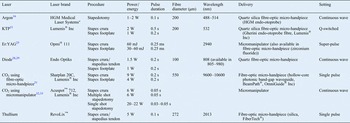
The argon laser is in the visible light spectrum and has a wavelength of 488–514 nm. It has a relatively short wavelength resulting in absorption by primarily haemoglobin, and is less well absorbed by bone, which is largely composed of water.Reference Frenz2 Its rapid absorption by haemoglobin enables excellent haemostasis. One further advantage is that unlike the CO2 laser, it is visible and therefore does not require an aiming beam, which comes with its own risks of misalignment. However, low absorption in bone during stapes surgery leads to higher penetration of the radiation, which theoretically can lead to thermal damage of the footplate and possibly inner-ear structures. Clinical experiments have demonstrated increased temperatures of up to 10°C within the perilymph after using the argon laser in stapes surgery (using power settings of 2 W and pulse durations of 0.5 seconds).Reference Vollrath and Schreiner13–Reference Schreiner and Vollrath15
Earlier techniques involved the use of a micromanipulator attached to an operating microscope. Horn et al. developed a fibre-optic micro-handpiece with a divergent beam at the tip (an ‘endo-otoprobe’).Reference Horn, Gherini and Griffin16 The divergence of the beam increased the beam diameter from 100 μm to 500 μm, and reduced the radiant exposure by a factor of three.Reference Hausler, Messerli, Romano, Burkhalter, Weber and Altermatt17 Temperature increases in the perilymph using this system were reduced to 2–3°C in an inner-ear model using the fibre-optic micro-handpiece.Reference Hausler, Messerli, Romano, Burkhalter, Weber and Altermatt17 The use of a handheld fibre-optic probe allows access to difficult areas that may be out of sigh, such as the anterior crus of the stapes.
Studies investigating the inherent risks of penetration into perilymph and inner-ear structures have demonstrated that the argon laser is safe in relation to other lasers if used by experienced surgeons at a low power setting (1 W at 0.2-second pulses or less) (Table I). Buchman et al. compared the argon laser and CO2 laser in a retrospective case review of 124 primary stapedotomies.Reference Buchman, Fucci, Roberson and De La Cruz18 Both groups showed similar results with regard to the mean change in air–bone gap (ABG) and in complication rates.
Laser parameters during stapes surgery

*No longer trading. KTP = potassium titanyl phosphate; Er:YAG = erbium-doped yttrium aluminium garnet laser
Potassium titanyl phosphate laser
The potassium titanyl phosphate (KTP) laser is a visible light laser with a wavelength of 532 nm that can be used with a micro-handpiece via fibre-optic cables.Reference Frenz2 The KTP laser used for stapes surgery was first described in the mid-1980s. Like the argon laser, it is not fully absorbed by bone, with the attendant risks of penetration through the footplate, heating of the perilymph and damage to inner-ear structures. However, clinical experiments on animal models have failed to provide evidence that the KTP laser is more likely to cause thermal damage to the inner ear compared to the CO2 laser. Kodali et al. performed 20 laser stapedotomies on adult chinchillas.Reference Kodali, Harvey and Prieto19 They compared the mean temperature elevation beneath the footplate and found no difference between the two techniques. The KTP laser is highly absorbed by haemoglobin and is therefore effective at achieving a blood-free surgical field.
Vincent et al. compared results following stapedotomy performed using either the flexible KTP laser (410 patients) or the flexible CO2 laser (408 patients) between 2006 and 2011.Reference Vincent, Bittermann, Oates, Sperling and Grolman20 The authors routinely used a drill to complete the stapedotomy; as the drill may be more traumatic to the inner ear in comparison to the laser, they state that this may negate any more substantial differences that exist between the two techniques. However, the results were slightly more favourable towards the CO2 laser, with a mean ABG of 3.1 dB, compared to a mean ABG of 4.3 dB for the KTP laser group (95 per cent confidence interval, 0.4–1.9). In addition, in the CO2 laser group, 96.5 per cent of patients achieved a post-operative ABG of 10 dB or lower, compared to 90.4 per cent in the KTP laser group. Complications were negligible in both groups, with reported SNHL in one patient in the KTP group and in zero patients in the CO2 laser group.Reference Vincent, Bittermann, Oates, Sperling and Grolman20, Reference Vincent, Grolman, Oates, Sperling and Rovers21
Clinical studies have shown that the KTP laser is safe when used for stapes surgery, despite concerns of thermal damage to inner-ear structures if used at low power settings with 0.2-second pulses or less.Reference Lescanne, Moriniere, Gohler, Manceau, Beutter and Robier22 Vincent et al. reported only 1 patient with SNHL in their series of 410 patients (0.25 per cent).Reference Vincent, Bittermann, Oates, Sperling and Grolman20 They specified laser parameters of 2 W with 0.5-second pulse duration for the stapes crura, and 1 W with 0.2-second pulse duration for the stapes footplate (Table I).Reference Vincent, Bittermann, Oates, Sperling and Grolman20, Reference Vincent, Grolman, Oates, Sperling and Rovers21 When compared with the new fibre-optic CO2 laser, the hearing results are less favourable, as discussed above.Reference Vincent, Bittermann, Oates, Sperling and Grolman20
The KTP laser has also been shown to be useful in revision stapes surgery, which in general has lower success rates than primary surgery. Stucken et al. evaluated a series of patients who underwent revision stapes surgery using the KTP laser.Reference Stucken, Brown and Selesnick23 There were no cases of post-operative SNHL, and approximately 91.3 per cent of patients achieved a post-operative ABG within 20 dB.
Erbium-doped yttrium aluminium garnet laser
The erbium-doped yttrium aluminium garnet (YAG) laser is in the infrared region, and has a wavelength of 2940 nm. Water is therefore the main absorption medium, with resulting strong bone absorption and minimal penetration to surrounding tissues. It seems, therefore, an ideal candidate for stapes surgery. Indeed, experiments have shown a very small lateral thermal damage zone of only 5–10 μm on a stapes footplate perforated using the erbium-doped YAG laser.Reference Pratisto, Frenz, Ith, Romano, Weber and Altermatt24 In addition, optical fibres are available through which the radiation can be safely transmitted.
Lippert et al. performed experimental studies on 54 human petrous bones, to determine optimal laser energy parameters for both posterior stapes crus dissection and footplate perforation using a micromanipulator.Reference Lippert, Gottschlich, Kulkens, Folz, Rudert and Werner25 With these optimal parameters, the erbium-doped YAG laser was used for posterior stapes crus dissection and footplate perforation in 29 patients with otosclerosis. The optimal pulse energy for posterior crus dissection was 60 mJ, with between three and seven pulses with a focused laser beam needed. For the footplate perforation, an optimal pulse energy of 100 mJ, using two to four single pulses with a defocused beam (diameter of 1.02 mm), was used (Table I).Reference Lippert, Gottschlich, Kulkens, Folz, Rudert and Werner25 No complications were reported in any of the 29 patients. The average post-operative ABG was 8.1 dB, which compares favourably with studies of other laser systems. Interestingly, in one patient in this series, the footplate perforation could not be performed with the laser as there was a blood vessel crossing the footplate. This illustrates the fact that whilst the erbium-doped YAG laser is absorbed efficiently by bone, it has very poor coagulation capability.Reference Lippert, Gottschlich, Kulkens, Folz, Rudert and Werner25
One major potential drawback of the erbium-doped YAG laser is the generation of acoustic waves during explosive ablation of bone, which can be heard as a loud ‘pop’, ‘bang’ or ‘gun-shot’ sound when used on a patient undergoing stapedotomy under local anaesthesia.Reference Hausler, Schar, Pratisto, Weber and Frenz26 Experiments on guinea pig cochleas have established safe parameters to minimise any acoustic trauma.Reference Arnold, Ehrenberger, Frenz, Pratisto, Weber and Felix27 Radiant exposure below 17 J/cm2 produces only a transient increase in the activity of postsynaptic inner hair cell receptors (suggesting no irreversible damage to cochlear function). However, at higher radiation exposure of 40 J/cm2, destruction of the cochlea occurs.Reference Arnold, Ehrenberger, Frenz, Pratisto, Weber and Felix27 Based on these observations, the maximum radiant exposure allowed for use in stapes surgery is 10–17 J/cm2.Reference Hausler, Schar, Pratisto, Weber and Frenz26
Diode laser
The diode laser is an electronic laser consisting of two semiconductor materials, which produces a wavelength of 805 to 980 nm. These wavelengths fall between the absorption peaks of haemoglobin and water, and therefore are less well absorbed by bone. These lasers are available in portable units, which are delivered via quartz fibres 100 μm in diameter, with power outputs of 1 to 10 W.
Poe evaluated a number of different lasers, including the diode laser (with wavelengths of 808 nm, 812 nm and 980 nm), for their gross interactions with water, fresh cadaver guinea pig muscle and bone, and fresh human blood.Reference Poe28 The findings demonstrated favourable bone and soft tissue effects with the diode laser. Stapes footplate fenestrations were also performed under endoscopic guidance on 10 human cadaver bones using the 812 nm laser. The findings revealed elevated vestibule temperatures of a mean of 3.25°C, with a rise of no more than 4.3°C during stapes footplate applications, which is considered clinically acceptable. The author noted clean, tight round craters, with minimal char on stapedotomy using this laser.Reference Poe28
Gerard et al. demonstrated the clinical suitability of the diode laser in stapes surgery.Reference Gerard, Serry and Gersdorff29 They performed a retrospective review of 139 patients undergoing 147 stapes operations by the same surgeon using the 808 nm diode laser. The diode laser was used in continuous mode at 1.5 W to divide the stapedius tendon and the stapes crura. Fragilisation of the footplate (prior to stapedotomy via the Skeeter microdrill) was performed using the laser in continuous mode at 1 W. Three patients presented with significant post-operative complications, including one patient with permanent profound SNHL. Overall, 86 per cent of patients had ABG closure of less than 20 dB, with more than 60 per cent with ABG closure of less than 10 dB.Reference Gerard, Serry and Gersdorff29
Navarrete et al. reported their experience with the 980 nm diode laser in a pilot study of six patients undergoing stapes surgery.Reference Navarrete, Boemo, Darwish, Monzon and Rojas30 They used the laser with 1 W of power and a pulse duration of 0.2 seconds. They employed 200-μm fibre to divide the stapedius tendon and the posterior crus of the stapes and to perform the stapedotomy. No patients had a decrease in bone conduction when tested 10 days post-operatively and no complications were reported.Reference Navarrete, Boemo, Darwish, Monzon and Rojas30
Carbon dioxide laser
Lesinski and Palmer illustrated the suitability of the CO2 laser for stapes surgery in a number of experiments.Reference Lesinski and Palmer31 Subsequently, a number of studies have shown that the CO2 laser achieves significantly better hearing results and fewer complications than conventional surgery.Reference Jovanovic, Schonfeld and Scherer32 Based on previously published data, safe parameters have been determined for this laser (see Table I).Reference Jovanovic33
The CO2 laser lies in the far infrared spectrum, with wavelengths of between 9600 and 10 600 nm2. The relatively long wavelength of the CO2 laser means that it is readily absorbed by water, which makes up 60 per cent of bone.Reference Smith and Roberson34 It follows therefore that the depth of penetration of the CO2 laser is also minimal, and deeper tissues are shielded from its effect: the greater the absorption, the smaller the depth of penetration. Despite this, the CO2 laser does cause an increase in temperature to surrounding structures. Experiments have shown an 8.8°C temperature increase at 2 mm from the stapes structures; SNHL and other ear symptoms have been described in association with its use.Reference Marchese, Scorpecci, Cianfrone and Paludetti35 However, Lesinski and Palmer demonstrated that with a short application time of 0.1 seconds, this increase in temperature is limited to 0.3°C at the footplate–perilymph interface, with at most a 0.5°C increase in temperature in the open vestibule on direct application of the laser (at 2 W, with a 0.1-second pulse).Reference Lesinski and Palmer31 This heat is generally dissipated to the labyrinthine fluids before reaching the vestibular membrane.Reference Vincent, Grolman, Oates, Sperling and Rovers21
One drawback to the CO2 laser is that the beam is invisible. This necessitates the use of a guiding visible laser beam, such as the helium–neon (’HeNe’) laser.Reference Jovanovic, Schonfeld and Scherer32 Inevitably, there is the theoretical risk of beam misalignment with this system. In addition, the spot size of the helium–neon laser initially exceeded 1 mm, making it tricky for the fine precision work of stapes surgery. However, the development of precision micromanipulators has reduced the diameter of the aiming beam to 300 nm at 250 mm focus.Reference Lescanne, Moriniere, Gohler, Manceau, Beutter and Robier22
The multiple-shot laser technique employs multiple juxtaposed or overlapping laser applications, in order to make a stapedotomy large enough to exactly fit the piston of the prosthesis (0.5–0.7 mm). The selected power for this multiple-shot stapedotomy technique is 6 W, with a pulse duration of 0.05 seconds (Table I).Reference Jovanovic, Schonfeld and Scherer32 These multiple laser applications increase the risk of guiding laser beam misalignment and of receiving too many laser shots to an already open vestibule.Reference Marchese, Scorpecci, Cianfrone and Paludetti35 In a preliminary study of 48 patients undergoing stapes surgery, Just et al. showed a trend towards worse bone conduction thresholds at 6 and 8 kHz after a second-shot CO2 application, compared to a single-shot technique.Reference Just, Guder and Pau36 The ‘one-shot’ laser technique uses a scanner system that utilises rotating mirrors to focus the laser beam onto a precise area of the footplate, allowing precise footplate perforation. In most patients, this negates the need for multiple laser applications.Reference Jovanovic33 Effective and safe laser parameters for the one-shot laser technique are power settings of 1–20 W, with a pulse duration of 0.03–0.05 seconds, in the continuous wave mode (Table I).Reference Jovanovic33
Previously, the CO2 laser was incompatible with the fibre-optic cable. This meant that the laser had to be directed by a micromanipulator coupled to the microscope. Surgery was therefore limited to the visual axis of the microscope, necessitating the use of the endaural approach and increasing the difficulty of the procedure, especially in cases with, for example, a dehiscent facial nerve.Reference Vincent, Grolman, Oates, Sperling and Rovers21 Moreover, the anterior crus can often be difficult to visualise using this approach, leading to a failure of vaporisation and subsequent fracture towards the promontory with the potential risk of footplate fracture. More recently, a new laser delivery system has been developed whereby the laser is transmitted via a handheld fibre (OmniGuide®).Reference Shepard, Kaylie, Danner, Deviah and Bartels37 The fibre has a hollow core at its centre, which is surrounded circumferentially by layers of mirrors that allow propagation of the laser energy. As described previously, the CO2 handheld fibre compares favourably with the KTP laser.Reference Vincent, Bittermann, Oates, Sperling and Grolman20 Laser input settings of 9 W with a 0.2-second pulse duration for the stapes crura, and 4 W with a 0.2-second pulse duration for the stapes footplate, were used (Table I).
Thulium laser
The thulium YAG laser, like the CO2 laser, is in the infrared spectrum. It has a wavelength of 2013 nm, with a 0.8 mm depth of penetration. Thulium (Tm69) is a rare earth metal belonging to the lanthanide group, which includes neodymium, holmium and gadolinium. The thulium laser shares some characteristics with the CO2 laser, such as strong absorption by water, whilst also retaining some of the properties of neodymium and holmium lasers. It is delivered via silica fibre-optics and can be used with clear protective eyewear, which prevents colour distortion. It provides excellent haemostasis and affords exceptional precision in tissue resection. It can be used in contact mode, which is superior for cutting and haemostasis, and in non-contact mode for tissue ablation, similar to the CO2 laser.
The thulium laser is widely used in urological surgery for prostate resection and lithotripsy.Reference Wendt-Nordahl, Huckele, Honeck, Alken, Knoll and Michel38, Reference Bach, Huck, Wezel, Hacker, Gross and Michel39 In otolaryngology, the thulium laser has been used in laryngeal surgery. Koufman et al. reported 27 patients who underwent unsedated office-based laryngeal surgery using the thulium laser.Reference Koufman, Rees, Frazier, Kilpatrick, Wright and Halum40 The indications for surgery included recurrent respiratory papillomatosis, vocal fold granulomas and amyloidosis. The authors reported complete success using the thulium laser, with only one complication of a vocal fold haematoma that resolved with conservative treatment. The thulium laser has also been used to treat airway disease in children.Reference Ayari-Khalfallah, Fuchsmann and Froehlich41 Ayari-Khalfallah et al. described a series of 12 endoscopic procedures using the thulium laser on children with laryngotracheal pathology.Reference Ayari-Khalfallah, Fuchsmann and Froehlich41 They used the laser with a power of 1–2.5 W, on continuous wave mode, with the 273-μm diameter fibre.
Bottrill et al. examined the thulium laser for its suitability in stapes surgery using dry human cadaver bones.Reference Bottrill, Perrault, Pankratov and Poe42 They found that the laser produced little charring of bone; however, it had the disadvantage of producing an audible acoustic shock, similar to the erbium-doped YAG laser. Of more concern was the potential of the dry cadaver stapes to ignite, although this was not observed with moistened bones. Temperature increases of 2°C were observed in the vestibule with a closed footplate, with a temperature increase of up to 11°C if the footplate was opened.Reference Bottrill, Perrault, Pankratov and Poe42
Whilst the thulium laser has ideal properties for use in middle-ear surgery, care must be taken in view of its potential for thermal trauma. In our experience, the thulium laser can be used safely at a low power of 5 W or less in single pulse mode, with a pulse duration of 0.1 seconds, using a micro-handpiece with a 272-μm diameter fibre. Many urological units widely use the thulium laser and therefore it may be possible to utilise the same laser unit for otological procedures. In the current climate, it may make financial sense for ENT departments to utilise expensive equipment that is already available, albeit in a different specialty.
Conclusion
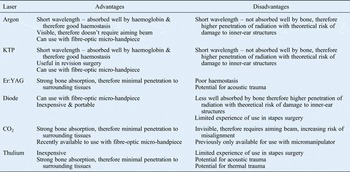
Table II summarises the advantages and disadvantages of the various lasers discussed above. Although each of the lasers differs in terms of wavelength, absorption characteristics and delivery, all of the above lasers have been used with success and safety. Clinically, there is little evidence to support the use of one laser above another, although the surgeon may wish to use the laser which is more readily available in his or her institution.
Advantages and disadvantages of lasers used in stapes surgery

KTP = potassium titanyl phosphate; Er:YAG = erbium-doped yttrium aluminium garnet laser; CO2 = carbon dioxide