


Introduction
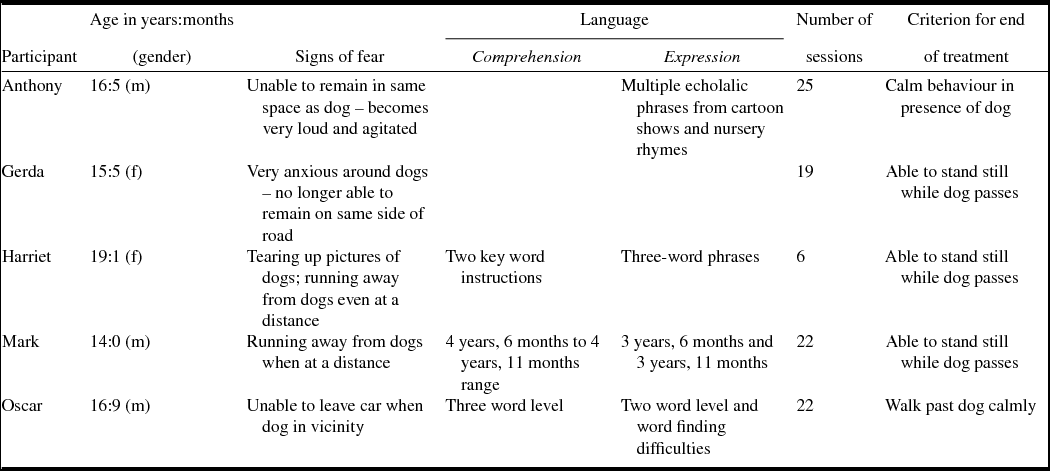
Specific phobias are common in people with autism spectrum disorders (ASD). In a study of lifetime prevalence, Leyfer et al. (Reference Leyfer, Folstein, Bacalman, Davis, Dinh, Morgan, Tager-Flusberg and Lainhart2006) found that about half of children and young people with ASD surveyed were found to meet criteria for a specific phobia compared with less than 5% in typically developing children and young people. Phobias in young people with ASD can lead to risky behaviours and impede their access to the wider community (Ricciardi et al., Reference Ricciardi, Luiselli and Camare2006; see also Table 1 for specific behaviours of the study participants). Dogs are a common focus of specific animal phobia (Mannuzza and Klein, Reference Mannuzza and Klein1993) and reduce access to the community even for people with no other difficulties. Reviews of the evidence on treatment of anxiety disorders in typically developing young people have concluded that cognitive behavioural therapy (CBT) is effective (Reynolds et al., Reference Reynolds, Wilson, Austin and Hooper2012). Adapted forms of CBT have been extended to populations of young people with ASD and comorbid anxiety disorders (Wood et al., Reference Wood, Drahota, Sze, Har, Chiu and Langer2009). The methods used include psychoeducation and behavioural components such as systematic desensitization aimed at reducing the anxiety response. Young people with ASD and intellectual disabilities (ID) are typically excluded from trials of CBT because they have social and communication issues that may include difficulties accessing thoughts, emotions and feelings, as well as information processing problems. In addition, those who have both ASD and ID may have additional communication needs. Many of the components of CBT (e.g. coping self-talk, verbally mediated coping, affective labelling) rely on verbal concepts before discussion with the therapist (Rosen et al., Reference Rosen, Connell and Kerns2016), thus rendering traditional CBT inappropriate for most individuals with ASD and ID.
Table of participant characteristics and number of sessions provided

A number of further issues should be considered when designing an intervention for young people with ASD and ID. First, young people with ASD and ID often have little spoken language and use alternative or augmentative communication (AAC) methods such as the Picture Exchange Communication System. Activities need to be explained by pictures alone and presented as a sequence to assist anticipation and learning. However, these methods are often unable to convey complex information (cf. problems with use of CBT referenced in the previous paragraph). Second, the use of long sessions (one hour or more typical of CBT) can be difficult for young people with ASD and ID due to attention problems. Third, it is unclear how far the cognitive components can be addressed. The final consideration in designing an intervention for animal phobia requires that the feared animal takes part in at least some sessions, particularly at the end of treatment. Some people with phobias do not escape (‘flight’) but will attack the animal instead (‘fight’), which might endanger the welfare of the animal taking part (Williams, Reference Williams, Beinart, Kennedy and Llewelyn2009). Therefore, the therapist has to take account not only of the person with the phobia, but also any animal involved. Protection for the animal might involve some form of barrier to prevent the animal being injured.
Potential solutions include the use of the behavioural components of CBT such as ‘in vivo exposure and participant modelling, with the goal being a graduated, systematic, and prolonged exposure to feared stimuli. . .’ (Zlomke and Davis, Reference Zlomke and Davis2008), which have demonstrable efficacy for dog phobias in adults with ID (e.g. Dansey and Peshawaria, Reference Dansey and Peshawaria2009). Systematic desensitization can be delivered without the use of language as it is designed to extinguish the link between a feared stimulus and the fight/flight response by (1) providing an alternative response (often relaxation), (2) development of a fear hierarchy from least to most frightening situations, and (3) work up the hierarchy learning not to respond negatively to the feared stimulus. In the case of the participants in this study, we developed the hierarchy based on observations of their responses to stimuli such as pictures, soft toy dogs, videos of dogs and exposure to dogs at a distance within the school site (see also May et al., Reference May, Rudy, Davis and Matson2013). Coping behaviours can also be modelled by other participants in the session to demonstrate effective ways of managing the situation, and the skills taught can be generalized to other dogs and other environments. In planning interventions, goals of treatment have to be carefully considered. It may not be appropriate to abolish avoidance completely, so the goal might be to recognize potentially dangerous situations (e.g. guard dogs) while being able to encounter dogs in the community. Adapted CBT interventions could therefore be used to treat animal phobias for young people with ID and ASD.
In the school where the authors work, reviews of pupil progress had shown that a number of pupils were unable to access the community due to their phobic reactions to dogs. The psychology department agreed to devise a method for overcoming the phobias, so as to improve the possibilities of community activities. This paper describes a series of cases in which the authors establish a flexible protocol for the treatment of dog phobia in young people with ASD spectrum disorder and intellectual disability and severe communication impairments. The intervention was designed following the recognition that dog phobia was hindering the inclusion of young people with ASD and severe ID in community-based activities. The basis of the method is systematic desensitization using a range of stimuli from drawings, to photographs and live animals, together with modelling of coping behaviours.
Methods
Participants
Five young people aged between 14 and 19 years with ASD and severe ID (IQ range 20–40) participated in the programme, which was agreed by the school ethics committee (see Table 1 for characteristics). The young people were resident during the week in a specialist school. Two dogs took part in the treatment sessions (a Jack Russell cross and a Labrador) after training by Pets as Therapy (http://www.petsastherapy.org/). The dogs were not trained to take part in behaviour therapy as such, but were trained to be calm and obedient for work in nursing homes and hospices. The training included not startling at rapid movements and learning not to bark unexpectedly.
Intervention
Most of the pupils at the school are not able to use speech for communication, which dictated that the intervention should be capable of delivery non-verbally. Intervention goals were determined jointly with the care and education staff and parents, so that the young person would be able to access the community for activities such as walks in the park and shopping trips in town centres. Our intervention therefore consisted of a hierarchy specific to each individual, reinforced practice and therapist modelling. Treatment sessions lasted no more 30 minutes and took place in an animal husbandry teaching area. Sessions were led by the same therapist (author A.P. or P.B.) and the same animal handler for each young person during each session. In each session the participant initially received a visual schedule that displayed the activities they would be doing, in the order that they would be doing them. The interventions began with exposure to photographs and pictures of dogs, including jigsaw puzzles. For one participant this phase continued until she was able to manipulate photographs (matching, sorting) without either destroying or hiding them. The others showed no avoidance of pictures. Participants were next introduced to furry toy dogs, which they learnt to ‘groom’. The subsequent phase was to expose them to a dog nearby but separated from them by a window, followed by bringing the dog in to the same building. The person handling the dog modelled appropriate behaviours to the situations. In the next phase they were encouraged to take items to the dog handler, groom the dog, walk the dog using a shared lead, walk alongside the dog and walk the dog on their own round a small field. Movement to the next step in the hierarchy only occurred when the young person was able to achieve the previous step without avoidance or obvious fear. In the final stage, the participants were exposed to dogs unexpectedly during their daily tasks. This was regarded as a generalization test, although we did not specifically test behaviour outside the premises of the school where the intervention took place.
Results
Table 1 shows the fear reactions at the start of the intervention and the goals. At the end of treatment all five participants were able to remain calm when coming across a dog unexpectedly but remained less willing to approach the dogs in a surprise situation than in an expected situation.
The number of sessions taken to treat to criterion as predetermined by the team working with the young person varied between 6 and 25 (see Table 1). Measurement of the outcome was by the therapist working with the young person. In addition, the therapy sessions were recorded on video.
Discussion
The five young people are no longer handicapped by their phobia of dogs. They can access the community without escape behaviour when meeting a dog, as recorded by staff working with them. Anecdotal evidence has shown that the young people have not become over-friendly with dogs in the community, and remain calm in the presence of dogs. The sessions were short and progress was enabled by using visual means of communication to explain the activities to the participants. The animals who took part were introduced to the young people gradually. An important component of the intervention was that the dogs had been trained to remain calm, and the interaction with the young people was carefully managed to protect the dogs from kicks and blows that might have been delivered by the young people.
The treatment methods outlined here offer potential for overcoming the phobic responses of people with minimal language and intellectual disabilities. Taken together with Dansey and Peshawaria (Reference Dansey and Peshawaria2009), this study provides case series evidence of benefit. For people working with individuals with little language and intellectual disabilities, the use of visual methods of communication alongside systematic desensitization tailored to the individuals’ unique reactions to feared stimuli offers an effective intervention. It seems likely that the mechanism of action is through learning that coming closer to a feared animal is safe. The use of visual methods of communication may have the unintended consequence of increasing the number and duration of exposure events, hence increasing the apparent effect of the intervention.
The duration of treatment was very variable before the treatment goal was reached. Nevertheless, the total treatment time (up to 11 hours) is similar to many treatment trials of CBT for anxiety in typically developing children and young people (Reynolds et al., Reference Reynolds, Wilson, Austin and Hooper2012). Further work is required to identify the modifications that may be necessary to write a full protocol and hence enable controlled trials. An alternative to controlled trials would be to use experimental designs that allow for the diversities among individuals with severe intellectual disability. Single-case designs offer possible solutions, although reversal designs (such as alternating baseline and intervention, ABAB) would not be appropriate as once the participant has learned different patterns of behaviour they are unlikely to forget them. One possible design would be a multiple baseline design that varied the length of the baseline randomly before initiating treatment. This would allow for the possibility that the participants would recover from dog phobia spontaneously over a longer period of time.
Further research to identify the characteristics of people with severe intellectual disabilities and dog phobia would be valuable as a prelude to the design of a randomized controlled trial using a manualized treatment. Such a manual will need to take into account the level of intellectual disability, the level of language skill and the types of phobic responses shown so that an appropriate metric can be developed. The variety of hierarchies used in case studies could be used to devise a behavioural measure of phobic response. For instance, one participant in this study would destroy pictures of feared animals, whereas the others were able to manipulate pictures from the beginning, thus changing the initial stage of the intervention, but also demonstrating that a measure needs to incorporate responses to pictures of feared animals as well as approach to the feared animal. Future studies might also use a wider range of measures of the phobic response, including generalization to the community and longer follow-ups. Ideally, physiological and behavioural response measures would be used as suggested by Davis and Ollendick (Reference Davis and Ollendick2005). Finally, the manual would have to be written in such a way that the intervention continues to include generalization and maintenance.
Main points
-
(1) Systematic desensitization can be combined with augmented communication methods to overcome small animal phobias in young people with comorbid ASD and ID.
-
(2) The sessions should be short, but the necessary number of hours of therapy time seems to be similar to that seen in other phobia treatment trials.
-
(3) This study has shown the potential of systematic desensitization for treating simple phobias in a population for whom there is little evidence-based guidance. Further research leading to an adequately powered controlled trial is warranted.
Acknowledgements
We are grateful to the staff, parents and young people who provided time and support to enable this work to proceed.
Ethical statements
We have abided by the Ethical Principles of Psychologists and Code of Conduct as set out by the Americal Psychological Association. Ethics approval was granted by the Senior Leadership of Priors Court Foundation on 17 September 2010. Prior to starting the intervention, consent was obtained from parents or other appropriate care-givers.
Conflicts of interest
Phillippa Burton, Anna Palicka and Tim Williams have no conflicts of interest with respect to this publication.
Financial support
This research received no specific grant from any funding agency, commercial or not-for-profit sectors.
-
(1) To demonstrate the possibility of treating specific phobias in young people with autism spectrum disorder (ASD) and severe intellectual disabilities (ID) using systematic desensitization.
-
(2) To draw attention to the use of symbol systems in communication with people with little functional communication.
-
(3) To identify the ethical issues that arise from using live animals in desensitization treatment.
-
(4) To indicate that the length of the intervention may be more variable in the population of those with ASD, severe ID and specific phobias.



Comments
No Comments have been published for this article.