In the United States, sequential bilingual children first acquire a minority (first) language (L1) in the home and later acquire English as a second language (L2) through school and community exposure. Variations in the timing of L2 introduction (Hakuta, Bialystok, & Wiley, Reference Hakuta, Bialystok and Wiley2003), the contexts for L1 and L2 use (Peña, Bedore, & Rapazzo, Reference Peña, Bedore and Rappazzo2003), the sociolinguistic status of each language within the community (Pearson, Reference Pearson2007), and the typological similarities between the two languages (Ramirez, Chen, Geva, & Luo, Reference Ramirez, Chen, Geva and Luo2011) can all influence the language acquisition process. Research on sequential bilinguals is increasingly expanding to consider more language pairs, more points in development, and more language communities. However, much remains to be explored.
One theory that can capture some of the complexity of sequential bilingual language development is the unified competition model (MacWhinney, Reference MacWhinney, Kroll and De Groot2004). The unified competition model seeks to explain language learning in both monolingual and bilingual learners across the lifespan within a single framework; it explains linguistic comprehension and production behaviors in terms of within-speaker competition among linguistic cues. Language learning over time results from this competition and the growth of resonant connections within and across languages (MacWhinney, Reference MacWhinney, Kroll and De Groot2004).
Within the unified competition model (and its predecessor, the competition model), sentence interpretation tasks have been used to examine how speakers use linguistic cues to assign meaning to sentences. Participants are asked to identify a picture representing one of the thematic roles (e.g., the agent) in a sentence; within the sentence stimuli, linguistic cues such as word order, noun animacy, noun–verb agreement, and linguistic prosody are systematically manipulated in order to determine which cues influence the participants’ behavior. The unified competition model predicts that cues will compete with each other, and that cue strength is based on the frequency and consistency (typically called reliability) of cues within the language (MacWhinney, Reference MacWhinney, Kroll and De Groot2004).
Here we offer a study of sequential bilingual language development framed within the unified competition model. The study expands previous work on sentence interpretation by examining change over time within children learning two languages. We consider the performance of typically developing Vietnamese–English bilingual children on a sentence interpretation task in both the L1 and the L2 across three time points during the early school years. Target cues are animacy and word order. This study is a longitudinal extension of Pham and Kohnert (Reference Pham and Kohnert2010).
In order to frame our study design and research questions within an empirical context, we first review the literature on typical language development in school-aged sequential bilinguals, focusing on work that has measured both languages and considered growth as a function of time or age. Second, we review previous work on sentence interpretation tasks, particularly their application and interpretation in bilingual children. Third, we present our study purpose and predictions.
LANGUAGE GROWTH IN TYPICALLY DEVELOPING SEQUENTIAL BILINGUALS
In general, children from minority language households demonstrate rapid growth in the L2 during the early school years (Rojas & Iglesias, Reference Rojas and Iglesias2013; Uccelli & Paez, Reference Uccelli and Páez2007). In contrast, skills in the L1 may continue to grow, albeit at a slower pace (Rojas & Iglesias, Reference Rojas and Iglesias2013; Pham & Kohnert, Reference Pham and Kohnert2014), or even show an overall lack of growth (Uccelli & Paez, Reference Uccelli and Páez2007). This pattern leads to a shift in proficiency (or language “dominance”) from the L1 to the L2 during the school years for sequential bilinguals (e.g., Jia, Kohnert, Collado, & Aquino-Garcia, Reference Jia, Kohnert, Collado and Aquino-Garcia2006; Kohnert, Bates, & Hernandez, Reference Kohnert, Bates and Hernandez1999; Pham & Kohnert, Reference Pham and Kohnert2014; Squires et al., Reference Squires, Lugo-Neris, Peña, Bedore, Bohman and Gillam2014; cf. Verhoeven, Reference Verhoeven1994). In other words, children may enter formal schooling performing more quickly and more accurately on language tasks in the L1, but transition to faster and more accurate performance in the L2 within a few short years.
A substantial proportion of the literature on dual language growth has focused on lexical-level tasks such as timed picture naming, picture–word verification, standardized vocabulary tests, and lexical diversity in language samples (Jia et al., Reference Jia, Kohnert, Collado and Aquino-Garcia2006; Kohnert & Bates, Reference Kohnert and Bates2002; Kohnert et al., Reference Kohnert, Bates and Hernandez1999; Pham & Kohnert, Reference Pham and Kohnert2014; Uccelli & Paez, Reference Uccelli and Páez2007). Other works have considered discourse-level measures such as story macrostructure (Squires et al., Reference Squires, Lugo-Neris, Peña, Bedore, Bohman and Gillam2014; Uccelli & Paez, Reference Uccelli and Páez2007). Relatively few investigations have considered sentence-level tasks, which are most closely related to the sentence interpretation task in the present study. Verhoeven (Reference Verhoeven1994) examined growth on several language tasks in a group of 74 Turkish–Dutch bilingual children, aged 6 to 8 years, living in The Netherlands. One task at the sentence level, sentence repetition, was included in the study. Participants made significant sentence repetition gains in both the L1 and the L2, with faster growth in the L2. However, as with other tasks in this study, participants remained more proficient in their L1 at the conclusion of the study (age 8 years). The mean length of utterance measure derived from story retells in Rojas and Iglesias (Reference Rojas and Iglesias2013) can also be considered sentence level, albeit contextually different. Results for the group of 5- to 7-year-old Spanish–English bilinguals in this study resembled the general trend outlined previously: growth was apparent in both the L1 and the L2 but relatively faster in the L2.
Finally, the specific languages spoken by participants as well as the sociolinguistic context in which they are learned may well influence studies of sequential bilingual language development. Studies of Spanish–English bilingual children in southwestern communities of the United States have predominated (Kohnert & Bates, Reference Kohnert and Bates2002; Kohnert et al., Reference Kohnert, Bates and Hernandez1999; Rojas & Iglesias, Reference Rojas and Iglesias2013; Squires et al., Reference Squires, Lugo-Neris, Peña, Bedore, Bohman and Gillam2014). Spanish and English share a degree of typological overlap that may facilitate cross-language interaction and transfer (Genessee, Geva, Dressler, & Kamil, Reference Genesee, Geva, Dressler, Kamil, August and Shanahan2006), whereas other language pairs may be more distinct. Furthermore, the social status of the L1 (Spanish) in relation to the L2 within these studies is likely to matter; there is evidence that sequential bilingual children maintain greater L1 growth in educational and social contexts that support L1 use (Wright, Taylor, & Macarthur, Reference Wright, Taylor and Macarthur2000).
Children in the present study were speakers of Vietnamese and English. To our knowledge, the only previous work on bilingual Vietnamese–English language development was conducted within the same community of children,Footnote 1 who lived in the southern United States and attended a school with instruction in both Vietnamese and English. Pham and Kohnert (Reference Pham and Kohnert2014) analyzed performance on receptive and expressive lexical tasks within this group across four time points, spanning the ages of 6 to 12 years. On all tasks, children improved in both the L1 and the L2 over time. However, L2 growth occurred at a significantly faster pace, resulting in the expected shift to L2 dominance. The transition to L2 dominance varied by task, with transitions on receptive tasks (e.g., receptive vocabulary) occurring later than those on expressive tasks (i.e., expressive vocabulary and timed picture naming).
Thus, at the most general level, the existing literature indicates that sequential bilingual children will show relatively rapid growth on a language task administered in the L2 during the early school years. While we expect this pattern to hold true in the current study, there are several complications in using the existing literature to predict performance here. There is very limited evidence to date on growth in the specific type of task under consideration (which can be considered both receptive and sentence level) as well as the specific population of Vietnamese–English bilinguals within the United States. Moreover, the purpose of sentence interpretation tasks differs from traditional assessments of language proficiency, which compare performance to a “correct” standard.
SENTENCE INTERPRETATION: LINGUISTIC CUES AND THE ROLE OF DEVELOPMENT
A history of cross-linguistic work on sentence interpretation in adults has shown that English speakers rely heavily on word order cues to interpret sentences (e.g., Bates, McNew, MacWhinney, Devescovi, & Smith, Reference Bates, McNew, MacWhinney, Devescovi and Smith1982), consistent with the canonical subject–verb–object word order of English. In other words, speakers of English assign the role of agent to preverbal rather than postverbal nouns, even when the result is semantically improbable (e.g., the sheep bit the lion) or even ungrammatical (e.g., the balls hits the boy). Adult monolingual speakers of other languages tend to rely less on word order cues, consistent with the predominant cues in the ambient language; for example, speakers of Spanish may use noun–verb agreement (e.g., Hernandez, Bates, & Avila, Reference Hernandez, Bates and Avila1994), and speakers of Chinese rely heavily on animacy (e.g., Su, Reference Su2001).
In the present study, two cues were of particular interest: word order and animacy. While word order is a reliable cue in English (e.g., Bates et al., Reference Bates, McNew, MacWhinney, Devescovi and Smith1982), the same may not be true for Vietnamese: corpus-based analyses show substantial variability in the sentence structures found in written Vietnamese texts (Pham & Kohnert, Reference Pham and Kohnert2010), suggesting that preverbal nouns may not be a reliable cue to agency. Meanwhile, two classifiers in Vietnamese, con and cái, are highly frequent and reliable animacy cues. These two classifiers are among the 150 most frequently used words in a Vietnamese language corpus of over 1 million words (Pham, Kohnert, & Carney, Reference Pham, Kohnert and Carney2008), and they have been found to provide reliable information about animacy (e.g., con gấu “bear” vs. cái ghế “chair”) in a corpus-based analysis of Vietnamese classifiers (Pham & Kohnert, Reference Pham and Kohnert2009). In sum, word order is a stronger cue to meaning than animacy in English, while animacy may be a stronger cue than word order in Vietnamese (cf. Pham & Kohnert, Reference Pham and Kohnert2010). In addition, these two cues differ in the type of linguistic information they provide. Animacy may be considered a lexical-level cue because it relates solely to the properties of the noun. Word order, in contrast, is a sentence-level cue because it relates to sentence-level syntax. We will return to this point of lexical- versus sentence-level cues when we describe the selection of tasks to measure proficiency in each language.
In addition to the specific languages and linguistic cues involved, performance on sentence interpretation tasks has been found to differ across ages. Monolingual toddlers generally utilize the most prevalent cues in the ambient language, such as word order in English and animacy in Italian (Bates et al., Reference Bates, MacWhinney, Caselli, Devescovi, Natale and Venza1984), showing some capacity to capitalize on language-specific information in early comprehension. However, there are also developmental effects on performance, with several studies showing changes in cue use as a function of age in monolingual children (Bates et al., Reference Bates, MacWhinney, Caselli, Devescovi, Natale and Venza1984; Reyes, Reference Reyes2003; Miao, Chen, & Yin, Reference Miao, Chen and Yin1984). In particular, word order may be a relatively salient cue for very young children. Candan et al. (Reference Candan, Küntay, Yeh, Cheung, Wagner and Naigles2012) recently demonstrated that 1- to 3-year-old children learning English, Turkish, and Mandarin were sensitive to the typical word order of their language in processing simple sentences, despite cross-linguistic differences in the reliability of this cue. In addition, both Reyes (Reference Reyes2003) and Miao et al. (Reference Miao, Chen and Yin1984) found a relatively greater reliance on word order than on language-specific cues (subject–verb agreement in Spanish and animacy in Chinese) in 5- to 7-year-old children completing sentence interpretation tasks. Thus, monolingual children appear to increase their reliance on language-specific, reliable cues as they develop. To our knowledge, however, existing work on monolingual development of sentence interpretation has been conducted cross-sectionally rather than longitudinally, limiting direct observation of growth over time.
Developmental changes in sentence interpretation strategies within monolingual children may stem from increased language proficiency, from enhanced cognitive processing associated with maturation, or from a combination of the two factors. Language proficiency has not been extensively investigated as a determinant of monolingual children's sentence interpretation performance. However, a study using a related sentence-processing task (Borovsky, Elman, & Fernald, Reference Borovsky, Elman and Fernald2012) demonstrated that vocabulary rather than age influenced performance in typically developing monolingual English-speaking children, aged 3 to 10 years. In this study, children's eye movements were tracked as they listened to transitive sentences and were asked to identify the target (or recipient of the action) from a set of four pictures. Children's ability to predict the target was related to vocabulary size but not to age, suggesting that linguistic proficiency rather than maturation influences sentence processing. Further work is needed to determine whether this pattern holds for other sentence processing tasks and for other populations, such as bilingual children.
SENTENCE INTERPRETATION IN BILINGUAL ADULTS AND CHILDREN
Within bilingual speakers, sentence interpretation tasks can be used to examine the relationship between the two languages via the intersection of two sets of cues. In general, patterns of cue use for bilingual speakers in sentence interpretation include amalgamation, in which predominant cues from both languages are combined and used to interpret sentences in both languages; forward and backward transfer, in which cues predominant in the L1 are applied to the L2, and vice versa; and differentiation, in which different cues are utilized in each language (Morett & MacWhinney, Reference Morett and MacWhinney2013; Reyes & Hernandez, Reference Reyes and Hernandez2006). Though all four patterns have been documented in bilingual adults, Reyes and Hernandez (Reference Reyes and Hernandez2006) assert that amalgamation is the most frequent pattern among bilinguals who learn their L2 during childhood and use both of their languages frequently. Relative proficiency in adult bilinguals does appear to play a role in sentence interpretation, with recent evidence showing increased reliance on L2 cues for individuals with greater L2 proficiency (Morett & MacWhinney, Reference Morett and MacWhinney2013; see also Pham & Kohnert, Reference Pham and Kohnert2010, for a review of previous evidence on this topic).
Although there is a substantial body of literature investigating sentence interpretation in both bilingual adults and monolingual children, there are relatively few studies of sentence interpretation by bilingual children. Reyes and Hernandez (Reference Reyes and Hernandez2006) investigated cue use as a function of age in Spanish–English bilinguals aged 5 years and older. Word order and subject–verb agreement were the cues of interest. Developmental effects were apparent, because the youngest group (5- to 7-year-olds) showed the greatest reliance on word order, with increasing use of subject–verb agreement over time. There was little evidence of cue differentiation for the school-aged children, because patterns of performance in Spanish and English were very similar within the youngest age groups; however, reaction time data showed greater differentiation between the languages. Reyes and Hernandez (Reference Reyes and Hernandez2006) emphasize the difference in performance between bilingual and monolingual children on these tasks.
The present study is a longitudinal extension of a second study on sentence interpretation in bilingual children (Pham & Kohnert, Reference Pham and Kohnert2010). Pham and Kohnert (Reference Pham and Kohnert2010) reported the sentence interpretation performance of this Vietnamese–English bilingual sample at a single (initial) time point in comparison to a group of monolingual English-speaking peers. All participants were 6–8 years old at Time 1, and linguistic cues included word order and animacy. The bilingual children relied more heavily on animacy than their monolingual English-speaking peers, particularly when word order and animacy cues conflicted. Patterns of cue use were nearly identical in each language at the group level; that is, there was no evidence that the bilingual children differentiated their cue use by language. However, at the individual level, 5 of 23 participants (22%) showed some degree of differentiation in their cue use across languages. Finally, bivariate correlations revealed an association between Vietnamese vocabulary and animacy cues, indicating that children who were more proficient in the L1 were more likely to rely on L1-specific cues.
Thus, the limited existing literature on sentence interpretation by early school-age sequential bilinguals suggests that children will utilize cues from both languages. Children appear to use an amalgamation of cues, although this pattern could change with development. Both language proficiency and development over time are likely to influence sentence interpretation in this group, but the existing literature has not yet established specific patterns.
STUDY PURPOSE AND PREDICTIONS
The purpose of this study is to examine change over time in the sentence interpretation performance of the typically developing Vietnamese–English bilingual children in Pham and Kohnert (Reference Pham and Kohnert2010). We measured sentence interpretation in both languages at three time points, and we also included two direct measures of language proficiency: vocabulary, a lexical-level measure, and sentence repetition, a sentence-level measure. To our knowledge, this represents the first longitudinal investigation of growth in sentence interpretation in children, monolingual or bilingual. With a longitudinal design and bilingual child participants, we are able to consider the development of sentence processing as a function of age and shifting language proficiency within a critical time period for sequential bilingual language development, the early school years. This study addresses three sets of predictions:
1. Longitudinal growth: We anticipate changes in word order and animacy cue use over time. Consistent with the unified competition model (MacWhinney, Reference MacWhinney, Kroll and De Groot2004), cross-language transfer is predicted to occur from the stronger to the weaker language. At the group level, we anticipate that reliance on animacy cues will decrease and reliance on word order cues will increase over the course of development, due to the anticipated shift toward English dominance within this age range.
2. Role of language proficiency: We predict that language proficiency will be related to cue use at the individual level. Specifically, we predict that children with greater Vietnamese (L1) proficiency will be more likely to rely on animacy cues. Because animacy is a lexical cue, vocabulary rather than sentence repetition may be the better measure of Vietnamese proficiency (i.e., the proficiency measure more closely related to animacy cue use). We expect an increase in reliance on word order as English proficiency increases; moreover, sentence repetition may be the most relevant measure of English proficiency, because it is a sentence-level measure.
3. Cue-use patterns: Based on the initial pattern of amalgamation in Pham and Kohnert (Reference Pham and Kohnert2010) as well as the cross-sectional results of Hernandez and Reyes (2006), we predict that at the group level, participants will continue to rely on an amalgamated set of cues rather than differentiated cues for each language. Consistent with previous studies with bilinguals (Liu, Bates, & Li, Reference Liu, Bates and Li1992; Pham & Kohnert, Reference Pham and Kohnert2010), we also anticipated individual-level variability in which individual children will show various patterns of forward or backward transfer, amalgamation or differentiation.
METHOD
Participants
Thirty-two children (18 girls, 14 boys) participated in this study over the course of 4 years. At the start of the study, the average participant age was 7.12 years (SD = 0.49, range 6.42–8.08). Participants lived in Florida, spoke Vietnamese as the primary home language, and attended an elementary school in which English was the language of instruction. In addition, children received 90 min/day of Vietnamese language and literacy instruction as part of a transitional bilingual education program. All participants were either first- or second-generation Vietnamese American, defined as having at least one foreign-born parent and being foreign born (first generation) or US born (second generation). Fourteen participants (44% of the sample) were foreign born and had attended school in the United States for at least 1 year prior to participating in the study. Eighteen participants (56%) qualified for free or reduced lunch, an indicator of low income. Participants were considered typically developing; there were no parent or teacher concerns for language or learning abilities and no history of special education services.
General procedures
Children completed sentence interpretation tasks in Vietnamese and English as part of a larger longitudinal study examining first and second language development among Vietnamese American children (Pham & Kohnert, Reference Pham and Kohnert2014). Children worked individually with an examiner fluent in the target language (Vietnamese or English) in a quiet area of the school. The first language of administration was counterbalanced each year. All participants completed the same tasks for a minimum of one time point and a maximum of three time points. Performance on sentence interpretation tasks at Time 1 (completed in 2007 or 2008) was reported in Pham and Kohnert (Reference Pham and Kohnert2010). Sentence interpretation tasks were part of a set of language measures administered in 2007, 2008, 2010, and/or 2011. (Sentence interpretation tasks were not administered in 2009.) Participant attrition occurred during the multiyear time period. The attrition rate at Time 2 was 9% (n = 29), and it rose to 58% (n = 12) by Time 3. Participant attrition was primarily due to families moving out of the school district, so they could no longer be contacted. There was no clear pattern in attrition, and data were considered to be missing at random; missing data were accounted for using maximum likelihood estimation (Widaman, 2006).
Sentence interpretation tasks
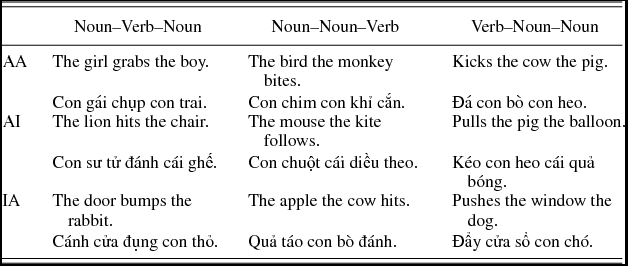
The goal of sentence interpretation tasks is to examine how children extract meaning from sentences in which linguistic cues combine or compete. Within the present study, two linguistic cues to meaning were varied within sentences containing two nouns and one transitive verb. The two cues, animacy (animate vs. inanimate objects) and word order (noun–verb–noun, noun–noun–verb, verb–noun–noun), were manipulated to create a total of 9 sentence structures in which A was animate noun, V was verb, and I was inanimate noun: AVI, AVA, IVA, AAV, AIV, IAV, VAA, VAI, and VIA. There were six exemplars of each structure for a total of 54 test items (see Appendix A for example stimuli in Vietnamese and English). Sentences were digitally recorded in a sound isolation booth in a neutral voice (i.e., flat intonation) by the first author, who is fluent in Vietnamese and English (for further information and a complete list of experimental stimuli, see Pham & Kohnert, Reference Pham and Kohnert2010).
Tasks in each language consisted of 3 practice items followed by the 54 test items. Item order was randomized for each language. For each item, participants listened to the sentence via an audio CD and headset. They viewed black-and-white line drawings depicting the two nouns occurring in the sentence and were asked to point to the picture depicting the “do-er” or agent of the action, even if the sentence sounded strange. The position of the picture depicting the first noun alternated between the top and bottom of each page. Consistent with previous sentence interpretation tasks (e.g., Bates et al., Reference Bates, MacWhinney, Caselli, Devescovi, Natale and Venza1984), responses were not based on accuracy but rather scored according to whether the participants chose the first or second noun as the agent of the sentence (i.e., a score of 1 is assigned when the first noun is chosen and a score of 0 for the second noun). The choice of the first noun as agent reflects a reliance on word order cues, which may agree or conflict with noun animacy cues, depending on the sentence type (e.g., first noun choice in an AVI sentence is consistent with animacy cues; first noun choice in an IVA sentence is not). The percentage of first noun choice for each type of cue in each language was calculated. Percentages were then converted into coefficients indexing relative use of animacy and word order cues (see Data Analysis section for further explanation).
Measures of L1 and L2 proficiency
Two measures of proficiency were obtained in both Vietnamese and English. The first, picture naming, served as a word- or lexical-level measure of expressive vocabulary knowledge within each language. Children were asked to name 40 common objects and 40 common actions in each language, and percentage accuracy was used as the dependent variable. Complete procedures and data for the vocabulary tasks are reported in Pham and Kohnert (Reference Pham and Kohnert2010, Reference Pham and Kohnert2014).
The second measure of proficiency was a sentence repetition task, used as a sentence-level measure of proficiency in both languages. The task is closely linked to language-specific grammatical knowledge (Riches, 2012) and is thus expected to roughly index morphosyntactic knowledge in each language. Task stimuli consisted of 20 sentences in each language. The English stimuli were the first 20 items from the recalling sentences subtest of the Clinical Evaluation of Language Fundamentals, 4th Edition (Semel, Wiig, & Secord, Reference Semel, Wiig and Secord2003). The Vietnamese stimuli were constructed by the first author to match the English stimuli in terms of grammatical complexity and length in syllables (for a complete list of Vietnamese stimuli, see Pham, Reference Pham2011).
Children were provided with a single auditory model of each sentence and asked to repeat it verbatim. Consistent with the Clinical Evaluation of Language Fundamentals, Fourth Edition (Semel et al., Reference Semel, Wiig and Secord2003), sentences were scored on a scale of 0 to 3 according to the number of errors (i.e., substitutions, deletions, additions, or changes in word order) produced. A sentence with no errors earned 3 points, whereas a sentence with four or more errors earned 0 points. The total number of points was summed in each language and divided by 60 (the total number of points possible) to create a percentage accuracy score for the task.
Data analysis
There were four dependent measures for the sentence interpretation tasks: animacy cue use in Vietnamese, animacy cue use in English, word order cue use in Vietnamese, and word order cue use in English. To quantify relative strength of cue use, we used the SPSS 22 statistical software program to conduct 3 × 3 analyses of variance for each individual participant in each language to calculate sums of squares (SS) for animacy, word order, and their interaction. Then we computed relative cue strength for individual children as the SScue/SStotal. For example, we calculated the eta coefficient for animacy cue use in Vietnamese (V) for an individual participant (i) using the following mathematical formula:
 \begin{equation*}
{\rm AnimacyV}_{\rm i} = {\rm SS}_{{\rm AnimacyV_i}} /({\rm SS}_{{\rm AnimacyV_i}} + {\rm SS}_{{\rm WordOrderV_i}} + {\rm SS}_{{\rm AnimacyV_i} \times {\rm WordOrderV_i}} {\rm )}{\rm .}
\end{equation*}
Consistent with previous studies of sentence interpretation among bilinguals (Liu et al., Reference Liu, Bates and Li1992; Pham & Kohnert, Reference Pham and Kohnert2010; Su, Reference Su2001), we calculated four eta coefficients to represent the four dependent measures for each child: animacy and word order cue use in Vietnamese and in English.
Analytical procedures focused on hierarchical linear modeling (HLM; Long, 2012) to examine language change over time. Statistical modeling was conducted using the lmer function of the lme4 package (Bates, 2005) and summary function of the lmerTest package (Kuznetsova, Brockhoff, & Christensen, 2014) in R software. Because end-point or terminal performance was of key interest, the time variable was chronological age centered on the oldest age at the last time point (11.08 years). We limited random effects to include only random intercepts in all HLMs in order to compare across models that differed solely in fixed effects (cf. Long & Ryoo, 2010).
In order to examine end-point performance and whether children used an amalgamation of cues in both languages or separate cues for each language, we conducted multivariate hierarchical linear models (Long, 2012; MacCallum et al., 1997) with Vietnamese and English as the two dependent measures in a single model (e.g., animacy cue use in Vietnamese and in English). Consistent with procedures outlined in Long (2012), we first tested whether one or two slopes were needed to model Vietnamese and English rates of change using analytical likelihood ratio tests (LRTs) of reduced and full models (e.g., one vs. two slopes). We then tested whether one or two intercepts were needed to model Vietnamese and English end points using LRTs of reduced and full models (e.g., one vs. two intercepts; for an example of this type of analysis, see Pham & Kohnert, Reference Pham and Kohnert2014).
In order to examine the role of language proficiency, we compared a series of univariate HLMs in which the outcome variable was either animacy cue use in Vietnamese or word order cue use in English. The percentage of accuracies on sentence repetition and vocabulary tasks were used as measures of language proficiency in each language. Consistent with guidelines proposed by Long (2012), models were compared using Akaike information criterion (AIC) fit indices, total variance accounted for by the model (R 2), and the unique variance accounted for by the last significant parameter (∆R 2).
RESULTS
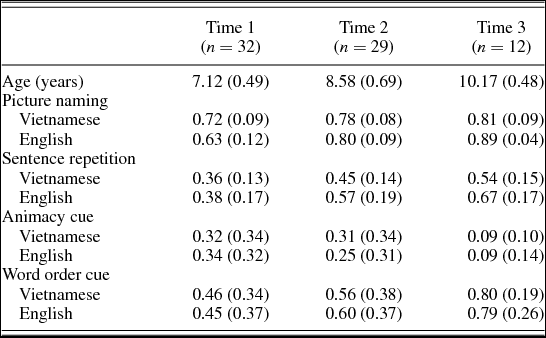
Table 1 displays descriptive statistics for the four dependent measures (word order and animacy cue use in Vietnamese and English) and the four measures of language proficiency (picture naming and sentence repetition in Vietnamese and English). Picture naming and sentence repetition increased for Vietnamese and English. Based on four separate univariate HLMs with each individual measure of language proficiency as the outcome variable and age as the predictor, picture naming increased at a rate of 2%/year in Vietnamese and 9%/year in English, while sentence repetition increased at a rate of 4%/year in Vietnamese and 11%/year in English. Findings indicate that picture naming and sentence repetition increased with age in both languages, albeit at a faster rate in English. As shown in Table 1, animacy cues generally decreased, and word order cues increased in each language. There was wide variability at each time point as demonstrated by standard deviations as large as the mean values in many cases. Standard deviations decreased, at least between Times 2 and 3, which may suggest decreased variability over time. However, decreased variability may also be related to the reduced sample size at Time 3.
Descriptive statistics

Note: Cue use was calculated using eta coefficients (SScue/SStotal) for individual children in each language. Means (standard deviations) are displayed by time point or wave of data collection. However, statistical analysis is based on chronological age as the time variable, rather than wave of data collection.
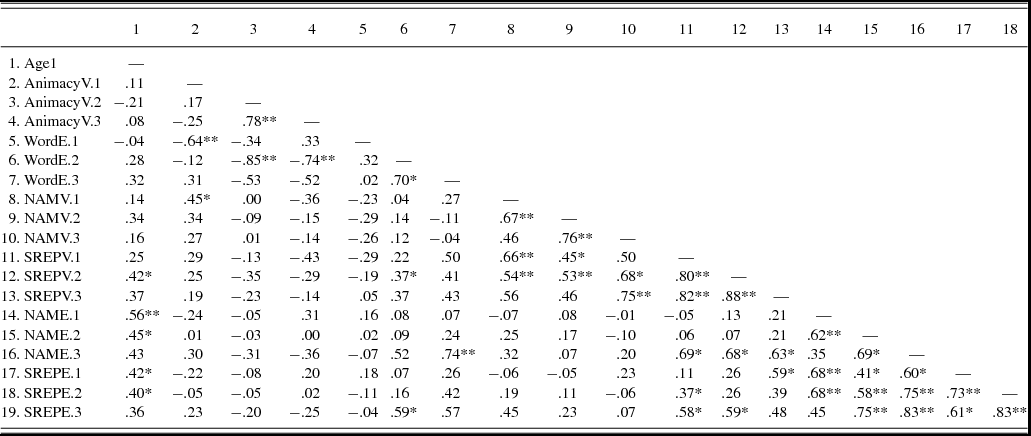
Table 2 displays bivariate correlations between study variables. Although the number of statistically significant associations was few, most likely limited by sample size constraints, there were positive associations between age and proficiency measures in each language and between proficiency measures (picture naming and sentence repetition) within each language. Regarding associations between language proficiency and cue use, there were relatively more associations within each language than between languages. Within Vietnamese, there was a positive association between picture naming and animacy use at Time 1 (r = .45, p < .01). Within English, there was a positive association between picture naming and word order cue use at Time 3 (r = .74, p < .01) and between sentence repetition at Time 3 and word order use at Time 2 (r = .59, p < .05). Between languages, there was one positive association between Vietnamese sentence repetition and English word order use at Time 2 (r = .37, p < .05).
Bivariate correlations among study variables
Note: Animacy, Animacy cue use; Word, word order cue use; SREP, sentence repetition; NAM, picture naming; V, Vietnamese; E, English; numbers indicate Time 1 (n = 32), Time 2 (n = 29), and Time 3 (n = 12).
*p < .05. **p < .01 (two tailed).
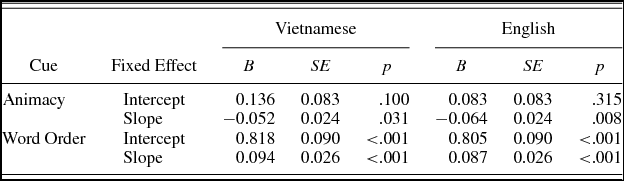
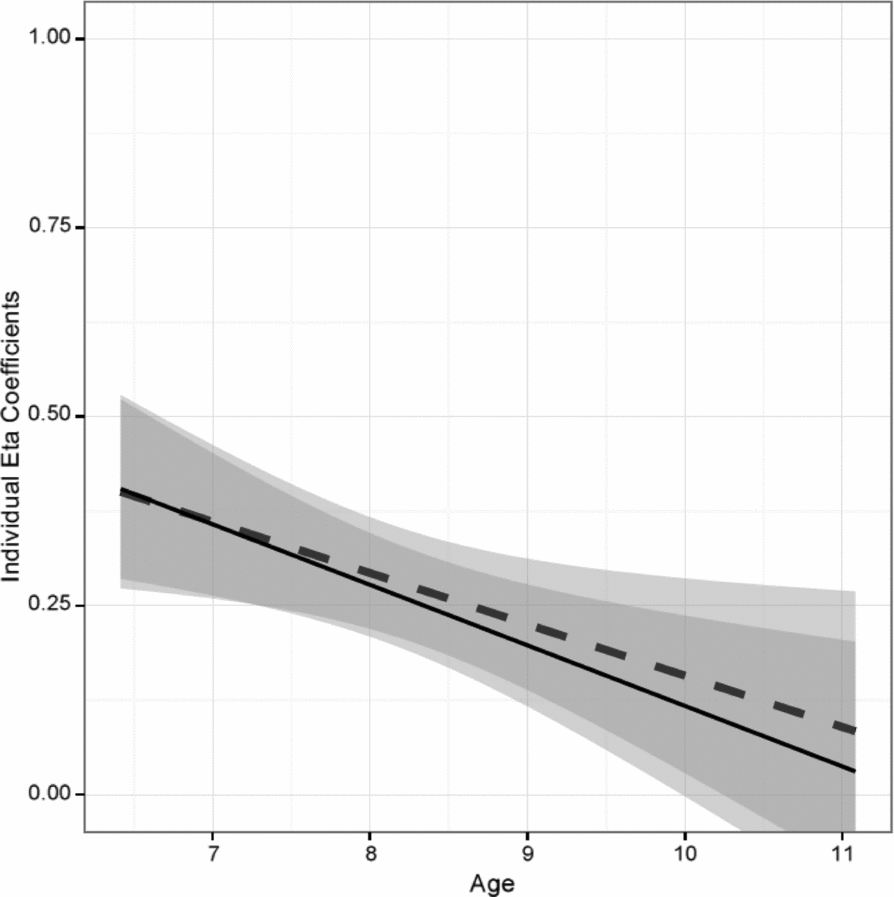
Table 3 displays fixed effects for animacy and word order cues in Vietnamese and English based on multivariate HLMs. Fixed slope estimates for animacy were negative in both languages. Animacy cue use decreased over time at a rate of approximately –0.05 η coefficient units/year, meaning that the percentage of variance in agent choice explained by reliance on animacy cues decreased by approximately 5% per year. Fixed intercept estimates for animacy cues were not statistically different from zero, indicating that children did not use animacy cues in either language by the end point. As shown in Table 3, fixed slope estimates for word order were positive, which indicated an increase in word order cue use over time at a rate of approximately +0.09 η coefficient units/year. Fixed intercept estimates for word order were over 0.80, suggesting almost exclusive use of word order cues by children's end point. Based on reduced and full model comparisons using analytical LRTs, there were no differences between the two languages on fixed intercepts or fixed slopes. This finding suggests that bilingual children continue to use an amalgamation of cues to interpret meaning in both languages. Figure 1 illustrates overlapping trajectories for Vietnamese and English and the downward slope for animacy cue use.
Fixed effects for animacy and word order cues across languages
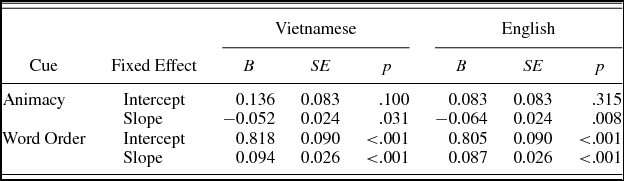
Note: There were no statistical differences between Vietnamese and English in fixed intercept and slope estimates. Age was centered on the oldest age (years) for intercept estimates to correspond to end-point performance.
Animacy cue use over time based on a multivariate hierarchical linear model with two outcome variables (Vietnamese and English). Age displayed in years. Vietnamese is represented by the dashed line. English is represented by the solid line. The standard error is shaded in gray.
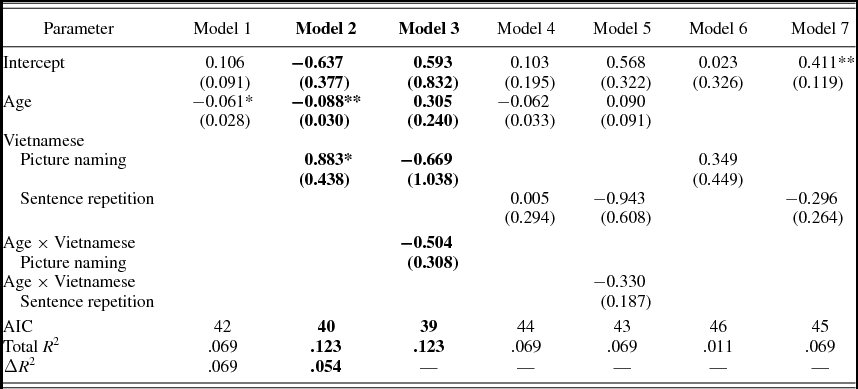
Table 4 displays a comparison of models that include time-varying predictors of animacy cue use in Vietnamese. The best fitting models were Models 2 and 3, as indicated by the smallest AIC and greatest amount of variance accounted for. Of the two models, Model 2 may be considered a better model than Model 3 for parsimony, because it excludes the nonsignificant interaction between age and Vietnamese picture naming. Model 2 accounted for 12% of the total variance in animacy cue use in Vietnamese. Both age and Vietnamese vocabulary were significant predictors. In contrast, Vietnamese sentence repetition was not a significant predictor of animacy cue use in Vietnamese. A comparison of the fixed effects estimates for age (–0.09) and Vietnamese picture naming (0.88) in Model 2 indicates that language proficiency (as measured by picture naming) played a larger role in predicting animacy use in Vietnamese.
Fixed effects estimates for models of the predictors of animacy cue use in Vietnamese
Note: Fixed effects estimates (SE) are displayed. Age was centered on the oldest age. AIC, Akaike information criterion.
*p < .05. **p < .01. ***p < .001.
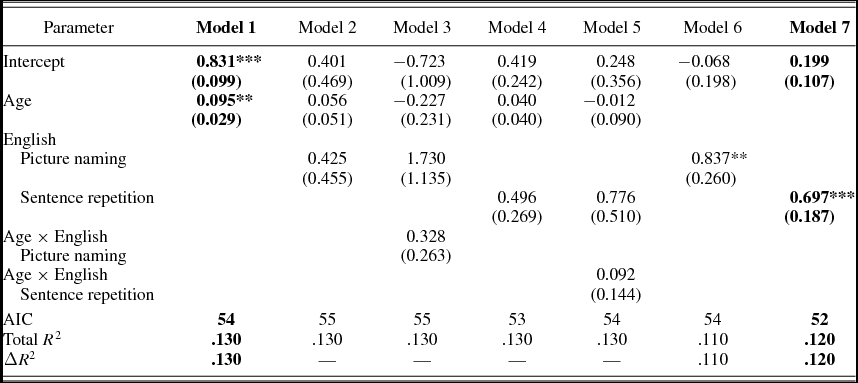
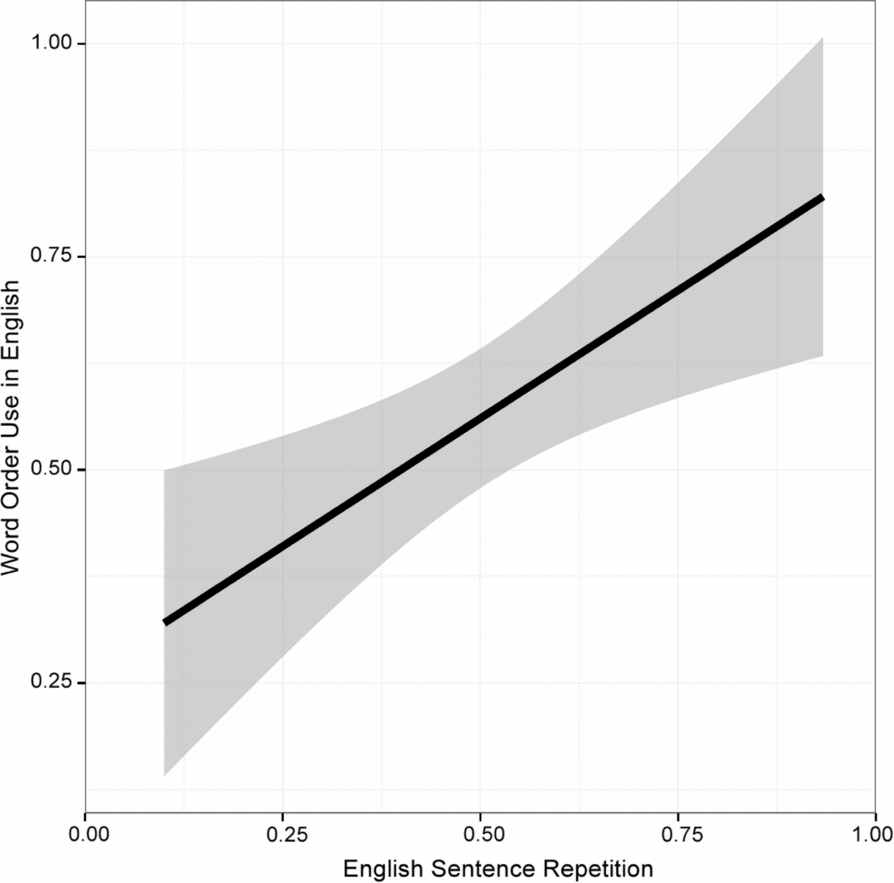
Table 5 displays the model comparison for word order cue use in English. The best fitting models were Model 1 and Model 7. Of the two models, Model 7 may be considered a better model as indicated by the lowest AIC. Model 7 accounted for 12% of total variance and included English sentence repetition as the time-varying predictor. Model 1, which included only age, accounted for a slightly larger proportion of variance (13%) but had a higher AIC. Although not the best fitting model, Model 4 compares the relative strength of age (0.040) and English sentence repetition (0.496); similar to Vietnamese models, language proficiency (as measured by sentence repetition) seemed to play a larger role than age in predicting linguistic cue use. Figure 2 illustrates the positive longitudinal association between English sentence repetition and word order cue use in English.
Fixed effects estimates for models of the predictors of word order cue use in English
Note: Fixed effects estimates (SE) are displayed. Age was centered on the oldest age (years). AIC, Akaike information criterion.
*p < .05. **p < .01. ***p < .001.
Longitudinal association between English sentence repetition and word order cue use in English. See Table 4 for fixed effects estimates for Model 7.
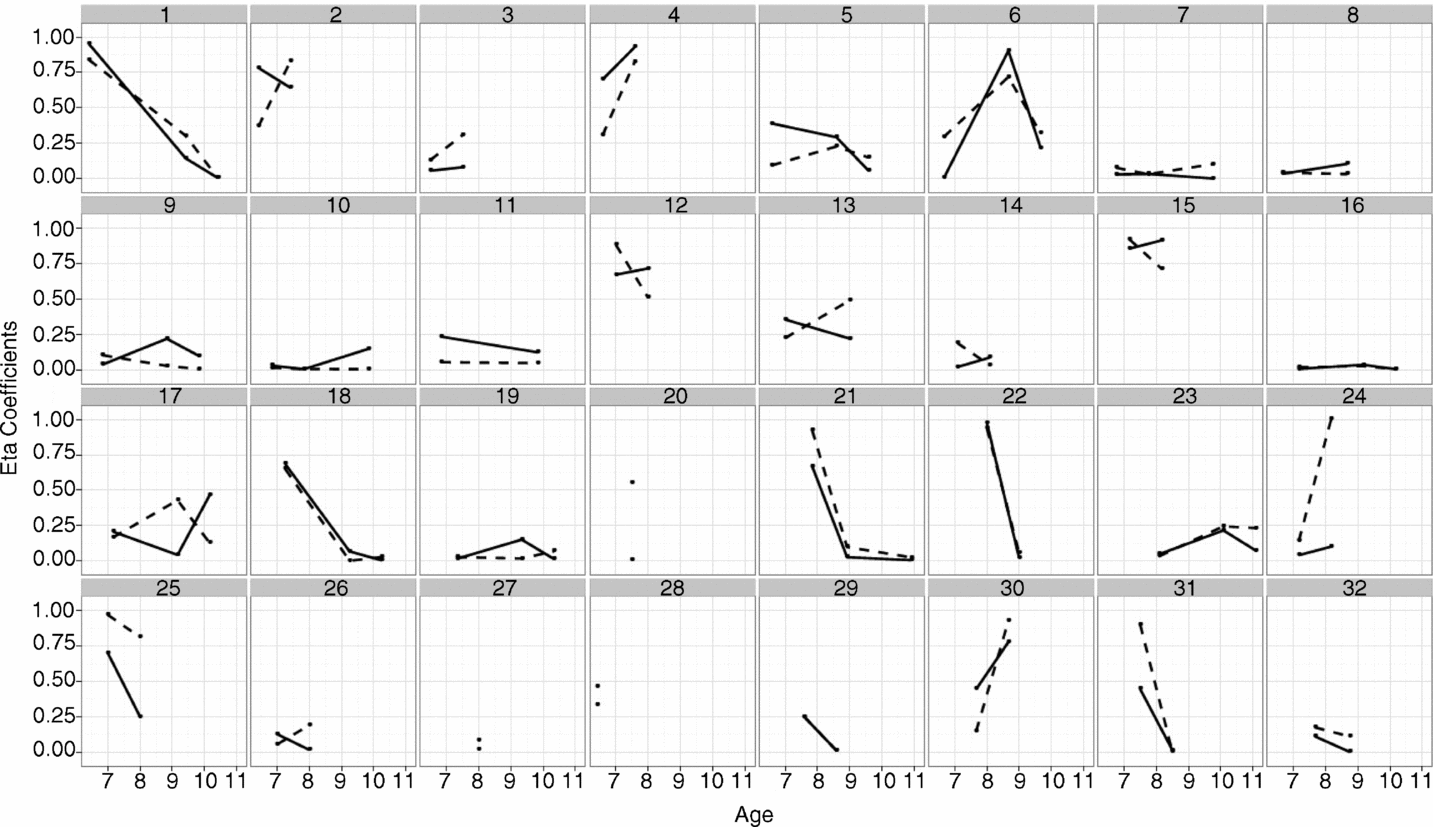
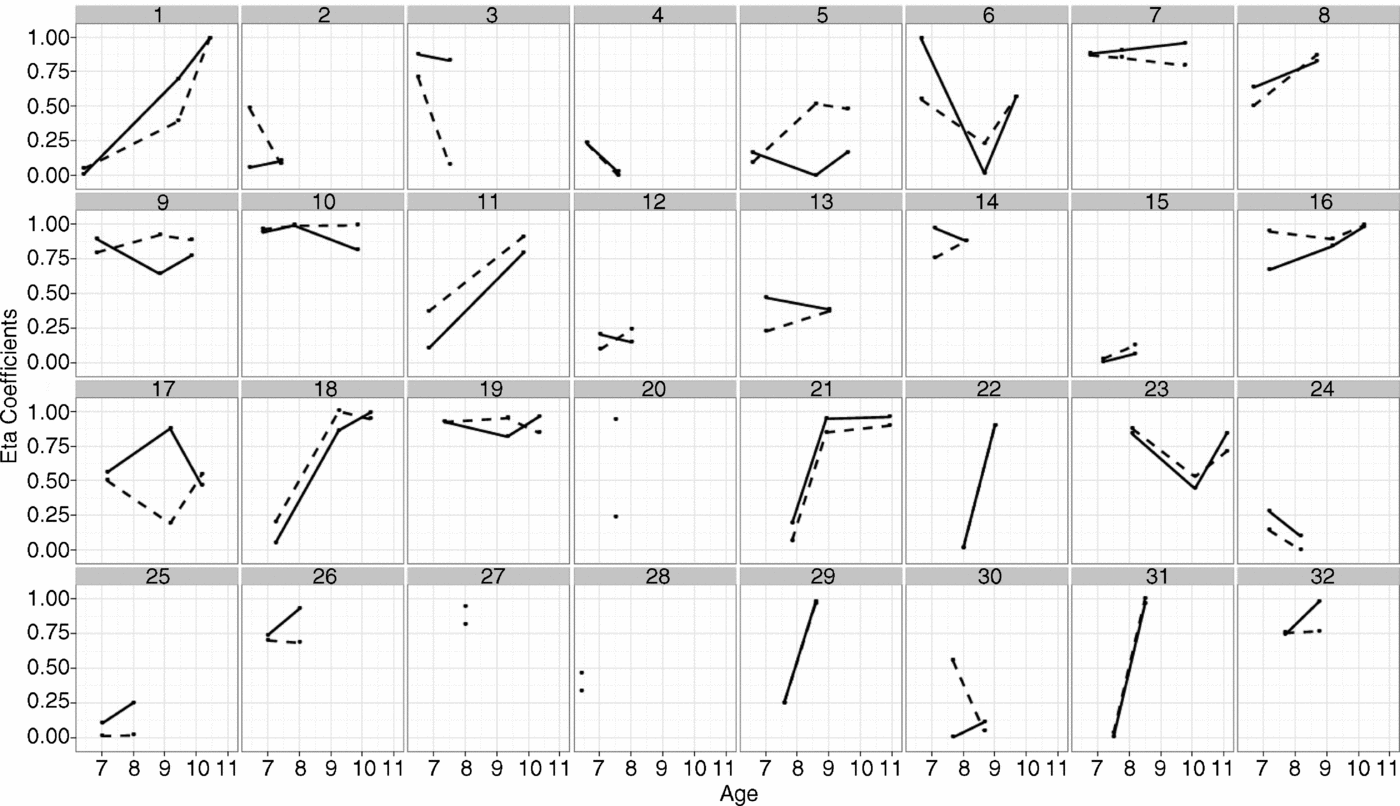
In order to analyze individual variation, we visually examined individual participant trajectories of the use of animacy cues (Figure 3) and word order cues (Figure 4) in Vietnamese and English. Overall, individual patterns were consistent with the group pattern of decreased use of animacy cues and increased use of word order cues. The majority of participants (19/32, or 59%) showed either consistently low levels of animacy cue use (0.25 or less) in both languages (Participants 7, 8, 9, 10, 11, 14, 16, 19, 23, 26, 27, 29, and 32) or declines in animacy cue use in both languages over time (Participants 1, 5, 18, 21, 22, and 31). Similarly, the majority of participants (17/32, or 53%) showed either consistently high levels of word order cue use (0.75 or greater) in both languages (Participants 7, 9, 10, 14, 19, 26, 27, and 32) or increased reliance on word order cues over time (Participants 1, 8, 11, 16, 18, 21, 22, 29, and 31). However, there were individual participants who did not follow group-level patterns. As shown in Figure 3, 6 participants (19%) showed strong reliance on animacy cues in Vietnamese (0.75 or greater) at their last time point (Participants 2, 4, 15, 24, 25, and 30), of which 3 participants showed strong reliance on animacy cues in English as well (Participants 4, 15, and 30). As shown in Figure 4, 7 participants (22%) showed low levels of word order cue use (0.25 or less) in both languages by their last time point (Participants 2, 4, 12, 15, 24, 25, and 30). Finally, while most participants showed patterns of amalgamation, there were 4 (13%) participants who showed patterns of differentiation: 3 participants showed relatively greater reliance on word order cues in English and animacy cue use in Vietnamese (Participants 3, 24, and 25; see Figures 3 and 4); and 1 participant (Participant 5) showed slight differentiation with more word order cue use in Vietnamese than in English (see Figure 4).Footnote 2
Individual trajectories of animacy cue use in Vietnamese (dashed line) and English (solid line). Performance at Time 1 was previously reported for a subset of participants in Pham and Kohnert (Reference Pham and Kohnert2010) for IDs 1 – 23.
Individual trajectories of word order cue use in Vietnamese (dashed line) and English (solid line). Performance at Time 1 was previously reported for a subset of participants in Pham and Kohnert (Reference Pham and Kohnert2010) for IDs 1 – 23.
DISCUSSION
The purpose of this study was to examine changes over time in sentence interpretation by typically developing Vietnamese–English bilingual children. We examined shifts in cue strength and cue-use patterns within the early school years, as well as the relationship between language proficiency and cue strength.
Changes in cue strength over time
We considered how the relative strength of word order and animacy cues shifts over time in Vietnamese and English at the group level. In both languages, there is a clear shift toward increased reliance on word order and decreased reliance on animacy. At the first time point, animacy cues played a significant role in sentence interpretation, with approximately one-third of the variance in performance explained by animacy. By the oldest ages included in the study, children were relying on word order cues to interpret meaning in both Vietnamese and English over 80% of the time. In contrast, they relied on animacy cues less than 10% of the time, a rate not statistically different from zero.
The shift to reliance on word order cues is consistent with the empirical literature demonstrating a shift to L2 dominance for school-age sequential bilinguals (Jia et al., Reference Jia, Kohnert, Collado and Aquino-Garcia2006; Kohnert et al., Reference Kohnert, Bates and Hernandez1999; Pham & Kohnert, Reference Pham and Kohnert2014; Squires et al., Reference Squires, Lugo-Neris, Peña, Bedore, Bohman and Gillam2014), perhaps particularly in language processing tasks. Within the unified competition model, cue reliability in general and conflict reliability in particular determine final cue strength in adulthood. Most sentences in the sentence interpretation task do not involve competition, in which case animacy and word order cues function together. The finding that word order cues win in competition cases is consistent with the theoretical model. Children in this study are using English (L2) more than Vietnamese (L1) in their daily lives. They begin to access their L2 more quickly than their L1, and thus it is to be expected that L2 cues will be more readily accessible as well.
Increasing reliance on English cues, however, should not be interpreted as evidence that the sequential bilingual children studied here become equivalent to monolingual English-speaking children by the oldest ages in the study. The sentence interpretation task deliberately creates competition between cues in order to reveal their relative strength; children are essentially forced to make a choice between animacy and word order in some contexts (e.g., in assigning agency to “The balloon pulls the monkey”). In typical contexts of language use, there is not necessarily a direct trade-off between two languages, and children can continue to demonstrate growth in both. The measures of proficiency included here show exactly that pattern: children continue to improve on Vietnamese sentence repetition and vocabulary tasks over time, even as they shift toward exclusive reliance on word order cues.
Relations between language proficiency and sentence interpretation
We next considered whether measures of L1 and L2 proficiency could predict sentence interpretation performance. Results supported a significant relationship between language proficiency and linguistic cue use both in Vietnamese and in English. As predicted, Vietnamese proficiency predicts the use of animacy cues, and English proficiency predicts the use of word order cues. Furthermore, our predictions regarding the relationship between the type of proficiency measure and the type of cue were borne out. A lexical-level measure of proficiency (picture naming) predicts use of a lexical cue, animacy; a sentence-level measure of proficiency (sentence repetition) predicts use of a sentence-level cue, word order.
However, we note that English picture naming also significantly predicted use of word order cues (albeit not as strongly as our sentence-level measure of proficiency), whereas the converse is not true: Vietnamese sentence repetition does not strongly predict use of animacy cues. The explanation for these patterns lies in the very strong relationship between overall English proficiency and age. Both sentence repetition and vocabulary performance in English grew rapidly over time, and including age in models eliminated L2 proficiency effects. In contrast, Vietnamese proficiency increased slowly over time (see also Pham & Kohnert, Reference Pham and Kohnert2014). The differences in growth rates between the languages result in the expected shift to L2 dominance and reliance on word order cues.
Amalgamation versus differentiation
Finally, we examined whether bilingual children would continue to use an amalgamation of word order and animacy cues in both of their languages over time. Our results show that this was the case. At the group level, reliance on word order and on animacy was nearly identical in both languages across all three time points. The result is consistent with initial performance for this group of children (Pham & Kohnert, Reference Pham and Kohnert2010) as well as with studies of proficient bilingual adults (Hernandez et al., Reference Hernandez, Bates and Avila1994; Liu et al., Reference Liu, Bates and Li1992). At the group level, children in the present study showed patterns of amalgamation and relied nearly exclusively on word order cues rather than on a combination of word order and animacy cues by the oldest ages. The finding that children used the same cue-use pattern to interpret meaning in Vietnamese and English underscores their “in-between” status (Hernandez et al., Reference Hernandez, Bates and Avila1994); in other words, these bilinguals process information differently than monolinguals of either language would (Grosjean, Reference Grosjean1989). It was noted, however, that at the individual level, there was a small but notable number of participants (4/32, or 13%) who showed differentiation patterns, namely, differences in cue use between their two languages. Individual variation has been said to be the hallmark of child bilingualism (Kohnert, 2010), and our data using sentence interpretation tasks underscore the complexity of cognitive and social factors inherent in sequential bilingual learners (MacWhinney, Reference MacWhinney, Kroll and De Groot2004).
Our interpretation of the patterns seen here is limited to some extent by the lack of existing literature on sentence interpretation in Vietnamese. To our knowledge, there are no studies of monolingual speakers of Vietnamese. Monolingual speakers of Chinese, a typologically similar language to Vietnamese, rely heavily on animacy to interpret sentences (Su, Reference Su2001). We have assumed here that monolingual speakers of Vietnamese would similarly rely on animacy. In support of this assumption, animacy was a significant cue for participants at the first time point (Pham & Kohnert, Reference Pham and Kohnert2010). However, further study is needed to verify the performance of Vietnamese speakers on sentence interpretation tasks. Studies testing the unified competition model among monolingual adult Vietnamese speakers would help to confirm similarities and differences between Chinese and Vietnamese speakers on the role of animacy in sentence interpretation.
Concluding remarks
The present study found a shift toward exclusive use of word order cues among sequential bilingual Vietnamese–English children who initially relied on a combination of word order and animcy cues to interpret meaning in both languages. The shift in cue strength occurred alongside the overall shift toward L2 dominance during the early school years for children who speak a minority L1 and majority L2. It is notable that despite the rapid growth of the L2 and the shift toward exclusive use of L2 sentence interpretation cues, children did continue to increase their L1 proficiency over time. Participants here appear to be developing skill in two languages (at least in terms of their picture naming and sentence repetition skills) while simultaneously shifting their language processing strategies to match the majority language of the surrounding community. On a more general level, children learn to “think” in the majority language but do not lose their ability to communicate in their home language. These linguistic traits may be part of an overall bilingual identity, which has been found to be beneficial for psychosocial development and academic achievement among immigrant youth (Bankston & Zhou, Reference Bankston and Zhou1995; Phinney et al., Reference Phinney, Romero, Nava and Huang2001).
Participants in this study received Vietnamese language and literacy instruction as part of their English school programming (see also Pham & Kohnert, Reference Pham and Kohnert2014). Schooling in the minority language has been found to promote continued development of L1 alongside rapid gains in the majority L2 (Cobo-Lewis, Pearson, Eilers, & Umbel, Reference Cobo-Lewis, Pearson, Eilers, Umbel, Oller and Eilers2002; Rolstad, Mahoney, & Glass, Reference Rolstad, Mahoney and Glass2005; Wright et al., Reference Wright, Taylor and Macarthur2000). Cue-use patterns for bilingual children who do not have educational support for the minority L1 may be different than the findings presented here. Rapid gains in the L2 may coincide with a decline in L1 proficiency. We speculate that children without L1 schooling may show more rapid shifts toward exclusive word order reliance and L2 dominance while losing their communicative ability in the minority L1, though this possibility remains in need of empirical investigation.
Measures of sentence-level processing complement conventional measures of language proficiency (e.g., vocabulary) in investigating the dynamic profile of sequential bilingual learners. Here we found a nuanced balance between relative strength in L2 proficiency and linguistic cue use alongside increases in L1 proficiency. A follow-up question is how reliance on L2 cues affects later L1 proficiency. Liu et al. (Reference Liu, Bates and Li1992) examined sentence interpretation with adult bilingual speakers of Chinese and English and found that Chinese adults who learned English (L2) in childhood showed backward transfer, namely, the use of L2 cues to interpret meaning in the L1. Authors suggested that backward transfer may have been a sign of L1 loss. However, the pattern of backward transfer was positively correlated with self-reported English skill and unrelated to Chinese skill (Liu et al., Reference Liu, Bates and Li1992). If backward transfer is not related to L1 skill, this cue-use pattern may not necessarily be detrimental to the L1 but rather a characteristic of sequential bilingual learners. That is, it may be possible for bilinguals who speak a minority L1 and majority L2 to maintain high L1 proficiency while relying heavily on L2 cues. Future studies that test this hypothesis can examine whether there are “many roads to Rome,” namely, whether sequential bilinguals can maintain strong communicative ability in their L1 while processing sentences using L2 cues.
Example stimuli in English and Vietnamese
ACKNOWLEDGMENTS
Data collection was supported by the National Institute of Child Health and Human Development (NICHD F31HD055113; Principal Investigator, G.P.). We acknowledge Kathryn Kohnert, Edward Carney, and Hai Anh Nguyen; the children and families who participated in this study; and research assistants Tien Pham, Amelia Medina, Kimson Nguyen, Irene Duong, Kelann Lobitz, and Bao Dang.