


Introduction
Procrastination, a behaviour characterized by intentional inactivity, can have deleterious effects on academic and work performance, relationships and mental well-being (Stöber and Joorman, Reference Stöber and Joorman2001). Cognitive therapy approaches to procrastination have focused on the presence of irrational fears and self-criticism (Ellis and Knaus, Reference Ellis, Knaus, Ferrari, Johnson and McCown1977). Procrastinators are thought to delay or postpone action primarily because they doubt their own ability to complete a task, and they fear possible negative consequences of failing to adequately complete a task (Shoham-Saloman, Avner and Neeman, Reference Shoham-Saloman, Avner and Neeman1989).
Although cognitive therapy approaches explain the crucial role of negative beliefs about the self in the maintenance of procrastination, they do not specify the mechanisms by which beliefs affect or control the cognitive processing of procrastinators. The Self-Regulatory Executive Function (S-REF; Wells and Matthews, Reference Wells and Matthews1994) theory was the first to conceptualize multiple metacognitive factors as control components of information processing that affect the development and persistence of psychological disorders. In this theory, psychological disturbance is viewed as being maintained by a combination of maladaptive coping strategies (e.g. worry and rumination), threat monitoring, avoidance and thought suppression, which fail to modify dysfunctional self-beliefs and increase the accessibility of negative information about the self. This array of factors constitutes a cognitive-attentional syndrome (CAS; Wells, Reference Wells2000). The CAS, which is activated in problematic situations, is derived from a person's set of metacognitive beliefs. Metacognitive beliefs refer to the information individuals hold about their own cognition and about coping strategies that impact on it (Wells, Reference Wells2000). Examples of metacognitive beliefs may include: “Worrying will help me cope” or “My thoughts are out of control”. The S-REF theory has led to the development of disorder-specific models of general anxiety disorder, social phobia, obsessions, PTSD, and depression (Wells, Reference Wells2000).
In recent work, a relationship between procrastination and particular metacognitive knowledge was observed in a non-clinical population (Spada, Hiou and Nikčević, 2006). Evidence was found of: (1) a positive association between metacognitive beliefs about cognitive confidence (i.e. appraisals of one's own cognitive processes, e.g. memory) and behavioural procrastination that is independent of negative emotions; and (2) a positive association between positive metacognitive beliefs about worry and decisional procrastination that is independent of negative emotions.
The study by Spada, Hiou and Nikčević (2006) utilised the short form of the Metacognitions Questionnaire (MCQ-30; Wells and Cartwright-Hatton, Reference Wells and Cartwright-Hatton2004) which was developed to assess general metacognitions related to psychological disturbance. The findings of this study suggested that a more detailed investigation into the metacognitive aspects of procrastination was warranted. We hypothesized that procrastination may be a maladaptive strategy similar to worry and rumination and thus a central part of the CAS. In line with this hypothesis, we predicted that procrastinators would possess both positive and negative metacognitive beliefs about procrastination. Our aim, in the current study, was to identify the presence and content of such beliefs, examine the nature of the goal of procrastination, and investigate the focus of attention of individuals when procrastinating.
Method
Participants
Twelve participants (6 men and 6 women) were recruited after responding to a flyer placed in the Royal Free Hospital, London, and London Metropolitan University, asking for individuals who considered themselves to be chronic procrastinators. Inclusion criteria were: (1) 18 years of age or above; (2) consenting to the study; (3) understanding spoken and written English; (4) absence of a past diagnosis of either Axis 1 or Axis 2 disorders; (5) no history of having received CBT treatment; and (6) a score on Lay's General Procrastination Scale (GPS; Lay, Reference Lay1986) and Mann's Decisional Procrastination Scale (DPS; Mann, Reference Mann, Ferrari, Johnson and McCown1982) that fell in the top quartile of scores obtained in the Spada et al. (Reference Spada, Hiou and Nikčević2006) study.
The mean DPS and GPS sample scores were respectively 19.0 (SD = 1.9; range = 17–22) and 81.8 (SD = 8.8; range = 68–93). The mean age of the sample was 31.8 years (SD = 7.2 years) and ranged from 25 to 53 years.
Materials
The interview was based on the metacognitive profiling template developed by Wells and Matthews (Reference Wells and Matthews1994). The purpose of metacognitive profiling is to identify problematic processing routines and metacognitions that are activated under conditions of stress. For present purposes, metacognitive components of cognition can be determined by particular questions used in tracing recent episodes of procrastination. In this study, metacognitive profiling was used to identify positive and negative metacognitive beliefs pertaining to procrastination, examine goal of procrastination, and investigate the focus of attention when procrastinating.
Procedure
Following completion of the DPS and GPS, and analysis of these scales, a semi-structured interview was conducted with each participant. All participants were interviewed using the metacognitive profiling template (Wells, Reference Wells2000) adapted to focus specifically on cognitive experiences associated with procrastination. The interview lasted approximately 30 minutes. The interview schedule attempted to elicit data from the following three areas:
Metacognitive beliefs and appraisals about procrastination
In order to examine positive metacognitive beliefs participants were asked to identify the perceived advantages of procrastinating on their thoughts and sensations, and whether they viewed any disadvantages of giving up the process. Negative metacognitive beliefs were elicited by asking participants about the possible disadvantages of procrastination on thoughts and sensations, and to consider any advantages of giving up procrastination.
Goal of procrastination
Participants were asked questions that sought to identify what was the goal of procrastination and how they knew when this goal had been achieved.
Attentional focus during procrastination
In this section of the interview, participants were asked what the focus of their attention was when they were procrastinating, and what the advantages and disadvantages were of using their attention in this manner.
Results
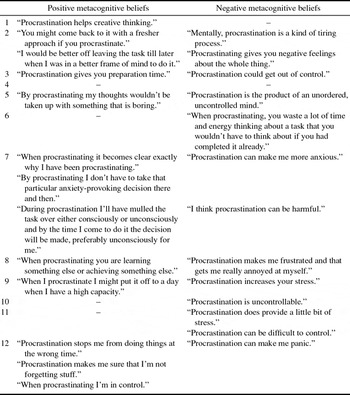
All participants were able to recollect a recent episode of procrastination. Eight participants endorsed positive metacognitive beliefs, and ten endorsed negative metacognitive beliefs about procrastination. Positive metacognitive beliefs concerned the usefulness of procrastination in improving cognitive performance (endorsed by eight participants). Negative metacognitive beliefs concerned the uncontrollability of procrastination (endorsed by four participants), its negative impact on emotional states (endorsed by six participants), harm (endorsed by one participant), and wasting time (endorsed by one participant). The content of each participant's metacognitive beliefs are presented in Table 1.
Participants’ positive and negative metacognitive beliefs about procrastination (n = 12)

In response to the question concerning the goal of procrastination, five participants reported using procrastination as a strategy for enhancing cognitive performance and seven for reducing negative affect ahead of task initiation. In response to the question concerning how they knew if their goal of procrastination had been achieved, five participants reported that they did not know how to determine this, and seven reported that an improvement in mood would signal the goal had been achieved.
Participants reported that the principal object of their attentional focus when procrastinating was their emotional state. All participants were able to identify disadvantages to their attentional strategies, whilst nine participants described perceived advantages. The disadvantages concerned the perseveration of procrastination because their attentional strategy did not lead to task initiation or completion, whilst the advantages often seemed directly contradictory to the disadvantages, insofar as they were associated with attaining an appropriate state of mind for initiating task performance.
Discussion
The findings of this study in combination with those of Spada et al. (Reference Spada, Hiou and Nikčević2006) suggest that metacognitions may indeed play a role in procrastination. The results are consistent with Wells and Matthews’ (1994) S-REF theory and align themselves to previous findings identifying positive and negative metacognitive beliefs in other disorders (Wells, Reference Wells2000).
Positive metacognitive beliefs concerned the usefulness of procrastination in improving cognitive performance. Such beliefs may be involved in the initiation of procrastinatory behaviour. Negative metacognitive beliefs concerned the uncontrollability of procrastination, its negative impact on emotional states, harm, and wasting time. These beliefs may play a role in propagating negative mood once procrastination has started and possibly lead to an escalation of procrastinatory behaviour. This would be consistent with the S-REF theory (Wells and Matthews, Reference Wells and Matthews1994), which suggests that psychological disturbance occurs when coping strategies (such as procrastination) become perseverative.
Participants reported that the principal goal of procrastination was to enhance cognitive performance and reduce negative affect ahead of task initiation. Participants reported that they either did not know how to determine if they had achieved their goal in procrastinating or that an improvement in mood would signal the goal had been achieved. During an episode of procrastination, many participants reported focusing on their feelings. This strategy is likely to lead to an increase in negative affect and consequently a perpetuation of procrastination. Indeed, it is difficult to see how procrastination, which might lead to task failure, would reliably improve mood. Internally attending to mood appears to be an unhelpful strategy for signalling the cessation or continuation of procrastination. In this respect procrastination shows some similarity with the process of rumination in depression.
A limitation of this study lies in the possible overlap between the reported attentional strategies and the goal of procrastination. Some participants reported that the focus of their attention during an episode of procrastination was on anything other than the immediate task. This could be viewed as a coping strategy to deal with their procrastinatory behaviour, or it could be construed as a form of cognitive avoidance that represents an aspect of procrastination itself. Future studies investigating the attentional strategies involved in procrastination will require a more detailed operationalization of both attentional and coping strategies to address this limitation.
The results of this study are clearly preliminary and are based on a small sample of individuals reporting problematic procrastinatory behaviour. The interview was retrospective; hence participants’ responses may merely reflect rationalizations of procrastinatory behaviour rather than beliefs and cognitive processes that contribute to procrastination. In addition, the sample was a heterogeneous group whose members were selected on the basis of procrastination being their primary presenting problem. Future studies could aim to control more formally for the effects of comorbidity.
Despite these limitations, we believe the present findings provide preliminary evidence that metacognitions may indeed play a role in procrastination.



Comments
No Comments have been published for this article.