Introduction
Adolescent pregnancy (AP) represents a significant public health issue with substantial societal burden and considerable deleterious consequences that are multifaceted and multigenerational (Centers for Disease Control and Prevention [CDC], 2017; Coyne & D’Onofrio, Reference Coyne and D’Onofrio2012). Indeed, AP is associated with adverse social, psychological, physical, educational, and economic outcomes that persist into adulthood (Patel & Sen, Reference Patel and Sen2012; Russotti et al., Reference Russotti, Rogosch, Handley, Douthit, Marquis and Cicchetti2020; Woodward et al., Reference Woodward, Fergusson and Horwood2001). Moreover, the offspring of adolescent mothers exhibit greater risk for a litany of negative developmental outcomes, such as adverse birth outcomes, maltreatment exposure, and greater levels of internalizing and externalizing psychopathology symptoms (Cederbaum et al., Reference Cederbaum, Putnam-Hornstein, King, Gilbert and Needell2013; Putnam-Hornstein & Needell, Reference Putnam-Hornstein and Needell2011; Russotti et al., Reference Russotti, Rogosch, Handley, Douthit, Marquis and Cicchetti2020), and these effects remain after adjusting for poverty and family-level factors (e.g., household composition).
AP and birth rates have recently declined in the U.S. due in part to effective prevention programs (Kost et al., Reference Kost, Maddow-Zimet and Arpaia2017). Yet, rates remain substantially higher than in other Western industrialized countries and more closely resemble rates in less developed nations (Sedgh et al., Reference Sedgh, Finer, Bankole, Eilers and Singh2015). Moreover, there is some indication that U.S. rates have not declined within more vulnerable populations, such that risks of AP and birth are increasingly concentrated among girls from difficult social environments (King et al., Reference King, Putnam-Hornstein, Cederbaum and Needell2014). Thus, prevention efforts have shifted towards targeted preventions that identify individuals at high risk for AP and address the unique mechanisms that place these vulnerable adolescents on developmental risk trajectories. This approach has the potential to optimize effective policies and interventions.
Child maltreatment
Child maltreatment (CM) has been identified as an especially robust and reliable predictor of AP using a range of methodological approaches, including prospective cohort designs that also account for several confounding factors (e.g., household composition, poverty; Abajobir et al., Reference Abajobir, Kisely, Williams, Strathearn and Najman2018; Garwood et al., Reference Garwood, Gerassi, Jonson-Reid, Plax and Drake2015; Negriff et al., Reference Negriff, Schneiderman and Trickett2015; Noll & Shenk, Reference Noll and Shenk2013; Noll et al., 2018), population-based studies (Putnam-Hornstein et al., Reference Putnam-Hornstein, Cederbaum, King, Cleveland and Needell2013), and comprehensive meta-analyses (Madigan et al., Reference Madigan, Wade, Tarabulsy, Jenkins and Shouldice2014; Noll et al., Reference Noll, Shenk and Putnam2009). The magnitude of risk conferred by maltreatment is substantial, with maltreated females twice as likely to experience adolescent childbirth (20% birth rate) compared to demographically matched comparison females (∼9%; Noll & Shenk, Reference Noll and Shenk2013).
CM is a broad term that encompasses several forms of exposure, including neglect and physical, sexual, and emotional abuse, each of which may engender different risk patterns. There is evidence that the strength of the association between CM and AP may vary as a function of CM subtype, with studies evincing strong support for the unique effects of sexual abuse (Madigan et al., Reference Madigan, Wade, Tarabulsy, Jenkins and Shouldice2014; Noll et al., Reference Noll, Shenk and Putnam2009, 2018; Senn & Carey, Reference Senn and Carey2010). However, there is equivocal evidence that risk for AP is also elevated by other forms of CM, such as neglect (Abajobir et al., Reference Abajobir, Kisely, Williams, Strathearn and Najman2018; Negriff et al., Reference Negriff, Schneiderman and Trickett2015), physical abuse (Madigan et al., Reference Madigan, Wade, Tarabulsy, Jenkins and Shouldice2014), and emotional abuse (Thibodeau et al., Reference Thibodeau, Lavoie, Hébert and Blais2017). Studies that can disentangle the unique effects of various CM subtypes on AP will continue to advance this area of inquiry.
Explanatory mechanisms
Despite consistent evidence that CM is a direct risk for AP, there is limited and incomplete literature delineating the distinct mechanistic pathways linking CM exposure to AP. For example, Noll et al. (2018) found that CM directly affected AP risk, over-and-above the direct effects of other covariate and confounding variables; however, this study did not determine whether the direct effect of CM is transmitted through intermediate processes (i.e., mediation or indirect effects) – a primary aim of modern vulnerability factors research (Goldstein et al., 2021). Indeed, establishing a predictive link between a risk factor and an outcome merely represents the starting point for explanatory analysis (Cicchetti & Toth, Reference Cicchetti and Toth2016). A deeper understanding of the etiological pathways leading from CM to AP can signal potent avenues for intervention and be leveraged to strategically deliver developmentally timed interventions that attenuate pregnancy risk.
To address this gap, we have taken steps toward generating a comprehensive theoretical model that may help explain how CM may probabilistically eventuate in AP. Developmental psychopathology was employed as an organizing framework to build and propose the current model. Developmental psychopathology is an integrative discipline that can be applied to the understanding of causes, pathways, sequelae, and prevention/treatment of high-risk conditions and atypical developmental outcomes (Cicchetti & Handley, Reference Cicchetti and Handley2019; Cicchetti & Toth, Reference Cicchetti and Toth2016). The present study aimed to examine how the sequelae of a high-risk condition (i.e., CM) may eventuate in an atypical developmental outcome (precocious transition to pregnancy/childbirth), via multilevel pathways.
Because no comprehensive theoretical framework stipulating how CM potentiates AP currently exists, the selection of plausible mechanisms to include in the model was guided by: (a) hallmark principles of the developmental psychopathology framework; and (b) the extant evidence for variables that have been shown to be sequelae of CM and risk factors for AP. Consistent with the principle of equifinality (i.e., the same outcome may be reached from a variety of pathways; Cicchetti & Rogosch, Reference Cicchetti and Rogosch1996), we assumed that multiple pathways could explain how CM eventuates in AP. Moreover, given the developmental psychopathology assumption that risk pathways likely exist across multiple levels of the individual (Cicchetti & Toth, Reference Cicchetti and Toth2016), we employed a multilevel perspective to examine how aspects of socioemotional, cognitive, interpersonal, and biological functioning may mediate the association between CM and AP. Further, we attended to biopsychosocial processes that may be considered developmentally salient tasks for adolescents, such as pubertal transition, emergence of advanced cognitive functions, the initiation of sexual behavior, experimentation with drugs and alcohol, the development of reproductive beliefs and intentions, and the peak emergence of various psychosocial difficulties (e.g., depression). Guided by these developmental psychopathology principles, we then drew on the extant literature to identify specific mediating constructs that fit within our framework and were supported as consequences of CM and antecedents to AP. The following sections briefly review the evidence for the purported mechanistic candidates.
Substance use behavior
There is substantial evidence that CM is prognostic of substance use and abuse during adolescence (Cicchetti & Handley, Reference Cicchetti and Handley2019; Trickett et al., Reference Trickett, Negriff, Ji and Peckins2011). For instance, CM is associated with greater quantity and frequency of substance use, heavy polysubstance use, and earlier onset of problematic substance use (Cicchetti & Handley, Reference Cicchetti and Handley2019). There are several theoretical reasons for this association, including positive beliefs about the benefits of substances (e.g., tension-reducing expectancies); the deployment of maladaptive coping strategies (i.e., self-medication; Cicchetti & Handley, Reference Cicchetti and Handley2019; Hussong et al., Reference Hussong, Jones, Stein, Baucom and Boeding2011); and compromised developmental adaptations in the social and academic domains, which then cascade into problematic use (Rogosch et al., Reference Rogosch, Oshri and Cicchetti2010). Additionally, maltreated adolescents are more likely to face rejection from prosocial peers and gravitate towards and/or be accepted by more deviant, substance-using peers (Cicchetti & Toth, Reference Cicchetti and Toth2016; Trickett et al., Reference Trickett, Negriff, Ji and Peckins2011), and peer use represents a robust proximal risk factor for adolescent substance use (e.g., Marklein et al., Reference Marklein, Negriff and Dorn2009).
In turn, substance use can escalate the risk for AP (Chapman & Wu, Reference Chapman and Wu2013). Substance use may impede contraceptive precautions on a situational basis and/or increase one’s exposure to sexual coercion/sexual victimization (i.e., nonconsensual sex; Gunby et al., Reference Gunby, Carline, Bellis and Beynon2012), as sexually coercive perpetrators often prey on intoxicated individuals and use substances as a predatory strategy (Mellins et al., Reference Mellins, Walsh, Sarvet, Wall, Gilbert, Santelli, Thompson, Wilson, Khan, Benson, Bah, Kaufman, Reardon and Hirsch2017). Thus, elevated substance use represents a testable candidate for indirectly connecting CM to AP.
Sexual risk behaviors (SRBs)
CM is also associated with SRBs, which do not necessarily result in AP, but are frequently precursors to this outcome (Negriff, Reference Negriff2018; Noll et al., Reference Noll, Haralson, Butler and Shenk2011; Noll, Reference Noll2021; Trickett et al., Reference Trickett, Negriff, Ji and Peckins2011). Studies have shown that CM is associated with earlier sexual debut, a greater number of sexual partners, unprotected sex, inconsistent condom use, sexual intercourse while under the influence of substances, and increased risk for sexually transmitted infections (Abajobir et al., Reference Abajobir, Kisely, Williams, Strathearn and Najman2018; Negriff et al., Reference Negriff, Schneiderman and Trickett2015; Noll et al., Reference Noll, Haralson, Butler and Shenk2011; Oshri et al., Reference Oshri, Tubman and Burnette2012; Thibodeau et al., Reference Thibodeau, Lavoie, Hébert and Blais2017; Wilson & Widom, Reference Wilson and Widom2009). Further, CM may elevate risk for AP due to its influence on sexual decision-making. As they become sexually active, adolescent females are tasked with navigating a complex sexual milieu that may include unique challenges such as condom use negotiation, sexual communication, relationship control/decision-making dominance, and reproductive coercion.
For example, the effective use of common contraceptive preferences (e.g., male condom) requires that adolescents feel confident in correctly using the method and communicating their preferences and desires to their partner, which may be difficult for maltreated adolescents who have learned that their needs and wishes are inconsequential (Noll, Reference Noll2021). Adolescent females with abuse histories report more fears of condom negotiation (Brown et al., Reference Brown, Young, Sales, DiClemente, Rose and Wingood2014) and less efficacy in their use of condoms (i.e., “condom use efficacy”; Brown et al., Reference Brown, Young, Sales, DiClemente, Rose and Wingood2014; Hovsepian et al., Reference Hovsepian, Blais, Manseau, Otis and Girard2010; Kovensky et al., Reference Kovensky, Khurana, Guyer and Leve2021), which is related to inconsistent condom use and unintended pregnancy (Baele et al., Reference Baele, Dusseldorp and Maes2001; French & Holland, Reference French and Holland2013; Sales et al., Reference Sales, Milhausen, Wingood, DiClemente, Salazar and Crosby2008). Relatedly, adolescent females exposed to CM report less relationship control and power in sexual decision-making (Brown et al., Reference Brown, Young, Sales, DiClemente, Rose and Wingood2014; Wingood et al., Reference Wingood, DiClemente and Raj2000), experience greater difficulty refusing unwanted sex (Brown et al., Reference Brown, Young, Sales, DiClemente, Rose and Wingood2014), and report fears of violent or negative partner reactions in response to their attempts at healthy sexual communication (Raiford et al., Reference Raiford, DiClemente and Wingood2009). Maltreated females are also more likely to experience reproductive coercion within relationships, which is associated with unintended AP (Miller et al., Reference Miller, McCauley, Tancredi, Decker, Anderson and Silverman2014; PettyJohn et al., Reference PettyJohn, Reid, Miller, Bogen and McCauley2021). Reproductive coercion is defined as behavior intended to interfere with the autonomous sexual and reproductive decision-making of a woman (Grace & Anderson, Reference Grace and Anderson2018; Miller et al., Reference Miller, McCauley, Tancredi, Decker, Anderson and Silverman2014), including (a) interference with contraceptive use or birth control sabotage (e.g., lying about condom use, not disclosing a condom fell off; destroying birth control pills); (b) condom manipulation (e.g., breaking condoms; intentionally removing a condom during intercourse); and (c) pregnancy pressure and control of pregnancy outcomes.
Pregnancy desires and expectations
The constructs of pregnancy desire and expectancies may constitute another reasonable pathway from CM to AP. Although adolescent pregnancies are largely unplanned, a proportion (∼24%) of adolescent girls report a desire or intention to become pregnant (Sipsma et al., Reference Sipsma, Ickovics, Lewis, Ethier and Kershaw2011). Further, studies have found that pregnancy desires are predictive of subsequent pregnancy in adolescence (East et al., Reference East, Khoo and Reyes2006; Stevens-Simon et al., Reference Stevens-Simon, Sheeder, Beach and Harter2005), doubling the risk of AP (Sipsma et al., Reference Sipsma, Ickovics, Lewis, Ethier and Kershaw2011). Relatedly, pregnancy expectancies, such as expectations about the difficulty of pregnancy or an inability to discern the negative consequences of AP and parenthood, are also significantly associated with AP (East et al., Reference East, Khoo and Reyes2006; Stevens-Simon et al., Reference Stevens-Simon, Sheeder, Beach and Harter2005). Notably, maltreated adolescents may be especially vulnerable to experiencing enhanced pregnancy desire or distorted pregnancy expectations, as pregnancy/parenthood may be viewed by the adolescent as a potential healing opportunity to cope with emotional deprivation or interpersonal dysfunction present in their abusive settings (Aparicio et al., Reference Aparicio, Pecukonis and O’Neale2015). One study found that adolescent females with a history of maltreatment reported greater pregnancy desire and increased pregnancy intendedness, which were associated with higher rates of AP (Noll et al., Reference Noll, Horowitz, Bonanno, Trickett and Putnam2003).
Internalizing symptom
CM and AP may be linked through symptoms of internalizing disorders (e.g., depression). CM is associated with greater depression chronicity, severity, and duration (Humphreys et al., Reference Humphreys, LeMoult, Wear, Piersiak, Lee and Gotlib2020), and findings from one meta-analytic review suggest that over half of global depression can be attributed to CM (Li et al., Reference Li, D’arcy and Meng2016). In turn, depressive symptoms may increase the likelihood of AP (Mollborn & Morningstar, Reference Mollborn and Morningstar2009). For instance, adolescents who are experiencing elevated levels of apathy, hopelessness, and/or helplessness as a function of depression may be indifferent or apathetic about contraceptive use and pregnancy prevention. Moreover, adolescents who are depressed tend to exhibit diminished self-efficacy and an external locus of control (Benassi et al., Reference Benassi, Sweeney and Dufour1988; Ehrenberg et al., Reference Ehrenberg, Cox and Koopman1991), which have been shown to be associated with pregnancy risk (McIntyre et al., Reference McIntyre, Saudargas and Howard1991; Salazar et al., Reference Salazar, DiClemente, Wingood, Crosby, Harrington, Davies, Hook and Oh2004; Santelli et al., Reference Santelli, Kaiser, Hirsch, Radosh, Simkin and Middlestadt2004; Young et al., Reference Young, Turner, Denny and Young2004).
Similarly, CM is a potent risk factor for posttraumatic stress disorder (PTSD) and there is evidence that PTSD symptoms represent a pathway linking CM and AP (Thompson & Neilson, Reference Thompson and Neilson2014). For example, PTSD symptoms (e.g., intrusive cognitions, hyperarousal, dissociation, or depersonalization) may interfere with attentional processes during sexual encounters and impede an adolescent’s ability to attend to risk reduction details (e.g., condom use). Additionally, PTSD-related alterations in self-perception (e.g., lack of self-worth) and relationships (e.g., poor judgment of others’ motives/intentions) may increase involvement with older, exploitative, or hypersexual peers who pressure the adolescent into age-inappropriate sexual behaviors, and/or affect their ability to assertively communicate sexual preferences to partners (e.g., condom use negotiation) due to a learned belief that their needs and wishes are inconsequential.
Age at menarche
CM may also operate through psychobiological processes to influence AP risk, as research indicates that CM may instigate earlier pubertal onset for females (Noll et al., Reference Noll, Trickett, Long, Negriff, Susman, Shalev, Li and Putnam2017). The effects of maltreatment on puberty may be caused by the biological embedding of stress and disrupted neuroendocrine functioning that hastens the initiation of normative hormonal cascades and accelerates pubertal development (Noll et al., Reference Noll, Trickett, Long, Negriff, Susman, Shalev, Li and Putnam2017; Saxbe et al., Reference Saxbe, Negriff, Susman and Trickett2015). Specifically, maltreatment can downregulate the hypothalamic-pituitary-adrenal (HPA) axis, and the dampening of the HPA axis can enact the progression of a hormonal cascade, via the hypothalamic-pituitary-gonadal axis, that initiates pubertal onset (Ruttle et al., Reference Ruttle, Shirtcliff, Armstrong, Klein and Essex2015; Saxbe et al., Reference Saxbe, Negriff, Susman and Trickett2015).
There is also evidence that earlier pubertal onset is a transdiagnostic risk factor for maladaptive psychosocial outcomes more generally (McLaughlin et al., Reference McLaughlin, Colich, Rodman and Weissman2020), and AP, specifically, with multiple psychosocial and biological explanations that may account for this association (e.g., Mendle et al., Reference Mendle, Turkheimer and Emery2007). For example, the early timing or developmental readiness hypothesis (Stattin & Magnusson, Reference Stattin and Magnusson1990) proposes that, when developmentally discordant with psychosocial maturation, early physical maturation may leave some individuals more vulnerable to AP (e.g., Kaltiala-Heino et al., Reference Kaltiala-Heino, Kosunen and Rimpelä2003). Specifically, due to their physical maturity, early-maturing females may attract older male peers who may then socially pressure them to engage in sexual behaviors that are normative for those older peers but are age-inappropriate for younger adolescents (Mendle et al., Reference Mendle, Turkheimer and Emery2007). Biological theories suggest that pubertal maturation triggers hormonal changes that spark and/or intensify the adolescent’s sexual desire and motivation, resulting in the adolescent actively pursuing and initiating sexual activity at a younger age (Negriff et al., Reference Negriff, Susman and Trickett2011).
Cognitive dysregulation
Impaired executive functioning (e.g., attentional focus, inhibitory control, planning) represents another possible pathway by which maltreatment confers risk for AP. First, the severe and chronic stress of CM can interfere with optimal brain development and impair cortical functioning (Cicchetti & Toth, Reference Cicchetti and Toth2016; Nikulina & Widom, Reference Nikulina and Widom2013), resulting in disrupted or underdeveloped cognitive regulatory processes in adolescence. These deficits may render certain adolescents vulnerable to impulsivity or maladaptive decision-making as they navigate the various relational challenges of adolescence, increasing risk for AP (Coyne & D’Onofrio, Reference Coyne and D’Onofrio2012; Reynolds et al., Reference Reynolds, Basso, Miller, Whiteside and Combs2019). For example, sexual decision-making involves several complex cognitive skills and processes that require an adolescent to simultaneously assess the relative risks and pleasurable rewards of sexual experiences (Ewing et al., Reference Ewing, Ryman, Gillman, Weiland, Thayer and Bryan2016). Adolescents, in general, exhibit more perceived invulnerability to harm, less competence in recognizing and assessing risks, and more “decisional myopia,” – decisions are informed by immediate rewards rather than future unintended consequences (Giedd, Reference Giedd2004; Ewing et al., Reference Ewing, Ryman, Gillman, Weiland, Thayer and Bryan2016); although, some argue these differences may be overstated (Smith & Rosenthal, Reference Smith and Rosenthal1995; Millstein & Halpern-Felsher, Reference Millstein and Halpern–Felsher2002) and better attributed to environmental exposures.
CM exposure may be one environmental factor that directly influences these processes, as maltreated youth exhibit lower risk perception and are less likely to adjust decision-making in risk situations than non-maltreated counterparts (Warmingham et al., Reference Warmingham, Handley, Russotti, Rogosch and Cicchetti2021; Weller & Fisher, Reference Weller and Fisher2013). In turn, perceived invulnerability to pregnancy and low perception of pregnancy risk, are related to AP likelihood (Breheny & Stephens, Reference Breheny and Stephens2004; Polacsek et al., Reference Polacsek, Celentano, O’Campo and Santelli1999), as individuals may be less able to foresee unanticipated consequences of intercourse or fail to plan for future sexual encounters by proactively taking the necessary risk-reduction steps to prevent pregnancy (Godiwala et al., Reference Godiwala, Appelhans, Moore Simas, Xiao, Liziewski, Pagoto and Waring2016).
Multiplicity of mediating pathways
As reviewed above, multiple risk factors have been documented as correlates of both CM and AP, resulting in an extensive list of plausible explanatory variables. However, studies designed to formally test the mediating mechanisms through which CM is causally related to AP are lacking and represent an important area to advance our understanding of this relationship. Furthermore, CM can induce several diverse and co-occurring risk processes that may result in multiple developmental trajectories that each uniquely contribute to AP. However, studying isolated pathways precludes our ability to detect unique pathways over and above alternative trajectories. Thus, models that test several potential mediators within the same model are necessary to inform our understanding of the risk for AP among maltreated populations.
Present study
The current study aimed to discern unique pathways from CM to AP in a sample of nulliparous adolescent females (14–17 years old), with and without a documented history of maltreatment, who were followed prospectively through age 19. We explicitly tested seven multi-level mediating pathways via (1) substance use (polysubstance use and substance use frequency); (2) sexual risk behavior (SRB); (3) depressive symptoms; (4) PTSD symptoms; (5) cognitive dysregulation; (6) pregnancy desires and expectations; and (7) pubertal timing. To better inform intervention efforts, we tested all seven mediating pathways within the same model and evaluated the relative contributions of each indirect pathway within the context of alternative pathways. Our set of potential mediating variables is theoretically and empirically supported; taps multiple levels of analysis; and includes factors occurring prior to the onset of pregnancy, facilitating temporal ordering. This approach strengthens the methodological rigor for testing mediation and allows us to draw powerful inferences about the pathways from CM to AP. We also sought to statistically account for additional contextual variables (i.e., minority status, poverty, single-parent household, family history of AP, and non-maltreatment traumas) which, based on the empirical literature, may act to confound mediational effects between CM and AP (Coyne & D’Onofrio, Reference Coyne and D’Onofrio2012).
While the current study was designed to focus on AP, we also included adolescent childbirth (AC) as a separate outcome. AP and AC are strongly linked, but not identical; thus, an increased risk for AP does not directly equate to increased risk for AC (∼61% of adolescent pregnancies result in birth; Kost et al., Reference Kost, Maddow-Zimet and Arpaia2017). That said, CM is associated with both AP and AC (e.g., Noll et al., 2018), therefore, we elected to include both AP and AC as separate outcomes in the model to examine outcome-specific mediational pathways.
Finally, we also conducted sensitivity analysis to determine if the effects of maltreatment on AP and AC differed by CM subtype. Specifically, we aimed to disaggregate the effects of sexual abuse, physical abuse, and neglect on the pathways to AP and AC and parse out potential unique pathways.
Method
Data were obtained from the Female Adolescent Development Study (FADS), a prospective, longitudinal cohort study of 514 ethnically diverse, nulliparous adolescent females designed to examine the impact of CM on sexual development. The sample was drawn from the catchment area of a Children’s Hospital located in the Mid-west region of the US, which included both urban and rural counties. Maltreated adolescents (n = 275) were identified and recruited via local child protective service (CPS) agencies. Eligibility was determined based on substantiated incidences of physical neglect, physical abuse, or sexual abuse by state and local standards within the past 12 months. A comparison group of adolescent females (n = 239) was recruited, via posted flyers, from a hospital-based adolescent primary care center within the same catchment area. Comparison participants were screened for CPS involvement during a telephone interview and, if deemed eligible, were then demographically matched to at least one maltreated female based on race/ethnicity, household income, age, and family constellation (single- or dual-parent households). Multiple procedures were in place to address maltreatment contamination in the comparison sample, including consent to access and review CPS records and the ongoing assessment of self-reported maltreatment. As a result, 35 female participants from the comparison group were excluded from analysis to preserve integrity of the groups.
Non-maltreating caregivers provided informed consent and accompanied adolescents (who also completed informed assent) to lab sessions, where both parent and adolescent separately completed questionnaires and semi-structured interviews. Higher-risk behaviors (e.g., polysubstance use) were assessed via multimedia computers to provide a layer of privacy. A Certificate of Confidentiality was secured from the National Institutes of Health to protect participant disclosures. All procedures were approved by a local Institutional Review Board. Participants completed comprehensive annual assessments for up to 4 years until age 19 (see Noll & Shenk, Reference Noll and Shenk2013, for full description of procedures).
The retention rate over the study duration was 97.5%, resulting in a final sample size of 469 (maltreated = 265; comparison = 204) for the current study. At the initial assessment (Time 1), participants in this sample had an average age of 15.27 (SD = 1.06) and a median household income of $30,000–$39,000. The sample was 45.7% White, 45.3% Black, 0.4% Native American, 0.8% Hispanic, and 7.7% other; and 56.4% of participants were from single-parent households. The maltreated and comparison groups did not differ based on age, race/ethnicity, or family composition.
Measures
Child maltreatment
CM status was determined by substantiated caseworker reports and confirmed by study staff following consent to review CPS records. Participants were coded as 1 = “maltreated,” 0 = “non-maltreated.” When multiple types of abuse or neglect are detected, CPS cases are given primary, secondary, and tertiary maltreatment subtype designations. Based on the primary designation of the index maltreatment, 50.1% of maltreated youth experienced sexual abuse, 34.4% physical abuse, and 15.5% neglect. To explore subtype-specific effects, dummy codes were created for sexual abuse, physical abuse, neglect, and non-maltreated categories. Categorizing specific maltreatment experiences is difficult because subtypes frequently co-occur (Vachon et al., Reference Vachon, Krueger, Rogosch and Cicchetti2015). We adhered to a common hierarchical strategy that involves basing the subtype designation on the most violating form of maltreatment, with categorizations of sexual abuse, physical abuse, and neglect ranging from most to least severe (Cicchetti & Toth, Reference Cicchetti and Toth2016). Based on this approach, individuals experiencing both sexual abuse and neglect would be classified as sexually abused.
To address the presence of polyvictimization within the sample, we created a count variable ranging from 0 (no maltreatment exposure) to 3 (exposure to physical abuse, sexual abuse, and neglect; M = 0.99). Our sample was distributed across this variable as follows: (a) no maltreatment (N = 204; 43.5%); (b) single subtype (N = 132; 28.1%); (c) two subtypes (N = 90; 19.2%); and (d) three subtypes (N = 43; 9.2%). Among maltreated youth (N = 265), 50.2% experienced multiple subtypes.
Cognitive dysregulation
The Dysregulation Inventory-Adolescent (DI; Mezzich et al., Reference Mezzich, Tarter, Giancola and Kirisci2001) is a 92-item self-report measure designed to broadly assess three features of psychological dysregulation (affective, behavioral, and cognitive). The DI yields subscales of each of the three domains of psychological regulation and the current study used the cognitive dysregulation subscale (α = .83). This subscale consists of fourteen items where participants are asked to respond to items (e.g., “I think about the future consequences of my actions”) on a scale from 0 = Never True to 4 = Always True. Scores above 31 indicate problematic dysregulation. The cognitive dysregulation subscale score at Time 1 was used as an intervening variable in the model.
Depressive symptoms
The Beck Depression Inventory-II (BDI-II; Beck et al. Reference Beck, Steer, Ball and Ranieri1996) is a commonly used 21-item self-report measure of depressive symptoms. Participants were asked to respond to each item (e.g., “I feel lonely”) by choosing one of four statements (0 = never, 1 = sometimes, 2 = often, 3 = always) that best represented their symptomatology over the past two weeks. A sum score of all 21 items at Time 1 was used to measure depressive symptomatology (α = .84). Scores above 19 indicate clinical-range symptoms. The BDI-II has good psychometric properties, including test-retest reliability scores ranging from 0.73 to 0.96 and strong convergent validity with other depression measures (Wang & Gorenstein, Reference Wang and Gorenstein2013).
PTSD symptoms
The Comprehensive Trauma Interview (CTI; Noll et al., Reference Noll, Horowitz, Bonanno, Trickett and Putnam2003), a semi-structured interview assessing traumatic life events and subjective responses to those events, was used to assess PTSD symptoms. The CTI queries the presence of various traumatic events and also assesses PTSD symptoms across symptom domains (re-experiencing, avoidance, and hyperarousal) according to the Diagnostic and Statistical Manual of Mental Disorders-IV-Text Revision (American Psychiatric Association, 2000). Participants respond Yes = 1 or No = 0 to questions, such as “Have you ever been jumpy, on edge, or easily startled because of what happened?” The CTI generates composite scores for each of the three symptom domains, as well as a total PTSD symptom score. The current study relied on the total PTSD symptom score as a measure of PTSD symptoms at Time 1 (α = .88).
Pregnancy desires and expectations
Pregnancy desires and difficulty expectancies were assessed with The Role-Timing Desires and Goals scale (East, Reference East1998), a semi-structured scale that measures female expectations about life transitions, such as desired age of becoming pregnant or expectations about the difficulty of motherhood. Relying on a scale from 0 (do not want to be pregnant) to 9 (very much want to be pregnant), participants reported on their desire to be pregnant at 3 time points: now, within 1 year, and within the next 2–3 years. Additionally, participants reported on how difficult they expected five aspects of pregnancy/motherhood to be (physically, financially, emotionally, socially, and spiritually) based on a scale of 0 (not difficult at all) to 9 (extremely difficult). Sum scores from Time 1 were created for pregnancy desire and difficulty expectations. To capture the riskiest combination of pregnancy desires and difficulty expectancies, the two sum scores were combined as follows to create a variable representing a continuum of risk: pregnancy difficulty (-1) + pregnancy desire (+1). Higher scores represent a higher desire to become pregnant and lower expectations of pregnancy difficulty (α = .87). Consistent with population estimates (Sipsma et al., Reference Sipsma, Ickovics, Lewis, Ethier and Kershaw2011), 23.9% of the sample endorsed at least some pregnancy desire. Pregnancy desire and pregnancy difficulty expectations were highly correlated (r = −.33, p < .001), such that greater pregnancy desire is related to lower perceived difficulty.
Substance use (polysubstance use and substance use frequency)
Participant substance use, defined as smoking, drinking, and illicit drug use in the past year, was assessed via items from the Monitoring the Future (MTF) national survey questionnaires (Johnston et al., Reference Johnston, O’Malley, Bachman and Schulenberg2005). To measure participant use, adolescents reported on the number of occasions in which they drank “more than a few sips of alcohol” and were “drunk” on a scale from (0 = “none” to 6 = “40 or more”). Illicit drug use was assessed with the same scale and defined as the number of occasions the adolescent used several drugs, including marijuana, lysergic acid diethylamide (LSD), cocaine, amphetamines, barbiturates, tranquilizers, and other narcotics. A sum of all alcohol use and drug use items was created to represent total substance use.
Age at menarche
Participant menstrual histories were obtained via a semi-structured interview designed to facilitate accurate reporting of age at menarche. Researchers prompted individuals to recall discrete periods (e.g., time of year) and anchoring events (e.g., in school) associated with the timing of menstruation. Subjective ratings of reporting accuracy were also obtained. These procedures have been used in previous studies of female adolescent development (e.g., Mendle et al., Reference Mendle, Beltz, Carter and Dorn2019). We elected this method over the use of Tanner Staging, considered the gold standard for measuring pubertal timing because age at menarche offers a clear demarcation for pregnancy potential (Mendle et al., Reference Mendle, Beltz, Carter and Dorn2019).
Sexual risk behavior
SRBs were assessed via the Sexual Attitudes and Activities Questionnaire (SAAQ; Noll et al., Reference Noll, Horowitz, Bonanno, Trickett and Putnam2003), a 44-item self-report measure which assesses sexual attitudes and activities. A computerized version of the SAAQ was administered at Time 1 and participants received questions via headphones and clicked responses. SRB was operationalized as a count variable of several SRB designed to generate a comprehensive assessment of higher-risk sexual behavior. The variable consisted of a sum of the number of partners with whom the adolescent: engaged in oral sex, one-night stands, unprotected sex, and sex while under the influence of substances.
Adolescent pregnancy/childbirth
AP and AC were assessed via the aforementioned SAAQ (Noll et al., Reference Noll, Horowitz, Bonanno, Trickett and Putnam2003) during each annual visit. AP was coded as having been pregnant (resulting in miscarriage, abortion, or live birth) by age 19 (1 = pregnancy, 0 = no pregnancy). Efforts were made to improve reliability of pregnancy reporting, including assessing the accuracy of pregnancy confirmation (e.g., “confirmed by doctor?”). AC was quantified as (1 = AC, 0 = no AC) and confirmed via official medical charts following consent.
Covariates
The following demographic characteristics were obtained via caregiver reports to be included as covariates in the model: minority status, household income, household composition (i.e., single- vs. dual-parent household), whether the participant’s mother was an adolescent parent, and whether the participant had a sibling who was an adolescent parent, and the occurrence of non-maltreatment traumas (e.g., loss or medical traumas).
Data analytic plan
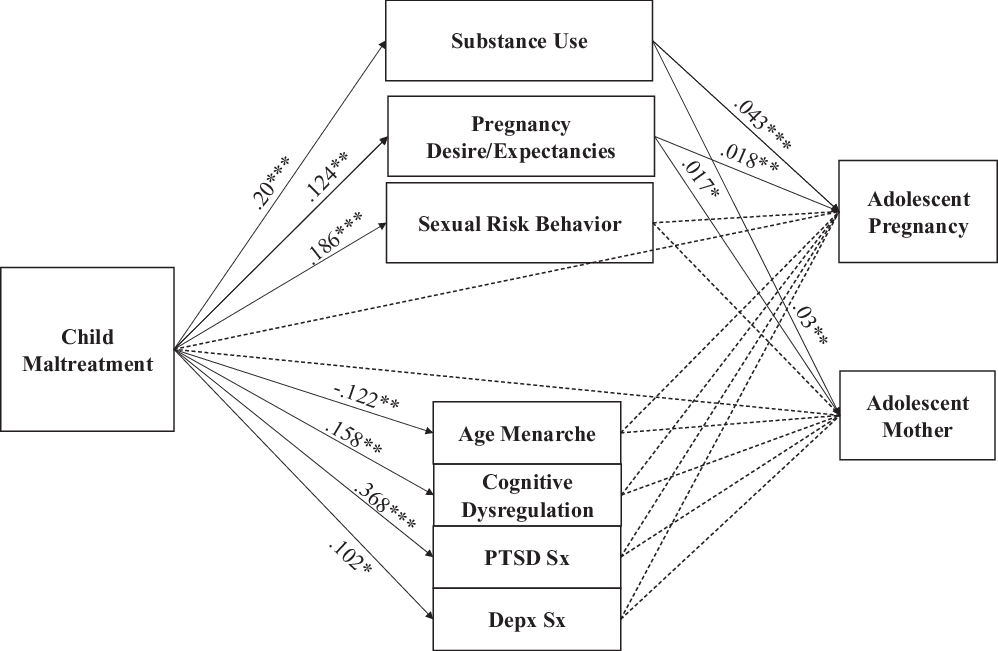
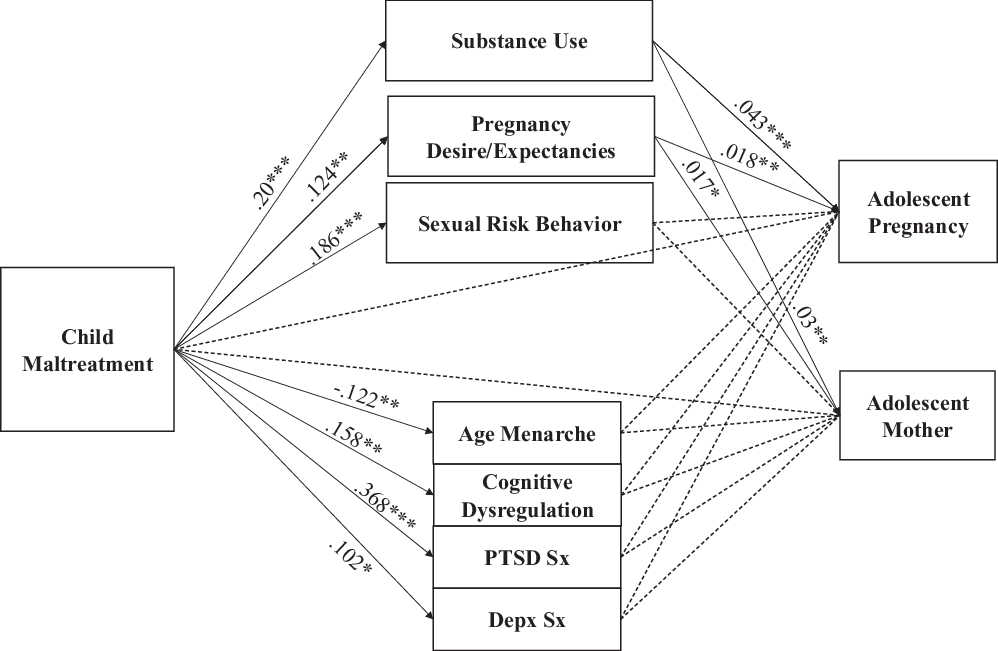
Descriptive data analyses were conducted using SPSS 25 and structural equation models (SEMs) were performed using Mplus Version 8.3 (Muthén & Muthén, Reference Muthén and Muthén2017). The SEM was specified as illustrated in Figure 1. CM was entered as an exogenous variable; age at menarche, cognitive dysregulation, pregnancy desires/expectancies, total PTSD symptoms, total depressive symptoms, SRBs, and total substance use were specified as mediators with correlated residuals; AP and AC were entered as endogenous variables predicted by CM and all seven mediating variables. Household composition, income, minority status, non-maltreatment traumas, and parent and sibling history of AP were entered as covariates predicting AP and AC. Missing data for endogenous variables were estimated as a function of exogenous variables based on the missing at random assumption (Schafer & Graham, Reference Schafer and Graham2002). All variables had less than 1% missing data.
SEM Model. Note. Inter-correlations among mediators and outcomes (i.e., AP with AC) were freely estimated and are reported in the results but are not shown to simplify the figure. Household composition, income, minority status, non-maltreatment traumas, and parental and sibling history of AP were entered as covariates predicting AP and AC. Standardized β parameter estimates presented for continuous outcomes and non-standardized probit regression coefficients are presented for categorical outcomes (AP and AC). Sx = symptoms. *p < .05, **p < .01, ***p < .01.
Structural relationships were tested using the weighted least squares mean and variance adjusted estimator (WLSMV) due to its robustness in analyzing a mix of both categorical and continuous variables in SEM, including when continuous variables have a non-normal distribution (Muthén & Muthén, Reference Muthén and Muthén2017). This type of model produces linear regression coefficients for estimated paths to continuous endogenous variables (e.g., depressive symptoms) and probit regression coefficients for paths to binary endogenous variables (AP and AC). Probit regression is a log-linear approach, similar to logistic regression (Allison, Reference Allison2012). As such, probit coefficients represent the change in the cumulative normal probability distribution of the outcome (i.e., z score or probit index) for each one-unit change in the predictor (Muthén & Muthén, Reference Muthén and Muthén2017). Because increases in the coefficient do not necessarily suggest a proportional change in a z-score, the effect can most easily be interpreted as (1) a positive statistically significant association means the likelihood of an outcome (e.g., AP) is increased when the predictor increases; and (2) a larger magnitude indicates higher likelihood.
Model fit for the SEM was determined using the following criteria: comparative fit index (CFI), root mean square error of approximation (RMSEA), and standardized root mean square residual (SRMR; Yu & Muthén, Reference Yu and Muthén2002). Strong model fit was determined by RMSEA values less than 0.08, CFI greater than 0.95, and SRMR less than 0.08 (Yu & Muthén, Reference Yu and Muthén2002). Mediation was tested using a resampling (i.e., bootstrapping) method with 1,000 sample replications and 95% confidence intervals (MacKinnon et al., Reference MacKinnon, Fairchild and Fritz2007). Confidence intervals that did not include the value of zero determined statistically significant mediation.
Results
Preliminary analyses
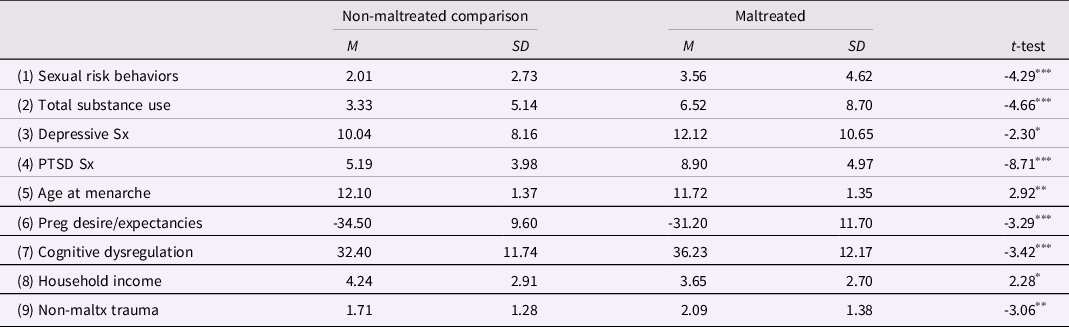
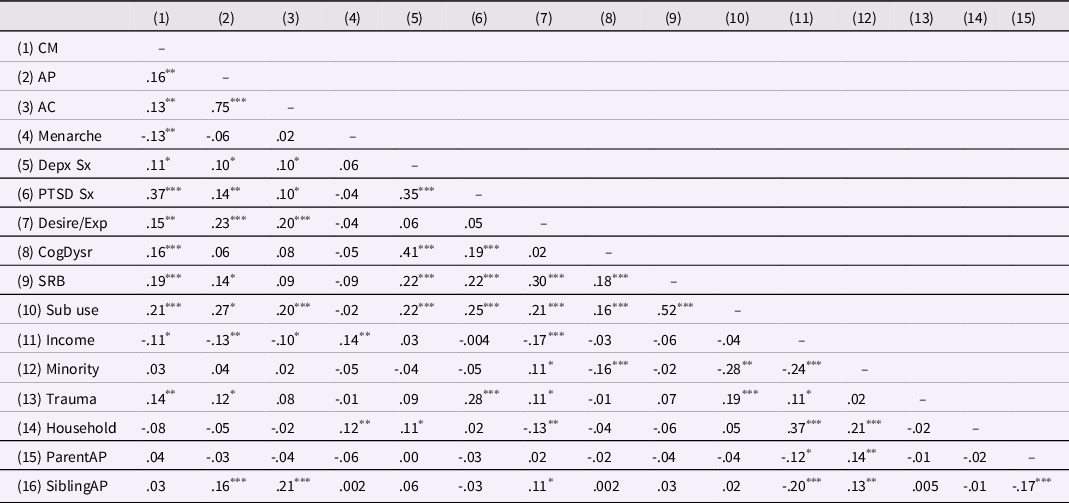
Table 1 provides descriptive and t-test statistics comparing group mean differences between non-maltreated comparison adolescents and maltreated adolescents. Table 2 provides the zero-order correlations among study variables. CM was significantly related to AP (ϕ = .162, p < .001) and AC (ϕ = .132, p < .01). CM survivors constituted 71.6% of APs and 70.3% of ACs. Thirty-one percent of maltreated adolescents experienced a pregnancy (vs. 17% of non-maltreated) and 20% experienced childbirth (vs. 10% of non-maltreated); CM survivors were significantly more likely than their non-maltreated counterparts to become pregnant χ 2 (1) = 12.28, p < .001 and give birth χ 2 (1) = 8.17, p =.004.
Descriptives with t-test for maltreatment group differences
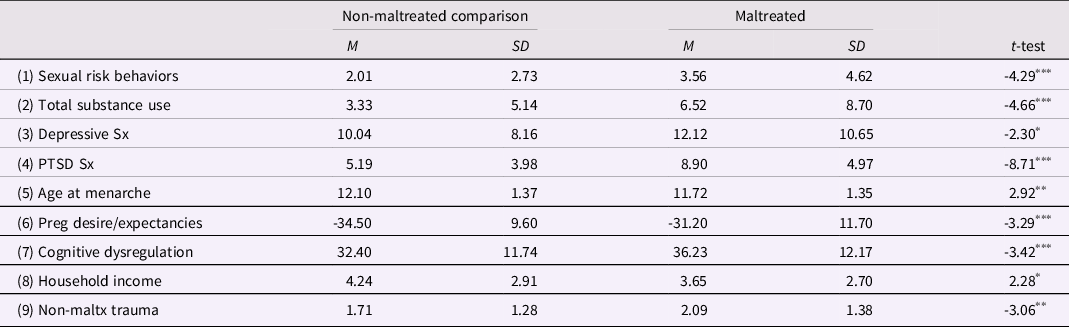
Note. The t-test represents group differences comparing non-maltreated comparison = 0 to maltreated = 1. Income value 3 = ($20,000–$29,999) and 4 = ($30,000–$39,999).
* p < .05.
** p < .01.
*** p< .001.
Bivariate correlations among study variables
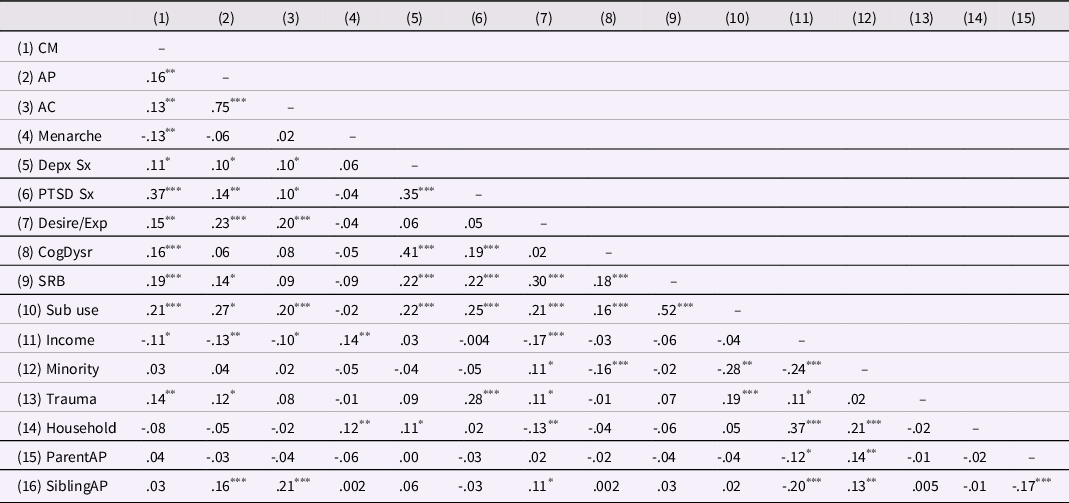
Note. CM = CM (1 = yes); AP = adolescent pregnancy (1 = yes); AC = adolescent childbirth (1 = yes); Menarche = age at menarche; Depx Sx = BDI-II sum score; PTSD Sx = PTSD sum score; Desire/Exp = pregnancy desires + difficulty expectations (-1); CogDysr = cognitive dysregulation sum score; SRB = SRB composite variable; SubUse = total substance use; Income = household income; Minority = Minority status (0 = White, 1 = Minority); Trauma = other traumas; Household = Household Composition (0 = dual-parent household, 1 = single parent); ParentAP = Parental history of AP (1 = yes); SiblingAP = sibling history of AP (1 = yes).
* p < .05.
** p < .01.
*** p < .001.
There were 118 pregnancies (25.2%) and 74 births (15.8%), resulting in a 62.7% birth rate (i.e., pregnancies resulting in birth). Among maltreated females (N = 265), there were 83 pregnancies and 53 births (birth rate = 63.9%). Conversely, there were 35 pregnancies and 21 births (birth rate = 60%) within the non-maltreated comparison group (N = 204). Birth rate did not differ by maltreatment status χ 2 = .156, p = .692.
Structural model
Fit indices for the SEM indicated adequate fit RMSEA=.06 (90% CI [.05, −.07]), CFI=.95, SRMR=.08 (see Figure 1 for graphical representation of model and results). There were no significant direct effects from CM to AP (probit = .179, p = .240) or AC (probit = .236, p = .180). CM predicted significantly greater PTSD (b = .368, p < .001) and depressive symptomatology (b = .102, p = .021), earlier age at menarche (b = −.122, p = .007), greater levels of cognitive dysregulation (b = .158, p = .001), higher pregnancy desires/expectancies (b = .124, p = .008), higher levels of substance use (b = .20, p < .001) and more SRBs (b = .186, p < .001).Footnote 1 AP was predicted by higher levels of substance use (probit = .043, p < .001) and higher pregnancy desire/expectancies (probit = .018, p = .001), but it was not predicted by depressive (probit = .003, p = .720) or PTSD symptomatology (probit = .018, p = .230), age at menarche (probit = −.051 p = .280), cognitive dysregulation (probit = .001, p = .860), or SRBs (probit = −.022, p = .200). Among covariates, AP was significantly associated with non-maltreatment trauma (probit = .095, p = .040) and sibling AP (probit = .409, p = .007).
AC was significantly predicted by greater substance use (probit = .03, p = .004) and pregnancy desires/expectancies ([probit = .017, p = .011]. No other intervening variable was significantly related to AC (SRB [probit = −.022, p = .280]; depressive symptomatology [probit = .004, p = .650]; PTSD symptoms [probit = .011, p = .550]; age at menarche [probit = .027, p = .630], cognitive dysregulation [probit = .005, p = .470]). Among covariates, only sibling AP was significantly associated with AC (probit = .62, p < .001).
The following residual correlations were significant: (1) total substance use with SRB (b = .508, p < .001), cognitive dysregulation (b = .099, p = .048), depressive symptoms (b = .194, p = .003), PTSD symptoms (b = .144, p = .001), and pregnancy desire/expectancies (b = .202, p = .001); (2) pregnancy desire/expectancies with SRB (b = .274, p < .001); (3) cognitive dysregulation with depressive symptoms (b = .413, p < .001), PTSD symptoms (b = .162, p < .001), and SRB (b = .161, p = .001); (4) depressive symptoms with PTSD symptoms (b = .337, p < .001) and SRB (b = .208, p = .001); and (5) PTSD symptoms with SRB (b = .153, p < .001). Finally, AP and AC had significantly correlated residuals (probit = .877, p < .001).
Specific indirect effects
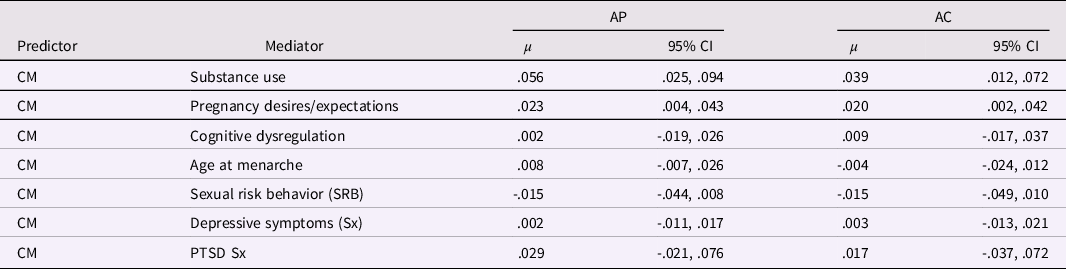
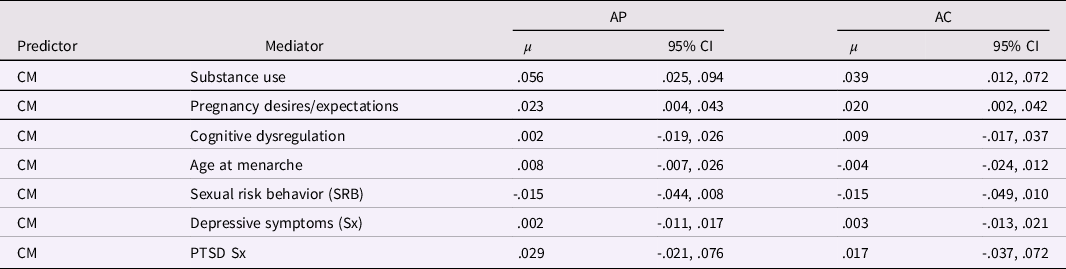
There were multiple significant mediated pathways (i.e., specific indirect effects) from CM to AP and AC. CM exhibited a significant indirect effect on: AP via high pregnancy desire/low difficulty expectations (95% CI [.004, .043]) and greater substance use (95% CI [.025, .094]); and AC via high pregnancy desire/low difficulty expectations (95% CI [.002, .04]) and greater substance use (95% CI [.012, .072]). See Table 3.
Indirect effects predicting AP and AC
Subtype analysis
To explore whether maltreatment subtypes differentially acted on the two statistically significant mediators (substance use and pregnancy desire/expectancies), dummy codes for sexual abuse, physical abuse, and neglect (reference: non-maltreated group) were substituted for CM (binary) as exogenous variables in the SEM model. To account for multi-subtype exposure, we included a count variable ranging from 0 (no maltreatment exposure) to 3 (exposure to physical abuse, sexual abuse, and neglect) as a covariate predicting all endogenous variables. All other aspects of the original model remained the same.
Compared to non-maltreated individuals: a) sexual abuse uniquely affected AP [.015, .135] and AC likelihood [.005, .104] through increased substance use. No other statistically significant indirect effect contrasts emerged between subtype groups and the non-maltreated group. To explore whether the proposed pathways differed between specific types of maltreatment, the reference group for the dummy codes was adjusted to allow for all comparisons and no statistically significant effects emerged.
Discussion
The findings from this study contribute to our understanding of why maltreatment is linked to higher AP and AC rates and further advance efforts to translate scientific knowledge into effective prevention and intervention strategies. Informed by a developmental psychopathology framework, this study prospectively tested seven multi-level, indirect pathways that could plausibly explain the relationship between CM and AP and AC: (1) substance use (polysubstance use and substance use frequency); (2) SRB; (3) depressive; (4) PTSD symptoms; (5) cognitive dysregulation; (6) pregnancy desire/expectancies; and (7) age at menarche. As a result, several important findings emerged. Results support evidence for the following indirect pathways to both AP and AC: (1) CMàgreater substance useàAP and AC; and (2) CMà greater pregnancy desire/expectancies àAP and AC. The significance of these risk pathways was maintained after adjusting for possible confounds such as family income, household composition, minority status, family history of AP, and non-maltreatment traumas.
Direct effect of CM
Consistent with previous research, CM was significantly related to AP and AC at the bivariate level (Garwood et al., Reference Garwood, Gerassi, Jonson-Reid, Plax and Drake2015; Madigan et al., Reference Madigan, Wade, Tarabulsy, Jenkins and Shouldice2014; Negriff et al., Reference Negriff, Schneiderman and Trickett2015; Noll & Shenk, Reference Noll and Shenk2013; Noll et al., 2018). This study aimed to advance research that previously found direct effects of CM on AP by examining the indirect processes that may explain this relationship with multivariate analysis. Results of the SEM demonstrate that the effect of CM on AP and AC may be indirectly mediated by the diverse sequelae of maltreatment. Thus, CM may act as a catalyst to initiate risk pathways to AP and AC, but those trajectories may be sustained by subsequent mechanisms.
Indirect effects
Because CM influences development across diverse domains of functioning, we applied a multi-level approach to investigate risk processes linking maltreatment to AP and AC. Specifically, we examined seven mechanistic candidates representing several levels of individual functioning (psychosocial, cognitive, behavioral, and biological). To our knowledge, these findings represent the first study to prospectively examine multiple developmental risk trajectories from documented CM to AP and AC.
Nonsignificant indirect pathways
Consistent with extant literature, CM was associated with greater depressive and PTSD symptoms, earlier age at menarche, more SRBs, and higher levels of cognitive dysregulation (Cicchetti & Toth, Reference Cicchetti and Toth2016; Jaffee, Reference Jaffee2017; McLaughlin et al., Reference McLaughlin, Colich, Rodman and Weissman2020; Noll & Shenk, Reference Noll and Shenk2013). However, none of these mechanisms, when competing for variance within the larger multiple-mediation model, significantly elevated risk for pregnancy or childbirth outcomes. Notably, this study aimed to identify risk processes that occurred over-and-above, or independent of, the other included variables. Yet, it is likely that our set of mediators operate in a cascading fashion across development, and it is possible that the statistically nonsignificant mediators in our model (e.g., cognitive dysregulation) impart an indirect effect on AP and/or AC as part of a larger mediational chain. For example, in our model, CM had an indirect effect on AP via increased substance use, and this effect occurred independent of the influence of cognitive dysregulation on AP. However, it is possible that CM impairs cognitive functioning, which then increases risk for substance use, which then elevates risk for AP – representing serial mediation. Conversely, substance use may result in deficits in executive functioning that increase risk for poor sexual decision-making and subsequent AP. Because all mediators in the present model were measured at the same pre-pregnancy time point (Time 1) to ensure all adolescents were nulliparous, it was not possible to explore developmental cascades or serial mediation. Future studies that begin much earlier in development and use cross-lagged models to examine bidirectional, cascading effects will advance this line of research and further elucidate the developmental unfolding of risk processes that link CM exposure to AP and AC.
It is also possible that some mechanisms confer low risk in isolation but increase risk as they converge with other mechanisms. This study examined mechanisms operating at multiple levels of the individual but the influence of levels on one another is often reciprocally interactive (Cicchetti & Toth, Reference Cicchetti and Toth2009). For example, age at menarche or cognitive dysregulation may only influence AP when synergistically coupled with other risk processes, such as when those who experience early sexual maturity also engage in substance use (Negriff et al., Reference Negriff, Schneiderman and Trickett2015). Further research is needed to explore whether distinct profiles or constellations of risk factors may uniquely influence pregnancy outcomes.
Substance use (polysubstance use and use frequency)
Our findings provide support for substance use as an indirect pathway linking CM to AP and AC. The illumination of this pathway is consistent with other studies establishing links between maltreatment and substance use (Oshri et al., Reference Oshri, Tubman and Burnette2012), and substance use with unintended AP (Chapman & Wu, Reference Chapman and Wu2013; Wellings et al., Reference Wellings, Jones and Mercer2013). There are several explanations for why greater substance use may elevate risk for AP. Adolescents who engage in higher levels of substance use may be more likely to have sex under the influence, which can complicate sexual communication and impair contraceptive decision-making during intercourse. Substance use can also increase the error rate of contraceptive methods through non-sexual behaviors, such as imperfect use (Trussell, Reference Trussell2009). For example, an adolescent who is frequently intoxicated may be less likely to adhere to oral contraceptive guidelines (e.g., missing a pill or inconsistent timing). Relatedly, individuals who problematically use drugs and alcohol are more likely to rely on contraceptive methods that are less effective and male-controlled (e.g., male condom; Terplan et al., Reference Terplan, Hand, Hutchinson, Salisbury-Afshar and Heil2015), and more likely to engage in sexual intercourse with a partner who is intoxicated. It follows that a partner who is intoxicated will be prone to ineffective condom use, increasing the risk of pregnancy. Finally, substance use is related to involvement with controlling partners (Baker, Reference Baker2016), and adolescent females who engage in substance use may be at greater risk of unintended pregnancy via their exposure to abusive patterns of sexual victimization, nonconsensual sex, and reproductive coercion (PettyJohn et al., Reference PettyJohn, Reid, Miller, Bogen and McCauley2021).
Pregnancy desires and expectancies
Pregnancy desire and expectancies (i.e., the inability to discern negative consequences of parenthood and an expressed intention to become pregnant) emerged as a statistically significant mechanism by which CM indirectly conferred risk for AP and AC. Specifically, adolescent females with a history of maltreatment reported an increased combination of pregnancy intendedness and fewer perceived difficulties related to parenthood than non-maltreated adolescents, which in turn predicted AP and AC. This finding is consistent with previous literature demonstrating an association between CM and heightened pregnancy desire (Noll et al., Reference Noll, Horowitz, Bonanno, Trickett and Putnam2003; Stevens-Simon et al., Reference Stevens-Simon, Sheeder, Beach and Harter2005).
Although few studies have explicitly examined maltreatment in relation to pregnancy intentions, studies examining youth in foster care can be informative to contextualize findings, as the majority of foster placements are the result of maltreatment. This literature suggests that youth in foster care express enhanced pregnancy intentions (e.g., Dworsky & Courtney, Reference Dworsky and Courtney2010), are more likely to minimize potential downsides of AP, and focus on perceived pregnancy benefits, such as the opportunity to create emotional connections (Boustani et al., Reference Boustani, Frazier, Hartley, Meinzer and Hedemann2015). Similarly, our finding that pregnancy desire/expectancies increased pregnancy risk aligns with other studies reporting that pregnancy intention and an absence of negative childbirth expectations are both salient factors in determining AP risk (Sipsma et al., Reference Sipsma, Ickovics, Lewis, Ethier and Kershaw2011; Stevens-Simon et al., Reference Stevens-Simon, Sheeder, Beach and Harter2005).
While the association between CM and pregnancy desire/difficulty expectancies is not well understood, there are several speculative explanations for why maltreated adolescent females may directly seek out pregnancy. CM represents arguably the greatest failure of the caregiving environment (Cicchetti & Lynch, Reference Cicchetti and Lynch1995) and individuals who suffer maltreatment endure abusive, dysfunctional, inadequate, and emotionally deprived circumstances. As such, maltreated adolescents may view pregnancy as an opportunity for reparative, redemptive, transformative, or empowering experiences, wherein their relationship with their child can fulfill unmet intimacy needs, address feelings of inadequacy, provide a sense of purpose, or offer escape from their own anguish (Beers & Hollo, Reference Beers and Hollo2009; Love et al., Reference Love, McIntosh, Rosst and Tertzakian2005).
These assumptions are supported by the actual voices of child welfare-involved adolescent mothers, as represented in qualitative studies. For example, Aparicio et al. (Reference Aparicio, Pecukonis and O’Neale2015) provided support for the notion that adolescent mothers in foster placements may view parenthood as a way to give and receive love that was absent from their lived experience. Similarly, in a review of 17 qualitative studies, Connolly et al. (Reference Connolly, Heifetz and Bohr2012) found that many adolescents with maltreatment histories believed that adolescent motherhood would fill an emotional need, be stabilizing, and offer an opportunity to improve on their parenting experiences. Finally, Svoboda et al. (Reference Svoboda, Shaw, Barth and Bright2012) detailed self-reported motivations for parenthood among youth in foster care, which included a desire to parent in a way they did not experience and a yearning to have something that belongs to them.
Unexplained variance
Notably, we focused on CM as a specific risk factor for AP and AC, including distinct individualistic pathways that might link the constructs. However, CM is typically embedded within an ecological context that contains several layers of risk and adversity (Cicchetti & Lynch, Reference Cicchetti and Lynch1993). Further, AP and AC are likely results of several complex transactions of risk operating at multiple levels of the ecology (i.e., individual, familial, societal, cultural) and our model only focused on one level (i.e., the individual). This reality is represented by the fact that our multi-mediator model only predicted 25% of the variance in AP and 21% in AC as respective outcomes. Clearly, several other unmeasured factors influence risk for AP. Future studies would benefit from an ecological-transactional approach (Cicchetti & Lynch, Reference Cicchetti and Lynch1993) to understand how the individual-level processes identified herein transact with factors present at other levels of the ecology (e.g., family, community, and cultural influences) to influence AP.
Subtype-specific pathways
We disaggregated sexual abuse, physical abuse, and neglect to discern whether any of the mediated pathways in our primary model uniquely stemmed from specific maltreatment experiences, while also controlling for multi-subtype exposure. Compared to non-maltreated individuals, substance use was a salient mechanism linking sexual abuse to AP and AC. However, sexual abuse did not have a unique indirect effect when directly compared to physical abuse or neglect. No unique indirect effects emerged for physical abuse or neglect.
As this is one of the first studies to investigate multiple explanatory mechanisms linking CM to AP and AC, there is naturally scant literature discerning maltreatment subtype-specific pathways with which to contextualize our findings. Sexual abuse was the only subtype with a statistically significant specific indirect effect, consistent with literature identifying sexual abuse as a distinct risk for AP (Noll et al., 2018). Further, results suggest that substance use may be especially prominent in linking sexual abuse to AP and AC, which is consistent with evidence that sexual abuse is a unique risk factor for alcohol and substance use disorders (Noll, Reference Noll2021). These analyses were intended to be exploratory, and findings should be interpreted through the limitations of the hierarchical approach to coding maltreatment subtypes. The observed subtype effects occur over-and-above the influence of multi-subtype exposure; however, we are unable to discern whether certain combinations of CM types (e.g., sexual and physical abuse) are more impactful than others. Finally, we were unable to determine whether the effect between mediating variables and AP/childbirth statistically differed based on subtype exposure.
Implications
An obvious implication of this study is the imperative to prevent the initial occurrence of maltreatment to stifle risk trajectories to maladaptive outcomes before they begin. Too often, interventions happen late in a maltreated child’s trajectory, well after a challenging outcome has occurred. That said, the need to prevent maltreatment is well known and difficult to achieve (Cicchetti & Toth, Reference Cicchetti and Toth2016). Thus, we have elected to instead focus on implications pertaining to the prevention of AP following CM exposure.
Prevention of AP
This study suggests that universal pregnancy prevention programs designed akin to those delivered in school settings would benefit from being trauma-informed (SAMSHA, 2014). This would involve developing curricula specifically designed to address the unique needs of maltreated youth such that at-risk individuals and those with detectable CM-related symptoms and behaviors can be provided with more intensive interventions (Dodge, Reference Dodge2020). Such an approach would also be enhanced by equipping providers with the knowledge to recognize, and then respond to, symptoms. The study findings also offer compelling evidence for the utility of a semi-universal pregnancy prevention approach that targets the entire child welfare population, based on the notably high risk for AP following CM exposure (Dodge, Reference Dodge2020). Such programs may address the role of intended pregnancies. Adolescent parenthood is now concentrated among youth for whom parenthood imposes few opportunity costs; indeed, it is the culmination of a process through which youth “drop out” of the mainstream pathway into adulthood – which typically would include education, career, and then family formation – when they cannot envision a viable path. Yet, prevention programs often focus solely or primarily on sexual activity and contraception use (Bennett & Assefi, Reference Bennett and Assefi2005; Sisson, Reference Sisson2012), even those developed specifically for youth with challenging family contexts (Covington et al., Reference Covington, Goesling, Clark Tuttle, Crofton, Manlove, Oman and Vesely2016). Effective prevention programs for CM-exposed youth should seek to increase the opportunity costs associated with early parenthood (e.g., by improving education, career, and relational prospects) for CM-exposed youth.
Implications for treatment
Clinical interventions can be provided to individuals exposed to maltreatment to prevent the downstream outcomes of AP and AC. Our findings may help sharpen the precision and efficacy of such efforts by delineating specific modifiable mechanisms that are amenable to intervention; namely, substance use and pregnancy intentions/difficulty expectations. To date, AP prevention programs have been successful in lowering rates in the U.S. (Goesling et al., Reference Goesling, Colman, Trenholm, Terzian and Moore2014) but they broadly represent blunt prevention tools that address universal features (e.g., sex education) and do little to target unique mechanisms operating for high-risk groups, such as adolescents with CM histories. Our findings suggest that individuals who suffered CM are more likely to experience AP as a result of greater pregnancy desire/lower difficulty expectations and teaching safe-sex practices to an adolescent with a desire and intention to become pregnant is a relatively hopeless strategy to prevent pregnancy. Instead, effective interventions should aim to directly modify pregnancy-vulnerable cognitions with these individuals.
For example, cognitive-behavioral approaches can be leveraged to address cognitive schemas that are contaminated by maltreatment experiences by restructuring maladaptive thinking patterns pertaining to pregnancy (e.g., “pregnancy represents an opportunity to heal”), as well as balancing unrealistic expectations (e.g., “parenting will be easy”) with realistic alternatives. Practitioners may also use activities, such as decisional balance exercises, to facilitate decision-making with adolescents by encouraging systematic weighing of the benefits and challenges of pregnancy. If youth elect to begin families, they may benefit from programs that offer multi-faceted support with the challenges of transitioning to parenthood during adolescence (Harding et al., Reference Harding, Knab, Zief, Kelly and McCallum2020; Paradis et al., Reference Paradis, Sandler, Manly and Valentine2013).
Alternatively, these youth may benefit from relational interventions, such as Interpersonal Psychotherapy (IPT-A; Mufson, Reference Mufson2004) or Attachment-Based Family Therapy (ABFT; Diamond & Siqueland, Reference Diamond and Siqueland1995), that create opportunities for the adolescent to experience corrective relationships within their existing environments, rather than seeking out connection through a future pregnancy. Although relational interventions are effective in abating the sequelae of CM (Toth et al., Reference Toth, Gravener-Davis, Guild and Cicchetti2013), most maltreatment survivors remain in the custody of their parents (Child Welfare Information Gateway, 2021) and youth must navigate repairing interpersonal dynamics with maltreating parents. Multiple relational interventions have been specifically designed to cautiously intervene with maltreating families and their children (Toth & Gravener, Reference Toth and Gravener2012). It is recommended that adolescent-focused relational interventions include: (a) initial assessment and ongoing monitoring of abusive parenting; (b) provision of support for the maltreating parent (e.g., emotional support and basic needs assessment); and (c) a tiered-service delivery model that initially focuses on parental sensitivity and the parent’s capacity to engage in intervention before progressing to more intensive relational treatments (Valentino, Reference Valentino2017).
Similarly, traditional messaging around reproductive health may not be enough to prevent AP in maltreated youth, especially among sexual abuse survivors, if subsequent substance use problems remain unaddressed. Evidence-based interventions that address substance use in maltreatment survivors through the development of adaptive coping alternatives (Cicchetti & Handley, Reference Cicchetti and Handley2019) may prevent undesirable pregnancy outcomes. Additionally, pregnancy prevention can be embedded within substance use intervention programs to further mitigate the risk of AP. For instance, condom use is typically promoted within substance use programs to prevent the higher rates of STIs occurring in this population (Terplan et al., Reference Terplan, Hand, Hutchinson, Salisbury-Afshar and Heil2015). However, condoms are typically male-controlled and only considered moderately effective in preventing pregnancy, ranked in the third tier of contraceptive efficacy (World Health Organization, 2021). Substance use programs may infuse contraceptive method choice counseling and promote dual-use contraceptive recommendations that balance STI and pregnancy prevention (e.g., condom and implanted contraceptive; Terplan et al., Reference Terplan, Hand, Hutchinson, Salisbury-Afshar and Heil2015). Additionally, substance use interventions designed for adolescents might consider the intersection of dating abuse and substance use to mitigate pregnancy risk by assessing for reproductive coercion and relationship abuse, and providing education, resources, and harm-reduction counseling (Hill et al., Reference Hill, Jones, McCauley, Tancredi, Silverman and Miller2019).
Strengths and limitations
Although advancing the current literature, these findings need to be considered within the context of study limitations. First, we examined several mechanistic pathways across multiple levels of analysis; however, our list of mechanisms is not exhaustive, and it is possible that other factors play a role in sustaining complex trajectories to AP and AC following CM. For instance, relationship violence (e.g., reproductive coercion) was presented as an explanation for some findings (e.g., Miller et al., Reference Miller, McCauley, Tancredi, Decker, Anderson and Silverman2014), yet we did not have a strong measure of relationship abuse to formally test this mechanism. Further, we tested six salient confounding variables, yet it is possible that other unexplored contextual variables influence the association between CM and AP, and causal assumptions would be improved with quasi-experimental designs that account for genetic confounding. As such, the results of the presented SEM provide tentative evidence that the modeled causal assumptions are plausible; however, as with any SEM, results must be replicated and considered against alternative models (Bollen & Pearl, Reference Bollen and Pearl2013).
Second, our study was designed to focus on substantiated maltreatment and, while this may improve objective rigor, it may also decrease generalizability by excluding unsubstantiated or unreported cases of maltreatment. Further, our study design was positioned to examine a global classification (exposure vs. no exposure) of CM and there were inherent limits on our ability to test alternative maltreatment parameters (e.g., polyvictimization, timing, chronicity). Third, we did not identify outcome-specific pathways from CM to AP and AC, respectively. This may suggest that once trajectories of AP risk begin, they are also likely to culminate in birth. Further research is needed in this area. Fourth, several of the predictor variables (e.g., CM exposure, condom use, substance use, pubertal timing) vary by race/ethnicity (Bleil et al., Reference Bleil, Booth-LaForce and Benner2017; Hampton-Anderson et al., Reference Hampton-Anderson, Carter, Fani, Gillespie, Henry, Holmes, Lamis, LoParo, Maples-Keller, Powers, Sonu and Kaslow2021; Holliday et al., Reference Holliday, Miller, Decker, Burke, Documet, Borrero, Silverman, Trancredi, Ricci and McCauley2018; Jackson et al., Reference Jackson, Karasek, Dehlendorf and Foster2016), yet the current model did not examine whether the developmental pathways linking CM to AP and AC differed based on race/ethnicity. Future studies could explore such differences to help inform the unique needs of racially/ethnically diverse female adolescents exposed to CM.
Despite the limitations, there are several methodological strengths of this study. The prospective cohort design and use of longitudinal data strengthens the inferences of the indirect pathways revealed in the multiple-mediation model. Moreover, to our knowledge, this is the first multiple mediator test of the relationship between CM and AP and AC. Additionally, the use of a demographically matched comparison group minimizes the possibility of confounding demographic effects (e.g., income, minority status, family constellation). Further, the model incorporates multi-method data, including substantiated CPS records of maltreatment and medical records of childbirths.
Conclusion
Adolescents who experience pregnancy following CM are not a homogenous group and a diversity of explanatory pathways may exist. In the current study, two pre-pregnancy constructs – substance use and pregnancy desires/expectancies – emerged as statistically significant and unique pathways to subsequent AP and AC. The findings gleaned from this study: (1) make a unique contribution to the extant literature; (2) act as a step toward elucidating the developmental pathways to AP and AC for maltreated female adolescents; and (3) highlight salient developmental targets for interventions designed to prevent AP. Given that approximately 678,000 children suffer CM each year (USDHS, 2019), and the rates of AP in the U.S. far exceed those of similar countries, addressing the factors involved in this association can have considerable impact for individuals, families, and society.
Funding statement
This research was supported in part by grants received from the National Institute of Child Health and Human Development under awards P50HD096698, R01HD052533, and P50HD089922.
Conflicts of interest
None.