INTRODUCTION
Sacoglossan opisthobranchs, a group of stenophagous sea slugs, have long fascinated biologists due to a suite of ecological attributes including kleptoplasty, horizontal gene transfer, and sequestration and de novo synthesis of natural products. While our understanding of a few ‘model species’ such as Elysia viridis (Montagu, 1804) and Elysia chlorotica (Gould, 1870) comprehensively spans the range from organismal to molecular features, basic taxonomic, ecological and biogeographical information about the group, particularly the cerata-bearing limapontiid sacoglossans is largely lacking. Around 300 nominal species are currently considered valid (Jensen, Reference Jensen2007); as she astutely points out, detailed investigation of the group has led not only to new species' descriptions but also to synonymies. For example, many of the sacoglossans described as endemic to parts of Asia are now being viewed as broadly distributed Indo-Pacific species. Our understanding of the species richness, distribution and algal host associations of sacoglossan species in Asia, Africa and South America are still in their infancy.
A recent literature survey for Japan (Trowbridge et al., Reference Trowbridge, Hirano and Hirano2011) indicated the region contains between 1/2 and 1/3 of the described sacoglossan species in the world. Yet, our survey and recent field-based, Indo-Pacific ones (e.g. Carlson & Hoff, Reference Carlson and Hoff2003; Nakano, Reference Nakano2004; Ono, Reference Ono2004; Gosliner et al., Reference Gosliner, Behrens and Valdés2008) report a large percentage of undescribed or unrecognized species. When faced with such uncertainty, some researchers attribute new records to: (1) undescribed (usually endemic) species; (2) introduced species (e.g. from other ocean basins); or (3) range extensions (e.g. pole-ward range expansion due to climate change) (see Sea Slug Forum for such discussions). Other colleagues, however, consider the group insufficiently documented to make such inferential generalizations. As part of a large-scale project on sacoglossan biology in Japan, extensive biodiversity surveys were made from May 2000 to April 2010 in temperate and subtropical Japan by the authors and their research students. The aim was to characterize the species richness and trophic associations of sacoglossans in this high-diversity biogeographical region. As sacoglossans are often associated with certain types of macroalgae, sea grasses or diatoms, our surveys were largely phytocentric, focused on the guild or assemblage of sacoglossans associated with certain hosts.
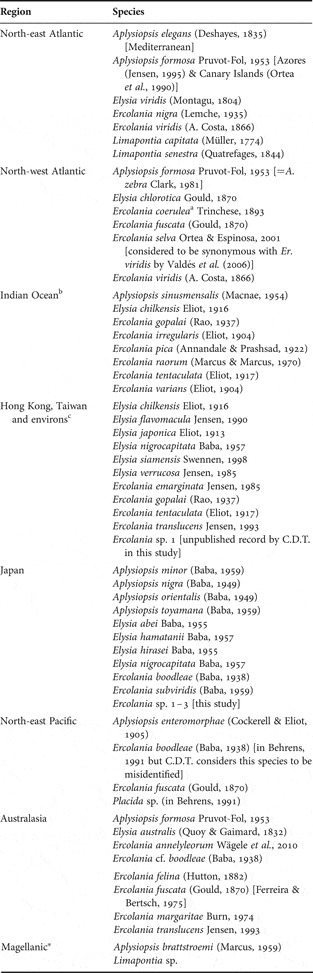
There are numerous feeding guilds of sacoglossans with ecological analogues in different geographical regions. Ecological study of these guilds has been driven in part by the accessibility of the species, the ecological and/or economic importance of the algal hosts and the possibility that some sacoglossans may have potential as biological control agents of invasive algae. Probably the best-studied sacoglossan guild to date is the one associated with bryopsidalean green algae (Codium, Bryopsis and allies) (Trowbridge et al., Reference Trowbridge, Hirano and Hirano2008a, Reference Trowbridge, Little, Stirling and Farnhamb, Reference Trowbridge, Hirano, Hirano, Sudo, Shimadu, Watanabe, Yorifuji, Maeda, Anetai and Kumagai2010, and references therein). A second recognized guild is the group of species that feed on Caulerpa, studied in part: (1) because of the pest-like attributes of strains of C. taxifolia (‘killer algae’), C. racemosa and C. brachypus; and (2) because of the chemical ecology of hosts (Baumgartner et al., Reference Baumgartner, Motti, de Nys and Paul2009). A third guild, well studied in some geographical regions, is the assemblage of species that feed on uniseriate green algae (e.g. Chaetomorpha, Cladophora and allies; Table 1).
Sacoglossan species in guilds that feed on filamentous green algae (Family Cladophoraceae and/or Family Boodleaceae).

a, juveniles found on Cladophoropsis but adults are not; b, Elysia siamensis Swennen, Reference Swennen1998 is associated with filamentous green algae in southern Thailand but the species' diet has not yet been determined; c, Gascoignella aprica Jensen, Reference Jensen, Morton and Dudgeon1985 is associated with filamentous green algae in Hong Kong but its diet has not yet been determined. Jensen (Reference Jensen and Morton2003) tested Cladophora and Chaetomorpha but no evidence was found; *, based on Linse (Reference Linse1999).
In the current 10-year study, we recorded the assemblage of sacoglossans that feed on uniseriate green algae in two regions of Japan (temperate and subtropical). Our objectives were twofold: (1) compare this guild to ecologically equivalent species in other geographical regions; and (2) review radular tooth and embryonic attributes worldwide to assist the identification of unrecognized and undescribed species.
MATERIALS AND METHODS
Study area
This study was based in two regions: Honshu and Okinawa, Japan. We made numerous trips to the marine laboratory of University of Tokyo: Misaki Marine Biological Station (MMBS) on the Miura Peninsula on the Pacific coast of Honshu, Japan. Sacoglossan specimens were collected from two habitats at MMBS (35°09′N 139°36′E): high-shore tidepools at Araihama and subtidal aquaculture ropes in Moroiso Bay. Supplementary Honshu collections were made at the Marine Biosystems Research Center (formerly the Kominato Marine Laboratory) of Chiba University (35°04′N 140°06′E) and at Seto, Kii (near the Seto Marine Biological Laboratory). From July 2002 to April 2010, we made numerous trips to the west-coast shore of Okinawa on the East China Sea. In March 2005 and 2006, the filamentous green algae Boodlea and Cladophora were collected from several Okinawan sites, particularly Sobe (26°23′N 127°43′E) in Yomitan and Zanpa (26°26′N 127°43′E).
Population structure and reproduction
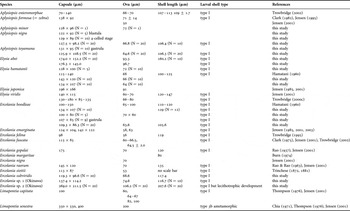
In May 2000, July 2001, June to July 2002, March 2004, April to May 2009, and April 2010, we collected all sacoglossan specimens we could find in the two MMBS habitats that were associated with uniseriate green algae (Cladophora, Chaetomorpha, Boodlea and Cladophoropsis). Specimens were gently blotted on paper towels and weighed to the nearest 1 mg. We collected egg masses and measured the diameter of egg capsules, uncleaved ova (when possible) and length of veliger shells, using a compound microscope with ocular micrometer. In a few cases, an image-analysis program was used to collect measurements from digital photographs. The type of larvae was determined based on shell shape and larval behaviour.
Feeding preferences
Ercolania boodleae (Baba, Reference Baba1938) specimens were used in two preference experiments to test if algal genus and/or filament diameter was a determinant of host choice. First, we tested whether they preferred feeding on the Cladophora sp. from high pools with narrow filaments or the congener from the low shore with coarse filaments (N = 38 slugs). Given the extraordinary species diversity within these algal genera in Japan (e.g. 23 Cladophora spp., 11 Chaetomorpha spp., etc.; Yoshida, Reference Yoshida1998), we took the conservative approach of not assigning species names to the genera. Second, we tested whether the specimens preferred the delicate Cladophora from high pools or the coarse Chaetomorpha sp. from suspended ropes (N = 37 slugs). In each experiment, individual slugs were placed in small dishes with fresh seawater, offered pairwise choices of algae, and monitored periodically for one day. Containers were placed on laboratory benches and held at room temperature for the 1-day experiments. Categorical data at the end of the experiment were analysed with a Fisher's exact test to determine if algal source significantly affected food choice. Then, because algal source was not significant, we combined data and tested whether slugs exhibited a significant preference between algal choices.
More abbreviated experiments were conducted with other sacoglossan species found. For Elysia hamatanii Baba, Reference Baba1957 we conducted two feeding preference experiments similar to those described above: (1) thin versus thick-filament species of Cladophora; and (2) Cladophora versus Chaetomorpha. Experimental details were similar to that described for Ercolania except for the smaller sample size (N = 8). For Aplysiopsis toyamana (Baba, Reference Baba1959), we investigated whether the subtidal sacoglossan species would eat the intertidal alga Cladophoropsis (N = 7 slugs). After the 3-hour check, we added Chaetomorpha to each container (changing the no-choice experiment to a choice one). We monitored the specimens after 16 and 24 hours to determine if any algae were eaten. For Okinawan Ercolania subviridis (Baba, Reference Baba1959), we offered specimens a pairwise choice of Boodlea (source alga) and Cladophora (sympatric alga). For Ercolania sp. 1 (Figure 1D), we conducted a pairwise choice of Boodlea and Cladophora as well as a no-choice trial to see if slugs would eat Cladophora. Finally, additional feeding experiments have already been conducted by Hirano & Hirano (Reference Hirano and Hirano1991) for Aplysiopsis orientalis (Baba, Reference Baba1949), A. nigra (Baba, Reference Baba1949), A. toyamana, Ercolania boodleae, and E. subviridis (using Cladophora wrightiana and Chaetomorpha crassa as choices).
Radular preparations
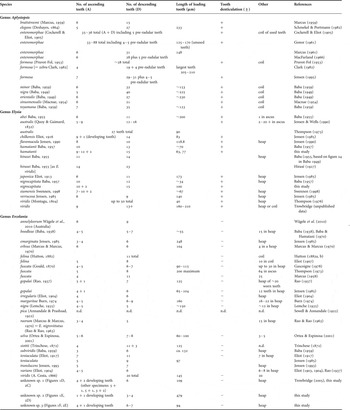
To confirm species identifications, we examined radular teeth of each sacoglossan species and compared them to the type descriptions and/or re-descriptions by colleagues (Appendix 1). We dissected the buccal mass of specimens and dissolved away the tissue using dilute Clorox®. Radular teeth were then photographed using light microscopy. The number of radular teeth in the ascending and descending limbs was counted and the length of leading tooth measured.
RESULTS
Honshu
POPULATION STRUCTURE AND REPRODUCTION
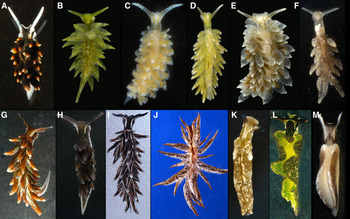
During our Honshu surveys, we recorded at least three species of Ercolania, three species of Aplysiopsis and two species of Elysia associated with filamentous green algae (Figure 1). Aplysiopsis orientalis (Figure 1J), common in the 1990s, was not seen during our study. Elysia nigrocapitata Baba, Reference Baba1957 (Figure 1M) was also not recorded although we received two specimens collected from Tokushima Prefecture (Shikoku).
Guild of Japanese sacoglossans that feed on uniseriate green algae: specimens A–F Ercolania, G–J Aplysiopsis and K–M Elysia. (A) Ercolania boodleae (3.5 mm, Sagami Bay, Honshu); (B) E. subviridis (10 mm, Okinawa); (C) Ercolania sp. 1 (6 mm, Kii, Honshu); (D) Ercolania sp. 1 (7 mm, Okinawa); (E) Ercolania sp. 2 (9 mm, Okinawa); (F) Ercolania sp. 3 (5 mm, Honshu); (G) Aplysiopsis toyamana (30 mm, Honshu); (H) A. minor (9 mm, Honshu); (I) A. nigra (24 mm, Honshu); (J) A. orientalis (~25 mm, Honshu); (K) Elysia abei (9 mm, Honshu); (L) E. hamatanii (~10 mm, Honshu); (M) Elysia nigrocapitata (5 mm, Shikoku).

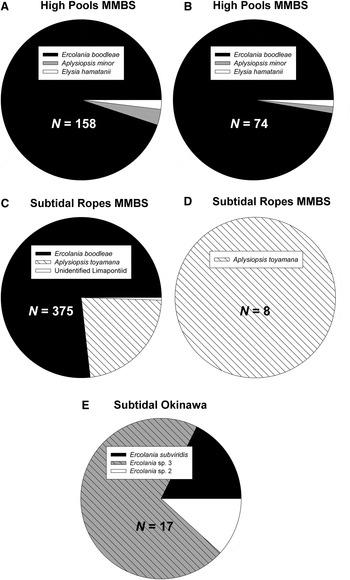
Ercolania boodleae (Figures 1A & 2A) was the most common species in the guild of sacoglossans that fed on uniseriate green algae at MMBS (Figure 3A–D). Aplysiopsis minor and Elysia hamatanii (Figures 1H, L & 2G, H) each composed ~3% of the specimens collected from the high pools in May 2000 and ~1% in April 2010 (Figure 3A, B). Aplysiopsis toyamana (Figures 1G & 2F) and an unidentified limapontiid composed 22.7% of the specimens from Chaetomorpha attached to the aquaculture ropes in 2002 (Figure 3C). In a comparable sample in March 2004 (Figure 3D), A. toyamana (Figure 1G) was the only species found.
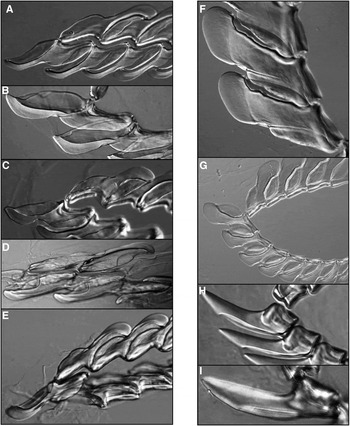
Radular teeth of sacoglossans that feed on green algae. (A) Ercolania boodleae (MMBS, Honshu, 13 October 2004, leading tooth 109.0 µm long); (B) Ercolania subviridis (Tateyama, Honshu, 5 September 2002, leading tooth 235.8 µm long); (C) Ercolania sp. 1 (Sobe, Okinawa, 4 March 2007, leading tooth 109.0 µm); (D) Ercolania sp. 2 (Sobe, Okinawa, 29 March 2006, first tooth of ascending series 478.8 µm long (leading tooth was broken)); (E) Ercolania sp. 3 (MMBS, Honshu, 13 October 2004, leading tooth 94.3 µm); (F) Aplysiopsis toyamana (MMBS, Honshu, 4 March 2004, leading tooth broken, tooth in ascending series next to leading tooth 212.1 µm); (G) Aplysiopsis minor (MMBS, Honshu, 5 March 2004, leading tooth 113.5 µm); (H) Elysia hamatanii (Seto, Kii, Honshu, 23 April 2006, leading tooth 63 µm); (I) Elysia nigrocapitata (Naruto, Shikoku, 16 April 2003, leading tooth 100 µm). Ercolania and Aplysiopsis spp. have sabot-shaped (Dutch shoe) radular teeth; Elysia spp. have blade-shaped teeth. Lateral denticulation very prominent in F and G. Radular tooth for A. nigra is shown in Hirano & Hirano (Reference Hirano and Hirano1991).

(A–B) Guild of sacoglossans from high pools at Araihama (May 2000 and April 2010); (C–D) from Chaetomorpha attached to aquaculture ropes at Moroiso Bay (June 2002 and March 2004); (E) Okinawa (March 2005).

Two unidentified Ercolania spp. were also found on Honshu. Ercolania sp. 1 (Figure 1C) was found at Seto, Kii (2 specimens: 6 and 4 mm, 27 April 2006) in a large tidepool on Boodlea coacta. This species had small red dots on the dorsum; it appeared conspecific with specimens (Figures 1D & 2C) found at Okinawa (next section). Ercolania sp. 3 (Figures 1F & 2E), a species with dusky brownish/black body pigmentation, was found in the pool at Seto on the same day (2 specimens: 4 and 4.5 mm) on Boodlea as well as at MMBS (5 mm, 13 October 2004) (host unknown).
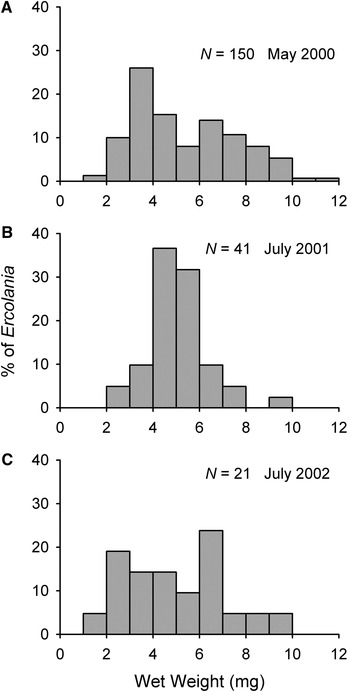
In the three late spring to summer collections of Ercolania boodleae made from the high pools at MMBS (Figure 4), the specimens varied from 1 to 12 mg in wet weight. However, E. boodleae from the subtidal Chaetomorpha grew to 28 mg. While there was no statistically significant difference in body weight with algal host (Mann–Whitney test, U = 68.5, N = 30, P = 0.235), maximum weight on Chaetomorpha was three times greater than that of conspecifics on Cladophora collected the same week. Egg capsule dimensions varied considerably among batches measured (Appendix 2) but all batches exhibited type I shells with planktotrophic larvae.
Size–frequency distribution of Ercolania boodleae in high-shore tidepools at MMBS during three brief research visits: (A) May 2000; (B) July 2001; (C) July 2002.

Three specimens of Elysia hamatanii (Figures 1L & 3A) were found in May 2000 in the high pools at Araihama. They ranged in size from 7 to 11 mm long and 13 to 31 mg (wet weight). A freshly deposited egg mass was examined: capsules averaged 128 × 100 µm with uncleaved ova averaging 72 µm (Appendix 2). In June 2002, eight more specimens of this species were found. In April 2010, we collected another specimen, 8 mm long. Additional measurements of egg masses indicate larger capsules and smaller ova (Appendix 2) than initially measured, suggesting considerable variation among egg masses.
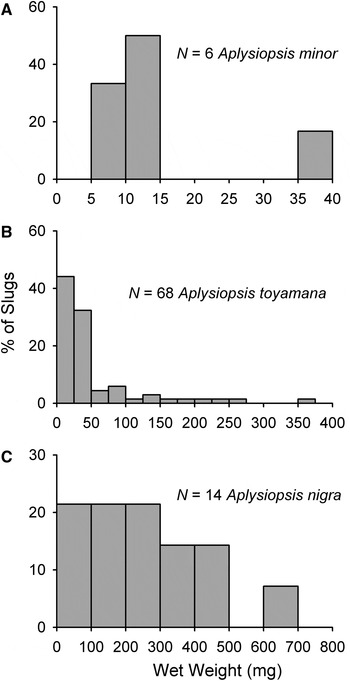
Another poorly known species recorded was Aplysiopsis minor (Figures 1H & 2G). Six specimens were found in May 2000 in the high pools at Araihama and another in April 2010 (Figure 3A, B). The largest specimen, 35 mg in wet weight (Figure 5A), was 13 mm long. Specimens of A. toyamana on subtidal Chaetomorpha were large. While most specimens were <50 mg (wet weight), maximum size was 351 mg (Figure 5B); maximum body length was 30 mm. Finally, A. nigra also attained large size—up to 618 mg (Figure 5C).
Size–frequency distribution of Aplysiopsis spp. (A) Aplysiopsis minor from MMBS pools in May 2000; (B) Aplysiopsis toyamana from MMBS aquaculture ropes in June 2002; (C) Aplysiopsis nigra from MBRC on 1–2 July 2002. Sample sizes refer to the number of specimens collected and measured.

FEEDING PREFERENCES
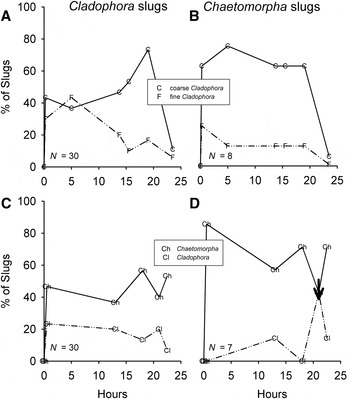
In the feeding trials with Ercolania boodleae (Figure 6), there was no significant difference in preference of slugs from different algal hosts (Fisher's exact test, P = 0.625 and P = 1.00, N = 24 for the two experiments) (specimens that made no algal selection were excluded from the analysis). However, in both cases, the species did exhibit significant feeding preferences (Figure 6). (1) Ercolania boodleae preferred the coarse, low-shore Cladophora to the delicate, high-shore, pool-dwelling congener (Pearson Chi-square (χ2) = 4.2, 1 df, P = 0.041). (2) Ercolania boodleae preferred the coarse, subtidal Chaetomorpha to the low-shore Cladophora (χ2 = 13.5, 1 df, P < 0.001).
Feeding preferences of Ercolania boodleae collected from two algal genera at MMBS in June 2002: (A, C) Cladophora sp.; and (B, D) Chaetomorpha. Sample sizes refer to the number of replicate specimens individually tested. Arrow indicates that Chaetomorpha was depleted so fresh material was added.

Two other sacoglossan species were not abundant enough to compare their feeding preferences statistically, just descriptively. In a pairwise-choice experiment, Elysia hamatanii strongly preferred the fine Cladophora from which it was collected to the coarse conspecific alga low on the shore; at 24 hours, all eight specimens were on the source alga. When offered a pairwise choice of Chaetomorpha and a coarse Cladophora, E. hamatanii preferred the former. Aplysiopsis toyamana specimens that were fed the low shore Cladophoropsis in a no-choice trial would not even approach the alga in three hours. When Chaetomorpha was added after 3 hours, the slugs all moved to the alga and consumed it.
These trials demonstrate two important points. First, there was no consistently preferred ‘best’ algal food. Second, coarse filaments with large cells were not necessarily preferred by sacoglossans: large cell size or volume was not the sole factor determining choice.
Okinawa
The green alga Boodlea was collected several times during our March 2005 and 2006 surveys with only small patches being recorded in other seasons. We collected Boodlea masses and gently separated the interconnected filaments to expose feeding sacoglossans. We found three species of Ercolania, namely Ercolania subviridis and two undescribed congeners (Figures 1B, D, E, 2B–D & 3E). The first species, E. subviridis, was extremely distinct due to the longitudinal lines along each ceras; these lines were formed by digestive diverticulae so were pale to dark green.
The two others (Ercolania sp. 1 and sp. 2) had white bodies with digestive diverticulae which were green. Ercolania sp. 1 typically had red spots on the dorsum (1–2) between the cerata and appeared similar to the specimens found at Seto, Kii, Honshu (Figure 1C, D). Ercolania sp. 2 lacked red spots (Figure 1E). The latter species also had distinctive digestive diverticulae in the cerata: they were unbranched. Radular teeth of all these species were clearly sabot-shaped (like a Dutch shoe) but subtle differences in tips were obvious (Figure 2B–D). In March 2005, specimens of Ercolania sp. 1 averaged 5.5 mm long (4–7 mm, N = 11).
These three Ercolania species were never abundant but were found associated with Boodlea and with some other algae. Two of these species were not commonly found associated with the other ~17 genera of green algae we searched at Okinawa regularly from 2002 to 2010. However, E. subviridis was occasionally found on the green alga Valonia aegagropila. Pairwise-choice tests conducted with Ercolania sp. 1 indicated that the species strongly preferred Boodlea to Cladophora and Dictyosphaeria: only 40% or fewer specimens would even approach Cladophora in a no-choice experiment (data not shown). In contrast, Ercolania sp. 2 associated with Boodlea, Valonia and Dictyosphaeria on the shore and also fed on Ventricaria ventricosa, Boergesenia forbesii and Cladophora in the laboratory. The lecithotrophic larvae metamorphosed on Valonia (other algae have not yet been tested).
DISCUSSION
Japanese species
The guild of green algal filament feeders on Japanese temperate shores contains at least three genera (Aplysiopsis, Ercolania and Elysia) although (1) not all the species in the latter two genera belong to this guild, and (2) some of the species in this guild also feed on taxonomically and/or morphologically different algae (including siphonaceous green filaments such as Bryopsis, septate red filaments such as Griffithsia and siphonaceous xanthophyte filaments such as Vaucheria). Japan is characterized by extraordinary species richness: the sacoglossan guild is composed of at least ten temperate species and at least three subtropical ones (with Ercolania subviridis and Ercolania sp. 1 occurring in both regions). Thus we recorded at least 12 species on the north-west Pacific shores plus the literature records 2–3 others (Table 1).
Of the temperate species, Ercolania boodleae is found most consistently (spatially and temporally). Baba & Hamatani (Reference Baba and Hamatani1952), Usuki (Reference Usuki1977) and others consider this species to occur all year around though its abundance declines during summer when pool water temperatures attain high levels (personal observation). The large (20–30 mm) Aplysiopsis spp. are common but which species is present varies spatially and temporally. For example, A. toyamana was frequent at MMBS during June 2002 and March 2004 visits; A. nigra and A. orientalis were recorded from MBRC (Hirano, Reference Hirano1991; and personal communication). Intriguingly, A. orientalis was a common species in the 1990s but was not recorded during our study (2000–2010).
Elysia hamatanii was found only a few times at MMBS. Baba (Reference Baba1957) reported the original collections from December and January so it may be a winter to spring species. Usuki & Hayashi (Reference Usuki and Hayashi1975) recorded the species in September in the Niigata Prefecture, the Japan Sea coast of Honshu. There is considerable confusion and inconsistency by professional and amateur malacologists about the identity of E. hamatanii and the congeners E. nigrocapitata and E. hirasei. The three have similar tooth counts except for the original record of E. hirasei (as E. viridis) by Hirasé (Reference Hirasé1927); furthermore, the internal anatomy of the three species has not been described. Thus, the primary distinction between the three species is the head coloration pattern. What appears distinctive in Baba (Reference Baba1955, Reference Baba1957) is not in practice. Given that the location of type voucher specimens is unclear and the passing of Baba, the best remaining evidence is what Hamatani considers these species to be. Colour photographs (Hamatani, Reference Hamatani and Okutani2000; plate 380, figure 8) indicate that E. hamatanii clearly matches our species (Figure 1L) and of Nakano (Reference Nakano2004). In these photographs, faint white markings can be discerned that appear to correspond with the bands in Baba (Reference Baba1957, plate III, figure 2). Elysia nigrocapitata, as shown by Nakano (Reference Nakano2004) and Baba (Reference Baba1957 as E. viridis, later amended to E. nigrocapitata in 1957) corresponds to our animal (Figure 1M). (Our initial report of Elysia cf. nigrocapitata (Trowbridge, Reference Trowbridge2000a) on the Sea Slug Forum corresponds to E. hamatanii; this amendment could not be posted to the website as the forum has discontinued, and the site is now locked.) Baba (Reference Baba1957) acknowledged the similarity of E. hamatanii and E. hirasei in appearance and radular teeth; whether the specimens examined by Baba (Reference Baba1947, Reference Baba1949, Reference Baba1955, Reference Baba1957) and Hirasé (Reference Hirasé1927) are really the same species is questionable as the tooth counts are dramatically different (Appendix 1).
Of the subtropical Ercolania species, all three discussed herein were present when the algal host Boodlea was present. Ercolania sp. 1 was also recorded in Taiwan in summer 2006 (C.D. Trowbridge, unpublished data).
Other regions
On north-eastern Atlantic shores, the high pool habitat is occupied by Limapontia capitata and L. senestra (Thompson, Reference Thompson1976). Limapontia capitata can attain high densities (maximum 2960/l of Cladophora) and consumes 1–10% of the standing crop (Jensen, Reference Jensen1975, Reference Jensen1976). The low shore and subtidal Chaetomorpha and Cladophora are consumed by Elysia viridis and Ercolania nigra which can decimate algal populations, causing algal fragmentation of filaments.
On north-western Atlantic shores, Ercolania fuscata feeds on Cladophora, Chaetomorpha and Bryopsis with peak densities of 723 slugs/g DW, 31.1, and 5.82, respectively. Based on reciprocal feeding experiments, E. fuscata, on average, grew best on Chaetomorpha but the relative performance depended on host source of the slugs (Clark, Reference Clark1975). The summer break-up of Cladophora and Chaetomorpha in Connecticut (USA) was preceded by peak in sacoglossan populations (Clark, Reference Clark1975). On Florida shores, Ercolania viridis, E. coerulea, and Aplysiopsis formosa also feed on filamentous, septate green algae although their ecological effects have (to our knowledge) not been evaluated.
On New Zealand shores, Ercolania felina and perhaps some cryptic congeners fill this ecological niche (Trowbridge, Reference Trowbridge1994, Reference Trowbridge1995). On the shores of Victoria, Australia, Ercolania margaritae attains densities of >12/m2 with maximum densities of 50/m2 (Burn, Reference Burn1974). On north-eastern Pacific shores, there is only a single common species, Aplysiopsis enteromorphae (Cockerell & Eliot, Reference Cockerell and Eliot1905), that fills this niche (Trowbridge, Reference Trowbridge1993a, Reference Trowbridgeb) although there have been single reports of three other sacoglossan species present (see Behrens, Reference Behrens1991; Trowbridge, Reference Trowbridge2000b). Finally, on the west-coast shores of India, Elysia cf. hirasei forms high density populations in tidepools on Chaetomorpha and Cladophora (Vishal Bhave, personal communication).
The ecological role of these sacoglossan species merits examination as cladophoracean and boodleacean algae are among the algae that flourish in nutrient-enriched shores. Are the sacoglossans primarily consumers or, alternatively, agents of algal fragmentation?
Unknown/unrecognized species
Hirano et al. (Reference Hirano, Trowbridge and Hirano2007) discussed the unrecognized diversity of Ercolania species in Japan, including external and internal morphology, distribution and algal associations of these species. Most authors report several to many Ercolania spp.; whether these records represent undescribed or just unrecognized species remains to be seen. For Japan, Ono (Reference Ono2004) reported seven unidentified Ercolania species for Okinawa, Nakano (Reference Nakano2004) reported one, and Trowbridge et al. (Reference Trowbridge, Hirano and Hirano2011) reported 7–8. Carlson & Hoff (Reference Carlson and Hoff2003) listed seven unknown species from the Marianas, and Burn (Reference Burn2006) reported four unknown Ercolania species from south-eastern Australia.
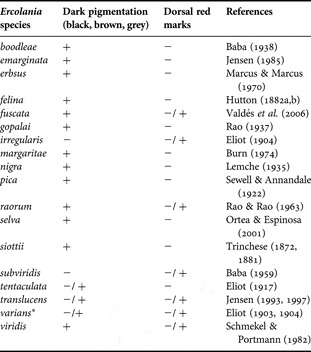
Sacoglossan pigmentation patterns are summarized (Table 2) for cladophoracean and boodleacean filament feeders. Based on this character, our undescribed, pigmented Ercolania sp. 3 from Honshu (Figure 1F) does not match any of the type descriptions for Pacific or Indo-Pacific species. On the one hand, this species may represent an introduction of Atlantic species (e.g. Ercolania fuscatus (Gould, 1870) or Ercolania viridis (A. Costa, 1866)). The proximity of the two collections to international ports (Seto Inland Sea and Tokyo Bay ports) and low abundance of specimens (N = 3) make this hypothesis realistic. On the other hand, these specimens may represent an undescribed species. Other specimens (Figure 1C, D) may be Ercolania annelyleorum Wägele et al., Reference Wägele, Stemmer, Burghardt and Händeler2010 described from tropical Australia. One species (Figure 1E), however, does not match any Ercolania species described to date (Table 2).
Dark and/or red pigmentation in described Ercolania species that consume cladophoracean and boodleacean green algae.

*, Eliot (Reference Eliot and Gardiner1903) erroneously called this species Hermaea minor but the error was corrected by Eliot (Reference Eliot1904) and Marcus & Marcus (Reference Marcus and Marcus1970).
Ercolania sp. 2 looks superficially similar to Ercolania coerulea (Trinchese, 1893). Although the juveniles of E. coerulea in Florida fed on filamentous algae (Jensen, Reference Jensen1983), this was not reported for Hong Kong populations (Jensen, Reference Jensen, Morton and Dudgeon1985) or the Japanese ones (this study). We do recognize a different species as E. coerulea in Okinawa, feeding on Dictyosphaeria cavernosa and Valonia aegagropila. Dictyosphaeria is a monostromatic saccate alga with thick cell walls (not filamentous); Valonia forms clumps or domes of enormous cells. Although these algal genera do belong to the order Siphonocladales, they are in different families (Siphonocladaceae and Valoniaceae, respectively) from those considered in this paper and are characterized, generally, by a different guild of sacoglossans. Ercolania sp. 2 has unbranched digestive diverticulae (rather than branched), substantially larger egg size, lecithotrophic larvae (rather than planktotrophic), and subtly different tooth shape. The parsimonious approach is to keep Ercolania sp. 2 separate from E. coerulea unless future compelling morphological and/or molecular evidence indicates they are congeneric ecotypes. Several colleagues consider that several distinct species have been lumped together under the name E. coerulea.
Finally, Ercolania sp. 1 was first observed by us in March 2005 and then by the first author in Taiwan in 2006. A similar species was subsequently collected from Boodlea in Australia and then described by Wägele et al. (Reference Wägele, Stemmer, Burghardt and Händeler2010) as E. annelyleorum. While we presume the Australian and Japanese specimens may be conspecific, the published species description of morphology was not sufficient for positive determination: it could have applied to several different undescribed species of Ercolania on Indo-Pacific or western Pacific shores. Hirano et al. (Reference Hirano, Trowbridge and Hirano2007) discussed the cryptic diversity within the genus within Japan. Premature lumping of species has contributed to taxonomic problems in many sacoglossan genera; thus, we consider the parsimonious approach is to consider that Ercolania sp. 1 may be E. cf. annelyleorum but should not be synonymized until definitive evidence is presented.
CONCLUSIONS
Four genera of sacoglossans contain some stenophagous species that feed exclusively or primarily on uniseriate filaments of septate green algae; three of these genera occur in Japan. One species of a fifth genus, namely Gascoignella, was ‘associated with’ green algae in Hong Kong although feeding experiments failed to demonstrate actual feeding on the species offered (Jensen, Reference Jensen, Morton and Dudgeon1985, Reference Jensen and Morton2003). At least ten described species and three undescribed species of sacoglossans occupy this trophic niche in Japan versus fewer species elsewhere (Table 1). Several of the sacoglossan species are locally abundant, particularly Ercolania boodleae and Aplysiopsis spp., analogous to those in other temperate regions. Little is known about the role of herbivory of this guild on Japanese shores and its ecological importance. However, in contrast to other regions (e.g. Connecticut and Florida, USA: Clark, Reference Clark1975; Jensen, Reference Jensen1983), algal hosts with larger filament size (i.e. larger cells) are not necessarily preferred by the sacoglossans. With a diverse suite of algal species in several sympatric genera, Japanese shores have more complex herbivore–algal interactions.
ACKNOWLEDGEMENTS
We thank our colleagues Clay Carlson, Patty Jo Hoff, Kathe Jensen, Dave Behrens, Ángel Valdés, Terry Gosliner, Hans Bertsch, Pat Krug, Heike Wägele, Bill Rudman and Vishal Bhave for their support and advice on sacoglossans worldwide. Our research benefited from valuable discussions with them about species' distributions, dispersal, morphology, feeding ecology, and the malacological literature. The paper was significantly improved by comments made by Kathe Jensen, Hans Bertsch, and Clay Carlson. We thank Yoshinori Kawano for kindly sending us the specimens of Elysia nigrocapitata.
This study was initiated with funding from the Women-In-Science Collaboration (WISC) program from AAAS/NSF (2002–2003) and the Japanese Society for the Promotion of Science (JSPS) Grant-in-Aid for Scientific Research C-15570073 (2003–2006).
Summary of radular tooth characters in Japanese sacoglossans and congeners elsewhere (based on the type descriptions and general literature) that are known to eat cladophoracean or boodleacean algae (based on references shown, Jensen Reference Jensen and Morton2003, or this study). Length of leading tooth for each species was estimated from line drawings if values were not provided.

n.d., no data.
Reproductive attributes of sacoglossans that feed on filamentous green algae.