Introduction
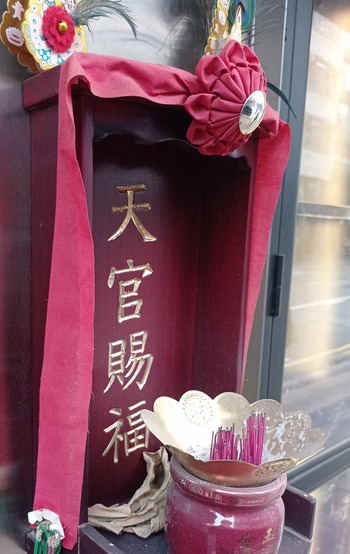
The Scripture of the Three Offices (Sanguan jing 三官經, hereafter, Scripture) is an early modern Daoist text devoted to the Officers of Heaven (Tianguan 天官), Earth (Diguan 地官), and Water (Shuiguan 水官). Known for conferring blessings (cifu 賜福), pardoning sins (shezui 赦罪), and averting disasters (jie'e 解厄), this exalted triumvirate has played an important role in Daoist rituals since Han times.Footnote 1 During the Song the gods begun to enjoy considerable prestige among the population in general. The Three Offices continue to be worshipped in contemporary China. Figure 1 shows an altar for the Celestial Officer in Hong Kong. Not surprisingly, recent decades have witnessed a renewed interest in the Scripture. According to Schipper (Reference Schipper2004b: 1226–7), the text has “existed at least since Yuan times (1279–1368) and possibly even during the Southern Song (1127–1279)”. The extant editions of the Scripture nevertheless date back to the Ming and Qing dynasties.Footnote 2 These materials were circulated among emperors, princes, officials, eunuchs, women of above-average social status, and commoners.Footnote 3
Altar for the Celestial Officer, Hong Kong, Shanghai Street. Photo: Bony Schachter, 10 January 2021.

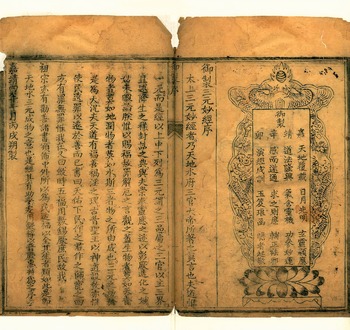
The scholarly study of the Scripture contemplates two equally legitimate possibilities. The first consists of examining the scriptural text with an interest in Song–Yuan religion and society. The second concerns comparing extant editions with a focus on the late imperial period. Following the latter proposition, this article examines the authenticity of Jiajing's (Zhu Houcong 朱厚熜, 1507–67) preface to the Scripture, which is shown in Figure 2. The corresponding edition from the Ming period is no longer extant. The imperial preface is preserved in the Commented Explanation of the Scripture of the Three Offices (Sanguan jing zhujie 三官經註解, hereafter, Explanation), which is an unstudied reprint produced in 1876.Footnote 4
Jiajing's Preface. Source: National Library of China.

Admittedly, the empirical relevance and the very authenticity of Jiajing's preface cannot be taken at face value. Accordingly, the first section of this article discusses the Explanation's provenance with a view to pinpointing the relationship between this reprint and local society. The second section offers a comparison between the Explanation and Ming editions of the Scripture. Relying on this comparison, the third section examines three aspects of the preface that support its authenticity: (1) its description of the physical and paratextual aspects of Jiajing's lost imperial edition; (2) its stance on local religious narratives; and (3) its relationship with Jiajing's early political and scholarly concerns. The article pays special attention to how Jiajing makes use of classical sources to subsume the Scripture under imperial authority.
Although it is central, authenticity per se is not the main issue addressed in this article. In examining the authenticity of Jiajing's preface, the article discusses the role of Daoist resources in shaping Ming imperial discourses on rulership. While previous scholarship has paid considerable attention to Jiajing's involvement with court Daoists (Geiss Reference Geiss, Mote and Twitchett1988: 479–82; Wang Reference Wang2012: 182), there is a paucity of studies on how Ming emperors gave written articulation to the role of Daoism in governing. Existing scholarship approaches Ming rulership from a variety of perspectives, including its legal (Wu and Jiang Reference Yanhong and Yonglin2007: 25–59), iconographical (Ching Reference Ching and Robinson2008: 321–64), and intellectual (Ditmanson Reference Ditmanson2017: 430–49) aspects. Ditmanson (Reference Ditmanson2017: 431) effectively argues that Neo-Confucian doctrines offered a contentious model of rulership, which set the Ming stage for inevitable tensions between emperors and scholars. This article demonstrates that Jiajing's preface to the Scripture was written by a young emperor keen to establish his authority vis-à-vis recalcitrant court officials and scholars. More specifically, his preface to the Scripture posits the imperial person as the final arbiter of imperial morality and advances a highly idiosyncratic interpretation of Daoist and Neo-Confucian texts.
1. Provenance
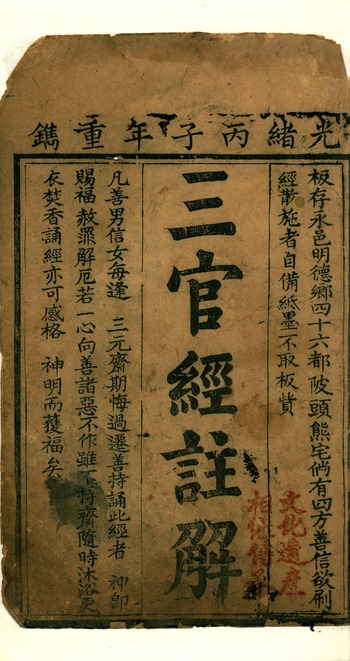
The documental value of Jiajing's preface rests in its significance to understanding key aspects of how Daoism and court politics intertwined during the Ming dynasty. However, a textual examination of the imperial preface must take into consideration several elements of philological importance. The preface's provenance is one of these elements. Despite being a Qing edition, the Explanation is the sole exemplar of the Scripture to record Jiajing's preface. This reprint provides significant evidence on how the interaction between affluent lineages contributed to shaping the material aspects of religious books in nineteenth-century rural Jiangxi 江西. Figure 3 shows its inner cover, which records important information about the Explanation's place and date of composition:
光緒丙子年重鐫
存板永邑明德鄉四十六都陂頭熊宅。
Reprinted in the bingzi year [1876]Footnote 5 of the Guangxu [reign].
Print blocks preserved in the residence of the Xiongs, [which is located near to] the end of the weir, in the forty-sixth block of Mingde district, in Yong county.
The Explanation's inner cover. Source: National Library of China.

The aforementioned “Yong county” must point to Yongfeng county 永豐縣, in Ji'an prefecture 吉安府, Jiangxi. According to the Yongfeng County Gazetteer (Yongfeng xian zhi 永豐縣志, hereafter, Gazetteer), Yongfeng county was thus named in 1054 (G. 2.6).Footnote 6 Mingde district was one of Yongfeng's five rural districts (xiang 鄉); the others were Longyun 龍雲, Xingping 興平, Qianying 遷鶯, and Yongfeng 永豐 (the administrative seat of the county, corresponding to a walled city). Together these five districts “totaled fifty-three blocks [du 都]”.Footnote 7 Mingde district comprised blocks 38 to 53 (G. 1.7), which matches the paratext translated above. The paratext also mentions a weir (bei 陂). In Mingde alone there were 91 weirs, out of a total figure of 692 weirs (G. 4.1–16). The Gazetteer offers a hydrographic chart that demonstrates how the five rural districts were connected to one another, forming an arterial-like network. This irrigation system played a critical role in the production of silk, rice, wheat, sugar cane, cotton, tea, paper, and a large variety of bamboo species, among other agricultural products (G. 5.7–14).
Simultaneously, Yongfeng's irrigation system co-existed with a temple network formed by more than 350 buildings. Most temples were post-Tang buildings located on the sacred mounts of Yongfeng. The county was home to a variety of local cults. In the vicinities of the residence of the Xiongs (Xiongzhai 熊宅), where the print blocks of the Explanation could be found, there was a temple devoted to the Perfected Lord Xu 許真君 (G. 8.8). As the patron saint of Jiangxi, this local god dominated the landscape, with at least 23 temples devoted to him (G. 8.6, 8). In the adjacent areas, there were two temples dedicated to the Three Offices (G. 8.8). The walled city was the seat of imperial altars (tan 壇) dedicated to the Earth God (sheji tan 社稷壇), the Gods of Wind, Clouds, Thunder, Rain, Mountains, and Rivers, 風雲雷雨山川, the First Farmer 先農, Wenchang 文昌, and Guandi 關帝. This arrangement occurred in all counties of Ji'an prefecture.Footnote 8 The unrequited souls could find solace during the Qingming 清明, an occasion on which salvation rituals were conducted in front of Yongfeng's Altars for Baleful Spirits (litan 厲壇). These altars were established in 1381 (Hongwu 14),Footnote 9 when the first Ming emperor “reforms his City Gods vis-à-vis the Eastern Peak, and the City Gods are made to relate institutionally to the autonomous spirits of local communities by establishing the Altar for Baleful Spirits” (Meulenbeld Reference Meulenbeld2015: 138). In addition, the 38 academies (shuyuan 書院) of Yongfeng were places of learning cum worship of exalted scholars and ancestors. The Gazetteer proudly notes that “From the Song onwards, commentators say that the talented men from Ji'an are the foremost under heaven, while the best among them come from Lu[ling], Ji[shui], and Yong[feng]”.Footnote 10 Some academies and shrines worshipped Ouyang Xiu 歐陽修 (1007–1072), Yongfeng's greatest symbol of intellectual accomplishment. The county's worship of the Song scholar received Jiajing's recognition in 1530 (G. 10.19).
Ouyang Xiu left many learned descendants, but other families claimed a similar cultural status. Late Qing Yongfeng was a complex of multi-lineage villages comprising more than 100 surnames. The Xiongs 熊, the Chens 陳, and the Nies 聶 were among the most culturally relevant of these families. Apart from producing presented scholars and court officials, these three families practised intermarriage, thus securing land control, political influence, and social status. These families also donated land to temples and monasteries, and constructed bridges,Footnote 11 administrative buildings, academies, and shrines. Prominent ancestors of these three families received worship in the walled city. The City God Temple of Yongfeng displayed altars devoted to its most remarkable officials, including the County Magistrate (xianling 縣令) Chen Ziren 陳自仁 and Xiong Yanming 熊彥明 (fl. 1132) (G. 8.11), an official of the same rank. About Xiong Yanming it is said that:
熊彥明,樂平人,本邑遇源裔。紹興二年壬子知永豐。舊志訛建炎三年,今照秋官表更正。時賊寇謝小兒等嘯衆破撫之崇仁,乘勢侵邑。彥明率民兵出境擊之。勢不敵力,戰而死。邑民立像祀焉。
Xiong Yanming was a person from Leping; he descended from Yuyan, in the present county. In Shaoxing 2 [1132] he became the prefect of Yongfeng. The old gazetteer erroneously records the year of Jianyan 3 [1129], which is now rectified according to the Table of Officials. At that time, the bandit Xie Xiao'er and others incited the masses to destroy Chongren, in Fuzhou [撫州]; taking advantage of the situation, they invaded [Yongfeng] county. [Xiong] Yanming led his militia to exit the border and attack them [i.e. the invaders]. [Xiong's] military strength could not counter the enemy's force, so that he died in battle. The people of [Yongfeng] county erected a statue in order to sacrifice to him.Footnote 12
The righteous death of the martyr Xiong Yanming guaranteed his posterity. As attested in the Gazetteer, the Xiongs continued to produce scholars until the late Qing.Footnote 13 The Xiongs also fabricated and stored the print blocks of the Explanation, which they made available free of charge:
倘有四方善信欲刷經散施者,自備紙墨,不取板貲。
If there are kind devotees from the four quarters who would like to print the Scripture in order to distribute and donate it, they must bring their own paper and ink; no costs will be charged for the [use of the] print blocks.
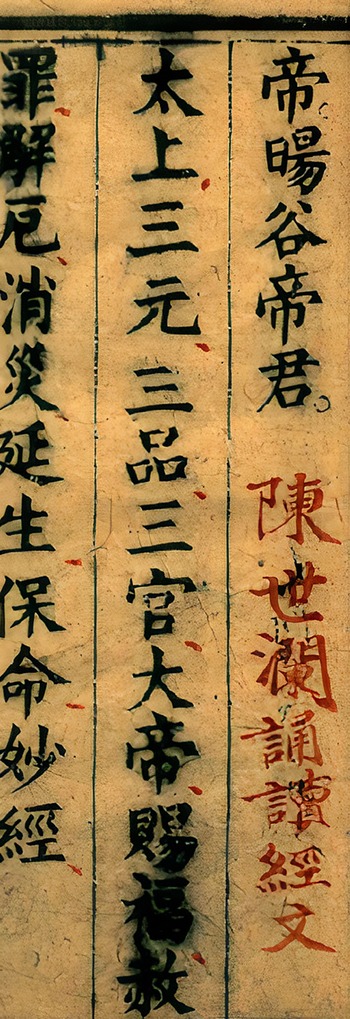
The Chens were a heterogenous lineage hailing from various parts of China. The Song magistrate Chen Ziren, the foremost among the Chens, was a native from Putian 莆田 who also received worship in the Kuixing Pavilion 魁星閣 (G. 10.36). The Shrine of Loyalty and Justice (Zhongyi ci 忠義祠) rendered cult to 73 members of the Chens who sacrificed their lives for Yongfeng (G. 8.12). This clan built the Zhongshan Academy 中山書院 (G. 33.34). The extant copy of the Explanation was owned by the Chens, who established a ritual relationship with the Scripture. According to the handwritten annotation shown in Figure 4, “Chen Shilan recited the scriptural text”. The otherwise unknown Chen Shilan 陳世蘭 also piously wrote down in red ink the corresponding characters of a blurred line on page 44a. In fabricating this copy of the Scripture, the Chens seemingly chose the so-called bamboo-paper (zhuzhi 竹紙), which was one of the many types of paper produced in Yongfeng for a diversity of clients, including literati, priests, and merchants (G. 5.24).
Chen Shilan's handwritten annotation. Source: National Library of China.

The Explanation preserves a long commentary in 4,847 characters attributed to the otherwise unknown Daoist priest Nie Shihao 聶士豪 (fl. 1691). The Nies hailed from Jinchuan 金川 (G. 33.37) in pre-Ming times, as attested in a record on the Shuangxi Bridge 雙溪橋, one of their architectural contributions to the landscape of Yongfeng. From the Yongle (1402–24) onwards, the Nies became the greatest patrons of a Buddhist complex centred upon the Northern Pagoda (beita 北塔; G. 8.31). The walled city of Yongfeng displayed a shrine devoted to the Ming dynasty Minister of War 兵部尚書 Nie Bao 聶豹 (1487–1563),Footnote 14 the most prominent among the Nies (G. 8.11). An inscription celebrating the Shrine of the Village's Virtuous Ones (Xiang xian ci 鄉賢祠), also devoted to his memory (G. 33.88–9), describes the Nies as a “prominent clan” (wangzu 望族) of Yongfeng (G. 33.88). According to the Gazetteer, Nie Bao was second in scholarly achievement only to Ouyang Xiu. Celebrated throughout southeast China for his Neo-Confucian scholarship, for establishing academies, and for his career in anti-corruption, Nie Bao composed inscriptions, letters, grave epitaphs, and poetry.Footnote 15 A disciple of Wang Shouren 王守仁 (1472–1529), he authored treatises on self-cultivation and Mind Learning (xinxue 心學).Footnote 16 In 1567 the emperor conferred upon Nie Bao the posthumous title Zhenxiang 貞襄. His descendants included the likes of Nie Minwen 敏文, Nie Youshan 有善, Nie Jing 靜, and Nie Fangsheng 芳聲, who managed to become officials and presented scholars.Footnote 17
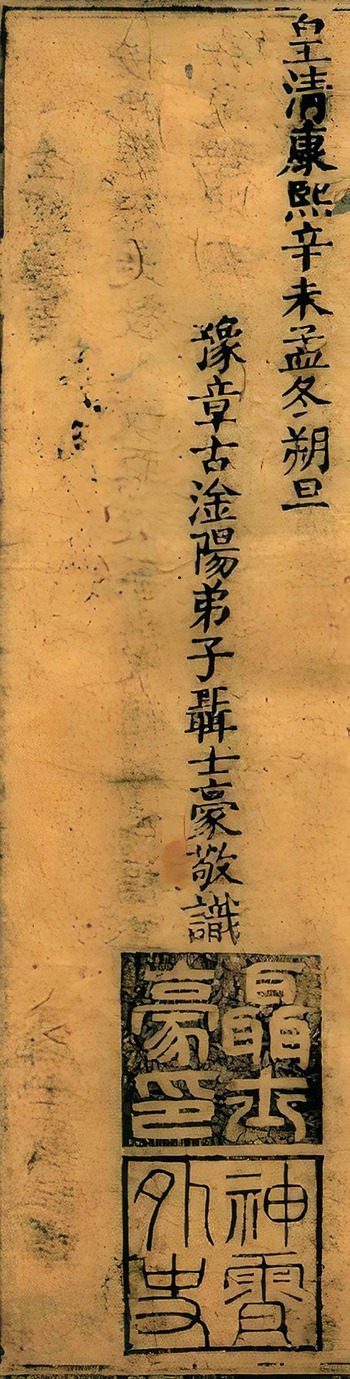
Nie Shihao signs his preface as the “disciple from the southern part of Gugan, in Yuzhang [i.e. Jiangxi] 豫章古淦陽弟子”. Gugan was located in Xiajiang county 峽江縣, which during the late imperial period was part of Linjiang prefecture 臨江府. Dated to the first day of the tenth lunar month of 1691, the preface reproduces two seals. Figure 5 shows that the first seal reads “Nie Shihao's seal 聶士豪印”, while the second identifies the Daoist priest as the “Outer emissary of the Divine Empyrean 神霄外吏”. Largely associated with Thunder Rites (leifa 雷法), in this case the term Divine Empyrean (Shenxiao 神霄) may be a toponym for Mount Jade Basket (Yusi shan 玉笥山). The early Ming scholar Hu Yan 胡儼 (1360–1443) dedicates the following poem to Mount Yusi:
佳哉古淦邑
有山鬱岧嶢
昔年隆玉笥
芳名標神霄
有峰高插天
Gugan, so magnificent!
It has steep murky mountains!
Since times of yore, the magnificent Jade Basket,
Whose fragrant name was recorded as the Divine Empyrean,
Had peaks so tall as to trespass Heaven!Footnote 18
Nie Shihao's seals. Source: National Library of China.

The term Divine Empyrean in Nie's seal and the reference to Gugan suggest that Nie Shihao studied Daoism on Mount Yusi, located in Xiajiang county. Although Nie Shihao never achieved fame as a Confucian scholar, the affluent families of Yongfeng would immediately associate his name with the Nies. Nie's commentary, of great significance for ritual theories, must be discussed in another contribution. His edition of 1691 is no longer extant. It is impossible therefore to ascertain whether or not the imperial preface was part of its paratextual structure. However, the fact that Jiajing's preface may be found in the Explanation suggests that imperial editions – or at least copies of such editions – could and did circulate among non-imperial circles of Ming–Qing society. The prestigious ties between Yongfeng's local elites and the Ming court makes this possibility highly likely. Although it is impossible to know whether Nie Shihao consulted a Ming imperial edition of the Scripture, a comparison between the Explanation and Ming editions demonstrates that the former derives its basic paratextual structure from the latter. The following sections explore extant editions in terms of their paratextual affinities and discrepancies.
2. Comparing editions
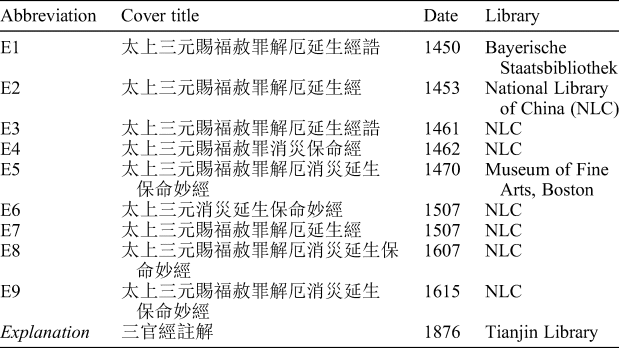
The paratextual structure of the Explanation demands a comparison between this Qing edition and extant Ming exemplars. In addition, the plausibility of Jiajing having commissioned an edition of the Scripture must be assessed in relation to the editorial history of the text during the Ming dynasty, for which paratextual materials provide ample evidence. Although more than 20 editions of the Scripture are known to exist (Wang Reference Wang and Chunwu2020: 206–8), a selection of ten editionsFootnote 19 should suffice for our goals (see Table 1).
A selection of editions

The long and pompous title Wondrous Scripture of the Three Primes Who Confer Blessings, Pardon Sins, and Dissipate Disasters Protecting the Allotted Lifespan, Prolonging Life, and Vanishing Disasters, [Revealed by the] Most High (Taishang sanyuan cifu shezui jie'e xiaozai yansheng baoming miaojing 太上三元賜福赦罪解厄消災延生保命妙經) consistently occurs at the beginning and at the end of the scriptural text in all editions. This book title must reflect a priestly standpoint. As a paratext, this scriptural title performs at least three functions. First, it portrays the text as a wondrous scripture (miaojing 妙經), i.e. a work of divine authorship.Footnote 20 Second, it marks the limits of the scriptural text, differentiating it from the surrounding paratextual apparatus. Third, it summarizes the narrational and theological framework of the Scripture. It appears on the covers of E5, E8, and E9. The variant titles seen on the covers of other editions represent formal solutions found by anonymous artisans. The Explanation's title emphasizes its nature as an exegetical work.
All editions are illustrated, but a proper analysis of their stylistic and iconographic features would go beyond the goals of this article. With the exception of the Explanation, which is a Qing dynasty thread-bound edition (xianzhuangben 綫裝本), all extant editions date back to the Ming and follow the concertina format (jingzheben 經折本). E5 and E9 are exquisite manuscripts in indigo paper and golden letters (nijin xieben 泥金寫本) dating back to the Chenghua 成化 (28 February 1464–9 September 1487) and the Wanli 萬曆 (19 July 1572–18 August 1620) reigns. As discussed later, Jiajing's lost edition did not follow the same format. All the other exemplars are printed editions of average quality and inferior materials, such as bamboo-paper.
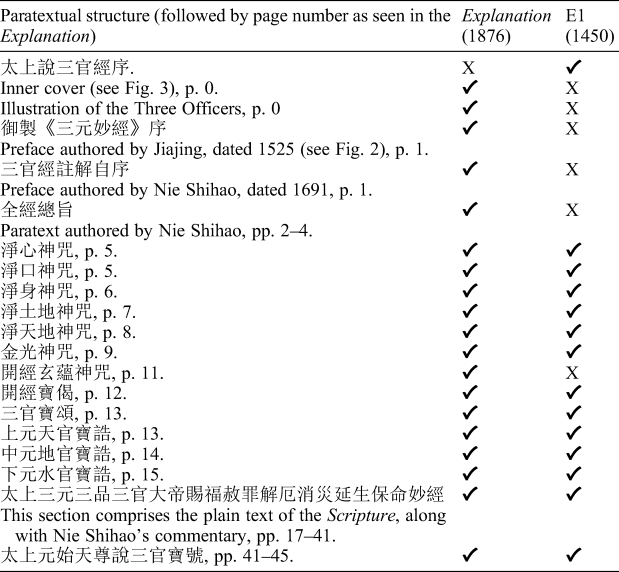
Regardless of dimensions, paper, and overall quality, all editions record the same ritual apparatus, which includes instructions on how to recite the Scripture and various divine incantations (shenzhou 神咒). Obviously, these Ming editions were designed as devotional objects for recitation. As importantly, according to Jiang (Reference Yanhong and Yonglin2007: 86) some editions were found inside Daoist statues. This means that editions of the Scripture could be used as auspicious items in the context of consecration (kaiguang 開光) rituals.Footnote 21 Remarkably, the Explanation displays the same ritual apparatus of Ming editions (see Table 2). The fact that our 1876 reprint produced in Jiangxi and a 1450 edition printed in Nanjing share the same ritual apparatus suggests that the Explanation descends from Ming editions, even if in an indirect manner.
Comparison between the Explanation (1876) and E1 (1450)

The paratextual evidence also suggests that the editorial history of the Scripture during the Ming dynasty follows a bottom-up pattern. The text's absorption in imperial circles was preceded by its ample diffusion in various regions of China. It is important to notice, for example, that the Celestial Master Zhang Yuchu 張宇初 (1359–1410)Footnote 22 did not incorporate the Scripture into the Daoist Canon of the Zhengtong Reign (Zhengtong Daozang 正統道藏), which was printed in 1444 under Shao Yizheng's 邵以正 (1368–1463) supervision (Schipper and Verellen Reference Schipper and Verellen2004: 32). Similarly, the early Ming prince Zhu Quan 朱權 (1378–1448) does not mention the Scripture in the Jade Slips of Great Clarity (Taiqing yuce 太清玉冊), his magnum opus dated to 1444.Footnote 23 The earliest extant exemplars of the Scripture include a Suzhou prefecture 蘇州府 edition printed in 1449Footnote 24 and a Nanjing edition (E1) produced in 1450. As noted by Franke (Reference Franke1977: 207–8), the latter's miracle tales mention the year of 1384 (Hongwu 17) and the Sichuan area. This means that the Scripture may have been circulated among Sichuanese devotees at least 66 years before its earliest surviving exemplars were printed in southern China. Therefore, the evidence suggests that the text became popular among Ming subjects as early as the Hongwu reign.
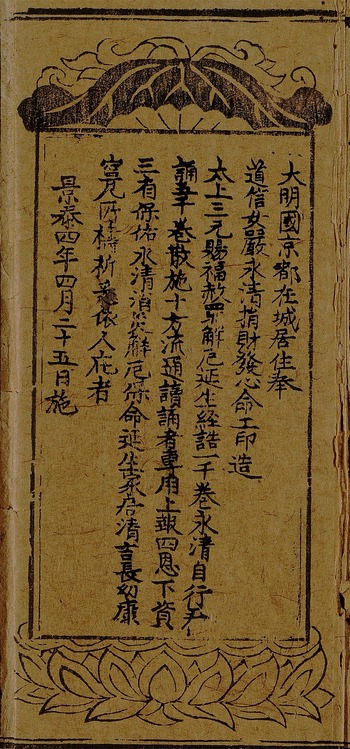
The text made its way to the capital a few decades later. Commercial workshops in Beijing printed more than 15,000 copies of the Scripture between the Jingtai 景泰 (22 September 1449–11 February 1457) and the Zhengde 正德 (19 June 1505–20 April 1521) reigns.Footnote 25 The corresponding editions record carefully designed colophons. Although stylistic variations do exist, the colophons of extant editions always assume the form of a votive plaque that sits above a lotus flower. Figure 6 shows that the plaque is graciously protected by what resembles a pumpkin leaf. These colophons celebrate the miraculous powers of the Scripture.
Colophon. Source: National Library of China.

In 1453 a woman named Yan Yongqing 嚴永清 had a total of 6,000 copies of the Scripture printed. Of these, 5,000 were printed for distribution throughout the realm. Yan wished to “repay above the four kindness and below benefit the three existents”,Footnote 26 as well as to “preserve the allotted lifespan and prolong life”.Footnote 27 The Scripture could satisfy more specific demands. In 1461 lady Yin 尹氏 had 1,000 copies of the Scripture printed in Tianshun prefecture 天順府, where many temples devoted to the Three Offices could be found. She did so in order to fulfil a promise she had made in a moment of distress, when her husband, the official (Guan 官) Zhu Jieyi 朱傑意, could not find his way back home from the Huguang 湖廣 regions. This edition “repays above the realm's grace and below it benefits fortunate ones in the abyssal realms”.Footnote 28 In 1462 Wan Zheng 萬政 and Wan Duo 萬鐸 had 1,000 copies of the Scripture printed in a workshop located in Xuanwu Road 宣武街, Tianshun Prefecture, on behalf of their sickened mother.Footnote 29 In 1507 a villager from Shanxi 山西 named Jiao Lian 焦璉 had 10,000 editions printed in Daxing 大興 (Beijing), “because his father got ill” and he wanted to heal him miraculously.Footnote 30
The Jingtai–Zhengde interval also saw the appearance of the first imperial edition of the Scripture, which was printed in 1470,Footnote 31 i.e. during the Chenghua reign. This was followed by princely editionsFootnote 32 and Jiajing's edition of 1525. Not surprisingly, the inclusion of the Scripture into an imperially sponsored collection is a comparatively late phenomenon. During the Wanli reign, the Celestial Master Zhang Guoxiang 張國祥 (fl. 1607) and the Quanzhen priest Zhou Xuanzhen 周玄貞 (1555–1627) included the text into the Supplement to the Daoist Canon (Xu Daozang 續道藏), dated to 1607. Epigraphic evidence shows that Zhou performed several Imperial Offerings (Huangjiao 皇醮) on Mount Wufeng 五峰山 (located in Shandong 山東), when the emperor Wanli (Zhu Yijun 朱翊鈞, 1563–1620) showered that important cultic centre with gifts in silver, not to mention innumerable editions of the Scripture and other Daoist texts (Schachter Reference Schachter2018: 1–86). In 1615 Wanli commissioned a manuscript edition of the Scripture and wrote a preface in praise of the power of the scripture (jingli 經力).Footnote 33
Evidently, Jiajing was not the first or the last emperor to have an edition of the Scripture printed. In addition, two aspects of the evidence deserve further examination. First, Ming editions of the Scripture preserve paratexts that present the Three Officers as local gods. Second, these paratexts prompted a variety of elite responses. In a sense, imperial editions constitute a response to the conflation between the Three Officers and local deities. Despite this observation, imperial patronage of Daoist scriptures cannot be subsumed under a general principle that would apply indiscriminately to all Ming emperors. Chenghua, Jiajing and Wanli printed the same text, but not for the same reasons. The following translates Jiajing's preface and situates it against its historical context.
3. Examining Jiajing's preface
The year 1525 marks Jiajing's initial rapprochement with Daoist institutions. The Veritable Records (Mingshilu 明實錄) mentions his first notable interaction with Daoists as happening on 26 April 1525, when the emperor “dispatched Daoist priests of the Divine Music Abbey so that they could perform sacrifices in homage of former Sages and emperors of previous reigns in their respective mausoleums”.Footnote 34 In the same year, Jiajing had the Palace of the Great Compassion that Extends Blessings (Daci yanfu gong 大慈延福宮) refurbished.Footnote 35 Devoted to the Three Offices, the temple was first built in 1481. The emperor wrote his preface to the Scripture on 16 October 1525:
御製《三元妙經》序
《太上三元妙經》者,乃天地水府三官大帝所著也。夫道惟一元,而是經以上、中、下列爲三元,謂之三品,屬之三官,以主三界,且述降生之祥,封誥之典,與夫崇奉靈應之跡,以彰厥造化之妙。姑未暇論,朕惟以賜福赦罪解厄之言觀之。蓋生物者莫如天,養物者莫如地,潤物者莫如水。斯三者,物之所由成也。三元之功於是為大,況夫天道有福善禍淫之理。古昔聖王以神道設教亦惟使民遠罪以遷於善而已。《書》曰:天佑下民。作之君。作之師。寵之四方。有罪無罪惟我在。又曰:斂時五福用敷錫厥庶民。故我祖宗亦有勸善諸書,頒佈中外,所以爲民造福,以全其生者。類如此,是卽天地水成物之意也。是經其有助乎!爰用鋟梓以普厥惠,并為之序。
嘉靖四年十月丙戌朔製
Imperial Preface to the Wondrous Scripture of the Three Primes
The Wondrous Scripture of the Three Primes [Revealed] by the Most High was authored by the Grand Thearchs of the Three Offices of Heaven, Earth, and Water. Now, the Path is the One Prime, which this Scripture arrays as Three Primes, the Superior, the Intermediary, and the Inferior Ones; they are called the Three Qualities; they belong to the Three Offices, so as to preside over the Three Realms. In addition, [this Scripture] describes the details about [the Three Offices’] incarnation and birth, and the precedents supporting their canonization and proclamations of honours; offering miraculous accounts about the numinous responses to its worship and reverence, [this Scripture] displays the wonders of the creation-transformation. Not proffering idle disquisitions [on these matters] for the time being, I consider it [i.e. the Scripture] merely for its words on the conferment of blessings, the pardoning of sins, and the dissipation of calamities. For when it comes to generating beings, nothing compares to Heaven; when it comes to nurturing beings, nothing compares to Earth; when it comes to nourishing beings, nothing compares to Water. These Three engender all things. In that, the merits of the Three Primes are great, and how much greater [are the merits of] the Celestial Path, which works according to the principle of blessing the good and punishing the wicked! The ancient Sage-Kings established the teachings according to the divine Path; indeed, their sole goal was driving people away from sinFootnote 36 in order that they move towards what is good. The Book of Documents says: “Heaven helps the inferior people, making for them rulers, and making for them instructors, who are favoured throughout the four quarters. As for who has sins and who has no sins, I am the only one [who may decide it]”. It also says: “[The sovereign] concentrates the five blessings, extending and conferring them upon the multitudes of his people”. Therefore, our ancestors likewise created books for encouraging what is good, which were distributed inside and outside [the realm]. [These books] are the means through which blessings are created for the people, in order to replenish their lives. Similarly, this is precisely the purpose of Heaven, Earth, and Water when creating [the myriad of] beings. This Scripture is of great assistance!Footnote 37 I thenFootnote 38 had it printed,Footnote 39 so as to concede its favour all around the realm, andFootnote 40 composed this preface.
Composed on the first day of the tenth month of the fourth year of the Jiajing reign.
Comprising 265 characters, the short and yet significant preface translated above provides relevant data on the paratextual and physical aspects of Jiajing's lost edition of the Scripture. The sentence “the precedents supporting their canonization and proclamations of honours” points to the Precious Declarations (baogao 寶誥) of the Three Offices. This is what Jiajing means by the term “precedents” (dian 典). As Schipper (Reference Schipper2004b: 1227) puts it, these “onomastic formulations contain not only the canonical tides of the gods, but also list their many attributes, as well as, in some cases, elements of their hagiography”. The Precious Declarations describe the bureaucratic structure of the Three Offices. For example, the Precious Declaration of the Celestial Office of the Superior Prime (Shangyuan Tianguan baogao 上元天官寶誥) claims that “Within the Original Luminosity of the Mysterious Capital, a myriad of 90 million [officials] from the thirty-six Departments in the Palace of Purple Tenuity collate the [books of life and death] of many thousands of worlds”.Footnote 41 This paratext may be found in all extant editions of the Scripture (see Table 2), including the Explanation.
There are noteworthy discrepancies between the paratextual structure of the Explanation and Jiajing's description of his own edition. Jiajing claims that his edition offers “miraculous accounts about the numinous responses to its worship and reverence”. This is an obvious reference to miracle tales, which the Explanation nevertheless does not record. In claiming that “[this Scripture] describes the details about [the Three Offices’] incarnation and birth”, the emperor means that his edition recorded the Introduction to the Scripture of the Three Primes, Revealed by the Most High (Taishang shuo Sanguan jing xu 太上說三官經序, hereafter, Introduction). Apart from E8 and E9, all extant Ming editions of the Scripture preserve the Introduction. The fact that Jiajing mentions the Introduction and miracle tales while the Explanation does not record such paratexts is indirect evidence supporting the authenticity of the imperial preface. Obviously, Jiajing's preface is not a posterior falsification meant to enhance the Explanation's prestige in the face of well-educated Qing readers.
The Introduction, to be found in most Ming editions of the Scripture, disseminates an intriguing story about the origins of the Three Officers. The three deities are the offspring of a somewhat improper relationship between a certain Chen Lang 陳郎, also known as Chen Zichun 陳子春, and his divine consorts, who were no less than the three daughters of the Dragon King (Long Wang 龍王).Footnote 42 Each daughter bore one of the Three Officers. The elder daughter bore the Celestial Officer (Tianguan 天官). The middle daughter gave birth to the Terrestrial Officer (Diguan 地官). The youngest of the three bore the Water Officer (Shuiguan 水官). This is just one of the many stories surrounding the human origins of the Three Officers (Wang Reference Wang and Chunwu2020: 210–20).Footnote 43 Suffice it to note that the Introduction portrays the Three Officers as personal gods who teach commoners how to recite the Scripture:
至七月初一日,有三人道士送此經一本,來教隆孫讀誦。此道士乃三官大帝,下世救民,教誦此經。
On the first day of the seventh lunar month, there appeared three Daoist priests who delivered one copy of this Scripture; they came in order to teach LongsunFootnote 44 how to recite [the Scripture]. These Daoist priests are the Grand Thearchs of the Three Offices who, descending into the world to save humankind, instruct [humanity] in the recitation of this Scripture.Footnote 45
According to the corresponding miracle tale, this happened between 1384 and 1385, when scriptural recitation miraculously healed a Sichuanese family. A testament to what Lagerwey (Reference Lagerwey2019: 29–102) terms the temple-centric society, the Introduction urges all sectors of society to support temples, donate statues, construct bridges, repair roads, and print scriptures. These meritorious actions guarantee salvation and propitiate prosperity, good health, and progeny. Even the poor are guaranteed “wealth and power in the next life”.Footnote 46 What is at stake here, however, is not the exploitation of the poor but the social status of generous donors who support temple networks. Although the Introduction suggests a connection with the Sichuanese context, the paratext was widely circulated in Beijing editions. Accordingly, Ming editions aggressively advertise the merits of their otherwise anonymous patrons, whose private, familial, and personal demands are presented as a matter of social and even national consequence. Scriptural patronage could and did elevate the social prestige of less visible elements of Ming elite society. As importantly, the Introduction did not pass unnoticed by Ming emperors and their immediate circles.
The Scripture's ample dissemination among various levels of late imperial society enraged Buddhist competitors and Confucian official-scholars of fundamentalist proclivities. In his Record on the Refurbishing of the Temple of the Three Offices (Chongxiu Sanguan miao ji 重修三官廟記), the official He Tang 何瑭 (1474–1543; jinshi 進士, 1502) castigates the Scripture as a spurious text. Composed in 1531, the text celebrates the refurbishing of a temple in Wuzhi County 武陟縣, Henan 河南. He Tang does not explicitly oppose temple networks or the worship of the Three Offices. His attacks are directed against the local narratives articulated in the Introduction:
謂陳氏子娶龍女生三子,俱有神通。一為天官,一為地官,一為水官,可謂恠誕之甚矣。
[The Scripture] claims that a son from the Chens took the daughters of the Dragon king as wives. They bore three sons, all of whom had divine powers. The first became the Celestial Officer, the second became the Terrestrial Officer, and the third became the Water Officer. One may say that this is extremely absurd!Footnote 47
He Tang obviously read the Introduction. The scholar defines the Scripture as a “mundane and vulgar narrative” (shisu zhi shuo 世俗之説), a text that may irresponsibly transform the worship of the Three Offices into a licentious cult (yinsi 淫祀). He Tang interprets the Scripture as an attack against what he terms the Rites (li 禮). Although not approving of the Scripture, he concedes that the worship of the Three Offices may cohere with the Rites if it follows a sacrificial paradigm:
夫人之所以祀天官者,謂其分我以神且覆我也。所以祀地官者,謂其分我以形且載我也。所以祀水官者,謂其分我以血脉且出雲而生百物以養我也。
People must sacrifice to the Celestial Officer, for He conferred spirits upon us and He overshadows us; they must sacrifice to the Terrestrial Officer, for He conferred bodily forms upon us and He sustains us; they must sacrifice to the Water Officer, for He conferred blood arteries upon us and He produced clouds and generated the hundred beings in order to nourish us.Footnote 48
He Tang urges that those who sacrifice (si 祀) to the Three Offices do so in order to express gratitude for their spirit (shen 神), form (xing 形), and blood arteries (xuemai 血脈).Footnote 49 He subsumes this ritual model under the rubric of “expressing gratitude to the source and returning to the beginning” (bao ben fan shi 報本反始). The locus classicus of this statement is the Record of Rites (Liji 禮記). The corresponding passage documents the ancient sacrifice to the Earth-Altar (sheji 社祭). He Tang would like to refashion the worship of the Three Offices as a symbolic variation of the territorial cult of the Earth-God (she 社). He Tang saw the Introduction's narrative, the ritual framework of the Daoist Offering (jiao 醮),Footnote 50 and the Scripture's promises of scriptural power as real dangers imbued with disruptive social consequences. His argument portrays the Scripture in an unfavourable manner, but it also pays testimony to the ubiquitous presence of the temple network as a successful form of social organization. Not coincidentally, attacks against the Introduction also occur in the writings of Qing authors, who advanced a conflation between the Three Officers and ancient cultural heroes of Confucian origins.
Jiajing's stance on the Scripture lies somewhere between the full acceptance seen in lay editions of the Ming and the rejection of the likes of He Tang and other Confucian fundamentalists. The emperor explicitly defines the Scripture as one of the “books for encouraging what is good” (shanshu 善書).Footnote 51 Against the likes of He Tang and his comrades, in the subsequent years of his reign Jiajing increasingly relied on Daoists and their services. Court officials disapproved of the emperor's pronounced interest in Daoism (Geiss Reference Geiss, Mote and Twitchett1988: 479), but Jiajing, on the other hand, saw no conflict whatsoever between Daoist patronage and his functions as the supreme ritual authority of the church-state.Footnote 52 The Jiajing emperor, who had “to cope with what was by far the world's most demanding political responsibility” (Dardess Reference Dardess2016: 1), saw the patronage of Daoist temples and scriptures as part of his governing responsibilities. Unlike He Tang, the emperor did not fully reject the Introduction. This attitude may reflect Jiajing's due respect for his subjects’ awe-inspiring gods, who “were at once far more powerful than the imperial state, and also more intimately engaged in the lives of their subjects”, as claimed by Richard von Glahn (Reference von Glahn and Lagerwey2004: 804).
However, similarly to He Tang, Jiajing shows reticence against the Introduction's hagiographical account of the Three Officers. Concerning this issue, the emperor chose not to proffer “idle disquisitions [on these matters] for the time being”. Challenging the Introduction, the emperor depicts the Officers of Heaven, Earth, and Water as generational principles of impersonal nature, instead of personal gods with a tragic human background: “These Three engender all things”. This claim subtly dismisses local narratives that personalize the Three Officers as historical individuals. In other words, Jiajing's edition of the Scripture absorbed and reinterpreted local narratives, now dismissed in favour of an imperial cosmology of the Three Officers as impersonal principles. What is more, Jiajing advances the notion that the imperial person is the sole principle responsible for the realm's order.
This notion seemingly contributed to determining the physical aspect of Jiajing's lost edition. Chenghua and Wanli commissioned lavish manuscript editions of the Scripture for personal use. Jiajing, on the other hand, commissioned a printed edition: “This Scripture is of great assistance! I then had it printed, so as to concede its favor all around the realm, and composed this preface.” Apparently, the emperor wanted his interpretation of the Scripture to be widely disseminated among his subjects. Prior to 1525, Jiajing had to cope with various obstacles to his authority, including the ever-present threat represented by the gods of the people and unco-operating officials.
Addressing the latter, the preface portrays Jiajing as a Sage-King who partakes in Daoist divine agency. This portrayal entails an imperial reaction to court politics. Jiajing affirms that “I consider it [i.e. the Scripture] merely for its words on the conferment of blessings, the pardoning of sins, and the dissipation of calamities.” In explaining what the text means by “pardoning sins” and “conferring blessings”, the emperor resorts to the Documents (Shangshu 尚書). More specifically, in order to substantiate his claims about why the Scripture is a morality book, what is “moving towards good”, and why the imperial person has supreme agency over moral matters, Jiajing quotes from two passages of the Book of Zhou 周書, a subdivision of the Documents.Footnote 53
The first passage is to be found in the Great Harangue (Taishi 泰誓). The second passage stems from the Great Plan (Hongfan 洪範). As is widely known, both passages concern events that allegedly happened during King Wu's 武王 reign (1046–1043 bce). Scholars agree that the Great Harangue and other parts of the Documents were redacted long after King Wu's demise (Kern Reference Kern, Lagerwey and Kalinowski2009: 146). Just as importantly, Kern (Reference Kern, Lagerwey and Kalinowski2009: 151) argues that the early speeches attributed to King Wu are “genuinely performative at their core”. During the whole imperial period, these speeches were part of a shared cultural patrimony, understood both as history (i.e. what happened in the past) and memory (i.e. how certain actors would like the past to be remembered), which partially explains their appropriation in Ming ritual paratexts such as the Canonization (Meulenbeld Reference Meulenbeld2015: 60–97). More importantly, Jiajing's interest for the Book of Zhou was not occasional.
During the first sixteen years of his reign, Jiajing held many audiences with his preceptors in order to discuss the Documents and other classics (Chu Reference Hung-lam and Robinson2008: 186–230). Robinson (Reference Robinson2008: 10) claims that during these lectures, Jiajing “periodically turned the tables on his instructors, taking the opportunity to lecture them on proper Confucian morality and correct rulership”. His interest in the Documents is attested as early as 1524.Footnote 54 Two months after issuing his edition of the Scripture, Jiajing had a new edition of the Great Plan printed as a separate book, when he proclaimed that “In the Book of Zhou, which is in the Documents, the chapters Against Luxurious Ease and the Great Plan with Imperial Commentaries by the Sagely Ancestor Footnote 55 represent the methods through which to rule the world.”Footnote 56 Throughout his reign, Jiajing presented many princes with fine editions of the Documents.Footnote 57 Now, apart from reflecting the emperor's early interest for the Documents, the preface also construes Jiajing's rulership in terms that are reminiscent of recent political and ritual conflicts.
The first passage of the Documents quoted by the emperor revolves around the ancient notion of pardoning sins (shezui 赦罪): “Heaven helps the inferior people, making for them rulers, and making for them instructors, who are favoured throughout the four quarters. As for who has sins and who has no sins, I am the only one [who may decide it].” The second passage concerns the notion of five blessings (wufu 五福): “[The sovereign] concentrates the five blessings, extending and conferring them upon the multitudes of his people.” The emperor's interest in sins and blessings demands explanation.Footnote 58 Admittedly, these are highly malleable terms. In a Daoist context, ritual transgressions practised by priests qualify as sins.Footnote 59 As importantly, Verellen (Reference Verellen2019: 5–7) identifies four cultural models informing early Chinese notions of sin, liability, and redemption: the court, juridical, economic, and occult models. This classification allows scholars to identify the variety of metaphors at stake in Daoist discourses about sins and salvation. Consider the following passage of the Scripture:
天官曰:轉誦此經,至滿千遍,大作踴躍,悔過愆尤,斷惡修善,即有地官赦罪,所有惡孽愆尤。
The Celestial Officer said: when one recites this Scripture one thousand times with great joy and happiness, repents from his sins and faults, refrains from practising evil deeds and cultivates what is good, then the Terrestrial Officer will immediately pardon his sins and all his wicked offences and faults.Footnote 60
Verellen's cultural models do not constitute self-contained categories. The passage translated above, for example, amalgamates the administrative and the occult models. The Terrestrial Officer is a bureaucrat and the ultimate source of human pardon. However, his pardon works according to invisible processes laid out in early Daoist scriptures. Since ancient times, Daoists have resorted to rituals in order to achieve divine pardon for their sins (Kleeman Reference Kleeman2016: 164). The Scripture understands sins as a variety of moral offences, social abuses, and acts of humiliation: the intelligent person who deceives the mentally impaired, the strong who bully the weak, the rich who oppress the poor, the politically powerful who harm the destitute. Whether or not these sins applied to the imperial person is highly debatable. Court Daoists would certainly welcome the emperor's interest for Daoist lore. Daoist ritual cosmologies seemingly offered no mechanisms through which to curb imperial arbitrariness. Similarly, Shao Yuanjie's example shows that court Daoists thirsty for imperial patronage offered little or no resistance to imperial agency. For these ritual specialists, Jiajing's exegetical accuracy was of no consquence. Therefore Jiajing's interpretation of the Scripture is highly idiosyncratic.
The young emperor saw in the Scripture but a useful resource through which to advance his own project. However, the malleability of Daoist resources and the welcoming attitude of court Daoists presupposed a dangerous balance-of-power game. While apparently approving of the Scripture, Jiajing must establish the boundaries of Daoist authority. Accordingly, his rhetorical manoeuvres represent an attempt at establishing the precedence of the imperial person over Daoist institutions. In quoting from the Documents, Jiajing reinterpreted the Scripture in the light of a Confucian classic while simultaneously legitimizing his political excesses.
Jiajing's scholarly audience would be able to identify immediately the locus classicus of the two passages quoted in his preface. Modern scholars, on the other hand, need to rely on a painstaking comparison of primary sources in order to understand fully the political implications of his rhetorical choices. In this regard, the entirety of the original passages proves as important as the quoted sentences. In its original context, the first passage quoted by Jiajing corresponds to the following harangue (shi 誓):
Now Heaven, to protect the inferior people, made for them rulers, and made for them instructors, that they might be able to be aiding the Thearch on High,Footnote 61 and secure the tranquility of the four quarters of the empire. In regard to who are criminals and who are not, how dare I give any allowance to my own wishes? “Where the strength is the same, measure the virtue of the parties; where the virtue is the same, measure their righteousness.” Shou has hundreds of thousands and myriads of ministers, but they have hundreds of thousands and myriads of minds; I have three thousand ministers, but they have one mind. The iniquity of Shang is full. Heaven gives command to destroy it. If I did not comply with Heaven, my iniquity would be as great. “I, who am a little child, early and late am filled with apprehensions. I have received charge from my deceased father Wen; I have offered special sacrifice to the Thearch on High; I have performed the due services to the great Earth; and I lead the multitude of you to execute the punishment appointed by Heaven. Heaven compassionates the people. What the people desire, Heaven will be found to give effect to. Do you aid me, the one man, to cleanse for ever all within the four seas. Now is the time! – It may not be lost.”Footnote 62
In quoting from the Harangue, Jiajing advances a juxtaposition between himself and King Wu. In Legge's translation, the passage quoted by Jiajing reads: “In regard to who are criminals and who are not, how dare I give any allowance to my own wishes?” Interestingly, the imperial preface quotes a variant version seen in Mengzi 孟子, which is slightly different. Not surprisingly, the Mengzian version emphasizes imperial authority and agency: “As for who has sins and who has no sins, I am the only one [who may decide it].”Footnote 63 As importantly, the sentence quoted by Jiajing in his preface is not the central passage of the Harangue in question. Arguably, the central passage of that text is: “Shou has hundreds of thousands and myriads of ministers, but they have hundreds of thousands and myriads of minds; I have three thousand ministers, but they have one mind”. Upon reading Jiajing's preface to the Scripture, his well-educated audience would immediately associate the passage quoted by the emperor with the central message of the Harangue. Shou's 受 foremost sin was being unable to establish complete agreement between himself and his officials. The various levels of government must work in harmony with the imperial will. Reading this passage in its entirety, it is impossible not to think about Jiajing's violent crackdown on the Great Rites remonstrators during 1524, which resulted in the death of 16 officials and the imprisonment of hundreds.Footnote 64 The second quotation confirms this preliminary impression.
The second quotation, from the Great Plan, narrates a dialogue between King Wu and Jizi 箕子, the wise preceptor once imprisoned by Shou. Jizi explains to King Wu the nature of the Great Plan and its nine divisions:
“Of those divisions, the first is called ‘The Five Phases’;Footnote 65 the second is called ‘The Reverent Practice of the Five Businesses’; the third is called ‘Earnest Devotion to the eight objects of Government’; the fourth is called ‘The Harmonious Use of the five Arrangements’; the fifth is called ‘The Establishment and Use of Royal Perfection’; the sixth is called ‘The Discriminating Use of the three Virtues’; the seventh is called ‘The Intelligent Use of the Examination of Doubts’; the eighth is called ‘The Thoughtful Use of the various Verifications’; the ninth is called ‘The Hortatory Use of the five Happinesses, and the Awing Use of the six Extremities’.”Footnote 66
The passage quoted by Jiajing concerns one of the nine divisions. More specifically, it concerns the fifth division, namely, “the establishment and use of royal perfection”:
The sovereign having established his highest point of excellence, he concentrates in himself the five happinesses, and then diffuses them so as to give them to his people: – then on their part the multitudes of the people, resting in your perfection, will give to you the preservation of it. That the multitudes of the people have no lawless confederacies, and that men in office have no selfish combinations, will be an effect of the sovereign's establishing his highest point of excellence. Among all the multitudes of the people, when any have counsel, and conduct, and keep themselves from evil, do you bear them in mind; those who do not come up to the highest excellence, and yet do not involve themselves in crime, let the sovereign receive; and when a placid satisfaction appears in their countenances, and they say – “Our love is fixed on virtue”, do you then confer favours on them. Those men will in this way advance to the perfection of the sovereign. Do not oppress the friendless and childless; do not fear the high and illustrious. When men have ability and administrative power, cause them still more to cultivate their conduct, and the prosperity of the country will be promoted. All right men, having a competency, will go on to be good. If you cannot make men have what they love in their families, they will only proceed to be guilty of crime; while they do not love virtue, though you confer favours on them, they will involve you in the guilt of employing them thus evil.Footnote 67
The Great Plan defines the five blessings in the following terms: “The first is long life; the second, riches; the third, soundness of body and serenity of mind; the fourth, the love of virtue; and the fifth, fulfilling to the end the will (of Heaven)”.Footnote 68 The passage above complements the passage from the Harangue. While the latter emphasizes unequivocal agreement among the ruler and his subjects as the political summum bonum, the Great Plan establishes the conditions through which this supreme goal may be achieved. The passage explicitly portrays the ruler as the ultimate source of blessings. It easily allows interpretations that understand the emperor as the final arbiter of moral matters. The ruler's moral perfection is supposed to produce agreement and political unity. Relying on spatial metaphors of verticality, the imperial person purportedly emanates blessings that engender social order and discourage wicked actions. Jiajing's quotation establishes a contrast between the classical notion of blessing recorded in the Great Plan and Daoist notions of blessing as seen in the Scripture, which entails divine agency. The emperor sequestered terminological resemblances in his own favour.
Like the Celestial Officer, Jiajing distributes blessings. As the Terrestrial Officer (Diguan 地官), the emperor has the ability to pardon sins (shezui 赦罪). What is more, in quoting from the Documents, Jiajing claims that the imperial person has precedence over divine agency. In quoting from the passages above, the emperor portrays himself as a wise and just Sage, the ultimate source of blessings and the sole authority in matters of pardon. Against Daoists, Jiajing consolidates his authority by establishing a hierarchical relationship between the imperial person and the Daoist gods. Against court officials and scholars, Jiajing offers claims that differ dramatically from the Neo-Confucian interpretations of imperial agency. The imperial person is central both to Neo-Confucian attempts at controlling imperial agency and to Jiajing's personal interpretation. However, making use of a Daoist resource, Jiajing made it clear to his subjects that the imperial person is the final arbiter of moral matters and the ultimate source of blessings, pardons, and punishments. Jiajing's discourse on rulership revolves around long-established notions about the role of divine interference in history and morality. The skilful juxtaposition of classical and Daoist sources was the rhetorical manoeuvre through which the emperor justified his governing style following the 1524 crackdown. In the face of unco-operative officials, he acted like King Wu and resorted to violence to re-establish the Middle Kingdom's lost harmony. On the one hand, Jiajing avoided Shou's sin. On the other, his brutality was but the administration of Heaven's justice, for the emperor partook in the Three Offices’ divine agency.
The preface of 1525 evidences the beginnings of a long-lasting relationship between Jiajing and Daoism. After 1525, the emperor built and refurbished Daoist temples throughout the realm, many of which were devoted to the Three Offices. Additionally, he was identified as the incarnation of the Daoist priest Chunyi daoren 純一道人 (Wang Reference Wang2012: 149–50). Not coincidentally, princely patronage to Daoism achieved its highest point during the Jiajing reign.Footnote 69 Future studies of Jiajing's patronage to local temples should touch upon one of the most fundamental questions of Daoist studies, namely, whether Daoism accomplished a religious revolution in China (Lagerwey Reference Lagerwey and Tim2013: 459–71), but this topic must be explored in another contribution.
Conclusion
This article examined the authenticity of Jiajing's preface to the Scripture with a view to exploring Ming imperial discourses on rulership. The first section discussed the preface's provenance, and demonstrated that the imperial paratext is recorded in the Explanation, an 1876 reprint of the Scripture produced in Jiangxi. The presence of an imperial preface in a reprint produced in rural Jiangxi may be hypothesized in terms of the close ties between local elites and the Ming court. The second section offered a comparison between Ming editions of the text and the Explanation. It demonstrated that the Explanation and extant Ming editions share the same ritual structure. This section also showed that the plausibility of Jiajing having an edition of the Scripture printed is explained by the text's popularity in Beijing, as well as the precedent set by the Chenghua emperor. The third section offered a translation and detailed examination of Jiajing's preface. This examination focused on philological and historical issues, which support the preface's authenticity. The preface's description of Jiajing's lost edition differs significantly from the paratextual structure of the Explanation. This suggests that the imperial preface is not a spurious falsification. Unlike other Ming emperors, Jiajing produced a printed edition of the Scripture, not an exquisite manuscript. This choice of format must be contextualized in relation to the unique discourse on rulership advanced in the imperial preface. The Scripture offered to the young emperor a resource through which to posit himself as the ultimate arbiter of moral matters, which is a reaction to literati attempts to limit imperial power. In this early phase of his life, Jiajing was an avid reader of the classics. The imperial preface, on the other hand, pays testimony to early signs of his strong interest in Daoism. Quoting from the Documents, the young emperor modelled himself on King Wu and advanced an interpretation of the Scripture according to which the imperial person has the monopoly over moral and soteriological matters. Partaking in Daoist divine agency, Jiajing portrayed rulership as a matter of applying punishments against those who perpetrate the sin of political disagreement. In printing his edition of the Scripture, Jiajing found atonement for his Neo-Confucian sins in a disputable interpretation of a Daoist text.
 for hu 乎.
 for yuan 爰.
 for qin 鋟.
 for bing 并.