Introduction
Delirium is a serious neuropsychiatric disorder that often occurs in frail older people (Lipowski, Reference Lipowski1990; Inouye et al., Reference Inouye, Westendorp and Saczynski2014). It is characterized by an acute and fluctuating disorder of attention and cognition, usually accompanied by disturbances of awareness, concentration, memory, thought process, perception, and sleep-wake cycle. There are often multiple underlying somatic disorders. Delirium is associated with an increased risk of dementia, accelerated cognitive decline in Alzheimer's disease, (re)hospitalization, admission to a nursing home, and mortality (Pitkala et al., Reference Pitkala, Laurila, Strandberg and Tilvis2005; Fong et al., Reference Fong2009; Witlox et al., Reference Witlox, Eurelings, de Jonghe, Kalisvaart, Eikelenboom and van Gool2010). Early detection of delirium is elementary for timely treatment of underlying somatic causes and appropriate delirium care (Lipowski, Reference Lipowski1990).
However, under-recognition of delirium is a stubborn obstacle to adequate care in clinical settings (Han et al., Reference Han2009; Clegg et al., Reference Clegg, Westby and Young2011). It often is taken for dementia or depression. This is likely to be true for patients living at home as well. Although an early epidemiological study of delirium in a general elderly population reported a prevalence as low as 1% (Folstein et al., Reference Folstein, Bassett, Romanowski and Nestadt1991), more recent studies reported prevalence rates between 10%–35% in older patient groups (Sandberg et al., Reference Sandberg, Gustafson, Brännström and Bucht1998; Sandberg et al., Reference Sandberg, Gustafson, Brännström and Bucht1999; Fick et al., Reference Fick, Kolanowski, Waller and Inouye2005; Eriksson et al., Reference Eriksson, Gustafson, Fagerström and Olofsson2011; de Lange et al., Reference de Lange, Verhaak and van der Meer2013). In recent Dutch and Japanese studies, delirium was present in 16%–19% of elderly outpatients referred to a memory clinic of a psychiatric hospital (Stroomer-van Wijk and Luijendijk, Reference Stroomer-van Wijk and Luijendijk2011; Hasegawa et al., Reference Hasegawa2013). Lack of referral to a somatic setting might suggest under-recognition of delirium in these outpatients.
To recognize delirium early in outpatients and to distinguish it from dementia, it is important to know with which symptoms delirium presents in these patients. Possibly, older patients living at home have a rather mild presentation of delirium and relatively “innocent” underlying illness. Also, high overlap with symptoms of dementia and hypoactive symptomatology impede recognition (Voyer et al., Reference Voyer, Richard, Doucet and Carmichael2009; Hölttä et al., Reference Hölttä2011). To the best of our knowledge, no study has been published that describes the clinical presentation of delirium in elderly outpatients. We therefore decided to perform an explorative study using data from medical files. The aim of our study was to investigate referral characteristics, symptom profiles, and underlying somatic disorders of delirium in elderly outpatients referred for cognitive evaluation to a center for old age psychiatry.
Methods
Design and setting
We performed a case-control study among patients of an outpatient department for old age psychiatry in The Hague, the Netherlands. In the period between January 1st and July 1st, 2010, a total of 551 patients aged 55 years and older were referred for psychiatric evaluation and treatment. Of these 551 patients, 275 were referred for cognitive evaluation.
As part of a special program to improve detection and treatment of delirium, a psycho-geriatrician (ASW) checked the referral data of the 275 patients for risk factors and signs of possible delirium (Stroomer-van Wijk and Luijendijk, Reference Stroomer-van Wijk and Luijendijk2011). Whenever the information was insufficient to rule out a current or recent episode of delirium, a psychiatric nurse contacted a family member or caregiver shortly after the referral. She interviewed them by phone using a semi-structured checklist to solicit features of delirium.
If one or more delirium symptoms were reported, a geriatrician (ASW) or psychiatric resident (BWJ) visited the patient at home within two working days after referral. They performed a psychiatric and somatic examination and ascertained or ruled out delirium. The assessments were discussed in weekly multidisciplinary meetings, in which at least a geriatrician, a neuropsychologist and a psychiatric nurse participated.
Cases and controls
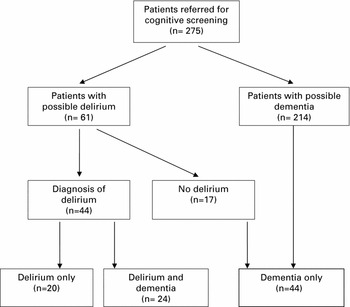
Diagnoses for delirium and dementia were made according to DSM-IV criteria (American Psychiatric Association, 2000). Delirium was diagnosed in 44 (16%) of the 275 patients referred for cognitive evaluation (Stroomer-van Wijk and Luijendijk, Reference Stroomer-van Wijk and Luijendijk2011). In addition to a prior diagnosed DSM-IV dementia, we considered a hetero-anamnestic report of persistent cognitive impairment during more than half a year prior to the first assessment as indicative of dementia comorbid to delirium. Twenty patients had delirium only, and 24 had delirium with comorbid dementia.
For each of the delirium cases, the first consecutively referred patient diagnosed with dementia only was selected as a control. Thus, cases and controls originated from the same outpatient population (see Figure 1). They were all aged 70 years or older and lived at home or in a home for the elderly.
Flow chart.

Measurements
Data for this study were abstracted from the patients’ medical files. These contained a referral letter, the telephonic interview with a caregiver, a comprehensive history as reported by a caregiver or family member during the home-visit, results of psychiatric and somatic in-home assessments, the scores on the Mini-Mental State Examination (MMSE) (Folstein et al., Reference Folstein, Folstein and McHugh1975), results of standardized blood and urine tests performed as part of the intake procedure, and additional information from the general practitioner (GP), hospital based specialists, and home care reports.
Characteristics at referral
We recorded age, sex, place of living, medical history including chronic diseases, physical impairments, prior episodes of delirium, (any) hospital admissions in the three months preceding the referral, and number and type of medications used at the time of referral. We also abstracted which health professional had referred the patient, the referral reasons and requests for an urgent visit within 1 to 7 days.
Delirium symptoms
We used the Delirium Rating Scale-Revised-98 (DRS-R-98) to systematically chart the cognitive, psychiatric, and behavioral symptoms and signs as described in the medical files (Trzepacz et al., Reference Trzepacz, Mittal, Torres, Kanary, Norton and Jimerson2001). The DRS-R-98 consists of 13 items for type and severity of delirium symptoms. Each item ranges from absent (0) to present (1–3). The maximum total severity score is 39 points. The additional items assess temporal onset (0–3), fluctuation of symptom severity (0–2) and presence of a physical disorder (0–2). Symptoms can be rated using all available sources, and a time frame between one day and several weeks depending on the goal of the assessments (Trzepacz et al., Reference Trzepacz, Mittal, Torres, Kanary, Norton and Jimerson2001; Meagher et al., Reference Meagher, Adamis, Trzepacz and Leonard2012). The DRS-R-98 distinguishes delirium only and delirium superimposed on dementia from dementia only well in hospital populations (de Rooij et al., Reference de Rooij2006; Meagher et al., Reference Meagher, Leonard, Donelly, Conroy, Saunders and Trzepacz2010).
The DRS-R-98 ratings in this study covered not only all reported symptoms that had been present at the time of our initial assessment but also all symptoms reported by family and caregivers that had occurred as from the day of the first delirium features.
Underlying physical disorders
We categorized physical disturbances in six groups: drugs/intoxication, infection, metabolic and endocrine disturbances, cardiovascular disorders, central nervous system disorders, and other health problems. We rated the degree to which a physical disorder or a drug could have contributed to the development or persistence of the delirium symptoms according to the instructions of the DRS-R-98 item “presence of physical disorder”: 0 = not present or active, 1 = might affect the mental state, 2 = can specifically be implicated in causing the altered behavior or mental state (Trzepacz et al., Reference Trzepacz, Mittal, Torres, Kanary, Norton and Jimerson2001). For instance, well-controlled diabetes was scored as “1”, a poorly regulated diabetes as “2”.
Statistical analysis
First, we assessed which patient characteristics and psychiatric symptoms were distinctive of delirium compared to dementia. This may depend on whether delirium is superimposed on dementia or not. We therefore compared the patients with delirium only (20) and the patients with delirium and dementia (24) to patients with dementia only (44). We used the two-sample test of proportions and t-test for means to determine statistical significance at a 5% level where appropriate. We compared the proportions of patients with a score of 1, 2, or 3 on an individual DRS-R-98 item, because the presence of a symptom is more informative to verifying a diagnosis and the means were not distributed normally. We did not perform multivariate analysis, because it is likely that some factors are associated (for instance sleeping disorders and hallucinations) and they would cancel each other out.
Next, we investigated which physical disorders could have contributed to delirium in outpatients. Although it is common practice to distinguish between predisposing (contributory) and precipitating (triggering) factors for the development of delirium, this distinction was hard to make at the time of our first in-home assessment. Many patients had multiple disorders most of which might have been present for some time before delirium onset, or which might have occurred after onset of delirium (but before first assessment) as a complication of delirium. Therefore, for each of the six groups of somatic disorders, we calculated the percentage of patients with disorders that might have affected the mental state or that could specifically be implicated (combined), and compared the proportion among delirium patients (44) with the proportion among patients with dementia only (44). Again, we used the two-sample test of proportions to determine statistical significance at a 5% level. Statistical analyses were performed with STATA 13.0.
Results
The total study population consisted of 88 patients including 20 patients with delirium only, 24 patients with delirium and dementia, and 44 patients with dementia only (Table 1). At the time of the first in-home assessment, 28 of the 44 delirium patients met all DSM-IV criteria for delirium. The other 16 had passed through an episode of full DSM-IV delirium shortly before the assessment. As they still had one or more core symptoms of (resolving) delirium, they were classified as DSM-IV delirium not otherwise specified. On average, delirium symptoms had started 3.7 weeks before referral (range 1 day–12 weeks).
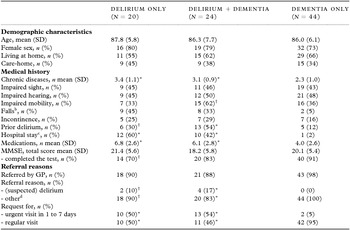
Patient characteristics at referrala

GP: general practitioner, SD: standard deviation.
aMost information was provided at referral, and some gathered during the first assessment.
bWithin last two weeks.
cWithin last three months.
dSuch as (suspected) dementia/consultation.
*p value < 0.01 as compared to dementia only group.
†p value < 0.05 as compared to dementia only group.
Characteristics at referral
Table 1 shows the demographic characteristics, medical history, and referral reasons for the three study groups. Age, gender and place of living in the three groups were comparable. A hospital stay in the last three months before referral had occurred in almost half of the delirium patients, versus once in the dementia group. The mean number of medications and chronic diseases were significantly higher in the two delirium groups than in the dementia group. Most study participants, including those with delirium, were referred for evaluation of (suspected) dementia. An urgent visit within one to seven days had been requested for 23 of 44 delirium patients, and for only three of 44 dementia patients.
Delirium symptoms
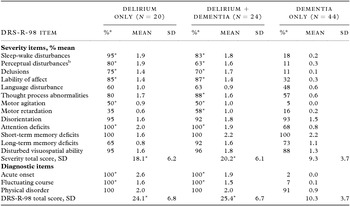
Table 2 presents the delirium symptom profiles according to DRS-R-98 items. Disturbances of the sleep-wake cycle were significantly more present in both delirium groups (95% and 83%) than in the dementia group (18%). Also the proportions of patients with perceptual disturbances (80% and 63%) and delusions (75% and 70%) were significantly higher in the delirium groups than in the dementia group (11% and 11% respectively). Perceptual abnormalities were mostly visual by nature. Acute onset and fluctuating course significantly distinguished the delirium groups from the dementia only group.
Neuropsychiatric symptoms scored with DRS-R-98

SD: standard deviation.
aProportion of patients with the symptom present at any degree (DRS-R-98 score 1–3).
bIncludes visual hallucinations, illusions, or misperceptions.
*p value < 0.01 as compared to dementia only group.
Both delirium groups had higher total DRS-R-98 severity scores than the dementia only group. In contrast, the differences between the two delirium groups seemed to be clinically small (not tested formally). The mean MMSE-score did not differ between groups but the proportion of patients able to complete the test was significantly lower in the delirium only group than in the dementia group.
Underlying physical disorders
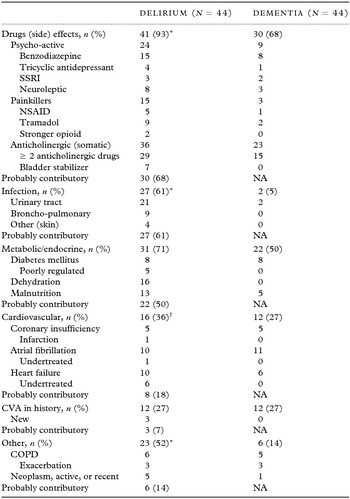
Most patients with delirium had multiple physical disorders and health problems from more than one category, which could have contributed to the development or persistence of delirium as presented in Table 3. The most common disturbances that were specifically implicated in delirium were effects of medications (68%), infections (61%), and metabolic disturbances (50%). In addition, many patients with dementia only (68%) used one or more medications known for their ability to affect mental functioning. The somatic treatment of most patients with delirium did not require hospitalization; 32 delirium patients (73%) were treated at home.
Probable and possible underlying somatic disturbances

NA: not applicable, CVA: Cerebro-Vascular Accident, COPD: Chronic Obstructive Pulmonary Disease.
*p value < 0.01 as compared to dementia only group.
† p value < 0.05 as compared to dementia only group.
Discussion
Among older patients who lived at home and were referred to an outpatient psychiatric center for cognitive evaluation, 16% had delirium. Symptom profiles in delirium patients with and without comorbid dementia were substantially different from those in patients with dementia only. The delirium features had started on average three to four weeks before referral. Potentially treatable somatic risk factors were present in almost all delirium patients, but also in many patients with dementia only.
As far as we know, this study is the first to address specifically the clinical profile of delirium in older patients living at home. Most delirium research so far has been conducted in clinical settings, and only a few studies have investigated delirium in the general elderly population (Lerner et al., Reference Lerner, Hedera, Koss, Stuckey and Friedland1997; Sandberg et al., Reference Sandberg, Gustafson, Brännström and Bucht1998; Fick et al., Reference Fick, Kolanowski, Waller and Inouye2005; Eriksson et al., Reference Eriksson, Gustafson, Fagerström and Olofsson2011). Some clinical studies reported symptom profiles of delirium in combined in- and outpatient care settings, but did not specify the results for outpatients (Sandberg et al., Reference Sandberg, Gustafson, Brännström and Bucht1999; Edlund et al., Reference Edlund, Lundström, Sandberg, Bucht, Brännström and Gustafson2007).
Clinical profile
The majority of the patients with delirium in our study had been referred for suspected dementia, and half of them had been referred without a request for urgent examination. Hence, it seems that referrers had difficulty recognizing delirium and distinguishing it from dementia. Moreover, the prevalence of 16% in our study is very similar to that of 19% in demented outpatients from a Japanese psychiatric center (Hasegawa et al., Reference Hasegawa2013). We think that these estimates are higher than health professionals in outpatient psychiatric settings might presume.
The DRS-R-98 has been demonstrated to distinguish delirium from dementia (Trzepacz et al., Reference Trzepacz, Mittal, Torres, Kanary, Norton and Jimerson2001). The differences between delirium and dementia in our patients consisted primarily of psychiatric and non-cognitive symptoms. However, disturbance of attention, generally assumed to be the cardinal symptom of delirium, was not only present in all delirium patients but also in two third of the dementia patients without delirium. Besides acute onset and fluctuating course, surprisingly, sleep-wake cycle changes appeared to be the most distinguishing feature between delirium and dementia: it was present in 83%–95% of the delirious patients and in 18% of the dementia only patients. Yet, it is not a core symptom in the DSM-IV and DSM-5 criteria for delirium. The presence of affect lability, also a symptom that occurred more frequently in delirium, in combination with sleep-wake cycle changes might explain why delirium can be misdiagnosed as depression.
The circumstances and health states of our patients, suffering from delirium in the setting of their own homes, are obviously very different from those of delirium patients in hospitals. Nevertheless, the DRS-R-98 symptom profiles showed similarities with two previous inpatient study populations, in particular in terms of the high frequency of attention disorders, cognitive symptoms, and sleep-wake cycle disturbances (Meagher et al., Reference Meagher, Moran, Raju, Gibbons, Donelly and Saunders2007; Mattoo et al., Reference Mattoo, Grover, Chakravarti, Trzepacz, Meagher and Gupta2012). On the other hand, psychotic symptoms occurred much more often in our delirious outpatients than in hospitalized patients (Meagher et al., Reference Meagher, Moran, Raju, Gibbons, Donelly and Saunders2007; Gupta et al., Reference Gupta, de Jonghe, Schieveld, Leonard and Meagher2008; Mattoo et al., Reference Mattoo, Grover, Chakravarti, Trzepacz, Meagher and Gupta2012). It is likely that cognitively impaired patients with psychiatric symptoms, whether or not related to delirium, had a higher chance of being referred to a psychiatric institution for screening. That delirium severity in our patients seemed comparable to that in inpatients can also be explained by this referral bias and by our method: We scored all symptoms that had occurred between onset of the delirium features and the first assessment (on average) a few weeks later, while inpatient scores are usually based on the previous 24–48 hours.
Delirium in hospitalized patients is often accompanied by obvious acute somatic illness, surgical interventions or life-threatening conditions. In contrast, in our delirious patients somatic problems seemed not to be considered prominent by their referrers. Nevertheless, most patients had numerous somatic disorders and medications that may have contributed to the development or persistence of the delirium. In the highly vulnerable and very old patients in our study, multiple relatively trivial disorders seemed to have triggered or facilitated the development of the delirium and interacted with underlying risk factors. This accords with the multifactorial model of delirium (Inouye and Charpentier, Reference Inouye and Charpentier1996). Striking was the high number of patients with potentially treatable disorders. As most of these disorders could be tackled in primary care, three quarters of the patients with delirium could be treated at home.
Notably, almost all delirium patients and three quarters of the patients with dementia used medication known for its ability to affect mental functioning. This may indicate room for prevention.
Strengths and limitations
A great advantage of our study is that it provides information about delirium in elderly outpatients, which has so far been under-researched. In addition, the data were extracted from well-documented medical files containing detailed information of cognitive and psychiatric symptoms in standardized formats. An experienced psychogeriatrician had examined most of the delirium patients (ASW) and extracted the data for this study. Family members and caregivers provided essential information to detect and diagnose delirium.
The clinical diagnoses of delirium and dementia had been made according to DSM-IV criteria through multidisciplinary consensus. We used the DRS-R-98, a validated and widely applied instrument, to document the presence and severity of individual delirium symptoms.
Our study has some limitations too. When studying the phenomenology and risk factors of delirium retrospectively some data may not have been collected in the same way for cases and controls. At the time the diagnosis was made, it is likely that the clinician was more thorough in collecting and recording data about the somatic status of the patient in cases than controls. The somatic data in the files were less well documented and the sources varied (physical examination, GP, family, specialist letters). On the other hand, both cases and controls received a detailed psychiatric examination to assess the presence, severity, onset, and course of psychiatric and cognitive symptoms. In addition, the caregivers and GPs of most cases were unlikely to be aware of the diagnosis when they reported the demographic variables, medical history and use of medication. We do not expect that these factors were reported differently for controls.
Additionally, although almost all patients were referred by GPs, the sample might not be representative for primary care settings, nor for hospital-based memory clinics. Nevertheless, risk factors and prognosis of delirium in outpatients need to be studied in larger cohorts longitudinally.
Our study showed that detection of delirium in a population of older, cognitively impaired patients living at home is feasible. Delirium is probably more common in vulnerable outpatients than family physicians, psychiatrists, and other mental healthcare professionals realize and they must remain vigilant for delirium signs and risk factors. As symptoms fluctuate and 24-hour observation is lacking, it is crucial to ask informal caregivers about the onset and course of cognitive, psychiatric, behavioral, physical, and functional changes. An adequate and explicit diagnosis of delirium will add greatly to appropriate, immediate, and comprehensive treatment, including the necessary in-home care, which may reduce the need for psycho-active drugs and hospitalization.
Conflict of interest
None.
Description of authors’ roles
ASW, BWJ, and HJL designed the study. ASW and BWJ collected the data. HJL performed the data-analysis. ASW and HJL interpreted the results and wrote the paper. RMK and RCM critically commented on study design and manuscript at multiple stages. All authors approved of the final version of the manuscript.