


On April 11, 1844, only three months after he announced his own candidacy for the United States presidency, the Mormon Prophet Joseph Smith was appointed “Prophet, Priest, and King” of a new secretive political organization that he believed was destined to rule the world. But even a theocratic monarchy required a governing structure. Therefore, a week later, the members of this religious and political body, the Council of Fifty, gathered together in their Mormon city-state on the banks of the Mississippi River, Nauvoo, Illinois, to discuss a new foundational text that would replace the American Constitution. “We, the people of the Kingdom of God,” started the document, in a curious combination of traditional republican language and theocratic principles. Though the new constitution was incomplete and required further revision, the delegates enthusiastically praised its general ideas. One participant, Ezra Thayer, remarked that “this [was] the greatest day of his life.”Footnote 1 The secretary of the council, William Clayton, noted in his journal that “it seems like heaven began on earth and the power of god is with us.”Footnote 2 Though relations with their Illinois neighbors had grown tense and the future seemed ambiguous, the new council made these Mormon leaders jubilant.
The Mormon constitution—drafted by and discussed in a clandestine political council that its members believed would someday act as a center for world government—was the culmination of increasingly radical political and theological developments over the previous decade. Five years earlier, Joseph Smith and his followers were expelled from Missouri by the threat of state-sponsored extermination, an episode that quashed their faith in local democratic order. At first, they tried to endear themselves to the national government and leverage the support of state parties. When those options failed, they simultaneously nominated Joseph Smith for president of America's democratic government and organized an embryonic theocracy. The Mormons refused to leave any option unexplored. Smith's critique of democratic governance—in which priestly leadership dictated populist participation, and revelatory law impelled political action—challenged the modern state's excision of ecclesiastical influence from civic control. The publication of this society's previously sequestered minutes provides scholars with an important and rare glimpse into this process.Footnote 3
In many ways, these were the actions of a radical fringe sect on the margins of the American experience. Yet they also expressed a broader anxiety over the nation's cultural disunity and democratic excesses. Traditional narratives of American political and religious expression have centered on the democratization process that eventually triumphed in the Protestant notion of a liberal republicanism.Footnote 4 Yet for figures and groups outside of the mainstream, the country's religious disestablishment invited chaos and mobocracy. Alexis de Tocqueville noted “the moral empire of the majority” was founded “on the principle that the interests of the greatest number ought to be preferred to those of the few.” While James Madison believed this division of factions was necessary for a functioning republic, Tocqueville warned that this “omnipotence of the majority” spelled “dire” and “dangerous” repercussions for those outside the center.Footnote 5 As a result, many sought alternative modes of sovereignty that would better preserve the liberties and rights for those under siege. This process inaugurated neither a clear nor a predetermined trajectory. Especially in the early nineteenth century, there was, according to one historian, “a steady escalation of rhetoric against as well as for democracy.”Footnote 6 Understanding how groups such as the Mormons grappled with the political and cultural implications of democratization and disestablishment—through orchestrated electoral participation, appeals to higher laws, and revisions to democratized authoritative structures—sheds light on the period.
I.
Before the creation of the Council of Fifty and the appointment of Joseph Smith as its “king,” the Mormons first experimented with various methods to secure political rights. Only a few years previous, Missouri residents expunged the Mormon church from the state after a series of violent clashes with non-Mormon neighbors. Tensions had simmered for some time, and the conflict escalated when a mob stopped Mormons from casting ballots in a local election. This in turn incited a number of violent acts on both sides. The governor, Lilburn Boggs, sought to end the dispute by issuing an executive order that declared that the Mormons “must be treated as enemies, and must be exterminated or driven from the State if necessary for the public peace.”Footnote 7 Simultaneously, a mob slaughtered seventeen Mormon men and boys in one of the most gruesome moments of the conflict. Joseph Smith and a handful of other leaders were jailed for six months and charged with treason, while the rest of their followers were forced to leave the state in the dead of winter. This form of frontier justice was common on the western edge of the United States, and Mormons learned not to trust local and state governments for their protection.Footnote 8 While Illinois welcomed them as refugees in the town of Quincy, they quickly sought both a new permanent settlement as well as federal redress. Not quite willing to eschew the American democratic structure yet, Smith and the Mormons instead looked for ways to use the system in their favor.Footnote 9
Once settled in the new town of Nauvoo, Smith tried to simultaneously maintain a rhetoric of neutrality while also offering allegiance to whatever politician promised help. While the Mormons had overwhelmingly supported William Henry Harrison's presidential run in 1840, they were not wedded to the Whig Party. In 1841, when Illinois was granted three new congressional seats, the saints in Nauvoo actively invited candidates to their city in order to hear their promises of political support. The politicians’ reward would be the entire Mormon vote.Footnote 10 This naturally aroused suspicion. The Democratic press accused Whig candidate John T. Stuart of trying “to palter to the Mormons,” despite the fact that their own nominee was doing the same thing. Such an action “portends some danger,” they warned, “when a candidate for congress, bargains in advance with any particular sect.”Footnote 11 Yet Mormons believed that bloc voting was the only way to preserve their rights and protect their interests in a democratic society. One Nauvoo resident explained to his non-Mormon father that while he “was never much of a politician,” this method of politicking was necessary. “We give our voats [sic] to the demmecrats [sic],” and due to their “great numbers” they could “gain” the influence they needed.Footnote 12 John Taylor, an apostle for the church and editor of its official newspaper, was forthright in stating Mormon aims. “It can serve no good purpose that half the citizens should disfranchise the other half,” he reasoned, “thus rendering Nauvoo powerless as far as politics is concerned.”Footnote 13 Onlookers noticed. The Niles National Register warned that the Mormons “have found out how to make a profitable market of this [voting] power,” as they had enough orchestrated votes “to give them the balance of power between parties in the state.”Footnote 14 The Mormons had discovered their route to political influence.
These methods grated against traditional forms of religious and political expression during the period. In the decades following the revolution and ratification of the United States Constitution, most Protestant sects incorporated principles of individual liberty and democratized authority as the key components of the public sphere. The evangelical impetus during the early republic, according to Nathan Hatch, eroded “respect for authority [and] tradition” and resulted in “the success of common people in shaping the culture after their own priorities rather than the priorities” of their leaders, whether ecclesiastical or political. The fundamental trajectory was “a liberating force” that “subverted centralized authority.”Footnote 15 And while ministerial influence was still common and indeed expected, preachers were expected to practice republican persuasion rather than ecclesiastical command. Many were successful. Especially on the frontier, Protestants became so dominant that they created, according to one historian, “a religious establishment by proxy” that allowed them to control the political culture and governance without direct clerical involvement.Footnote 16 Religious communities and institutions learned how to maximize influence through the private sphere because disestablishment had cut off avenues for public intervention. States throughout the nation, according to one legal analysis, “imposed discipline on religious institutions . . . based on concerns for individual conscience and lay control.” Governmental pressure supplemented the persistent idea that institutional churches should remain weak within the political sphere, even if their religious beliefs remained consequential.Footnote 17
Smith was therefore forced to construct a political language that fit within these expectations. For instance, he couched the church's political approach in the language of political “friendship,” a rhetoric that matched the period's emphasis on republican brotherhood and shared interests. If a politician promised friendly terms to the Mormons, he reasoned, the Mormons would in turn provide friendly support. “Judge [Stephen A.] Douglas has proved himself friendly to this people,” Smith declared concerning the congressional candidate who later became a much larger political figure.Footnote 18 When the Democrats nominated Adam Snyder for governor, Smith explained that he and his running mate, John Moore, “are known to be our friends,” and “their friendship is vouched for by those whom we have tried.” The language of “friendship” enabled the Mormons to discuss politics in terms of reciprocity and representative governance. They were not so much committed to party loyalty—“we care not a fig for Whig or Democrat,” Smith explained—but rather to personal loyalty: “we shall go for our friends, our TRIED FRIENDS, and to the cause of human liberty.”Footnote 19 The Mormons stayed true to their word. The 1842 state election in Nauvoo took place in the office of Hyrum Smith, Joseph Smith's brother and one of the leading authorities in the Church, where individual votes were carefully and singularly recorded in a ledger. Of the four hundred fifty-seven people who cast votes for local, county, and state offices, only eleven did not follow the same pattern.Footnote 20 (See Figure #1.) Given the split power between Whigs and Democrats in Illinois at the time, Mormonism's ten thousand votes were enough to swing an election. Parties soon admitted that they were now, according to one operative, “depending on the Mormon vote.”Footnote 21
Illinois, Hancock County, Nauvoo Precinct Election Returns, August 1, 1842, CHL.

Smith's political maneuvering became even more precarious in 1843. Though he stated his wish to “be let alone” and “attend strictly to the spiritual welfare of the Church,” impulses that would enable him to stay within the appropriate boundaries of a religious leader, he quickly became entangled in a new electoral thicket.Footnote 22 In an attempt to avoid extradition to Missouri, Smith appealed for help from successful lawyer, old friend, and Whig congressional candidate Cyrus Walker, who immediately saw the situation as an opportunity. Walker was one of several Illinois politicians who had lent Smith help over the years, expecting Mormon support in response. Yet when Walker's opponent, Democrat Joseph P. Hoge, visited Nauvoo in late July and early August, he apparently won over a number of Mormon leaders, including Joseph Smith's brother, Hyrum, who believed Hoge would support Nauvoo's city powers. Smith struggled over how to handle the situation. He wielded significant power through a committed voting bloc, but he did not know how to direct them without inviting more scorn. Smith hedged on July fourth by claiming, “I never tell any man how to vote or who to vote for,” yet he knew he would create enemies if he did not fulfill his promise.Footnote 23
Smith's attempt to appease both sides ended up satisfying none. He maintained his commitment to personally vote for Walker, but he subverted that very support by allowing Hyrum to direct the Mormon vote to Hoge. In a move that confused many in Nauvoo in mid-July, Smith declared that he would not prophesy anymore and that his brother “Hyrum held the office of prophet to the church by birth-right.”Footnote 24 Though he later claimed that he “said it Ironically” and figured the saints “would all understand,” the move served to validate Hyrum's prophetic authority and soften Joseph's personal vote.Footnote 25 In a carefully choreographed dance, Hyrum then announced two days before the election that god wanted the people of Nauvoo to vote for Hoge. Smith followed up by claiming that, “the Lord has not given me a revelation concerning politics,” but “I never knew Hyrum say he ever had a revelation & it failed.”Footnote 26 One non-Mormon observer rightfully identified this interplay as “a political ruse.”Footnote 27 Hoge then won the congressional seat thanks to widespread Mormon support. In this elaborate ploy to maintain his personal promise to Walker, retain a tether between prophetic authority and democratic elections, and still rig the vote for the Democrat Hoge, the extent of Smith's political manipulation was laid bare.Footnote 28
To most non-Mormons, this was a betrayal of the delicate balance between religious leadership and civic participation. The separation of church and state, as much as the concept existed in the early republic, was primarily seen as a safeguard against the very type of backroom dealing taking place in Nauvoo. One observer in the neighboring town of Warsaw claimed that “when a body of men acting under the garb of religion (as the Mormons themselves say they are) shall decide our elections and act together as a body politically,” it was time to “bid a final farewell to our liberties and the Comon [sic] rights of man.” Such electioneering, he believed, would have made “old Tom Jefferson . . . ashamed.” The author praised Missouri Governor Boggs for executing an extermination order against the Mormons in that state, as the “lawless rabble” had forfeited “all claims” to the rights of a religious establishment.Footnote 29 This was not a marginal opinion. “From this time forth,” Governor Thomas Ford later wrote of this August 1843 election, both Illinois political parties “determined upon driving the Mormons out of the state,” because “everything connected with the Mormons became political.”Footnote 30 Smith and his followers may have originally appeared a benign heretical threat to the Protestant mainstream, but they had become an imminent danger to the democratic process. And Smith's political heresies were to become greater still.
II.
In the Fall of 1843, Mormon leaders wrote letters to the five prospective United States presidential candidates to ask them, “What will be your rule of action, relative to us as a people?”Footnote 31 Joseph Smith and his followers had grown wary with elected officials, convinced that none of them were willing to look out for their interests. Smith would often repeat an anecdote that when asked for help, President Martin Van Buren responded, “I can do nothing for you [, because] I shall come in contact with the whole State of Missouri.”Footnote 32 Smith's pessimism was again reaffirmed in 1843. Of the five candidates the Mormons contacted, only three responded, and none of them promised assistance. “If I should be elected, I would strive to administer the government according to the constitution and laws of the union,” explained John C. Calhoun, but “the case does not come within the Jurisdiction of the Federal Government, which is one of limited and specific powers.”Footnote 33 Similarly, the great compromiser Henry Clay cautioned that he could “enter into no engagements, make no promises, give no pledges to any particular portion of the people.”Footnote 34 Smith was unsatisfied with their responses. “I am surprised,” he responded to Calhoun, that the men placed “in the highest stations of public life” should have such “a fragile view” of the constitution. In other words, if the constitution couldn't protect the rights of those peripheral groups on the margins of society, what good was it? If a federal government could not prevent a state from “expel[ling] any portion of her citizens with impunity,” then the state had become “sovereign” unto itself and more powerful than “the parent government,” and now reigned supreme. Smith urged that “the States rights doctrine,” rather than preserving the liberty of Americans, it is “what feeds mobs.” Smith's faith in the American Constitution was weakening, even as he hoped it could still be redeemed.Footnote 35
If the national candidates refused to fulfill the constitution's provisions, then it was left for Smith to do it himself. On January twenty-ninth, at a meeting held in Smith's own office, secretary Willard Richards moved to “have an independent electoral ticket, and that Joseph Smith be a candidate for the next Presidency.” Smith responded that, if elected, he would “protect the people in their rights and liberties.” In celebration, one Captain White of Quincy offered a toast: “May all your enemies be skinned, and their skins be made into drum heads for your friends to beat upon.” Less violently, he added, “also May Nauvoo become the empire seat of the Government.”Footnote 36 Smith ordered his ghostwriter William Phelps to draft a campaign pamphlet that could be distributed, and they began organizing a vast electoral push to distribute Smith's message nationally. Even if the federal system was corrupted, the right man could bring necessary reform. Though it is unclear if Smith intended his candidacy to be more of a public protest to garner attention and sympathy or a sincere effort, bolstered by his radically escalating rhetoric and vision over the preceding years, this campaign energized both the prophet and his followers.Footnote 37
Smith came up with two distinct, yet related, solutions, one secular and one sacred, to the problem of a fractured government that did not represent the interests of minority groups. The secular solution involved a reinterpretation of America's constitution—or, in Smith's view, a restoration of the original meanings of the document, what he referred to as “the strength of government” envisioned through “the patriotism of Washington.” The “fire of ’76,” Smith explained, was in recapturing the “power, force, and honor” necessary to control mobocracy and anarchy.Footnote 38 Smith had urged Calhoun earlier to recognize “the sublime idea that Congress, with the President as executor, is as Almighty in its sphere as Jehovah is in his.”Footnote 39 Based on his experiences in Missouri and Illinois, the Mormon prophet critiqued the federal government for being either too inefficient or too inept to protect those on the fringes of society. The solution was a strengthening of national power in order to overturn the perils of local rule and “mobocratic” spirit. Smith published a campaign pamphlet that called for annexing Texas, the gradual emancipation of slavery through monetary compensation of slave owners, and prison reform. As one historian concluded, the platform was “an intriguing blend of ante-bellum political rhetoric, Whig economic doctrines, Democratic expansionism, abolitionism, and the original and wide-range constitutional and political ideas of Joseph Smith.”Footnote 40 But even if the particulars were far from original, Smith's prophetic position promised to be novel: the amalgamated party principles and his revelatory authority would mend the fractured political body. “Unity is power,” he declared, and he hoped his election would bring an end to “separate views or party animosities.”Footnote 41 Just as a chaotic religious scene was mended by his prophetic control, so too would the democratic system.
For many in Nauvoo, the opportunity to vote for Smith was more than just a political strategy but also a culmination of their political theology centered on friendship and secured interests. “Our object was to vote for a man whom we know to be our friend,” one resident later recalled, “as we had proven many and found them faithless and untrue to their trust, and in all respects unworthy of our confidence and the confidence of all good men.”Footnote 42 Over three hundred “electioneering” missionaries were sent to eastern states to campaign for their prophet and president. “Lift up your voices like thunder,” urged Smith's brother, Hyrum, for “there is power and influence enough among us to put in a President.”Footnote 43 A witness to this jubilant call believed God's kingdom “is rowling [sic] on in majesty and great power.”Footnote 44 One missionary sent out to campaign for Smith, Dwight Harding, urged his non-Mormon father to support the Mormon Prophet in his quest to redeem America's society. “You wrote to me that you wanted [our neighborhood] to vote for Jo Smith for President of the united states,” Dwight's father, Ralph Harding, angrily responded. However, “the people here arent such fools as to vote for Jo Smith.” The skeptical father deduced a manipulative ploy: “I see what you are after [,] that is for the mormon[s] to get the power into their own hands for to rule this nation.” He doubted “that time will never come,” but he feared that if it did “that will be awful work.” Harding's son was part of a group that not only preached heresy but also posed a threat to American democracy through ecclesiastical meddling.Footnote 45
But if observers such as Ralph Harding felt Smith's public run for the presidency veered toward political blasphemy, they would have quickly decried his private activities as abject treason. While Smith was running for the presidential seat of democratic governance, he also envisioned a remodeled form of religious and political sovereignty that transformed how democratic councils operated. In early March of 1844, after receiving news concerning potential new areas for Mormon settlement, Smith convened a new council to oversee the church's most pressing matters. This council, colloquially referred to as the “Kingdom of God” and later identified as the “Council of Fifty” due to the number of participants, was based “on an eternal principle after the order of God.” Members were “bound to eternal secrecy,” prohibited from mentioning it “even to our wives,” and they were warned that anyone “who broke the rule should lose his cursed head.” Weekly meetings followed a distinct and regimented pattern, with everyone sitting in a semi-circle according to age and allowed to speak in order from “the oldest down to the youngest.” All decisions had to be unanimous, as “the most perfect harmony” must prevail. This council was not to be like the contested and divisive halls of congress, where representatives were divided by competing interests and popular concerns. Everyone “agreed” the only lasting solution was to “establish a Theocracy” where impartial decisions could be dictated through divine help. The very name of the council was given by revelation: “Verily thus saith the Lord, this is the name by which you shall be called, The Kingdom of God and his Laws, with the keys and power thereof, and judgement in the hands of his servants.” The omnipotent voice of God would finally bring order to the chaotic society of men.Footnote 46
The very existence of the council was predicated upon the idea that the nation's democratic experiment had gone awry. Two years earlier, Smith had published an editorial that declared that the earth was “rent from center to circumference, with party strife, political intrigue, and sectional interest” due to the fact that no nation or kingdom acknowledged the role of divine rule.Footnote 47 The solution, according to Smith's new council, was to “amend that constitution & make it the voice of Jehovah.”Footnote 48 They “resolved to draft a constitution which should be perfect, and embrace those principles which the constitution of the United States lacked.”Footnote 49 This effort was not a novel concept in America at the time. Both abolitionists and women suffragists argued for constitutional amendments, and William Lloyd Garrison believed the entire founding document had to be scrapped. John Brown would later create his own provisional constitution in preparation for his raid at Harper's Ferry.Footnote 50 But the Mormon constitution was to be unique: it aimed to be based on the laws of God as enunciated through a chosen prophet, and then implemented through a form of theocratic governance.
After several weeks of effort and debate, the Mormon council eventually came up with a draft for its constitution. It declared that since no government “acknowledge[d] the creator of the Universe as their Priest, Lawgiver, King and Sovereign, neither have they sought unto him for laws by which to govern themselves,” it was time for a revelatory intervention. The world's “party spirit, faction, perplexity and distress of nations” were “the natural results of these illegitimate governments.” This new, divinely appointed constitution would serve as “an ensign to the nations, and establish a standard for all people.” After a lengthy preface, the first article declared God the ruler of heaven and earth, and that He would “acknowledge no other law, rule, power, Authority or dominion” other than that dictated by divine will. This was an undivided sovereignty that did not respect national boundaries. The second article articulated God's prophet as his mouthpiece in governance, “to whom I will reveal my laws, my statutes, my ordinances, [and] my Judgements [sic].” The third and final article dictated that God would retain the “power to appoint Judges and officers in my kingdom.” While the document was still incomplete, its message was clear: sovereignty was based in God's law, authority was vested in God's prophet, and citizens’ rights were tethered to following God's will.Footnote 51
Council members knew that they were embarking on something radical. One attendee noted that they were “not playing childs [sic] play.” Apostle John Taylor declared “they were treading on holy ground.” All other constitutions had failed, Taylor stated, because people failed to recognize that humanity “were fools” and required God's supervision to obtain peace and liberty. Democracy's promise to empower the common man was a dupe's errand. Apostle and clerk Willard Richards, who believed these “to be the happiest days of his life,” compared the godless governments of the world to “an old ship without a rudder on the midst of the sea.” Another participant, Reynolds Cahoon, was similarly anxious for a political system that would consume all other bodies and denominations. “We dont [sic] want a methodist, nor a baptist, nor presbyterian government,” he proclaimed, “but we want that government that God has pointed out.” America's current constitutional model favored those mainstream churches and cultures to the detriment of those on the margins.Footnote 52 Yet even this constitutional draft was too static to capture heavenly commandments: a week later Smith recorded a revelation declaring that the entire council was “my constitution, and I am your God, and ye are my spokesmen.”Footnote 53 Divine law was too sacred to be formalized on paper and too adaptable to be cemented in form. Therefore, it must be dictated through authorized servants according to evolving circumstances. Apostle and prolific author Parley Pratt, who was one of the authors of the constitution's draft, noted that he “burnt [his] scribbling” as soon as “a ray of light showed” that the council was to be the constitution itself.Footnote 54
These developments introduced new possibilities for Smith's followers. One inductee into the council, Albert Carrington, used his private notebook as a scriptural workbook to process the newly-organized council. His study wove together passages from the gospels of Luke and Matthew, the letters of Paul, and the Book of Samuel that spoke of a coming “Kingdom of God” promised by ancient apostles. He concluded that “the causes for the blindness of the people” in the political world was due to “the loss of inspiration” from God which led to governments “institut[ing their] own opinions” and “depart[ing] from [the] eternal meaning” of laws. The pure political order was based on “covenants entered into between God and man by revelations.”Footnote 55 Both the scriptures and experience pointed to the necessity of theocratic governance. Another member of the council, Orson Hyde, was so disgusted with the disunity of congress during a mission to Washington DC that he described congress as “a chequer board; the members are players, and are extremely cautious how they move.” Because they were intent on pleasing their constituents and political party, rather than focusing on the eternal laws that should dictate human society, they had “become so tangled up” and “the sword must cut them clear.” Hyde scoffed when comparing a democratic congress, where politicians represented only the interests of those who had influence, to the Mormon council, where they were all to work together in establishing God's will: “There is more wisdom and order manifested in one of our councils at Nauvoo, than you would ever see here.” Hyde concluded that without divine guidance, “a Republican form of Government is as unwieldy in the hands of the people” as a “Long Tom” cannon is “in the hands of a school boy.”Footnote 56 In failing to acknowledge the true origin of rule, the American government had lost its way.
The critique that America's constitution did not include a reference to God or God's laws had been a sticking point for a small yet vocal segment of society since its creation, and it only became more divisive during the antebellum period. During the early republic, some evangelicals used God's absence to denounce the “godless” constitution. One Anti-Federalist in Massachusetts stated that “if civil rulers won't acknowledge God,” then God “won't acknowledge them; and they must perish from the way.”Footnote 57 The absence of God, God's covenant, and God's gospel promised to spell doom for the nation. Even if the Enlightenment inaugurated a new discourse on universal rights, many believed that those rights both originated with and depended upon the Christian deity. The political argument for a separation between church and state only reaffirmed the need for religious individuals and organizations to take on a prominent role in guiding the nation's morality. In the wake of disestablishment, ministers throughout America sought to fill that vacuum of authority through a rhetoric of human depravation and the necessity of divine governance. As Amanda Porterfield has argued, the religious response to doubt and chaos for some was to push for an authoritarianism based on “nostalgia for monarchy.” Anything less would lead to anarchy and the loss of providential aide.Footnote 58
Smith's message struck a chord because it tapped into a broader cultural anxiety. This political theology that argued for higher laws to dictate federal legislation intensified in mid-century, often in debates over disenfranchised people. Angelina Grimke, for instance, argued that the rules dictated by “the government of God,” which posited equality between the sexes, should take precedence over federal policies that “subjected [women] to the despotic control of man.”Footnote 59 Her sister, Sarah, used the same foundation when she urged citizens to “stand upright on that ground which God designed us to occupy,” and argued that America's laws should more closely resemble her feminist interpretation of Genesis.Footnote 60 These arguments were repeated in the debates over slavery. Abolitionist Theodore Parker believed that for America to achieve its potential, it must make “a connection” with the “absolute Right” dictated by “a great moral Law of God,” which should serve as the fount from with all laws flow.Footnote 61 Parker argued that citizens had no obligation to “respect the statutes” that were not based on “the Unalienable Rights of men.” Because “there is a God who is the Author of Men and of the Universe,” he argued, “then man owes Allegiance to that God, to the Laws of his own Nature and to the Constitution of the Universe.”Footnote 62 In attempting to overturn national traditions that oppressed particular demographics, many appealed to the higher laws of God in order to protest temporal laws of the state. The implementation of these principles, however, would still follow traditional democratic structures of persuasion and debate rather than divine fiat. The Grimke sisters and Parker were not theocrats. Further, most of these critiques came from the very same evangelical reformers who worked to disenfranchise Mormons.Footnote 63
These appeals to divine order could work in both directions, demonstrating the malleability of this political discourse. Pro-slavery southerners responded to abolitionist attacks by positing the sectional crisis was rooted in the constitution's silence on God's racial order. George Fitzhugh argued that “sensible and prudent statesmen” must “study carefully the will of God and designs of Providence” when crafting federal policy. He begged congressmen to ask themselves, whenever they considered new legislation, “Does the law coincide with the ‘Higher Law?’” The solution to the country's problems was to reaffirm the sacred nature of coerced labor and buttress federal laws with religious reasoning.Footnote 64 Virginia minister George Armstrong declared that according to “the plain teaching of Scripture,” it was clear that “the Civil government is as truly an institution of God as is the Church.” Sectional tumult was the result of the country failing to recognized God's sovereign order.Footnote 65 When the Confederate States of America passed its own constitution in 1861, its preamble stated that it sought to “secure the blessings of liberty to ourselves and our posterity [by] invoking the favor and guidance of Almighty God.” Whatever side of the political divide, one could find the authoritative nature of divine validation enticing.Footnote 66
These arguments run counter to traditional narratives of America's political trajectory. Common treatments of American democratic thought address the disenchantment with religious answers to societal problems as the nineteenth century evolved, at least when it came to public policies. The Protestant mainstream could appeal to a static political mainstream and bully those on the peripheries due to its privileged status. Baptists and Methodists, who made up the most predominant churches of the day, had grown, according to Sean Wilentz, “wary of connecting religion and politics,” because their interests were already protected.Footnote 67 Especially on the frontier, according to Sam Haselby, the “national evangelists” who dominated the religious and political scene defended “the advance of liberal political democracy” over specific religious dogmas, even if evangelicals wrested control from “secular” leaders.Footnote 68 The Protestant mainstream, composed of the denominations that came to power during the early republic, as Eric Schlereth has explained, learned how to “safely engage in religious controversy without inciting religious violence,” a balance predicated on resisting supernatural intervention into democratic politics.Footnote 69 The secularization of politics prioritized the interests of those within the religious majority.Footnote 70
Yet such a position was untenable for those who argued for the extension of political rights to disenfranchised groups. For many who argued for those on the margins, there was a common belief that politics required more spirituality, not less. Divine law was the only thing that could secure universal freedoms. “Many men conceive of God as separate altogether from the [political] world,” the Unitarian minister Parker bemoaned, but such a perspective misunderstood how the world operated.Footnote 71 Likewise, the Mormon Apostle, Brigham Young, declared that once one sees the truth, it is impossible to “see the differen[ce] between a religious or political government.”Footnote 72 Yet what made the Mormons different from radical abolitionists and suffragists was their emphasis on an ecclesiastical body and priesthood authority that would dictate these divine laws. Anytime that “god sets up a system of salvation,” preached Joseph Smith's counselor Sidney Rigdon, he also “sets up a system of government. . .that shall rule over temporal and spiritual affairs.” The one could not exist without the other.Footnote 73 The only way to overcome traditional modes of oppression, extend the rights of citizenship and liberty, and preserve true religious practice was to centralize authority in a disinterested and just power—like God. The only way to correct an ineffective flailing political system was through radical prophetic disruption. To do so, the Mormons had to look further afield than the Protestant tradition.
III.
Though there were ideological symmetries between the Mormons and some of their radical Protestant contemporaries, perhaps the most salient comparison for their democratic critiques were the Catholics. Mormonism's committed ritualism, allegiance to institutional authority, and demographic diversity made the two faiths constant colleagues among Protestant bogeymen. Nor did Joseph Smith always hide from the connection. Mere weeks before his death, Smith announced to his followers that the “old Catholic church is worth more than all,” a rare opinion within America's Protestant culture.Footnote 74 In the Mormon prophet's mind, the papist faith represented some of the institutional success the LDS faith hoped to emulate. Further, both churches were outcasts from America's Protestant majority. In May, after learning the Catholics in Philadelphia had experienced ruthless mob violence, Mormon apostle Willard Richards reached out to a Catholic alderman, Hugh Clark, to express their sympathy and support. To Richards, they were “the only two [denominations] who have suffered from the cruel hand of Mobocracy” due to their refusal to adopt Protestantism. It was time for them to stand together in a moment of unrest.Footnote 75
It was natural for these two denominations to find a common purpose. To many Americans, Catholics had long represented a direct threat to the nation's democratic order. Their allegiance to a foreign pope, not to mention the immigrant demographics of America's Catholic community, invited ridicule and persecution. But even more, Catholic conceptions of liberty—which privileged communal cohesion and institutional authority over individualist freedom and representative governance—seemed out of step with what quickly became the dominant model of democratized authority in the antebellum period. As one historian has noted, their belief in an “ordered liberty” was out of step with Protestantism's political culture.Footnote 76 Though many of the more progressive Catholic intellectuals like Orestes Brownson sought to demonstrate Catholicism's confluence with democracy, their message failed to stick with mainstream culture. Indeed, American conceptions of a strict boundary between religious influence and political participation that appeared during the mid-nineteenth century came in response to Catholicism's growing presence.Footnote 77 And as one early anti-Mormon author put it, Mormons were “natural allies” with “Romanism” and its theocratic standard.Footnote 78
There were many who fought against this characterization. Tocqueville himself argued that while some saw Catholicism as the “natural enemy” to democracy, and that democratic agitators were “prone to shake off all religious authority,” he believed the future was bright for American Catholics. “Catholicism appears to me,” he reasoned, “one of the most favorable to equality of conditions.” While a priest is meant to serve as an authoritative leader, “everything is equal below him.” Catholicism provided the necessary balance of control and equality. If anything, the church was the only thing that could keep Americans from being “carried violently by the nature of their beliefs toward democratic and republican opinions.”Footnote 79 Many other Catholics agreed. Prominent bishops like John Hughes and John McCloskey argued that Catholicism was the only denomination strong enough to withstand the chaotic winds of self-rule. Upon his conversion to Catholicism in 1844, Brownson declared his mission “to Christianize democracy and democratize the Church.”Footnote 80 During the next decade, Isaac Hecker, another New York priest, founded the Paulist Fathers in order to better court Americans to the Catholic order by proving the faith's viability within a democratic republic. If steered the right direction, democracy could still be saved. There were limits, of course—just a couple decades later, the First Vatican Council canonized papal infallibility as an authoritative check against democratic chaos—but Catholics represented an attempt to merge the old faith with the modern age.Footnote 81
Similarly, Smith was anxious to appropriate democracy in a way that matched his theocratic principles. He even revised the term's definition in a way that incorporated theocracy, calling it “theodemocracy,” a neologism that captured his blended agenda. The purpose of individual liberty was the ability to follow divine counsel. A “theodemocracy,” explained Smith, was when “the people . . . get the voice of God and then acknowledge it, and see it executed.” He explained that the popular American maxim “Vox populi, Vox Dei” should not mean the common translation of “the voice of the people is the voice of God,” but rather “the voice of the people assenting to the voice of God.” Yet Smith was not always as worried about meshing theocratic titles with democratic rhetoric. One month after the council's inauguration, it was moved “that this honorable assembly receive from this time henceforth and forever, Joseph Smith, as our Prophet, Priest & King, and uphold him in that capacity in which God has anointed him.” The vote was unanimous. Even if Smith believed the council retained democratic elements, it was still to be governed by prophetic monarch.Footnote 82
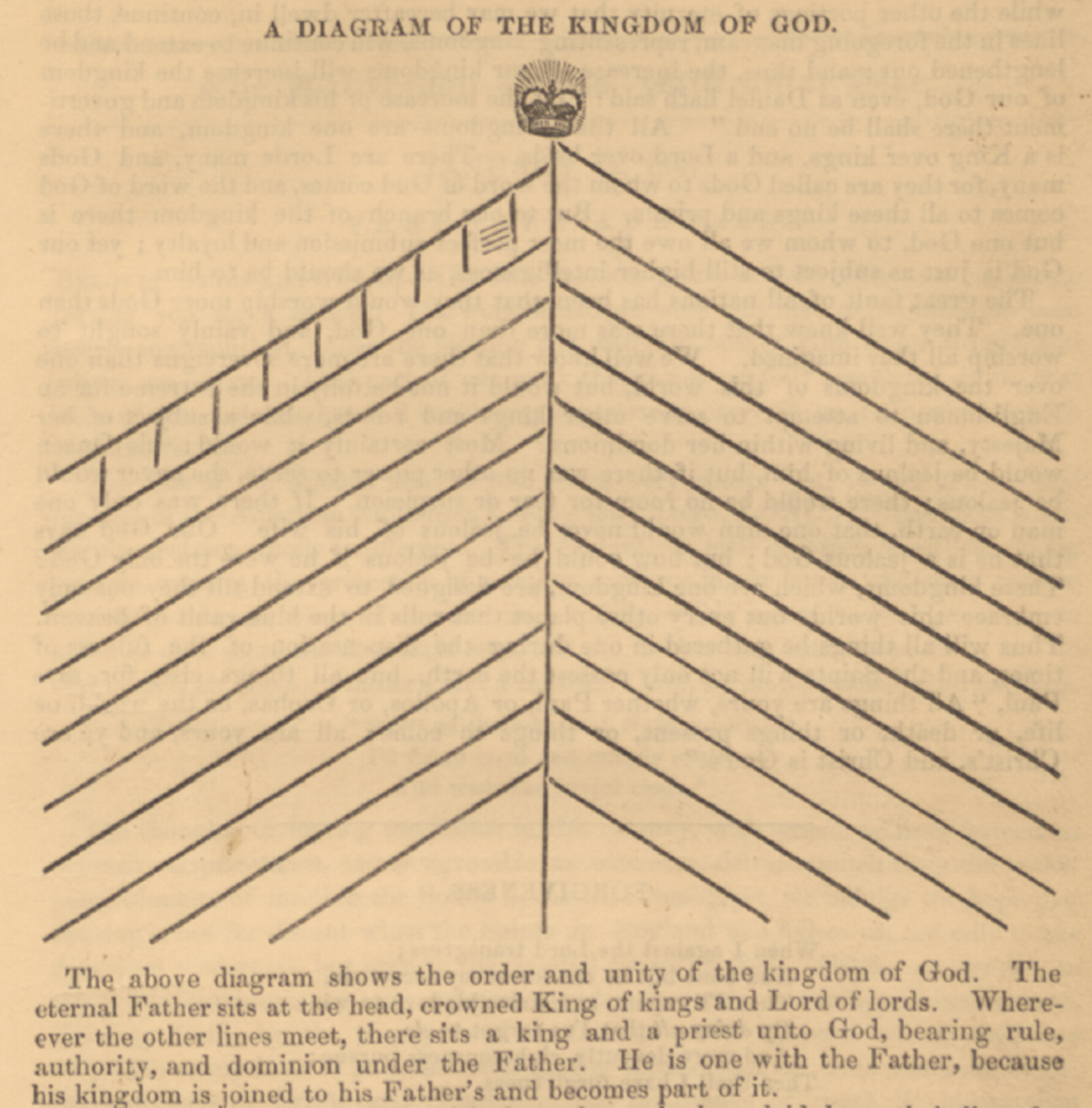
While Smith orchestrated this monarchical political council, he was also implementing a sacerdotal salvific structure based on sacred rituals that bound families and communities together with hierarchical precision. Polygamous unions were, of course, the most controversial element of this realignment of human relations, as Smith was both sealed to over thirty women as well as arranged similar plural families for another two-dozen male leaders into a dynastic system of relations. But Smith and his followers also introduced adoptive rights in which entire families were ritually pledged to authoritative figures. In an era of rapid societal transition toward democratized rule, the Mormon response was to restore stability by anointing men “a King and Priest unto the most High God” over their individual, patriarchal kingdoms.Footnote 83 One apostle, Orson Hyde, sketched a “Diagram of the Kingdom of God” to reflect these developments. (See Image #2.) “The eternal Father sits at the head, crowned King of kings and Lord of lords,” he explained. Below that one centralized point were ecclesiastical and familial pedigree lines that dictated the order of humanity. “Where-ever the other lines meet,” Hyde clarified, “there sits a king and a priest unto God, bearing rule, authority, and dominion under the Father.”Footnote 84 All of human society was governed by this priestly network. If much of the mainstream Protestant culture during the period was a “centrifugal epoch” in which citizens circled away from “centralized authority,” as Nathan Hatch described, Mormonism attempted to reorient those dispersed pieces back into one coherent whole.Footnote 85
Yet Smith knew that this monarchical language would appear odious to the American public. “It is not wisdom to use the term ‘king’ all the while,” he confessed. His suggested replacement, however, was just as instructive: “let us use the term ‘proper source’ instead of ‘king’ and it will be all understood and no person can take advantage.” Besides merely using a coded language to avoid backlash, it provided meaning to the role of revelation in a political organization. Smith and other leaders had used “proper source” in previous correspondence, so it was not new to the council. But while previously it had been used in ecclesiastical matters to emphasize Smith's authoritative role over doctrinal and ecclesiastical matters, now it adopted a new political meaning.Footnote 86 Around the same time, the apostle and prolific essayist Parley Pratt penned an essay proclaiming Smith the “Fountain of Knowledge” that would “burst the chains” of America's reliance on apostate ideas. Humanity required the stability provided through a prophetic voice. The chaotic environment of antebellum America deserved nothing less.Footnote 87
Orson Hyde, “A Diagram of the Kingdom of God,” Millennial Star, January 15, 1847.
To those in the Mormon council, what made a theocratic government function was the prophetic authority of its leader. Councils and democratic participation were important, but only inasmuch as they revealed and enacted prophetic counsel. Apostle Brigham Young declared that it wouldn't matter if “the whole church” disagreed with Smith, because their prophet “is a perfect committee of himself.” The core democratic principle that elected officials represented the interests of the citizenship was misguided, as it led to bickering, factionalism, and stalled progress. American authority looked in the wrong direction. They had not “elected [Smith] to be our Prophet, Priest and King,” but rather “our prophet has chosen us, and what this people receives through him is law.” Young could not conceive of a “differen[ce] between a religious or political government,” as the prophetic authority in the former also wielded control in the latter. Smith, for his part, believed there was a separation. “There is a distinction between the Church of God and kingdom of God,” he explained, for the former focused on “spiritual matter[s]” while the latter was a “distinct and separate government” meant to protect “their religious rights and worship.” That Smith was to hold the titles of both “king” and “prophet” didn't imply, at least to him, that the two spheres were congruous. Another participant, George J. Adams, explained that “the establishment of the Church of God was the stepping stone to the establishment of the kingdom of God.” The American expectation concerning a separation between civil and ecclesiastical leaders was enough to make Mormons struggle to define their “kingdom” in appropriate ways.Footnote 88
Those outside the faith did not find this reasoning persuasive. News of this secret council quickly trickled outside of Nauvoo and garnered heated reactions. George Davis, who edited the Alton Telegraph and Democratic Review, declared that Smith had been “CROWNED KING under God” by a “council of fifty,” who had been sworn to “secrecy, under the penalty of death.”Footnote 89 The nature of the council betrayed American ideals. In a letter that was republished in a number of eastern newspapers, Davis explained that this secret council was part of “the Prophet's grand design” to install a theocratic government that would rule the world.Footnote 90 Illinois Governor Thomas Ford later wrote that Smith “conceived the idea of making himself a temporal prince as well as a spiritual leader of his people,” and his “new and select order of the priesthood . . . were to be the upholders of his throne.” Smith's desire to “be crowned and anointed king and priest, far above the rest” was the final straw that broke the religion's back.Footnote 91 Newspapers as far away as New York re-printed correspondence that accused Smith of corrupting democratic politics through “his triune function of Prophet, Priest and King.”Footnote 92 The secret of Mormonism's clandestine government was out. This new political body was confirmation that Smith and the Mormons were not willing to work within the boundaries of democratic governance.
A flurry of activities in June of that year, including Smith's ordering the destruction of an anti-Mormon newspaper, led to the prophet's arrest and imprisonment. Tensions appeared to reach a climax. Leading anti-Mormon editor William Sharp declared that “War and extermination is inevitable!” Tired of Smith continually evading punishment through legal loopholes, it was time to take immediate action. “We have no time for comment,” Sharp urged. “Every man will make his own. LET IT BE WITH POWDER AND BALL!”Footnote 93 Even before the trial could begin, a mob rushed the prison and killed Smith and his brother, Hyrum, on June 27, 1844. A nearby resident reported that “60 men were all in disguise blackened &c” marched on the jail and finally put “an end to two of perhaps the worst men that have ever lived.”Footnote 94 Another observer put the mob closer to “150 to 200 men,” but similarly described it as an act of justice.Footnote 95 Just like in Missouri, Illinois citizens concluded that extralegal justice was necessary to silence such an ominous threat to democratic order. Mormons embodied the dangers of disestablishment, the sheer lunacy introduced when fanatics were allowed to form a fraudulent sect and delude thousands into corrupting the political process. Vigilante action was necessary to save democracy.
Smith's death did not lead to a cooling off in relations between the Mormons and their Illinois neighbors. Those who were tried for the murder were acquitted, and non-Mormons were anxious to force the entire church out of the state. One Nauvoo resident noted that everything had “ben [sic] thrown into such confusion.”Footnote 96 As a result, many in Nauvoo were ready to cut all ties with the American government. Smith's secretary William Clayton believed both the state and country were “stained with the blood of innocence.”Footnote 97 Amasa Lyman did not “believe this government will ever do any thing to protect us. It is a damned wrotten thing,” he reasoned, “full of lice, moth eaten, corrupt and there is nothing but meanness about it.”Footnote 98 Brigham Young, while taking control of the church, declared in an official epistle that as the nation had rejected God's prophet, “it is not wisdom for the saints to have any thing to do with politics, voting, or president-making, at present.”Footnote 99 The state stripped Nauvoo of its city charter, which Clayton believed “laid us open to all the raviges of mobs & murderers.” Due to the government revoking any chance they had of redress, they were “an independent people claiming no alliance with any of the kingdoms of the earth.”Footnote 100 Reynolds Cahoon believed that because the “gentiles” had rejected the gospel, the state had killed their prophet, and the government refused to protect them, “these United States has set us off as a nation to ourselves.”Footnote 101 Antagonists were similarly convinced that the Mormons were officially severed from the political body. William Sharp, who spear-headed the anti-Mormon newspaper crusade, wrote that the saints were “beyond the reach of the law” and that “the removal of the mormons from the State” was the only solution.Footnote 102 The Mormons would once again be refugees.
In the midst of this turmoil, Young collapsed any boundaries between religious and political authority. While this was partly due to his personal demeanor—he had argued against a separation between religious and political kingdoms even before Smith's death—it was also a result of Young's attempt to consolidate authority during a succession crisis over Smith's mantle.Footnote 103 Young held the government at fault for Smith's death and had given up any hope for gentile redemption. Whereas Smith had made a point to include three non-Mormons in the original council as a token toward religious liberty, Young's first action when the council reconvened for the inaugural meeting under his leadership was to dismiss any “gentiles” from attendance.Footnote 104 Two months later he declared that “he will defy any man to draw the line between the spiritual and temporal affairs in the kingdom of God.”Footnote 105 The previous attempt to balance traditional spheres was gone. After a particularly contentious debate in the council where it appeared that someone was questioning prophetic leadership, George Miller chided those in dissent and urged them “never to throw objections in the way of any thing proposed by the proper source.” Miller desired “to be always in perfect subjection to those whose place it is to govern whether his views agree with theirs or not.”Footnote 106 Discord was not tolerated in the Kingdom of God. One former participant of the council who had a falling out with Young declared the new prophet “a usurper a tyrant and an apostate.” Those who stayed within the fold believed he brought necessary stability.Footnote 107
This series of events only reaffirmed to a number of Mormon leaders that democratic politics as governed by a Protestant majority did not work. They also recognized that the central point of conflict was a disagreement over the role of religious leadership in civic governance. William Phelps accurately posited that “the greatest fears manifested by our enemies is the union of church and state. I believe we are actually doing this and it is what the Lord designs.”Footnote 108 Rather than attempting to salvage some form of democratic governance based within the confines of America's boundaries, it was time to acknowledge that an alternate method was required. Clayton posited that their organizational structure, contrasted with America's degraded system, took its cue from “the [divine] council, which sat previous to the organization of this world.”Footnote 109 They had a new model for leadership, and now they were ready to act on it. Apostle Heber Kimball “moved that we declare ourselves an independent nation.”Footnote 110 It was time to look outside of America's confines for a fresh start, only this time sanctioned by God's will. Of the available migration options, Orson Hyde proposed moving to California—then under Mexican rule—because “the people of that country are of the Catholic faith.”Footnote 111 Not only would they be sympathetic to the Mormons’ persecuted past, but they shared similar ideas concerning the sovereignty of God's voice and the dangers of democratic excess. They were colleagues in the quest to reconstitute the proper relationship between church and state. The Mormons were anxious to flee the Protestant nation and join ideological kin.
IV.
When Joseph Smith was on his way to the county jail in June 1844, he assumed he might not escape alive. Before he left, he whispered instructions to his secretary, William Clayton, “to burn the records of the kingdom, or put them in some safe hands and send them away or else bury them up.” Smith knew their scandalous contents would be seen as treasonous. Clayton chose the last of the three options and “put the records in a small box and buried them in my garden.” The records were too important to burn, despite their scandalous contents. After Clayton dug them back up and copied their contents into minute books devoted to the council, the records remained secreted away from public view for over one hundred and seventy years until a published version appeared as part of the Joseph Smith Papers Project in the fall of 2016.Footnote 112
Just like the council's records, alternative forms of political theologies that did not match the Protestant mainstream have similarly been buried under the narratives of America's democratic tradition. The Mormon attempt to secure constitutional rights through a secretive political council was indeed a radical action within the context of America's political and religious histories. Yet the anxieties that underwrote Joseph Smith's Council of Fifty embodied the cultural tensions at play in America's democratic order during the antebellum period as religionists grappled with the implications of disestablishment. The United States’ experiment in political self-rule was far from a predetermined trajectory that marched toward today's unapologetic embrace. For many in the antebellum period, America's political structure appeared as tenuous as ever. To these marginalized groups, the role of divine law, as seen through Mormonism's political heresies, were still under question. Identifying and contextualizing alternative modes of political and religious sovereignty outside the Protestant mainstream helps flesh out the tale of those who believed the nation's democratic order had failed. Only by better understanding the angst on the peripheries can we get a better picture of eventual dominance of those in the center.



