INTRODUCTION
Watermelon (Citrullus lanatus (Thunb.) Matsum. & Nakai.) is an important vegetable crop, accounting for 0·06 of the area devoted to vegetables worldwide in 2009 (FAOSTAT 2011). Most of the cultivation includes cultivars with sweet, red fruits, primarily grown for dessert purposes and as a thirst quencher. The world acreage of watermelon was 3·41 million ha in 2009 with 0·07 cultivated in Africa. The world annual production of watermelon in 2009 was estimated at 98 million tonnes with 0·05 million tonnes produced in Africa (FAOSTAT 2011). Watermelons are popular in West Africa, and the red, sweet types are becoming a very important source of income for small-scale farmers of the semi-arid tropics (Fatondji et al. Reference Fatondji, Pasternak and Woltering2008). In Mali, the production of the red, sweet type watermelons ranked number 15 in value of agricultural commodity items in 2009 (FAOSTAT 2011).
Some types of watermelon can also be used for cooking as a multipurpose vegetable and watermelons grown for their seed are important in some countries, such as China (Yang & Walters Reference Yang and Walters1992), India (Das et al. Reference Das, Das and Suthar2002), Arabian countries (El-Adawy & Taha Reference El-Adawy and Taha2001) and West Africa (Badifu Reference Badifu1993; Loukou et al. Reference Loukou, Gnakri, Djè, Kippré, Malice, Baudoin and Zoro Bi2007). Cucurbit species grown for their seed, including seed-type watermelons, are in several West African countries popularly called egusi melons. The name originates from the Yoruba language spoken in Nigeria, Benin and Togo, and it was originally used for the species Cucumeropsis mannii Naud (Burkill Reference Burkill1985), but it is now used more generally for cucurbit species grown for their seeds (Robinson & Decker-Walters Reference Robinson and Decker-Walters1997; Achigan-Dako et al. Reference Achigan-Dako, Fagbemissi, Avohou, Vodouhe, Coulibaly and Ahanchede2008). Egusi seed from watermelon commonly has a bright colour and the seeds are sometimes surrounded by a pericarp. White-fleshed seed types may also have other seed characteristics, but are not then referred to as egusi.
The seeds are commonly consumed as a snack or they are processed into flour or oil. In Benin, seed types of C. lanatus remain the most important cucurbit seed crop species cultivated for household consumption (Achigan-Dako et al. Reference Achigan-Dako, Fagbemissi, Avohou, Vodouhe, Coulibaly and Ahanchede2008). In Nigeria, watermelon is considered one of the most common oilseed crops used in almost every household (Badifu Reference Badifu1993). Studies of the macronutrient composition of the egusi seeds in the Ivory Coast (Loukou et al. Reference Loukou, Gnakri, Djè, Kippré, Malice, Baudoin and Zoro Bi2007) revealed a protein content of 290 mg/g, and an oil content of 560 mg/g in shelled kernels, which was superior to the content in peanut (Arachis hypogaea) of 240 and 480 mg/g, respectively, confirming the nutritional potential of seed crop watermelons.
It is believed that watermelon originates from Africa (van der Vossen et al. Reference van Der Vossen, Denton, EL Tahir, Grubben and Denton2004; Wasylikowa & van der Veen Reference Wasylikowa and van Der Veen2004). The domestication process has, as for other plant species, led to the development of landraces associated with geographic locations. These landraces have been defined as ‘dynamic population(s) of a cultivated plant that has historical origin, distinct identity and lacks formal crop improvement, as well as often genetically diverse, locally adapted and associated with traditional farming systems’ (Villa et al. Reference Villa, Maxted, Scholten and Ford-Lloyd2005). Some landraces have ‘a high capacity to tolerate biotic and abiotic stress, resulting in high yield stability and an intermediate yield level under a low-input agricultural system’ (Zeven Reference Zeven1998). In addition, they are recognizable morphologically, and farmers have names for them (Harlan Reference Harlan1975). Such farmer-named landraces of watermelon exist in Mali and are used for different purposes (Jensen et al. Reference Jensen, Touré, Hamattal, Touré and Nantoumé2011).
In Mali, red sweet dessert types are produced mainly in the central region of Segou. In contrast, white flesh seed-type watermelon landraces are produced mainly in the more northern, semiarid and arid regions at the southern border of the Sahara desert, in particular around the towns of Tombouctou and Gao. Here, the crop is rain-fed, except when cultivated near the riverbed of the Niger River. Watermelon appears to be the only crop that germinates, grows and produces fruit in the sandy soils in the Tombouctou region, which receives c. 200 mm of rain/year (WMO 2011), and many resource-poor families rely on the crop as a source of plant-based protein and oil to supplement nutritional intake from livestock. The seeds are used for various energy-rich snacks, and the flour is processed into local dishes such as sauces served on rice (Jensen et al. Reference Jensen, Touré, Hamattal, Touré and Nantoumé2011). In addition, the seeds are used for local oil extraction and soap production.
Previous yield studies with seed-type watermelons in West Africa are few, and are mainly from experiments on research stations, carried out to identify optimal levels of input such as fertilizer, or ideal companion crops when intercropped. In Nigeria, the seed yield of 20 different egusi accessions varied from 25 to 515 kg/ha (Idehen et al. Reference Idehen, Kehinde and Adegbite2006), and Ikeorgu et al. (Reference Ikeorgu, Ezumah and Wahua1989) reported a seed yield of 709 kg/ha. In addition, the seed yield of egusi watermelon increased significantly when nitrogen (N) and phosphorous (P) fertilizers were applied in a field trial with the well-performing egusi cultivar ‘Black-edged bara’ in Nigeria (Olaniyi & Fagbayide Reference Olaniyi and Fagbayide2008). The highest seed yield of 2·0 kg/ha was obtained with 60 kg N and 3·2 kg P/ha (Olaniyi & Fagbayide Reference Olaniyi and Fagbayide2008). In Nigeria, intercropping studies of an egusi seed-type intercropped with cassava or maize, or both crops, revealed seed yield reductions of more than 50% in comparison with the sole egusi crop (Ikeorgu et al. Reference Ikeorgu, Ezumah and Wahua1989). Similarly, an economic study of the profitability of intercropping egusi in two, three or four crop mixtures v. sole cropping of egusi showed that the sole cropping system produced the highest farm income (Yusuf et al. Reference Yusuf, Sanni, Ojuekaiye and Ugbabe2008). However, the long-term effects of intercropping on, for instance, the nutritional status in the field, or disease and pest impact, were not considered.
An estimated 540 ha of land was used for production of various, apparently distinct seed-type watermelon landraces in 2008/09 in the arid region of Tombouctou. The drought and heat tolerance of these seed types, grown at the edge of the desert, is particularly of interest because of climate change. The risk of drought is predicted to increase in the years to come, particularly in Africa, with forecasted yield reductions (Liu et al. Reference Liu, Fritz, van Wesenbeeck, Fuchs, You, Obersteiner and Yang2008; Li et al. Reference Li, Ye, Wang and Yan2009; Thornton et al. Reference Thornton, Jones, Ericksen and Challinor2011) and reduced food security (Schmidhuber & Tubiello Reference Schmidhuber and Tubiello2007). The purpose of the present study was to evaluate the fruit and seed yield potential of three commonly grown, white-fleshed, seed-type watermelon landraces on-farm under arid growing conditions with no inputs, to assess the potential of the local landraces for food security under such conditions.
MATERIALS AND METHODS
Location, climate and soil conditions
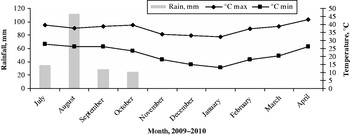
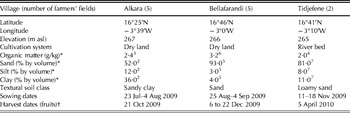
Yield experiments were carried out in 2009/10 in 12 farmers’ fields in three villages at the border of the desert under ‘dry land’ cultivation (Alkara and Bellafarandi, with five farmers in each village) and ‘river bed’ cultivation (Tidjefene with two farmers). All fields were within a radius of 80 km from Tombouctou town, situated at the southern border of the Sahara desert (Table 1). In the ‘dry land’ system, sowing was carried out after the rain started at the end of July through to August. In the ‘river bed’ system, sowing took place near the Niger River when the river was subsiding after the rainy period in November (Table 1). For exact sowing and harvest dates, see Table 1. The soils in the farmers’ fields all contained more than 50% sand by volume, and the content of organic matter was below 5 mg/kg (Table 1). Precipitation and temperature during the growing season were obtained from the local weather station, Direction Nationale de la Météorologie du Mali, Tombouctou and are shown in Fig. 1.
Rainfall, maximum and minimum temperature in Tombouctou from sowing to harvest of watermelon yield trials in farmers' fields. Data were obtained from Direction Nationale de la Météorologie du Mali, Tombouctou.

Position, soil characteristics and sowing and harvest dates for watermelon yield experiments in farmers’ fields in the Tombouctou region in 2009/10

* Based on analyses from 0·2–1·2 m depth. Samples were taken to represent as much variation as possible from the fields. Superscript numbers show the number of samples analysed.
† Fruits in the fields of Tidjefene were mature before the harvest date, but harvest was postponed.
Plant material
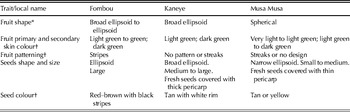
Farmers differentiate landraces mainly on the basis of seed characteristics. Each farmer received seed from a common standard source of three local seed-type watermelon landraces with white flesh and distinct seed size, shape and colour (Table 2). Seed of the landraces Fombou and Musa Musa were bought from farmers in Bellafarandi, while seed of the landrace Kaneye was bought in Kaneye village, 100 km south of Tombouctou town. Each farmer also selected one to three accessions of the same landraces (Fombou, Musa Musa and Kaneye) from their own farm-saved seed. In total, 30 accessions, representing the three landraces from farm-saved seed (10 from Alkara, 14 from Bellafarandi and 6 from Tidjefene) were tested.

Trial design and farmers cultivation practices
The experiment was a randomized block design, with farmers' fields (environments) as blocks. Each farmer sowed the three landraces from the common standard seed source, and their own farm-saved seed of two to three of the same landraces. Each accession was sown in a plot of 5 × 10 m. Sowing distances and cultivation practices were according to the individual farmer's practice. Seeds were sown directly in fields that had been cleared of roots and weeds. Approximately 4–5 seeds, picked by the fingertips, were sown per sowing-hole made with a hoe. Weeding was carried out once or twice during the growing season. None of the farmers used fertilizer or pesticide treatments and there was no irrigation. Landraces from the common standard seed sources were lost in some individual farmers' fields, but Fombou, Kaneye and Musa Musa were successfully included as ‘standards’ in 9, 8 and 9 farmers' fields, respectively.
Field assessment of cultivation, plant characteristics and yield
Field assessment included observations of sowing-hole density, plant density after establishment, morphology of the plants and yield data. The sowing-hole density (based on distances between two pairs of planting holes in the same row and between two pairs of planting holes in adjacent rows) and the plant density were determined in each plot after germination. The number of plants with fruits was determined 50 days after sowing. Morphological descriptions of leaves, fruits and seeds were performed on the basis of a watermelon descriptor list (EAPGREN 2007). Briefly, the length and width of leaves and the internode length on the main stem were measured for two leaves on two plants per plot. The fruits were harvested at maturity 3–4·5 months after sowing. The total number of fruits per plot was counted and the fruits were pooled and weighed. Three fruits per plot were cut to measure the fruit length and width and the rind thickness. The three individual fruits were weighed and the content of total soluble solids (TSS) was determined using a hand-refractometer to indicate the sugar content. Seeds from each of the three fruits were extracted, the seed weight per fruit and the average seed weight was determined. The length and width of three seeds from each fruit were measured.
Length and width data of leaves, fruits and seeds were used to calculate a length/width ratio, according to UPOV (2004). Fruit number/ha and fruit yield/ha were determined. The seed yield/ha was determined using the mean seed weight for the three individual fruits, multiplied by the number of fruits harvested/plot.
Statistical analyses
Analyses were mainly carried out using SAS/STAT version 9.2 (SAS Institute Inc., Cary, NC, USA). Yield data collected during the field trials were subjected to analyses of variance. Analyses included morphological traits and yield components to detect effects of the seed source (standard seed v. farm-saved seed), landrace (Fombou, Kaneye and Musa Musa), the field environment (12 farmers' fields) and the interaction between seed source and landrace:
 $$Y = \mu + F + S + L + S \times L + \rm \varepsilon $$
where μ is the general mean, F is the effect of farmers field (farmers 1–12), S is the effect of the seed source (standard v. farm-saved seed), L is the main effect of the landrace (Fombou, Kaneye or Musa Musa) and S×L are the interactions between landrace and seed source. ε is the random error.
Linear regression analyses were also carried out on the yield components to test whether the slopes were significantly different (heterogeneity of slopes) for the two seed sources and the three landraces according to the model:
 $$Y = \mu + S + L + \beta _A {\rm fm} + \beta _S {\rm fm} + \beta _L {\rm fm} + \rm \varepsilon $$
where μ is the general mean, S is the main effect of seed source (standard v. farm-saved seed), L is the main effect of landraces (Fombou, Kaneye or Musa Musa), β A fm estimates the average slope β A of regression on fm, each farmer's average yield, β S is the heterogeneity of slope between seed sources and β L is the heterogeneity of slope among landraces. ε is the random error.
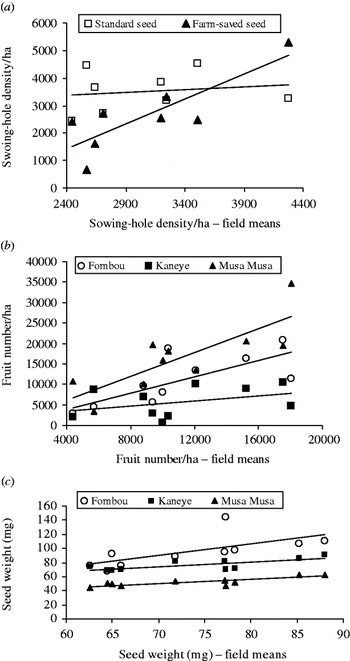
Finally, yield components revealing significant heterogeneity of slope for the relevant source of variation (seed source or landrace) were used to produce graphs of the field plot values against the farm mean values.
RESULTS
Crop cycle and morphological traits of landraces
Sowing was carried out at the start of the rainy season, and germination of the seeds relied on the rain or the moisture in the fields near the river bed (Table 1 and Fig. 1). A rainfall of 204 mm was recorded during the growing season from July to April with more than 0·50 recorded in August (112 mm). The average minimum and maximum temperatures were 21 and 37 °C, respectively. The crop cycle was, in general, 3–4 months for the watermelon seed crop under these conditions. The watermelon landraces produced fruits with morphologically different fruit and seed size, shape and colour (Table 2). Fruits of Fombou were striped and more uniform than those of the other two landraces. Fruits of Musa Musa and Kaneye were difficult to differentiate by the appearance of the rind. Musa Musa mainly had thin streaks or no pattern, while Kaneye mainly had no pattern, but occasionally produced fruits with thin streaks. All seeds harvested from the trial plots sown with the three landraces of both standard and farm-saved seed produced the same seed-type as the seed-type sown. Seeds of Fombou were red–brown with darker irregular stripes, clearly different from the tan or yellow seeds of Musa Musa and Kaneye. The latter two types could be differentiated by the shape of the seeds (Table 2).
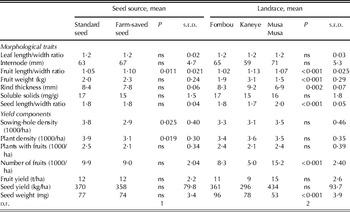
Analyses of variance of morphological traits showed significant difference for seed sources (standard and farm-saved) for the fruit length/width ratio (P = 0·011). The average fruit length/width ratio was 1·05 for standard landraces and 1·10 for the farm-saved landraces (Table 3). None of the remaining morphological traits revealed significant differences between the two seed sources. Landraces Fombou, Kaneye and Musa Musa revealed significant differences for fruit length/width ratio (P < 0·001), fruit weight (P < 0·001), rind thickness (P = 0·002) and seed length/width ratio (P < 0·001) (Table 3). The fruit length/width ratios showed highest average value for Kaneye (1·13) and so these fruits were more ellipsoid than those of Fombou and Musa Musa, which were nearly spherical. Kaneye also clearly produced the largest fruits, 3·11 kg on average. The rind thickness was thin for Musa Musa and thicker for Fombou and Kaneye. The seed length/width ratio revealed that seeds of Musa Musa were more oblong and narrow than those of Fombou and Kaneye (Table 3). These observations were in accordance with the visual observations made in the field during the experimental period.
Morphological traits and yield components of three seed watermelons grown under farmer's field conditions in the Tombouctou region

The TSS content was on average 16 mg/g and did not vary significantly among the three landraces. Some red-fleshed, sweet-type ‘Kankani’ watermelons were grown in two of the farmers' fields and were also analysed for TSS (results not shown). Although these types were not included in the statistical analyses, the tests showed that this type had a higher value of 32 mg/g. The measurements reflected the taste of the fruits. The flesh of the seed types was fresh with a mild cucumber taste, but not sweet like the Kankani dessert type.
Significant differences were identified among farmers' fields, representing the environmental and cultivation effects, for the following morphological traits: leaf length/width ratio (P = 0·006), fruit weight (P < 0·001), rind thickness (P = 0·010) and seed length/width ratio (P < 0·001).
Yield and yield components
A significant difference was detected between the two seed sources (standard and the farm-saved seed) for the sowing-hole density and plants/ha (P = 0·025 and 0·019, respectively) (Table 3), which was 3746/ha for the standard seed and 2861/ha for the farm-saved seed. Correspondingly, the number of plants/ha was also significantly higher for the standard seed (3927 plants/ha) than the farm-saved seed (3098 plants/ha) (Table 3). The sowing-hole density (for example 3746/ha for standard seed) and the established plant density (3927/m2 for standard seed) were of the same magnitude, although several seeds were sown per sowing-hole.
The three landraces revealed significant differences for the number of fruits/ha and seed weight (P < 0·001 and <0·001, respectively) (Table 3). Kaneye, which produced large fruits, produced the lowest number of fruits/ha, and Musa Musa, with the smallest fruits, had the largest number of fruits/ha (Table 3). Seed of Musa Musa were light, Kaneye heavier and Fombou the heaviest, with a seed weight of 95·7 mg, nearly double the weight of Musa Musa seed (52·6 mg) (Table 3). On average, the three seed types produced a fruit yield of 11·6 t/ha, and an estimated seed yield of 364 kg/ha, with no significant difference among types. Significant differences were identified among farmers' fields, representing the effects of the environment and the cultivation practices, for the following components: plants/ha (P < 0·001), plants with fruits/ha (P < 0·001), number of fruits/ha (P = 0·033), seed yield/ha (P = 0·039) and seed weight (P = 0·002) (results not shown). No significant interactions were revealed between seed sources and landraces for morphological traits or yield components (results not shown).
The yield stability of the seed sources and the landraces when grown under different farm environments were studied further by regression analysis of the yield components. The average slope of regression was significant for all yield components, which showed that farmers' fields represented different growing environments. Some yield components revealed heterogeneity of slopes for the seed sources (sowing-hole density) and the landraces (fruit number/ha and seed weight). Differences of slope for the seed source revealed a more uniform sowing-hole density across farmers for the standard seed source than for farm-saved seed (Fig. 2 a). The differences in slope for landraces showed that with higher mean fruit number/ha, the increase in fruits/ha was highest for landrace Musa Musa and medium for Fombou, while Kaneye showed the highest stability of fruit yield in relation to the different environments (Fig. 2 b). However, when seed weight was analysed, Fombou was the most responsive to favourable conditions, whereas Kaneye and Musa Musa showed more stable seed weights in the different environments (Fig. 2 c).
Regressions of yield components on farm-mean values to study the stability of the landraces. (a) Sowing-hole density for the two seed sources plotted against farm means of sowing-hole density. (b) Fruit number/ha for the three landraces plotted against farm means for fruit number/ha. (c) Seed weight for the three landraces plotted against farm means for seed weight.

Positive significant correlations (P < 0·001) were observed between some of the yield components. Sowing-hole density correlated with the number of plants/ha (r = 0·53), and plants/ha correlated well with fruits/ha (r = 0·73). The number of fruits/ha correlated as anticipated with fruit yield/ha (r = 0·67), and also highly with the seed yield (r = 0·81). Finally, the fruit yield/ha correlated well with the seed yield (r = 0·60) (results not shown).
DISCUSSION
The three seed-type watermelon landraces included in the present study were selected by farmers, who differentiated these landraces according to seed characteristics such as size, shape and colour, and their use (Jensen et al. Reference Jensen, Touré, Hamattal, Touré and Nantoumé2011). A fleshy pericarp surrounding the seed was a trait used to distinguish the landraces Kaneye and Musa Musa from Fombou, which did not have a pericarp around the seeds at harvest. The seed characteristics remained unchanged from sowing to harvesting of the next generation seed in farmers' fields, although grown next to each other in the experiments. Apparently, these seed-type watermelon landraces are mainly self-pollinating and therefore breed quite true. Furthermore, the generally modest difference between seed sources, the clearer difference among landraces and the absence of interactions between seed sources and landraces in the experiment for the observed morphological traits and yield components indicate that farmers have an understanding of the differentiation and characterization of these landraces and that they form rather distinct populations. UPOV (2004) suggests the use of leaf, fruit and seed length/width ratios to differentiate genotypes of watermelon. Both fruit and seed length/width ratios differentiated the landraces efficiently in the present study, and therefore seem to be useful for differentiation of accessions. Using a larger number of landraces might have revealed differentiation using the leaf length/width ratio, as reported for a study including 50 sweet, red flesh type watermelons (Szamosi et al. Reference Szamosi, Solmaz, Sari and Bársony2009).
The local landraces were able to develop and produce fruits and seeds under daily temperatures often exceeding 35 °C and with a precipitation of only 204 mm, of which more than 0·50 fell in August, the month when most of the fields were sown. It shows that this crop can grow under rather hot and drought-prone conditions. The on-farm fruit yield of the three seed type landraces ranged from 9·1 to 14·7 t/ha, which is comparable with the fruit yield of 10·2 t/ha reported for a seed-type watermelon landrace grown under research station conditions in Namibia without application of fertilizer or irrigation (Maggs-Kölling & Christiansen Reference Maggs-Kölling and Christiansen2003). In the Namibian study, it was noted that fruits of the seed type were small in comparison with improved sweet dessert, red flesh types and cooking types, and this is in accordance with observations of large size fruits of a local sweet type watermelon, included in two of the farmers' fields in the present study (results not presented).
The estimated seed yield of 296–434 kg/ha for the three seed-type landraces is in line with the previously reported seed yields in West Africa of 25–515 kg/ha on-station for other egusi-type watermelons (Idehen et al. Reference Idehen, Kehinde and Adegbite2006). The highest seed yield reported, also on-station, is 709 kg/ha (Ikeorgu et al. Reference Ikeorgu, Ezumah and Wahua1989). Considering that the present study was carried out on-farm in sandy soils with no farm inputs, under hot and drought-prone conditions with low precipitation, the yield seems rather high. The observed positive correlations between sowing-hole density and number of plants/ha, the number of plants with fruits, and the number of fruits/ha, as well as plants/ha and fruits/ha, indicate that farmers may have some estimate of the yield potential of their fields early in the growing season, on the basis of the plant establishment. By counting the fruits before harvest they may also be able to estimate the seed yield.
In all fields, sowing-hole density and plant density were quite similar, with 4–5 seeds were sown per hole. This means that the germination or plant establishment was, on average, not higher than 0·20–0·25 for the seeds sown. This may be due to environmental factors, such as low precipitation, or to the quality of the seeds, which in watermelon depends upon the harvest of mature fruits and proper seed extraction and storage practices. It is possible that the seed quality of the local landraces may be improved through improvement of farmers' practice of seed harvest, extraction and storage. Oven and smoke drying of seeds have been shown to improve seed germination after storage by reducing the seed moisture content and the number of diseased seeds (Bankole et al. Reference Bankole, Osho, Joda and Enikuomehin2005). Also, in other crops there seem to be a positive effect on germination and plant establishment when seed quality is improved (Peltonen-Sainio et al. Reference Peltonen-Sainio, Rajala and Jauhiainen2001).
Another way to improve the seed purity of their landraces to obtain higher yields may be for farmers to weed wild watermelon plants off in their fields. Wild plants were observed in farmers' fields, and although weeding was carried out once or twice, the wild plants were not completely removed from the fields because farmers make use of them as a source of fodder. Different watermelon species are cross-compatible with each other to varying degrees (Robinson & Decker-Walters Reference Robinson and Decker-Walters1997). So, the wild-type may cross with the cultivated local types, although no sign of such cross-breeding was observed during the present study. As indicated above, there was also no indication that the landraces were cross-pollinating. Further studies are needed to clarify to what extent cross-pollination is a problem for maintenance of pure seed-type landraces.
The seed of the standard landraces resulted in a higher sowing-hole density than when planting farm-saved seed. This may be due to the fact that standard seed was given to the farmers in a limited amount, and that they were more careful when sowing these before sowing their own farm-saved seed. However, later in the growing season, no differences in fruit or seed yield between seed sources were detected, presumably because of plant growth compensation.
Kaneye showed the most stable fruit number/ha in relation to the different field environments, suggesting that this landrace is the best among the three for poor growing environments, whereas Fombou, and especially Musa Musa respond to more favourable environments. However, these differences were not reflected in the seed yield, and seed weight revealed a different trend among the three landraces. Although the clay content of the soil in Alkara was higher than in Bellafarandi, the two villages with most participating farmers, there was no indication that this led to higher fruit number/ha or higher seed weight. Neither was there any positive effect of the ‘river bed’ cultivation system on these two parameters for one grower in Tidjefene (results not shown). In contrast, testing of Indian seed watermelons under different environmental conditions revealed a highly significant difference in seed-yield stability among 13 genotypes (Raiger et al. Reference Raiger, Dua, Sharma, Phogat and Rathi2009). This could indicate that the landraces included in the present study, all originating from the same region within a diameter of c. 100 km, have been under similar selection conditions through many generations, making them well-adapted to the local environment, and therefore they also produce similar seed yields.
Africa is identified as a region highly vulnerable to climate change as a result of projected warming and rainfall deficits (Thornton et al. Reference Thornton, Jones, Ericksen and Challinor2011). A major goal of adaptive solutions is the development or identification of crops that are resilient under drought stress or perform well in poor quality soil, such as some underutilized crops with good nutritional value (Thompson et al. Reference Thompson, Berrang-Ford and Ford2010).
The main conclusions from the present work are that the three Malian seed-type watermelon landraces are distinct, able to grow and yield well under hot and drought-prone conditions and that they showed rather stable performance under the tested on-farm conditions. Since such genetic material can produce 300–450 kg of high value seed/ha, it may be a valuable genetic resource for securing food and nutrition in drought-prone areas, such as the Sahelian region. A further step would be to study the plasticity of such seed-type watermelons to clarify their level and mechanism of stress tolerance and potential in even drier and hotter environments.
The present study was funded by a research grant from Danida (Project no. 919-LIFE). We thank Drisssa Maïga and colleagues, Direction Nationale de l‘Agriculture, Tombouctou, and Mali Folkecenter (MFC), for collaboration and Direction Nationale de la Météorologie du Mali, Tombouctou for providing the meteorological data. We are grateful to colleagues at Institut d´Economie Rurale (IER) regional centres in Bamako and Gao for collaboration. We thank Makan Sissoko for soil sampling, Alhassane Samaké for the analysis and Mamadou Doumbia and Kadiatou Touré Gamby for supervision. Special thanks to the farmers in the Tombouctou Region for collaborating with us to carry out the trials in their fields.