In the past decade scholars who analyse politicians’ policy strategies have emphasized the strategic importance of valence dimensions of voters’ evaluations of political parties and candidates. Valence dimensions, a term first coined by Stokes,Footnote 1 refer to dimensions ‘on which parties or leaders are differentiated not by what they advocate, but by the degree to which they are linked in the public's mind with conditions, goals, or symbols of which almost everyone approves or disapproves’.Footnote 2 Valence dimensions include such factors as parties’ and party leaders’ images with respect to honesty, competence, charisma, and unity. These dimensions contrast with position dimensions such as tax policy, foreign policy and debates over immigration controls and abortion policy, on which ‘parties or leaders are differentiated by their advocacy of alternative positions’.Footnote 3 Many recent studies explore how the introduction of valence dimensions affects the positional strategies of office-seeking or policy-seeking politicians.Footnote 4
In a recent article in this Journal, Adams and Merrill develop a spatial model of multiparty elections in parliamentary democracies with proportional representation (PR), in which voters are motivated by both valence and positional issues, and where parties vary their policy promises in pursuit of policy objectives.Footnote 5 Three central conclusions emerge from the Adams–Merrill paper: first, that a Nash equilibrium configuration of parties’ positional strategies exists, given quite general assumptions about parties and voters; secondly, that for most realistic scenarios the parties can be expected to coalesce into rival blocs, with one bloc of parties presenting similar sets of leftist policies, and the other bloc presenting similar sets of right-wing positions; thirdly, that parties will moderate their policies when their valence images deteriorate (and will shift to more radical policies when these images improve), an effect the authors label the centripetal valence effects result.
In this article we generalize the Adams–Merrill model to elections where voters hold two or more parties collectively responsible for behavior or outcomes that reflect on these parties’ valence images. An obvious example of collective responsibility involves a coalition of governing parties, whose valence-related images may jointly depend on voters’ judgements about how skilfully the government is handling public concerns relating to the economy, crime, and foreign and domestic policy crises, as well as governing elites’ reputations for honesty and unity. And, in certain situations, voters may even assign collective responsibility to a set of opposition parties, particularly when these parties are widely viewed as a ‘proto-coalition’, i.e. a likely government at some future time. Of course, voters’ tendencies to assign collective responsibility for valence-related performance, as opposed to singling out individual coalition members for special credit or blame, surely vary with the political context.
We extend the Adams–Merrill model to consider how collective responsibility affects parties’ policy-seeking strategies, when they compete in a PR election in a parliamentary democracy. Specifically, we develop a collective responsibility model that allows us to vary the degree of collective responsibility that voters assign to coalitions of parties, so that we can analyse situations where voters assign nearly equal credit or blame for valence-related events to all coalition members, as well as situations where collective responsibility is attenuated. Our model can also accommodate elections that feature two or more coalitions of parties. We report Monte Carlo simulations and theoretical results based on our collective responsibility model, and we compare our results to those we obtain for the ‘basic’ Adams–Merrill model, that does not incorporate collective responsibility. Our study produces five central findings.
First, we find that a unique Nash equilibrium in parties’ policy-seeking strategies almost invariably exists under the collective responsibility model, just as it does for the Adams–Merrill basic model that does not incorporate collective responsibility.
Secondly, we find that the Adams–Merrill centripetal valence effects result, that parties moderate (radicalize) their policies when their valence images deteriorate (improve), also extends to the collective responsibility model.
Thirdly, our computations suggest that the greater the degree of collective responsibility that voters assign to a coalition of parties, the stronger these parties’ incentives to converge towards similar sets of policy positions – i.e. the more voters assign joint credit/blame to coalitions of parties for events that reflect on these parties’ honesty and competence, the greater these parties’ policy-seeking incentives to converge towards similar sets of policies. This result, which we label the coalition convergence effect, is relevant to remarkable research by Fortunato and Stevenson, who report empirical findings that voters perceive that the policy positions of the governing parties in coalition governments converge significantly over time.Footnote 6 Our coalition convergence result suggests that voters’ perceptions of policy convergence between coalition partners may enhance these governing parties’ abilities to achieve their policy objectives.Footnote 7 Our coalition convergence result also implies that in situations where the party system in a PR-based parliamentary democracy is divided into two rival coalitions (as is arguably the case in Germany, Norway and Denmark), collective responsibility motivates parties to coalesce into two spatial ‘clusters’, with modest policy differentiation between the parties in each cluster.
Fourthly, and relatedly, we present theoretical and computational results that the coalition convergence effect is driven primarily by the strategic imperative for small, peripheral members of coalitions – such as the German Greens and the French Communists – to moderate their positions and thereby converge towards the positions of their more centrist, mainstream, coalition partners (such as the German Social Democrats and the French Socialists) – a dynamic we label the peripheral governing party moderation result.
Fifthly, we find that when voters ascribe collective responsibility to a coalition of parties, this depresses the likelihood that the coalition's members will realize their policy objectives – a finding we label the coalition penalty effect.Footnote 8 This coalition penalty result plausibly illuminates an empirical puzzle that has sparked widespread scholarly interest: namely, why parliamentary democracies at times feature minority governments that receive consistent parliamentary support from parties that choose to remain outside the governing coalition.Footnote 9 Our results suggest that parties’ decisions to forgo formally joining governments whose policies they support may be due to these parties’ desire to avoid sharing collective responsibility, which can hinder their policy objectives.
Policy-Seeking Parties in Multi-party Elections under Proportional Representation: A Valence-Uncertainty Model with Collective Responsibility
Our model, which is a direct extension of the one developed in Adams and Merrill, employs the assumptions set out in the following three sub-sections.Footnote 10
Assumptions on Seat Allocations and Policy Outputs
We specify a model in which parties and voters locate along a one-dimensional positional continuum – which we label the Left–Right policy continuum – and each voter supports the party that she prefers based upon her evaluations of the parties’ policy proximities and their valence attributes, using a decision rule that we specify below. We assume that parties’ parliamentary seat shares are exactly proportional to vote shares, i.e. that the voting system is perfectly proportional. We also assume that policy outputs are determined entirely by the parliament, an assumption that is best approximated in parliamentary democracies with unicameral legislatures.Footnote 11 Finally, we specify that the number of seats in the parliament is odd, so that there exists a single location for the median legislator.
Following Adams and Merrill, we assume that there are K policy-seeking parties with preferred positions R 1,…,RK and policy positions (strategies) s 1,…,sK .Footnote 12 We define the median parliamentary party (MPP) as the party that, together with all the parties with policy positions to its left, can form a majority and that can also form a majority if, alternatively, it were combined with all the parties with policy positions to its right.Footnote 13 We further assume that the parties project that following the election the MPP dominates the policy-making process and that it is constrained to implement its pre-election policy position. Thus, a party k's utility Uk for an election outcome is equivalent to its utility for the policy position of the MPP. Defining f (sj , Rk ) as party k's utility for party j's policy position sj , where f (sj , Rk ) is assumed to be concave and to peak at Rk ,Footnote 14 it follows that k's utility for an election outcome is:
 $${\rm{Party }}\ k{\rm{'s \ utility}}\,{\rm{ = }}\,f{\rm{(}}{{s}_j}{\rm{,}}\ {{R}_k}{\rm{)\ if\ party }}\ j\ {\rm{ is \ the \ MPP}}{\rm{.}}$$
We note that our assumption that the MPP controls policy outputs contrasts with alternative models of policy making in parliaments – both theoretical and empirical – which emphasize the policy primacy of the parties in the governing coalition;Footnote 15 the central importance of the formateur, i.e. the party charged with forming the government;Footnote 16 the dominance of the party with jurisdiction over the relevant government ministry;Footnote 17 or a model in which all parliamentary parties exert some influence on policy outputs.Footnote 18 Choosing between these competing models is difficult, because the empirical literature on the relationship between parties’ policy positions and government policy outputs is under-developed. McDonald and Budge, however, report empirical results from a study of twenty-one post-war democracies, which is to our knowledge the only extensive, cross-national, study that analyses the links between parties’ policy positions and government policy outputs.Footnote 19 These authors analyse government policy outputs in three areas – central government spending, social spending and international policy – and find more instances of statistically significant associations with the MPP assumption than with the position of the government or with that of the relevant government ministries, and that overall support for an MPP assumption is comparable to that for these alternative assumptions.Footnote 20
In addition to the McDonald–Budge results summarized above, we note that Cho and Duggan have recently presented important theoretical results that, as legislators become arbitrarily patient, a large class of bargaining models of distributive politics collapses to the position of the median legislator.Footnote 21 This result, which runs counter to the folk theorem for repeated games that any possible division of resources can be supported as a subgame perfect equilibrium outcome, also supports our assumption of the policy primacy of the MPP. Thus, we have both theoretical and empirical reasons to believe that our model is relevant to policy making in real world democracies. At the same time, we emphasize again that our MPP-based model is only one of several plausible models of government policy outputs, and that the degree to which it captures policy-making processes in real world democracies surely varies across political contexts. On this basis we proceed.
Assumptions on Voters
We assume that voters’ party evaluations depend on their evaluations of the parties’ policy positions, plus a valence component.Footnote 22 Specifically, for each voter i with policy preference xi , the policy distance component of i's evaluation of party j is given as ag(sj , xi ), where g(sj , xi ) represents i's utility for party j's position sj , and a is a strictly positive parameter denoting the salience of the policy dimension relative to the valence dimension. We assume that for each voter i, g(sj , xi ) is concave and peaks at xi . We assume no abstention.
The valence component of voter i's evaluation of party j is assumed to be the same for all voters and has two components: the party's measured valence characteristics, Vj , which the parties know at the time they select their policy strategies, and which we label the party's long-term valence image; and unmeasured valence characteristics εj , which capture valence-related events that occur between the dates when the parties select their policies and election day, and which the parties cannot anticipate at the time they choose their policy positions. We label the εj terms the parties’ short-term valence images. Thus:
 $${\rm{Voter }}\ i{\rm{'s \ utility \ for \ party }}\ j\,{\rm{ = }}\,ag({{s}_j},{{v}_i})\, + \,{{V}_j}\, + \,{{{\epsilon}}_j}.$$
Our distinction between the measured, long-term components of valence, Vj , and the unmeasured, short-term valence components, εj , plausibly captures the information environment party elites confront as they devise their election strategies. At the time that parties commit to their policy strategies – which is typically well in advance of the electionFootnote 23 – political elites are likely to have formed general impressions about the parties’ comparative valence images, based upon their contacts with constituents, public opinion polls, media coverage and conversations with fellow elites. Such information forms the basis for the measured, long-term valence component, Vj . However, elites are well aware that parties’ valence images can fluctuate sharply between the time they select their policy positions and election day, in response to late-breaking political scandals, voters’ evaluations of politicians’ responses to foreign or domestic crises, changing economic conditions and how skilfully the parties conduct their election campaigns (we discuss real-world examples of such short-term valence effects below). The unmeasured, short-term, valence component εj captures this uncertainty.
Note that our model specifies that voters prefer the party that offers the most attractive combination of policies and valence characteristics, so that a voter may prefer a party that is less attractive on policy grounds (relative to its competitors), if this party has strong valence-related characteristics along such dimensions as competence, integrity and unity. We assume that all voters vote sincerely. The following remarks, which are proved in Adams and Merrill,Footnote 24 develop two important implications of our model, and also support our assumption of sincere voting:
-
Remark 1. When all individuals vote sincerely, then the party that is supported by the median voter will be the MPP.
-
Remark 2. The situation where all citizens’ votes reflect their sincere party preferences is also an equilibrium in outcome-oriented voters’ strategies, i.e. no voter can increase her utility for the election outcome by voting strategically.
Assumptions on How Voters Assign Responsibility for Valence-Related Events: A Generalized Extreme Value (GEV) Model
To this point, our model is identical to the one presented in Adams and Merrill.Footnote 25 However, we depart from the Adams–Merrill model in our assumptions about the joint distribution of the εj 's, where εj is the unknown, short-term component of voters’ valence evaluations of party j. In the Adams–Merrill model the εj 's are selected independently over parties from a type 1 extreme value distribution, an assumption that implies that voters’ choice probabilities can be represented via a logit probability function. Note, however, that independence of the εj terms is a very strong assumption because, substantively, this implies that there is no connection between the short-term events that influence voters’ evaluations of the focal party j's valence image, and short-term events or conditions that influence voters’ evaluations of other parties’ valence images. Yet this independence specification is problematic. Empirically, there is extensive evidence that in cases of coalition government, voters have difficulty assigning responsibility for economic conditions to any single governing party, so that governing parties tend to share the credit or blame for the state of the economy.Footnote 26 In addition, Michael Clark's analyses of valence effects in nine West European party systems concludes that when a governing party's valence image is damaged due to negative media coverage pertaining to political scandals, incompetence, or internal divisions, this event has a ‘spillover’ effect that depresses support for the party's coalition partners.Footnote 27 Significantly, Clark also identifies this effect with respect to ‘proto-coalitions’ of opposition parties, i.e. groups of opposition parties that have been in a governing coalition together in the past, and/or that are viewed as constituting a potential future government.
Two West European elections held in 2002 illustrate the impact of late-breaking, valence-related, events, and how these effects are mediated by collective responsibility. In the Dutch parliamentary elections on 15 May 2002, the governing ‘purple coalition’, consisting of the Labour Party (PvdA), the People's Party for Freedom and Democracy (VVD), and the Democrats ‘66 (D'66), suffered significant electoral losses due to valence-related events leading up to the election. Pim Fortuyn, the charismatic leader of his own party, the Lijst Pim Fortuyn (LPF), was extremely critical of the performance of the ‘purple coalition’, as portrayed by a Fortuyn pamphlet called the Purple Mess. Pim Fortuyn was assassinated nine days before the election, which served to amplify these performance-related criticisms in the public, and the difference between the results of public opinion polls just prior to the parliamentary elections and the actual outcome of the election suggests that the coalition's standing was thereby undermined, serving as an example of a late-breaking valence-related event that plausibly contributed to these parties’ unexpectedly poor election results.Footnote 28 Academic accounts suggest that the parties in the purple coalition were held jointly responsible for its performance. Furthermore, in the September 2002 German Bundestag election the Social Democratic Party and its leader, Gerhard Schroeder, waged an unexpectedly dynamic campaign that enhanced the party's valence image, and helped it achieve an unexpectedly strong election result. There is, however, little evidence that the SPD's strong campaign in the 2002 German election significantly enhanced the image of its coalition partner, the Green Party.Footnote 29
The studies and examples discussed above suggest that political parties’ valence images are not always independent of each other. In particular, at the time when governing parties select their policy strategies, they likely anticipate that the government's handling of foreign (or domestic) policy crises will have similar effects on the short-term valence images of all members of the governing coalition, as will economic fluctuations prior to Election Day.Footnote 30 , Footnote 31 However the example of the 2002 German election suggests that collective responsibility is not absolute – i.e. a coalition member's short-term valence image can improve (or deteriorate) unexpectedly, for instance due to skilful or inept campaigning, without affecting its coalition partners’ valence images.
To capture these effects, we employ a generalized extreme value distribution (GEV). Using the GEV specification (the details of which are described in the Appendix), we can model situations where the error terms associated with parties’ unmeasured, short-term, valence images are correlated with each other. Specifically, let the set K of parties be partitioned into n subsets, or coalitions, labelled c 1, c 2,…, cn , where C = {c 1, c 2,…, cn }. Within each coalition cf , let rf represent the common correlation between the error terms εj and εk associated with the unmeasured characteristics of the valence images of any two parties {j, k}∈cf , j ≠ k. We label rf the collective responsibility coefficient associated with the coalition of parties, cf , where higher values of rf denote greater degrees of collective responsibility. Furthermore, let the correlation between all εj and εl for which parties j and l are in different coalitions equal zero. Under these conditions, McFadden demonstrates that the probability P(k) that the median voter prefers party k∈cf is
 $$P(k)\, = \,\frac{{{{{\exp }}^{\left[ {ag({{s}_k},m)\, + \,{{V}_k}} \right]/(1{\rm{ - }}{{r}_f})}} {{{\left[ {\mathop{\sum}\limits_{j \in {{c}_f}} {{{{\exp }}^{\left[ {ag({{s}_j},m)\, + \,{{V}_j}} \right]/(1{\rm{ - }}{{r}_f})}} } } \right]}}^{({\rm{ - }}{{r}_f})}} }}{{\mathop{\sum}\limits_{{{c}_h} \in C} {{{{\left[ {\mathop{\sum}\limits_{j \in {{c}_h}} {{{{\exp }}^{\left[ {ag({{s}_j},m)\, + \,{{V}_j}} \right]/(1{\rm{ - }}{{r}_h})}} } } \right]}}^{(1{\rm{ - }}{{r}_h})}} } }},$$
where m denotes the median voter's position.Footnote 32 We label the voting model described above the collective responsibility model. For this model, party k's expected policy utility Uk is
 $${{U}_k}\, = \,\mathop{\sum}\limits_{j\, = \,1}^K {P(j)f} ({{s}_j},{{R}_k}).$$
that is, party k's expected policy utility is an average of its policy utilities for each party as a prospective MPP, weighted by the probabilities that each party is in fact the MPP. In turn, each party k chooses that strategy sk that maximizes its expected policy utility, Uk. We note that in the special case where rf = 0 for all cf ∈C, indicating no correlation between the unmeasured components of parties’ valence images, Equation 2 simplifies to the familiar logit equation
 $${{P}_k}\, = \,\frac{{{{{\exp }}^{\left[ {ag({{s}_k},m)\, + \,{{V}_k}} \right]}} }}{{\mathop{\sum}\limits_{j \in K}^{} {{{{\exp }}^{\left[ {ag({{s}_j},m)\, + \,{{V}_j}} \right]}} } }}.$$
We label this special case the basic model.
Policy-Seeking Equilibrium in Parliamentary Elections: Simulation Results
Adams and Merrill report two theoretical results on equilibrium for the basic model (where rf = 0 for all cf ∈C):Footnote 33 an equilibrium result, that a Nash equilibrium in parties’ policy-seeking strategies must exist;Footnote 34 and a centripetal valence effects (CVE) result, that a party has an incentive to unilaterally moderate its policy strategy when the measured component V of its valence image deteriorates (and to shift to more radical policies when this image improves).Footnote 35 The intuition behind the CVE result is that when a party's valence image deteriorates, which depresses its probability of being the median parliamentary party (MPP), it has incentives to moderate its policies – thereby shifting farther away from its sincere policy preference – in order to recoup some of its diminished electoral prospects.Footnote 36 The Adams–Merrill results, however, do not account for the possibility of collective responsibility.
To investigate the optimal behaviour of all parties under the collective responsibility model, we use numerical calculations for illustrative cases, because analytic analysis is intractable. For our illustrative calculations we consider four parties – labelled A, B, C and D – and we specify the conventional 1–7 scale, that the median voter's position is m=4, quadratic-loss utility for voters and for parties, and that the policy-salience parameter is a = 0.25.Footnote 37 The parties’ preferred policy positions are RA = 1, RB = 3, RC = 5, RD = 7. We initially assume that the parties A and B form the governing coalition, and that voters ascribe some degree of collective responsibility to these two parties: formally, we designate rAB as the correlation between εA and εB , where εA and εB represent the unmeasured, short-term, components of these parties’ valence images. For the initial simulations we assume that voters do not ascribe any degree of collective responsibility to the opposition parties C and D, i.e. the correlation coefficient between the error terms εC and εD (and between all other pairs of error terms aside from εA and εB ) is 0.
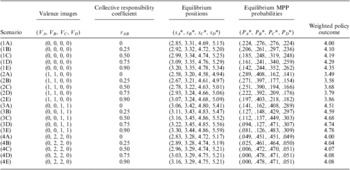
Table 1 reports the computed equilibrium strategiesFootnote 38 for alternative values of the collective responsibility coefficient, ranging from rAB
= 0 (i.e. no collective responsibility, as in the Adams–Merrill basic model) to rAB
= 0.9, and for alternative values of the parties’ measured valence images VA
,VB
,VC
,VD
. To clarify the results reported in Table 1, scenarios 1A–1E (presented in the first five rows) are scenarios where the parties’ long-term valence images are set to the equal values VA
= VB
= VC
= VD
= 0 (see column 2). The top row in the table (scenario 1A) reports that when voters ascribe no collective responsibility to the governing parties A and B (i.e. when rAB
= 0), the equilibrium configuration is
 $$)(--><$>\{ {{s}_A}^{\ast}\, = \,2.85,{{s}_B}^{\ast}\, = \,3.31,{{s}_C}^{\ast}\, = \,4.69,{{s}_D}^{\ast}\, = \,5.15\} <$><!--$$
and the parties’ equilibrium probabilities of being the MPP are
 $$)(--><$>\{ {{P}_A}^{\ast}\, = \,0.224,{{P}_B}^{\ast}\, = \,0.276,<$><!--$$
 $$)(--><$>{{P}_C}^{\ast}\, = \,0.276,{{P}_D}^{\ast}\, = \,0.224\} <$><!--$$
. The next four rows (scenarios 1B–1E) report equilibrium configurations for alternative scenarios where voters ascribe varying degrees of collective responsibility to A and B:
 $$)(--><$>{{r}_{AB}}\, = \,0.25{{,}_{}}{{r}_{AB}}\, = \,0.5{{,}_{}}{{r}_{AB}}\, = \,0.75{{,}_{}}{{r}_{AB}}\, = \,0.9<$><!--$$
(note that higher values of rAB
denote greater degrees of collective responsibility). Table 1 reports results for fifteen additional scenarios (Scenarios 2A–2E, 3A–3E, and 4A–4E) – to be discussed below – in which we again vary the parties’ long-term valence images and the degree of collective responsibility.
Equilibrium Positions for Varying Degrees of Collective Responsibility: Voters Hold the Leftist Parties A-B Collectively Accountable

Notes: Party preferences were set at RA = 1, RB = 3, RC = 5, RD = 7. For these computations parties and voters were assumed to have quadratic policy losses, the median voter's position was m = 4, and the policy salience parameter was a = 0.25. The parties’ equilibrium positions are those that maximize their expected policy utilities, which are given by Equation 3 in the text; their equilibrium probabilities of being the MPP are calculated using Equation 2 in the text. The weighted policy outcome in the RHS column is the mean of the parties’ equilibrium positions, weighted by their equilibrium probabilities of being the MPP.
The computations reported in Table 1 reveal four striking patterns. First, we located a unique Nash equilibrium in parties’ policy-seeking strategies for every scenario that we investigated, which suggests that the Adams–Merrill equilibrium result, which applies to the special case where there is no collective responsibility, generalizes to the collective responsibility model that we investigate here. Secondly, note that the parties’ optimal strategies at equilibrium are highly dispersed. Each party attempts to balance its policy preference with its likelihood of being the MPP, resulting in two groupings: two parties (A and B), who present moderate to sharply leftist positions, and two rightist parties (C and D), who present moderate to sharply rightist positions.Footnote 39 This pattern was also identified in the simulations on the basic model, reported in Adams and Merrill, ‘Policy-seeking Parties in a Parliamentary Democracy.’
The third pattern in Table 1 relates to how collective responsibility influences parties’ equilibrium positions. Note that as the degree of collective responsibility that voters ascribe to the governing parties A and B increases, i.e. as the value of rAB
increases, the leftmost governing party (Party A) moderates its position, thereby shifting towards the position of its centre-left coalition partner, Party B. For instance in the simulations with VA
= VB
= VC
= VD
= 0, party A's optimal position is
 $$)(--><$>{{s}_A}^{\ast}\, = \,2.85<$><!--$$
, when there is no collective responsibility (i.e. when rAB
= 0 in scenario 1A), but when rAB
= 0.5, party A shifts to a more moderate position,
 $$)(--><$>{{s}_A}^{\ast}\, = \,2.99<$><!--$$
(scenario 1C), and when rAB
= 0.9, Party A presents an even more moderate position,
 $$)(--><$>{{s}_A}^{\ast}\, = \,3.20<$><!--$$
(scenario 1E). For this latter scenario the governing parties’ equilibrium positions are extremely similar (
 $$)(--><$>{{s}_A}^{\ast}\, = \,3.20{{,}_{}}\ {{s}_B}^{\ast}\, = \,3.35<$><!--$$
), so that these parties essentially offer the electorate a single policy alternative. By contrast, the opposition parties C and D offer more distinctive policy positions, with D locating approximately 0.5 units to the right of C along the 1–7 scale, and these parties’ positions do not vary greatly as a function of rAB
. The same patterns emerge in the additional sets of simulations reported in scenarios 2A–2E, 3A–3E, and 4A–4E in Table 1: in each set of scenarios Party A converges towards Party B as these left-wing governing parties share more collective responsibility, while the opposition parties C and D – who do not share collective responsibility – maintain distinctive policies on the right of the policy spectrum.
What accounts for the pattern that we observe in the numerical calculations, in which collective responsibility motivates the more radical governing party, Party A, to moderate its position, thereby converging towards its coalition partner, Party B? Party A's strategic logic revolves around the fact that when two (or more) coalition partners share collective responsibility, then these parties’ probabilities of being the MPP are highly sensitive to each other's relative policy positions. This is because these coalition partners project that, to the extent that their short-term valence images fluctuate, these images will likely fluctuate in tandem because voters will ascribe joint responsibility to these parties for valence-related events or conditions. Therefore, in the presence of collective responsibility, it is critical to a focal party's goal of becoming the MPP – which is necessary in order for this party to implement its announced policies – that the focal party be in a strong electoral position vis-à-vis its coalition partner(s) at the time that it announces its policy strategy. And, given that in the scenarios we investigate the more radical governing party A is at an electoral disadvantage vis-à-vis its coalition partner, Party B (in terms of these parties’ relative likelihoods of winning the support of the median voter and thus becoming the MPP), this strategic imperative motivates Party A to moderate its position, thereby improving its electoral standing vis-à-vis Party B.Footnote 40 We label the strategic imperative for coalition partners to improve their electoral standing relative to each other the coalition convergence effect. In supplementary materials we support the interpretation offered above with the theoretical result shown in the following sub-section.Footnote 41
The Peripheral Governing Party Moderation Theorem
Suppose that party K is a member of a coalition cf , that K's optimal position lies strictly between its sincere policy preference RK and the median voter position m, that this equilibrium position is to the left (right) of all competing parties, and that K's equilibrium probability P(K) of being the MPP is smaller than the MPP probabilities of the other members of the coalition cf . Then if the collective responsibility coefficient rf increases, K is motivated to unilaterally moderate its position relative to the median voter position m, i.e. to converge towards the positions of its coalition partners.
In words, the theorem states that when a member of a governing coalition is a peripheral party, i.e. when it promises the most radical right-wing or left-wing policies of all the parties contesting the election, and when moreover this peripheral party's prospects of becoming the MPP are weaker than those of its coalition partner(s), then, as the degree of collective responsibility shared by the coalition members increases, this party experiences strategic pressure to moderate its policies. This result is relevant to the computations reported in Table 1, where the left-most party A has a lower equilibrium probability of being the MPP than does its coalition partner, Party B, and where Party A's equilibrium position becomes increasingly moderate as the collective responsibility coefficient rAB increases.
We note that the peripheral governing party moderation result is relevant to many real world scenarios where small, non-centrist, parties – such as the German Greens and the French Communists – have entered into governing coalitions with large, mainstream, coalition partners (such as the German Social Democrats and the French Socialists). In these scenarios the peripheral governing party moderation theorem implies that the smaller, more radical, coalition member will experience pressure to moderate its policies by converging towards the position of its more centrist coalition partner.
The fourth pattern in Table 1 relates to how collective responsibility affects parties’ probabilities of being the median parliamentary party (MPP). Note that as voters ascribe more collective responsibility to the governing parties A and B, these parties’ equilibrium probabilities of being the MPP decline (see the second column from the right in Table 1). For instance, for the first scenario in Table 1, we see that when voters ascribe no collective responsibility to A and B, i.e. when rAB
= 0, then these parties’ equilibrium probabilities of being MPP are
 $$)(--><$>{{P}_A}^{\ast}\, = \,0.224{{,}_\ {}}{{P}_B}^{\ast}\, = \,0.276<$><!--$$
(scenario 1A). However for rAB
= 0.5 these probabilities decline to
 $$)(--><$>{{P}_A}^{\ast}\, = \,0.185{{,}_{}}\ {{P}_B}^{\ast}\, = \,0.248<$><!--$$
(scenario 1C), and for rAB
= 0.9 these equilibrium probabilities decline even more, to
 $$)(--><$>{{P}_A}^{\ast}\, = \,0.142{{,}_{}}\ {{P}_B}^{\ast}\, = \,0.244<$><!--$$
(scenario 1E).Footnote 42 The additional scenarios 2A–2E, 3A–3E, and 4A–4E display similar patterns. And, these reductions in the leftist governing parties’ prospects of being MPP, as a function of collective responsibility, imply an increased probability that one of the right-wing opposition parties (C or D) becomes the MPP. The effects of these probability changes are displayed in the RHS column of Table 1, which reports the weighted policy outcome of the election, defined as the mean of the parties’ equilibrium positions weighted by their equilibrium probabilities of being the MPP. We see that as voters ascribe more collective responsibility to the leftist governing parties A and B (i.e. as rAB
increases), this weighted policy mean shifts to the right, away from the governing parties’ preferred positions. These results thereby suggest that collective responsibility depresses the responsible parties’ prospects of being the MPP, which in turn damages their policy expectations. We label this the coalition penalty effect.
Why does collective responsibility depress coalition partners’ probabilities of becoming the MPP? The intuition is that when voters ascribe high degrees of collective responsibility to a coalition of parties, then, substantively, the voters view these parties as being interchangeable, in the sense that the coalition members no longer represent distinct alternatives to the voters.Footnote 43 Thus from the voters’ perspectives, high degrees of collective responsibility effectively collapse the distinct alternatives that coalition members would otherwise represent into a single alternative – an effect that depresses the likelihood that the median voter will prefer some member of the coalition to all the parties outside the coalition.
Additional Illustrative Examples
Scenarios 2A–2E, 3A–3E, and 4A–4E in Table 1 illustrate alternative scenarios in which we vary the parties’ long-term valence images, along with the degree of collective responsibility. In scenarios 2A–2E, for instance, the governing parties A and B are specified as having stronger long-term valence images than the opposition parties C and D, i.e. VA = VB = 1, VC = VD = 0.Footnote 44 Consistent with the centripetal valence effects (CVE) result that Adams and Merrill prove for the basic model,Footnote 45 we see that the governing parties’ improved long-term valence images motivate them to shift to more radical positions, compared to their positions for scenario 1, in which all parties have equal long-term valence images. The results for scenarios 3A–3E, in which the governing parties A and B are specified as having weaker valence images than the opposition parties (i.e. VA = VB = 0, VC = VD = 1), again support the CVE result: now the governing parties A and B moderate their positions in order to recoup their electoral prospects. Finally, scenarios 4A–4E illustrate the situation where the centre parties, B and C, have stronger long-term valence images than the peripheral parties A and D, i.e. VA = VD = 0, VB = VC = 2.Footnote 46 This corresponds to the common real world scenario where a large, mainstream, party such as the Dutch Labour Party, the French Socialists or the German Social Democrats, governs in coalition with a smaller and more radical party (or parties). Compared to scenario 1, in which all parties have equal long-term valence, we see that in scenario 4 the centrist parties shift to (slightly) more radical policies, which again supports the CVE result. And, note that for all of the scenarios in Table 1, increases in the collective responsibility term rAB are associated with more moderate equilibrium positions for the peripheral coalition member Party A, a pattern that supports the peripheral governing party moderation theorem. By contrast the equilibrium position of the moderate coalition member, Party B, is not very responsive to the value of rAB .
Extensions to Alternative Scenarios: Opposition ‘Proto-Coalitions’ and Centrist Governing Coalitions
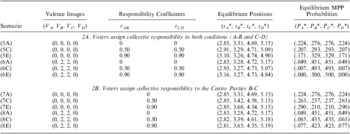
Table 2 reports computations for scenarios that illustrate additional strategic implications of the collective responsibility model. Table 2A presents computations for situations where voters assign collective responsibility to the governing parties A and B and to the ‘proto-coalition’ of opposition parties C and D. For both sets of scenarios illustrated in Table 2A – one where all parties have equal long-term valence images (scenarios 5A–5C) and one where the centrist parties B and C have stronger long-term valence images (scenarios 6A–6C) – we see that the coalition convergence effect operates for both the governing coalition and the opposition proto-coalition: namely, as collective responsibility increases, the peripheral parties A and D converge towards the positions of their coalition partners, as the peripheral governing party moderation theorem predicts. Indeed, when the collective responsibility coefficient is set to the high value rAB = 0.9, there is minimal policy differentiation within each coalition (i.e. the coalition partners are separated by less than 0.2 units along the 1–7 Left–Right scale) but substantial policy variation between the coalitions, i.e. the policy distance between the coalitions is nearly 1.5 units on the 1–7 scale. These computations thereby illustrate how the strategic incentives associated with collective responsibility can transform a multi-party system into what is effectively a two-party system, in terms of the meaningful policy alternatives offered to the electorate.
Equilibrium Positions for Alternative Scenarios

Notes: Party preferences were set at RA = 1, RB = 3, RC = 5, RD = 7. For these computations parties and voters were assumed to have quadratic policy losses, the median voter's position was m=4, and the policy salience parameter was a = 0.25. The parties’ equilibrium positions are those that maximize their expected policy utilities, which are given by equation 3 in the text; their equilibrium probabilities of being the MPP are calculated using equation 2 in the text.
Table 2B reports computations for scenarios where the governing coalition now comprises the two centrist parties B and C. Again, we see that as the degree of collective responsibility increases, the coalition partners converge towards each other (the coalition convergence effect), and that collective responsibility again depresses the coalition partners’ probabilities of being the MPP (the coalition penalty effect).
In toto, the computations reported in Tables 1–2 suggest that the two central results that Adams and Merrill identified for a basic policy-seeking model – i.e. a model that does not incorporate collective responsibility – extend to the collective responsibility model:Footnote 47namely, an equilibrium result, that an equilibrium configuration in parties’ policy-seeking strategies will exist, and a centripetal valence effects (CVE) result, that parties will moderate (radicalize) their policy strategies when their long-term valence images deteriorate (improve). Our computations and theoretical results also identify three additional effects relating to collective responsibility: a coalition convergence effect, that as coalition partners share more collective responsibility they converge towards each other's policy positions; a peripheral governing party moderation effect, that coalition convergence is often driven by smaller, more radical coalition partners moderating their policies as collective responsibility increases; and a coalition penalty effect, that collective responsibility depresses coalition partners’ probabilities of being the MPP, which in turn diminishes their policy expectations. All the conclusions of this paragraph are further substantiated by our computer simulation analysis in the next section.
Simulation Analysis
To substantiate the conclusions suggested by our illustrative examples and the peripheral governing party moderation theorem, we simulated 1,000 four-party elections in which parameters were chosen randomly from a parameter space, with the parties’ probabilities of being the MPP given by Equation 2 above. Parties A and B were assumed to be the governing parties, and the value of the collective responsibility coefficient rAB was chosen from a uniform distribution on the interval [0.0, 0.9], while voters were assumed to ascribe no collective responsibility to the opposition parties C and D (i.e. rCD = 0). Parties’ long-term valence images were chosen independently from a uniform distribution on the interval from 0.0 to 2.0, and the preferred policy positions for parties A, B, C and D were chosen from uniform distributions on the intervals [1.0, 2.5], [2.5, 4.0], [4.0, 5.5] and [5.5, 7.0], respectively. The median voter position was set at m = 4, the policy salience coefficient was set to a = 0.25, and quadratic policy losses were used for voters and parties.
For these simulations we located an equilibrium configuration for all but three of the 1,000 scenarios we generated,Footnote 48 which again supports the hypothesis that the Adams–Merrill equilibrium existence result – which applies to the basic model – extends generally to the collective responsibility model that we analyse here. To assess uniqueness of the equilibrium in each scenario, we generated for each of the 1,000 scenarios two sets of starting values, with each starting value for each party randomly generated on the continuous interval from 1 to 7. In all but five of the 1,000 scenarios the two sets of starting values led to the same set of equilibrium configurations, strongly supporting the conclusion that the equilibria are in nearly all cases unique.Footnote 49 Finally, the evidence is strong that the equilibria are generally global (not just local) because each party's equilibrium position was evaluated as optimal by calculating its utility while varying its location in steps of 0.001 over the entire scale from 1 to 7. Thus, overall, we have strong evidence that, for the collective responsibility model, unique Nash (global) equilibrium configurations virtually always exist for an extensive parameter space.
The parties’ preferred positions and their optimal strategies were then normalized by taking the absolute distance from the median voter's position. Each party j's optimal strategies were regressed on seven independent variables: the party's preferred position Rj
; the square of this position
 $$)(--><$>R_{j}^{2} <$><!--$$
, the party's long-term valence image Vj
; the degree of collective responsibility that voters assign to the governing parties, rAB
; and the interaction terms (Rj
× Vj
), (Rj
× rAB
), and (Vj
× rAB
), resulting in equations for the optimal strategy of party j of the form:
 $${{{s}_j}\, = \,{{\beta }_0}\, + \,{{\beta }_1}{{R}_j}\, + \,{{\beta }_2}R_{j}^{2} \, + \,{{\beta }_3}{{V}_j}\, + \,{{\beta }_4}{{r}_{AB}}\, + \,{{\beta }_5}({{R}_j}\,\times \,{{V}_j})\, + \,{{\beta }_6}({{R}_j}\,\times \,{{r}_{AB}})\, \cr+ \,{{\beta }_7}({{V}_j}\,\times \,{{r}_{AB}}).$$
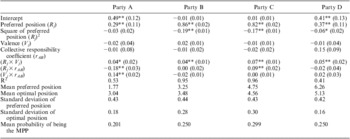
Regression statistics are presented in Table 3 for each of the four parties. As expected – and as indicated by the positive coefficients on the preferred positions (Rj
) – all four parties move to significantly more extreme positions as their preferred positions become more extreme, but at a diminishing rate (as indicated by the negative coefficients on
 $$)(--><$>R_{j}^{2} <$><!--$$
). The moderating effect of greater collective responsibility on the optimal strategy of party A is greater as party A's preferred position becomes more extreme, as indicated by the highly significant negative sign of the coefficient of the interaction term (Rj
× rAB
). In addition, the fact that this coefficient is significant (and negative) for Party A but not for B implies that the policy distance between these parties’ equilibrium positions diminishes as collective responsibility increases – an observation that supports the coalition convergence effect we identified earlier. Furthermore, the highly significant positive coefficient of (Vj
× rAB
) shows that the optimal position of peripheral governing party A becomes more moderate as its valence decreases along with enhanced collective responsibility with its coalition partner B. This effect supports the peripheral governing party moderation effect, that smaller, more radical coalition partners moderate their policies as collective responsibility increases. Finally, we note that the optimal positions of the two parties not in the government coalition (C and D) are not significantly affected by the variables involving the collective responsibility coefficient rAB
of the governing parties, except for the dependence of party C on (Rj
× rAB
)
 $$)(--><$>({{R}_j}\times {{r}_{AB}})<$><!--$$
.
Regression Results for Simulated Data

Notes: In these analyses the dependent variable was the absolute distance between the focal party's equilibrium position and the median voter position. Regression results are based on the 993 (out of 1,000) simulated four-party elections that yielded unique convergent equilibrium configurations (see the text of the article for a description of these simulations). Regression coefficients significantly different from zero at the 0.05 level are indicated by (*); those significant at the 0.01 level, by (**). Values in parentheses are standard errors. (Regression coefficients using all 1000 simulated scenarios and one of the equilibrium sets for each of the seven aberrant cases differ only minutely from those reported above.) Parties A and B were assumed to be the governing parties. The collective responsibility coefficient rAB was chosen from a uniform distribution on the interval [0.0, 0.9], parties’ long-term valence images VA ,VB ,VC ,VD were chosen independently from a uniform distribution on the interval from 0.0 to 2.0, while their preferred policy positions RA , RB , RC , RD were chosen from uniform distributions on the intervals [1.0, 2.5], [2.5, 4.0], [4.0, 5.5], and [5.5, 7.0], respectively. The median voter position was set at m = 4.
The parties’ mean equilibrium probabilities of being the MPP over the simulation runs (see the bottom row of Table 3) indicate that the coalition partners A and B have diminished prospects of becoming the MPP, compared to their counterparts from outside the coalition: specifically, the left-most coalition member, Party A, has a lower mean MPP probability than the right-most party from outside the coalition, party D, while the moderate coalition party, Party B, has a lower mean MPP probability than the moderate party outside the coalition, Party C. As a result the mean weighted policy outcome over the simulations was 4.13, significantly to the right of the median voter position, m = 4. This supports the proposition that collective responsibility diminishes the coalition parties’ policy expectations – the coalition penalty effect that we identified earlier.
Finally, we see that parties’ optimal strategies are more moderate than their preferred positions (see the comparison between the parties’ mean preferred positions and their mean optimal strategies, presented near the bottom of Table 3), most strikingly for the two extreme parties A and D, and especially for party A which is subject to the peripheral governing party moderation effect. This effect results in an equilibrium configuration in which the two parties on the left (and the two parties on the right) are much closer to each other than they are to the locations of the other coalition members. In fact, the gap between the mean optimal strategy for parties B and C is about twice the size of the gap between parties A and B or between parties C and D. Hence, the parties naturally coalesce into centre-left and centre-right coalitions, even though their preferred positions were drawn from equally-spaced intervals.
Conclusion and Discussion
Our computational and theoretical results suggest that introducing collective responsibility into a model of policy-seeking parties in a PR-based parliamentary democracy, generates interesting new insights into the nature of parties’ policy strategies. On the one hand, our computations suggest that the two central theoretical results that Adams and Merrill derive for a basic modelFootnote 50 – one that omits collective responsibility – extend to the collective responsibility model we present here: namely, we find numerically for a wide range of parameter values that a global (Nash) equilibrium in parties’ policy-seeking strategies almost invariably exists and is unique, and, furthermore, that parties have incentives to moderate (radicalize) their policies when their long-term valence images improve (decline) – the centripetal valence effect result. On the other hand, we have identified three additional strategic incentives associated with collective responsibility: a coalition convergence effect, that jointly responsible parties have policy-seeking incentives to converge towards similar policy positions; a peripheral governing party moderation effect, that coalition convergence is primarily driven by smaller, more radical coalition members moderating their policies and thereby converging towards the positions of their larger, more mainstream, coalition partners; and a coalition penalty effect, that sharing joint responsibility for short-term, valence-related, events depresses coalition partners’ policy expectations. This latter effect provides strategic incentives for political parties that approve of the government's policies to support the government from outside the coalition – as opposed to formally joining the coalition – in order to side-step collective responsibility for valence-related events that reflect on all the governing parties. Such incentives may contribute to the widely discussed phenomenon of minority governments, i.e. governing coalitions that control less than half the seats in parliament.Footnote 51 Contemporary examples of this minority government phenomenon include Norwegian politics, where the small, left-wing, Socialist Party typically supports the large, centre-left, Labour Party from outside the government, and the current minority ruling coalition of the Dutch People's Party for Freedom and Democracy (VVD) and the Christian Democratic Appeal (CDA), which is supported from outside the formal coalition by the Party for Freedom (PVV).Footnote 52
From an empirical standpoint, it would seem promising to evaluate empirically the strategic policy positioning incentives we have identified relating to the coalition convergence effect and the peripheral governing party moderation effect. As we noted in the introduction, remarkable empirical research by Fortunato and Stevenson concludes that rank-and-file voters typically perceive the policy positions of partners in governing coalitions as converging over time, a pattern that supports our coalition convergence effect argument;Footnote 53 these authors, however, propose an alternative explanation for this empirical pattern that emphasizes the information shortcuts citizens employ to infer party policy positions.Footnote 54 It would be useful to conduct follow-up empirical research to parse out these alternative explanations. In addition, we are conducting an empirical study to evaluate our hypothesized peripheral governing party moderation effect, that small, peripheral members of coalitions show disproportionate tendencies to moderate their policies.
The hypothesized coalition penalty effect we identify raises an additional empirical question: if real world parties are policy-seeking, as we assume in our model, but parties suffer penalties in terms of their expected policy payoffs when they join a governing coalition, then why do parties ever choose to enter into coalitions as opposed to supporting a minority one-party government from outside the government?Footnote 55 With respect to this question, we suggest two promising lines for future investigation. The first is that real world party elites are largely unaware of the coalition penalty effect we identify, at least as it relates to the strategic disadvantages associated with collective responsibility.Footnote 56 Given that we have just developed the coalition penalty effect hypothesis – which we hope political scientists and politicians will view as a novel argument! – it seems plausible that party elites sometimes fail to project how the collective responsibility that comes with coalition membership can hamper their long-term policy objectives. A second possibility – one that applies particularly to smaller parties that have limited histories of participating in government – is that these parties’ elites project that coalition membership will burnish the party's image with respect to voters’ perceptions of the party's competence and leadership ability, i.e. its ability to govern. In this regard, some commentators argue that the British Liberal Democrats’ decision to enter into a governing coalition with the Conservative party, following the May 2010 general election, was driven by the Liberal Democratic leader Nick Clegg's belief that formal participation in government – the party's first such participation during the post-war period – would convince the British public that the Liberal Democrats could be trusted to govern the country, a perception that might strengthen the party's appeal in subsequent elections.Footnote 57 This suggests that we might extend our model to incorporate projected changes in parties’ valence images relating to formal government participation. These considerations notwithstanding, we believe the coalition penalty effect we identify offers a promising explanation for the phenomenon of minority government, which has long puzzled political scientists.
From a theoretical standpoint, our conclusions on how collective responsibility affects parties’ policy-seeking strategies is relevant to work by Adams, on how collective responsibility affects parties’ vote-seeking strategies – which is to our knowledge the only previous study that incorporates collective responsibility into the spatial modelling framework.Footnote 58 In contrast to our conclusion that policy-seeking parties tend to converge towards each other's positions when they share collective responsibility, Adams concludes that vote-seeking parties that share collective responsibility have incentives to diverge in the policy space.Footnote 59 This suggests that the phenomenon of collective responsibility is important for party strategies regardless of parties’ mixtures of vote-seeking versus office-seeking motivations – but that the implications of collective responsibility differ depending on which goal is most salient to party elites.
Appendix The Generalized Extreme Value (GEV) model is specified as follows. Let the set K of parties be partitioned into n subsets labelled c
1, c
2,…, cn
, where C = {c
1, c
2,…, cn
}. The utility that the voter i obtains from party j in subset cf
is denoted
 $$)(--><$>{{U}_i}(j)\, = \,ag({{s}_j},{{v}_i})\, + \,{{V}_j}\, + \,{{{\epsilon}}_j}<$><!--$$
, where
 $$)(--><$>[ag({{s}_j},{{v}_i})\, + \,{{V}_j}]<$><!--$$
is measured and εj
is the unmeasured, random variable. The GEV model is obtained by assuming that the εj
, for all j∈cf
are distributed according to the GEV distribution. For the GEV, the joint cumulative distribution of the random variables, for all j∈cf
, is assumed to be:Footnote 60
 $$\exp \left[ {{\rm{ - }}\mathop{\sum}\limits_{{{c}_h} \in C} {{{\alpha }_{{{c}_h}}}} {{{\left( {\mathop{\sum}\limits_{j \in {{c}_h}} {{{e}^{{{{\epsilon}}_j}/(1{\rm{ - }}{{r}_h})}} } } \right)}}^{(1{\rm{ - }}{{r}_f})}} } \right]$$
This distribution is a generalization of the distribution that gives rise to the logit model. For logit, each εj is independent with a univariate extreme value distribution. For GEV, the marginal distributions of each εj within each subset are correlated with each other. Specifically, rf is the correlation of the error terms within each subset, cf . For any two candidates j and k that are in different subsets, there is no correlation between εj and εk .