Introduction
The reconstruction of the biological history of a population and its genetic structure is nowadays usually undertaken through molecular techniques (Lippold et al., Reference Lippold, Xu, Ko, Li, Renaud, Butthof, Schröder and Stoneking2014). However, depending on the features of the population and the genetic markers, this information may not be of sufficient resolution for a detailed reconstruction of the demographic and historic events that occurred within the population (King & Jobling, Reference King and Jobling2009). In such cases, an interesting option is to try to reconstruct the population history using methods based on isonymy. This methodology, particularly if high-quality data are available, allows demographic events affecting the population to be reconstructed, and their genetic consequences to be estimated. Another advantage is that it reflects the interaction between culture and biology, a typical phenomenon of our species.
Isonymous surname analysis makes it possible to study fundamental aspects of population genetics, such as genetic diversity, inbreeding or the presence of genetic structures. It also calculates phylogenetic relationships between populations and estimates the existence of genetic barriers. Due to the rapid development of technology, isonymous studies have moved from analyses of small populations with a relatively small number of surnames (Yasuda & Furusho, Reference Yasuda and Furusho1971; Morton et al., Reference Morton, Smith, Hillm, Frackiewiczm, Lawm and Yee1976; Jorde & Morgan, Reference Jorde and Morgan1987; Allen, Reference Allen1988) to analyses of huge geographic regions with a massive amount of information (Liu et al., Reference Liu, Chen, Yuan and Chen2012; Herrera Paz et al., Reference Herrera Paz, Scapoli, Mamolini, Sandri, Carrieri, Rodriguez-Larralde and Barrai2014; Dipierri et al., Reference Dipierri, Rodríguez-Larralde, Barrai, Camelo, Redomero and Rodríguez2014).
The present study aims to analyse one of the most isolated valleys in the southern Pyrenees. This area presents two advantages that make it suitable for studies using isonymy. Firstly, it has conserved parish records over a long period of time (1638–1988), something that is unusual in studies of this type (Colantonio et al., Reference Colantonio, Lasker, Kaplan and Fuster2003). Secondly, demographic changes in the area have been well documented and are related to deep socioeconomic changes. This study’s objective was therefore to reconstruct the demographic history of the Alta Ribagorça by estimating its genetic structure, inbreeding and demographic movements through the analysis of surnames.
Methods
The population of the Alta Ribagorça
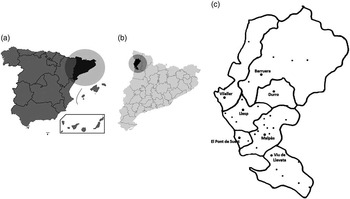
The Alta Ribagorça administrative district (Fig. 1) is located in one of the steepest north–south valleys of the central Catalonian Pyrenees. It covers an area of about 427 km2 and has peaks rising to over 3000 m. It is situated on the left bank of the Noguera Ribagorçana River and is divided into three smaller valleys: Noguera Ribagorçana, Boi and Viu. The first of these is the main axis and has two distinct parts: a northern one occupied by the Barrabés Valley, centred on Vilaller, and a southern part of the valley where the capital is Pont de Suert. The Alta Ribagorça is the least populated district of Catalonia.
Location of the Alta Ribagorça region in Spain (a), among the autonomies of Cataluña and Aragón (b). The locations of the seven population nuclei of the region are shown in (c).

There are 28 population nuclei in the area, most of them currently uninhabited and traditionally grouped in seven administrative entities or parishes. Currently, however, there are only three, with the capital at the administrative and service centre of Pont de Suert. The economy has traditionally been based on livestock farming, but began to change rapidly after 1950 when hydroelectric and coal-mining activities were established (del Valle & Espona, Reference del Valle and Espona2006). Today tourism is the most important economic activity. It is worth mentioning that UNESCO declared the Romanic churches from the XII century a World Heritage Site in 2000.
Sources of information
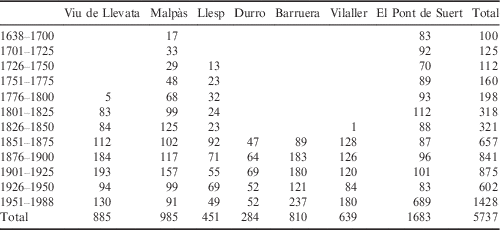
The information used in this study was extracted from marriage records compiled in the religious archives of the seven traditional municipalities: Viu de Llevata, Malpàs, Llesp, Durro, Barruera, Vilaller and El Pont de Suert. These archives contain information on 5737 marriages for the period 1638–1988 (Table 1). The following information was extracted from every marriage registration: year of marriage, parish name, origin and surnames of each spouse. Because of the introduction of hydroelectric activities and the subsequent changes, the study was divided in two periods: 1638–1950 and 1951–1988. These temporary divisions were selected for two main reasons. First of all, this was to avoid splitting information and because some periods were poorly represented both at local and parish level. It is important to remember that in some parishes data were available from 1851, and in others, because of its limited population size, the number of marriages was relatively low. Secondly, it was vital for the method used that all parishes were represented. Moreover, the work did not pretend to study changes over time, but to determine the effect of industrialization on the genetic structure of an isolated population, expressed here in the development of a hydroelectric industry in the area.
Number of marriage registers per parish, Alta Ribagorça, Catalonia

Data analysis
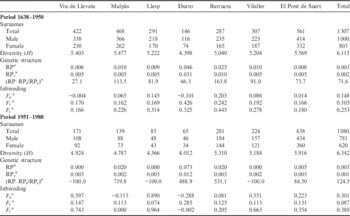
Statistical methods were based on the application of isonymous analyses (Crow & Mange, Reference Crow and Mange1965) using the transmission of Spanish surnames according to the Catholic tradition (Lasker, Reference Lasker1968; Lasker & Kaplan, Reference Lasker and Kaplan1985; Pinto-Cisternas et al., Reference Pinto-Cisternas, Pineda and Barrai1985, Reference Pinto-Cisternas, Rodriguez-Larralde and Castro de Guerra1990; Madrigal & Ware, 1997; Rodríguez-Larralde et al., Reference Rodríguez-Larralde, González-Martín, Scapoli and Barrai2003). Thus, each individual has two surnames: the first from the father and the second from the mother. The study therefore began with the calculation of the total number of surnames and the total number of different male and female surnames, per period and parish (Table 2).
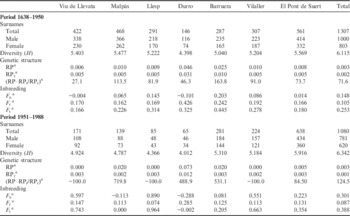
Number of different male and female surnames for each parish and period, and the diversity index (H), frequency of isonymous marriages (RP), expected marriages when spouses have the same surname at random (RPr) and non-random (F n), random (F r) and total (F t) inbreeding coefficients
a Values multiplied by 102.
Diversity indexes
The Shannon index (H) (Lewontin, Reference Lewontin1972; Bhatia & Wilson, Reference Bhatia and Wilson1981) was applied to estimate surname diversity. This method, known as the probabilistic similarity coefficient (Sneath & Sokal, Reference Sneath and Sokal1973), gives excellent results when applied in studies of human population genetics (Barrai et al., Reference Barrai, Formica, Barale and Beretta1989, Reference Barrai, Formica, Scapoli and Beretta1990).
Population sub-structure
The total number of repeated pairs (RP) of surnames for all marriages (Lasker & Kaplan, Reference Lasker and Kaplan1985), and its expected value under random conditions (RPr), were calculated (Chakraborty, Reference Chakraborty1985) (Table 2). Population subdivision is related to preferential selection by the spouses and can be expressed as (RP−RPr)/RPr (James et al., Reference James, Lasker and Morell1986; Chakraborty, Reference Chakraborty1986; Koertvelyessy et al., Reference Koertvelyessy, Crawford, Huntsman, Collins, Keeping and Uttley1988, Reference Koertvelyessy, Crawford, Pap and Szilagyi1990).
Inbreeding indexes
The inbreeding coefficients were calculated based on Crow’s method B (Crow, Reference Crow1980). The coefficient of total inbreeding (F t) depends on the following components:
 $$F_{t} \,{\equals}\,{\raise0.7ex\hbox{$1$} \!\mathord{\left/ {\vphantom {1 4}}\right.\kern-\nulldelimiterspace}\!\lower0.7ex\hbox{$4$}}\,F_{n} {\plus}(1{\minus}F_{n} ){\times}F_{r} ,$$
where F r (the random inbreeding coefficient) essentially depends on population size, whereas F n (the non-random inbreeding coefficient) indicates the intensity of selection of partners with the same surname (either positive or negative) (Bittles & Neel, Reference Bittles and Neel1994).
Geographic distribution and genetic barriers
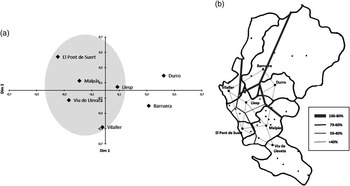
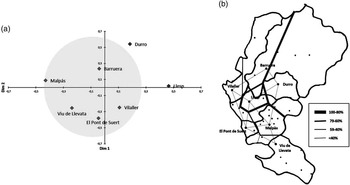
Hendrick genetic distances were calculated by means of the frequency distribution of surnames, and represented in a multidimensional scaling (MDS) per parish and period (Figs 2 and 3). In order to detect potential genetic barriers (Barbujani & Belle, Reference Barbujani and Belle2006; Balanovsky et al., Reference Balanovsky, Dibirova, Dybo, Mudrak, Frolova and Pocheshkhova2011), Monmonier’s (Monmonier et al., Reference Monmonier, Calafell, Benchemsi, Helal, Lefranc and Stoneking2000) maximum difference algorithm was applied through Barrier v.2.2 software (Manni et al., Reference Manni, Guérard and Heyer2004) (Figs 2 and 3).
The MDS (a) shows the genetic similarities between the seven parishes of the Alta Ribagorça for Period 1 (1638–1950). The genetic barriers detected, based on the frequency and distribution of surnames, are shown in (b).

The MDS (a) shows the genetic similarities between the seven parishes of the Alta Ribagorça for Period 2 (1951–1988). The genetic barriers detected, based on the frequency and distribution of surnames, are shown in (b).

Spatial distribution
The distribution of total inbreeding coefficient values (F t), surname diversity (H) and substructure populations ((RP−RPr)/RPr) are shown for different periods, using a system of geographic information (GIS), specifically through ArcGis 10.2 software applying the ‘kriging’ method.
Results
The population size of the Alta Ribagorça, at between 2000 and 7000, has always been relatively small, with a current population of around 4000 inhabitants. The surnames in the area were studied for two different periods: before and after 1950. The hydroelectric industry was established in the area from 1950 onwards and brought about many deep economic and social changes.
In total 5737 marriages were analysed: 4309 from the first period and 1428 from the second. Some populations have no data prior to 1851, such as Barruera, Durro and Vilaller (Table 1). The municipalities with the highest number of marriages were El Pont de Suert (1683), Malpàs (985) and Viu de Llevata (885).
Two surnames for each spouse were extracted from the marriage registers. The highest number of different surnames was detected for the first period (1307), and generally the number was higher for men than for woman in both periods (Table 1). Just six out of the 20 most frequent surnames – considering the seven parishes and both genders – were autochthonous, with the rest coming with the migrants who arrived after 1950 as the area industrialized. In general, the most frequent surnames were García (70), Martínez (55), López (47) and Rodríguez (42). The most frequent autochthonous surnames were Palacín (32), Farrero (28) and Farré (27), the 8th, 10th and 11th most frequent out of the 20, respectively.
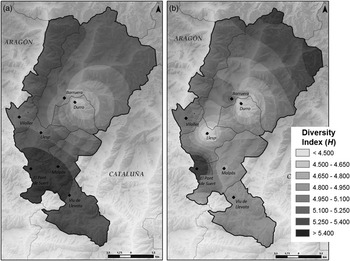
The diversity index (Table 2; Fig. 4) was higher in the second period (H=6.342) than in the first (H=6.115). In the first period, the most diverse parishes were El Pont de Suert (H=5.569) and Malpàs (H=5.477), and the least diverse were the parishes in the Boí Valley: Durro (H=4.398) and Barruera (H=5.040). In the second period, the highest diversities were concentrated in El Pont de Suert (H=5.915) and Barruera (H=5.310), and the lowest in Llesp (H=4.366) and Durro (H=4.012).
Diversity index of the parishes expressed by mean H: (a) Period 1 (1638–1950); (b) Period 2 (1951–1988).

The existence of genetic subdivision is related to the absence of panmixia (mating system in which mate choice is made randomly), and may imply genetic differentiation between populations. The value of (RP−RPr)/RPr was calculated as an approximation. The resulting value indicates that there is a tendency to marry randomly a spouse with the same surname. There were more marriages with common surnames than would be expected by chance (Table 2), particularly in the second period ((RP−RPr)/RPr=124.5). Although the area was more isolated during the first period ((RP−RPr)/RPr=71.6), the existence of genetic subdivision was more likely in the second (Fig. 3).
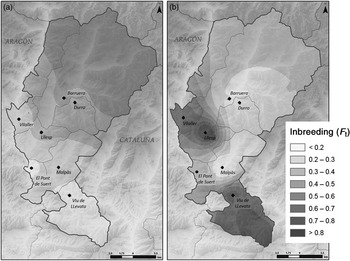
Inbreeding is one of the most important phenomena regulating population structure and the evolutionary processes that populations experience. The isonymous method allowed the total inbreeding coefficient values (F t) (Fig. 5) to be calculated and its random (F r) and non-random (F n) components to be estimated. The highest inbreeding levels belong to the second period (F t=0.00388) – specifically to the municipality of Llesp (F t=0.00964). In the first period, the highest inbreeding levels were detected in Durro (F t=00314). The maximum levels of the F n component were identified in the second period in the parishes of Llesp (F n=0.0089) and Viu de Llevata (F n=0.00597). With regard to the random component, the highest values were found in the first period in Durro (F r=0.00426).
Total inbreeding coefficient (F t) per parish: (a) Period 1 (1638–1950); (b) Period 2 (1951–1988). Values multiplied by 102.

Using the frequency of surnames, Hendrick’s genetic distance was calculated and plotted as an MDS. Figure 2 shows population distributions according to Hendrick’s genetic distances for the first period. A cluster can be observed formed by El Pont de Suert, Malpàs and Viu de Llevata and, at some distance, Vilaller and Llesp, whereas Durro and Barruera are isolated from the group. In the same figure (Fig. 2), the genetic barriers calculated using Barrier software were plotted superimposed on the (RP−RPr)/RPr values. The most solid barriers are found in the southern municipalities, in the lowest part of the region. The most important genetic barriers isolate the populations located in the Boí Valley, that is, the parishes of Barruera and Durro.
The MDS and the geographic barriers for the second period appear in Figs 3a and b, respectively. All populations are grouped together except for Durro and Llesp, the latter being the most isolated. This plot also agrees with the genetic barriers created by Barrier software: Llesp and Durro are surrounded by solid barriers. The rest of the barriers are less solid and created a passage down the valley from north to south following the recently constructed roads.
Discussion
Reconstructing the history of human populations, and analysing the factors that have regulated and determined their current genetic structure, is one of the objectives of the discipline known as Physical Anthropology. However, such studies are difficult to perform, given the biological and cultural complexity of our species. For that purpose, the isonymous method was developed specifically for human populations (Boattini et al., Reference Boattini, Griso and Pettener2011; Darlu et al., Reference Darlu, Bloothooft, Boattini, Brouwer, Brouwer and Brunet2012). This method is based on the analysis of surnames as genetic markers (Sykes & Irven, Reference Sykes and Irven2000). Some requirements must be fulfilled in order to apply this method, but as they are usually not completely met, several statistic corrections are included in the analysis. These corrections are commonly related to the polyphyletic origin of the surnames – the same surname may have different origins – and/or to discontinuity in their transmission, e.g. because of adoptions (Boattini et al., Reference Boattini, Lisa, Fiorani, Zei, Pettener and Manni2012). Despite the drawbacks, the isonymous method has been widely applied, with excellent results in the study of human populations (Scapoli et al., Reference Scapoli, Mamolini, Carrieri, Rodriguez-Larralde and Barrai2007), in the field of biomedicine (Calderón et al., Reference Calderón, Aresti, Ambrosio and González-Martín2009) and recently, in genomics (Gymrek et al., Reference Gymrek, McGuire, Golan, Halperin and Erlich2013). In addition, it is sometimes the only way to analyse specific aspects of the past, especially when applying other anthropological methods, such as molecular techniques, is complicated (Tarskaia et al., Reference Tarskaia, El’chinova, Scapoli, Mamolini, Carrieri, Rodriguez-Larralde and Barrai2009; Mikerezi et al., Reference Mikerezi, Xhina, Scapoli, Barbujani, Mamolini and Sandri2013).
This study used information contained in the marriage registers found in parish records from the Alta Ribagorça region of Catalonia. It is worth mentioning that marriage is, in biological terms, the entry of individuals into the reproductive pool. The surnames of the consorts therefore act as genetic markers of patrilineal inheritance and are representative of the population.
The Alta Ribagorça region is located in the Central Catalonian Pyrenees, and is very interesting from an anthropological point of view for several reasons. Firstly, it is one of the most rugged and isolated areas in the Iberian Peninsula, with elevations in excess of 3000 m in some cases. It is also interesting because its demographic history may be used as a model applicable to other rural areas of the Peninsula. This region has experienced several significant demographic oscillations. The first of these occurred in the middle of the XVII century as a result of a general improvement in living conditions in rural areas of the Iberian Peninsula (Vila, Reference Vila1990). The second increase in population size was considerably more marked from 1950 onwards, and was associated with the development of hydroelectricity and mining. The impact of this industrialization was hugely important at a demographic and social level, and had clear consequences for the genetic structure of the population. During this period communication routes in the region improved greatly, and the demographic increase was mainly associated with the arrival of immigrants, chiefly from Andalusia (Sànchez i Vilanova, Reference Sànchez i Vilanova1991). For this reason, the study has been divided in two periods: the first between 1638 and 1950, and the second from 1951 until 1988.
The first interesting result to note is that in both periods and in all seven parishes there was a higher number of different surnames for men than for woman. This result supports the idea of different models for movement for the two genders, with men moving more frequently and further than women. The high number of masculine surnames demonstrates that these differences in movement were not only performed over long distances, but also at a micro-geographic level.
The analysis of how marriages are distributed in the area allows the relative importance of each population nucleus and what its social role was to be estimated. Viu de Llevata, Barruera and Malpàs are the parishes with the greatest demographic importance during the first period. However, during the second period this circumstance changed radically: El Pont de Suert and Vilaller became the most important parishes from a demographic point of view. The reason behind this is that both nuclei were selected as centres of production for the hydroelectric industry and, as a result, received large numbers of immigrants, converting them into the region’s main service centres (especially El Pont de Suert).
Surname diversity reflects the genetic history of a population. Hence, a decrease in diversity is the result of genetic isolation, which may bring about a potential increase in the frequency of consanguineous marriages. The highest diversity during the first period was detected in El Pont de Suert, which acted as a demographic catalyst, even though it was not very important for the region quantitatively speaking (Major, Reference Major1994). Interestingly, for this period the most diverse populations were also the ones with the lowest indexes of inbreeding as a consequence of immigration. The parishes with the lowest diversity and highest inbreeding were the most endogamic and, therefore, also the most isolated (Durro and Barruera), both in the highest part of the Boí Valley.
If the information on diversity and inbreeding for the second period is combined, a very different pattern can be observed to that described for the first period. In this case, Llesp is the parish with the lowest diversity and the highest levels of inbreeding. In addition, the F n component of Llesp shows that marriage between spouses with the same surname was much more frequent, i.e. inhabitants tended to select partners potentially related to them. This result is difficult to justify, although one possibility might be that this trend was a reaction against immigrants, an unconscious and collective strategy to maintain social cohesion.
From 1950 onwards, Llesp conserved the traditional way of life, whereas Barruera – the capital of the Boí Valley – became somewhat less isolated due to the development of the service sector in the valley. El Pont de Suert and Villaller became the regional social centres, whereas Viu de Llevata and Malpàs developed activities that were more related to mining.
Taking into account that the methodology and time periods considered may not be similar, these results for inbreeding can be compared with those of other studies. The total inbreeding coefficient (F t) in this region was 0.00288, lower than that of Spain and Catalonia calculated for 15 years of the 20th century (0.00595 and 0.00462 respectively) (Rodríguez-Larralde et al., Reference Rodríguez-Larralde, González-Martín, Scapoli and Barrai2003), but similar to that of other rural population groups in the Iberian Peninsula. For instance, small agricultural-based population groups in Galicia for the period 1900–1979, with industrial development after 1960, presented a F t of 0.00225 (Varela et al., Reference Varela, Aínsua and Fariña2001), 0.00194 in Santiago de Compostela (Varela et al., Reference Varela, Lodeiro and Fariña1997), 0.00118 in Sierra de Gredos (Fuster et al., Reference Fuster, Jiménez and Colantonio2001) and 0.0031 in Andorra (González-Martín & Toja, Reference González-Martín and Toja2002).
Population subdivision is an important evolutionary parameter because it may regulate intra-population genetic differences. The lowest values of the estimator of population subdivision were detected in the first period, proving that there was some movement and genetic flow inside the region. However, the value of (RP−RPr)/RPr increased considerably during the second period, showing that population subdivision existed, and also reflecting local attitudes to immigrants. Locals and immigrants co-existed in the same territory but they maintained a certain degree of isolation. The obvious consequence of this attitude is the reduction of intra-population genetic variability as a result of the division into endogamic groups (Lasker et al., Reference Lasker, Mascie-Taylor and Coleman1986).
The interpretation of the combined information from the MDS and the genetic barriers recreated by means of Barrier software allows the genetic flows in the region to be reconstructed. There is some genetic continuity during the first period, as reflected by the clusters of the MDS and the distribution of barriers, with the exception of the Boí Valley (Durro and Barruera). This result confirms that this valley was isolated for most of its history, whereas the rest of the region was more connected with the outside world. Given their position in the MDS and the absence of solid barriers, there was some genetic flow between Viu de Llevata and Malpàs, and a lower level of contact among Pont de Suert, Vilaller and Llesp. This distribution changed radically, however, when the region began to industrialize. During the second period, the parishes that were most similar and separated by the weakest barriers were the ones that received immigrants, and hence the ones that were most affected by industrialization. Nonetheless, this homogenization of El Pont de Suert, Vilaller and Viu de Llevata may be interpreted in different and non-exclusive ways. This homogenization was facilitated by the improvement of roads and subsequently greater contact between these nuclei, and also by the arrival of immigrants and their homogeneous distribution among the nuclei. Both factors decreased genetic distances and led to weaker genetic barriers. The same phenomenon affected Barruera and Malpàs, which were also recipients of immigration. In fact, the diversity indexes confirm the increase in the variety of surnames as a result of the arrival of surnames from outside the region. Nonetheless, Llesp and Durro maintained a certain degree of isolation during this period of relatively important social and demographic development.
In conclusion, this study proves the efficacy of isonymy as a tool with which to reconstruct the history of human populations. This method has been applied to one of the most isolated regions of the Iberian Peninsula, with an interesting biological and demographic history. The results show that during the period 1638–1988 this area was genetically homogeneous in the lower parts of the valley where communication was easier and facilitated genetic flow between parishes. This schema was different further up the valley, however, as for example in the Boí Valley, where isolation was an important factor determining the historic development of the parishes. The industrialization of the region implied an increase in the visible genetic diversity, mainly in the parishes that received most of the immigrants. An interesting phenomenon of increased levels of inbreeding in some parishes as a reaction towards the arrival of immigrants was also detected. This behaviour of the autochthonous population might be related to the instinct to preserve traditions and patrimony.