Numerous studies have documented that adolescents and young adults exhibit significant increases in risk behaviors such as substance use, health-risking sexual behavior, and criminality when compared to other developmental periods (Arnett, Reference Arnett1992; Reyna & Farley, Reference Reyna and Farley2006; Steinberg, Reference Steinberg2004). Increases in these behaviors have been linked to neurodevelopmental changes that co-occur with pubertal onset and continue into emerging adulthood (Crone & Dahl, Reference Crone and Dahl2012). Adolescents who have been involved in the child welfare system due to maltreatment are a particularly vulnerable population for engaging in such risk-taking behaviors (Garland et al., Reference Garland, Hough, McCabe, Yeh, Wood and Aarons2001). Overall, these youth have elevated rates and earlier initiation of delinquent acts, participation in HIV-risk behaviors (e.g., sex with multiple partners without protection), drug/alcohol use, and psychopathology (e.g., Aarons, Brown, Hough, Garland, & Wood, Reference Aarons, Brown, Hough, Garland and Wood2001; Cobb-Clark, Ryan, & Sartbayeva, Reference Cobb-Clark, Ryan and Sartbayeva2012; Gramkowski et al., Reference Gramkowski, Kools, Paul, Boyer, Monasterio and Robbins2009).
Although maltreated youth of both genders have higher incidences of risk behaviors, girls with abuse histories tend to be at particular risk for a wide range of poor proximal and distal physical, social, and mental health outcomes (Cauffman, Feldman, Waterman, & Steiner, Reference Cauffman, Feldman, Waterman and Steiner1998; Leve & Chamberlain, Reference Leve, Chamberlain, Pepler, Madsen, Webster and Levine2005; Leve, Fisher, & DeGarmo, Reference Leve, Fisher and DeGarmo2007; Teplin, Abram, McClelland, Dulcan, & Mericle, Reference Teplin, Abram, McClelland, Dulcan and Mericle2002). For example, studies consistently indicate that rates of childhood sexual and physical abuse are significantly higher for girls in the juvenile justice system than for boys, with rates from 3.5 to 10 times higher (Johansson & Kempf-Leonard, Reference Johansson and Kempf-Leonard2009; Leve & Chamberlain, Reference Leve, Chamberlain, Pepler, Madsen, Webster and Levine2005). Moreover, the health-risking sexual decisions often made by maltreated girls contribute to an increased prevalence of teen pregnancy and teen parenting. These girls frequently display deficits in parenting their own children, thus perpetuating the intergenerational transmission of risk behaviors (Leve, Kerr, & Harold, Reference Leve, Kerr and Harold2013).
As a consequence of these behaviors, a growing amount of national and state public health costs are annually expended for mental health, educational, and justice system services for this population (Fang, Brown, Florence, & Murphy, Reference Fang, Brown, Florence and Mercy2012). However, a considerable number of maltreated youth exhibit resilience in the face of early adversity. Evidence shows that maltreatment does not have a completely deterministic effect on outcomes (Cicchetti, Reference Cicchetti2013). One implication of this insight is that systematic interventions applied during sensitive periods of development may offer the potential to alter neurobiological pathways associated with problem behaviors, and subsequently, have a sustained impact on improving outcomes for youth who experienced early maltreatment. For maltreated girls, such interventions may be particularly beneficial during adolescence, given their increased engagement in risk-taking behaviors during the teen years.
A key link in understanding pathways from early maltreatment to adolescent psychopathology (versus adjustment) is identifying how maltreated youth process decisions involving risks, and whether these decision-making processes can be modified. Such information could be instrumental in informing intervention strategies to reduce engagement in health-risking behaviors. Guided by past research in child maltreatment and behavioral decision theory, the current study addresses this important gap, with a focus on adolescence as a potential sensitive period where neurocognitive processes such as decision making may be malleable.
Specifically, we compared how adolescent girls with prior maltreatment histories differ from their nonmaltreated peers in how they make choices in the face of uncertain, or risky, outcomes (i.e., choosing an option with high outcome variability), including both decision making to achieve gains and to avoid losses. We also examined the degree to which adolescents effectively utilize expected value to guide their choices, which can signal whether it is normatively appropriate to approach or avoid a risky choice. In addition, we assessed the effects of an earlier intervention designed to reduce risk-taking behaviors (e.g., unprotected sex) on decision-making abilities. Early childhood intervention research has demonstrated that some of the harmful effects of maltreatment on neurocognitive development can be remediated through skill-based, family-centered interventions (Dozier, Peloso, Lewis, Laurenceau, & Levine, Reference Dozier, Peloso, Lewis, Laurenceau and Levine2008; Fisher, Gunnar, Dozier, Bruce, & Pears, Reference Fisher, Gunnar, Dozier, Bruce and Pears2006; Gunnar, Fisher, & the Early Experience, Stress, and Prevention Network, Reference Gunnar and Fisher2006). However, less is known about neural plasticity later in development, and whether similar interventions are effective many years after children experience maltreatment. Finally, we tested the degree to which the frequency of neglect moderates the effects of the intervention. If more frequent neglect experiences result in less plasticity (reduced intervention effects), this would suggest that interventions for neglected populations may need to be delivered earlier in development, when neurocognitive functions may be more malleable.
Risky Decision Making: A Behavioral Decision-Making Perspective
Although clinical and lay definitions of the term risk often connote a behavior that involves danger or likelihood of a negative outcome, risk taking can be beneficial in certain circumstances, presenting opportunities for material and personal growth. Thus, an empirical investigation of risk must not only consider one's propensity to take risks but also incorporate one's ability to discern when it is advisable to take a risk, and when to avoid one.
One strategy to help guide decisions is to choose the option with the more favorable expected value (EV), expressed as the product of the probability of an outcome occurring and the magnitude of that outcome. Among choice options, choosing the EV-favorable option will lead to more positive outcomes over the long run according to normative models of rationality (Von Neumann & Morgenstern, Reference Von Neumann and Morgenstern1947). In this sense, greater EV sensitivity reflects a tendency to select a risky option when its EV is favorable to that of the sure option, and to avoid taking a risk when the EV favors the sure option.
However, the ability to make choices based on EV may be especially difficult for decisions involving potential losses. A robust finding in the behavioral decision literature has been that individuals prefer risk-averse choices when a risk involves potential gains, and are risk seeking when the choice involves avoiding a potential loss of an equal amount (Kahneman & Tversky, Reference Kahneman and Tversky1979). In this sense, losses are believed to “loom larger than gains.” According to this loss-aversion account, negative information tends to be overweighted relative to positive information, which may lead to neglect for the probability that the negative outcome may actually occur (Baumeister, Bratslavsky, Finkenauer, & Vohs, Reference Baumeister, Bratslavsky, Finkenauer and Vohs2001; Rottenstreich & Hsee, Reference Rottenstreich and Hsee2001). Instead, the decision maker may focus on the magnitude of consequences for the focal outcome. Yechiam and Hochman's (Reference Yechiam and Hochman2013) attention allocation model of risk taking proposes that potential losses attract more attention, mediated by a stronger orienting response. Risks involving potential losses have been shown to increase autonomic arousal, generate more perceived conflict, and increase cortical activation (Gehring & Willoughby, Reference Gehring and Willoughby2002; Sokol-Hessner et al., Reference Sokol-Hessner, Hsu, Curley, Delgado, Camerer and Phelps2009). This perspective is consistent with emerging work in decision neuroscience suggesting that potential losses may recruit a more complex neural system than for choices that involve potential gains (Kuhnen & Knutson, Reference Kuhnen and Knutson2005; Mohr, Biele, & Heekeren, Reference Mohr, Biele and Heekeren2010).
With these points in mind, advantageous decision-making involving risky gains and losses may follow a different developmental course. Weller, Levin, and Denburg (Reference Weller, Levin and Denburg2011) found that 8- to 11-year-old children took more risks to achieve gains than adults, but showed no differences in EV sensitivity. In contrast, for decisions involving potential losses, children show reduced EV sensitivity when making choices involving potential losses (cf. Schlottmann & Tring, Reference Schlottmann and Tring2005). This discrepancy between EV sensitivity across the gain and loss domains also introduces the possibility that there may be different sensitive periods and malleability for these two facets of neurocognitive development.
Neurocognitive Development During Adolescence and Associations With Risky Decision Making
Theories bridging typical neurodevelopmental patterns with decision-making research have suggested that the increased prevalence in risk-taking behaviors observed during adolescence may partially reflect immature functioning of still-developing neural systems. Neurodevelopmental theories of risk have focused on the development of two primary neural systems: the limbic system (especially the ventral striatum and amygdala) and a cognitive control system involving the dorsolateral prefrontal cortex and the dorsal anterior cingulate cortex (Crone & Dahl, Reference Crone and Dahl2012). Specifically, imaging studies have found increased activation in the ventral striatum and amygdala, areas implicated in tying emotional salience to stimuli, in response to both threat and reward stimuli during adolescence (e.g., Galvan, Hare, Voss, Glover, & Casey, Reference Galvan, Hare, Voss, Glover and Casey2006; Guyer et al., Reference Guyer, Monk, McClure-Tone, Nelson, Roberson-Nay and Adler2008). These findings suggest that adolescence is typically a time of increased emotion processing, which has implications for the valuation, and subsequent comparison, of risky choice options. For instance, using a task involving an opportunity to accept (vs. not accept) a 50/50 gamble to win a certain amount (otherwise lose), Barkley-Levenson and Galvan (Reference Barkley-Levenson and Galván2014) found that adolescents, when compared with adults, demonstrated increased bilateral activation in the ventral striatum as the EV of the choice increased, suggesting a hyperactive reward processing of a broader neural valuation system (Bartha, McGuire, & Kable, Reference Bartra, McGuire and Kable2013).
Increased emotional intensification may present issues for a developing cognitive control system, which is vital for inhibitory control and goal-directed behaviors (Casey, Jones, & Somerville, Reference Casey, Jones and Somerville2011; Crone & Dahl, Reference Crone and Dahl2012). Immature executive function components in adolescence (e.g., inhibitory control), in part, are believed to account for increased sensitivity to both losses and gains (Ernst et al., Reference Ernst, Nelson, Jazbec, McClure, Monk and Leibenluft2005; Galvan et al., Reference Galvan, Hare, Voss, Glover and Casey2006; Huizenga, Crone, & Jansen, Reference Huizenga, Crone and Jansen2007). Inhibitory control, which reflects dispositional tendencies to plan behavior, suppresses incorrect or inappropriate prepotent responses and regulates emotion-related behaviors (Rothbart & Ahadi, Reference Rothbart and Ahadi1994), and has been shown to be associated with increased risk-taking behaviors, and with poorer social, academic, and health outcomes more generally (e.g., Romer, Reference Romer2010; Weller, Moholy, Bossard, & Levin, Reference Weller, Moholy, Bossard and Levin2015). Moreover, lower reported inhibitory control has been associated with a decreased ability to follow decision rules to arrive at an answer and a greater miscalibration between one's actual and perceived level of knowledge (i.e., over/underconfidence), which are believed to be skills related to competent decision making (Weller, Levin, Rose, & Bossard, Reference Weller, Levin, Rose and Bossard2012).
Maltreatment Experiences and Neurocognitive Development
The experience of childhood maltreatment (e.g., abuse and neglect) has been shown to have long-term effects on neurocognitive functioning and emotional regulation (Beers & DeBellis, Reference Beers and DeBellis2002; Cicchetti, Rogosch, Howe, & Toth, Reference Cicchetti, Rogosch, Howe and Toth2010; Lewis, Dozier, Ackerman, & Sepulveda-Kozakowski, Reference Lewis, Dozier, Ackerman and Sepulveda-Kozakowski2007; Pollak et al., Reference Pollak, Nelson, Schlaak, Roeber, Wewerka and Wiik2010). In addition, maltreated children frequently demonstrate dysregulation of the hypothalamic–pituitary–adrenal (HPA) axis, a system that mediates reactions to environmental stressors (Cicchetti & Rogosch, Reference Cicchetti and Rogosch2001). Chronic dysregulation of the HPA axis is believed to have profound structural and functional neurological impacts on the developing brain (Gunnar et al., Reference Fisher, Gunnar, Dozier, Bruce and Pears2006; Pechtel & Pizzagalli, Reference Pechtel and Pizzagalli2011). Specifically, early maltreatment experiences in humans have been associated with structural and functional deficits in brain areas with bidirectional connections with the HPA system, including the amygdala, anterior cingulate cortex, hippocampus, and the medial and lateral prefrontal cortex (Cisler et al., Reference Cisler, James, Tripathi, Mletzko, Heim and Hu2013; Fisher, Stoolmiller, Gunnar, & Burraston, Reference Fisher, Stoolmiller, Gunnar and Burraston2007; Gunnar et al., Reference Fisher, Gunnar, Dozier, Bruce and Pears2006; van der Werff et al., Reference van der Werff, Pannekoek, Veer, van Tol, Aleman and Veltman2013; Wang et al., Reference Wang, Dai, Peng, Tan, Ding and He2014). For instance, researchers have found evidence for more diffuse brain activation on executive functioning tasks in maltreated children (Fisher, Bruce, Abdullaev, Mannering, & Pears, Reference Fisher, Bruce, Abdullev, Mannering, Pears, Bardo, Fishbein and Milich2011). In addition, child maltreatment has been associated with smaller hippocampal volumes and decreased cortical volumes of both white and gray matter in the prefrontal cortex (Carrion et al., Reference Carrion, Weems, Eliez, Patwardhan, Brown and Ray2001; Carrion, Weems, Richert, Hoffman, & Reiss, Reference Carrion, Weems, Richert, Hoffman and Reiss2010; DeBellis et al., Reference DeBellis, Keshavan, Shifflett, Iyengar, Beers and Hall2002). Herringa et al. (Reference Herringa, Brin, Ruttle, Burghy, Stodola and Davidson2013) found maltreatment-associated alterations in the functional connectivity of neural fear circuits. In particular, they found that adolescent girls with prior maltreatment histories demonstrated alterations in both ventromedial–hippocampal and ventromedial–amygdala connectivity. In contrast, maltreated boys showed alterations in the prefrontal–hippocampal connectivity only, further suggesting that females may be more vulnerable to the effects of maltreatment. In another study, McCrory et al. (Reference McCrory, De Brito, Sebastian, Mechelli, Bird and Kelly2011) found that maltreated children showed increased activation of the anterior insula in response to threat stimuli (i.e., angry faces). Teicher, Anderson, Ohashi, and Polcari (Reference Teicher, Anderson, Ohashi and Polcari2013) found that the insula may be a central neural communication hub for adults who reported experiencing childhood maltreatment. These findings are important because the insula is believed to support interactions between perceived threat signals mediated by amygdala activity and bodily arousal states, which leads to the subject experience of emotional states (Wiech et al., Reference Wiech, Lin, Brodersen, Bingel, Ploner and Tracey2010).
The functional and structural neurocognitive differences observed in individuals with prior maltreatment experiences are especially important because the integrity and maturity of these neural structures are believed to be vital for making advantageous decisions in the face of uncertain outcomes (Bartha et al., Reference Bartra, McGuire and Kable2013; Levin et al., Reference Levin, Xue, Weller, Reimann, Lauriola and Bechara2012; Mohr et al., Reference Mohr, Biele and Heekeren2010). For example, lesions to the medial prefrontal cortex and amygdala have been shown to result in alterations in risk propensity on laboratory-based tasks (Bechara, Damasio, Demasio, & Lee, Reference Bechara, Damasio, Damasio and Lee1999; Weller, Levin, Shiv, & Bechara, Reference Weller, Levin, Shiv and Bechara2007). In addition, the insula is believed to hold a prominent role in the processing of risky decisions, especially ones that involve potential losses (Mohr et al., Reference Mohr, Biele and Heekeren2010; Rolls, McCabe, & Redoute, Reference Rolls, McCabe and Redoute2008; Singer, Critchley, & Presuchoff, Reference Singer, Critchley and Preuschoff2009; Weller, Levin, Shiv, & Bechara, Reference Weller, Levin, Shiv and Bechara2009).
Risky Decision Making in Maltreated Youth
Despite the robustly documented association between early adversity and risk behaviors, few studies have examined the decision-making abilities of maltreated children. In one study, Guyer et al. (Reference Guyer, Kaufman, Hodgdon, Masten, Jazbec and Pine2006) used a Wheel of Fortune Task (Ernst et al., Reference Ernst, Dickstein, Munson, Eshel, Pradella and Jazbec2004), which asked participants to make a choice between a low-reward/high-probability win and a greater reward with a lower probability of success. Although maltreated children (8–14 years) showed similar decision-making tendencies in terms of overt behavior (i.e., the choices that were made) as same-age nonmaltreated youth, maltreated youth were quicker to select a risky option, suggesting a possible alteration in the reward processing system.
In a prior study by our research group on this same topic, Weller and Fisher (Reference Weller and Fisher2013) found evidence that risk-taking tendencies may be a function of whether the choice involved achieving a potential gain or avoiding a potential loss. In particular, using the cups task paradigm, a task that has been shown to be sensitive to lesions of the ventromedial prefrontal cortex, anterior insula, and amygdala, Weller et al. (Reference Weller, Levin, Shiv and Bechara2007, Reference Weller, Levin, Shiv and Bechara2009) found no behavioral differences between children (10–12 years) with maltreatment histories and nonmaltreated peers when the risks involved potential gains. In contrast, maltreated children showed elevated risk taking when presented with decisions involving avoiding a potential loss. Moreover, the maltreated children demonstrated a lower ability to make choices based on the relative expected value between choice options (referred to hereafter as expected value, or EV sensitivity) in loss-related risk taking, but no differences in EV sensitivity for potential gains. Decomposing the EV sensitivity effect, the observed differences were associated with a relative insensitivity to increases in the magnitude of the potential loss (which should reduce the likelihood of taking a risk), rather than insensitivity to changes in the likelihood that the negative outcome associated with the risky option would be realized. This finding suggests that these decision-making differences were not due to general deficits in knowledge about mathematical processing or understanding of probabilities. Weller and Fisher (Reference Weller and Fisher2013) also found that maltreated children were slower to make a choice, highlighting the possibility that maltreated children may have greater difficulty disengaging from the heightened emotional arousal associated with uncertainty. Together, these findings suggest that the neurocognitive systems involved in decision making are affected by maltreatment experiences early in development, but it is unknown whether such effects persist into later adolescence, and whether they can be remediated via intervention.
The results reported by Weller and Fisher suggest that the distinction between risky gains and losses may be especially important. If losses loom larger than gains in terms of their emotional impact, they may present a greater potential for affective engagement and, as a result, more strongly orient an adolescent to the potential magnitude of the loss. Event-related potential studies have suggested that early adversity is associated with attentional biases toward threatening emotional stimuli (Cicchetti & Curtis, Reference Cicchetti and Curtis2005; Curtis & Cicchetti, Reference Curtis and Cicchetti2011, Reference Curtis and Cicchetti2013; Parker, Nelson, & the Bucharest Early Intervention Core Group, Reference Parker and Nelson2005; Pollak & Tolley-Shell, Reference Pollak and Tolley-Schell2003). To make an EV-based judgment, the ability to disengage from emotional information and approach the problem more deliberatively, a decision strategy believed to be partially mediated by the cognitive control system, is vital. Maltreated children often demonstrate functional difficulties in the cognitive control system (e.g., Bryck & Fisher, Reference Bryck and Fisher2012; Fisher et al., Reference Fisher, Bruce, Abdullev, Mannering, Pears, Bardo, Fishbein and Milich2011; Merz, McCall, & Groza, Reference Merz, McCall and Groza2013; Rieder & Cicchetti, Reference Reider and Cicchetti1989; Span et al., Reference Spann, Mayes, Kalmar, Guiney, Womer and Pittman2012), which subsequently may lead to difficulties disengaging from threatening emotional stimuli (Pollak & Tolley-Schell, Reference Pollak and Tolley-Schell2003). Because potential losses are believed to elicit stronger affective responses (Baumeister et al., Reference Baumeister, Bratslavsky, Finkenauer and Vohs2001), the tendency to make EV-sensitive choices in the face of a potential loss especially may be compromised.
The Potential for Plasticity During Adolescence
Although the adverse effects of maltreatment on neurocognition and psychosocial well-being widely have been documented, numerous studies have documented that strength-based interventions can improve behavioral and neurodevelopmental outcomes for youth who have experienced maltreatment (Leve et al., Reference Leve, Harold, Chamberlain, Landsverk, Fisher and Vostanis2012). A review of evidence-based intervention for youth in foster care identified three effective interventions for this population in early childhood, four in middle childhood, and one in adolescence (Leve et al., Reference Leve, Harold, Chamberlain, Landsverk, Fisher and Vostanis2012), with numerous other promising programs across development. All three of the early childhood foster care interventions have demonstrated effects on neurobiological systems in foster care samples (Dozier et al., Reference Dozier, Peloso, Lewis, Laurenceau and Levine2008; Fisher & Stoolmiller, Reference Fisher and Stoolmiller2008; Fox, Almas, Degnan, Nelson, & Neanah, Reference Fox, Almas, Degnan, Nelson and Zeanah2011). In addition, there is strong evidence from the English–Romanian adoption study that neurobiological systems are more malleable when a child is removed from an orphanage and adopted into a family within the first years of life (Rutter et al., Reference Rutter, Sonuga-Barke, Beckett, Castle, Kreppner and Kumsta2010). Moreover, Cicchetti, Rogosch, Toth, and Sturge-Apple (Reference Cicchetti, Rogosch, Toth and Sturge-Apple2011) found that early psychosocial interventions during infancy improved morning cortisol levels for maltreated children. In contrast to the literature on early childhood interventions for maltreated youth, we are not aware of any middle childhood or adolescent randomized intervention trial that has shown evidence of malleability in complex cognitive abilities such as decision making, which are presumed to be dependent on the integrity of the same neurobiological systems, for maltreated youth. This raises the critical question as to whether the effects of maltreatment on neurocognitive development can be remediated if systematic interventions and supports are not implemented until middle childhood or adolescence.
Despite the dearth of research examining this question, there may be potential for a sensitive period in neuroplasticity during the transition to middle school, because periods of transition and change can offer opportunities for resilience (Cicchetti, Reference Cicchetti2013; Rutter, Reference Rutter, Shonkoff and Meiseis2000, Reference Rutter2007). Middle school is a challenging period for students in general; decreases in academic achievement, positive peer relations, self-esteem, perceived competence, school liking, and increases in psychological distress have often been documented across middle school (e.g., Cantin & Boivin, Reference Cantin and Boivin2004; Chung, Elias, & Schneider, Reference Chung, Elias and Schneider1998; Fenzel, Reference Fenzel2000). Children who perform poorly across both elementary school and middle school are at the highest risk for negative outcomes in future years, such as dropping out of school (Alexander, Entwisle, & Kabbini, Reference Alexander, Entwisle and Kabbini2001). The middle school period also coincides with the onset of puberty, which has been associated with increases in sensation-seeking tendencies (Forbes & Dahl, Reference Forbes and Dahl2010; Steinberg, Reference Steinberg2008). In addition, numerous studies have documented that youth who experience pubertal timing at an earlier age are at increased risk for a host of psychopathological outcomes during adolescence, including increased delinquency (Ge, Natsuaki, Jin, & Biehl, Reference Ge, Natsuaki, Jin, Biehl, Kerr, Stattin, Engles, Overbeerk and Andershed2011). Poor outcomes associated with pubertal timing may be particularly pronounced among maltreated girls (e.g., Mendle, Leve, Van Ryzin, Natsuaki, & Ge, Reference Mendle, Leve, Van Ryzin, Natsuaki and Ge2011; Natsuaki, Leve, & Mendle, Reference Natsuaki, Leve and Mendle2011).
Resilience occurs through ordinary processes involving the operation of basic human adaptational systems, even in the face of adversity (Masten, Reference Masten2001). These adaptational systems include family-level characteristics, such as close relationships with involved and caring adults. Through adaptational systems such as involved caregiving, interventions could enhance child resilience by directly adding sufficient positive experiences to the child's life, thereby offsetting the impact of adversity (Cicchetti, Reference Cicchetti2013; Garmezy, Masten, & Tellegen, Reference Garmezy, Masten and Tellegen1984; Masten, Reference Masten2001). An earlier study using the same sample of girls as in the current study provided support for this assertion: a family-based, skill-building intervention lowered maltreated girls' substance use at age 14 (Kim & Leve, Reference Kim and Leve2011). The current study extends this work to age 16 and examines decision-making skills as the outcome of interest, drawing on evidence that decision-making skills are mediated by underlying neural processes believed to be altered by the experience of maltreatment. We focused on the impact of neglect because, compared to physical and sexual abuse, neglect is more pervasive among maltreated samples, and it has comparable deleterious effects on physical, cognitive, and mental well-being (Johnson, Cohen, Kasen, Smailes, & Brook, Reference Johnson, Cohen, Kasen, Smailes and Brook2001; Lissau & Sorenson, Reference Lissau and Sorensen1994; Montgomery, Bartley, & Wilkinson, Reference Montgomery, Bartley and Wilkinson1997; Trickett & McBride-Chang, Reference Trickett and McBride-Chang1995).
The Current Study
In this study, we examined the plasticity of neurocognitive functioning by comparing the decision-making performance across three groups of adolescent girls: (a) maltreated girls who were randomly assigned to receive a family-based, skill-focused foster care intervention; (b) maltreated girls who were randomly assigned to receive foster care services as usual (SAU); and (c) a nonmaltreated, low-income community comparison (CC) sample, matched for age with the maltreated girls and living with their biological parent(s). The inclusion of a low-income comparison group (vs. a middle-income group) provides an advantage by demonstrating that the effects of maltreatment may be separable from the adverse conditions that low socioeconomic status may have on decision making (Cicchetti, Reference Cicchetti2013). To assess risky decision making, we used the expanded cups task paradigm (Weller et al., Reference Weller, Levin, Shiv and Bechara2007). The cups task separately measures risky decision making to achieve gains and risk taking to avoid losses. Because of its design, the cups task allows for the assessment of EV sensitivity for both types of risky choices.
Based on past research and theory, we first aimed to characterize maltreatment-related differences in risky decision making using the three samples of girls (Aim 1). We hypothesized that maltreated girls would show greater levels of overall risk taking compared to the nonmaltreated community girls. We further hypothesized that the intervention that occurred in early adolescence would attenuate differences between maltreated girls and their nonmaltreated peers approximately 5 years later. Our second aim was to examine plasticity during the adolescent period in the two maltreated samples only. Specifically, we hypothesized that girls randomly assigned to a traditional foster care condition (SAU) would demonstrate greater risk taking and lower sensitivity to the relative EVs between choice options than girls who received the foster care intervention. Further, we predicted that the observed EV differences would be due to insensitivity to changes in outcome magnitude of the risky choice, consistent with Weller and Fisher (Reference Weller and Fisher2013). The third aim of this study was to examine the boundaries around the potential for neural plasticity in the two maltreated samples. We hypothesized that the effectiveness of the intervention would be moderated by the degree of neglect that the adolescent had experienced during early childhood. Specifically, we predicted that girls in the SAU condition who experienced greater levels of neglect would show the greatest decision-making impairments.
Method
Participants
Adolescent girls (median age = 16.47 years; n = 92) with a history of maltreatment and prior involvement in the Child Welfare System in the state of Oregon were recruited as part of an ongoing longitudinal study. Girls originally had been recruited into the study 5 years prior, when they were in foster care and were transitioning to middle school (Chamberlain, Leve, & Smith, Reference Chamberlain, Leve and Smith2006). To be recruited into the original study, the caseworker, the foster family, and the child had to consent/assent for participation. Additional recruitment details are provided elsewhere (Kim & Leve, Reference Kim and Leve2011).
On average, the girls were first placed in foster care at age 7.63 years (SD = 3.14), and had an average of 5.84 (SD = 5.01) prior placements based on official child welfare records. Overall, 56% of girls in the sample had a documented history of physical abuse, 67% sexual abuse, and 78% neglect. Approximately 40% of girls had a documented history of both physical and sexual abuse, and 32% reported all three types of maltreatment. The ethnicity breakdown of the sample was 63% European American, 9% African American, 10% Latino, 4% Native American, and 14% multiracial.
In addition, at-risk girls from the community were recruited as a nonmaltreated, low income, CC group. They were age- and socioeconomic-status matched to the maltreated girls. To ensure comparability with the maltreatment sample, the CC sample was recruited in the same two counties as the maltreated girls through flyers posted in public places, inserts in the local newspapers, ads on Craigslist, and contacts with local youth groups and community organizations. A 5-min telephone screening was conducted to determine eligibility for the study: (a) living with biological parent, (b) age-matched to the maltreatment sample, (c) total annual household income $40,000 or less, (d) parent education less than a college degree, and (e) no history of child welfare system involvement in the family. Of 85 CC girls who met the recruitment criteria and completed a baseline assessment, 80 participated in the present study. The ethnicity breakdown of the CC girls was 58% European American, 7% African American, 17% Latino, 12% multiracial, and 2% other.
Intervention condition
The maltreated sample was randomly assigned either to foster care SAU or to the Middle School Success intervention (MSS). The MSS intervention began during the summer prior to middle school entry, with the goal of preventing risk-taking behaviors such as delinquency, substance use, and related problems (Chamberlain, Price, et al., Reference Chamberlain, Price, Reid, Landsverk, Fisher and Stoolmiller2006). The intervention consisted of three primary components: (a) six sessions of group-based caregiver management training for the foster parents prior to middle school entry, (b) six sessions of group-based skill-building sessions for the girls prior to middle school entry, and (c) weekly group-based caregiver management training for the foster parents and weekly one-on-one skills training for the girl during the first year of middle school. Prior to middle school, the groups met twice a week for 3 weeks, with approximately seven participants in each group. The caregiver sessions were led by one facilitator and one cofacilitator. The girl group sessions were led by one facilitator and three assistants to allow a high staff to girl ratio (1:2) for individualized attention, one-on-one modeling/practicing of new skills, and frequent reinforcement of positive behaviors. The follow-up intervention services, namely, ongoing training and support during the first year of middle school, were provided to the caregivers and girls in the intervention group once a week for 2 hr (foster parent meeting and one-on-one session for girls). The interventionists were supervised weekly. Videotaped sessions were reviewed and feedback was provided to maintain the fidelity of the clinical model (Chamberlain, Price, et al., Reference Chamberlain, Price, Reid, Landsverk, Fisher and Stoolmiller2006).
The curriculum for the foster parent groups focused on developing a behavioral reinforcement system to encourage adaptive behaviors across home, school, and community settings. Weekly home practice assignments were provided to encourage foster parents to apply new skills. On average, participants completed 5.62 of the 6 summer sessions (SD = 0.99) and 20 weekly follow-up sessions (SD = 10.4). When a participant missed a session, the interventionist either went to the families' home to deliver the content in person or delivered the content via a telephone call. The curriculum for the summer group sessions for girls was designed to prepare the girls for the middle school transition by increasing their social skills for establishing and maintaining positive relationships with peers, increasing their self-confidence, and decreasing their receptivity to initiation from deviant peers. The group structure typically included an introduction to the session topic, role-plays, and a game or activity during which girls practiced the new skill. Participation rates mirrored those of their caregivers. The individual skills coaching sessions during the first year of middle school continued to focus on establishing and maintaining positive peer relations, increasing knowledge of accurate norms for problem behaviors, and increasing self-competence in academic and social areas. Approximately 40 sessions were offered, and the average attendance rate was 56.4% (SD = 28.5%). Additional information regarding the intervention can be found elsewhere (Kim & Leve, Reference Kim and Leve2011).
Control condition
The maltreated girls and their caregivers who were randomly assigned to the SAU control condition received the usual services provided by the child welfare system, including referrals to individual or family therapy, parenting classes for biological parents, and case monitoring. Sixty-two percent of girls in the control condition received individual counseling, 20% received family counseling, 22% received group counseling, 30% received mentoring, 37% received psychiatric support, and 40% received other counseling or therapy services (e.g., school counseling and academic support) during the first year of middle school. Note that many girls received more than one service, and therefore the percentages listed here exceed 100%. Child welfare caseworkers managed each case and were responsible for making all decisions on referrals to community resources, including individual and family therapy and parenting classes.
Measures
Decision-making task
Risky decision making for gains and losses was measured using the cups task paradigm (Levin & Hart, Reference Levin and Hart2003; Weller et al., Reference Weller, Levin, Shiv and Bechara2007; see for detailed illustration of the task, see Weller & Fisher, Reference Weller and Fisher2013, Figure 1). In this task, participants see two arrays of cups on each side of the screen. One array is identified as the sure side, in which one quarter will be gained/lost for whichever cup is selected (“You will win [lose] $0.25 for sure”). The other array involves a “risky” choice option: the selection of one cup will lead to a designated number of quarters gained/lost and the other cups will lead to no gain/loss (“You may win [lose] ‘$X’ or nothing”). Choosing the risky option always involves the opportunity to win [lose] more money than choosing the sure option. For each gain trial, participants are asked to make a choice between the sure option and the risky option. Participants select a cup from either side and are given feedback on the result of their choice, indicated by the addition or subtraction of coins from a “bank” depicted at the bottom of the screen. At the beginning of each trial, the bank clears, and therefore, feedback about cumulative performance throughout the task is not provided. To avoid ending up with negative scores and to increase the salience of potential losses, participants start each loss trial with enough quarters in their bank to ensure a positive balance (presented at the bottom of the screen).
Domain-specific risk-taking differences between maltreated girls and community controls.

The task consists of 54 trials representing 3 trials each of all combinations of two domains (gain/loss), probability level (2/3/5 cups, or probabilities of .50/.33/.20), and outcome magnitude for the risky option (2/3/5 quarters). The gain and loss trials are presented as blocks, counterbalanced in order across all participants. Within each domain, the order of each Probability × Outcome Magnitude Combination trial block is presented randomly. A random process with p = 1/(number of cups) determines whether the risky choice led to a gain/loss. When the participant completes all 54 trials, the total amount won appears on the screen. Participants receive a final score at the end of the task indicating how much they earned, and they are then compensated for their task performance by receiving a small cash bonus.
For correlation analyses, risk taking for gains and losses was calculated by adding the number of risky choices made for each domain, leading to a maximum possible score of 27 in each domain. However, in the main analyses, risk taking is conceptualized as a binary variable indicating whether the participant chose the risky option on each individual trial (0 = safe, 1 = risky choice). Similarly, for correlational analyses, EV sensitivity for each domain was calculated by subtracting the proportion of risky choices made when the EV actually favored the sure choice (i.e., a risk-disadvantageous trial) from the proportion of risky choices made on trials in which the EV favored the risky option (i.e., a risk-advantageous trial). More positive EV values reflected more favorable long-term consequences: an EV sensitivity score = 1.0 would indicate that a participant always selected the option that had the more favorable EV).Footnote 1 In the main analysis, EV level is treated as a covariate; each individual choice is associated with the corresponding relative EV between the risky and riskless choice options, calculated by the equation, EV = outcomerisky × probabilityWin(loss) – $0.25 (or + $0.25 for the loss domain).
Motivation check
After completing the cups task, participants were asked to complete four items that assessed motivation to perform well on the task (e.g., “Doing well [on the task] was important to me”). Items were rated on a 5-point Likert scale (1 = strongly agree, 5 = strongly disagree). We created a summed composite variable (α = 0.81).
Covariates
Verbal intelligence
Girls completed the vocabulary subscale of the Shipley Institute of Living Scale (Shipley, Reference Shipley1940). This measure contains 40 multiple-choice items that involved matching a target word with its synonym, with items becoming more difficult as the task progresses. Despite its age and short length, the Shipley vocabulary strongly correlates with more modern intelligence measures (Zachary, Paulson, & Gorsuch, Reference Zachary, Paulson and Gorsuch1985). We used the raw vocabulary scores as an index of vocabulary knowledge (α = 0.79; M correct = 22.17, SD = 5.81; range = 9–35 correct).
Age of menarche
Because of the multiwave nature of this project, we were able to report the age of menarche as a measure of pubertal timing for both maltreated groups. Research has suggested that pubertal timing may predict increased risk taking more precisely than chronological age (Steinberg, Reference Steinberg2008). Because this variable was unavailable for the CC girls, we include this variable as a covariate only when we compared the two maltreated groups. The median age of reported menarche was 12 years.
Frequency of neglect
The girls' cumulative maltreatment experiences at enrollment into the original study (age 11) were drawn from child welfare case records that were coded using a modified version of the Maltreatment Classification System (MCS; Barnett, Manly, & Cicchetti, Reference Barnett, Manly, Cicchetti, Cicchetti and Toth1993). We also confirmed via child welfare records that no girls in the CC group had a maltreatment incident on record. Coders examined child welfare case records to identify incidents of maltreatment, which (a) had to match the MCS definitions of maltreatment and (b) had to be reported by a mandatory reporter or verified by the child welfare system caseworker. Case files included all information on incidents of childhood maltreatment and family history available to child welfare at the time of the study. Training in the use of the MCS was initially conducted by one of its authors (Manly). Because of the complexity of the coding system, two thirds of the cases were double coded and then discussed to attain a final consensus rating. Interrater reliability was computed from the 67% of files that were double-coded (prior to consensus discussions). The average percent agreement for the number of neglect incidents was acceptable (82%). In addition, coders attained high levels of agreement (81%) about the total number of incidents per case. For each girl, we used the number of incidences of neglect, calculated as the number of incidences of emotional abuse, failure to provide care, lack of supervision, and moral/legal maltreatment. Overall, the mean number of reported neglect incidents prior to study entry was 7.07 (SD = 4.32). Seventy-eight percent of girls had at least one incident of neglect.
Intervention condition
Treatment groups were dummy-coded in the main analyses, with the CC group as the reference group. When comparing MSS and SAU groups only, we used contrast coding (MSS = 1, SAU = –1).
Results
Preliminary analyses
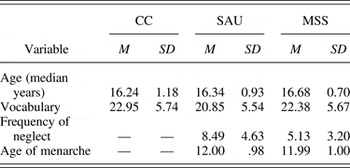
We present the group-level descriptive statistics for the variables of interest in Table 1. A one-way analysis of variance found no group differences on vocabulary scores, F (2, 169) = 2.05, p = .13. For the SAU and MSS groups, we observed no significant differences in reported age of menarche t (85) = 0.03, p = .27. However, there was a significant difference between groups with respect to the number of reported neglect incidents. Those in the SAU group had experienced more neglect (M = 8.49, SD = 4.63) than those in the MSS group (M = 5.10, SD = 3.20), t (90) = 4.03, p < .001. There were no significant differences between intervention groups on the number of prior placements, t (90) = 0.69, p = .49, or the presence of prior sexual abuse, χ2 (1) = 0.20, p = .82, or prior physical abuse, χ2 (1) = 1.10, p = .40.
Descriptive statistics

Note: CC, Community comparison group; SAU, foster care services as usual; MSS, middle school success intervention group.
We also tested for evidence of motivational differences to perform well on the cups task among the CC, SAU, and MSS groups. A one-way analysis of variance revealed no significant self-reported motivational differences between groups, F (2, 169) = 1.72, p = .18 (M SAU = 8.28, SD = 3.44; M MSS = 8.51, SD = 3.10; M CC = 7.58, SD = 2.81). Because all girls reported being sufficiently motivated to do well on the task, we do not discuss this issue further.
Correlations between covariates and risky decision making indices
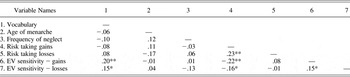
Next, we tested the correlations between the study covariates and the indices of risky decision making (risk taking and EV sensitivity; see Table 2). We did not find a significant association between vocabulary scores and domain-specific risk taking, but found that greater vocabulary scores were associated with greater EV sensitivity. For the MSS and SAU girls, neither age of menarche onset nor the number of reported neglect experiences significantly correlated with risk taking or EV sensitivity in either domain.
Intercorrelations between study variables

Note: EV, Expected value. Ns = 92–172. Age of menarche and frequency of neglect were only assessed for the maltreated sample of girls.
*p < .05. **p < .01 (two-tailed).
Aim 1: Maltreatment-related differences in risky decision making
To test group differences in risky decision making, we conducted a generalized estimating equation (Liang & Zeger, Reference Liang and Zeger1986) analysis that allows for a within-subjects analysis of participants' decision behavior for each trial. We fit a binomial response model using a logit-link function using each choice (0 = safe, 1 = risky) as the dependent measure. An exchangeable covariance matrix was used, which assumes nonzero homogeneous within-subject correlations across responses. Parameter estimates were achieved using hybrid maximum likelihood estimation. We began the analyses with a full-factorial model regressing choice on domain (gain/loss), EV, and dummy-coded treatment groups (SAU/MSS) with the CC group as the reference category. EV and vocabulary performance, which was included as a control covariate in the model, were mean centered.
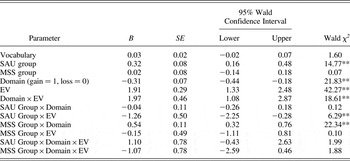
As shown in Table 3, we found a main effect for domain. Participants took more risks to avoid losses than to achieve gains regardless of the group status, consistent with documented “reflection” or “preference shift” effects (Levin, Gaeth, Schreiber, & Lauriola, Reference Levin, Gaeth, Schreiber and Lauriola2002; Kahneman & Tversky, Reference Kahneman and Tversky1979). In addition, we found a main effect for EV level; individuals were more likely to make a risky choice as its EV became more favorable relative to the EV of the riskless option. As with other studies using the cups task, we observed a significant EV Level × Domain interaction, in which participants demonstrated greater EV sensitivity for decisions involving risky gains (vs. risky losses). Vocabulary scores did not account for variance in overall risk taking.
Effects of foster group intervention status on cups task performance

Note: SAU, Foster care services as usual; MSS, middle school success intervention; EV, expected value.
**p < .01.
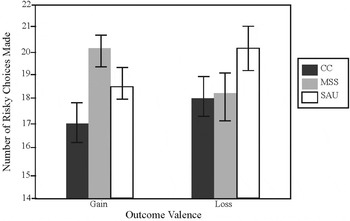
Regardless of domain, the SAU girls demonstrated greater overall risk taking compared to the CC group. In comparison, we did not find a significant main effect for the MSS (vs. the CC group) on risk taking for the MSS group. We observed a significant Domain × MSS Group interaction, revealing that the MSS group was more likely to take risks to achieve gains than the CC group (see Figure 1).
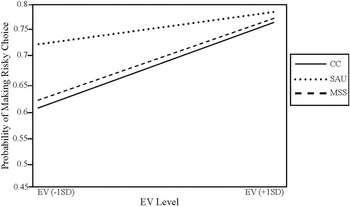
As illustrated in Figure 2, we found a significant EV × SAU Group interaction. SAU girls were less able to adjust their choices as the EV of the risky option became less favorable, leading to excessive risk taking when the EV signaled to avoid making a risky choice. We did not observe a similar effect for the MSS group. The three-way Domain × EV × Group interactions were not significant.
Overall expected value-sensitivity differences across foster care intervention groups. Model-based estimates are represented.

Aim 2: Intervention effects for sensitivity to probability level and outcome magnitude in the two maltreated samples
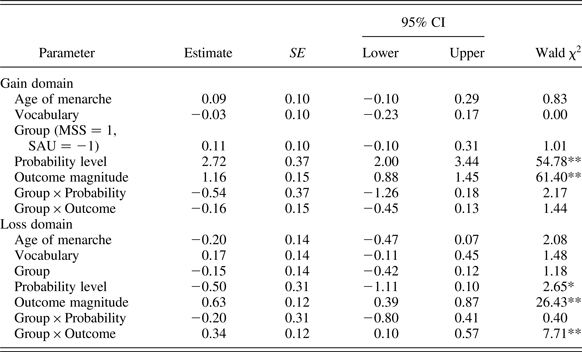
As suggested in Figures 1 and 2, the SAU group demonstrated greater risk taking and lower EV sensitivity than did the MSS group, especially for risks involving potential losses. Because group status was dummy-coded in the prior analysis, we did not directly compare treatment groups. To further confirm and explain the potential mechanisms for these differences, we examined how SAU and MSS girls differentially utilized probability and outcome information for risks involving potential gains and losses. This analysis served to replicate Weller and Fisher's (Reference Weller and Fisher2013) results suggesting that EV differences observed in maltreated youth were related to insensitivity to changes in outcome magnitude especially in the loss domain. We predicted that SAU girls would demonstrate lower sensitivity to outcome magnitude than would MSS girls. To test this hypothesis, we conducted two parallel generalized estimating equation analyses in which we regressed choice on the probability level of choosing the winning or losing cup, the outcome magnitude of the risky choice, and group status (SAU = –1, MSS = 1). Vocabulary scores and age of menarche scores were included as control variables. Probability level and outcome magnitude, along with the control variables, were mean centered.
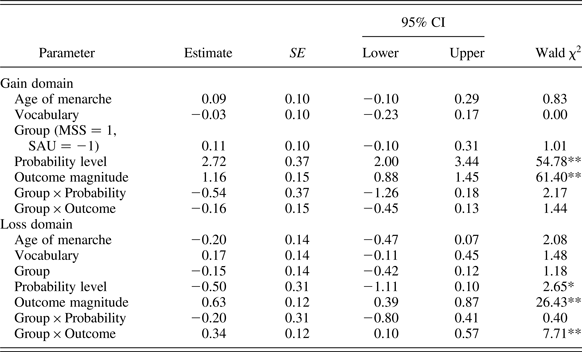
The results of these analyses are shown in Table 4. For both the gain and loss domains, neither covariate significantly accounted for variance in choice, holding other variables constant. As expected for decisions involving risky gains, as the probability level increased from a 20% chance to win (i.e., five cups were presented) to a 50% chance (i.e., two cups presented), participants were more likely to choose the risky option, holding other variables constant. In addition, as the outcome magnitude of the risky choice increased, participants were more likely to make a risky choice. The higher order interactions were not significant.
Effects of probability level and outcome magnitude on risky decision making as a function of foster group intervention status
Note: SAU, Foster care services as usual; MSS, middle school success intervention
*p = .05. **p < .01.
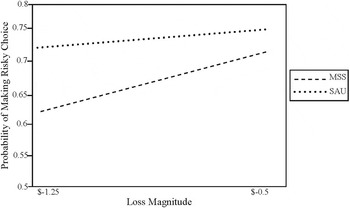
For risky losses, we found a significant effect for probability level. On average, participants made fewer risky choices as the probability of choosing the losing cup became greater. We also found that as the magnitude of the potential loss associated with the risky option became greater, participants were more likely to avoid taking risks. However, a Group × Outcome Magnitude interaction demonstrated that the MSS group was more sensitive to relative changes in the outcome magnitude of the risky choice (see Figure 3). In contrast, SAU girls were relatively insensitive to these differences. The Group × Probability interaction was not significant.
Proportion of risky choices as a function of outcome magnitude and foster care intervention status. Model-based estimates are represented.

Aim 3: Neglect as a moderator of intervention effects
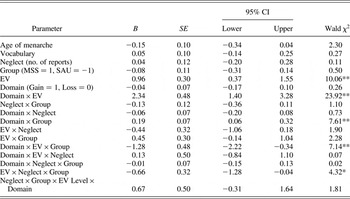
As a final analysis, we tested the degree to which frequency of neglect incidences may impact the long-term efficacy of this intervention on decision-making performance. In this analysis, we regressed choice on EV level, domain, the number of reported neglect incidences, vocabulary scores (and interactions with cups task), and age of menarche (see Table 5 for results).
Effects of neglect as a moderator of foster group intervention status on risky decision-making

Notes: SAU, Foster care services as usual; MSS, middle school success intervention; EV, expected value.
*p <. 05. **p < .01.
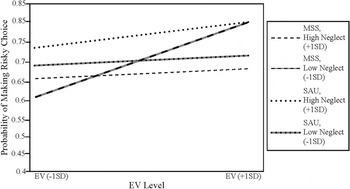
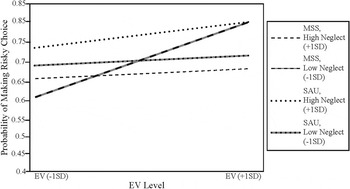
Foremost, the Group × EV Level × Domain Effect observed in the prior analyses remained significant, even with the inclusion of pubertal timing and neglect frequency. As illustrated in Figure 4, we observed a three-way Group × Neglect × EV Level interaction. SAU girls who had greater neglect histories showed increased risk taking and lower overall EV sensitivity. In contrast, MSS girls with less extensive histories of neglect demonstrated a pattern of decision making similar to that of the CC group.
Three-way interaction effect among expected value level, and foster care intervention group status on overall risk taking.
Discussion
This study contributes to the extant literature on sensitive periods for neural plasticity in three main ways. First, we found specific aspects of adolescent decision-making abilities are affected by exposure to childhood maltreatment, suggesting sustained effects of early maltreatment on neurocognitive functioning. Second, we identified the potential for plasticity via an intervention effect on risk-taking decisions to avoid losses: only those girls receiving traditional foster care services (vs. those in the intervention condition, i.e., SAU vs. MSS) took more risks to avoid losses. In addition, EV sensitivity, an index of advantageous decision making, was especially impaired for risks involving potential losses in girls in the SAU, but not the MSS, condition. Our results suggest that these differences may result from a lesser ability to adjust for changes in the outcome magnitude of the risky option, which signals increasing negative consequences. Third, the chronicity of reported neglect experienced during childhood moderated the effects of the intervention, suggesting the limits of plasticity. As hypothesized, girls in the SAU who reported more instances of neglect demonstrated the greatest amount of risk taking and the lowest degree of EV sensitivity. Conversely, the MSS girls reporting fewer instances of neglect most closely resembled the decision-making tendencies of nonmaltreated, low socioeconomic status peers.
Although past research has suggested neurocognitive deficits as a function of maltreatment status, less research has focused on the decision-making abilities of these youth. In this regard, this study reinforces and extends the results presented in Weller and Fisher (Reference Weller and Fisher2013), which reported significant differences in risky decision making between maltreated preadolescents (10–12 years) and nonmaltreated cohorts using the same paradigm. Specifically, the prior study found that maltreated youth were more likely to take risks to avoid losses, but did not differ from the comparison group when taking risky gains. Similarly, we found that the girls in the SAU condition demonstrated increased risk taking to avoid losses and EV sensitivity. However, we also demonstrated that some aspects of decision making may be modifiable, and that the sensitive period for improving neurocognitive function extends to adolescence: girls randomly assigned to the MSS intervention demonstrated a pattern of decision making that more closely resembled that of nonmaltreated peers, especially with respect to EV sensitivity. Moreover, the differences in EV sensitivity between the MSS and SAU groups appeared to be more closely related to an insensitivity to changes in the outcome magnitude of the risky choice, rather than insensitivity to the probability that the event will occur. Considering that these effects were obtained controlling for a measure of crystalized intelligence, it suggests that the observed differences are not due simply to cognitive ability or basic understanding of probability rules.
These results are consistent with Yechiam and Hochman's (Reference Yechiam and Hochman2013) attention–allocation model, which suggests that losses elicit greater attention than an equal gain. Applying this model to the effects of maltreatment on decision making, we propose that maltreated children and adolescents may have more difficulty effectively making decisions for potential losses due to both increased attentional biases toward potential losses and the inability to subsequently disengage from its emotional arousal to conduct a more compensatory evaluation of the choice options. Animal (rodent) and human research investigating variations in maternal caregiving and studies focusing on child maltreatment have indicated that the experience of early adversity is related to heightened attention to threat stimuli (Cameron et al., Reference Cameron, Champagne, Parent, Fish, Ozaki-Kuroda and Meaney2005; Cicchetti & Curtis, Reference Cicchetti and Curtis2005; Curtis & Cicchetti, Reference Curtis and Cicchetti2013; Pollak, Cicchetti, Klorman, & Brumaghin, Reference Pollak, Cicchetti, Klorman and Brumaghim1997; Pollak & Tolley-Schell, Reference Pollak and Tolley-Schell2003). Additional research is needed to further test this model from a neurocognitive developmental perspective within the context of maltreatment.
In contrast to Weller and Fisher's study that focused on preadolescent maltreated children, we found that maltreated girls take more risks for decisions involving potential gains during adolescence. Neurodevelopmental research has suggested adolescence may be a time of increased emotional reactivity in terms of sensitivities to both rewards and punishments (Cauffman et al., Reference Cauffman, Shulman, Steinberg, Claus, Banich and Graham2010; Crone & van der Molen, Reference Crone and van der Molen2004; Ernst et al., Reference Ernst, Nelson, Jazbec, McClure, Monk and Leibenluft2005; Huizenga et al., Reference Huizenga, Crone and Jansen2007). Although comparing raw data across independent samples has obvious limitations, it is notable that maltreated girls, regardless of intervention condition, appeared to demonstrate greater risk taking for potential gains, compared to the younger maltreated children studied in Weller and Fisher (Reference Weller and Fisher2013). We speculate that the confluence of puberty and potential dysregulation of the HPA system, which is observed in many maltreated children (Cicchetti et al., Reference Cicchetti, Rogosch, Howe and Toth2010; Cicchetti & Rogosch, Reference Cicchetti and Rogosch2001; Gunnar et al., Reference Fisher, Gunnar, Dozier, Bruce and Pears2006), may contribute to an increase in reward-related risk taking during adolescence in our maltreated sample (Crone & Dahl, Reference Crone and Dahl2012; Mather & Lighthall, Reference Mather and Lighthall2012).
This increased sensitivity may make adolescence a period of potential plasticity. Crone and Dahl (Reference Crone and Dahl2012) posit that these neurodevelopmental changes may contribute to either a positive growth trajectory that emphasizes personal growth and adaptive exploration of the social environment or a negative trajectory in which adolescents demonstrate excess motivation to engage in health-risking behaviors such as drug use and unprotected sex with multiple partners. This study reinforces that early adolescence is an important inflection point for which trajectories ultimately may be realized. With the appropriate interventions, we propose that the former can be more likely. Interventions targeting reward sensitivity for decisions involving potential gains may be more effective when implemented earlier in development. In the absence of an early intervention, the observation that overall risk propensity to achieve gains may be less malleable during adolescence implies that interventions initiated later in life might focus on leveraging these tendencies and highlight the potential benefits of taking risks that promote personal growth and social competence, rather than solely emphasizing an overall reduction in reward sensitivity.
In addition, the current study provided evidence of plasticity in some areas of decision making. Specifically, MSS girls demonstrated similar EV sensitivity to that of nonmaltreated girls, whereas the SAU girls showed deficits in EV sensitivity. The ability to make EV-sensitive judgments not only requires the ability to value each option subjectively by tying emotional salience to the choice options but also requires comparing each option, accurately judging which option will maximize happiness (or minimize pain), and then acting based on those predictions. In this sense, making EV-sensitive judgments involves resources related to executive function and cognitive control, facets of behavior that our MSS intervention targeted through intervention components such as goal setting, planning, and emotion regulation coaching. In general, however, adolescents' abilities to automatically recruit resources related to cognitive control may not be fully developed (for a recent review, see Crone & Dahl, Reference Crone and Dahl2012). A decreased tendency to automatically engage cognitive control strategies may lead even typically developing adolescents to have difficulties disengaging from emotionally arousing contexts. This disengagement may preclude the ability to conduct a more deliberative decision analysis that considers and appropriately integrates all relevant information. The positive effect of the MSS intervention on EV sensitivity suggests that the neurocognitive systems related to executive function and cognitive control may continue to be malleable into adolescence, reinforcing the proposition that neural plasticity may extend into early adolescence.
However, there may be limits to the plasticity in neurocognitive functions related to decision making. Our analyses examining the impact of severity of neglect on intervention effects suggested that girls who experienced a greater number of neglect incidents had poorer decision making than the CC girls, regardless of whether they received the MSS intervention or not. That is, MSS girls with high levels of neglect were not able to fully rebound and show decision-making capacities similar to nonmaltreated girls. However, the SAU girls with greater levels of neglect showed the poorest decision-making skills. This suggests that although the MSS intervention did not fully improve the abilities to the levels observed for nonmaltreated peers, it yielded some improvements even among those girls who experienced the highest levels of neglect. Although their EV sensitivity did not change, they nonetheless took fewer risks overall than did the girls who experienced greater levels of neglect in the SAU group. Nonetheless, these results suggest that pervasive neglect experiences may affect neurocognitive development in ways that are difficult to remediate once a youth reaches adolescence, and interventions implemented earlier in development may be needed to increase effectiveness among youth exposed to high levels of neglect.
Future directions and limitations
This study provides preliminary evidence for plasticity during adolescence in a key ability domain (with relatively well-understood underlying neural correlates) that is associated with important health and life course outcomes. This point is especially noteworthy because our focus population was a high-adversity group known to demonstrate disparities in these areas. Although prior research has shown similar plasticity in younger high-adversity children, this study begins to extend the scientific knowledge base into adolescence.
It is important to acknowledge that the present study focuses only on behavioral measures of risk taking in maltreated adolescent girls. Although we described the associations between behavioral measures and underlying neural systems in the limbic and prefrontal areas of the brain, an essential direction for future research in this area is to directly measure the activation of regions of interest in these areas via studies of tasks like the cups task in a neuroimaging environment (see Xue et al., Reference Xue, Lu, Levin, Weller, Li and Bechara2009, for an functional magnetic resonance imaging study using a modified cups task). Such research has the potential to greatly expand our understanding of the role of these regions (and the connections between the regions) in decision making. It also carries with it the potential to determine the similarity between adolescents with maltreatment histories and others in the neural circuitry subserving components of risky decision making. Similar circuitry would suggest that interventions for maltreated adolescents might need to be increased in magnitude, but we can apply similar approaches to interventions found to be effective for the general population. In contrast, different circuitry would suggest that adaptations of existing strategies, or development of novel ones, might be required to maximally improve decision-making abilities in child welfare and other high-adversity populations.
A limitation of this study was that we did not assess the CC group on pubertal timing. Although pubertal timing has been associated with increased risk taking more than chronological age (Steinberg, Reference Steinberg2008), we did not find significant correlations between age of pubertal onset and decision making. Without the assessment of menarche onset in the CC group, we cannot fully assess the impact of pubertal timing in this study. Future research needs to be conducted to more explicitly answer this question.
Although maltreatment records were examined as part of the screening procedures for study entry, there also always exists a possibility of unreported maltreatment in all groups. Therefore, we cannot rule out the possibility that some of the CC girls experienced maltreatment. However, the number of such instances likely would have been small, based on estimated base rates of abuse/neglect in the general population and the absence of a documented case of abuse/neglect. Nonetheless, in the event that some girls in the CC group had experienced unreported neglect, this likely would have attenuated our results; more so, it would be difficult to explain how unreported maltreatment would have impacted the observed interaction effects.
We feel that this study offers unique insights into the development of decision-making preferences in the face of risky outcomes. However, this study only included a measure of risk taking in which the participants explicitly knew the potential outcomes and the associated probabilities in which they occur. Explicit information about risk is frequently unavailable or vague in many of the decisions that are faced on a day-to-day basis. In addition, real-world risks are often cumulative, such that the more one engages in a behavior, the more likely it is to result in harm (e.g., Weinstein, Slovic, Waters, & Gibson, Reference Weinstein, Slovic, Waters and Gibson2004). Future research should involve the assessment of how maltreatment impacts risky decision making in a more dynamic and diverse context.
Finally, an unanswered question is the degree to which laboratory-based assessments of risk taking to avoid losses and to achieve gains may differentially predict health-risking behavior. This question spans beyond the focus of this article. Based on the current results and Yechiam and Hochman's (Reference Yechiam and Hochman2013) attention–allocation model, we predict that risk taking to avoid losses may be more likely to be associated with real-life risk behaviors. In support, Yechiam and Telpaz (Reference Yechiam and Telpaz2013) found evidence that risks involving potential losses predicted self-reported risk propensity across several domains (i.e., health/safety, financial, ethical, and social risks). Currently, we are conducting a follow-up study to address this issue directly within a maltreatment context.
Given the adverse effects that maltreatment bears upon its victims, in addition to the societal and economic costs incurred, gaining a deeper understanding of how maltreatment impacts neurocognitive processes and at what period during development that malleability is feasible become important goals. Our results highlight the negative impact of maltreatment on decision-making skills during adolescence, as well as the potential for partial recovery via a family- and skill-based intervention delivered during early adolescence. Conceptualizing how maltreatment impacts decision processes during different developmental periods and how the negative effects of maltreatment can be remediated can inform future researchers as to intervention approaches to help curtail decision-making deficits and the subsequent health-risking behaviors that are frequently observed in maltreated youth. This study provides an important step in this regard.