Introduction
Urinary schistosomiasis, caused by the trematode Schistosoma haematobium, is a debilitating and intractable chronic disease of the poor in over 74 countries, with more than 750 million people at risk (Steinmann et al., Reference Steinmann, Keiser, Bos, Tanner and Utzinger2003). Its clinical signs and symptoms include dysuria, haematuria, granulomatous host responses and urinary egg excretion. The quantification of eggs in the urine is still the diagnostic gold standard, but because most methods based on this (viz. filtration, sedimentation, floatation, etc.) are tedious, expensive and demand high levels of technical skill emphasis is increasingly shifting towards cheaper and rapid methods that are equally reliable, sensitive and specific.
Most of these rapid assessment methods are based on other signs and symptoms, including visual and historical evidence of gross haematuria (Savioli et al., Reference Savioli, Dixon, Kisumku and Mott1989; Lengeler et al., Reference Lengeler, de Savigny, Mshinda, Mayombana, Tayari, Hatz-Degremont and Tanner1991a, Reference Lengeler, Kilima, Mshinda, Morona, Hatz and Tannerb; Ansell et al., Reference Ansell, Guyatt, Hall, Kihamia, Kivogo, Ntimbwa and Bundy1997), dipstick detection of microhaematuria and proteinuria (Arm et al., Reference Arm, Pelle and Rainford1986; Mafe, Reference Mafe1997; Anosike et al., Reference Anosike, Nwoke and Njoku2001; French et al., Reference French, Rollinson, Basáñez, Mgeni, Khami and Stothard2007), as well as monoclonal antibodies and/or soluble egg antigens in the urine (Bosompem et al., 2004). Of these, dipstick detection of microhaematuria and proteinuria have been found to be most useful, rapid, cheap, and easy to use even by assistants without formal technical training (Lengeler et al., Reference Lengeler, de Savigny, Mshinda, Mayombana, Tayari, Hatz-Degremont and Tanner1991a, Reference Lengeler, Kilima, Mshinda, Morona, Hatz and Tannerb). However, several research and control reports suggest that although the sensitivity and specificity are usually high, the accuracy varies according to differences in infection and morbidity patterns (Sarda et al., Reference Sarda, Minjas and Mahikwano1985; Mtasiwa et al., Reference Mtasiwa, Mayombana, Kilima and Tanner1996). Thus local validation is required prior to large-scale application.
Nigeria embarked on a national schistosomiasis control programme more than two decades ago and to date there is no systematic assessment available on the performance and outcome of the programme. Some argued that this may be because the intervention measures were not systematic and focused, and that there were no mapped baseline data of endemic communities upon which control outcome could have been assessed (Ofoezie, Reference Ofoezie2002). Clearly, a rapid and cost-effective test tool that is reliable in the Nigerian environment would be indispensable for evolving such a map.
To fill this gap, we present the reports of two separate investigations conducted at 14-year intervals in two settings with different epidemiological characteristics, using chemical reagent strips from different producers. We determined the diagnostic accuracy of these strips in assessing urinary schistosomiasis in Nigeria, and assessed whether such accuracy depends on time of study, epidemiological setting and type of reagent strips used. It is hoped that the results of this study and others in different endemic foci will help fashion out the most appropriate approach to use of reagent strips in Nigeria and other tropical countries with similar cultural and ecological characteristics.
Materials and methods
Study area
The study was conducted in five communities in south-western Nigeria, namely two communities in Ogun State (Ibaro and Abule-titun, Abeokuta local government area) and three communities in Osun State (Eko-ende, Ore and Oba-Ile in Ifelodun, Odo-Otin and Olorunda local government areas, respectively). The communities of Ibaro and Abule-titun are located about 20 km north-west of Abeokuta, on latitudes 7°13.5′to 7°14′N and longitudes 3°12.5′ to 3°13′E, while the three Osun communities lie between latitudes 7°30′ to 7°35′N and longitudes 4°30′ to 4°35′E (detailed characteristics of the communities have been presented in Oladejo & Ofoezie, Reference Oladejo and Ofoezie2006; Ugbomoiko & Ofoezie, Reference Ugbomoiko and Ofoezie2007). All five communities are located within lakeside ecologies. While Ibaro and Abule-titun were planned, albeit poorly, to resettle persons displaced by the Oyan Dam (Ofoezie et al., Reference Ofoezie, Asaolu, Christensen and Madsen1997), the Osun communities are traditional villages where substantial landmasses are flooded by the closure of the Erinle Dam (Oladejo & Ofoezie, Reference Oladejo and Ofoezie2006). The populations of the communities range between 4500 and 8000, with an annual growth rate of 3% (National Population Commission, 1991).
The inhabitants of all the communities are predominantly of the Yoruba ethnic group, although Ibaro and Abule-titun had a substantial proportion of people from other ethnic groups in Nigeria who came to explore new opportunities in fishing and irrigation farming. Thus, while subsistence farming and petty trading were the predominant occupations in the Osun communities, fishing played a major role in the life of Ibaro and Abule-titun inhabitants. Lake water was a major source of water supply in Ibaro and Abule-titun, while in the Osun communities boreholes were the major source of drinking water (Ofoezie et al., Reference Ofoezie, Christensen and Madsen1998; Ugbomoiko & Ofoezie, Reference Ugbomoiko and Ofoezie2007). There was no paved access road leading to any of the communities and no major markets. The Osun communities also lacked many other amenities, such as electric power supply, health centres, primary and secondary schools, while Ibaro and Abule-titun had a primary school each. Schistosomiasis was endemic in the Osun communities (Oladejo & Ofoezie, Reference Oladejo and Ofoezie2006; Ugbomoiko & Ofoezie, Reference Ugbomoiko and Ofoezie2007) and epidemic in Ibaro and Abule-titun (Ofoezie et al., Reference Ofoezie, Asaolu, Christensen and Madsen1997).
Subjects and sample collection
Permissions to undertake the investigations were obtained from the universities, States Ministries of Health, local government authorities and community heads. The 1992 investigation was carried out at household level, while in 2006 subjects were examined at central locations at the insistence of the community heads. The objectives of the investigations were explained and informed consent was obtained from the subjects (parents or guardians in the case of children). A structured questionnaire was administered to each consenting subject to obtain information on basic age, sex, marital status, educational background, occupation, travel patterns, access to water supply and sanitation, and knowledge of schistosomiasis transmission. Information about the presence of blood in the urine in the preceding weeks and treatment status was obtained from each subject. Clean, wide-mouthed plastic containers were distributed with appropriate instructions on how to collect mid-terminal urine between 10.00 and 14.00 hours local time, when peak individual egg excretion occurs in Nigeria (Pugh, Reference Pugh1979). Each sample was examined visually for gross haematuria and chemically tested for microhaematuria and proteinuria using reagent strips. The BM-5L test, manufactured by Mannnheim Boehringer of Germany, was used in 1992 at Ibaro and Abule-titun, while the Combur-9 test, manufactured by Analyticon Biotechnologies, Germany, was used in 2006 in the Osun communities. The level of blood in each sample was scored on a scale of 0 (negative),+1 (trace or ≤ 10 × 106 erythrocytes l− 1),+2 (moderate or ≤ 50 × 106 erythrocytes l− 1) or +3 (heavy or ≤ 250 × 106 erythrocytes l− 1). Protein levels were similarly scored from 0 (negative),+1 (trace or ≤ 0.3 g albumin l− 1),+2 (moderate or ≤ 1.0 g albumin l− 1) or +3 (heavy or ≤ 3 g albumin l− 1) (Cheesbrough, 2005). Finally, a 10 ml urine subsample was collected, preserved in 10% formaldehyde and processed for presence and number of schistosome eggs, using the method of sedimentation of urine by gravity (Asaolu & Ofoezie, Reference Asaolu and Ofoezie1990). The number of eggs in each sample was expressed as eggs/10 ml urine. Infected persons were treated with praziquantel at the end of each investigation at the recommended dose and regimen (results of treatment in 1992 are given in Ofoezie, Reference Ofoezie2000).
Data analyses
Differences in prevalence of infection between subgroups and between diagnostic tests were determined using the χ2 test from the contingency table. The diagnostic values of haematuria and proteinuria were assessed by computing their indices of agreement, i.e. sensitivity (proportion of positive cases identified as positive), specificity (proportion of negative cases identified as negative), positive predictive value (proportion of positive cases identified as truly positive) and negative predictive value (proportion of negative cases identified as truly negative), with egg microscopy used as the gold standard. The strength of haematuria and proteinuria in the screening of urinary schistosomiasis is directly proportional to the levels of their diagnostic criteria (Hammad et al., Reference Hammad, Gabr, Talaat, Orieby, Shawky and Strickland1997). Association between the various diagnostic tools was assessed using Spearman's rank correlation.
Results
Summary of overall prevalence and indices of agreement
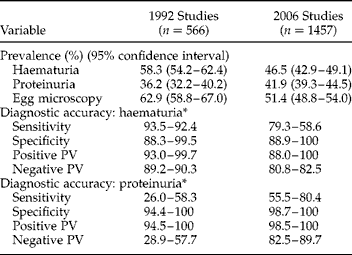
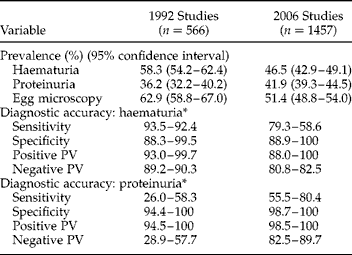
The overall prevalence of urinary schistosomiasis as detected by the various diagnostic tools in 1992 and 2006 is presented in table 1. Egg microscopy gave the highest prevalence (62.9 and 51.4%) and proteinuria the least (36 and 41.9%) in 1992 and 2006, respectively.
Summary of the prevalence of Schistosoma haematobium infection and indices of agreement according to different diagnostic tools and reagent strips used in 1992 and 2006.
PV, predictive value.
* All values expressed at ≥ +1 to +3 positivity levels.
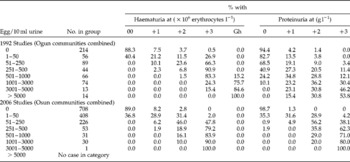
Haematuria identified over 90% of egg positive samples in 1992 (58.3% compared to 62.9%) and 2006 (46.5% compared to 51.4%), while proteinuria identified only 58% in 1992 (36.2% compared to 62.9%) and 82% (41.9% compared to 51.4%) in 2006, suggesting that dipstick results for proteinuria were weaker than for haematuria, but behaved better in 2006 than in 1992. The combined criterion of haematuria and proteinuria with a prevalence of 59.9% in 1992 and 50.0% in 2006 was significantly better than proteinuria alone, but comparable with haematuria. Intensity by egg microscopy was strongly related to the positivity levels of haematuria and proteinuria (table 2). Haematuria false-positive rates were comparable between 1992 (11.7%) and 2006 (11.0%) while those of proteinuria varied significantly between the 2 years (5.6% in 1992 and 1.3% in 2006). In contrast, false-negative rates of both haematuria and proteinuria varied significantly between 1992 (6.5%, 43.5%) and 2006 (20.0%, 19.6%); with a higher rate for haematuria in 2006 and proteinuria in 1992. However, while haematuria false-negative results occurred only among individuals excreting 50 eggs or fewer per 10 ml urine, those of proteinuria spread across all intensity groups up to 1000 eggs/10 ml urine. Thus, the likelihood of obtaining a false-negative result is associated with light infections for haematuria and all intensity groups, though with decreasing rates up to 1000 eggs/10 ml urine, for proteinuria. A Spearman's correlation analysis showed that prevalence of infection by egg microscopy, haematuria and proteinuria were highly significantly and positively correlated in both 1992 and 2006 (r = 0.69–0.80; P < 0.001).
Prevalence of haematuria and proteinuria in relation to egg intensity of Schistosoma haematobium in states of south-western Nigeria.

Gh, gross haematuria.
Table 1 also summarizes the overall sensitivity, specificity and predictive values of haematuria and proteinuria using egg microscopy as the gold standard. Generally, sensitivity and negative predictive value (NPV) of both haematuria and proteinuria decreased with increasing positivity levels while specificity and positive predictive values (PPV) increased, attaining 100% at +3 positivity level in most cases. In 1992, haematuria was more sensitive and less specific than proteinuria while in 2006, both had comparable sensitivities but proteinuria remained more specific.
Prevalence and indices of agreement by demographic groups
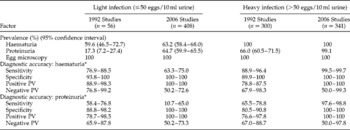
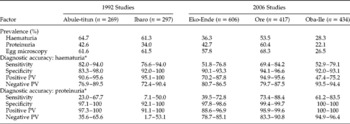
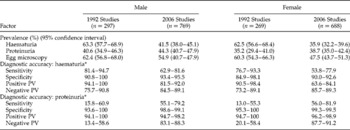
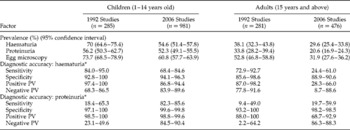
The comparative distribution of prevalence, sensitivity, specificity and predictive values of haematuria and proteinuria in light and heavy infections in 1992 and 2006 are presented in table 3. Similar information is given in table 4 for the communities investigated, table 5 for the sexes and table 6 for children and adults.
The diagnostic values of haematuria and proteinuria in the assessment of light and heavy infections of urinary schistosomiasis in south-western Nigeria.

PV, predictive value.
* All values expressed at ≥ +1 to +3 positivity levels.
The diagnostic values of haematuria and proteinuria in cross-sectional assessment of urinary schistosomiasis in south-western Nigeria.

PV, predictive value.
* All values expressed at ≥ +1 to +3 positivity levels.
The diagnostic values of haematuria and proteinuria in the assessment of urinary schistosomiasis between the sexes in south-western Nigeria.

PV, predictive value.
* All values expressed at ≥ +1 to +3 positivity levels.
Age-dependent diagnostic values of haematuria and proteinuria in the assessment of urinary schistosomiasis in south-western Nigeria.

PV, predictive value.
* All values expressed at ≥ +1 to +3 positivity levels.
In all cases, haematuria assessed prevalence of infection better than proteinuria, though the capacity of both increased with increasing intensity of infection but decreased with age of subjects. Neither sex nor community of residence played a significant role in the ability of either haematuria or proteinuria to assess prevalence of infection.
Generally, sensitivity, specificity and predictive values of haematuria and proteinuria varied with their positivity levels and followed the same general pattern described earlier, i.e. decreasing sensitivity and NPV, increasing specificity and PPV with increasing positivity levels. The sensitivity and specificity of both haematuria and proteinuria were higher in children than adults, and in heavy than light infections, but neither varied substantially according to sex or communities investigated. However, when the children and adult groups were further categorized by sex, sensitivity of haematuria in 1992 varied significantly between women (81.6%) and men (90.0%), and in 2006 between girls aged 14 years or less (82.2%) and women aged 15 years and above (61.8%). Specificity was also higher among girls (93.5%) than women (86.5%) but the level of variation was not significant.
Discussion
Although comparative assessment of chemical strips was not anticipated in 1992, the scarcity of BM-5L test strips and the widespread availability of Combur-9 test in 2006 provided an opportunity to determine the effect of strip brands and manufacturers on the outcome of a screening test. This assessment is important for two reasons. First, several foreign research materials used in Third World nations such as Nigeria, usually vary in time and space, and unless available substitutes are known to be comparable, vertical and cross-sectional comparison of research reports would be impossible. Second, the cost of materials may vary according to brand or manufacturer and, where budgetary constraints play vital roles, knowledge of comparative efficacy of brands will be invaluable in making cost-effective decisions.
Our findings showed that in 1992 when the BM-5L test was used, haematuria was more sensitive and less specific than proteinuria, while in 2006 when the Combur-9 test was used, haematuria and proteinuria were equally sensitive but proteinuria remained more specific. Comparing the performance of the two strip tests, it was found that the BM-5L test was more sensitive to haematuria (i.e. has a greater capacity to correctly identify positive haematuria than proteinuria) and Combur-9 more sensitive to proteinuria (identifies positive proteinuria better than haematuria). Put differently, the likelihood of a false-negative result was lower using the BM-5L test than Combur-9 to test for haematuria, while the reverse is the case when testing for proteinuria. Both strip brands were, however, equally specific for haematuria and proteinuria, suggesting a comparable false-positive rate or ability to identify samples with no traces of either haematuria or proteinuria irrespective of confounding factors. According to Cheesbrough (Reference Cheesbrough2005), false results of rapid screening tests depend on the concentration of haematuria and proteinuria, urine contamination with oxidizing detergents, disinfectants and/or vaginal or urethral secretions. While neither the 1992 nor 2006 investigations assayed vaginal or urethral secretions in urine, the observed false results cannot be explained by contamination with anthropogenic materials since clean sterile bottles were used. However, it appears that the high haematuria sensitivity in 1992 can be explained by the abnormally high prevalence and intensity patterns of schistosomiasis in the communities (Ofoezie et al., Reference Ofoezie, Asaolu, Christensen and Madsen1997). This conclusion is in agreement with those of Mott et al. (Reference Mott, Dixon, Osei-Tutu and England1983) which showed that there is a strong and direct relationship between intensity and morbidity patterns such as haematuria and proteinuria.
Therefore it appears from our findings and those of several other workers using either BM-5L test or Combur-9 or several other brands, that the diagnostic value of rapid assessment of urinary schistosomiasis will continue to depend on the criteria adopted (i.e. positivity levels) and transmission pattern rather than the brand of reagent strips used (Stephenson et al., Reference Stephenson, Latham, Kinoti and Oduori1984; Ng'Andu, Reference Ng'Andu1988; Nwaorgu & Anigbo, Reference Nwaorgu and Anigbo1992). Our findings also agree with several reports that the criteria of trace haematuria and proteinuria have the highest level of sensitivity (low false negative) and lowest level of specificity (high false positive). This poses a dilemma to control programmes that must choose between the risk of not treating an infected person (underestimation of sensitivity) and treating a healthy person (underestimation of specificity). While the latter overestimates prevalence with heavy financial implications, the former underestimates prevalence with a heavy health implication (Mascie-Tailor, Reference Mascie-Tailor, Ulijaszsil and Mascie-Tailor1993). While both considerations affect the overall outcome of control programmes, it appears the criterion of ≥ 1 offers the most acceptable balance because its high sensitivity (i.e. low risk of not identifying a sick person) is more acceptable than the high specificity (low risk of identifying healthy persons as sick) associated with the other criteria. Put differently, the low specificity (high risk of identifying healthy persons as sick) associated with this criterion will guarantee more effective treatment outcome than the low sensitivity (high risk of not identifying sick persons) associated with the other criteria even though the cost of treatment may be higher. However, Lengeler et al. (Reference Lengeler, Mshinda, Morona and de Savigny1993) posited that while this criterion may be more acceptable for control implementation, it is inconsistent as a basis for vertical and cross-sectional comparison of prevalence in endemic foci. This suggests that no single criterion has universal application, hence usefulness for all purposes. While trace or more criteria may be most suitable for control programmes, others are recommended for comparative epidemiological research.
Authors' contributions
U.S.U. conceived the idea of the paper, conducted the survey in Osun State and wrote the first draft of the manuscript; R.N.N.O. assisted in data analysis and gathered the majority of the supporting evidence; T.A.B.O. assisted in the field work in Ogun State; I.E.O. conducted the survey in Ogun State, analysed data, wrote the final draft of the manuscript and is the conceptual author. All authors read and approved the final manuscript.
Acknowledgements
The authors would like to thank Professor L.D. Edungbola for providing the urine filtration kits. We wish to thank the community leaders of our study villages, particularly in Osun State, for their cooperation and motivation.