Introduction
In 2021, Brazil will celebrate 40 years since its first scientific expedition to Antarctica, the only continent to have a specific system of its own, the Antarctic Treaty System (ATS), governing by the consensus of the 29 different national Consultative Parties. In this context, scientific research is the basis of the system, along with geopolitics. If substantial scientific production is the key condition for the maintenance of consultative status in the ATS, then it is linked to geopolitics. Therefore, both have been inseparable since the negotiation of the 1959 treaty. In 2048, ATS members will have the right to propose revisions relating to key issues, such as the mining ban (Coburn Reference Coburn2017). Although the system has proved to be stable and efficient so far, geopolitical shifts will most probably occur before 2048 (Allen et al. Reference Allen, Burns, Garrett, Haass, Ikenberry and Mahbubani2020). Multiple factors must be taken into account: there are seven (in abeyance under the Antarctic Treaty) territorial claims over the frozen continent, the ice sheet continues to melt, the global demand for oil and minerals may grow, mining technologies will become more viable and so on.
In this context of future technological, scientific and geopolitical shifts, Brazil is a middle-income country struggling to remain within the ‘rising powers’ (Narlikar Reference Narlikar2013) group (Viola & Gonçalves Reference Viola and Gonçalves2019). It is also an ATS Consultative Party and one of the non-claimant countries. Therefore, this article aims to explore the key features of Brazilian Antarctic science by focusing on the question of how Brazilian scientific research in Antarctica evolved. The first feature is the domestic policy network (Barros-Platiau et al. Reference Barros-Platiau, Søendergaard and Prantl2019), revealing the key role played by the Navy as a promoter, notably under former Brazilian military rule (1964–85), as well as in the recent past, after 2019. The Navy is the ‘maritime authority’ of the Brazilian policy network and the coordinator of an inter-ministerial commission created in 1974 (CIRM) and its secretariat (SECIRM) in 1979. The second feature is funding inadequacy and instability, being partially disconnected from geopolitical priorities and the ongoing work of the scientific community. The third feature is that the national scientific output is probably greater than would be expected if one looked only at the numbers of papers, suggesting that there is informal collaboration amongst scientific groups.
In addition, Brazilian research is much stronger in pure science fields (e.g. biology, climatology, etc.) than in the humanities. However, Brazil needs to engage better with the research roadmap for the twenty-first century, as described by Kennicutt et al. (Reference Kennicutt, Kim, Rogan-Finnemore and Anandakrishnan2016). Therefore, we hypothesize that Brazil's scientific output has been the result of enabling conditions such as geopolitics, political priorities and funding, but also the Brazilian scientific community's formal and informal cooperation with scientific groups from various countries, which needs to be properly assessed in detail in future research.
Methodology and data
We used a triangulation method drawing on official data from civilian and military institutions, scientific outputs and informal discussions with other Brazilian authorities and scientists to address our research questions. The data were retrieved from the Ministries of Defence (MD), Science, Technology, Innovation and Communication (MCTI), Foreign Affairs (MRE/Itamaraty) and Environment (MMA) websites and archives, especially Andrade et al. (Reference Andrade, Mattos, Cruz-Kaled and Hillebrand2018), Brazil (1987, 2005a, 2005b 2006a, 2006b, 2007, 2008, 2009, 2013a, 2013b, 2014a, 2014b, 2016, 2018a) and Sampaio et al. (Reference Sampaio, Cardone, Abdenur, Dodds, Hemmings and Roberts2017). Data from the national funding agencies CNPq (MCTI) and CAPES (Ministry of Education; MEC) were analysed, as well as from the Centre for Strategic Management and Analysis (CGEE 2006) report. Brazilian Congress and the Antarctic Treaty Consultative Meeting (ATCM) databases were helpful in the qualitative analysis. Scientific output was selected from international and Brazilian reviews from various fields of research, notably life sciences and humanities. Informal discussions over the past five years included meetings with Navy officers, diplomats, scientists, National Congress (parliament) representatives and other decision-makers in Brasilia.
From an analytical perspective, we argue that Brazil had a ‘diplomatic strategy’ (Goh & Prantl Reference Goh and Prantl2017) under military rule (1964–84), but this became less clear subsequently. Brazil started with a modest but intensifying power, as argued by Child (Reference Child1988), but then scientific production and policy papers did not increase significantly (CGEE 2006, Sampaio et al. Reference Sampaio, Cardone, Abdenur, Dodds, Hemmings and Roberts2017, Boyadjian et al. Reference Boyadjian, Câmara, Barros-Platiau, Albergaria, Barros-Platiau and Oliveirain press). We acknowledge that there are multiple factors that have contributed to the development of Antarctic science in Brazil, notably national policy networks and university priorities, but we decided to focus on the international agenda first. Future research will be necessary in order to shed light on the other factors. Finally, this article highlights four phases of Brazilian Antarctic science, relating to tipping points and national funding policies.
Results
Phase 1: Antarctica in the Brazilian diplomatic strategy (1975–91)
Antarctic science is primarily a matter of resources and capabilities. In the late 1950s and 1960s, while some countries were testing nuclear weapons, planning to go to the Moon and building stations in Antarctica, countries such as Brazil did not have the means or the political interest to do so, although there was some geopolitical debate over these matters. Hence, Brazilian history in Antarctica starts with international cooperation, scientific interdisciplinarity and the direct participation of the Navy (Mattos Reference Mattos2015). The physician and journalist Durval Sarmento da Rosa Borges were the first Brazilian citizen to set foot on Antarctic soil, having been invited by the USA in 1958. He visited the US station McMurdo, and his comments and views helped to raise interest in the region.
In 1963, the Chilean government invited some Navy officers to visit its facilities in the Antarctic Peninsula (Mattos & Câmara Reference Mattos and Câmara2020). The next year, the meteorologist Rubens Junqueira Villela became the first Brazilian scientist to visit Antarctica. He became the first Brazilian national to travel to the South Pole as a guest of the US Antarctic programme. He was also a member of the first official Brazilian Antarctic expedition (OPERANTAR I).
The 1970s oil crisis was the first systemic tipping point. Under military rule, this first phase was marked by a growing interest in Antarctica from the 1970s to the late 1980s, although Brazil never made any territorial claims. Some Army officers, National Congress members and researchers (most notably the geographers Therezinha de Castro and Carlos Delgado de Carvalho) promoted the so-called frontage theory for Brazilian territorial claims in Antarctica, but they were a minority (Mattos Reference Mattos2015). As defence and energy security were strategic priorities, military officers and diplomats had stronger voices in political decisions. In this context, President General Ernesto Geisel decided to join the Antarctic Treaty in 1975.
In 1976, the Brazilian Navy sent the officer Luiz Antônio de Carvalho Ferraz to the frozen continent, whose name was later chosen to designate the Brazilian Antarctic station. Ferraz visited Antarctica with the invitation of the UK, which continued to issue such invitations until the late 1970s, resulting in the participation of several Brazilian officers as observers in the British programme in Antarctica (Mattos & Câmara Reference Mattos and Câmara2020).
In 1982, under President General João Figueiredo, Brazil proved their interest in Antarctica by launching PROANTAR, a programme aimed at developing scientific activities in the region. In the same year, the Brazilian Navy acquired a polar ship (named Barão de Teffé) and then launched its first Antarctic operation (OPERANTAR I) in 1983. Four years later, Brasilia established the Antarctic National Policy (POLANTAR). After OPERANTAR I, expeditions have taken place annually without a break. During this period, the Brazilian Navy financed not only the logistics, but also scientific projects almost exclusively, with proposals made by invitation and on demand. Projects focused initially on areas such as ornithology and oceanography (CGEE 2006), but funds were very limited. The Brazilian presence in Antarctica, although modest, was slowly increasing.
The scientific station named ‘Comandante Ferraz’ (EACF) was established in 1984, first as a summer-only facility, but becoming year-round in 1986. It was one of the few year-round stations in the region, along with two refugia that were built in the summer of 1984–85 on Elephant and Nelson Islands. Another refuge was built on Fildes Peninsula on King George Island in the summer of 1985–86. In 1991, Comissão Nacional para Assuntos Antárticos (CONANTAR), in charge of the PROANTAR guidelines, was established. With two ships, the Barão de Teffé and the Wladimir Besnard from the University of São Paulo (USP), Brazil had a very good start.
Phase 2: the Navy sharing control (1991–2002)
The second phase started with the agreement of the Convention on Environmental Protection to the Antarctic Treaty (generally known as the Madrid Protocol, agreed in 1991 and came into force in 1998) which can be considered another tipping point. At this time, the MMA participated in the negotiation process (CGEE 2006). Since 1991, the Ministry of Science and Technology (MCT; but now MCTI) started to fund scientific projects by the means of its agency, the National Research Council (CNPq; Conselho Nacional de Desenvolvimento Científico e Tecnológico). Admiral Mário Flores and Science Minister José Goldenberg decided to transfer the responsibility for funding Antarctic science to the MCT, with the Navy remaining in control of. logistics. Furthermore, the Defence Ministry was created in 1999 to encompass the three national armed forces, so the Navy lost part of its autonomy. Nonetheless, the Navy was in charge of the replacement of the original polar ships, and the Ary Rongel was acquired in 1994 to replace the Barão de Teffé.
The policy network was also reinforced with the participation of scientists. In 1996, the National Committee for Antarctic Research (Comitê Nacional de Pesquisas Antárticas; CONAPA) was created as a means of improving participation in the Scientific Committee on Antarctic Research (SCAR). CONAPA was responsible for the monitoring and support of Brazilian policy related to scientific and technological priorities (Brazil 1996). Despite its importance, it was frozen from 1998 to 2004.
Increased funding from 1992 to 1994 encouraged more projects from 1994 to 1997, so the scientific output from 1996 to 1998 also improved. Unfortunately, however, the MCT funding capacity was very limited, so uncertainties and instability prevailed. Consequently, Antarctic researchers had to submit short-term projects for funding on an individual basis. In response, National Congress representatives created a support group in 2003 and provided financial help (Frente Parlamentar Mista de Apoio ao Programa Antártico Brasileiro).
Phase 3: continuing ups and downs (2002–12)
The third phase started c. 2002, when President Lula was elected and geopolitical priorities underwent a turning point. Brazilian energy security was reinforced with the pre-salt discovery, and other ministries gained more power in the national policy network, such as the MRE/Itamaraty, MCTI and MMA. Over the years, research in Antarctica functioned under various sources of funding. In 2005, for instance, the Antarctica Agenda was set up to improve Brazilian participation in the Fourth International Polar Year (2007–09).
Consequently, research conditions varied significantly. The EACF was renovated several times until it was destroyed by fire in February 2012, with the loss of two lives. During this phase, the role of the Navy as a key promoter of Antarctic research became central again. With relevant support from the MCTI, greatly influenced by the president's visit to Antarctica, the Navy acquired the Polar Vessel Almirante Maximiano in 2009.
In this context, the CNPq's first federal call for Antarctic research, in September 2002, worth USD 1.029 million, was insufficient at that time. Since then, calls have been launched periodically, usually lasting three or four years and covering primarily areas of the Earth sciences, marine sciences and biological sciences. The calls were numerous but underfunded, making this a difficult period for all researchers. During this phase, the CNPq was in charge of preparing the calls for Antarctic research, but the MMA also contributed to the funding of subject areas and to the creation of two networks. It is interesting to note that the MMA played its most important role during this phase.
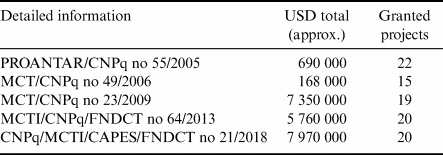
The PROANTAR/CNPq no 55/2005 call for projects focused on two lines of research: life sciences, geosciences and physical sciences; and ‘Evolution and Biodiversity in Antarctica’, providing a total of USD 690 000. There were 22 projects selected for funding between 2006 and 2008. Then, in early 2006, another public call was launched for the development of research related to PROANTAR (MCT/CNPq n° 49/2006). A total of USD 168 000 was to be shared amongst 15 proposals, with terms lasting two years.
In August 2009, the call MCT/CNPq n° 23/2009 offered funds of USD 7.35 million to support four main areas: biodiversity and environmental impacts in Antarctica; geology and geochemistry in Antarctica and the Southern Ocean; environmental, climate and atmospheric monitoring in Antarctica; and technological, cultural and socioeconomic aspects in Antarctica. It is interesting to note that, for the first time, the call included projects specifically related to cultural, social and/or economic matters. Including the four main areas covered by the call, 19 projects were funded with terms of 36 months.
Also in 2009, the National Institutes of Science and Technology Program became operational, after the launch in the year before of the public call MCT/CNPq/FNDCT/CAPES/FAPEMIG/FAPERJ/FAPESP no 015/2008. Among the 102 proposals selected for the establishment of the National Institutes of Science and Technology (INCTs), there were two proposals related to research in Antarctica: the cryosphere and Antarctic environmental research. After a more recent call for new grants and renewals from the INCTs, which was launched in 2014, only the cryosphere proposal remained active. This call is particularly interesting because of the participation of funding agencies from three States: Minas Gerais, Rio de Janeiro and São Paulo.
The Brazilian science developed under PROANTAR also contributed to other INCTs not directly related to Antarctic issues, such as the INCT for climate change, the INCT for tectonic studies and several INCTs associated with marine sciences and oceanography (Brazil 2018b).
Phase 4: a roadmap for Antarctic science in Brazil (2012–22)
The fourth phase started at the end 2012, when funding for a new station became necessary. This was a tipping point for Brazilian researchers. Although public authorities decided rapidly to fund a new scientific station after the disastrous fire, it took eight years before the new Comandante Ferraz Station (still designated EACF) was inaugurated in January 2020. In addition, no consensus was established among the executive power authorities or the National Congress, as the high cost of the new station (~ USD 100 million) had to be justified against other issues, such as poverty alleviation and healthcare. Once again, the Navy played a key role, and the new EACF was built to be the best initiative Brazil had ever achieved in Antarctica. In addition, as of 2020, three new and recently acquired Navy helicopters will be dedicated to supporting the OPERANTAR activities.
It is important to stress that scientific activities did not stop because of the loss of the station. Scientists pursued their research aboard the two polar ships, from field camps, in the cryosphere module (built inland more than 2000Km from EACF in 2012 as one of the major steps Brazil took regarding the continent) and at the emergency modules. The latter were constructed in the same spot as the old EACF shortly after the fire. It is also important to note that scientific stations from other cooperating countries also continued to host Brazilian scientists during this period. Along with traditional cooperation with South American partners that ranges from navigation logistics to data sharing, Brazilian researchers work with colleagues from countries such as the USA, the UK, Poland and France, however information documenting this international cooperation is virtually non-existent in Brazil, Most importantly, funding for research was disconnected from the EACF building effort.
The fourth phase also started with a roadmap developed by MCTI and CNPq, along with Brazilian scientists. The document, named ‘Antarctic Science for Brazil’, consists of an action plan and intends to give directions and goals for Antarctic science between 2013 and 2022, therefore covering the last two calls for proposals. In order to set a new agenda for PROANTAR, five scientific thematic programmes were created: 1) the role of the cryosphere in the Earth system and interactions with South America, 2) biocomplexity of the Antarctic ecosystems and their connections with South America and climate change, 3) climate change and the Southern Ocean, 4) geodynamics and geological history of Antarctica and its relations with South America, and 5) dynamics of the Antarctic upper atmosphere, geospace interactions and connections with South America (Brazil 2013a).
The plan also highlights the possibilities of research in the social sciences, such as archaeology, sociology, political geography and international relations. Studies on vectors of communicable diseases, human biology, polar medicine and psychology of groups under extreme conditions are also mentioned as fields to be explored. The action plan stresses the participation of some other relevant national bodies with regards to Antarctic science, besides the INCTs and universities. The Brazilian Panel on Climate Change (PBMC), the Brazilian Research Network on Climate Change (Rede Clima) and the Mineral Resources Research Company (CPRM) stand out for their cooperative links with national scientific projects carried out in Antarctica.
The first call for proposals under the new document guidelines (MCTI/CNPq/FNDCT 64/2013) offered USD 5.76 million to support new science projects for three years. A total of ten areas were open, five being considered as priorities: 1) ice-atmosphere interactions: the role of the cryosphere in terrestrial systems and the record of climate change, 2) effects of climate change on Antarctic ecosystem biocomplexity and its connections with South America, 3) changes and climatic vulnerability in the Southern Ocean, 4) geodynamic evolution and Antarctic geological history and connections with South America and the South Atlantic, and 5) Antarctic high-atmosphere dynamics, interactions with geospace and South America connections. Another five areas were considered as emerging: 6) prospecting of extremophiles present in various Antarctic environments, 7) transmissible disease vectors and anthropogenic Antarctic microbiota, 8) human biology, psychology and polar medicine, 9) anthropology and archaeology in Antarctica, sociology, public politics and scientific research and technology and innovation in Antarctica, and 10) development of civil constructions, equipment and innovative materials for use in Antarctic research. A total of 20 projects were funded. The call was intended to last 3 years but, due to economic constraints, there were then no new calls until 2018.
The second call issued after the launch of the action plan is currently active (CNPq/MCTI/CAPES/FNDCT 21/2018). It offered USD 7.97 million and supported 20 new science projects for four years. This call was divided into nine different areas: 1) ‘the role of the cryosphere in terrestrial systems and the interactions with South America’, 2) ‘high-atmosphere dynamics in Antarctica, interactions with geospace and South America connections’, 3) ‘climate change and the Southern Ocean’, 4) ‘Antarctic ecosystem biocomplexity and its connections with South America and climate change’, 5) ‘geodynamics and geological history of Antarctica and its relations with South America’, 6) ‘ocean chemistry, marine geochemistry and marine pollution’, 7) human and social sciences, 8) human biology and polar medicine, and 9) innovation and new technologies. Areas 1–6 were considered priorities, while areas 7–9 were considered emerging areas. Proposals from areas 1 and 2 were assigned USD 2.65 million, those from area 3 were assigned USD 2.65 million, those from area 4 were assigned USD 1.329 million, those from areas 5 and 6 were assigned USD 715 000 and those from areas 7–9 were assigned USD 626 000.
Only 16 proposals were funded, 50 were recommended but not funded and 37 were not recommended. Four recommended but not funded proposals were able to secure funds elsewhere and grouped within PROANTAR, giving a total of 20 science projects that are currently active. Unfortunately, many important programmes from various areas of science, some running for more than 20 years, did not receive any funding. Many other projects face the same threat of discontinuation. Consequently, researchers fear that their work will lose significance in the eyes of their competitors, amongst other negative outcomes.
Discussion
Antarctic scientific research is not painless. It is also not a coincidence that countries with territorial claims over Antarctica, as well as the members of United Nations Security Council, have always provided greater funds for science. Hence, scientific research is very sophisticated and internationalized. Consequently, scientific output is also predominantly published in English, with the USA being by far the leader in funding and output. China is now the fastest-evolving science producer, while South American countries are lagging behind in general (Boyadjian et al. in press).
In this vein, Brazilian research has continuously experienced ups and downs. Geopolitical, political and scientific priorities have often seemed disconnected. The importance of Brazilian polar research in the national agenda seems to have benefitted from a stronger consensus during the first and fourth phase due to the hard work of researchers and Navy officers in particular.
In the first phase, the geopolitical goal for Brazil was to ensure its acceptance into the ATS regime as quickly as possible. At that time, the future regulation of oil exploration and mining in Antarctica was on the ATCM agenda. Amidst an oil crisis and the 1978 voluntary moratorium on prospecting, the outcomes of the Convention on the Regulation of Antarctic Mineral Resource Activities (CRAMRA) negotiations were uncertain (Mackenzie & Joyce Reference Mackenzie and Joyce1990). From a purely geopolitical standpoint, the obvious entry point was membership of the Antarctic Treaty System, and Brazilian scientists benefitted directly from this.
However, because the political interests changed in the 1980s and Brazil experienced a strong economic recession, the entry point moved to national oil production on Brazilian soil. Consequently, Antarctic mineral wealth became less of a priority and researchers faced difficult times in terms of funding. This marked the end of the first phase, as Brazilian interests started to fade when the Madrid Protocol entered into force and prohibited mining activities in 1998. With the end of the Cold War and the consolidation of the ATS, geopolitical threats of appropriation and militarization diminished.
During the second and third phases, despite the fact that scientific research was evolving, the creation of the CIRM and the fragmentation of funding sources led to instability and uncertainties in terms of the continuation of projects. There was a clear paradox in terms of the geopolitical and scientific priorities compared to the political decisions taken in Brasilia. Although Antarctica was considered part of the ‘strategic surrounding’ in the 2012 Brazilian Defence White Paper and the National Defence Strategy (Brazil 2012a, 2012b, Mattos & Câmara Reference Mattos and Câmara2020) and a political structure (CIRM) was set up, there was reduced strategic diplomacy (in the sense of Goh & Prantl Reference Goh and Prantl2017), as most political decisions were made on a yearly basis, including budgetary allocation (CGEE 2006, Sampaio et al. Reference Sampaio, Cardone, Abdenur, Dodds, Hemmings and Roberts2017). In 2019, with President Bolsonaro's revogaço (a deep reform in the federal public administration system, closing almost all national commissions and similar multi-stakeholder bodies) (Brazil 2019), two important Antarctic structures were shut down: CONANTAR and CONAPA, leaving Brazil without its highest decision making bodies on Antarctic science. MRE/Itamaraty supported the closing of CONANTAR, based on the favourable opinion of the Division of Seas, Antarctica and Space (DMAE).
Today, Brazil has the same policies (under POLANTAR) as it had during the Cold War. Therefore, Brazil is in a puzzling situation with a brand new and well-equipped scientific station but no funds assured for the near future, as well as a largely outdated Antarctic policy. However, because MRE/Itamaraty was drastically reformed in early 2019, the Antarctic agenda was refocussed towards the Navy once again, along with the MCTI (Barros-Platiau et al. Reference Barros-Platiau, Søendergaard and Prantl2019). Therefore, Antarctic research funding for the near future will depend mostly on the Navy, MCTI and National Congress representatives’ interactions, and, of course, on the Brazilian economic situation after the COVID-19 crisis.
For almost four decades now, Brazilian scientific research in Antarctica has evolved in various ways. First, from the institutional design perspective, research depends on funding authorized by various decision-makers, notably from the executive and legislative powers. The Navy was and still is a major player in all of the phases, but it had to share power with MRE/Itamaraty and the Science and Technology Ministry in phases 2 and 3. The Environment Ministry also had a limited role to play in phases 2 and 3. The National Congress was a key player in funding decisions from phases 2 to 4. In phase 4, only the Navy, the MCTI and National Congress remain as key funding sources. The Ministry of Education was expected to contribute to the funding effort with Ministry of Education Funding Agency (CAPES) resources, but this is not yet significant. Although there has been a formal governance structure since 1982 (the SECIRM, coordinated by an admiral), scientific research funding is dependent on various institutional sources. While the MCTI funded ongoing projects in 2018 for the next four years, the next call is not yet ready, and National Congress representatives have not decided on how they would contribute to the funding effort in 2020. As a result, Brazil now has a top-quality research station, but no funds assured for the continuation of research in the coming decades.
Second, much of the Brazilian resources allocated to Antarctic research has been used for financing projects selected through short-term public calls for proposals. Table I presents the calls for scientific project proposals related to Antarctic science and PROANTAR over the last 15 years.
Brazilian calls for proposals related to PROANTAR (2005–20).

Source: authors' own collation based on MCTI data.
Considering the development of Brazilian scientific projects in Antarctica, stable and adequate financing has been the most important challenge. When PROANTAR turns 40, it is not guaranteed that there will be funding for ongoing or new projects. Although it is broadly recognized that insufficient funding in the previous decade prevented some projects from continuing, and many young scientists had to give up their research to look for employment elsewhere, this same scenario persists. This is leading to the grave consequence of an entire generation of junior scientists being lost. As the country's senior scientists retire, Brazil will increasingly face a skills gap of newly qualified polar scientists.
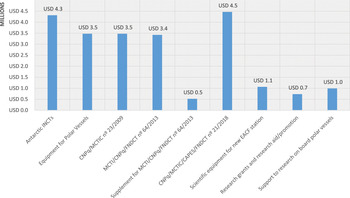
Third, financing decisions are not necessarily connected to strategic diplomacy, or to the Antarctica Roadmap framework. Figure 1 demonstrates the amount of financing committed to various actions in the period 2009–19. Besides the three calls for proposals issued during this period, resources were provided for the purchase of equipment, not only for the new EACF station, but also for the two current Brazilian polar vessels. The brand new EACF has a floor area of 4500 m2 and houses 17 fully equipped labs. It constitutes the largest research facility in the Antarctic Peninsular region, and is one of the largest Antarctic stations. In the 2019–20 expedition, 48 scientists and 16 other staff worked there in excellent conditions.
Brazilian resources allocated to Antarctic science according to the action performed (2009–19). Source: MCTI (unpublished data 2020).

The EACF is only part of the Brazilian diplomatic strategy. Some of the funds were allocated to the Antarctic INCTs (currently only one is active) and for the provision of research grants and the support of research carried out on board the polar vessels. Once again, we emphasise that Brazil should make efforts to ensure that the financing of Antarctic science is not only sufficient, but also continued and guaranteed in order to safeguard the sustainability of the research being carried out and to expand the opportunities for science, technology and innovation achieved from a qualified Brazilian presence in Antarctica. The amount of science achieved is clearly expected to increase in quantity and quality with these new facilities, thereby helping to support the privileged position of Brazil as a Consultative Party. However, this is predicated on the future security of research funding. Furthermore, as noted by Kennicutt et al (Reference Kennicutt, Kim, Rogan-Finnemore and Anandakrishnan2016), research becomes more sophisticated and expensive as ‘a wide range of cyber-infrastructure, information and geospatial analysis technologies will be needed to retrieve, process, synthesize, preserve and transmit data (e.g. from remote locations on the continent, in situ instruments, remote sensors and observatories, and on ships)'.
Conclusion
By using the concept of strategic diplomacy as a framework to navigate the international system by identifying end points (goals), entry points (options to start acting) and tipping points (Goh & Prantl Reference Goh and Prantl2017), we stress that Brazilian policies towards Antarctica had clear goals (end points) from the beginning. The country's Antarctic scientific funding in the 1970s seemed to be directly correlated with energy security as a first entry point, although this then lost relevance. Over time, other issues, such as the impacts of Antarctica on the Brazilian climate, weather and fisheries, came into consideration, notably in the 2012 National Defence White Paper and the National Defence Strategy.
Brazilian interest and funding for research faded over the years, in parallel with the sharing of the Antarctic agenda between the Navy and other ministries, and the creation of the CONANTAR, CONAPA and SECIRM policy network did not succeed in raising the relevance of Antarctic research in Brazil, rather fragmenting it. Following the 2019 federal reforms, the Navy will return to having a greater role as a supporter of scientific research, to the detriment of the MCTI and MEC. Similarly, the MRE/Itamaraty and MMA are expected to play much smaller roles in the policy network. Concerning the National Congress, there is no pattern allowing prediction of its participation in the Antarctic research funding effort.
Since the first official Antarctic national mission, Brazilian researchers have experienced a highly unstable research environment. We suggest that this is due to disconnection between geopolitical, scientific and political interests. While the Navy and the scientific community have common priorities in participating in the Antarctic agenda, other federal bodies, such as the various ministries, have been shown not to share the same view. Although the MCTI is responsible for the bulk of federal funding, it has been unable to ensure long-term budgets, while other ministries’ funding capacities have varied considerably over the last 38 years.
Today, new scientific challenges, such as bioprospecting and climate change, need to be taken into account so that Antarctic research receives the priority it deserves. Brazilian scientists achieved a considerable body of research in the original EACF, the cryosphere module, field camps and at sea before 2012, even with the unstable funding environment. Research was maintained even after the destructive EACF fire, often with the support of international academic networks. With the 2020 inauguration of the new EACF, a further increase in productivity is expected. However, this is challenged by funding and institutional stability, and the failure to provide a realistic career pathway for the next generation of young researchers. At worst, the consequence will be that Brazilian influence in the ATCM will shrink dramatically.
Our primary recommendation is that Antarctica be considered as a diplomatic strategy priority, not only in terms of geopolitics and diplomacy, but also in terms of the scientific research that Brazil needs in the near future. Expertise in diverse disciplines including climate, meteorology, glaciology, biodiversity and others will be key for Brazilian environmental health.
To potentially improve the ‘way forward’, we suggest three secondary measures to reduce instability and uncertainty. The first is to ensure a minimum level of funding annually, so that researchers can have a point of reference. The second is for MCTI to promote increased international collaboration, which will result in increased collaborative scientific output, so that researchers are encouraged to be more engaged in long-term projects within existing networks. The final measure is for the new scientific station be used as a hub, ready to host other researchers working with Brazilian scientists.
Acknowledgements
We thank the Brazilian Navy, PROANTAR, CNPq and MCTI civil servants for their support. We also thank Dr Jefferson Simões (UFRGS), Dr Luiz Henrique Rosa (UFMG), Dr Rosalinda Montone (USP) and Dr Andrea Cruz-Kaled (MCTI). Finally, we thank anonmymous reviewers for helping to improve the manuscript.
Author contributions
Paulo E.A.S. Câmara made significant contributions to the concieving of this paper, interviews in Brasilia, the interpretation of findings and the revision process. Ana F. Barros-Platiau worked on the design of theoretical approach in international relations and the preparation of the manuscript. Israel de Oliveira Andrade contributed to the research design, drafted the manuscript and contributed to its revision. Giovanni R.L. Hillebrand collected official data and contributed to the execution of this study.
Conflict of interest
The authors state that they have no conflicts of interest.