Motivation for the study of language acquisition is based in part on the assumption that understanding how specific languages are acquired will inform us about general principles that underlie all languages. For example, an important question for both first language acquisition in children and for second language acquisition (SLA) in adults is whether universal aspects of language develop in a different way and on a different time scale from the language-specific details of any one language.
In addition to questions that arise in the investigation of spoken language acquisition, the study of signed language acquisition opens additional avenues of inquiry because of the intrinsic perceptual and motor differences between the oral/aural modality of spoken languages and the visual/manual modality of signed languages. Signed languages conform to the same grammatical constraints and linguistic principles as those found in spoken languages (for reviews see Emmorey, Reference Emmorey2002; Sandler and Lillo-Martin, Reference Sandler and Lillo-Martin2006), and children exposed to sign languages from birth acquire their native sign language with the same ease as children exposed to a spoken language (Newport and Meier, Reference Newport, Meier and Slobin1985; Morgan and Woll, Reference Morgan and Woll2002; Schick, Marschark and Spencer, Reference Schick, Marschark and Spencer2005). Further, early exposure to a language in the visual/manual modality is just as critical as early exposure to spoken language (Newport, Reference Newport1990; Mayberry, Lock and Kazmi, Reference Mayberry, Lock and Kazmi2002). However, virtually nothing is known about the degree to which language-specific properties of a spoken first language (L1) might influence the acquisition of a signed second language (L2), or about how language-universal vs. language-specific aspects of a signed language are acquired.
We have previously demonstrated that eye gaze plays a systematic role in marking arguments of American Sign Language (ASL) verbs also marked by manual agreement (Thompson, Emmorey and Kluender, Reference Thompson, Emmorey and Kluender2006). As outlined in more detail below (see the next section, “The grammatical use of space”), ASL signers associate referents with locations in space, and agreement can be marked by directing eye gaze to a referent location. The use of eye gaze to mark agreement raises interesting questions that are relevant to a general understanding of SLA.
Relevant to our understanding of SLA is the fact that native signers (those exposed to ASL from birth) use directed eye gaze during the production of verbs to mark agreement with the lowest-ranked argument on a universal accessibility hierarchy of arguments (Thompson et al., Reference Thompson, Emmorey and Kluender2006). This noun phrase accessibility hierarchy (NPAH) has been previously shown to have a variety of important syntactic consequences across spoken languages (Keenan and Comrie, Reference Keenan and Comrie1977). Thompson et al. presented the first evidence for the potential influence of the NPAH in a signed language, buttressing the case for the universality of its cross-linguistic application. If eye gaze agreement follows a universal hierarchy, then the use of eye gaze to mark syntactic arguments in ASL might be easier to acquire, or might be acquired earlier, than properties that are idiosyncratic. With regard to agreement marking in ASL, one such idiosyncratic property is the division of the lexicon into verbs that take agreement markers and those that do not. We examine proficient late learners of ASL to better understand how these language-universal vs. language-specific aspects of a signed language can influence SLA.
Background
The grammatical use of space
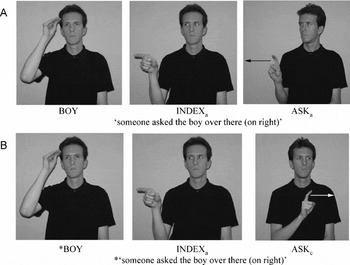
Discourse referents in ASL are associated with spatial locations (e.g., to the right, left, or center of the signer) and signers make use of this referential space to encode meaning and mark grammatical relationships. Signers direct pronouns or verbs toward spatial locations to refer to specific referents or to mark agreement with referents. The association between a locus and a referent must be established (e.g., by producing a lexical sign such as BOY followed by a pronoun pointing to the location to be associated with the referent).Footnote 1 Once established, the use of spatial locations for signed referents follows grammatical rules. This means, for example, that if a signer associates a referent with a particular location in space (e.g., “boy” is established on the right) and then refers back to this referent using another location in space (e.g., the left), the result is an ungrammatical sentence with the intended meaning (see Figure 1).
Two ASL sentences that differ only in the final location of the verb ASK. (A) is grammatical because the verb ASK agrees with the location associated with the boy, while (B) is not grammatical (with the intended meaning) because the verb ASK is directed toward another location in space.

ASL verb classes and agreement
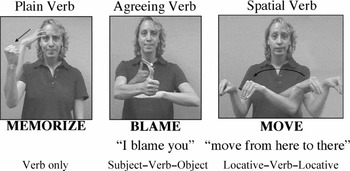
There are three verb classes in ASL: agreeing verbs, spatial verbs and plain verbs (Padden, Reference Padden1988). The verbs in the first two of these verb classes are directed toward locations associated with referents in space in order to mark agreement manually (i.e., the direction of movement and orientation of the hands mark features of the noun arguments). Agreeing verbs, the first class, are directed toward locations in signing space to indicate person and number features for subject and object, and spatial verbs, the second class, are directed toward locations in signing space to specify locatives. Plain verbs, the third class of ASL verbs, are not directed toward spatial locations and are not marked for agreement. Thus, agreement in ASL represents a complex system in which three distinct patterns can be found: verbs that show agreement with subject and object, verbs that show agreement with their locative arguments, and verbs that do not show agreement at all (see Figure 2; and for further discussion see Padden, Reference Padden1988).
Illustration of ASL verb types (from Emmorey, Reference Emmorey2002; these verbs are in citation form, and therefore eye gaze is not directed).

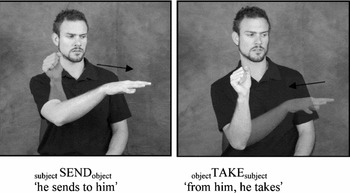
Analyses of manual agreement have been proposed that are syntactically based (Padden, Reference Padden1988; Rathmann and Mathur, Reference Rathmann, Mathur, Meier, Cormier and Quinto-Pozos2002) or semantically based (Friedman, Reference Friedman1975; Shepard-Kegl, Reference Shepard-Kegl1985; Taub, Reference Taub2001) but neither of these types of analyses has been able to explain the pattern of manual agreement completely. Such unilateral analyses are problematic because certain phenomena can only be explained in terms of grammatical relations (e.g., in ASL, object agreement is obligatory while subject agreement is optional), while other phenomena are best explained semantically, e.g., the behavior of “backwards” verbs. Backwards verbs (e.g., TAKE, BORROW, INVITE, etc.) are a sub-class of agreeing verbs that mark object first and subject second, unlike regular agreeing verbs (e.g., GIVE, LEND, ASK, etc.), which mark the subject first and the object second (see Figure 3). The differing behavior of regular agreeing vs. backwards agreeing verbs can be accounted for straightforwardly with a semantic analysis positing that agreeing verbs (both regular and backwards) mark source and goal, rather than subject and object.
Illustration of a regular agreeing verb (SEND) which moves from subject to object location and a backwards agreeing verb (TAKE) which moves from object to subject location. For both verb types, eye gaze is toward the object location (to the signer's left in this illustration).

As a solution to the seemingly conflicting behaviors of manual agreement, Meir (Reference Meir1998a, Reference Meirb) proposed that ASL agreement (along with Israeli Sign Language agreement) encodes both syntactic and semantic arguments, with the syntactic argument of a verb encoded by the facing of the hands, and the semantic argument by the movement of the verb. For example, SEND, an agreeing verb, and TAKE, a backwards verb, are both produced with the palm facing out (toward the indirect/direct object), but move in opposite directions (toward the differing goal locations).
In addition to manual agreement in ASL, non-manual markers (e.g., eye gaze and head tilt) are claimed to mark agreement (Bahan, Reference Bahan1996; Neidle, Kegl, MacLaughlin, Bahan and Lee, Reference Neidle, Kegl, MacLaughlin, Bahan and Lee2000). Our previous eye-tracking study showed that eye gaze is used to mark agreement in a pattern similar to manual agreement (Thompson et al., Reference Thompson, Emmorey and Kluender2006). Parallel to the absence of manual agreement for plain verbs, native signers did not produce directed eye gaze with plain verbs. This finding contrasts with Neidle et al.'s (Reference Neidle, Kegl, MacLaughlin, Bahan and Lee2000) earlier claim that eye gaze can mark agreement with plain verbs.Footnote 2 When producing agreeing verbs, native signers most frequently directed their gaze to mark agreement with objects (the direct object for transitive verbs and the indirect object for ditransitive verbs) in much the same way as in their production of manual agreement morphology. Eye gaze agreement occurring with backwards verbs was consistently directed toward the location associated with the object (see Figure 3). Thus, eye gaze patterns with the facing of the hands in marking syntactic rather than semantic agreement for both regularly agreeing and backwards agreeing verbs.
Transitive spatial verbs (e.g., PUT as in “I put the hat on the table”) mark manual agreement with locatives, and can additionally encode the direct object with a handshape indicating object type (e.g., round, flat). Therefore, it would be possible for native signers to mark eye gaze agreement with either the object (by gazing in the direction of the hands) or with the locative (by gazing toward the location in space associated with the locative argument). Bahan (Reference Bahan1996) claims that eye gaze is used to mark objects of the verb and gaze should therefore track the hand with spatial verbs in order to mark object agreement features. However, eye gaze again patterned with manual agreement for spatial verbs, in that signers consistently directed their gaze toward the locative (the spatial location) rather than toward the object (the hand).
Unlike manual agreement, eye gaze agreement occurred only 73% of the time with native signers (74% for agreeing verbs, and 72% for spatial verbs). Thompson et al. (Reference Thompson, Emmorey and Kluender2006) suggest that the reason eye gaze agreement is not always present is likely due to several factors, such as social/stylistic variables as well as other competing functions of eye gaze, (e.g., regulating turn taking, checking addressee comprehension, and marking role shift). These factors may create a co-articulation problem that can block eye gaze agreement (for further details see the discussion in Thompson et al., Reference Thompson, Emmorey and Kluender2006).
In summary, observations of eye gaze behavior during the production of backwards verbs, ditransitive verbs, and spatial verbs provided evidence about the nature of eye gaze during native signer verb production. Specifically, during the production of backwards verbs, gaze is toward the syntactic object (the first location of the sign) rather than toward the semantic goal (the final location of the sign). Gaze likewise does not follow the movement of the hands to the end point of the sign. During the production of ditransitive verbs, gaze is toward the indirect object rather than toward the direct object. Finally, during the production of spatial verbs, gaze is directed toward the locative argument rather than toward the object. In the current study we examine gaze patterns during the production of backwards verbs, ditransitive verbs and spatial verbs in order to determine the pattern of gaze for late L2 learners.
Factors that could influence the acquisition of ASL eye gaze agreement
Eye gaze and modality
Empirical studies on language transfer among learners of different L1 backgrounds have shown that language typology of the L1 overrides other important variables such as proficiency (DeBot, Reference DeBot1992; Poulisse, Reference Poulisse1990) and amount of L2 exposure (Jarvis and Odlin, Reference Jarvis and Odlin2000). Learning a second language in a different modality presents another possible influence of an L1 on L2 acquisition (Rosen, Reference Rosen2004; Mayberry, in press). In the current study, we examined L2 learners of a signed language (ASL) whose L1 was spoken (English) and asked if the oral/aural modality of the LI affects the acquisition of eye gaze as a grammatical marker in the visual/gestural modality.
Predictable patterns and typological universals
In the realm of language acquisition, as in other cognitive domains, patterns that are internally consistent and easily predicted may be easier to acquire than patterns that are less consistent and difficult to predict (Wonnacott and Newport, Reference Wonnacott, Newport, Brugos, Clark-Cotton and Ha2005). Within ASL, there are two aspects of eye gaze agreement that could make SLA difficult because they are not easily predicted: verb class membership and use of the NPAH to determine agreement.
First, as explained earlier, the ASL lexicon is divided into verbs that take agreement markers and those that do not. This division of the lexicon appears to be based in part on phonological restrictions (e.g., many plain verbs make contact with a body location and are thus not amenable to spatial displacement), semantic restrictions (e.g., psychological predicates do not mark agreement), and features of the controller of agreement (i.e., the abstract case of the nominals; see Janis, Reference Janis, Emmorey and Reilly1995). However, it is unclear whether all verb agreement patterns can be predicted in this way, and verb class membership may sometimes simply be arbitrary. This lexically governed pattern of marking agreement with some verbs but not with others can be characterized as an idiosyncratic feature of ASL that is not common across spoken languages.Footnote 3
Second, in ASL, verbs can mark agreement with the subject and direct object, the subject and indirect object, or with locatives. While some verbs only mark agreement in one way (e.g., HELP and KILL only mark agreement with subject and direct object), other verbs mark agreement according to the arguments that they occur with. For example, the verb BITE can mark agreement with a direct object (e.g., “Bob” established in some location in space). However, if the sentence is produced with a locative argument as well (e.g., FOREARM) then BITE will mark agreement with the locative argument instead.
Thompson et al. (Reference Thompson, Emmorey and Kluender2006) proposed that both manual and eye gaze agreement are marked according to an agreement hierarchy that follows the same ordering as the NPAH originally proposed by Keenan and Comrie (1997) to account for universal patterns of relative clause formation. According to this hierarchy, verbs in ASL (with the exception of plain verbs) mark agreement with their lowest-ranking argument: Subject > Direct Object > Indirect Object > Locative (see Thompson et al. Reference Thompson, Emmorey and Kluender2006 for evidence that locatives are arguments rather than adjuncts of a verb in ASL). The NPAH has also been used to explain other phenomena such as causativization and case marking (Comrie, Reference Comrie and Shibatani1976; Croft, Reference Croft, Barlow and Ferguson1988).
The NPAH has been found to have consequences within SLA. For example, Gass (Reference Gass, Gass and Selinker1979, Reference Gass, Scarcella and Krashen1980) studied the acquisition of English relative clauses by adult L2 learners of English in a sentence-combining task, a grammaticality judgment task and free composition, and found a close relationship between accuracy order (from most accurate to least accurate use) and the order of the NPAH. Additionally, Deaf native ASL signers had more difficulty with object than with subject relative clauses in both Manually Coded English (spoken English on the hands) and written English (Lillo-Martin, Hanson and Smith, Reference Lillo-Martin, Hanson and Smith1992). This finding indicates that L1 ASL signers adhere to the NPAH in grammaticality judgments of relative clauses in their L2, English.
While neither aspect of eye gaze agreement – idiosyncratic marking of verbs and use of the NPAH to determine which noun is the controller of agreement – may be easily predicted, they differ in their universality across languages. Specifically, marking agreement on some verbs and not others appears to be a rather idiosyncratic feature of signed languages, while the NPAH used to determine eye gaze agreement captures a typologically universal, natural ordering of arguments. If predictability is considered in isolation, L2 learners are expected to do poorly across the board in the attainment of eye gaze patterns. However, if we consider typological universals (as in Greenberg, Reference Greenberg1966), in which systematic patterns emerge cross-linguistically even though they may or may not be easily predicted, then universal constraints on eye gaze agreement (i.e., the NPAH used to determine the controller of agreement) should be facilitated in the acquisition process in a way that idiosyncratic features of eye gaze agreement are not (marking of agreement on some verbs and not others).
Several other studies have looked at the possible role of the Accessibility Hierarchy in the acquisition of relative clauses and found that linguistic markedness (i.e., lower positions on the NPAH) may play a role in the extent to which learners avoid using relative clauses, the order in which they acquire relative pronoun functions, and the extent to which they make pronominal copy errors (Gass, Reference Gass, Scarcella and Krashen1980; Pavesi, Reference Pavesi1986; Eckman, Bell and Nelson, Reference Eckman, Bell and Nelson1988).Footnote 4 These findings suggest another possible pattern for the L2 acquisition of eye gaze agreement. Namely, L2 learners may do better at correctly marking eye gaze agreement with the direct object (high on the NPAH) than with marking agreement with locatives (low on the NPAH). Such a finding would show evidence of the applicability of the NPAH for SLA outside the realm of relative clauses.
Possible outcomes and predictions
In the first study, we examined proficient signers who are likely at asymptote (i.e., they are unlikely to improve their ASL skills significantly in the future) in order to discover the ultimate level of attainment for SLA of eye gaze agreement. Specifically, we asked whether or not eye gaze agreement can be acquired at all by late L2 learners, and if so, to what degree these learners are able to master the idiosyncrasies and universal aspects of the system.
The acquisition of morphological features like verb agreement has been shown to correlate not only with age of first exposure, but also with years of study in a formal setting (for regular morphology) and with the use of the second language in daily life (for lexically driven idiosyncrasies; Flege, Yeni-Komshian and Liu, Reference Flege, Yeni-Komshian and Liu1999). Proficient participants in this study were all formally trained in ASL, they all use ASL consistently on a daily basis and they all work as ASL interpreters. Further, at the time of testing, proficient participants had all been signing for an extended period of time (M = 18.8 years). They therefore represent the best possible scenario for successful late acquisition of ASL.
The pattern of acquisition found in the proficient L2 data will inform us about the impact of several possible SLA influences. The first is the visual/manual modality of ASL. Specifically, given the modality-specific use of eye gaze to mark agreement, L2 learners may completely overlook this feature of ASL. However, if proficient L2 learners are able to even partially acquire eye gaze agreement, we can then assess their level of attainment for eye gaze agreement patterns. There are likely many different SLA factors that converge to create a final learning outcome. If predictability of L2 patterns is key, then L2 learners should be unable to correctly systematize which verbs are agreeing and also be unable to correctly determine which noun is the controller of agreement (two crucial features needed to master eye gaze agreement patterns). This is because neither pattern is easily predicted from surface forms in the input. Alternatively, if SLA is constrained by language universals, then the typologically universal pattern of the agreement hierarchy may be relatively easier to acquire than the cross-linguistically rare, ASL pattern of agreement.
Experiment 1
Method
Participants
Ten non-native proficient signers (eight women, two men) participated (mean age = 38.5 years). Proficient signers all began signing after the age of 16 (mean age = 19.33 years; range = 16–24 years) and had been signing for over 11 years at the time of testing (mean number of years = 18.8; range = 11–30 years). They were all currently working as interpreters and reported signing between 15–50% of the time during the day (as stated on a background questionnaire). Additionally, they all reported being involved in the Deaf Footnote 5 community. A comprehension test was given as a further, more direct measure of signing skills. The test consisted of participants viewing two ASL stories followed by comprehension questions. The mean comprehension score for proficient signers was 48 (mean score of native signers (N = 10) = 52.36).
Materials
Using the same methodology as Thompson et al. (Reference Thompson, Emmorey and Kluender2006), participants were asked to make up a story about two characters (Jack and Jill) using specific verbs (12 plain, 7 agreeing, and 7 spatial verbs; see Appendix 1). The “Jack and Jill Story” task was one of three tasks from Thompson et al.'s original study (no significant difference was found for eye gaze across tasks in this original study). The verbs were given to participants one at a time (signed by their interlocutor) as they progressed through their created stories. Participants were allowed to use as many sentences as needed with each verb to make the story coherent. Thus, not only were the specified verbs produced, but many speaker-generated verbs were elicited as well.
Procedure
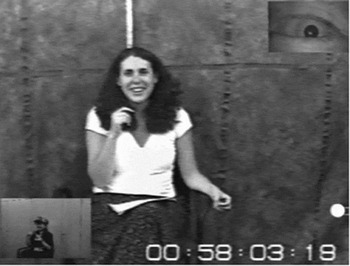
Participants’ eye movements were monitored using iView, a head-mounted eye-tracking system (SensoMotoric Instruments, Inc.). The eye-tracking device consists of two miniature cameras: one, the scene camera, filmed the participant's field of view, and the second, the eye camera, tracked the participant's eye movements. In the resulting video, a cursor indicating the participant's eye position was superimposed on the image of the participant's field of view. Another camera recorded the participant's signing and was time-locked to the eye position video via a digital mixer. The composite video also contained an image of the participant's eye, which was used to identify eye blinks and to corroborate eye gaze direction (see Figure 4).
A videoframe from the scene camera mixed with signer's eye image (upper right corner) and view of the signer (lower left corner). The white dot indicates the direction of the signer's gaze which is to the right of the addressee.

Coding and analysis
For each task, the full screen videotape of the participant signing was time-coded and transcribed. The transcription was used to determine (a) the exact start and end times for each verb, and (b) where participants placed referents in signing space. The videotape with the eye-position cursor was used to record the exact position of gaze during verb production. Eye gaze coordinates were determined by using a graph overlay with one-inch cells on the video monitor. (For reference, the addressee's head took up about 4 cells.) Gaze coordinates allowed us to pinpoint the exact location of gaze in order to make direct comparisons.
Eye gaze was coded as follows. Gaze to the addressee was coded as anywhere on the addressee's face or falling within one inch around the addressee's head. Eye gaze was coded as toward the object location for the direct object of transitive verbs, and either toward the direct or indirect object for ditransitive verbs. Eye gaze toward the assigned subject location was coded as subject gaze. For transitive spatial verbs, eye gaze was coded as toward the object if it was directed at the signer's hand (recall that the object is encoded in spatial verbs by the shape of the hand) and toward the locative if gaze was directed toward the location associated with that locative (usually the end point of the sign; gaze coded as toward the locative was not directed toward the hand at any point just prior to or during the production of the verb). Finally, eye gaze was coded as “other” when gaze was directed above the addressee's head, toward the addressee's body, or toward an unassigned location in signing space. Approximately 21% of the verbs collected were not used in the study. Verb productions were discarded when the eye gaze data were unclear or uncodable (e.g., when the participant blinked during the production of a verb). Data were excluded from the analysis when gaze occurred with a first person object, because eye gaze cannot be directed toward first person (i.e., the signer's own body). Data were also excluded when a plain verb was produced with no established object location (i.e., a signer might produce the sentence BOB LIKEplain BILL “Bob likes Bill”, without providing a location for BILL). Using this coding system, inter-rater reliability for gaze position was 93% (based on two coders analyzing a subset of the data, including half of the data for two subjects). See Appendix 2 for examples from the data set.
Use of previous data
The availability of native signer data from Thompson et al. (Reference Thompson, Emmorey and Kluender2006) allowed for direct comparisons of data from the current L2 study with native signer data from the previous study. These data comprise an analysis of ten native signers’ eye gaze behaviors (six women and four men; mean age = 28.6 years). All were from Deaf families and exposed to ASL from birth (nine Deaf, one hearing native signer). Only data from the story completion task were compared to the data from the proficient late learners.
Results
Proficient late L2 signers produced 167 agreeing verbs, 207 plain verbs, and 170 spatial verbs with clear gaze direction. For each participant, we calculated the mean percentage of eye gaze toward each location for all three verb types. For agreeing and plain verbs, we calculated the mean percentage of eye gaze directed toward the subject, direct object, indirect object, addressee, and other. For spatial verbs we calculated the mean percentage of gaze toward the subject, object, addressee and locative. For both native and proficient signers, gaze toward the location associated with the grammatical subject was dispreferred across all verb types (mean < 10% across all verb types and groups). A repeated measures ANOVA comparing subject gaze across all three verb types (agreeing, plain, and spatial) and two participant groups (native and proficient) revealed no significant differences. Therefore, gaze toward the grammatical subject was not included in further analyses. We also compared gaze toward the direct object for transitive verbs with indirect object gaze for ditransitive verbs and found no significant difference between the two. Gaze was consistently toward the indirect object for ditransitive verbs (mean = 80.4%, SD = 6.74) and toward the direct object for transitive verbs (mean = 72.8%, SD = 8.66). Following Thompson et al. (Reference Thompson, Emmorey and Kluender2006), direct object gaze for transitive verbs and indirect object gaze for ditransitive verbs were therefore collapsed into one “object” category. Collapsing these two object types allowed for more direct statistical comparisons across verb types and did not affect the results (i.e., only agreeing verbs are ditransitive and occur with indirect objects – plain and spatial verbs do not). The native signer data from the story completion task (Thompson et al., Reference Thompson, Emmorey and Kluender2006) were entered into each analysis as appropriate. Below we compare proficient signer data with native signer data for the three verbs types (agreeing, plain, and spatial).
Agreeing and plain verbs
To determine whether eye gaze differed significantly for native and proficient signers, we conducted a repeated measures analysis of variance (ANOVA) with a 2 (verb type: agreeing, plain) × 2 (participant group: native, proficient) × 3 (gaze direction: object, addressee, other) experimental design. The dependent variable was the mean percentage of eye gaze toward each location. Before analyses were conducted, percentages were normalized using arcsine transformations.
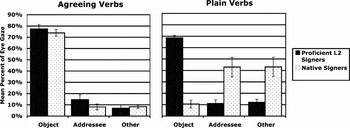
The results showed a main effect of eye gaze direction (F(2,36) = 40.69, p < .0001), indicating that the direction of gaze was not random, and a main effect of group (F(1,18) = 14.9, p = .001). Interactions between gaze direction and group (F(2,36) = 71.92, p < .0001) as well as between gaze direction and verb type (F(2, 36) = 47.03, p < .0001) were significant, further qualified by a three-way interaction between verb type, gaze direction and participant group (F(2, 36) = 5.07, p < .011). As shown in Figure 5, for agreeing verbs, both native and proficient L2 signers directed their gaze toward the location associated with the object (73.8% and 77.5%, respectively). However, for plain verbs, native signers directed their gaze toward the location associated with the object 10.5% of the time, while proficient L2 signers did so 68.5% of the time (see Figure 5). An ANOVA comparing participant group and gaze direction for individual verbs (agreeing or plain) revealed no significant difference of gaze direction between native and proficient signers for agreeing verbs (F(2,36) = .509, n.s.), but a significant difference in gaze direction between native and proficient signers for plain verbs (F(2,36) = 30.26, p < .0001). Further, while native signers’ gaze was significantly different between plain and agreeing verbs (verb type x gaze direction: F(2,18) = 37.81, p < .0001), there was no such difference in gaze direction between plain and agreeing verbs for proficient L2 signers (F(2, 18) = 2.69, n.s.). This pattern of results for plain and agreeing verbs suggests that proficient L2 signers treat these verb types similarly with respect to eye gaze.
Mean percent of native signer and proficient L2 learner eye gaze for agreeing and plain verbs. Error bars indicate the standard error of the mean.

Backwards agreeing verbs
As described above in the section “ASL verb classes and agreement”, most agreeing verbs mark the subject first and the object second, but a sub-class called “backwards verbs” instead mark the object first and subject second. We examined eye gaze data from backwards verbs to determine whether gaze was toward the first location associated with the syntactic object, or toward the second location, the end point of the sign associated with the semantic goal. For proficient L2 signers, gaze was directed more often toward the syntactic object, the beginning of the sign (88%), than toward the final location of the sign, the semantic goal (9%; t(9) = 7.32, p < .0001), mirroring the gaze pattern for native signers (82.5% toward the syntactic object). The eye gaze data from both regularly agreeing verbs and backwards agreeing verbs thus suggest that proficient late learners treat eye gaze as a syntactic marker, and not as a marker of semantic roles.
Spatial verbs
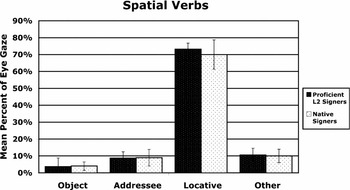
The spatial verb data were analyzed using a 4 (gaze direction: object, addressee, locative, other) × 2 (group: native, proficient) repeated measures ANOVA. There was a main effect of gaze direction, indicating that direction of eye gaze was not random (F(3,54) = 44.57, p < .0001). There was no interaction between gaze direction and participant group (F(3,54) = .62, n.s.) indicating the pattern of gaze for native and proficient L2 signers was not different. As shown in Figure 6, for transitive spatial verbs, both native and proficient signers directed their gaze toward the location associated with the locative (73.3% and 68.3%, respectively).
Mean percent of native signer and proficient L2 learner eye gaze for spatial verbs. Error bars indicate the standard error of the mean.

Discussion
Proficient L2 signers show evidence of having mastered, for the most part, the complex patterns of ASL eye gaze agreement. This is the case despite the modality-specific use of eye gaze as a grammatical marker that might have been overlooked by L2 signers from a spoken language background. In our study, L2 learners with English as their spoken L1 were able to take in and make use of relevant language input, despite the fact that eye gaze is likely to be unexpected as a linguistic marker. Thus, L2 learners recognize (perhaps unconsciously) the grammatical use of eye gaze within ASL, despite its nonlinguistic social functions within their L1 and in other parts of ASL discourse.
In addition to the types of errors that proficient L2 learners made, the types of errors that these L2 learners did not make are informative. There are several patterns of eye gaze that L2 learners might produce which would be almost identical to native signers’ patterns, but that would nonetheless be indicative of divergent underlying representations of eye gaze agreement (i.e., production patterns that are systematic and yet different from those of native signers; Sorace, Reference Sorace1993). One possible pattern would be directing eye gaze toward the semantic goal rather than the syntactic object during the production of backwards verbs. However, proficient L2 learners correctly directed their gaze toward the location associated with the grammatical object, whether the object was associated with the first location of the verb (backwards agreeing verbs) or the second location (regular agreeing verbs). Proficient L2 learners thus did not acquire a divergent eye gaze agreement system based on semantic roles. Nor did they acquire a system in which eye gaze simply follows the hands in space.
We next looked for errors during the production of spatial transitive verbs to determine if proficient L2 learners have a representation of eye gaze agreement as always directed toward the object (as opposed to arguments along the NPAH). No evidence for such a system was found. Proficient L2 learners, like native signers, consistently directed their gaze toward the location associated with the locative argument of the verb, and not toward the object location. Further, proficient L2 learners like native signers looked toward the location associated with the indirect object, not the direct object, during the production of ditransitive verbs (a mean of 80.4% toward the indirect object vs. 0% toward the direct object). These two facts taken together indicate that proficient late L2 learners adhere to the eye gaze agreement hierarchy in marking the lowest-ranked argument with their directed gaze.
While proficient L2 signers appear ‘native-like’ in marking agreeing and spatial verbs with eye gaze agreement, a key difference was found for gaze occurring during the production of plain verbs. Native signers did not direct gaze toward the location associated with the object for plain verbs, while proficient signers did so in a manner consistent with gaze for agreeing verbs. This suggests that the mental representation of the L2 grammar for eye gaze agreement is divergent from that of native signers in this one crucial area. Proficient L2 signers systematized the input they received, but in a way that caused their output to differ systematically from that of native signers. Crucially, L2 signers did not differ from native signers in marking agreement with the correct noun phrase. Both determining which noun phrase controls agreement, and which verbs are marked for agreement requires the ability to acquire patterns that are not easily discernible or predictable. Nevertheless, the first is a typologically universal pattern (agreement is determined by the NPAH), while the second is not.
In terms of acquisition differences related to a verb argument's ranking on the NPAH, proficient L2 signers did not differ from native signers in marking direct objects (relatively high on the hierarchy), or locatives (relatively low on the hierarchy). However, it may be that agreement marking is acquired according to the hierarchy progressively as L2 proficiency increases. If so, such a difference would only be evident in the SLA of less advanced learners. This possibility is explored in a second experiment (described below) that investigates the eye gaze of novice ASL learners.
In the second experiment, we also explore the possibility that eye gaze occurring during the production of verbs is based on more general cognitive processes, such as visualization or attentional focus during signing. While the grammatical use of eye gaze with a spoken language is unattested and unexpected, cognitive functions of eye gaze have been widely reported. Specifically, eye movements have been argued to be a behavioral expression of attention, providing a real-time measure of visual and cognitive processing (for reviews see Hayhoe and Ballard, Reference Hayhoe and Ballard2005, and Henderson, Reference Henderson2003). For example, when viewing scenes or performing tasks, gaze is directed toward informative regions within a scene or toward task-relevant objects. It is possible that the grammatical use of eye gaze in ASL originated from an attentional preference for signers to gaze toward discourse-salient spatial locations. Such an origin would suggest a direct relationship between attentional mechanisms and eye gaze agreement that could be easily learned by second language learners.
In Thompson et al. (Reference Thompson, Emmorey and Kluender2006) we argued against this position (at least for native signers), because attentional gaze (i.e., gaze toward an imagined referent that is the focus of attention) should not be consistently different across the three types of ASL verbs. However, while L2 signers do pick out different arguments of the verb with their gaze, they produce directed gaze across all verb types. Thus a direct comparison between gaze behavior of hearing speakers and L2 signers (both proficient and beginning) will provide further insight into the underlying nature of gaze during sign production. Further, beginning learners of ASL might naturally gaze toward spatial locations associated with key discourse referents. Such a pattern of gaze would be similar but not identical to the native eye gaze pattern, because eye gaze agreement for native signers is controlled by syntactic, not discourse-attentional factors. Such gaze behavior might indicate a link between attentional gaze during speech and the production of gaze during sign for L2 learners. Therefore, we investigated the eye gaze behaviors of early L2 learners to determine whether directed eye gaze is acquired early, whether gaze is syntactically or cognitively controlled, and whether the NPAH is acquired progressively. In addition, we investigated the eye gaze behaviors of non-signing English speakers under the same experimental conditions in order to assess what happens outside the scope of ASL. These data will indicate whether novice ASL learners produce the gaze behaviors that are observed for monolingual English speakers, adopting English gaze patterns when signing ASL.
Experiment 2
Eye gaze behaviors outside of signed languages
Similar to signs that are produced in spatial locations to indicate referents, McNeill (Reference McNeill1992) found that speakers sometimes gesture toward locations in space when using referring expressions in spoken language. He argued that concepts can be visualized in space, and that this space can be indexed with gestures. For example, when re-telling a cartoon story (Canary Row), one character (Tweety) may be associated with the right side of gesture space while a second character (Sylvester) may be located on the left. With this association in place, a gesture toward the right side of space refers to Tweety, and not to Sylvester. Furthermore, although these gestures are not constrained by the grammar, listeners are sensitive to mismatches between anaphoric gestures and referring expressions (e.g., saying “Sylvester” while gesturing to the right, which is Tweety's location). Thus speakers can create locations for referents in space by using gesture, demonstrating a clear parallel between co-speech gesture and the anaphoric use of space in ASL.
Once speakers have formed a mental image of referents in gesture space, the tendency may be to gaze toward these specific locations when referents become the focal point of the discourse. Such gaze may signal attention (i.e., attentionally-based gaze) to a discourse referent similar to a manual gesture. Gullberg and Holmqvist (Reference Gullberg and Holmqvist1999) found that speakers sometimes look at their own hands while gesturing, providing evidence that directed eye gaze can accompany gesture. Further, addressees frequently look toward a gesture that is being self-fixated by the speaker producing it, suggesting that these attentional gazes are a signal that the gesture being produced is important (Streeck, Reference Streeck1993; Tuite, Reference Tuite1993). It is possible that a parallel also exists between the attentional eye gaze of speakers and the production of eye gaze agreement by signers.
We investigated the eye gaze patterns of novice signers to determine whether directed gaze during the production of ASL might originate as attentionally-based gaze. If so, novice signers are predicted to produce more directed gaze while signing than non-signers do while talking. Because novice signers are taught very early how to manually establish referents in space while signing, they can both use and understand referring expressions and manual verb agreement. Once discourse characters are located in space, novice signers may naturally gaze toward these locations as they attend to them, creating a pattern of gaze controlled by the salience of discourse referents. Thus while English speakers are not required to set up referents in space and may only do so under certain conditions, novice signers with relatively little signing experience should have a mental image of referent locations, providing them with the best possible conditions under which to produce attentionally-based eye gaze.
If the use of eye gaze in ASL stems from a pre-existing bias such as attentionally-based gaze, which is a cognitive process outside the realm of language, then novice signers’ gaze is predicted to be toward the location associated with any salient discourse referent, regardless of grammatical role. In contrast, the pattern of native signers’ gaze is toward specific arguments, regardless of their discourse salience.Footnote 6 For example, while signing #BILL ASK #BOB (“Bill asks Bob”) a novice signer producing attentionally-based eye gaze could look at either the location associated with the subject “Bill” or the object “Bob”, depending on which character was the most salient at that point in the discourse. A native signer however, whose gaze is controlled by the syntax, would look at the location associated with the object (“Bob”) regardless of salience.
Possible outcomes and predictions
In this second experiment, we first observed the eye gaze behaviors of monolingual English speakers with no exposure to signed languages to determine the pattern of eye gaze during a spoken-language version of the “Jack and Jill” narrative. We made use of the same elicitation procedures so that direct comparisons between signers and speakers would be possible. We next examined novice signers who were just beginning the language learning process. If we were to find that novice signers’ eye gaze is controlled by the salience of discourse referents, we could conclude that directing eye gaze toward verb argument locations is relatively “natural” and stems from more basic cognitive functions, such as a speaker's attention, or visualization during discourse. Another possibility is that novice signers will show evidence of acquiring grammatical eye gaze agreement. In this case, gaze patterns for these novice L2 signers may be similar to the SLA of relative clauses: novice signers may produce verb agreement with direct objects (relatively high on the NPAH) more often than with locatives (relatively low on the NPAH).
Method
Participants
Nine novice signers (seven women, two men) and five non-signing monolingual English speakers (three women, two men) participated in Experiment 2 (mean age = 20.7 and 28.8 years, respectively). Novice signers all began signing after age 16 (mean age = 18.3; range = 16–19) and had completed between 9 and 15 months of ASL instruction (six hours of in-class time per week) at the time of testing. Novice signers also took a sign story comprehension test resulting in a mean score of 11.5 (SD = 7.5) out of a possible 73 points. The mean score for native signers was 52.36 (SD = 5.5) and 48 (SD = 7.1) for proficient L2 signers. Non-signing participants (two women, three men) were all monolingual English speakers (mean age = 25) with no knowledge of ASL other than the fingerspelled alphabet. All participants were hearing.
Materials and procedure
The same materials and procedure were used as in Experiment 1. Instructions and verbs for the story were produced orally for the hearing English-speaking participants. English-speaking participants were not given additional information, in particular gesture was not mentioned. As in Experiment 1, signs were produced for novice signers as they progressed through the story. If a novice signer was unfamiliar with the sign, then the English word was fingerspelled for them and an example sentence was produced.
Coding and analysis for signing participants
The same method of coding and analysis were used as in Experiment 1 with one notable exception. Novice signers, unlike proficient L2 signers, produced manual agreement errors during the signing condition. Thus, in addition to discarding verb productions when eye gaze data was unclear or uncodable (14% novice signers, 5% English-speaking participantsFootnote 7), data for novice signers were further excluded when a manual agreement error made it impossible to determine the intended location of referents. Agreement errors included either an error of omission (i.e., failure to show agreement when producing an agreeing or spatial verb; 10%), or an error in referent placement (i.e., marking agreement in one location in space for a referent already established in another spatial location; 4%). Referent placement errors were counted only once per incorrect location shift. For example, if “Jack” were placed on the right in signing space, followed by an agreeing verb meant to reference Jack as the object directed to the left, this was counted as a placement error and the data from this verb were excluded. However, if the next verb indicating agreement with Jack was again on the left, this was not coded as a second error. If, on the other hand, Jack was placed on the right, and a verb was directed to the left in signing space to refer to him, followed by another verb directed to the right to again refer to Jack, this would count as two unique placement errors, and both verbs would be eliminated. Referent placement errors were coded as such when there was no clear reason for a shift in referent location (e.g., signing “JACK aMOVEb “Jack moved from ‘a’ to ‘b”, and then referring to Jack in location “b” is not a placement error). Using this coding system, inter-rater reliability for gaze position was 89% (based on two coders analyzing a subset of the data, including half of the data for two subjects). For sample sentences across all groups, see Appendix 2.
Results
Monolingual English speakers
The five non-signing English-speaking participants produced a total of 207 verbs with clear eye gaze data. These participants gazed toward their addressee 93% of the time when producing English verbs. In comparison, all three signing groups looked at their addressee less than 20% of the time across all verb types (native signers 19.4%, proficient signers 8.8%, and novice signers 16.3%). An analysis of gaze throughout the entire production of the “Jack and Jill” story (not just during verb production) showed that non-signing English speakers looked at the addressee 92% of the time across the entire narrative.
ASL novice signers
Novice signers produced 122 agreeing verbs, 105 plain verbs, and 140 spatial verbs with clear gaze direction. To determine if gaze toward any one direction (subject, object, locative, addressee, other) occurred more frequently than would be expected by chance, we conducted planned comparisons using one-tailed t-tests. Subjects’ gaze toward the grammatical subject, object, addressee or other locations (as well as locative for spatial verbs) was compared to chance (25% for plain and agreeing verbs, 20% for spatial verbs), and no significant differences were found. The highest (non-significant) t-value across all comparisons was t(8) = 1.91, d = .98, p = .92, indicating that gaze toward any one location occurred no more frequently than would be expected by chance, i.e., there was no consistent eye gaze pattern for novice signers. (For a comparison of eye gaze across all signing groups, see Appendix 3.)
Discussion
Non-signing English speakers did not make use of eye gaze to indicate discourse referents, and only rarely varied their gaze during the production of English verbs (or during any part of a sentence). Thus, native and proficient signers consistently use eye gaze in a task in which English-speaking participants do not, indicating a clear difference in the use of eye gaze between signing and non-signing groups.
English speakers may use eye gaze to indicate discourse referents under different circumstances (see Clark, Reference Clark1996), but evidently the story continuation task used in our study did not lend itself to this type of eye gaze behavior, or for that matter to manual gesturing. English-speaking participants produced few gestures overall, with only one gesture (across all participants) indicating the location of a character in space. The fact that the story continuation task consistently elicited directed gaze from native and proficient L2 signers indicates that directed gaze with ASL verbs is not a gestural phenomenon driven by attentional focus.Footnote 8
Further evidence that eye gaze with verbs is not cognitively or gesturally based comes from the novice signer data. Unlike the participants in McNeill's (Reference McNeill1992) studies, the non-signers in our study did not have a visual aid such as a cartoon to help them form a mental image of characters in space. In contrast, novice signers were forced by the grammar of ASL to locate characters at particular locations in space. Specifically, in the ASL task the experimenter began a story by introducing the characters, “Jack” and “Jill”, and, as is frequently the case with the first mention of characters, assigned them to locations in space (i.e., Jack was located on the left in signing space and Jill was located on the right). Participants then continued the story, adopting the already established locations when referring to Jack and Jill and, as required by ASL grammar, making frequent reference to these locations with pronouns and manual verb agreement. If having an established location in space for discourse-salient referents is what controls directed eye gaze, then novice signers should preferentially look at the spatial locations of salient discourse referents. A pattern in which eye gaze is directed primarily at discourse referents would be the result. However, while novice signers frequently produced directed gaze, their gaze was dispersed across all possible spatial locations, including the spatial locations of discourse referents, but also toward the addressee, and crucially to non-associated locations in space (an average of 38% across all verb types). The eye-tracking results from novice signers thus indicate that the use of eye gaze to mark locations in space does not arise “naturally” as a property of attentional focus in sign language, but rather that it must be learned.
The fact that the gaze of novice signers was directed but undifferentiated indicates that these beginning signers recognized that they were supposed to be doing something with their gaze during ASL verb production. While the novice signers had only recently begun learning ASL and had not yet mastered its grammar, their eye gaze patterns were not equivalent to those of the English-speaking non-signers. This finding suggests that learning is already taking place in this L2 population: even beginning signers are attending to eye gaze as an aspect of ASL grammar. However, the data further suggest that, at this stage of acquisition at least, novice signers are not better at producing eye gaze agreement with noun phrases higher on the NPAH – their gaze patterns are no better than chance with both spatial verbs (requiring locative agreement) and agreeing verbs (requiring object agreement).
General discussion
Given the unique nature of eye gaze agreement (i.e., it is produced with the eyes), the present set of experiments provides a perhaps surprising pattern of SLA that is nonetheless consistent with acquisition patterns across all languages. While English-speaking participants (with no knowledge of ASL) showed no evidence of directed eye gaze toward locations in space, novice signers exhibited the expected profile of beginning language learners, producing gaze that was directed, but full of errors. On the other end of the proficiency spectrum, proficient late learners exhibited an eye gaze pattern that approximated the native pattern. Proficient L2 signers correctly produced eye gaze agreement according to the typologically universal pattern of the NPAH, but diverged from native signers in overgeneralizing an idiosyncratic pattern by marking agreement with plain verbs as well. Thus our findings demonstrate a difference between L1 and L2 ASL acquisition.
The proficient non-native signers in our study erroneously marked eye gaze agreement when producing plain verbs, but they did not make manual agreement errors with plain verbs. One possible explanation for the difference in ultimate attainment in manual vs. non-manual (i.e., eye gaze) agreement is perceptual salience. Specifically, large articulators (the hands) that produce movements in space may be more perceptually salient (and thus easier to learn) than smaller articulators (the eyes) with smaller, more localized movements. However, this is only one possible interpretation of “salience”. In Emmorey, Thompson and Colvin (Reference Emmorey, Thompson and Colvin2008), we find that native sign perceivers generally look at the area around the signer's eyes when viewing signed narrations. This finding suggests that the majority of manual signs are perceived through peripheral vision while the eye gaze of the narrator is seen through foveal vision. Thus another possible interpretation of salience is attentionally based: the focus of attention might provide the most salient information. It is well known that both humans and apes are sensitive to the direction of eye gaze (Emery, Lorincz, Perrett, Oram and Baker, Reference Emery, Lorincz, Perrett, Oram and Baker1997; Tomasello, Call and Hare, Reference Tomasello, Call and Hare1998), and some theorists have even proposed that the increased exposure of the sclera in humans is an evolutionary development favoring detection of eye gaze (Emery, Reference Emery2000). Therefore, while salience may well be a factor in the ultimate attainment of ASL agreement, it is unclear how “salience” should be most appropriately defined in this context, and therefore the relative salience of manual vs. eye gaze agreement markers is also unclear.
Another possible explanation for the difference in ultimate attainment for manual and non-manual agreement lies in the consistency of the input. In a study of adults exposed to a miniature artificial language, Wonnacott and Newport (Reference Wonnacott, Newport, Brugos, Clark-Cotton and Ha2005) found that participants did not regularize their input when word order or determiners occurred inconsistently; rather they matched the probability of the input for both word order and for the presence/absence of determiners. Similar to this artificial language situation, eye gaze agreement is inconsistently marked on a single verb form, and L2 ASL learners matched the input probability by producing eye gaze agreement about 75% of the time.
Crucially, L2 ASL learners are exposed not only to an inconsistent pattern of eye gaze for spatial and agreeing verbs, but also for plain verbs because native signers gaze toward the location associated with the object for plain verbs about 10% of the time.Footnote 9 Thus, there is one probability of occurrence (75%) that is more frequent than another probability of occurrence (10%). Using another artificial language, Hudson Kam and Newport (Reference Hudson, Elissa and Newport2005), found that while adults did not regularize when two forms were used in free alternation (e.g., determiner present or absent), they did regularize when many different determiners were used and one form was more frequent than the others. In this case, participants adopted the most frequent pattern across the board. Similarly, proficient L2 signers produced the most frequent eye gaze pattern (marking agreement approximately 75% of the time), and applied it across the board to all verbs.
The patterns emerging from the current study suggest that novice signers have an incomplete pattern of eye gaze with their sign production (i.e., they appear to know they should be directing their eye gaze during manual agreement marking without knowing exactly where), while proficient L2 signers’ productions exhibit a pattern divergent from that of native signers. Clahsen and Felser (Reference Clahsen and Felser2006) argue that L2 patterns may arise because of cognitive resource limitations as opposed to the L2 learners’ lack of relevant grammatical knowledge. This could certainly be true of eye gaze agreement, which co-occurs with and parallels manual agreement marking, but also obeys its own unique set of constraints. Simultaneous production of eye gaze agreement with manual agreement marking may thus create a processing overload, with too many computations required at once, at least for novice L2 signers.
However processing overload does not account for the proficient L2 signers’ data. Proficient signers not only exhibit the requisite processing resources to reproduce native-like eye gaze agreement patterns to accompany manual agreement marking, they also show sufficient processing resources to continue to produce eye gaze agreement in the absence of manual agreement marking (i.e., with plain verbs), when it is not required (by the grammar). In other words, proficient L2 signers are actually making more online computations than native signers in this instance. It is unlikely that proficient signers produce eye gaze agreement with plain verbs simply because it is too costly to inhibit its production on the basis of lexically idiosyncratic information. If this were the case we would expect to see a similar pattern for manual agreement with plain verbs.
We therefore suggest that the near-native L2 signers in our second study actually possess grammatical representations divergent from those of native signers, and not just a divergent processing capacity.
Even with unreliable input, proficient signers proved adept at internalizing language patterns that hold cross-linguistically. What makes particular language features more prevalent cross-linguistically is still an open question. While the applicability of the NPAH to relative clause formation and other phenomena seems quite robust cross-linguistically, why this generalization should hold up so consistently has never been adequately demonstrated. Thus while the NPAH is able to predict certain behaviors, it does not explain them.
One possible explanation of the cross-linguistic prevalence of the NPAH is ease of processing related to structural differences between argument positions (see Keenan and Comrie, Reference Keenan and Comrie1977; Ellis, Reference Ellis1994; Gass and Selinker, Reference Gass and Selinker2001 for discussion). In one version of a processing account, it is proposed that the difficulty of relative clauses can be predicted by the differences in how deeply the gap is embedded within the structure of a sentence (e.g., Hawkins, Reference Hawkins1999; O'Grady, Reference O'Grady1997, Reference O'Grady1999). O'Grady proposes that the relative difficulty of subject and object relative clauses can be “determined by the distance calculated in terms of intervention nodes between the gap and the [head]” (Reference O'Grady1999, p. 628). In other words, by counting the number of nodes intervening between the gap and the head of the relative clause, one can predict the respective difficulty of subject and direct object relative clauses.
The ASL data are suggestive here because under a processing account of the NPAH based on the distance between the gap and the head, there is no reason to expect a priori that the overall pattern of the NPAH would be easier to acquire than other aspects of ASL grammar. Further, under a processing account it is not clear why L2 signers appear to do equally well in producing eye gaze agreement for objects (both direct and indirect) and locatives. However, while no differences within the NPAH were found at the stage of ultimate attainment (proficient signers), or at the beginning stages of acquisition (novice signers), it would be necessary to investigate intermediate stages of acquisition in order to determine whether or not eye gaze agreement is acquired differentially across the accessibility hierarchy.
The findings presented here indicate that language learners do not come to the table with pre-established notions of what forms language might take (i.e., speech stream or directed eye gaze). Rather, the ability to acquire a language appears dependent on the human capacity to pick out consistent patterns related to grammar, no matter what form these patterns appear in. In the introduction, we stated that some of the motivation for studying language acquisition is based on the assumption that understanding how specific languages are acquired will inform us about the general principles that underlie all languages. The results suggest that consistency of language patterns is important to relative success in acquiring those patterns. In cases where patterns are inconsistent, the outcome may be overgeneralization (as was the case for marking different verbs with eye gaze). However, the ability to recognize a pattern in the input appears to be informed by an understanding of language universals (i.e., cross-linguistically prevalent patterns – as in the case of marking agreement with different arguments of the verb). Thus, there is support for ease of learning associated with language universals in a signed language.
Appendix 1. Verbs used for the “Jack and Jill Story” continuation task

* = backwards verb
Appendix 2. Example sentences from the data set

Appendix 3. Eye gaze across all signing groups
Percentage of eye gaze towards the location associated with the grammatical subject, object, locative, or toward the addressee or other location. Percents shown are before arcsine transformation. The standard deviation is given in parentheses.