Introduction
Frailty and cognitive impairment are major issues facing older adults, and have implications for their families, friends, and society at large (Clegg et al., Reference Clegg, Young, Iliffe, Rikkert and Rockwood2013). The concept of frailty has deep roots in geriatric medicine, with more recent attempts to define and conceptualize it. Two main theories have emerged: The “Frailty as a Phenotype” model (Fried et al., Reference Fried2001) postulates that frailty is a state of vulnerability characterized by unintentional weight loss, exhaustion, weakness, slow walking speed, and low physical activity. It is conceptualized as a distinct syndrome distinguishable from the effects of multimorbidity and disability. Conversely, the “Accumulation of Deficits” model of frailty (Rockwood and Mitnitski, Reference Rockwood and Mitnitski2007) proposes that frailty is the cumulative effect of multiple deficits in multiple domains which pile up over time, resulting in a high risk of adverse outcomes. Common to both theories is the acceptance of complex causal mechanisms operating over long-time frames, and the desire to move beyond simple disease-based measures of disease. Neither theory explicitly considers cognition, although Searle et al. comment that measures of cognition should be considered in frailty measures (Searle et al., Reference Searle, Mitnitski, Gahbauer, Gill and Rockwood2008).
Cognitive impairment is a common issue for older adults (Winblad et al., Reference Winblad2016), and is associated with a high risk of death (Todd et al., Reference Todd, Barr, Roberts and Passmore2013) and disability (Reitz et al., Reference Reitz, Brayne and Mayeux2011). A relationship between general health and cognition has long been postulated. In Ancient Greek and Roman medicine, a link was postulated between mind and body, and a sound mind required a healthy body (Porter, Reference Porter1997). In the Wolverhampton Inquiry, Sheldon noted a very strong association between general health and cognitive status (Sheldon, Reference Sheldon1948). Subsequently, a risk index designed to measure outcomes of geriatric assessment units incorporated both functional status and cognitive status (Arnold and Exton-Smith, Reference Arnold and Exton-Smith1962). One of the first frailty measures used in the Canadian Study of Health and Aging (CSHA Working Group, Reference Group1994) was very similar to this early risk index, and also included cognition (Rockwood et al., Reference Rockwood, Stadnyk, Macknight, Mcdowell, Hebert and Hogan1999). However, later measures from the CSHA, such as the Frailty Index (FI) (Mitnitski et al., Reference Mitnitski, Mogilner and Rockwood2001, Searle et al., Reference Searle, Mitnitski, Gahbauer, Gill and Rockwood2008) and the Clinical Frailty Scale (Rockwood et al., Reference Rockwood2005), did not include cognitive measures. Similarly, the “Frailty as Phenotype” (Fried et al., Reference Fried2001) operationalizes frailty with a series of physical performance measures, and does not include cognitive measures.
Recently, there has been increasing research demonstrating a strong association between frailty and dementia. Song et al. (Reference Song, Mitnitski and Rockwood2011) report that the FI predicts dementia in community-living older adults, and other studies have demonstrated a strong and consistent link between the “Frailty as a Phenotype” model of frailty and cognitive status (Buchman et al., Reference Buchman, Boyle, Wilson, Tang and Bennett2007, Robertson et al., Reference Robertson, Savva, Coen and Kenny2014, Feng et al., Reference Feng2016) with possible bidirectional causal associations. This had led some to consider “cognitive frailty” as a complement to physical frailty (Kelaiditi et al., Reference Kelaiditi2013; Dartigues and Amieva, Reference Dartigues and Amieva2014). To date, however, there have been relatively few studies reporting on the joint effect of cognitive impairment and frailty on mortality, and these studies have had somewhat differing results (Avila-Funes et al., Reference Avila-Funes2009; Jacobs et al., Reference Jacobs, Cohen, Ein-Mor, Maaravi and Stessman2011; Matusik et al., Reference Matusik2012). It is also not clear if there are interactions in the effects of frailty and cognition. It is possible that the effect of cognition on mortality is only seen in those who are not frail, since the effect of frailty on mortality is so important that other factors may not be apparent. Furthermore, cognitive impairment may result in functional deficits which are included in deficit tallies and thus may reduce the apparent effect of cognition on mortality.
The combined effect of frailty and cognition may be important for several reasons. First, correct identification of older adults at risk of adverse outcomes may require consideration of both factors. Including frailty and functional status may improve the performance of risk adjustment models (Covinsky et al., Reference Covinsky, Justice, Rosenthal, Palmer and Landefeld1997). Indeed, functional status and frailty may be more powerful predictors of adverse outcomes than measures of disease states. Failing to consider them in adjusting for performance measures could seriously distort incentives and league tables of healthcare performance (Iezzoni, Reference Iezzoni2014). Cognition is also a strong predictor of adverse outcomes. It is not clear, however, if the effects of cognition are present after considering frailty. If the effects of cognition and frailty are cumulative, then it would be important to consider both in risk adjustment measures. Second, the presence of frailty and cognitive loss could serve to identify those who may require more services and clinical care. Conversely, they may also be used to identify those who may not benefit from, or may be harmed by, aggressive medical interventions. Considering these factors may be important in designing screening programs and in targeting services to a heterogeneous older population. Third, accurate prognostication has been important to patients and physicians since the time of Hippocrates. Patients and families may value accurate prognostication, particularly when facing healthcare decisions. This prognostication may be more accurate when considering both cognition and frailty.
We have therefore analyzed an existing prospective cohort study to determine: (1) if the MMSE and the FI individually predict death over a five-year interval after accounting for the effect of the other; and (2) to determine if there is an interaction in this effect.
Methods
Sample
Manitoba is a province in the prairie region of Canada. It had a stable population of 1,091,940 in 1991 with 13.4% of the population over the age of 65 years (Statistics Canada, 1992). Data used in this study are from the Manitoba Study of Health and Aging (MSHA), a prospective cohort study of aging and cognition conducted in conjunction with the Canadian Study of Health and Aging (CSHA Working Group, Reference Group1994). The primary objectives of the MSHA were to estimate the prevalence and incidence of dementia in Manitoba and to examine issues related to informal caregiving. The MSHA received ethics approval from the Research Ethics Committee of the University of Manitoba and adhered to the Helsinki Declaration. Informed consent was obtained from the participants or from the appropriate proxy.
People aged 65 years and over who were living in the community were randomly selected according to health region and age group from a list provided by Manitoba Health. Since healthcare is universal in Manitoba, this is one of the most complete listings of residents available. There was an over-sampling of the oldest old (>85 years), in order to increase the likelihood of obtaining adequate numbers of individuals with cognitive impairment. All health regions were represented, including rural areas. Initially 2,890 persons were selected. Of these, 443 refused to participate, 480 were not eligible (had died, entered a nursing home or were too ill), 162 could not be located, and 54 did not complete the screening questionnaire. This resulted in a sample of 1,751 participants. Interviews were conducted in person by trained interviewers.
Measures
Age, gender, and education were all self-reported. The FI is an index based upon the “accumulation of deficits” model of frailty. Here, we replicated the scale described by Mitniski et al. (Reference Mitnitski, Song and Rockwood2004) in the MSHA data set. This scale tallies 40 deficits and subjective complaints, and then divides this number by the maximum number of deficits and complaints. Thus, the index was scored from 0 to 1. The deficits include items from several domains – mostly self-reported symptoms, health conditions, and functional status – but do not include cognitive measures. We considered this score as a continuous variable, and as a dichotomous variable, using a cut-point of 0.25.
The Modified Mini-Mental State Examination (3MS) (Teng and Chui, Reference Teng and Chui1987) was used as the screening test for cognitive impairment and dementia. The 3MS extends the MMSE (Folstein et al., Reference Folstein, Folstein and Mchugh1975) to include additional items on date and place of birth, animal naming, similarities, and a second recall task, and expands the total score from 30 points to 100 points. The 3MS was conducted in a manner that allowed calculation of the MMSE. We considered the MMSE in our primary analyses, and the 3MS in sensitivity analyses. The results were similar, and we report the results from the analyses with the MMSE. Since the risk of death and functional decline is apparent across the entire range of both of these measures, we considered them as continuous variables. In sensitivity analyses, for graphs and in examining interactions, we stratified analyses with a cut-point for the MMSE of 25/6.
Time to death was considered the primary outcome for these analyses. Death over the five-year interval was obtained by proxy reports, death certificates, and administrative records. Mortality was coded as either alive or deceased by the end of MSHA-2. The time to death was determined using the methodology of the Canadian Study of Health and Aging (Dubois and Hebert, Reference Dubois and Hebert2001). Briefly, if death certificate data were available (N = 247), the date of death on the death certificate was used. If death certificate data were not available, then the date of death was obtained from proxy report (N = 73) or administrative data (N = 97). The participants were considered to have been censored after the end of the time 2 follow-up phase. There were several possible time points to use as the study endpoint (e.g. time to second screening questionnaire, time to clinical examination, or time to the point of last contact with the participant). We considered the time of last contact as the endpoint of the observation period. Six participants were contacted at mid-point between the study waves, but were subsequently lost to follow-up. These individuals were considered alive at that point, and subsequently censored.
Statistical analyses
All participants for whom complete data were available were included in this analysis (N = 1,751). Associations between Time 1 variables and between time 1 variables and the risk of mortality were assessed using χ 2 tests, and ANOVA. To determine differences in the risk of death over time, Kaplan–Meier plots were constructed and Log rank tests were used. To adjust for the effect of confounding variables, Cox proportional hazards regression models were constructed with the outcome being the time to death. Covariates included age, gender, education, the FI, and the MMSE Score. Continuous variables were entered directly into the model, while categorical variables were entered as dummy variables. For the primary analyses, we considered both the MMSE and the FI as continuous variables. To determine the relative contribution of each factor, we calculated the Akaike Information Criteria (AIC; Akaike, Reference Akaike1974) for the empty model, and for a model with each factor, and with both factors. For graphs, bivariate analyses, and in seeking interactions, we categorized the FI as frail (0.25+) and non-frail (<0.25); and we categorized the MMSE as intact (26+) and impaired (<26). Interactions were sought by the inclusion of interaction terms into Cox proportional hazards models, and also by stratifying on the variable of interest (MMSE and FI). Analyses were conducted in SPSS version 10 and Stata version 10. Regression diagnostics (e.g. model fit and model assumptions) were performed. Note that in this data set, education and the MMSE score are highly correlated. For interpretation, we considered education in the models. Excluding education in regression models did not alter the effect of either the FI or the MMSE, and we therefore present models considering education.
Results
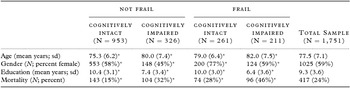
The FI and the MMSE were highly correlated at baseline. The baseline characteristics are shown in Table 1. Participants who were older or less well educated were more likely to be cognitively impaired and frail. It should be noted that the participants of the MSHA had a lower educational attainment than their counterparts in the overall CSHA. The very strong effect of educational attainment upon both frailty and cognitive impairment should be noted.
Baseline characteristics of the sample

*Denotes p < 0.05 comparing the four groups; N is number; sd is standard deviation.
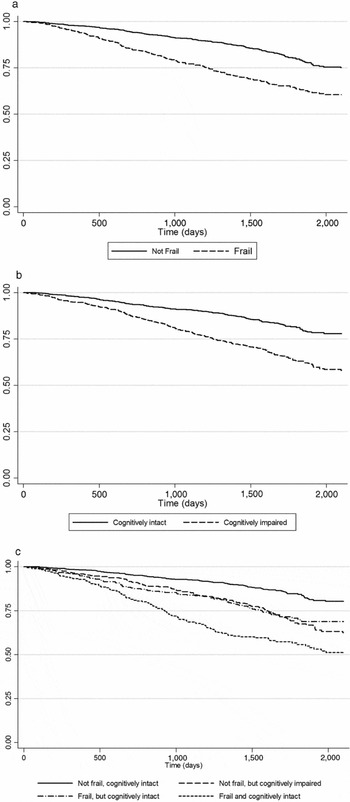
Both frailty and cognitive impairment were strong predictors of dying (Table 1). The risk of dying over the course of the follow-up period was 41.0% among those who were frail compared to 22.6% among those who were not frail (p < 0.001, χ 2 test). Figure 1(a) shows the Kaplan–Meier plot for mortality for frail and non-frail participants. Cognition was also significantly associated with mortality: Almost twice as many participants with a low MMSE died during the follow-up period compared to those with a normal MMSE (48.0% vs. 25.2%, p < 0.001, χ 2 test). Figure 1(b) shows the Kaplan–Meier plot for mortality for cognitively impaired and cognitively intact participants. The joint effect of cognitive impairment and frailty on mortality is shown in Figure 1(c). There is a cumulative effect of low cognition and frailty on mortality – those who are both frail and cognitively impaired have the highest mortality.
(a) Kaplan–Meier plot for survival in frail and non-frail older adults. (b) Kaplan–Meier plot for survival in cognitively impaired and cognitively intact older adults. (c) Kaplan–Meier plot for survival for the cumulative effect of cognitive impairment and frailty.

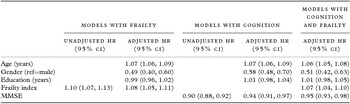
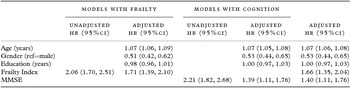
We constructed Cox proportional hazards models for the FI and the MMSE treated as continuous variables (Table 2). Here, we noted a strong effect of both the MMSE score and the FI on the time to death in unadjusted models and after adjusting for age, gender, and education. Each factor added information to the predictive accuracy of the model: The AIC of the empty model was 6011, compared to 5749 for a model with age, gender, and education; 5719 for a model with age, gender, education, and the FI; 5732 for a model with age, gender, education, and the MMSE; and 5711 for the full model with all variables. The FI added slightly more information than the MMSE. The information added from age and gender alone was considerable. We also constructed models with the dichotomized FI and the dichotomized MMSE (Table 3). When we included an interaction term for the FI and the MMSE, this was non-significant (p = 0.30). We also stratified the analyses on the FI. In both frail and non-frail individuals, the MMSE predicted death.
Results of cox proportional hazards models, with the frailty index and the MMSE treated as continuous variables

Ref is reference category; HR is the hazard ratio for mortality; 95% CI is 95 percent confidence interval.
Results of cox proportional hazards models, with the frailty index and the MMSE treated as categorical variables

Ref is reference category; HR is the hazard ratio for mortality; 95% CI is 95 percent confidence interval.
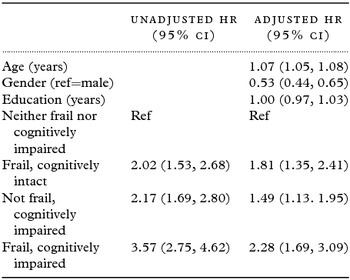
Considering categories of both frailty and cognition in the Cox regression models demonstrates the cumulative effect of the two factors (Table 4). Those who were both frail and cognitively impaired were most likely to die, and those who were either frail or cognitively impaired had intermediate mortality risks.
Results of cox proportional hazards models for the combined effect of the frailty index and the MMSE on mortality

Ref is reference category; HR is the hazard ratio for mortality; 95% CI is 95 percent confidence interval.
Discussion
In a sample of community-living older adults, we found that both cognition and frailty independently predict death. The effect was fairly large for both factors. This effect is cumulative, with those who were both frail and cognitively impaired having the highest mortality. Furthermore, we noted no interaction in this effect. Cognition remained an important predictor of death in both frail and non-frail older adults. We also noted the strong association between frailty and cognition, which has previously been reported. As we have previously observed, we noted no effect of educational attainment on mortality (St John et al., Reference St John, Montgomery, Kristjansson and Mcdowell2002). However, this finding must be interpreted with considerable caution, since the MMSE and education are highly correlated, and it is possible – indeed likely – that the well observed association between a low educational attainment and death is mediated through impaired cognition and global health.
This adds some clarification to previous studies. Our findings are similar to those of Avila-Funes et al. (Reference Avila-Funes2009) who found that cognitive impairment and frailty (using the “Frailty as a Phenotype” model) both predicted frailty, and that considering cognition added to the prognostic accuracy of frailty. Kelaiditi et al. (Reference Kelaiditi, Andrieu, Cantet, Vellas and Cesari2016) also found a strong independent effect of both the FI and a diagnosis of dementia on mortality. However, both Cano et al. (Reference Cano, Samper-Ternent, Al Snih, Markides and Ottenbacher2012) and Jacobs et al. (Reference Jacobs, Cohen, Ein-Mor, Maaravi and Stessman2011) noted that the effect of frailty was more marked than the effect of cognition in models including both factors. These studies both used the Phenotype model of frailty, and both considered the MMSE as a dichotomous variable, while we considered used the FI.
There are some strengths to our approach. There was a large sample with valid, reliable measures collected by trained interviewers. The participation rate was high, and there was complete follow-up, and relatively few missing variables. There are also limitations to our findings. First, the data were collected some time ago, and the effect between cognition, frailty, and death may have altered considerably since that time. On the other hand, the association between cognition and death was noted millennia ago, and has been consistently present since then. A second limitation is our measure of frailty. The definition and operationalization of frailty has been the source of some controversy in geriatrics and gerontology. We considered only the “Accumulation of Deficits” model of frailty. The MSHA does not include physical performance measures, so we are unable to consider the “Frailty as a Phenotype” model of frailty. The effects we noted may not be apparent when using other definitions of frailty. Third, some of the dates of death were obtained from administrative data and proxy-report, which may be less accurate than death certificate data. Fourth, there may be unmeasured confounding or mediating factors. Notably, we did not consider biomedical measures such as blood pressure or cholesterol; nor did we consider physical performance measures, such as gait speed or grip strength. We also did not consider social networks, supports, or engagement. These factors could be associated with either frailty or cognition, as well as the outcome of mortality.
In spite of these limitations, we feel our results are important for several reasons. First, they lend support to the notion of cognitive frailty. Even in non-frail older adults, the effect of cognition on mortality is apparent. Furthermore, the effects of frailty and cognition are independent and cumulative. Future research should revisit the approach taken in earlier measures of frailty which incorporated cognitive measures. Frailty measures which include cognition may be more accurate in predicting adverse outcomes than those that do not. Perhaps, cognition should be considered as another important deficit which accumulates. Alternatively, cognition could be considered independently. Regardless of the approach, some consideration of cognition is important in prognostic models. Second, general health and cognitive status are strongly associated. This observation was made decades ago, and has been supported in epidemiological and clinical studies since then. However, it is often tempting to consider cognitive impairment in isolation as a distinct clinical entity, which one can identify in early stages and prevent. This may not be the case: Cognitive impairment may be a complex syndrome with multifactorial risks operating over different time horizons. In this, it may be similar to physical frailty. Preventive measures may need to be broad, general, and operate over long-time horizons. Moreover, they may not ever be fully effective in completely preventing cognitive impairment. Third, the effect of both the FI and the MMSE are apparent over the entire range of both measures. We and others have noted this previously (Neale et al., Reference Neale, Brayne and Johnson2001; St John et al., Reference St John, Montgomery, Kristjansson and Mcdowell2002), and others have noted it for the FI index as well (Rockwood et al., Reference Rockwood2004). This has clinical and policy implications. It may be difficult to set cut points for identifying distinct states for either of these measures. Rather, the risk may be apparent over the entire spectrum and the current categorical nomenclature of Dementia, Mild Cognitive Impairment, and Cognitively Intact may need to be reconsidered. Another implication is that improvements in either cognition or frailty may have effects across the entire population. Perhaps, global population interventions, such as educational improvements, increased physical activity and social engagement, and access to primary care may improve frailty status and cognition regardless of the severity of deficit. This approach, long advocated for cardiac prevention, may be an important addition to the current focus of identifying and treating those at very high risks of adverse events. Finally, our findings are important for administrators. Frailty is an important predictor of adverse outcomes, and failing to consider it results in inaccurate risk adjustment. Yet, frailty and functional status are not routinely considered in adjusting for administrative outcomes such as quality measures or resource utilization measures. Our results support the importance of including not only frailty measures, but also cognitive measures. All of these measures are fairly straightforward and inexpensive to gather – particularly when compared to biomarkers. If we continue to measure and report quality of care, then it is imperative to consider both cognition and frailty in order to accurately interpret outcome data.
Conflict of interest
None.
Description of authors’ roles
Dr St John was a co-investigator on the second wave of the MSHA, and assisted in obtaining funding and conducting clinical assessments on the second wave of data collection. All authors conceived these analyses, and Dr St John conducted the analyses. All authors assisted in drafting the paper as well as commenting on, and correcting, the paper.
Acknowledgments
The Manitoba Study of Health and Aging (MSHA) was funded primarily by Manitoba Health, with additional funding provided through the Canadian Study of Health and Aging by the Seniors Independence Research Program of the National Health Research and Development Program of Health Canada.
Sponsor's role
The sponsors had no role in the design, methods, subject recruitment, data collection, analysis, or preparation of paper.