Introduction
A study conducted in 1980–1981 suggested that some parasites of the digestive tract of Atlantic cod Gadus morhua were useful bioindicators to distinguish distinct geographically located populations inhabiting the north-western Atlantic Ocean off the eastern coast of Canada (Khan & Tuck, Reference Khan and Tuck1995). Five stocks were identified based previously on tagging, migratory routes and a number of biological variables such as meristics and time of reproduction (Templeman, Reference Templeman1974; Cross & Payne, Reference Cross and Payne1978). Commercial overexploitation had been occurring since the 1960s but the decline was not detected until the late 1980s, culminating eventually in the closure of the cod-fishery within the Canadian 200-mile limit in 1992. Trawl surveys by federal research ships revealed a paucity of cod for commercial purposes in the 1990s but, most important, absence of a breeding population only off coastal Labrador (Rose & O'Driscoll, 2002). Coincident with the decline of several species of fish in this area was a decrease of the benthic ocean temperature where cod was normally abundant (Drinkwater, Reference Drinkwater2004) and an apparent absence of capelin Mallotus villosus, its main food source (Rose & O'Driscoll, Reference Rose and O'Driscoll2002). Except for declining fish populations, oceanographic changes were not as profound in other geographical areas, such as the northern and southern Grand or St. Pierre Banks (Drinkwater, Reference Drinkwater2004).
Parasites have been used previously to identify stocks of Atlantic cod inhabiting the Atlantic Ocean and Barents Sea (Templeman et al., Reference Templeman, Squires and Fleming1957, Reference Templeman, Hodder and Fleming1976; Khan et al., Reference Khan, Murphy and Taylor1980; MacKenzie, Reference MacKenzie1983, Reference MacKenzie2002; McClelland et al., Reference McClelland, Misra, Mortell and Bowen1990; Hemmingsen et al., Reference Hemmingsen, Lombardo and MacKenzie1991; Karasev et al., Reference Karasev, Mitenev and Shulman1996). A study conducted prior to the collapse of cod populations in the north-western Atlantic provided evidence to support the view that distinct stocks inhabited different geographical areas (Khan et al., Reference Khan, Murphy and Taylor1980). Relevant to the present study, distinct stocks were identified in subareas 2J–3K, Labrador–east Newfoundland stock complex, 3L (northern Grand Bank), 3N-0 (southern Grand Bank) and 3Ps (St. Pierre Bank). The abundance of metazoan parasites infecting the digestive tract was also significantly greater in cod captured off coastal Labrador than from adjacent subareas, the Gulf of St. Lawrence or the northern Grand Bank (Khan & Tuck, Reference Khan and Tuck1995).
A preliminary study conducted on cod sampled off coastal Labrador in North Atlantic Fisheries Organization (NAFO) subarea 2J in 2000 revealed that both the abundance and prevalence of metazoan parasites from the digestive tract of cod had declined when compared to samples examined in 1980–1981, and a change in the dominance of some digenetic trematodes was also seen (Khan & Chandra, Reference Khan and Chandra2006). It was concluded that climatic change was responsible for the decline that affected one of the cod's major food sources and its parasites. As a result of these observations, a study was designed to sample and compare gastrointestinal parasites of cod from additional NAFO subareas during the years 2002 and 2003, as well as to compare the results with data that were obtained from the same geographical areas in 1980–1981 (Khan & Tuck, Reference Khan and Tuck1995).
Materials and methods
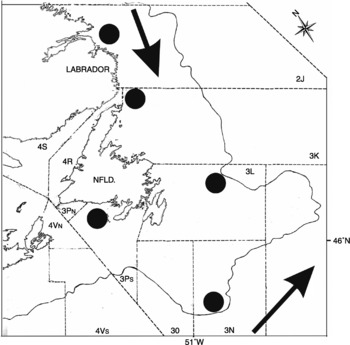
Atlantic cod were captured in 2002–2003 by otter trawlers, M.V. Teleost and W. Templeman, of the Department of Fisheries and Oceans (DFO), Canada at depths of 300–600 m in NAFO subareas 2J, 3K, 3L, 3N and 3Ps (fig. 1). Sampling of cod in NAFO subareas was consistently conducted by DFO surveys for decades at specific times of the year when the fish were aggregated. Cod in subareas 2J (Hamilton Bank) and 3K (Belle Isle Bank) were caught either in November and/or January–February, in 3Ps in March–April and in 3L and 3N between May and June. Only fish of 4+ years (subadult–adult) were examined for parasites. The fish were frozen immediately after capture at − 30°C and necropsied about 3 months later. Length, weight and stomach contents were recorded and otoliths removed by technical assistants of DFO. The number of cod, all 4+ years, sampled for parasites from the five NAFO subareas included 48 from subarea 2J, 43 from 3K, 48 from 3L, 42 from 3N and 51 from 3Ps. Parasites were removed from the digestive tract following conventional methods and preserved in 70% ethanol. Trematodes were stained with either carmine or Mallory's triple stain before mounting on glass slides in balsam for identification afterwards. Nematodes and an acanthocephalan were cleared in glycerol or Rubin's fluid and mounted subsequently in Canada balsam for identification.
Subareas of the North Atlantic Fisheries Organization where Atlantic cod were sampled between 2000 and 2003. Dark circles indicate sampling sites (subareas 2J, Hamilton Bank; 3K, Belle Isle Bank; 3L, Northern Grand Bank; 3N, Southern Grand Bank; and 3Ps, St. Pierre Bank) and arrows show the direction of flow of the cold ( < 0°C) Labrador Current (upper) and the warm (>20°C) Gulf Stream (lower). A bathymetric line outlines the continental shelf in this area of the north-western Atlantic.

Logarithmic transformation of the parasitic data was performed to remove variability. A one-way ANOVA compared abundance and was followed by a post hoc test (Sheffe's F-test) if the initial analysis was significantly different (P ≤ 0.05). A comparison was also made with data of cod (>4 years) examined in 1980–1981 (see Khan & Tuck, Reference Khan and Tuck1995). Chi-square and Fisher's exact probability tests were used to compare prevalence (%) between groups. Prevalence, mean abundance and standard errors (SE) are used in accordance with terminology suggested by Bush et al. (Reference Bush, Lafferty, Lotz and Shostak1997).
Results
Food and age of cod in NAFO subareas
Prey present as food in the stomach of Atlantic cod depended on the subarea where the samples were captured. About 60% of the fish taken in NAFO subarea 2J lacked food in the stomach and the remainder contained remnants of unidentified crustaceans, whereas in subarea 3K more than 40% contained remnants of fish, mostly capelin and sand lance Ammodytes americanus, and fragments of crustaceans. Most (>90%) of the samples taken from NAFO subareas 3L, 3N and 3Ps fed on capelin but also on crustaceans. Cod sampled in subarea 2J were immature, 4–6 years old, but 13% captured in subarea 3K were mature with ages varying from 5 to 9 years. Samples trawled from NAFO subareas 3L, 3N and 3Ps were either mature or subadult and ages varied from 4 to 10 years.
Parasites in the digestive tract of cod
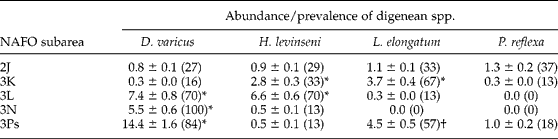
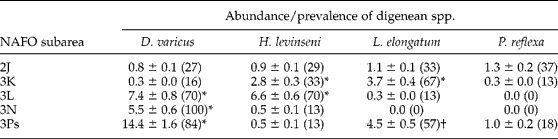
Six species of trematodes, two species of larval anisakine nematodes and an acanthocephalan, Echinorhynchus gadi, were identified in the digestive tract of cod sampled in 2002–2003 in the five NAFO subareas. The dominant digeneans, including Podocotyle reflexa, Lepidapedon elongatum, Derogenes varicus and Hemiurus levinseni, occurred more often (95%) than Lecithaster gibbosus and Prosorhynchus sp. Variation in species composition and abundance were noted in cod sampled in the five NAFO subareas. None of the four species, namely D. varicus, H. levinseni, L. elongatum or P. reflexa was dominant in NAFO subarea 2J, whereas H. levinseni and L. elongatum were significantly more abundant than the two other species in the adjacent subarea 3K. D. varicus and H. levinseni were predominant in fish taken from subarea 3L (table 1). D. varicus occurred most often in samples from subareas 3N and 3Ps while L. elongatum also infected cod from the last-mentioned subarea. Overall, D. varicus was the dominant digenean in subareas 3L, 3N and 3Ps while H. levinseni and L. elongatum were either similar or less abundant and prevalent in fish taken from subareas 3L and 3Ps, respectively. A larval anisakine nematode, Hysterothylacium ( = Contracaecum) aduncum, was more prevalent (85%) in samples, while Anisakis simplex infected 13% and Pseudoterranova decipiens (2%) was rarely observed.
Abundance (x±SE) and prevalence (%) of four species of digeneans infecting Atlantic cod in five NAFO subareas off the coasts of Newfoundland and Labrador during 2002–2003.
NAFO, North Atlantic Fisheries Organization.
* Significantly different (P ≤ 0.05) from comparative subareas except each other.
† Significantly different (P ≤ 0.05) from other groups.
Paired comparison of parasites in Atlantic cod sampled in 2002–2003
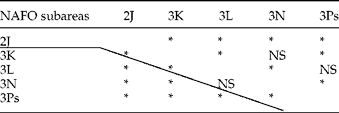
Paired comparison of the abundance of individual taxa of the metazoan parasites, digeneans and larval nematodes, between groups of Atlantic cod sampled from the five NAFO subareas indicated significant differences. Overall, digeneans and larval anisakine nematodes were significantly more abundant in samples from NAFO subarea 3Ps and less abundant in subarea 2J than from other subareas (table 2). Moreover, parasites in fish collected from adjacent subareas differed significantly from each other. Abundance of the acanthocephalan, E. gadi, also differed significantly between samples from subarea 2J and 3Ps but paired comparison of the parasite from other geographical subareas revealed no apparent differences.
Paired comparison of the abundance of digeneans and larval anisakine nematodes in the digestive tract of Atlantic cod sampled from different NAFO subareas in 2002–2003.
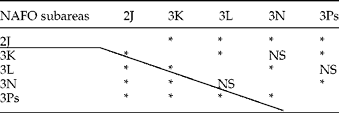
Tests above the line refer to digeneans and below to larval nematodes.
* Significant difference (P ≤ 0.05) between pairs; NS, not significant.
Comparison of abundance of parasites in 1980–1981 and 2002–2003 samples
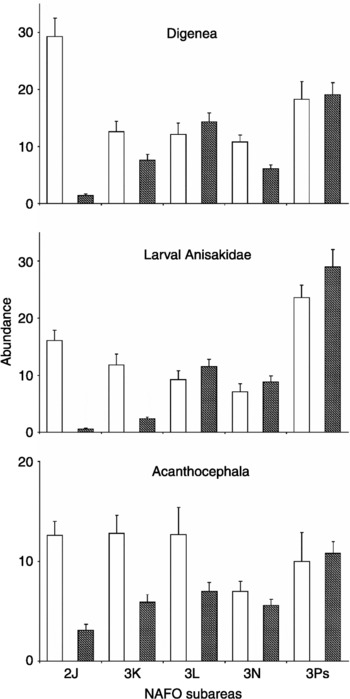
Comparison of the abundance of metazoan parasites from the digestive tract of cod sampled in five NAFO subareas in 1980–1981 with 2002–2003 revealed a significant decline in subareas 2J and 3K but no apparent change in subareas 3L, 3N or 3Ps. The most dramatic changes occurred in subarea 2J, where a precipitous decline, as much as 20-fold, was observed in the digeneans and larval anisakine nematodes (fig. 2). A decrease, although significant, was not as drastic in the abundance of E. gadi in this subarea (2J) as well as the three major taxa in subarea 3K where it rarely exceeded twofold. While some variation in abundance of the three taxa of parasites occurred in samples examined from the other three subareas, 3L, 3N and 3Ps, significant differences were not apparent.
Comparison of the mean abundance (x ± SE) of Digenea, larval Anisakidae and Acanthocephala from the digestive tract of Atlantic cod sampled between 1980 (clear bars) and 2000–2003 (black bars) in the north-west Atlantic.

Discussion
Evidence based on oceanographic data indicated that a cooling trend occurred in the north-western Atlantic ocean during the mid-1980s and early 1990s (Drinkwater, Reference Drinkwater2004). Cooler than normal air and water temperatures, increased numbers of icebergs and velocity of south-westerly winds and also maximum cloud cover were apparent in the Labrador Sea (Drinkwater, Reference Drinkwater2004, Reference Drinkwater2005). Cooling of the oceanic temperature through the water column culminated eventually in a ‘trophic cascade’ in the 1990s off the coast of Labrador and the north-eastern shelf off Newfoundland (Carscadden et al., Reference Carscadden, Frank and Leggett2002a, Reference Carscadden, Montevecchi, Davoren and Nakashimab). Zooplankton, primarily crustaceans that are food of larval cod and some forage species including capelin, all acutely sensitive to environmental changes, declined in a short period of time (Lilly et al., Reference Lilly, Parsons and Kulka2000; Tittensor et al., Reference Tittensor, de Young and Tang2003). Cod stocks declined in most areas off Newfoundland and Labrador, but this was most dramatic in the latter area (subareas 2J and 3K), where the fish virtually disappeared (Rose & O'Driscoll, 2000). As a result, other predators of capelin such as Greenland halibut Reinhardtius hippoglossoides and American plaice Hippoglossoides platessoides also declined in abundance (Carscadden et al., Reference Carscadden, Frank and Leggett2002a, Reference Carscadden, Montevecchi, Davoren and Nakashimab). Dempson et al. (Reference Dempson, Shears and Bloom2002) reported that the mean weight of Arctic charr Salvelinus alpinus, an anadromous species that feeds on capelin during its sea phase, decreased off coastal Labrador. Additional changes in this area associated with the decline of capelin included reproductive failure of a seabird, the black-legged kittiwake Rissa tridactyla, and impaired growth of chicks of the common murre Uria aalge (Carscadden et al., Reference Carscadden, Montevecchi, Davoren and Nakashima2002b; Davoren & Montevecchi, Reference Davoren and Montevecchi2003). In the absence of cod, a major predator of pink shrimp Pandalus borealis, there has been a substantial increase of its biomass, enough to warrant commercial exploitation and an extension of its distribution on the continental shelf (Lilly et al., Reference Lilly, Parsons and Kulka2000). Biomass of the spider crab Chionoecetes opilio, another food source of cod during winter, also increased off Labrador, resulting in a commercial fishery, until now a non-profitable venture (Taylor, unpublished data, DFO, St. John's, Newfoundland). All of these occurrences coincided with environmental changes that affected the food web and became apparent as the abundance of crustaceans, fish, sea birds and possibly marine mammals declined off coastal Labrador and the north-eastern Newfoundland shelf.
Atlantic cod become infected with parasites after feeding on a variety of prey (Polyanskii, Reference Polyanskii1955). Subadult and mature cod are top-level predators in the north-western Atlantic, feeding primarily on capelin for most of the year, pink shrimp and spider crab in winter and less often on copepods, amphipods and euphausiids (Lilly, Reference Lilly1984; Lilly et al., Reference Lilly, Almeida and Lear1984, Reference Lilly, Parsons and Kulka2000). Young cod living close to shore feed primarily on a variety of small crustaceans, including copepods, amphipods and euphausiids that are intermediate hosts of several metazoan parasites (see Valtonen et al., Reference Valtonen, van Maren and Timola1983; Marcogliese, Reference Marcogliese1994, Reference Marcogliese1996; Hemmingsen & MacKenzie, Reference Hemmingsen and MacKenzie2001). However, the prevalence of these parasites in the crustaceans is extremely low (>0.01%). Capelin is an epipelagic species that also feeds on crustaceans and accumulates many more parasites than the latter group (Palsson, Reference Palsson1986). Consequently, prevalence and abundance of the three major taxa of parasites in mature capelin tend to be similar to that in juvenile cod (Polyanskii, Reference Polyanskii1955). Since most endoparasites have a limited life span, cod, as they become older and feed less on small crustaceans, acquire most of their parasites after feeding on capelin (Polyanskii, Reference Polyanskii1955).
A previous study reported that the abundance of some metazoan parasites of the digestive tract of Atlantic cod were useful bioindicators to distinguish between adjacent stocks living on the continental shelf off the eastern coast of Canada (Khan & Tuck, Reference Khan and Tuck1995; Lee & Khan, Reference Lee and Khan2000). Digeneans and larval anisakine nematodes were more useful as stock indicators than an acanthocephanan, E. gadi. Results from the present study also support this view but, because the abundance of the metazoan endoparasites of cod in NAFO subarea 2J declined, levels once significantly greater than in all other subareas were now lower than in all other groups and probably associated with an absence of capelin in the diet. In 2000–2003, abundance of all taxa were significantly greater in subarea 3Ps, where water temperatures were warmer than all other subareas. Major differences were also observed between cod sampled in subareas 2J and 3K. The presence of capelin in the stomach of cod sampled in subarea 3K is suggestive of acquisition of the parasites from this paratenic host, rather than from crustaceans as observed in cod sampled in subarea 2J.
Abundance and prevalence of species of the digeneans were also useful in distinguishing between adjacent stocks of cod in the present study. While both variables were similar for the four species in NAFO subarea 2J, D. varicus and P. reflexa were rare in fish from subarea 3K. Additionally, abundance and prevalence of L. elongatum and P. reflexa were either low or absent in cod from subareas 3L and 3N, whereas D. varicus only and combinations of either H. levinseni or L. elongatum were dominant in other NAFO subareas. Most studies have reported that D. varicus and H. levinseni were more abundant in offshore samples of cod than inshore, especially when the cod were feeding on capelin (Polyanskii, Reference Polyanskii1955; Appy & Burt, Reference Appy and Burt1982; Khan & Chandra, Reference Khan and Chandra2006). Consequently, a paucity or absence of L. elongatum and P. reflexa, respectively, in cod stocks that do not migrate inshore, such as fish in subareas 3L (northern Grand Bank since the 1990s) and 3N (southern Grand Bank) is plausible, in contrast to the population that is located in subarea 3Ps (St. Pierre Bank) that migrates inshore. This view is supported by recent observations that noted the presence of the parasitic copepod, Laemeocera branchialis, which is acquired inshore, in samples only from subarea 3Ps and not from subareas 3L or 3N (Khan, unpublished data).
It is evident from the present study that, in spite of environmental changes, the metazoan parasites infecting the digestive tract of Atlantic cod can be useful in separating samples from adjacent NAFO subareas off the east coast of Canada. Previous studies have shown a cline in the prevalence of a blood protozoan flagellate, Trypanosoma murmanensis, greater in subarea 2J and decreasing southwards, and distinct differences in the prevalence of a blood-feeding copepod, Lernaeocera branchialis, which was greater in the south and decreasing northwards (Templeman et al., Reference Templeman, Hodder and Fleming1976; Khan et al., Reference Khan, Murphy and Taylor1980). Two larval nematodes, Pseudoterranova decipiens and Anisakis simplex, display a similar pattern of decreasing abundance and prevalence northwards and are related to seals (Phocidae), the definitive hosts, that inhabit islands off the southern coast of Newfoundland (Templeman et al., Reference Templeman, Squires and Fleming1957; Brattey et al., Reference Brattey, Bishop, Myers and Bowen1990; Chandra & Khan, 1988). A recent study in 2002 suggested that both L. branchialis and larval nematodes in cod from the south-western coast of Newfoundland have remained unchanged since the 1980s (Khan, unpublished data). A greater prevalence of T. murmanensis, Myxidium gadi, L. branchialis and larval nematodes in cod from the northern Grand Bank, NAFO subarea 3L, distinguishes this stock from that on the southern Grand Bank, subareas 3N and 3O (Templeman et al., Reference Templeman, Squires and Fleming1957, Reference Templeman, Hodder and Fleming1976; Khan et al., Reference Khan, Murphy and Taylor1980; Brattey et al., Reference Brattey, Bishop, Myers and Bowen1990; Khan & Tuck, Reference Khan and Tuck1995).
The decline of the metazoan parasites in the digestive tract of Atlantic cod off coastal Labrador was undoubtedly associated with an absence of capelin in the diet, the main source of the infections, and not related to the discharge of pollutants (Khan & Thulin, Reference Khan and Thulin1991). Moreover, changes in oceanographic conditions and a decline of the biomass of the copepod, Calanus finmarchicus, were responsible for movement of capelin out of this area, east and southwards, with the onset of a cooling trend during the mid-1980s and early 1990s (Carscadden et al., 2002b). There is now evidence of a warming trend in the area, perhaps related to global warming, as juvenile capelin were observed in 2002 and spawning reported in several areas off coastal Labrador, especially Markkovik in 2005 (DFO, unpublished data). Small concentrations of subadult and juvenile cod have now been detected in the area in numbers exceeding those observed in the past decade (DFO, unpublished data). Since cod require an oil-rich fish diet for reproductive development, it is likely that the return of capelin to coastal Labrador will provide the nutrition necessary for maturity and spawning (Rose & O'Driscoll, 2002; Rose, 2005; Rideout & Rose, Reference Rideout and Rose2006). Several gastrointestinal parasites of cod are acquired passively from capelin (Polyanskii, Reference Polyanskii1955) and could eventually result in an increase in abundance and prevalence as oceanographic conditions return to normal. However, recovery of the stock off the Labrador coast, NAFO subareas 2J–3K, has been slow despite a warming trend. Consequently, a monitoring programme will be essential to ascertain whether or not the parasite levels revert to those observed previously in 1980–1981 (Khan & Tuck, Reference Khan and Tuck1995).
Acknowledgements
The author is grateful to the Department of Fisheries and Oceans, St. John's, Newfoundland, for providing fish samples for this study, C.V. Chandra for technical assistance, Ms S. Wall for typing the manuscript, Mr R. Finken for preparing the illustrations and the Natural Sciences and Engineering Research Council of Canada for monetary support.